Security operations. Analysts in control.

SOC automation
& cyber threat
detection.

Give analysts the context to investigate, prioritize, and decide. GS Consulting connects alert enrichment, triage, and SIEM/SOAR workflows with traceable evidence and explicit human approval boundaries.

20-minute fit check · Built around your existing team and tools

From signal to decisionIllustrative workflow
EndpointIdentityCloudSIEM alerts
  1. 01
    Enrich & connectAssets · vulnerabilities · related activity
  2. 02
    Correlate & prioritizeDetection context · impact · missing evidence
  3. 03
    Prepare analyst reviewSource-linked summary · questions · next steps
Human approval boundaryReview the evidence. Authorize the action.
InvestigateEscalateApprove response

Evidence follows the workflow. A model's recommendation does not grant response authority.

Start with one alert workflowA defined scope and measurable acceptance
Keep analysts in controlEvidence, review, and response authority
See the implementation evidencePrivate AI connected to cyber operations

SOC automation services

Less manual assembly.
More time for investigation.

When analysts repeat the same lookups across disconnected tools, useful work backs up. We design the preparation, routing, and review steps around the alert families that matter to your organization.

01

Alert enrichment

Put the context beside the alert.

Bring together approved asset ownership, identity activity, vulnerability exposure, threat indicators, and recent changes. Keep source references and freshness visible; flag missing context instead of filling gaps with guesses.

02

Triage automation

Prepare the case before the analyst opens it.

Normalize the alert, gather related records, build a timeline, and route the work to the right queue. Define exception handling for incomplete data, connector failures, and time-sensitive escalations.

03

Correlation and prioritization

Show why this activity deserves attention.

Connect related events by entity, time, and documented detection logic. Add asset criticality, exposure, and business impact to prioritization, with visible reasons and a way for analysts to challenge the result.

04

Analyst decision support

Make the evidence easier to inspect.

Present supporting records, contradictory signals, open questions, and suggested next steps. Private or approved AI can assist with summaries and structured analysis; recommendations stay separate from verified facts.

05

SIEM/SOAR integration

Keep the work in your operational tools.

Connect the SIEM, SOAR playbooks, case management, APIs, and databases through approved interfaces. Define schemas, scoped identities, retries, duplicate handling, and confirmation that each handoff completed.

06

False-positive handling

Tune the noise. Keep the evidence.

Use analyst feedback to review recurring alert patterns. Give suppression rules a scope, owner, rationale, and review date. Sample closed and suppressed alerts, test known threats, and track misses as well as queue volume.
Need the data engineering underneath the workflow?

Our SIEM integration service covers ingestion, normalization, event and JSON schemas, and delivery of structured findings.

Explore SIEM integration

Human approval boundaries

Automate preparation.
Make response authority explicit.

Decide what each task may do before connecting a playbook. These are starting boundaries for a scoped design, not a claim that all security work belongs in the same automation category.

Approved unattended work

Prepare

Collect permitted context, normalize fields, assemble timelines, and route work using documented rules.

  • Scoped read access and approved destinations
  • Visible source freshness and validation checks
  • Failed or incomplete work enters an exception queue

Analyst review

Decide

Assess the evidence, challenge priority, record disposition, and determine whether escalation is needed.

  • Separate observed facts from AI suggestions
  • Show conflicting signals and missing evidence
  • Review closure and suppression decisions

Explicit human approval

Authorize response

Approve consequential actions such as isolating a host, revoking access, or changing a security control.

  • A separate, permission-limited execution path
  • Approval bound to the target and action
  • Result confirmation and tested recovery procedures

Uncertainty is an escalation condition. Missing evidence, connector failure, or an unverified recommendation must not silently become a benign classification or permission to act.

Evidence retention and auditability

A decision trail
your team can follow.

Keep enough evidence to reconstruct how an alert became a decision. Define what is retained, who can see it, how integrity is protected, and when it is deleted under your organization's requirements.

Do not log credentials or copy sensitive payloads by default. Retention periods and access rules are agreed for the environment, not assumed from a generic playbook.

Evidence package
Designed for review and handoff
Source & context
Alert references, entity identifiers, event times, collection times, and enrichment provenance.
Analysis & versions
Detection and processing versions, relevant model configuration, structured findings, and the evidence used.
Decision & approval
Analyst disposition, rationale, escalation owner, and approval linked to a specific target and action.
Execution & exceptions
Run identifiers, destination acknowledgments, failures, retries, recovery results, and unresolved work.

Documented implementation

Private AI analysis.
Inside operational systems.

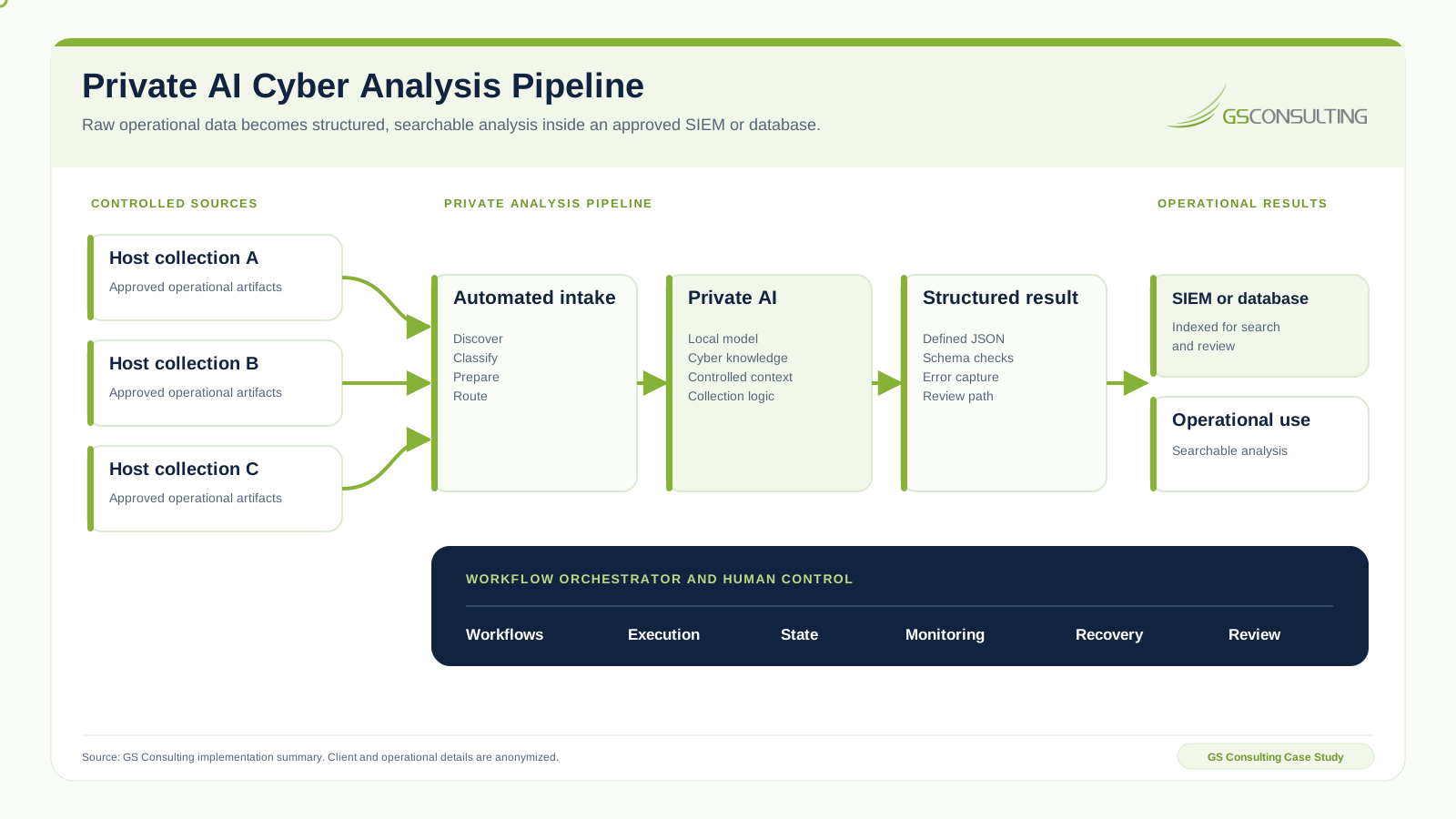
GS Consulting built a private cyber-analysis pipeline that converts approved host and operational data into structured JSON, then connects the findings to an approved SIEM or database for indexing and search.

  • Custom Python handles data preparation, model interaction, and structured output.
  • Collection-specific instructions guide the cyber analysis; schema checks validate output structure.
  • Workflow orchestration exposes execution state and failures for operator review.
Published architecture connecting approved host data, private AI analysis, structured JSON, workflow orchestration, and an approved SIEM or database
Architecture from the published implementation. Click to view at full size. No client data or client interfaces are shown.

Evidence of a working analysis and integration pattern. A SOC pilot separately evaluates detection quality, analyst effort, approval controls, and false-positive handling in your environment.

A bounded starting point

One alert family.
One review path.
A pilot you can evaluate.

Start with a SOC workflow assessment or a scoped pilot. Choose a repetitive, valuable task with approved data access, an accountable analyst owner, and a clear definition of success.

Agree the scope, price, and milestones before work begins. This is project-based engineering for your team, not a 24/7 monitoring or emergency response service.

Scope My SOC Workflow Start with a 20-minute fit check.

Define the work before expanding it

  1. Map the current workflowDocument the alert family, manual steps, tools, data access, queue owner, and escalation path.
  2. Design the controls and handoffsSpecify enrichment, triage rules, SIEM/SOAR interfaces, review gates, and retained evidence.
  3. Test against representative casesInclude benign and malicious examples, missing data, duplicates, connector failures, and analyst disagreements.
  4. Make an evidence-based go/no-go decisionCompare analyst effort, triage quality, false positives and misses, escalation behavior, and exception recovery against an agreed baseline.

Before an engagement

Practical questions.
Clear boundaries.

What this service covers, what stays with your analysts, and how a project begins.

What does SOC automation mean in this service?

Security operations center (SOC) automation connects repeatable tasks: collecting alert context, grouping related activity, preparing triage, routing work, and retaining evidence. GS Consulting designs and implements those workflows around your existing team and tools. Detection logic and analyst judgment still need testing, ownership, and review; automation does not turn every alert into a reliable conclusion.

Is this a managed SOC, MDR, or emergency incident response service?

This page describes project-based assessment, engineering, integration, and pilot work for security operations. It does not offer 24/7 monitoring, managed detection and response, or an emergency response retainer. We can scope work alongside your internal security team or existing provider. For an active incident, use your established incident response channel.

How is this different from your SIEM integration service?

The SOC automation service starts with analyst work: enrichment, triage, prioritization, investigation support, escalation, and review. The SIEM integration and cyber analysis automation service focuses on ingestion, normalization, event and JSON schemas, APIs, databases, and delivery of structured findings. An engagement can combine both, with a single agreed workflow and clear ownership of each handoff.

Can you work with our existing SIEM and SOAR?

We assess the specific products, versions, interfaces, licensing, permissions, and deployment restrictions before confirming compatibility. The aim is to place context and review tasks in the systems your analysts already use. The published private-AI cyber-analysis case study demonstrates custom integration into an approved SIEM or database, not universal out-of-the-box connector support.

Will AI close alerts or take response actions on its own?

Model output alone does not authorize closure, suppression, containment, or access changes. We define which preparation tasks may run unattended, which decisions need analyst review, and which actions require explicit approval. Host isolation, account changes, and other consequential actions need a separate approved execution path, scoped permissions, and confirmation of the result. Incomplete evidence or failed checks route to an exception owner.

How do you handle false positives without hiding threats?

We use analyst dispositions, source evidence, and detection-rule context to identify repeatable noise patterns. Any suppression needs a defined scope, owner, rationale, expiry or review date, and retained records. Testing includes known malicious cases, disagreements, missing context, and samples of suppressed or closed alerts. A lower alert count is not proof of better detection, and we do not promise a specific false-positive reduction before evaluating your environment.

What evidence is retained, and where can AI analysis run?

The design specifies approved source references, timestamps, enrichment context, processing versions, recommendations, analyst decisions, approvals, and execution results. Access, integrity protection, retention, and deletion follow your organization's requirements; there is no universal retention period for this service. We assess private or approved model environments where AI is useful and keep credentials and unnecessary sensitive content out of workflow logs.

What is the first engagement, and what determines cost?

Start with a 20-minute fit check and one high-level example of an alert workflow. We can scope a workflow assessment or a bounded pilot with agreed data sources, an alert family, review owners, and acceptance criteria. Cost and timing depend on interface access, data quality, workflow complexity, controls, and testing. Scope, price, and milestones are agreed before work begins. Do not send live alerts, credentials, or sensitive incident data through the initial contact form.

Your next SOC improvement

Which alert workflow
keeps your analysts waiting?

Tell us where context gathering, triage, or handoffs become repetitive. We will help scope the workflow, the integration, and the controls needed to move it forward.

Scope My SOC Workflow Review the assessment and pilot scopeShare a high-level workflow only. Do not send live alerts, credentials, or sensitive incident data through the initial form.

© GS Consulting, LLC . All Rights Reserved | For more information, contact us at info@gsconsultingllc.com. Privacy Policy | Terms of Use