Enterprise AI Strategy | | 28 min read
Assessing Enterprise AI Readiness for Regulated Organizations

Key Takeaways
AI readiness is evidence that the prerequisites for scaling exist.
Assess more than AI activity
Review business use cases, data, infrastructure, security, compliance, governance, skills, and leadership.
Distinguish readiness from maturity
Readiness asks whether an initiative can proceed; maturity describes demonstrated organizational capability.
Produce an actionable roadmap
Assign owners to gaps and define the evidence and work needed before scaling.
Most organizations are not ready for enterprise AI.
That does not mean they are behind. It means they are honest if they admit it.
A lot of companies already have AI activity. Employees are using AI tools. Teams are testing copilots. Vendors are adding AI features. Executives are asking for faster workflows, better reporting, and lower cost.
But activity is not readiness.
Enterprise AI readiness is not about whether someone in the company knows how to write a good prompt. It is about whether the organization has the infrastructure, data, security, compliance posture, governance, and executive ownership to use AI across real business workflows without creating a mess.
For regulated organizations, that bar is higher. If your business handles government data, customer records, employee data, financial records, healthcare data, contracts, security logs, audit evidence, or other sensitive information, AI readiness has to be measured before AI is scaled.
The right question is not, "Can we use AI?" The right question is: are we ready to use AI in a way the business can trust, defend, and measure?
Need an honest AI readiness assessment before funding enterprise AI?
GS Consulting helps CIOs, CTOs, founders, and regulated organizations assess AI readiness across use cases, data, infrastructure, security, compliance, governance, workforce skills, and executive alignment.
Request an AI Readiness AssessmentWhat Is an Enterprise AI Readiness Assessment?
An enterprise AI readiness assessment is a structured review of whether an organization is prepared to adopt AI across the business.
It looks at the real operating environment. Not the slide deck. Not the vendor demo. Not the excitement around a few pilots.
It reviews whether the organization has the people, data, systems, controls, governance, and leadership alignment needed to move from AI interest to AI execution.
A good assessment answers practical questions. What AI is already being used? Which workflows are actually ready for AI? Is the data clean enough to trust? Can sensitive data be protected? Can AI connect to systems safely? Who approves AI use cases? Who owns AI risk? What compliance obligations apply? Can we measure the value? What should be fixed before scaling?
NIST's AI Risk Management Framework is useful here because it frames AI risk work around Govern, Map, Measure, and Manage. In plain terms, leaders need ownership, context, measurement, and ongoing management before AI becomes part of business operations.
That is also the core of readiness. Can the organization govern AI? Can it map where AI fits? Can it measure value and risk? Can it manage AI after launch?
If not, the organization is not ready to scale.
Why Regulated Organizations Need a Formal Assessment
A normal business can experiment with AI and learn as it goes. A regulated organization has less room for casual experimentation.
A GovCon company may handle CUI. A healthcare organization may handle PHI. A financial services company may handle customer financial records. An insurance company may handle claims and personal data. A law firm may handle privileged material. A security team may handle incident data. An HR team may handle employee records.
In those environments, AI does not just create productivity questions. It creates data, security, compliance, audit, contractual, and trust questions.
The organization needs to know what data exists, where it lives, what tools can process it, what vendors can touch it, what outputs become records, and who approves decisions. If leaders cannot answer those questions, approving an enterprise AI budget may only fund faster confusion.
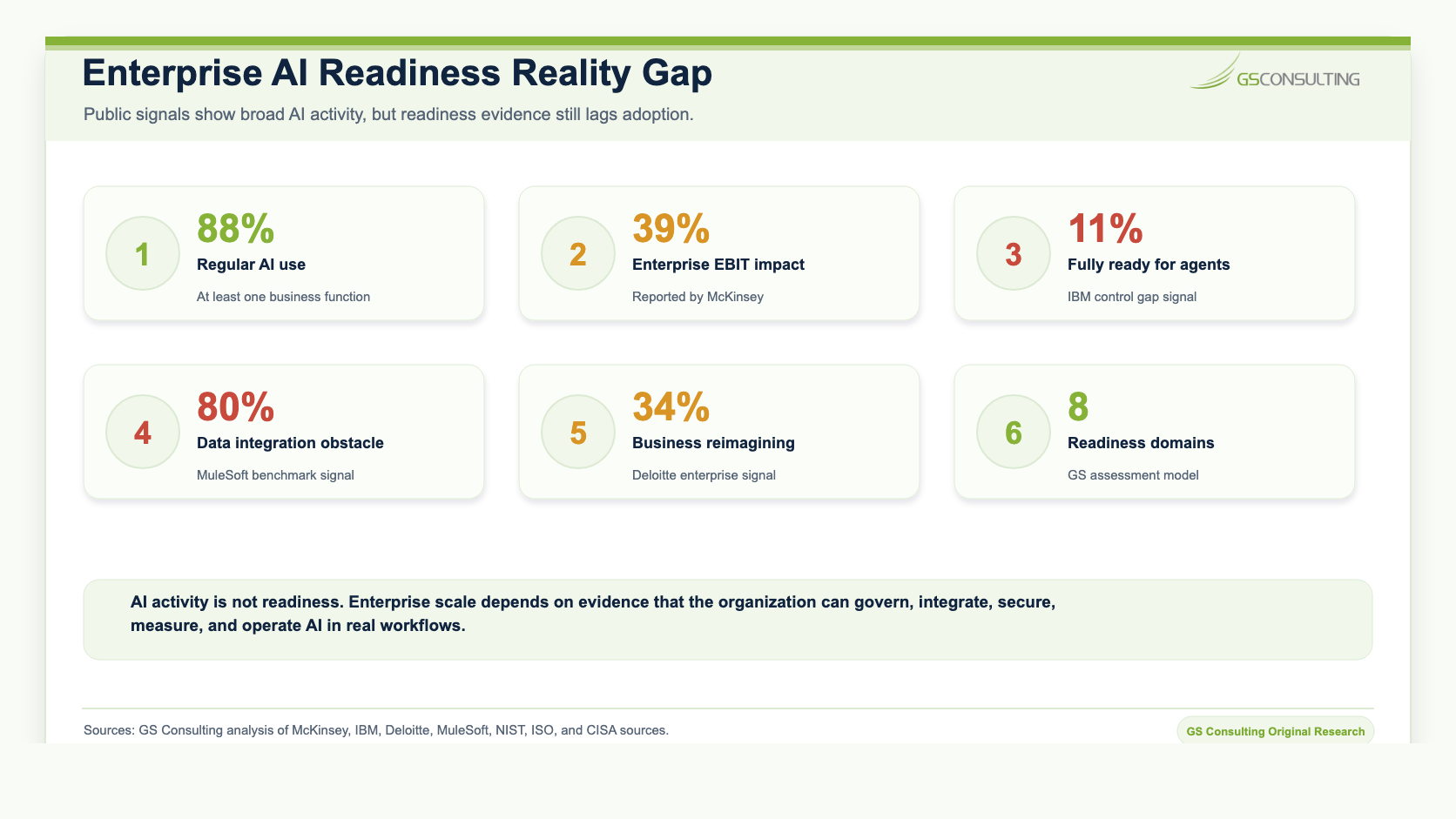
Original Research: The Enterprise AI Readiness Evidence Gate Index
Original GS Consulting research shows that enterprise AI readiness is an evidence gate problem, not an adoption problem.
GS Consulting analyzed public AI adoption research, governance frameworks, cybersecurity guidance, integration benchmarks, and AI management system guidance against eight readiness areas: business use cases, data readiness, infrastructure, security posture, compliance exposure, governance and decision rights, workforce skills, and executive alignment.
The highest burden readiness areas were governance and decision rights, security posture and access control, data readiness and classification, and infrastructure and integration. The practical takeaway is clear: organizations should not approve enterprise AI budget simply because employees are already using AI or vendors are adding AI features. They should first determine whether AI can be governed, connected, secured, measured, monitored, and defended in real workflows.
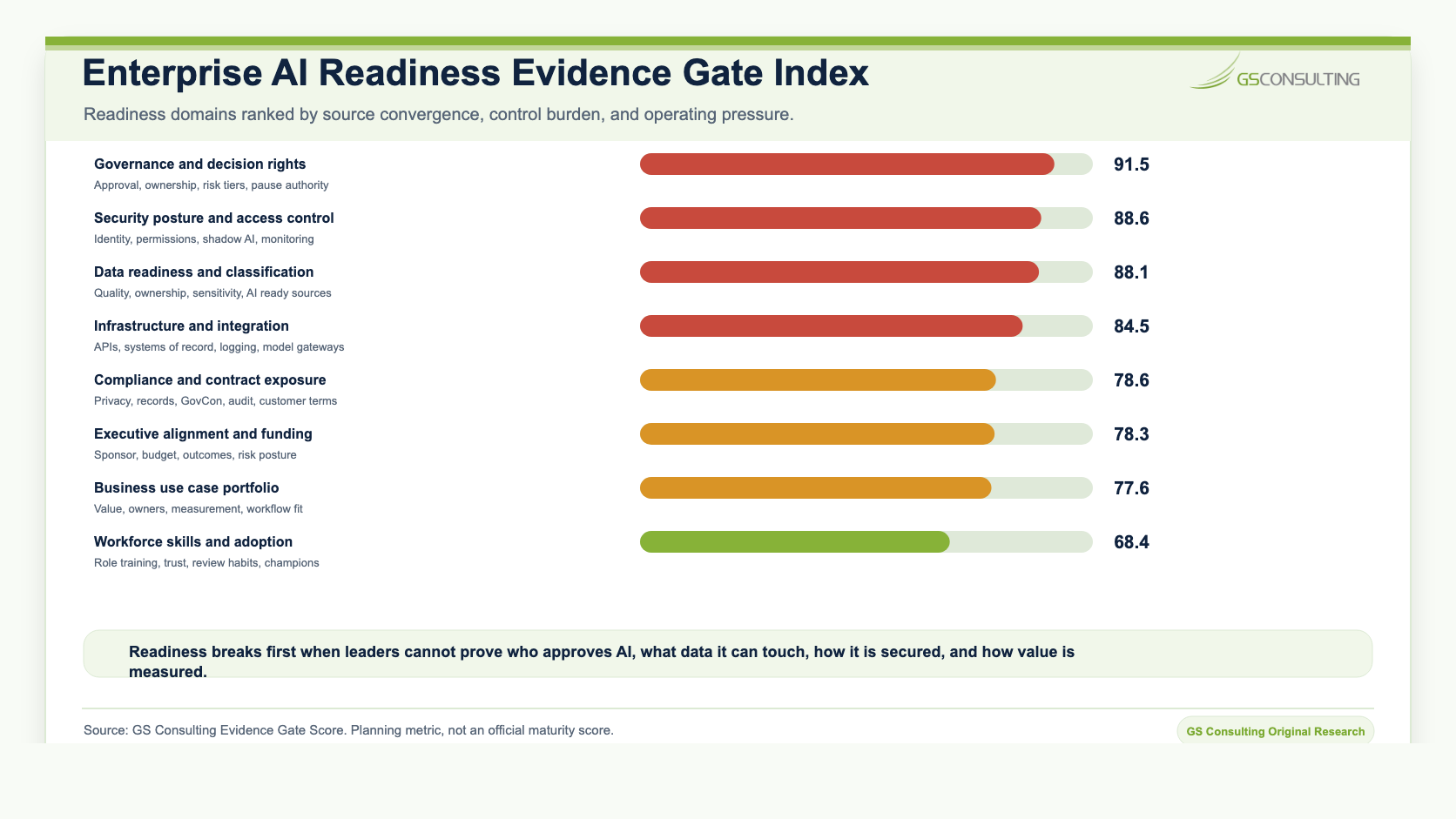
The Enterprise AI Readiness Evidence Gate Score, Pilot Readiness Score, and maturity model are GS Consulting derived planning tools. They are not official NIST, ISO, CISA, McKinsey, IBM, Deloitte, MuleSoft, legal, audit, compliance, certification, or ROI determinations.
The Enterprise AI Readiness Framework
A practical enterprise AI readiness assessment should review eight areas: business use cases, data readiness, infrastructure, security posture, compliance exposure, governance and decision rights, workforce skills, and executive alignment.
If any one of these is weak, AI can still move forward in limited pilots. Enterprise scale will just be harder and riskier.
1. Business Use Case Readiness
Start with the business. Too many organizations begin with the tool. That is backwards.
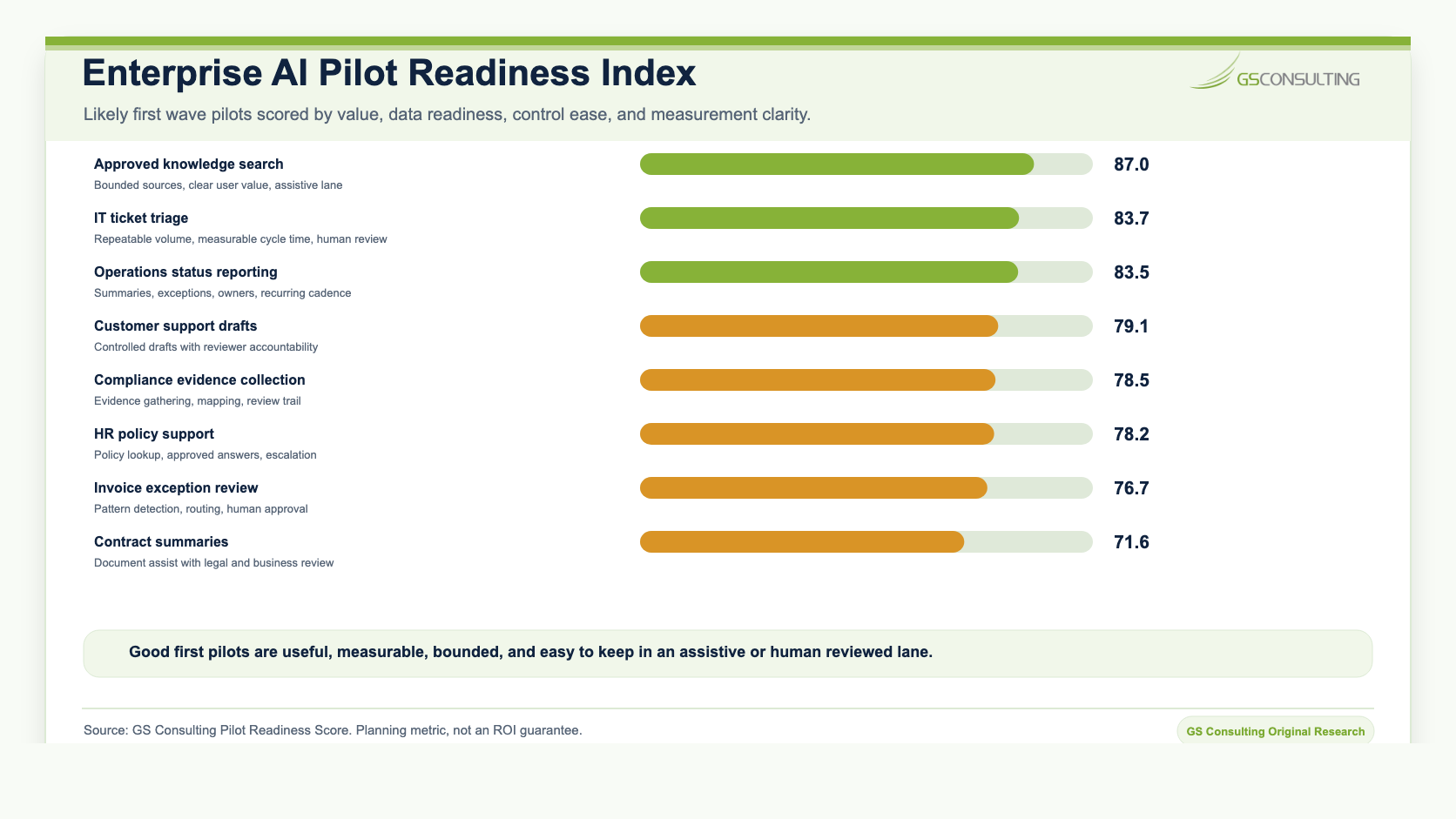
AI should be used where it improves a real workflow, not where a vendor can make a good demo. Look for workflows that are repetitive, slow, document heavy, error prone, expensive, or hard to track.
Good candidates often include IT ticket triage, customer support drafts, contract summaries, compliance evidence collection, operations reporting, invoice exception review, HR policy support, security alert summaries, proposal support, and knowledge search.
Bad first candidates often involve final hiring decisions, payment approval, legal conclusions, compliance certification, security containment, production changes, or customer commitments. Those may become future use cases. They should not be first moves unless the control model is strong.
2. Data Readiness
Data is where enterprise AI either works or fails. AI readiness depends on whether the organization has data the model can actually use safely.
This is where many companies discover the uncomfortable truth. Their data is scattered. Their documents are duplicated. Their systems do not agree. Their folders mix public, internal, confidential, and regulated content. Their ticketing systems contain sensitive data nobody classified.
AI will not fix bad data. It will expose it.
Evaluating data readiness for AI means asking what data exists, where it lives, who owns it, whether it is accurate, whether it is current, whether it is classified, whether it is searchable, whether permissions are enforced, and whether outputs can be protected.
For regulated organizations, data classification is not optional. You need to know what is public, internal, confidential, regulated, restricted, or prohibited before connecting AI to documents, systems, tickets, and records.
3. Infrastructure Readiness
Enterprise AI needs infrastructure that can support real workflows. A few users testing AI in a browser is one thing. Enterprise AI is different.
It may require identity integration, private or controlled AI environments, model gateways, secure APIs, data connectors, retrieval systems, vector databases, workflow engines, logging, monitoring, cloud architecture, endpoint controls, data loss prevention, and integration with systems of record.
The question is not whether the company can access an AI model. The question is whether the company can connect AI to workflows without breaking security, compliance, operations, or evidence.
NIST Cybersecurity Framework 2.0 organizes cyber outcomes around Govern, Identify, Protect, Detect, Respond, and Recover. AI infrastructure should fit into the same security operating model, not create a separate unmanaged path.
4. Security Readiness
Security readiness is where regulated organizations need to be blunt. AI changes how data moves.
It may read documents, summarize records, call APIs, create outputs, store prompts, create embeddings, route tickets, trigger actions, or expose data if permissions are weak.
Security needs to review the full workflow, not just the model. A readiness assessment should ask whether approved tools are defined, unapproved tools are blocked or monitored, sensitive data can be prevented from entering public tools, identity controls can be enforced, service accounts are scoped, prompts and outputs are protected, logs are secure, vendor access is controlled, and AI incidents can be detected and handled.
The organization should also assess shadow AI. Shadow AI is not always a discipline problem. Sometimes it is a workflow problem. Employees use unofficial tools because the official process is slow, unclear, or nonexistent.
5. Compliance Readiness
Compliance readiness is not a final review at the end. It belongs at the start.
For regulated organizations, AI use may affect privacy, cybersecurity, contract terms, customer obligations, records retention, audit requirements, employment rules, financial controls, GovCon requirements, or sector specific rules.
AI readiness for GovCon needs to account for CUI, CMMC, NIST SP 800 171, DFARS obligations, customer data handling, and subcontractor data flows. Do not build an AI workflow and then ask compliance to bless it later. That is how projects get delayed, redesigned, or killed.
6. Governance Readiness
AI governance is not a committee for the sake of a committee. It is how the organization decides what AI can do.
A readiness assessment should review approved tools, prohibited uses, use case intake, risk tiering, decision rights, data handling rules, vendor review, human review rules, audit trail requirements, escalation paths, monitoring requirements, and pause authority.
ISO IEC 42001 is an AI management system standard that gives organizations a structured way to manage AI risks and opportunities while balancing innovation with governance. That is the right mindset.
Governance should not exist to slow down the business. It should make responsible scaling possible.
7. Workforce Readiness
AI adoption fails when users do not trust the workflow. It also fails when users trust it too much. Both are problems.
Employees need to know which tools are approved, what data they can use, what data is prohibited, how to verify outputs, when human review is required, how to report problems, how AI changes their workflow, and what AI is not allowed to do.
Managers need to know how to supervise AI enabled work. Technical teams need skills in integration, security, data pipelines, model evaluation, prompt design, RAG, logging, and monitoring. Executives need to understand value, risk, budget, and ownership.
8. Executive Alignment
Enterprise AI needs executive alignment. Not interest. Alignment.
Interest sounds like this: "We should use AI." Alignment sounds like this: "These are the workflows we will prioritize, this is the budget, this is the risk posture, this is who owns the program, this is how we measure value, and this is what we will not automate yet."
If executives are not aligned, AI will turn into scattered tools, scattered pilots, and scattered accountability. That is expensive.
The AI Readiness Maturity Model
Use a simple AI maturity model. Readiness asks whether the organization can safely begin or expand AI adoption now. Maturity asks how advanced the organization is in using AI across the organization.
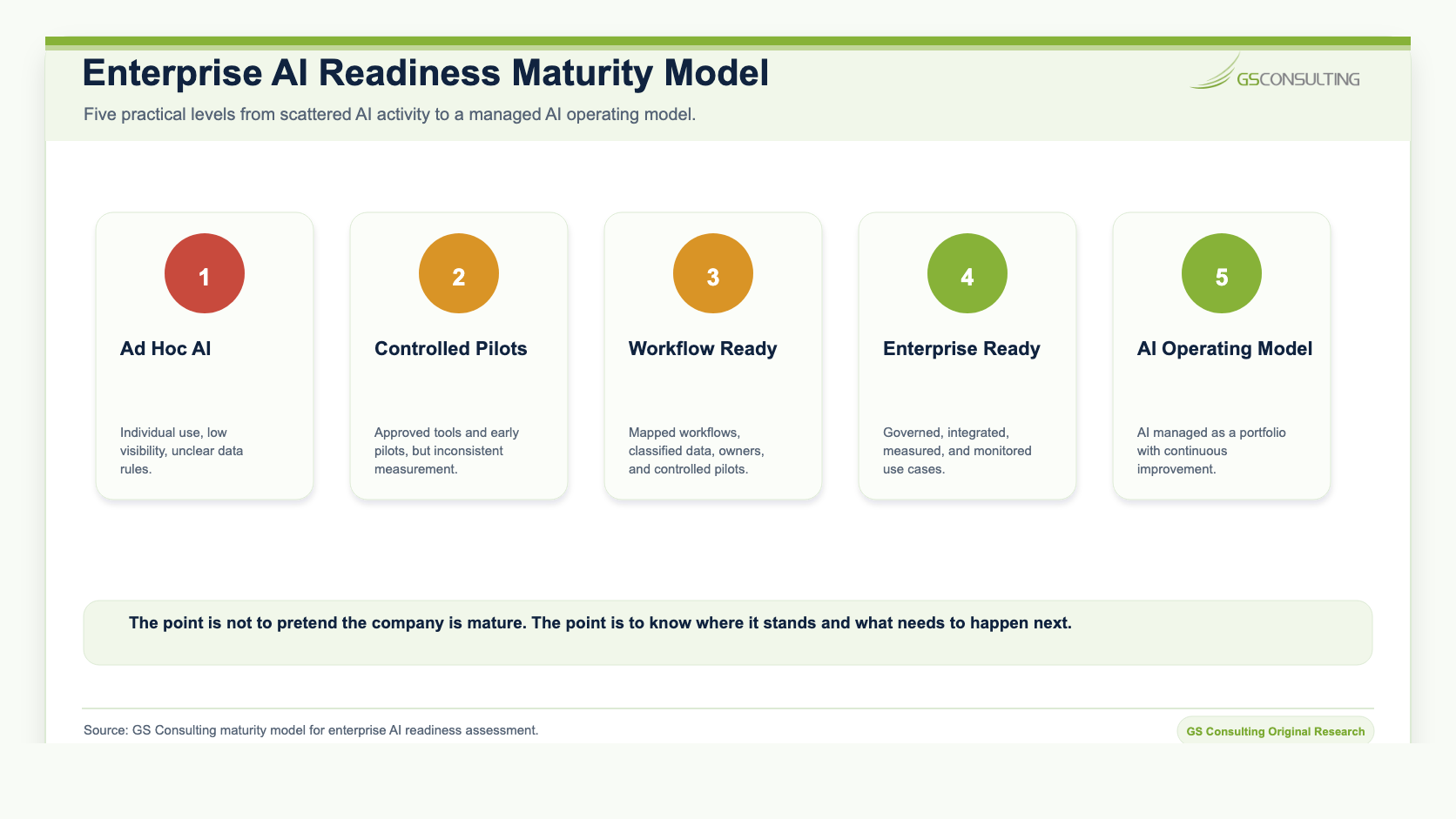
- Level 1, Ad Hoc AI: Employees use AI on their own. Visibility is low. Shadow AI is common. Data rules are unclear.
- Level 2, Controlled Pilots: The organization has approved tools and a few pilots. Governance exists, but measurement is inconsistent.
- Level 3, Workflow Ready: Workflows are mapped, data is classified, owners are defined, security is reviewed, and controlled pilots are launched.
- Level 4, Enterprise Ready: AI use cases are prioritized, governed, integrated, measured, and monitored. Executives receive value and risk reporting.
- Level 5, AI Operating Model: AI becomes part of how the organization runs. Use cases are managed as a portfolio and improved continuously.
What an AI Readiness Assessment Should Produce
A good assessment should not end with a vague report. It should produce decisions.
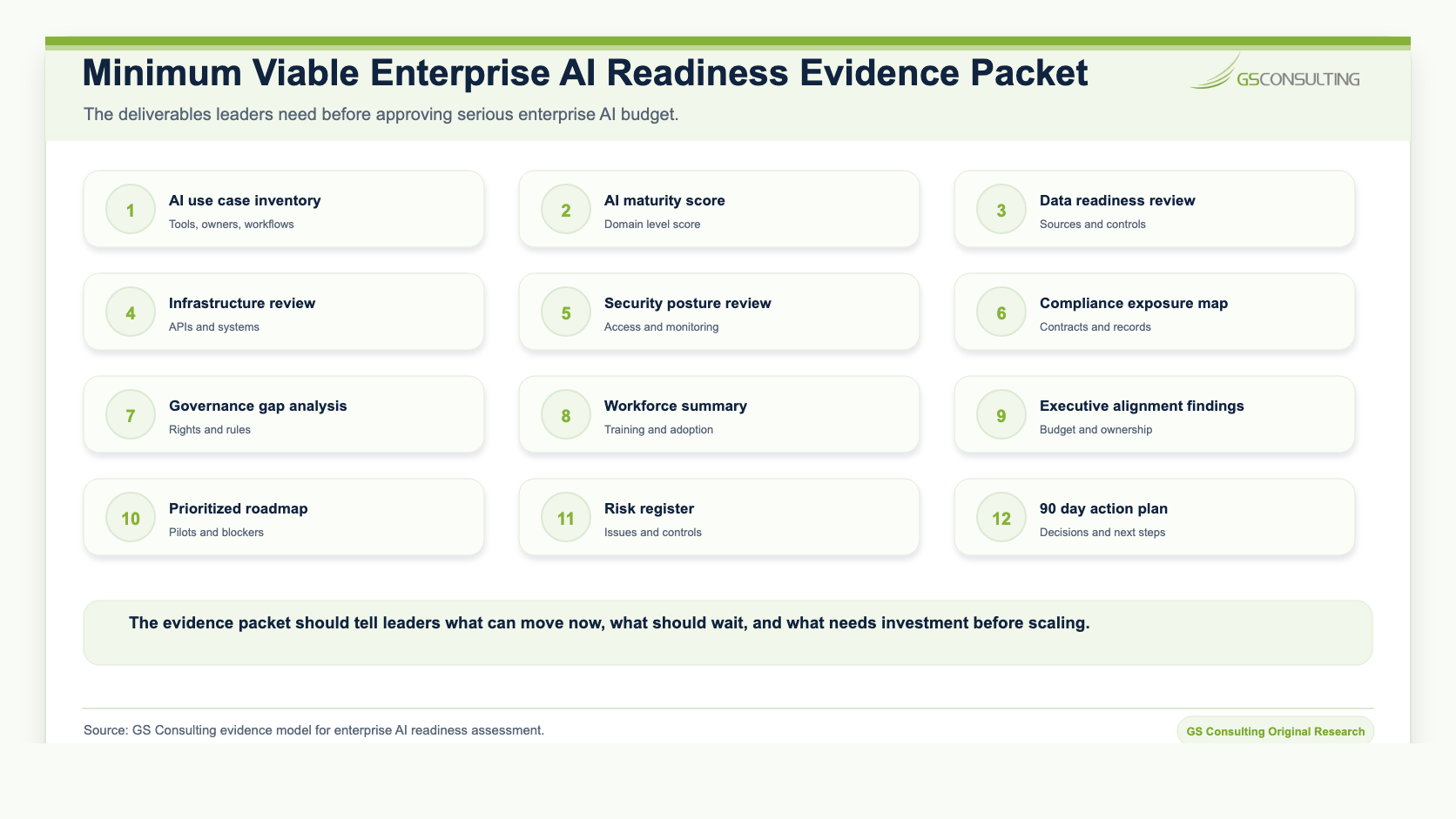
GS Consulting's AI Readiness Assessment should produce an AI use case inventory, AI maturity score, data readiness review, infrastructure readiness review, security posture review, compliance exposure map, governance gap analysis, workforce readiness summary, executive alignment findings, prioritized AI roadmap, quick win pilots, foundation projects, risk register, budget guidance, and a 90 day action plan.
The leadership team should leave with clear answers: what can we do now, what should wait, what needs investment, what risk must be reduced, what data must be cleaned, what governance must be built, and what pilots should be funded?
The First 30 Days of an Enterprise AI Readiness Assessment
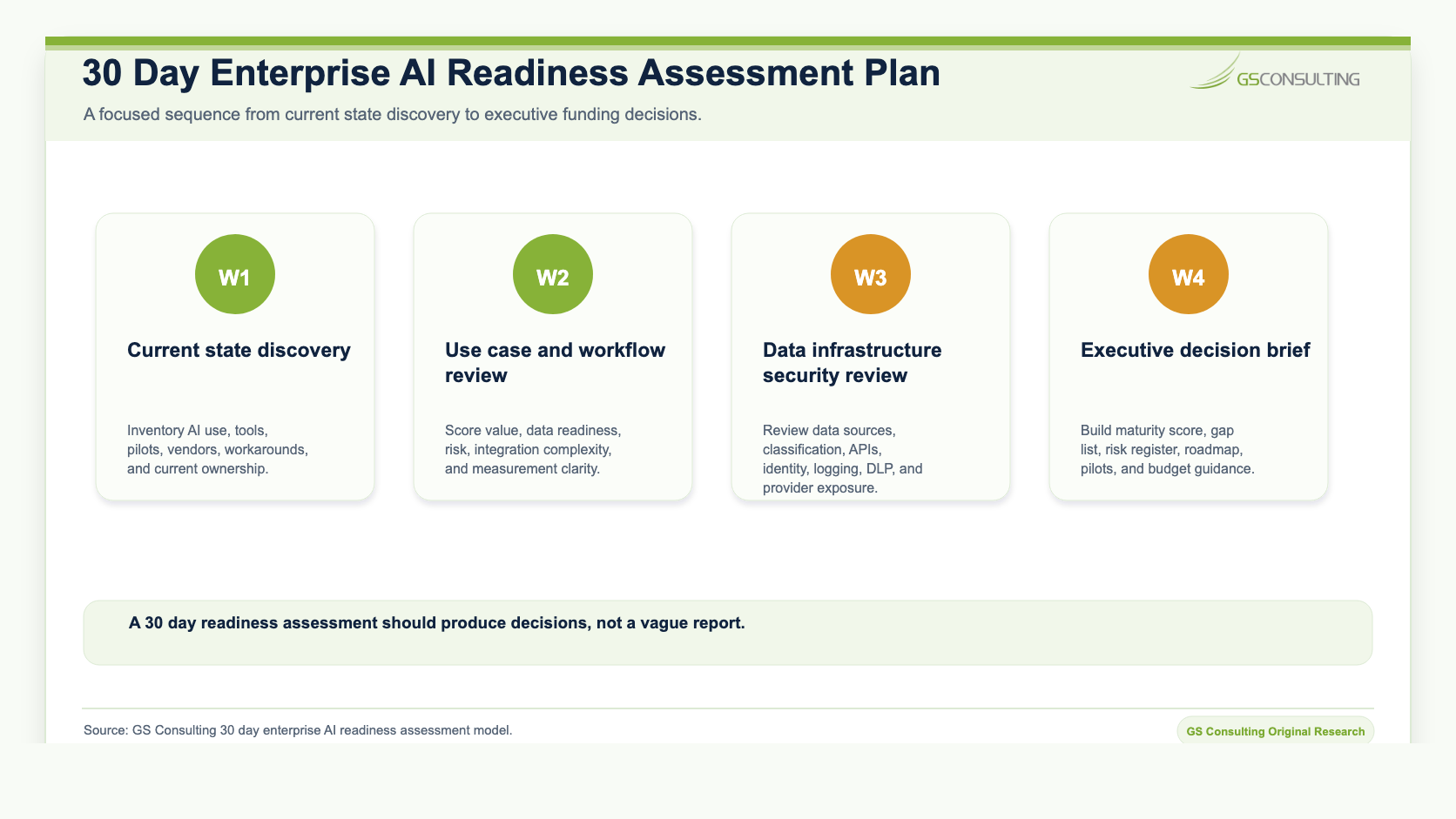
- Week 1Current State Discovery.
Inventory current AI use, approved tools, unapproved tools, vendor AI features, employee workarounds, and active pilots. Interview leaders across IT, security, compliance, operations, HR, finance, legal, sales, and delivery.
- Week 2Use Case and Workflow Review.
Identify high value workflows. Score each one by value, data readiness, risk, integration complexity, and measurement clarity. Find the best first pilots.
- Week 3Data, Infrastructure, and Security Review.
Review data sources, data classification, access controls, AI architecture, cloud environment, APIs, logging, DLP, vendor exposure, and identity integration. Identify blockers.
- Week 4Roadmap and Executive Brief.
Build the AI maturity score, gap list, risk register, pilot roadmap, foundation projects, and budget recommendations.
Common Readiness Gaps
Most regulated organizations find the same gaps. They want AI, but the data is not classified. They want automation, but the workflow is not mapped. They want copilots, but users have too much access. They want RAG, but the document library is messy. They want AI agents, but action rights are not defined.
They want internal chatbots, but vendor terms are not reviewed. They want enterprise AI, but no one owns the program. They want ROI, but there is no baseline. They want speed, but compliance is brought in too late.
None of this means AI should stop. It means the organization needs a readiness plan before it scales.
How This Supports Secure Enterprise AI Strategy
Secure Enterprise AI Strategy explains how GS Consulting helps regulated organizations connect business goals, data strategy, security, compliance, governance, AI architecture, and measurable outcomes.
This article answers the executive question: are we actually ready to support enterprise AI, or are we just excited about the idea?
Readiness asks whether a proposed rollout can proceed. To assess demonstrated capability across business units over time, use the enterprise AI maturity scorecard and its downloadable workbook. Record missing evidence separately from low scores.
That question connects directly to Enterprise AI Governance Frameworks for GovCon, Aligning Enterprise AI Strategy with CMMC and NIST, Developing a Phased Secure AI Adoption Roadmap, What Is an Enterprise AI Strategy?, Building the Business Case for Secure Enterprise AI, Total Cost of Ownership for Secure Enterprise AI, Aligning AI Strategy with Legacy IT Modernization, Enterprise AI Maturity Assessment, AI ROI Calculation for Enterprise Leaders, How to Identify Workflows for AI Automation, and Secure AI Automation Readiness Assessment.
The Bottom Line
Most organizations do not need another AI demo. They need an honest readiness assessment.
Enterprise AI readiness means the business has the right use cases, clean enough data, secure enough infrastructure, clear enough governance, strong enough compliance posture, trained enough users, and aligned enough executives to scale AI without creating unnecessary risk.
If those pieces are missing, the organization may still run pilots. But it is not ready for enterprise wide AI.
Ready to find the gaps before approving enterprise AI budget?
Contact GS Consulting for an AI Readiness Assessment.
Contact GS ConsultingResearch Sources and Caveats
The Enterprise AI Readiness Evidence Gate Score, Pilot Readiness Score, and maturity model are GS Consulting derived planning tools. They are not official NIST, ISO, CISA, McKinsey, IBM, Deloitte, MuleSoft, legal, audit, compliance, certification, or ROI determinations.
Actual readiness depends on the organization's real workflows, data sensitivity, contracts, vendors, infrastructure, security controls, regulatory exposure, employee adoption, executive risk tolerance, and budget priorities.
- McKinsey: The State of AI in 2025
- IBM: AI Control Gap Study
- Salesforce MuleSoft: Connectivity Benchmark
- Deloitte: State of AI in the Enterprise
- NIST AI Resource Center: AI RMF Core
- NIST Cybersecurity Framework 2.0
- ISO/IEC 42001: Artificial Intelligence Management System
- CISA: Securing AI Data Guidance
Frequently Asked Questions About Enterprise AI Readiness
What is an enterprise AI readiness assessment?
An enterprise AI readiness assessment is a structured review of whether an organization has the use cases, data, infrastructure, security, compliance posture, governance, workforce skills, and executive alignment needed to adopt AI across real business workflows.
How is AI readiness different from AI maturity?
AI readiness asks whether the organization can safely begin or expand AI adoption now. AI maturity asks how advanced the organization is in using AI across the business. Readiness tells leaders what needs to be fixed before scaling.
Why do regulated organizations need a formal AI readiness assessment?
Regulated organizations handle sensitive data, contracts, records, audit evidence, security logs, or customer obligations. A readiness assessment helps determine what data AI can touch, which workflows are safe to automate, what controls are missing, and what evidence leaders need before approving budget.
What should an AI readiness assessment produce?
A strong assessment should produce an AI use case inventory, readiness score, data readiness review, infrastructure review, security posture review, compliance exposure map, governance gap analysis, workforce readiness summary, executive alignment findings, prioritized roadmap, risk register, quick win pilots, and a 90 day action plan.
Related Reading
- Secure Enterprise AI Strategy
- Enterprise AI Governance Frameworks for GovCon
- Aligning Enterprise AI Strategy with CMMC and NIST
- Developing a Phased Secure AI Adoption Roadmap
- What Is an Enterprise AI Strategy?
- Building the Business Case for Secure Enterprise AI
- Total Cost of Ownership for Secure Enterprise AI
- Aligning AI Strategy with Legacy IT Modernization
- Enterprise AI Maturity Assessment
- AI ROI Calculation for Enterprise Leaders
- How to Identify Workflows for AI Automation
- Secure AI Automation Readiness Assessment