Secure AI Automation | | 22 min read
Secure AI Automation Readiness Assessment: A Practical Guide

Key Takeaways
AI adoption has to move fast and stay controlled.
Start With Mission Value
Prioritize use cases tied to measurable business, delivery, or mission outcomes.
Protect the Data Boundary
Define what data AI tools can touch before selecting vendors or architectures.
Keep Humans Accountable
Use AI to support workflows while retaining trained review and escalation paths.
Document the Controls
Maintain inventories, testing evidence, monitoring plans, and risk decisions.
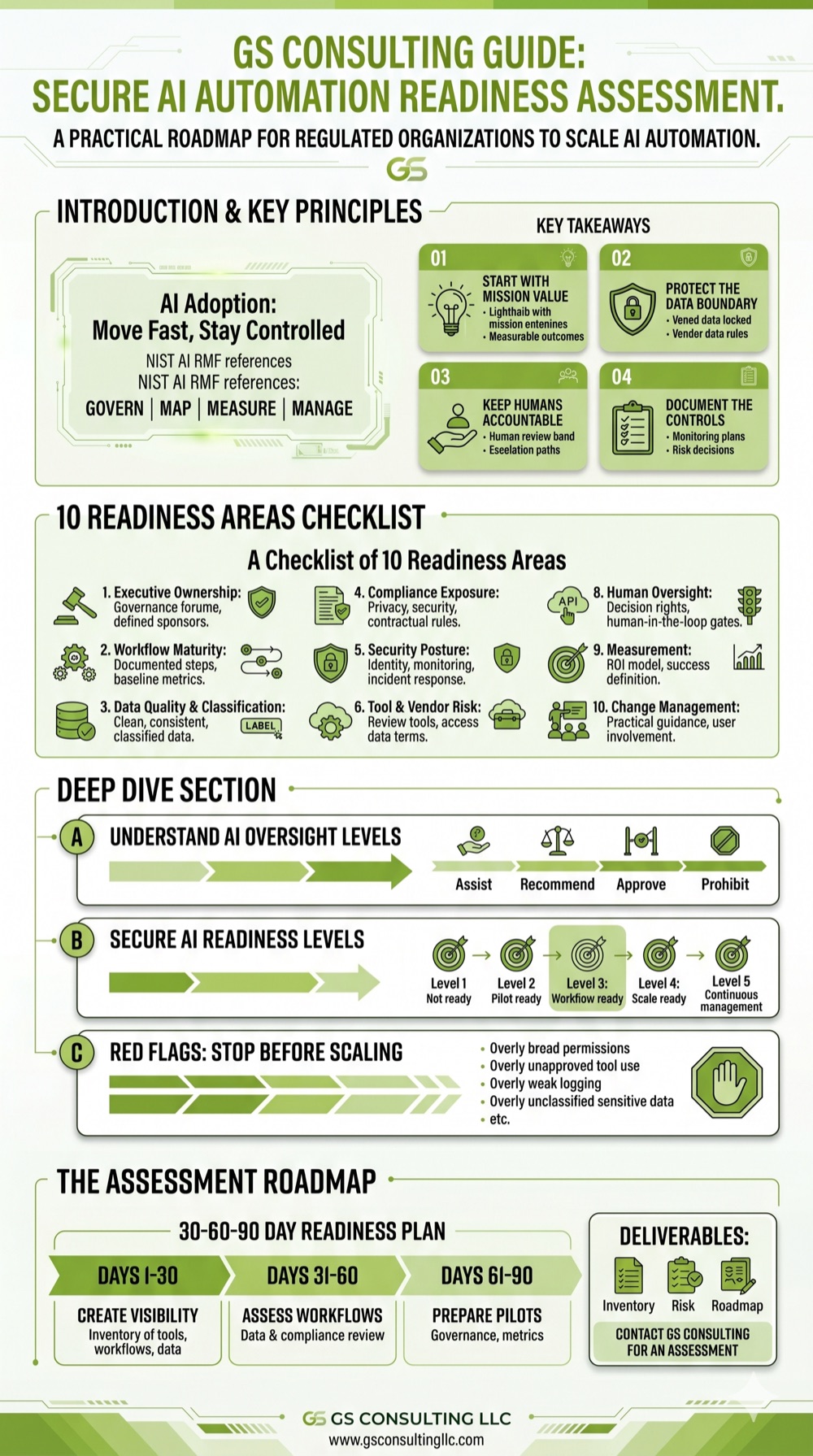
AI automation can create real value, but there is a big difference between being interested in AI automation and being ready for it. A secure AI automation readiness assessment helps regulated organizations evaluate whether their workflows, data, controls, vendors, and leadership model are prepared for AI-enabled automation.
AI can reduce manual work, speed up decisions, improve service delivery, help employees find information faster, and bring consistency to messy workflows. But a company handling sensitive customer data, employee records, financial information, health information, government data, intellectual property, security logs, or compliance evidence cannot simply connect AI to workflows and hope everything works out.
The organization needs to know which processes are mature enough, which data can safely be used, which systems are exposed, which regulations apply, who owns the risk, and where humans must remain accountable.
Need a Secure AI Automation Readiness Assessment?
GS Consulting helps regulated organizations evaluate workflow maturity, data risk, compliance exposure, security posture, vendor readiness, and executive ownership before AI automation scales.
Talk to GS ConsultingThis guide explains how to evaluate AI automation readiness across workflow maturity, data quality, compliance exposure, security posture, vendor risk, integration complexity, employee adoption, and executive ownership.
What Is a Secure AI Automation Readiness Assessment?
A secure AI automation readiness assessment is a structured review of whether an organization is prepared to use AI to automate business workflows without creating unacceptable security, compliance, operational, or reputational risk.
It is not just a technical assessment. It is not just a cybersecurity review. It is not just a list of possible AI tools. A good readiness assessment looks at the whole operating environment.
- Which workflows are good candidates for AI automation?
- What data will AI need to access?
- Is that data accurate, classified, protected, and approved for AI use?
- What compliance obligations apply?
- Can the current security architecture support AI automation?
- Are there clear owners for AI risk and business outcomes?
- Where does human review need to stay in the process?
- Can the organization measure ROI and monitor the system after launch?
The NIST AI Risk Management Framework is useful here because it organizes AI risk work around four functions: govern, map, measure, and manage. Those functions translate well into readiness work: define ownership, understand context, test performance and risk, and manage AI after deployment.
Why Readiness Matters Before AI Automation
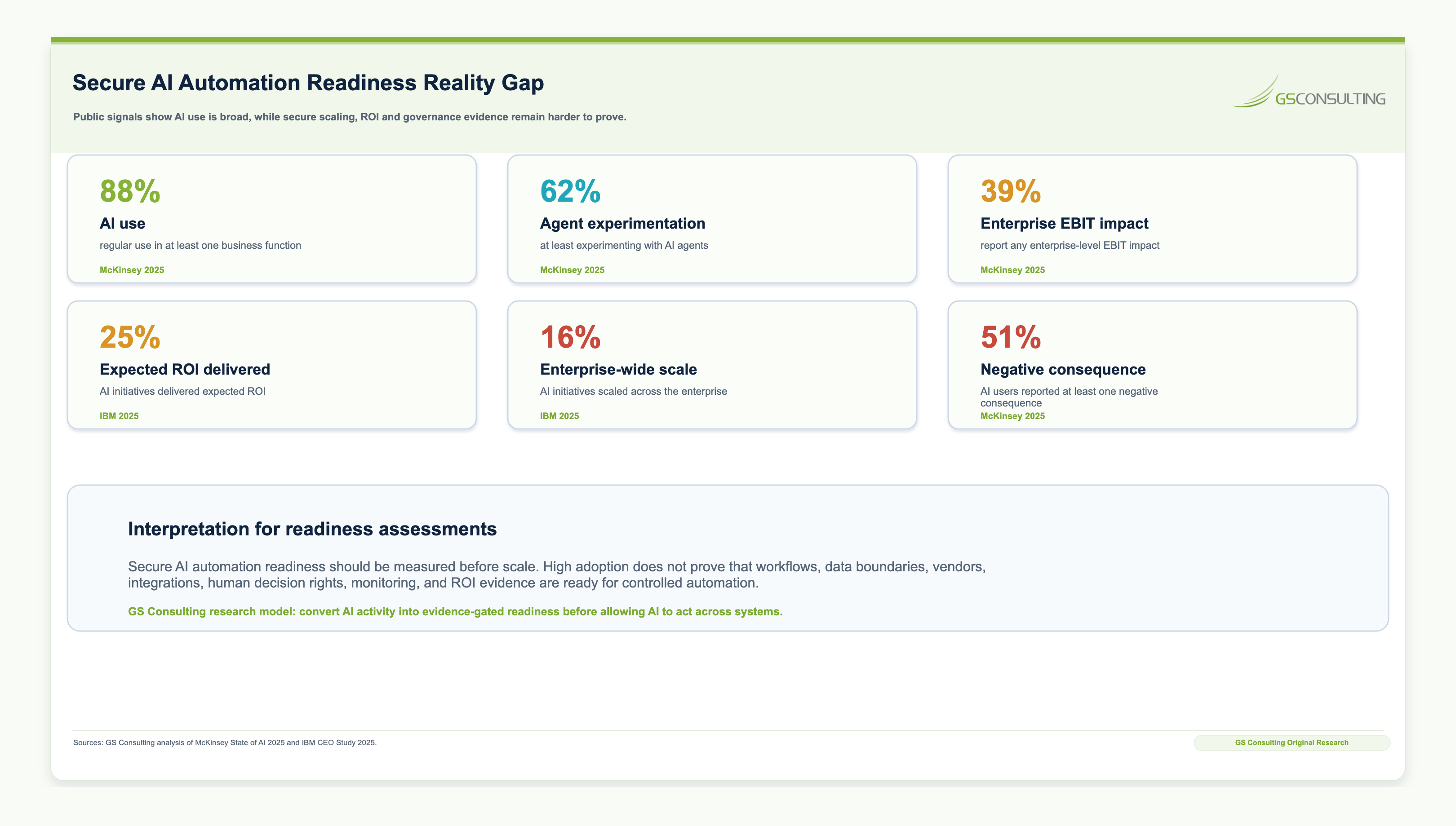
Most organizations already have some form of AI use happening inside the business. Employees may be using AI to draft emails, summarize documents, write code, analyze spreadsheets, or answer operational questions. Some departments may be testing vendor tools. IT may be evaluating copilots. Operations may want automated reporting. HR may want an employee support assistant. Compliance may want help organizing evidence.
That activity can be useful, but it can also create shadow AI risk. The organization may not know what data employees are entering into tools. It may not know whether prompts and outputs are retained. It may not know whether sensitive information is being used to train models. It may not know whether AI-generated outputs are being relied on in customer, compliance, legal, financial, HR, or security workflows.
Cybersecurity agencies have warned that agentic AI systems can introduce significant risks when they are granted broad access, especially in sensitive environments. CISA guidance on careful adoption of agentic AI services recommends aligning agentic AI adoption with an organization's existing security model and risk posture.
The Five Core Questions of AI Automation Readiness
AI will not fix a process that no one understands.
AI automation depends on data quality, access, classification, and protection.
AI can touch privacy, cybersecurity, employment, financial, contractual, and sector-specific obligations.
AI automation may need access to systems, documents, APIs, logs, and workflows.
AI automation cannot be owned by IT alone. Business, security, compliance, legal, operations, and data owners need defined roles.
If the organization cannot answer these questions, it is probably not ready to scale AI automation.
Original Research: The Secure AI Automation Readiness Evidence Gap
Original GS Consulting research shows that secure AI automation readiness is an evidence problem, not just an adoption problem.
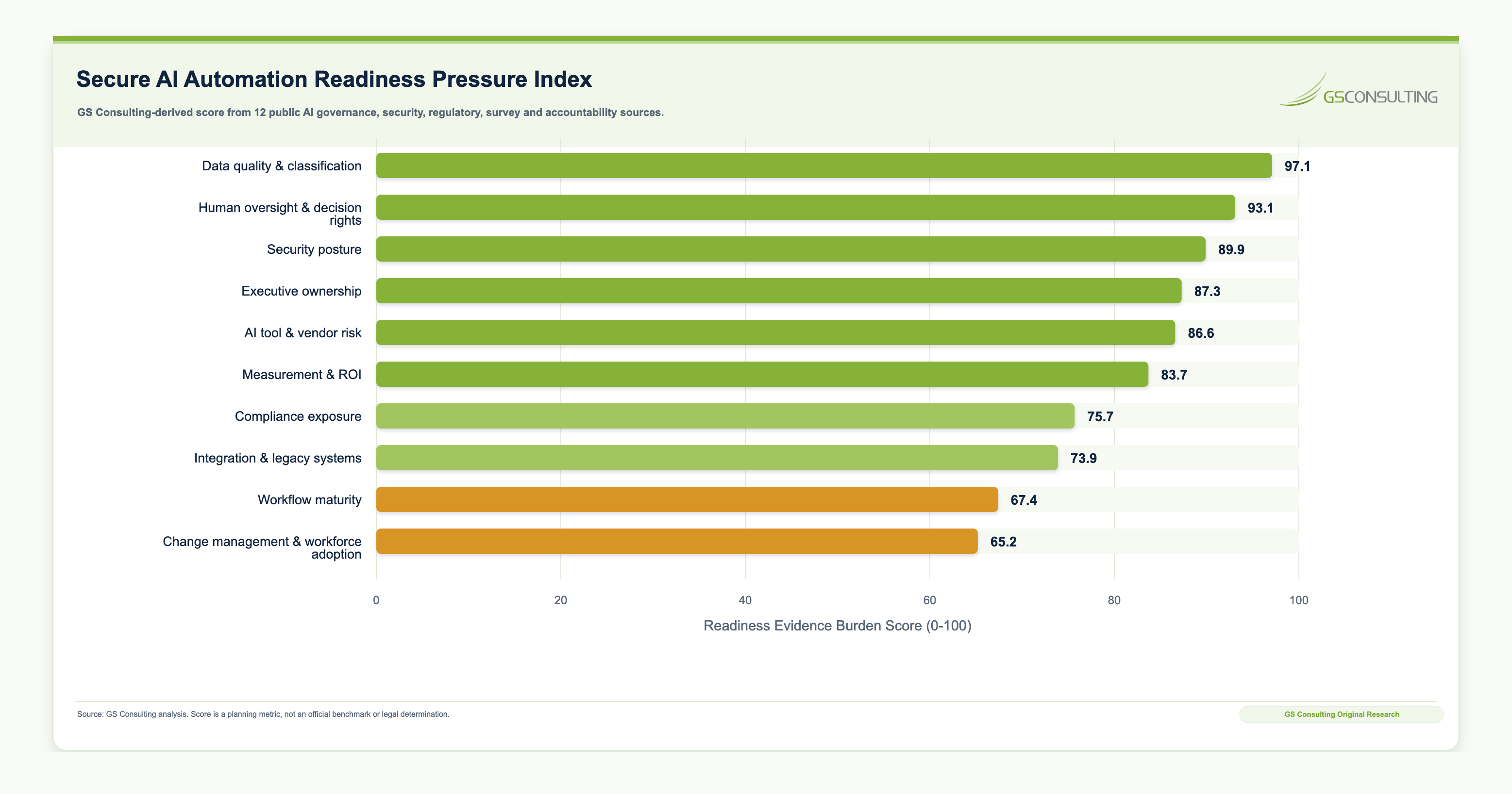
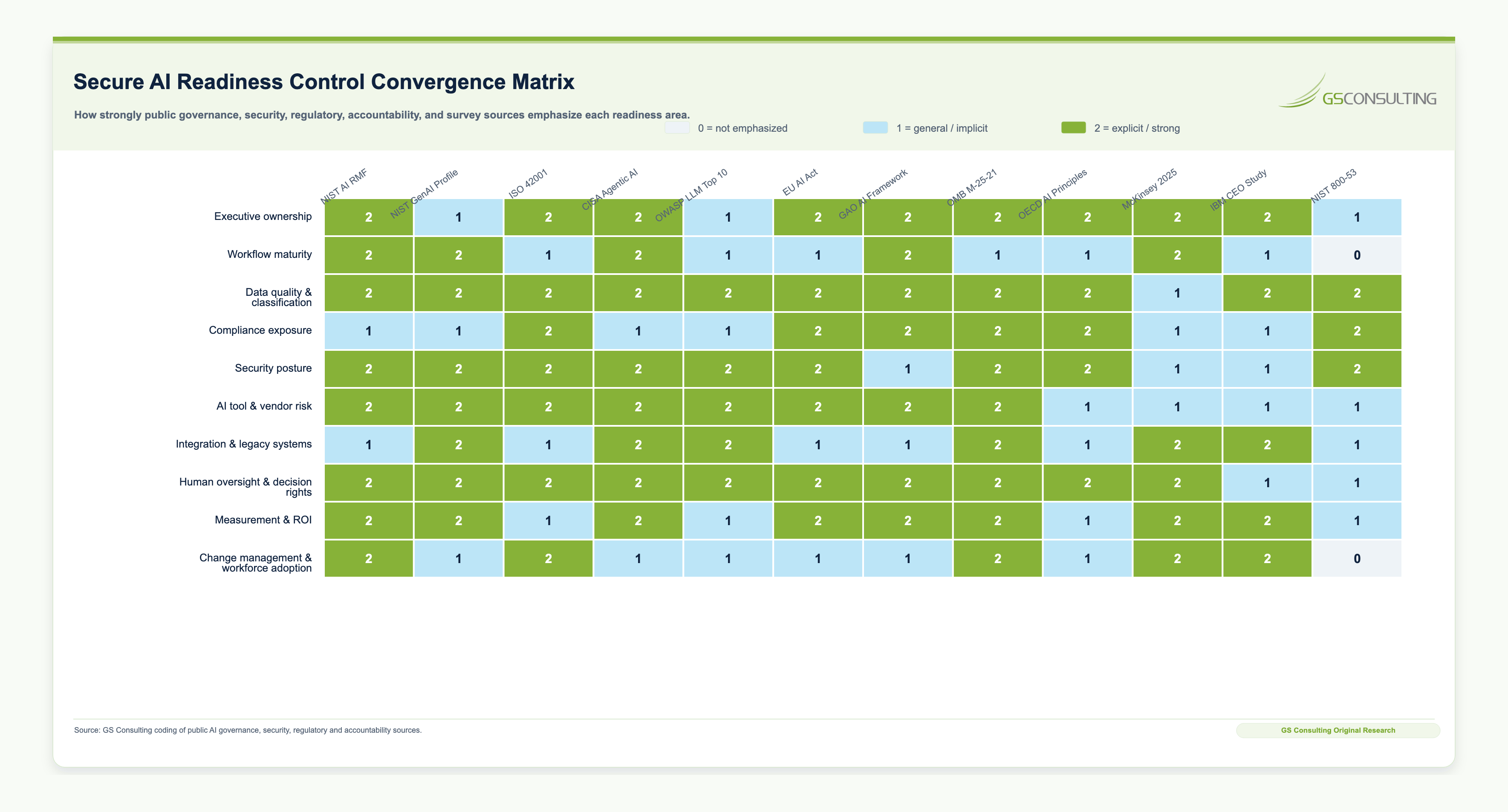
GS Consulting analyzed 12 public AI governance, security, regulatory, accountability, and enterprise adoption sources against the ten readiness areas in this guide. The source set included NIST AI RMF, the NIST Generative AI Profile, ISO/IEC 42001, CISA and allied agentic AI guidance, OWASP LLM Top 10, the EU AI Act, GAO's AI Accountability Framework, OMB AI guidance, OECD AI Principles, McKinsey's 2025 State of AI survey, IBM's 2025 CEO Study, and NIST SP 800-53.
The highest scoring readiness areas were data quality and classification, human oversight and decision rights, security posture, executive ownership, AI tool and vendor risk, and measurement and ROI. That finding matters because the hardest part of secure AI automation is not usually the model. It is proving that the workflow, data, controls, people, systems, and evidence trail are ready for the model to touch real operations.
The practical takeaway is simple: organizations should not scale AI automation simply because employees are already using AI or a vendor demo looks promising. Secure AI automation requires evidence that workflows are understood, data is classified, vendors are reviewed, integrations are controlled, humans remain accountable, security teams can monitor activity, incidents can be handled, and business value can be measured.
Methodology and caveat
Sources included the NIST AI Risk Management Framework, NIST Generative AI Profile, ISO/IEC 42001, CISA and allied guidance on agentic AI, OWASP LLM Top 10, EU AI Act guidance, GAO's AI Accountability Framework, OMB AI guidance, OECD AI Principles, McKinsey's 2025 State of AI survey, IBM's 2025 CEO Study, and NIST SP 800-53. The Readiness Evidence Burden Score, source coding, control ladder, launch gates, and evidence packet are GS Consulting derived planning tools. They are not official NIST, ISO, EU, CISA, GAO, OMB, OECD, OWASP, legal, compliance, audit, or certification determinations.
Ten Readiness Areas to Assess
1. Executive Ownership
Secure AI automation starts with leadership. Without executive ownership, AI efforts usually become scattered experiments: one team buys a tool, another builds a chatbot, a vendor introduces AI features, employees use public tools, and IT tries to create guardrails after the fact.
A readiness assessment should identify who owns enterprise AI strategy, use case approval, AI risk, data governance, security review, compliance review, vendor approval, business ROI, and the authority to stop an AI workflow if it creates risk. ISO/IEC 42001 provides a useful management-system lens for this kind of ownership.
Readiness signal: The organization is more ready when AI has executive sponsorship, defined governance forums, named business owners, a clear approval path, and a shared understanding of acceptable AI use.
2. Workflow Maturity
AI automation works best when the underlying workflow is understood. Many business processes exist partly in systems, partly in spreadsheets, partly in email, and partly in people's heads. There may be no consistent intake process, no clear owner, no reliable metrics, and no agreement on what good looks like.
The best first AI automation candidates are usually workflows that are repetitive, high-volume, measurable, and painful enough to matter. Examples include IT ticket triage, employee support questions, invoice exception review, customer support classification, compliance evidence tracking, operational status reporting, contract intake, procurement request routing, knowledge base search, and security alert summarization.
Readiness signal: The organization is more ready when priority workflows have clear owners, documented steps, known bottlenecks, measurable baselines, and defined escalation paths.
3. Data Quality and Data Classification
AI automation depends on data. If the data is wrong, outdated, duplicated, incomplete, or poorly controlled, AI automation will inherit those problems. In regulated environments, the stakes are higher because the data may include sensitive, restricted, confidential, or legally protected information.
A readiness assessment should evaluate both data quality and data sensitivity. The organization should know whether data is accurate, current, complete, consistently formatted, trusted by employees, tied to a system of record, and owned by a named team. It should also know whether data is public, internal, confidential, regulated, restricted, customer-owned, employee-related, financial, government-controlled, or security-sensitive.
Readiness signal: The organization is more ready when data owners are defined, systems of record are known, sensitive data is classified, access rules are enforced, and AI-approved data boundaries exist.
4. Compliance Exposure
Regulated organizations need to understand how AI automation intersects with compliance. An internal AI assistant that helps employees find public marketing templates may be low risk. An AI workflow that handles employee records, customer complaints, financial approvals, health information, legal obligations, government data, security events, or contractual deliverables may require formal review.
The assessment should identify privacy requirements, cybersecurity frameworks, employment rules, financial controls, healthcare data protection, government contract data rules, sector regulations, customer contractual requirements, records retention, audit evidence, data residency, and third-party risk management obligations.
Readiness signal: The organization is more ready when compliance requirements are mapped to workflows, sensitive use cases receive early review, records obligations are understood, and AI outputs are included in governance.
5. Security Posture
AI automation expands the security conversation. A normal workflow automation tool may move data from one system to another. AI automation may interpret that data, summarize it, generate new content from it, recommend an action, or trigger a workflow.
The most important security question is not simply whether the AI tool is secure. The better question is whether the full AI-enabled workflow is secure: the user, device, identity system, data source, AI tool, integration layer, output location, system of record, approval step, logs, and vendor relationship.
Readiness signal: The organization is more ready when access controls are mature, sensitive systems are monitored, AI tools go through security review, logs are available, and incident response includes AI-related scenarios.
6. AI Tool and Vendor Risk
AI automation usually depends on vendors: foundation models, cloud platforms, orchestration tools, plug-ins, APIs, vector databases, workflow automation platforms, SaaS applications, or managed service providers.
Vendor marketing language is not enough. Regulated organizations need contractual clarity, technical evidence, and operational controls. They should understand what data the vendor processes, whether prompts and outputs are retained, whether customer data can be used for training, whether vendor personnel can review data, which subprocessors are involved, and whether logs are exportable.
A practical vendor review should also cover model changes, incident notification, data residency, audit rights, subprocessors, output ownership, service provider permissions, integration access, and whether the organization can export the logs it needs for monitoring and evidence.
Readiness signal: The organization is more ready when AI vendors are reviewed through security, privacy, legal, procurement, and compliance processes before deployment.
7. Integration and Legacy Systems
AI automation creates the most value when it connects to real workflows. That usually means connecting to CRM, ERP, HRIS, ITSM, finance platforms, document management, contract management, data warehouses, security tools, case management systems, project management tools, or custom legacy applications.
Integration readiness matters because many organizations have older systems, limited APIs, inconsistent data, manual workarounds, and unclear system ownership. Read-only integration is often the safest starting point for regulated organizations: let AI retrieve, summarize, classify, and recommend before allowing it to update records or trigger actions.
Readiness signal: The organization is more ready when systems of record are known, APIs are governed, integration patterns are documented, and AI write-back permissions are limited and controlled.
8. Human Oversight and Decision Rights
Secure AI automation is not about removing humans from every process. It is about putting humans in the right places. AI can help gather context, summarize information, classify requests, draft responses, detect anomalies, and recommend next steps. But humans should remain accountable for decisions that affect customers, employees, compliance, security, finances, safety, legal obligations, or regulated outcomes.
The assessment should classify each workflow by the authority AI is allowed to have: assist, recommend, prepare an action for approval, perform a constrained action, or remain prohibited from autonomous action. The more authority AI has, the more evidence the organization needs.
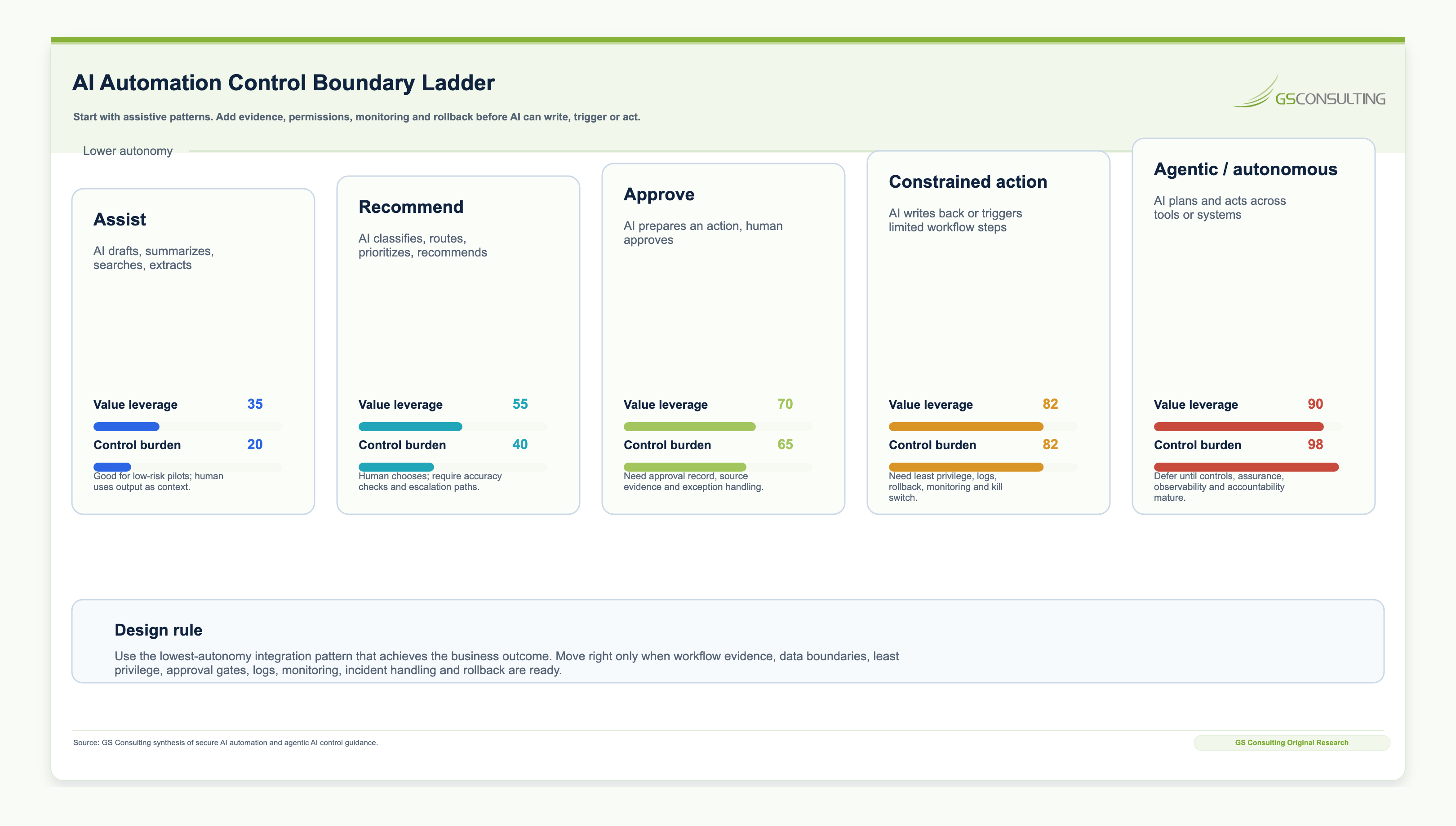
Readiness signal: The organization is more ready when human review rules are written into workflow design and employees understand when AI output must be verified.
9. Measurement and ROI
AI automation should be measurable. Without measurement, organizations end up with AI activity but not AI value. Teams may be impressed by a demo, but leadership cannot tell whether the workflow is faster, cheaper, safer, more accurate, or more reliable.
Useful metrics include cycle time, handling time, cost per transaction, ticket volume, backlog, error rate, rework rate, escalation rate, SLA performance, employee satisfaction, customer satisfaction, audit findings, compliance evidence completeness, manual reporting hours, human override rate, and output acceptance rate.
Measurement is also a control. Baselines, acceptance criteria, override rates, incident trends, and monitoring evidence help leaders decide whether a pilot should scale, pause, or be redesigned.
Readiness signal: The organization is more ready when priority workflows have baseline metrics and business owners can define what success looks like.
10. Change Management and Workforce Adoption
Even secure, well-designed AI automation can fail if people do not use it. Employees need to understand what the AI does, when to trust it, when to question it, what data not to enter, how to escalate problems, and how their work will change.
AI automation should be introduced as a better way to perform work, not as a mysterious system imposed on employees. For regulated organizations, trust is especially important. Employees need to know that AI tools are approved, sensitive data has rules, humans remain accountable, and mistakes can be reported.
Readiness signal: The organization is more ready when employees receive practical AI guidance, managers understand the workflow impact, and users are involved in pilot design.
The Secure AI Automation Readiness Scorecard
A simple readiness scorecard can help leadership decide whether to move forward, pause, or remediate.
- Executive ownership
Low: no clear AI owner.
High: clear executive sponsor, governance, and decision rights.
- Workflow maturity
Low: process is undocumented or inconsistent.
High: workflow is documented, owned, and measurable.
- Data quality
Low: data is scattered or unreliable.
High: data is trusted, owned, classified, and accessible.
- Compliance exposure
Low: requirements are unknown.
High: compliance is mapped to workflows and data.
- Security posture
Low: weak access, logging, or vendor controls.
High: strong identity, monitoring, vendor, and incident controls.
- Integration readiness
Low: manual workarounds dominate.
High: systems of record and integration paths are clear.
- Human oversight
Low: review rules are vague.
High: decision rights and approval gates are defined.
- Measurement
Low: no baseline metrics.
High: clear ROI model and success measures.
- Change management
Low: no training or adoption plan.
High: users, managers, and support teams are prepared.
- Vendor governance
Low: tools are purchased ad hoc.
High: AI vendors are reviewed and monitored consistently.
A workflow does not need a perfect score to begin a pilot. But low readiness in data, security, compliance, or ownership should be addressed before AI automation scales.
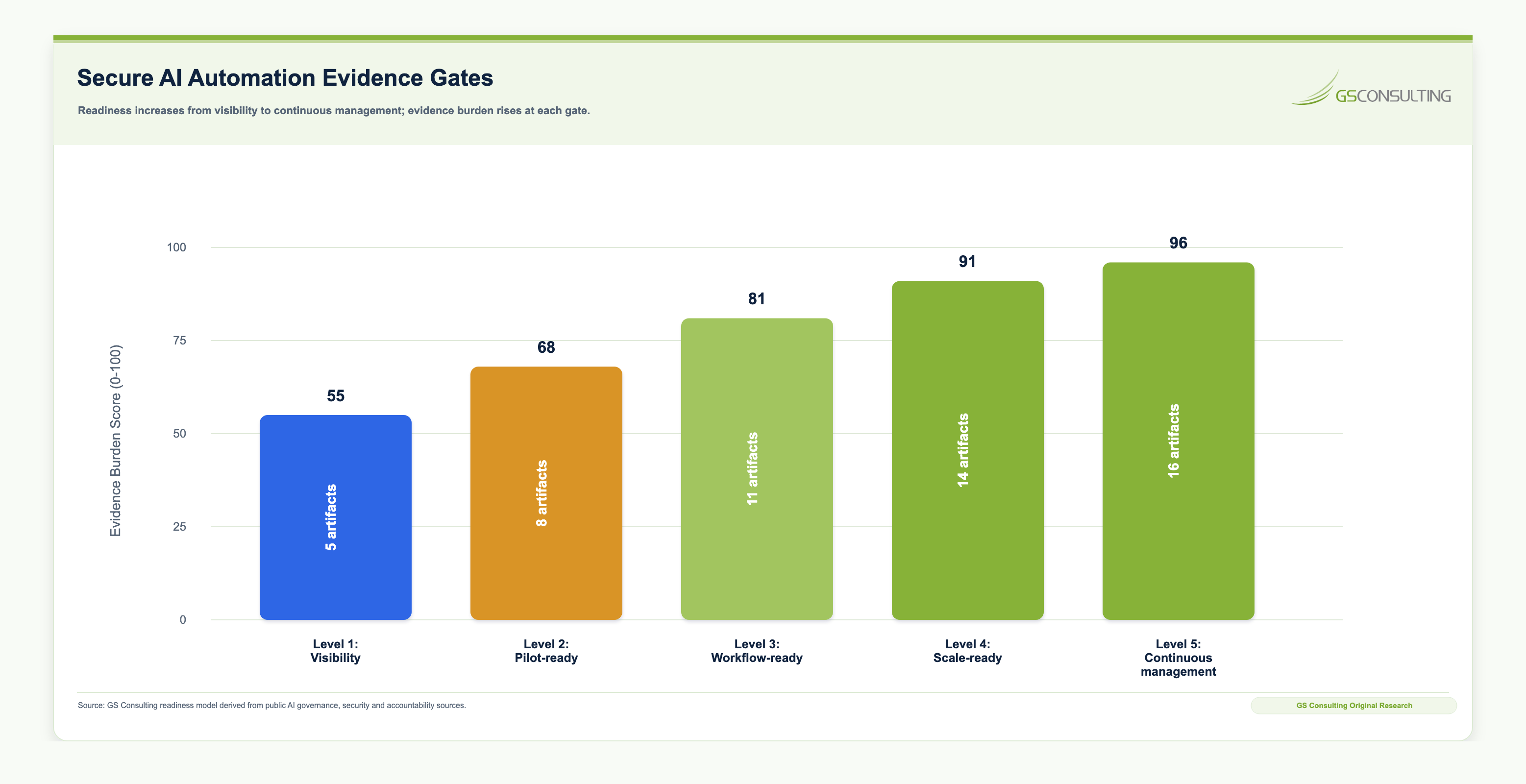
Readiness Levels
- Level 1Not ready: AI use is ad hoc and sensitive data may be entering unapproved tools.
- Level 2Pilot ready with guardrails: low-risk use cases, basic data rules, approved tools, and human review.
- Level 3Workflow ready: priority workflows, data boundaries, owners, security review, and metrics are defined.
- Level 4Scale ready: strong identity controls, logging, vendor management, approval gates, and monitoring.
- Level 5Continuous AI automation management: performance, risk, adoption, compliance, vendors, and workflows are monitored.
Most regulated organizations should aim for Level 3 before scaling and Level 4 before allowing AI to take meaningful actions across systems.
Red Flags That an Organization Is Not Ready
- No one owns AI risk.
- Employees are already using unapproved AI tools with business data.
- Sensitive data is not classified.
- The workflow is not documented.
- There is no system of record.
- AI vendors are not reviewed.
- Security logs are weak or unavailable.
- Access permissions are overly broad.
- Compliance does not know which workflows are being automated.
- AI outputs are used without human review.
- There is no incident response plan for AI-related issues.
- Leadership cannot explain what AI tools are in use.
- The business case has no baseline metrics.
These red flags do not mean AI automation should stop forever. They mean the organization should fix the foundation before scaling.
What a Readiness Assessment Should Produce
A good assessment should produce practical outputs, not just observations.
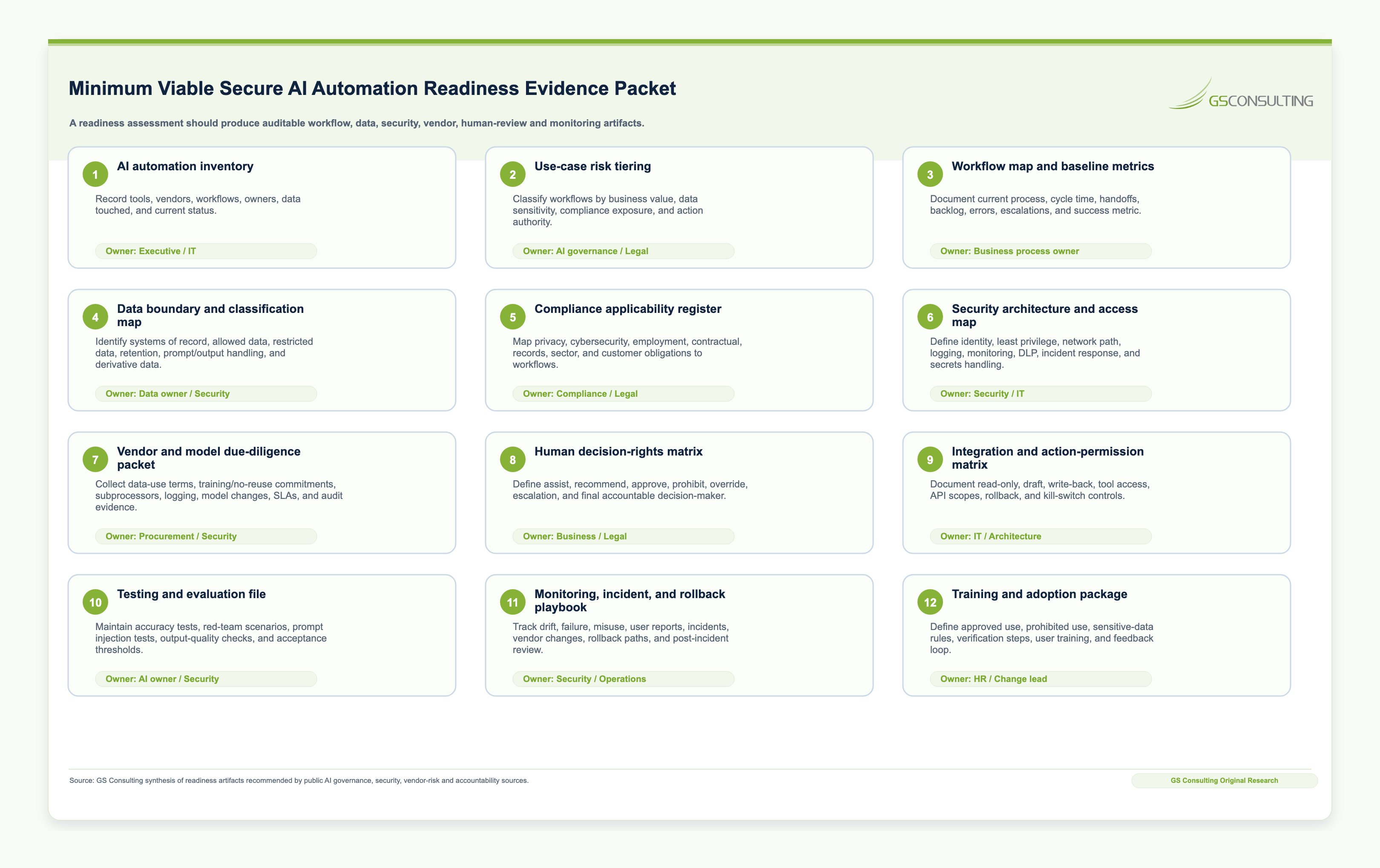
The minimum viable evidence packet should include an AI automation inventory, use case risk tiering, workflow map and baseline metrics, data boundary and classification map, compliance applicability register, security architecture and access map, vendor and model due diligence packet, human decision rights matrix, integration and action permission matrix, testing and evaluation file, monitoring and rollback playbook, and training package.
A Practical 30-60-90 Day Readiness Plan
- Days 1-30Create visibility.
Inventory current AI tools, unofficial AI use, major workflows, sensitive data types, vendors, and business pain points.
- Days 31-60Assess priority workflows.
Map selected workflows, identify data sources, determine compliance exposure, review security controls, evaluate vendors, and define human oversight.
- Days 61-90Prepare controlled pilots.
Build governance, security, data, and measurement plans. Define success metrics, approval gates, logging requirements, escalation paths, and user training.
The Bottom Line
Secure AI automation can help regulated organizations move faster, reduce manual work, improve service quality, and strengthen operational visibility. But readiness matters.
An organization is ready for secure AI automation when its workflows are mature enough, its data is trusted and classified, its compliance exposure is understood, its security posture can support AI access, its vendors are reviewed, its humans remain accountable, and its executives own the outcome.
The best readiness assessment does not ask, "Can we use AI?" It asks a better question: where can we use AI automation safely, measurably, and responsibly, and what must be fixed before we scale?
GS Consulting helps regulated organizations assess secure AI automation readiness, map workflows, evaluate data and compliance exposure, review AI security posture, define governance, calculate ROI, and build practical roadmaps for controlled AI adoption.
Ready to understand whether your organization is prepared?
Contact GS Consulting for a Secure AI Automation Readiness Assessment.
Contact GS ConsultingFrequently Asked Questions About Secure AI Automation Readiness
How do you measure an organization's readiness for AI automation?
Enterprise AI readiness is measured by evaluating maturity across key operational domains, including data classification, workflow maturity, security posture, vendor risk management, and human-in-the-loop oversight for high-impact decisions.
What is the biggest risk when scaling enterprise AI automation?
The biggest risk is scaling AI before establishing strict data boundaries. If an AI tool is deployed without proper access controls and data classification, employees may expose regulated data, PII, or proprietary company information to unauthorized users or third-party LLM training models.
Does NIST have a framework for AI risk management?
Yes. The NIST AI Risk Management Framework provides a voluntary structure to help organizations manage AI risks. It is built around four core functions: Govern, Map, Measure, and Manage. Those functions help enterprises design, deploy, and monitor AI automation systems more securely.
Suggested Future Reading
- Secure AI Automation for Regulated Organizations
- Human in the Loop AI Automation
- How to Identify Safe AI Automation Use Cases
- What Is Secure AI Automation?
- How to Identify the Best Workflows for AI Automation
- Enterprise AI Process Automation Framework
- Legacy System Integration for Enterprise AI Automation