Enterprise AI | | 21 min read
AI ROI Calculation: How to Measure the Business Case for Enterprise AI

Key Takeaways
AI adoption has to move fast and stay controlled.
Start With Mission Value
Prioritize use cases tied to measurable business, delivery, or mission outcomes.
Protect the Data Boundary
Define what data AI tools can touch before selecting vendors or architectures.
Keep Humans Accountable
Use AI to support workflows while retaining trained review and escalation paths.
Document the Controls
Maintain inventories, testing evidence, monitoring plans, and risk decisions.
AI ROI is not measured by how many tools a company buys, how many pilots it launches, or how many employees get access to AI.
The real question is whether AI improves a specific workflow in a way the business can measure, trust, and capture. That means knowing the baseline, the volume, the time saved, the quality of the output, the human review required, the full cost, the risks, and what the organization will actually do with the value created.
The spreadsheet is the easy part. The hard part is proving that AI changed the business.
Do not let AI spending outrun measurement.
GS Consulting helps organizations calculate AI ROI, map workflows, establish baselines, build pilot scorecards, identify hidden costs, evaluate risk, and decide which AI automation projects deserve to scale.
Request an AI ROI AssessmentBuying AI tools is easy. Proving business impact is harder.
Many enterprise AI programs look active from the outside. There are pilots, licenses, demos, employee assistants, vendor features, and executive updates. But activity is not ROI.
ROI appears only when AI improves a real workflow and the organization can prove the improvement. That requires a baseline, a clear use case, realistic assumptions, full cost accounting, adoption data, output quality data, human review measurement, and a plan for capturing the value.
If AI saves time but the process does not change, the savings may never become business value. If employees do not use the tool, the model fails. If outputs require heavy correction, the benefit shrinks. If integration and governance costs are missing, the business case is inflated.
This article shows how enterprise leaders can calculate AI ROI without fooling themselves.
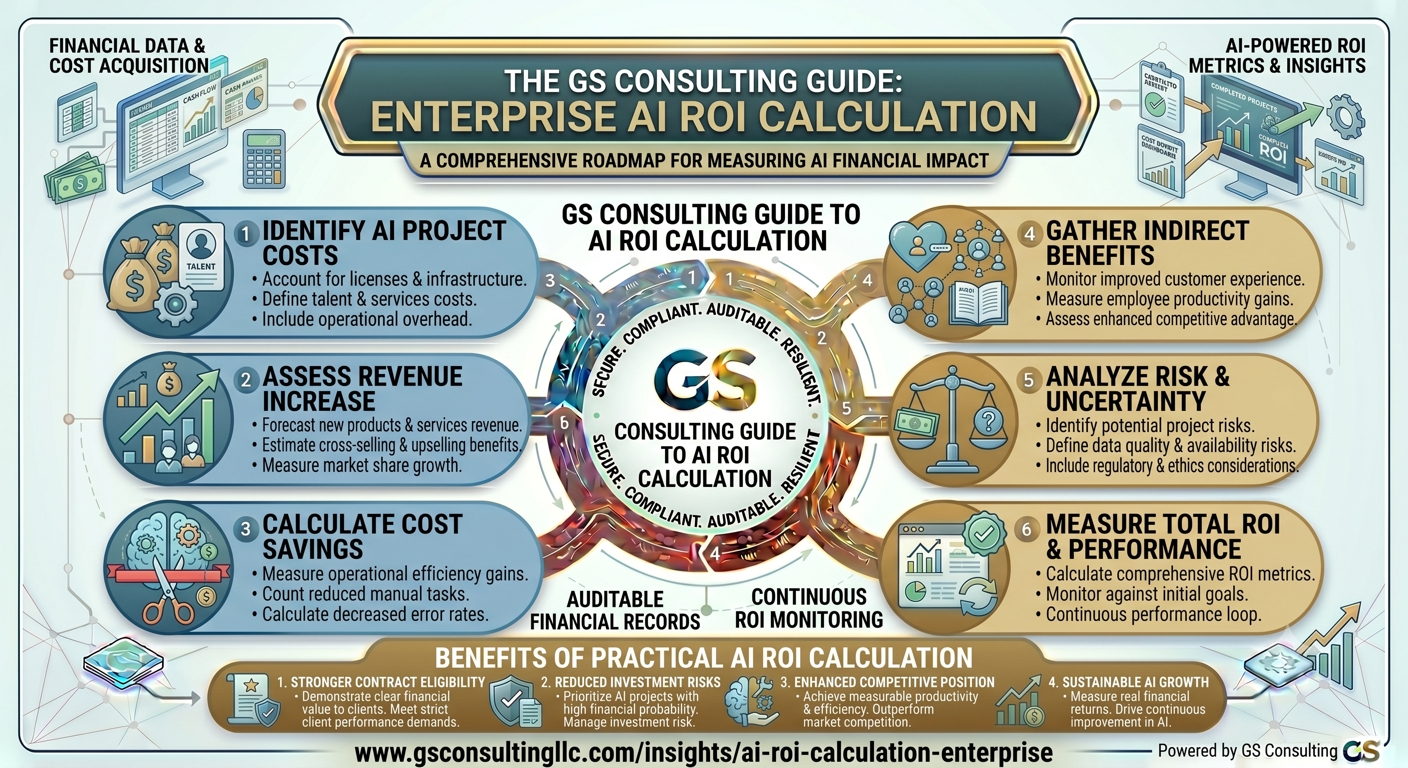
Why AI ROI Is Hard to Measure
AI ROI is hard because AI does not just replace software. It changes work.
A traditional system may automate a known step. AI can summarize, classify, draft, recommend, detect, route, generate, and assist across messy workflows. That flexibility is powerful, but it makes ROI easier to exaggerate if leaders do not measure what actually changed.
A chatbot may save employees time, but only if employees use it consistently and the outputs are accurate enough to reduce work. An AI document review tool may accelerate first pass analysis, but the true savings depend on how much human correction is required.
Original Research: The AI ROI Capture Gap
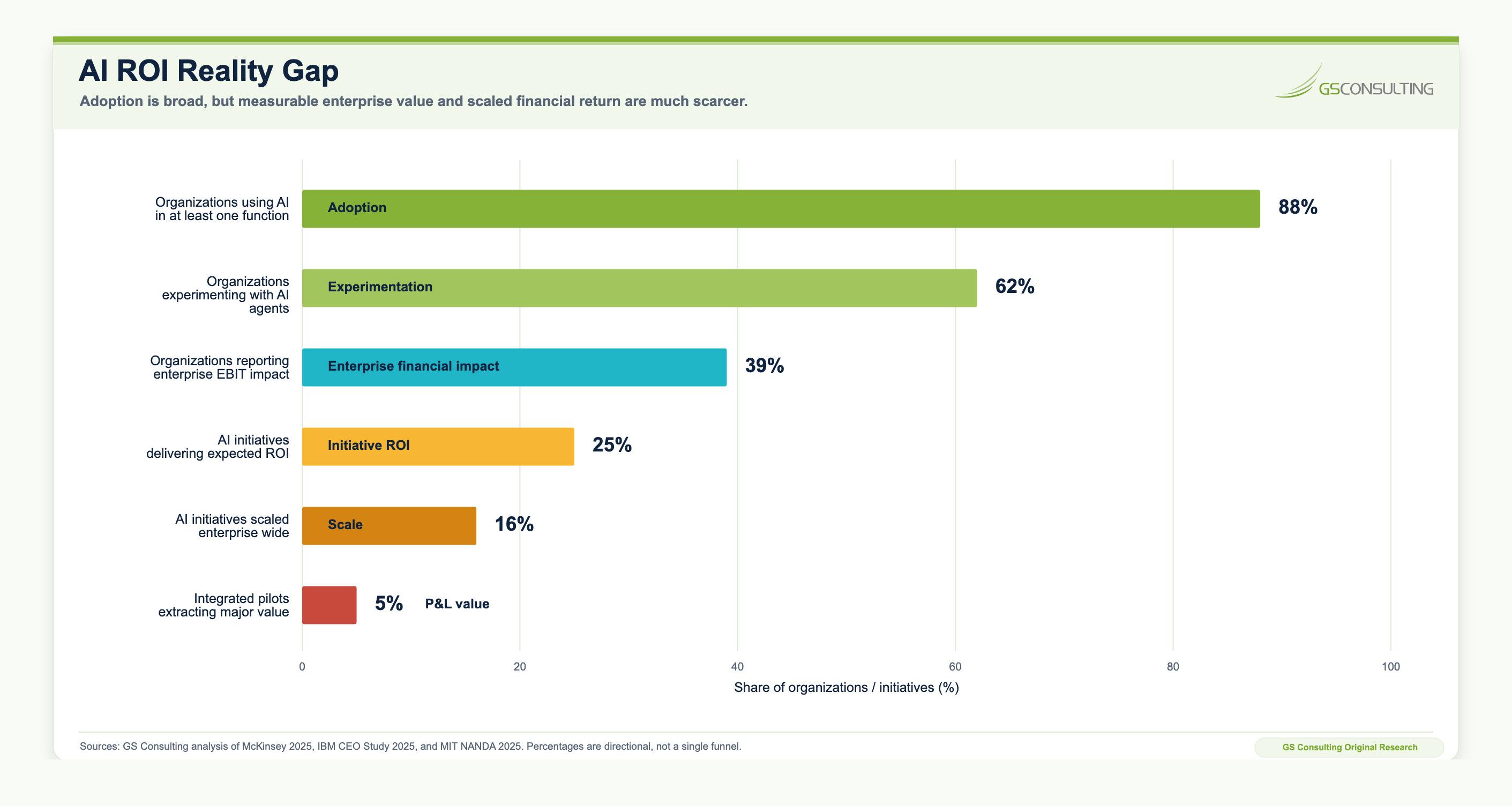
The ROI problem is not that companies are ignoring AI. The problem is that many companies are using AI without converting that use into measurable financial impact.
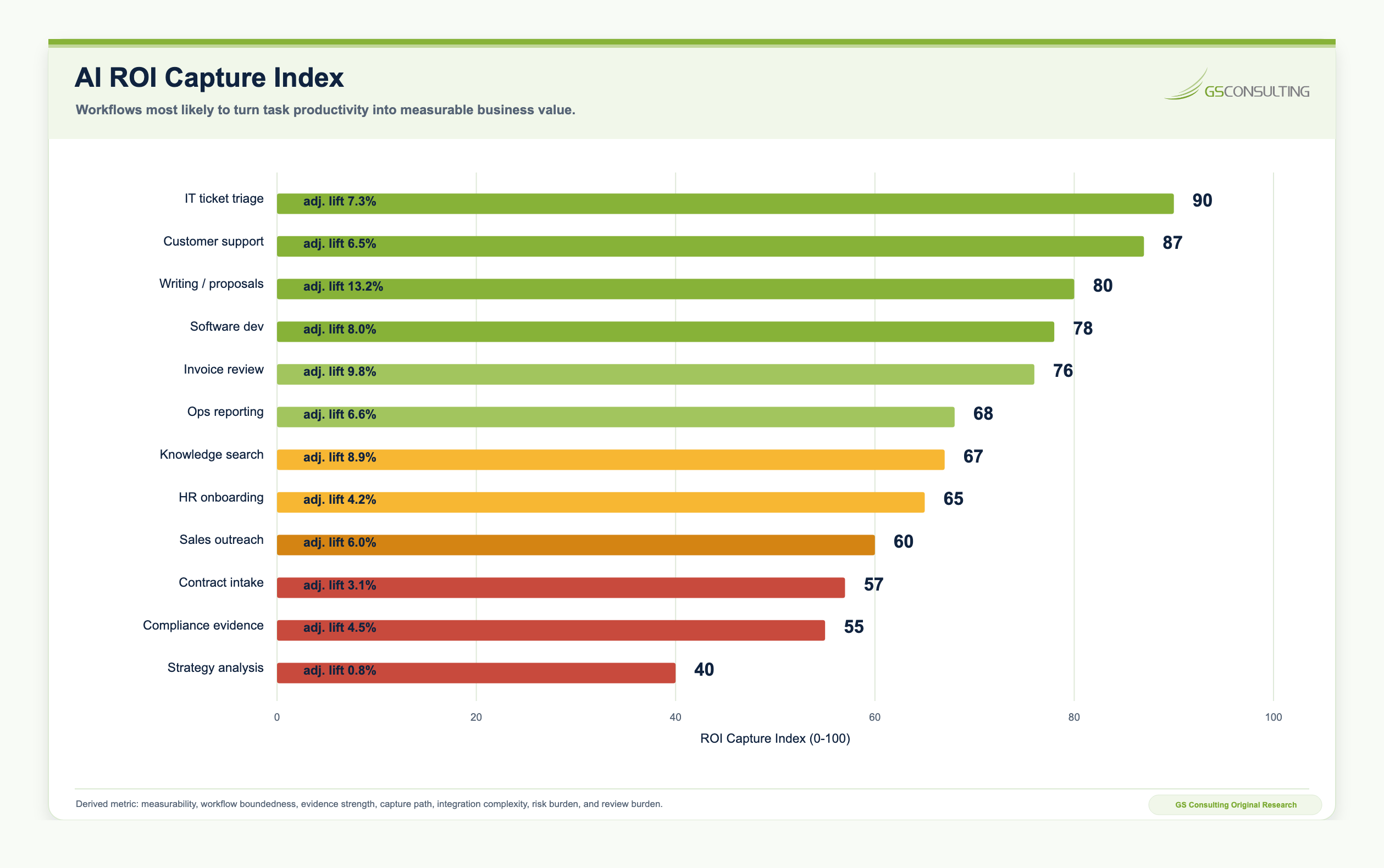
GS Consulting's AI ROI Capture Index was built around that gap. The research separates AI activity from AI value by looking at whether productivity gains can actually become measurable business outcomes after adoption, output quality, process capture, integration complexity, risk controls, and human review are considered.
McKinsey's 2025 State of AI survey reports that 88% of respondents say their organizations use AI in at least one business function, while only 39% report enterprise level EBIT impact. Other public ROI research points in the same direction: many organizations are experimenting, but far fewer are scaling AI in ways that clearly show financial return.
Methodology and caveat
The AI ROI Capture Index is not an official benchmark, valuation model, accounting conclusion, or guarantee of project performance. It is a planning signal based on public AI productivity studies, adoption surveys, and ROI research. The modeled ROI values use conservative labor capacity assumptions and should be replaced with each organization's own workflow volume, labor rate, adoption data, output quality data, integration cost, risk controls, and realized business outcomes.
The practical takeaway is simple: leaders should stop asking whether AI is being used and start asking whether AI value is being captured.
The Basic AI ROI Formula
The formula is simple. The assumptions are where bad business cases hide.
At the simplest level, AI ROI compares total benefit against total cost. But the model is only useful if the benefit is tied to a real workflow and the cost includes everything required to make the workflow work safely at scale.
AI ROI = (Total AI benefit - Total AI cost) / Total AI cost x 100
For example, if an AI automation project creates $500,000 in annual value and costs $200,000 to implement and operate, the ROI is 150%.
Benefits should be tied to real workflow outcomes, not generic productivity claims.
AI business cases often fail when implementation and operating costs are undercounted.
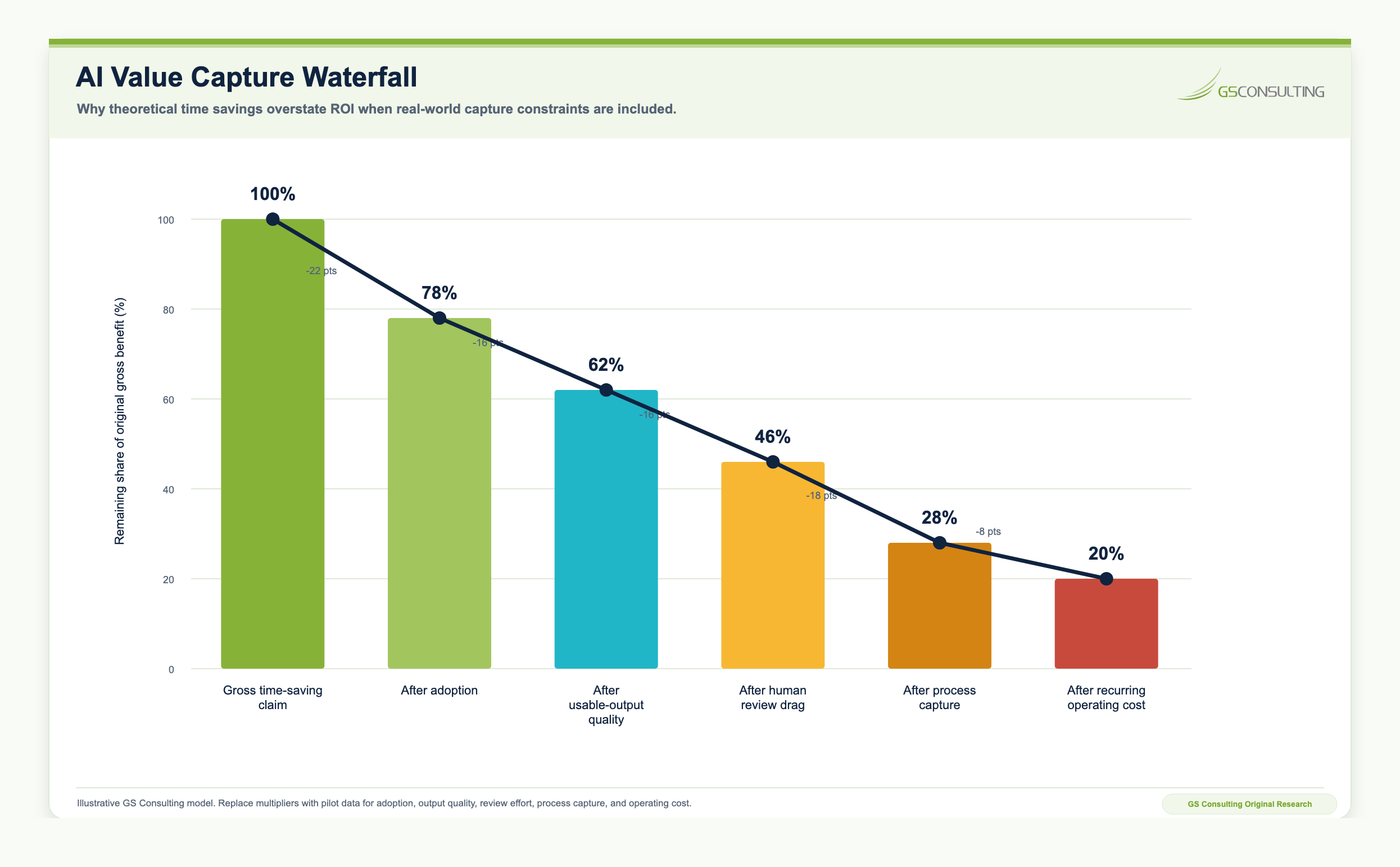
Gross benefit must be adjusted before leadership can trust the ROI model.
ROI should help leadership make a decision. It should not be a number reverse engineered to defend a project that already has momentum.
Start With the Workflow, Not the Tool
Do not calculate the ROI of "generative AI." That question is too vague to be useful.
Calculate the ROI of using AI to reduce Tier 1 IT ticket triage time, automate invoice exception review, accelerate proposal drafting, reduce audit preparation effort, shorten onboarding, or improve customer response throughput.
AI value becomes measurable when it is tied to a workflow with volume, baseline performance, labor effort, quality metrics, and business outcomes.
A useful AI ROI statement sounds like this: "We process 8,000 support tickets per month. Each ticket requires an average of 6 minutes of manual triage. If AI can reduce triage time by 40%, with 80% adoption and a 90% usable output rate, we can estimate annual labor capacity savings and decide whether the investment is justified."
That is the standard. A real AI ROI statement includes volume, baseline effort, expected improvement, adoption, output quality, and a value capture path. Anything less is usually a slogan.
The Five Types of AI ROI
AI ROI is not only labor savings. Labor savings are usually the easiest to explain and the easiest to overstate.
A serious AI business case should separate five types of value so leadership can see what kind of return the project is actually supposed to create.
1. Productivity ROI
Productivity ROI measures time saved, but time saved is not automatically money saved.
AI may reduce time spent searching, reading, summarizing, drafting, classifying, routing, comparing, reporting, or reviewing information. The business case gets stronger when that time becomes real capacity, avoided hiring, reduced backlog, faster service, or higher value work.
Annual productivity value = transaction volume x time saved per transaction x fully loaded labor rate x adoption rate x quality factor
2. Cost Reduction ROI
Cost reduction ROI is the cleanest when the organization can point to a direct expense that goes down.
That may include outsourcing cost, overtime, manual processing cost, rework, error correction, audit preparation, exception handling, or avoidable escalations.
3. Speed and Throughput ROI
Speed only matters when faster work changes a business outcome.
AI created speed can matter when it accelerates onboarding, sales response, contract review, procurement intake, incident response, claim handling, report production, or month end close.
4. Quality and Risk Reduction ROI
Quality ROI matters when AI reduces errors, missed steps, inconsistency, compliance gaps, rework, false positives, or preventable risk.
This category is especially important when the workflow sits in regulated, customer facing, security, finance, legal, healthcare, government contracting, or mission critical environments.
5. Revenue ROI
Revenue ROI can be powerful, but it is also where teams can get sloppy.
AI may support growth by improving sales productivity, proposal speed, conversion, renewal risk detection, customer retention, personalization, pricing analysis, or market response speed. The model should use conservative attribution assumptions, a clear baseline, and a control group where possible.
The AI ROI Calculation Model
A useful AI ROI model should be boring in the best way: specific, documented, conservative, and tied to a decision.
The goal is not to create a perfect forecast. The goal is to create a model leadership can trust enough to decide whether to fund, pilot, scale, redesign, or stop the initiative.
Step 1: Define the Use Case
Start with a use case a business owner can explain in one paragraph.
Name the workflow, owner, current process, AI role, users, systems, data required, expected benefit, risks, controls, and measurement period.
If the use case cannot be described clearly, it is too early to calculate ROI.
Step 2: Establish the Baseline
No baseline, no credible ROI.
Baseline metrics may include transaction volume, average handling time, cycle time, labor hours, cost per transaction, error rate, rework rate, escalation rate, backlog, SLA performance, customer satisfaction, revenue conversion, audit effort, or reporting hours.
A baseline does not have to be perfect. Even a reasonable estimate is better than no measurement, but it should be documented, agreed to by the business owner, and refined during the pilot.
Step 3: Estimate the Gross Benefit
Gross benefit is the optimistic version of the story. It is useful, but it is not the number leadership should trust yet.
For productivity, start with annual transaction volume, time saved per transaction, and fully loaded labor rate. For error reduction, use error volume and cost per error. For revenue, use opportunity volume, conversion improvement, average deal value, and gross margin.
The important point is to use a formula the business understands. If the formula is too abstract, the business case will not be trusted.
Step 4: Apply Realistic Adjustment Factors
This is where inflated AI ROI models get corrected.
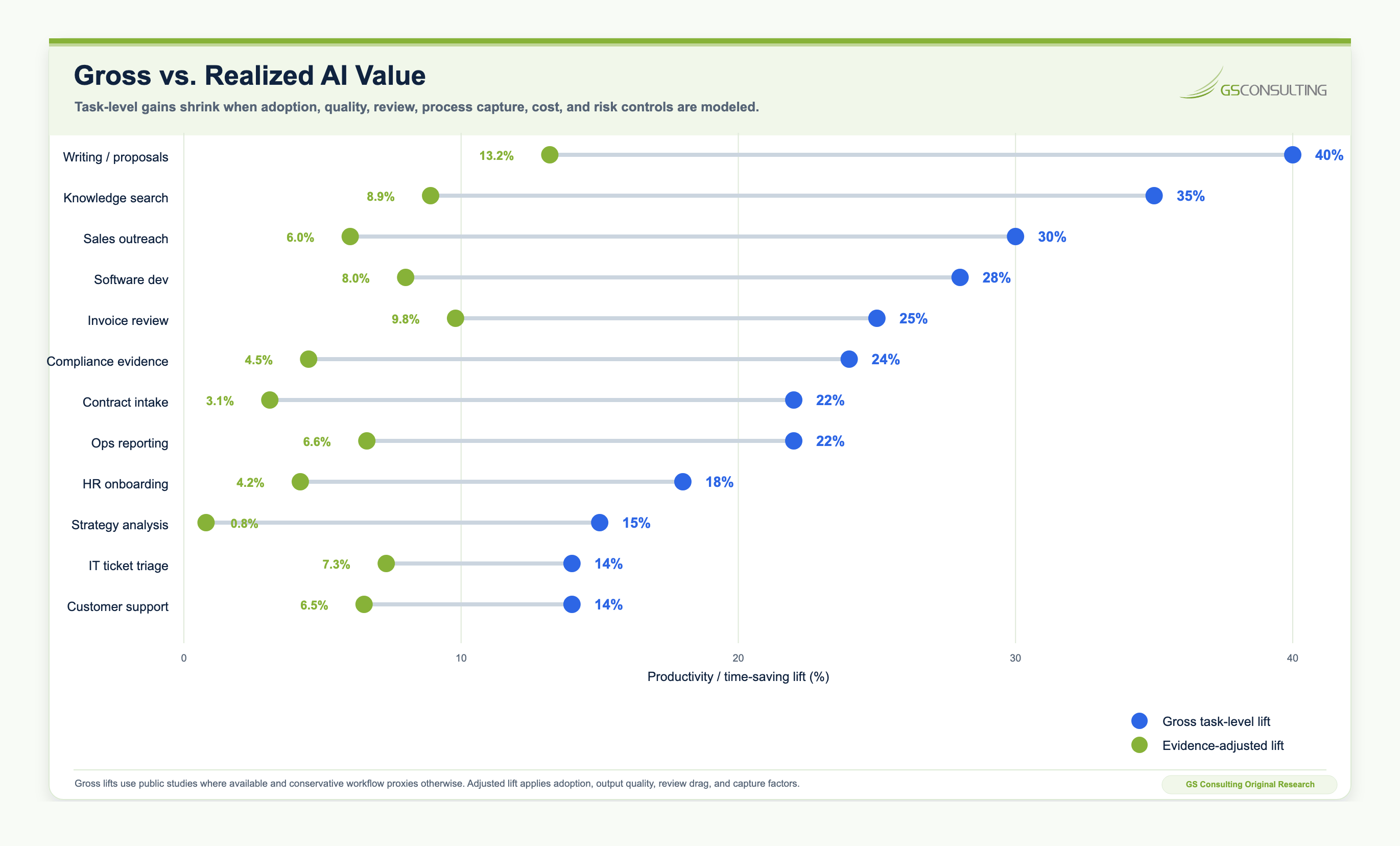
Gross benefit is not realized benefit. The model has to account for whether people actually use the tool, whether outputs are good enough, how much review is still required, and whether the organization can convert the saved effort into business value.
Realized benefit = gross benefit x adoption rate x usable output rate x process capture rate
This conservative adjustment prevents inflated ROI claims. It also forces the team to explain how the business will capture the value instead of simply admiring a productivity estimate.
Step 5: Estimate the Full Cost
Software is usually only the visible cost.
A complete cost model should include software subscription or usage fees, implementation services, workflow redesign, data preparation, system integration, cloud infrastructure, security review, privacy review, legal review, vendor risk review, governance setup, training, change management, internal project time, testing, validation, monitoring, support, maintenance, model evaluation, and ongoing improvement.
A simple cost model can separate upfront costs such as implementation, integration, workflow redesign, training, and governance from recurring costs such as licensing, usage, cloud, support, monitoring, maintenance, model evaluation, and ongoing training.
Step 6: Calculate ROI, Payback, and Net Value
Once benefits and costs are estimated, calculate ROI percentage, payback period, and net annual value.
- ROI: annual realized benefit minus annual cost, divided by annual cost.
- Payback period: upfront implementation cost divided by monthly net benefit.
- Net annual value: annual realized benefit minus annual recurring cost.
These numbers give leadership a clearer basis for deciding whether to fund, scale, redesign, or stop the initiative.
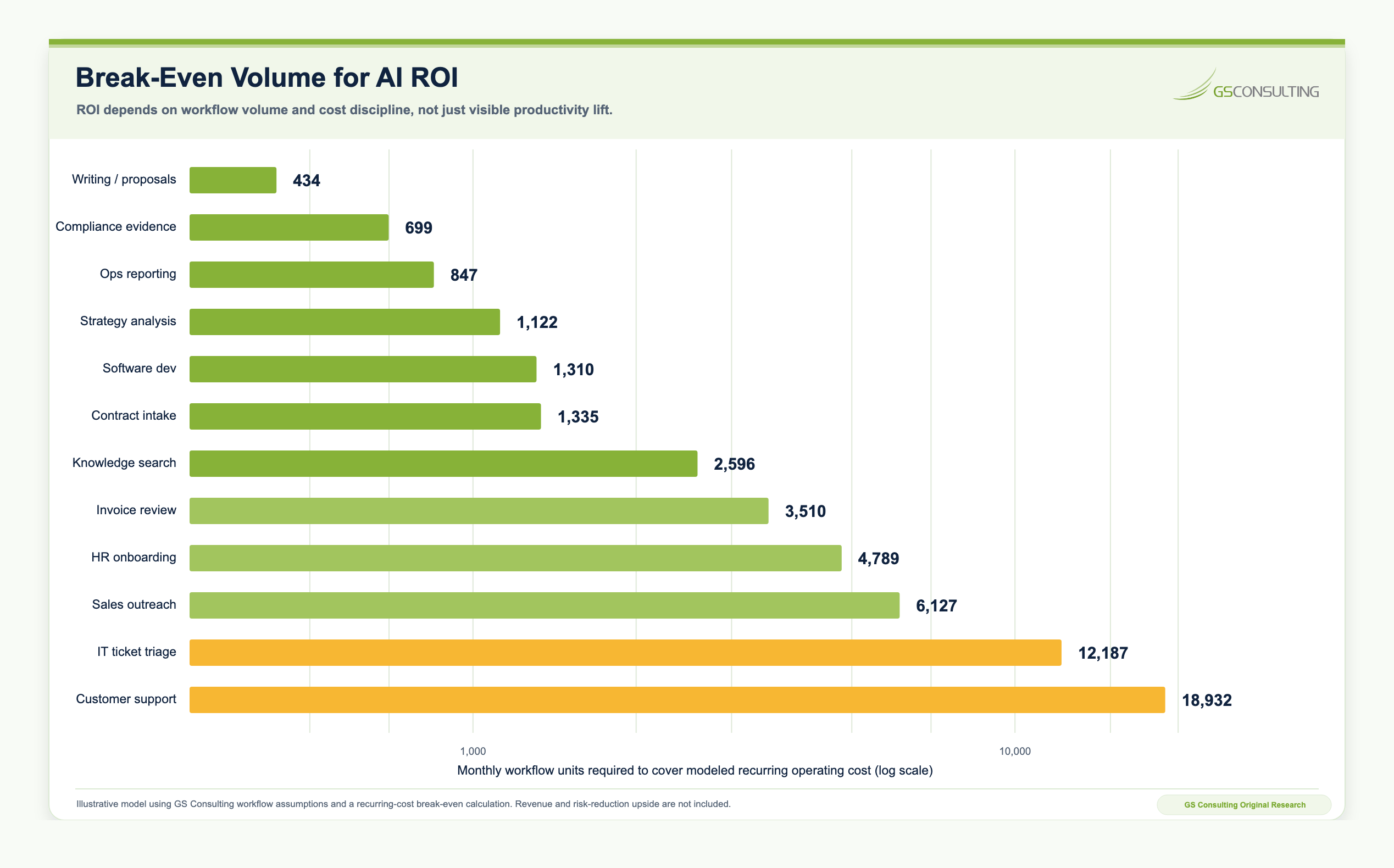
AI ROI Examples
Example 1: IT Ticket Triage
An IT department handles 10,000 tickets per month. Each ticket takes an average of 5 minutes to triage. AI classifies tickets, summarizes issues, recommends routing, and suggests knowledge articles.
If annual triage cost is $647,400 and AI reduces triage time by 45%, the gross savings are $291,330. After applying 85% adoption, 90% usable output, and 75% process capture, the realized annual benefit is about $167,210. With a $120,000 year one cost, year one ROI is about 39%.
Example 2: Finance Invoice Review
A finance team reviews 60,000 invoices per year. Each invoice takes 8 minutes to review. AI extracts fields, flags anomalies, matches purchase orders, and routes exceptions.
If annual review cost is $462,840 and AI reduces time by 50%, the adjusted productivity benefit is about $153,292. Add reduced invoice errors and fewer late payment penalties, and total realized benefit becomes about $208,292. With a $185,000 year one cost, year one ROI is about 13%.
Example 3: Sales Proposal Support
A sales or business development team creates 400 proposals per year. Each proposal requires 12 hours of research, drafting, and internal coordination. AI supports research summaries, first draft language, compliance checks, and reusable content retrieval.
After adoption and quality adjustments, productivity benefit may be about $69,768. If faster and better proposals help generate two additional wins with $100,000 gross margin each, total benefit becomes about $269,768. With a $135,000 year one cost, year one ROI is about 100%.
This example shows why revenue related AI use cases can be powerful, but the revenue assumptions should be conservative and validated over time.
The AI ROI Scorecard
Not every AI project should be funded based on ROI alone. Some projects are strategic. Some are enabling investments. Some reduce risk. Some build the foundation for future automation.
Score higher when the use case maps to business priorities and measurable outcomes.
Score higher when the business owner trusts the data and success criteria.
Score higher when the use case can prove value in 90 to 180 days.
Score higher when reusable components and governance can support future use cases.
Metrics That Matter for AI ROI
AI ROI should be measured across business, operational, adoption, quality, and risk dimensions.
The best AI dashboards show more than time saved. They show whether AI is improving the process safely and consistently.
How to Handle Soft AI Benefits
Some AI benefits are real but difficult to quantify. These include employee satisfaction, improved knowledge sharing, faster onboarding, better decision confidence, reduced frustration, stronger customer experience, and improved organizational learning.
Do not ignore these benefits, but do not inflate them either. Treat soft benefits as a separate category. Use operational proxies, track them over time, and connect them to measurable outcomes only when the data supports it.
Why Adoption Rate Can Make or Break AI ROI
A tool nobody uses has no ROI.
An AI project can look great in a demo and collapse in the workflow because employees do not trust it, do not understand it, do not need it, or have to leave their normal systems to use it.
Adoption depends on trust, workflow fit, training, leadership support, ease of use, output quality, and whether AI is embedded where people already work.
Access is not adoption. Adoption requires workflow design.
Why Integration Costs Are Often Underestimated
The pilot is usually cheaper than the real deployment.
Many AI pilots work because the team manually uploads files, uses a limited dataset, avoids messy integrations, and has motivated users. Scaling is different. Scaling means connecting AI to the systems where work actually happens.
The company may need to connect AI to CRM, ERP, HRIS, ITSM, document repositories, ticketing platforms, data warehouses, identity systems, contract systems, finance tools, or legacy databases.
A true ROI model should separate pilot ROI from scaled ROI. The scaled model has to include integration, governance, training, monitoring, support, security, privacy, and operational ownership.
AI ROI by Maturity Stage
AI ROI should mature with the project.
Do not demand full financial proof from an early exploration effort. But do not let a project move from exploration to pilot to deployment to scale without stronger evidence at each stage.
Not every initiative needs full ROI in exploration. Every initiative needs a credible path to measurable value before it earns the right to scale.
Common AI ROI Mistakes
Most AI ROI mistakes do not start in the math. They start in the assumptions.
Mistake 1: Counting theoretical time savings as cash savings. Saving employee time is valuable, but the company still has to decide what happens to that time. Does it reduce cost, increase capacity, cut backlog, speed service, improve quality, or support revenue? If not, the savings may stay theoretical.
Mistake 2: Ignoring human review. If AI saves 10 minutes but requires 8 minutes of correction, the ROI is not based on 10 minutes saved. It is based on the net improvement after review, correction, escalation, and quality control.
Mistake 3: Undercounting implementation costs. Software licensing is only one cost. Data preparation, integration, security, privacy, training, workflow redesign, governance, monitoring, support, and internal project time can change the business case fast.
Mistake 4: Failing to measure adoption. A tool that only 20% of users adopt will not deliver the ROI model built around 80% adoption. Usage has to be measured, not assumed.
Mistake 5: Scaling before proving workflow fit. A successful demo does not mean the tool fits the workflow, the data, the users, the systems, the controls, or the support model.
Mistake 6: Measuring only productivity. AI can create value through speed, quality, risk reduction, revenue, consistency, customer experience, and avoided cost. Labor savings are only one part of the model.
Mistake 7: Ignoring risk. AI that creates compliance, privacy, security, legal, operational, or customer trust problems can erase its own ROI.
Mistake 8: Treating pilot ROI as scaled ROI. A manually supported pilot can look profitable while the scaled deployment becomes expensive because integration, training, monitoring, governance, and support were not counted.
Mistake 9: Letting the business case become a sales document. An AI ROI model should help leadership make a decision. It should not exist just to make a project look fundable.
The AI ROI Business Case Template
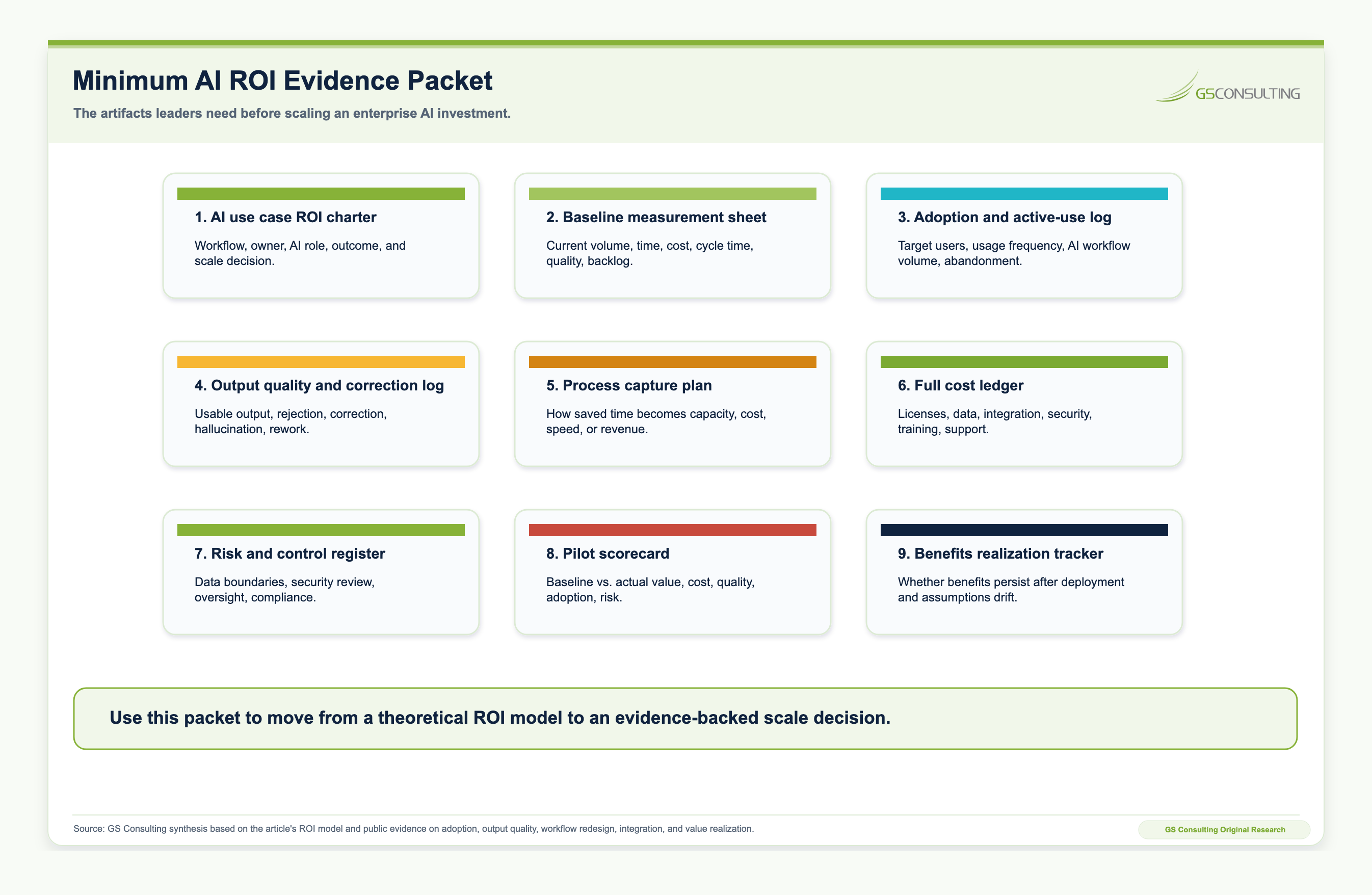
A strong AI business case should be more than a spreadsheet.
The spreadsheet matters, but leadership also needs the operating evidence behind it: the workflow, owner, baseline, assumptions, costs, risks, pilot plan, governance model, measurement plan, and scale decision criteria.
A useful AI ROI business case should include:
- Use case summary.
- Business owner.
- Current workflow baseline.
- AI role in the workflow.
- Target users.
- Data and systems involved.
- Expected benefit.
- Assumptions and confidence level.
- Full cost estimate.
- Adoption model.
- Output quality model.
- Human review estimate.
- Process capture plan.
- Risk review.
- Governance model.
- Pilot plan.
- ROI, payback, and net value calculation.
- Scale, redesign, pause, or stop criteria.
This keeps AI investment decisions grounded in business value instead of hype, demos, or vendor promises.
A 90 Day AI ROI Action Plan: Move From Interest to Evidence
Ninety days is enough time to stop guessing.
The goal is not to prove every AI investment in one quarter. The goal is to identify the workflows worth measuring, build credible business cases, run controlled pilots, and give leadership evidence for which projects should scale, pause, redesign, or stop.
- Days 1 to 30Find measurable workflows.
Identify high volume, repetitive, painful, or revenue relevant workflows where AI could reduce time, increase throughput, improve quality, reduce risk, or support growth. Capture baseline volume, current effort, cycle time, error rate, backlog, cost, and business owner.
- Days 31 to 60Build the business case.
Estimate gross benefit, apply adoption and quality adjustments, identify human review effort, calculate process capture, include full costs, review risk, and select two or three use cases strong enough for controlled pilots.
- Days 61 to 90Run controlled pilots.
Measure actual performance against the baseline: savings, adoption, usable output, correction effort, cycle time, satisfaction, cost, risk issues, and whether the value can be captured in the business.
By the end of 90 days, leadership should be able to answer which AI use cases have measurable business value, what baseline is being improved, what assumptions drive the ROI, what costs are included, what risks must be controlled, what the pilot proved, and which projects deserve more investment.
The Bottom Line
AI ROI is not measured by activity. It is measured by captured value.
Buying tools, launching pilots, and giving employees access to AI may all be useful steps. None of them prove ROI by themselves.
The strongest AI business cases start with a specific workflow, establish a baseline, calculate realistic benefit, include full cost, adjust for adoption and quality, measure human review, account for risk, and track results after deployment.
The companies that get this right will not be the ones with the biggest AI slide deck. They will be the ones that can answer the basic business questions: what changed, how much it improved, what it cost, what risk it created, and whether the value was actually captured.
That is the standard: no vanity metrics, no fake savings, no pilot theater.
GS Consulting helps organizations move from AI interest to measurable AI value.
That means identifying workflows worth improving, establishing baselines, calculating realistic AI ROI, separating gross benefit from realized benefit, finding hidden costs, evaluating data and integration readiness, building pilot scorecards, designing governance, and deciding which AI automation projects should scale.
The goal is not to make every AI idea look good. The goal is to help leaders fund the right projects, stop the weak ones, and capture value from the work that actually improves the business.
Research Sources and Caveats
The original research in this article uses GS Consulting planning metrics. The AI ROI Capture Index is not an official benchmark, valuation model, accounting conclusion, or guarantee of project performance.
It is a planning signal. It helps leaders think more clearly about where task productivity gains are most likely to become measurable enterprise value.
Modeled ROI values use conservative labor capacity assumptions and should be replaced with each organization's actual workflow volume, labor rates, adoption data, output quality data, cost structure, risk controls, and realized business outcomes.
- McKinsey, The State of AI: Global Survey 2025
- Noy and Zhang, Experimental Evidence on the Productivity Effects of Generative Artificial Intelligence
- GS Consulting analysis of public AI adoption, ROI, and productivity research, including task productivity experiments and enterprise AI scaling studies.
Ready to prove which AI projects are worth scaling?
GS Consulting helps organizations map workflows, calculate realistic AI ROI, build pilot scorecards, identify hidden costs, measure adoption and output quality, and decide which AI automation projects deserve more investment.
Contact GS ConsultingFrequently Asked Questions About Enterprise AI ROI
How do you calculate the ROI of enterprise AI?
Calculate enterprise AI ROI by comparing realized benefit against total cost. Start with a specific workflow, establish the baseline, estimate gross benefit, then adjust for adoption, usable output, human review, and process capture. Compare that realized benefit against the full cost of software, integration, data preparation, security, governance, training, monitoring, support, and change management.
What are the hidden costs of AI implementation?
The hidden costs are usually outside the software license. A defensible AI business case should include data preparation, legacy system integration, security and privacy review, vendor risk review, workflow redesign, employee training, governance, monitoring, support, and the internal time required to make the new process work.
How long does it take to see a return on AI investments?
Bounded, well integrated use cases such as IT ticket triage, invoice review, proposal support, or controlled knowledge retrieval may show initial value within 90 to 180 days. Larger enterprise transformations that require heavy data engineering, legacy integration, governance, and change management may need a 12 to 18 month payback horizon. The key is to separate pilot proof from scaled ROI.
Suggested Future Reading
- Building the Business Case for Secure Enterprise AI
- Total Cost of Ownership for Secure Enterprise AI
- Aligning AI Strategy with Legacy IT Modernization
- Enterprise AI Process Automation Framework: How to Move from AI Pilots to Measurable Business Transformation
- How to Identify the Best Workflows for AI Automation
- Legacy System Integration for Enterprise AI Automation
- AI Transformation for HR: Automating Employee Support and Onboarding
- AI Transformation for IT: Service Desk, Ticket Triage, and Knowledge Management
- AI Transformation for Operations: Exception Management, Reporting, and Process Control