Enterprise AI | | 21 min read
AI Transformation for Operations: Exception Management, Reporting, and Process Control

Key Takeaways
AI adoption has to move fast and stay controlled.
Start With Mission Value
Prioritize use cases tied to measurable business, delivery, or mission outcomes.
Protect the Data Boundary
Define what data AI tools can touch before selecting vendors or architectures.
Keep Humans Accountable
Use AI to support workflows while retaining trained review and escalation paths.
Document the Controls
Maintain inventories, testing evidence, monitoring plans, and risk decisions.
Operations AI is not about automating the business. It is about controlling the exceptions that keep the business from delivering.
The best operations teams do not need more dashboards, more status meetings, or more manual reporting. They need earlier visibility into what is stuck, late, missing, off target, misrouted, under owned, or about to affect a customer.
AI can help with that. But only when the workflow, source systems, exception rules, escalation paths, ownership, and system of record updates are clear.
Do not automate operations before you understand the exceptions.
GS Consulting helps organizations map operational workflows, identify exception heavy processes, define source system rules, automate reporting, design human controlled escalation, calculate ROI, and launch controlled operations AI pilots.
Request an Operations AI AssessmentOperations is where strategy either becomes delivery or becomes noise.
The work is rarely clean. Orders change. Vendors miss dates. Approvals sit too long. Fields are incomplete. Inventory does not match demand. Service levels drift. Quality issues repeat. Customer commitments depend on updates from three different systems and two people who are already overloaded.
That is why operations is a strong AI target.
AI can help teams detect exceptions earlier, summarize operational status, compare actual performance against targets, identify handoff delays, classify severity, draft follow ups, and show leaders where the process is breaking. But AI should not become an uncontrolled side channel that makes commitments, updates records, or changes the plan without review.
The smart move is not to automate operations blindly. The smart move is to use AI to make the real process easier to see, easier to control, and easier to improve through practical AI workflow automation.
Why Operations Is a Strong AI Transformation Target
Operations is a strong AI target because the work already leaves a trail.
Every order, ticket, shipment, approval, inspection, handoff, vendor update, schedule change, service request, and status report creates signals. The problem is that those signals are usually scattered across systems, spreadsheets, emails, dashboards, and meetings.
AI can help only if those signals are tied back to the real process. It should help teams answer practical questions: what changed, what is late, what is missing, which exception matters most, who owns the next action, which customer is exposed, and what leadership needs to know now.
Original Research: Where Operations AI Should Start
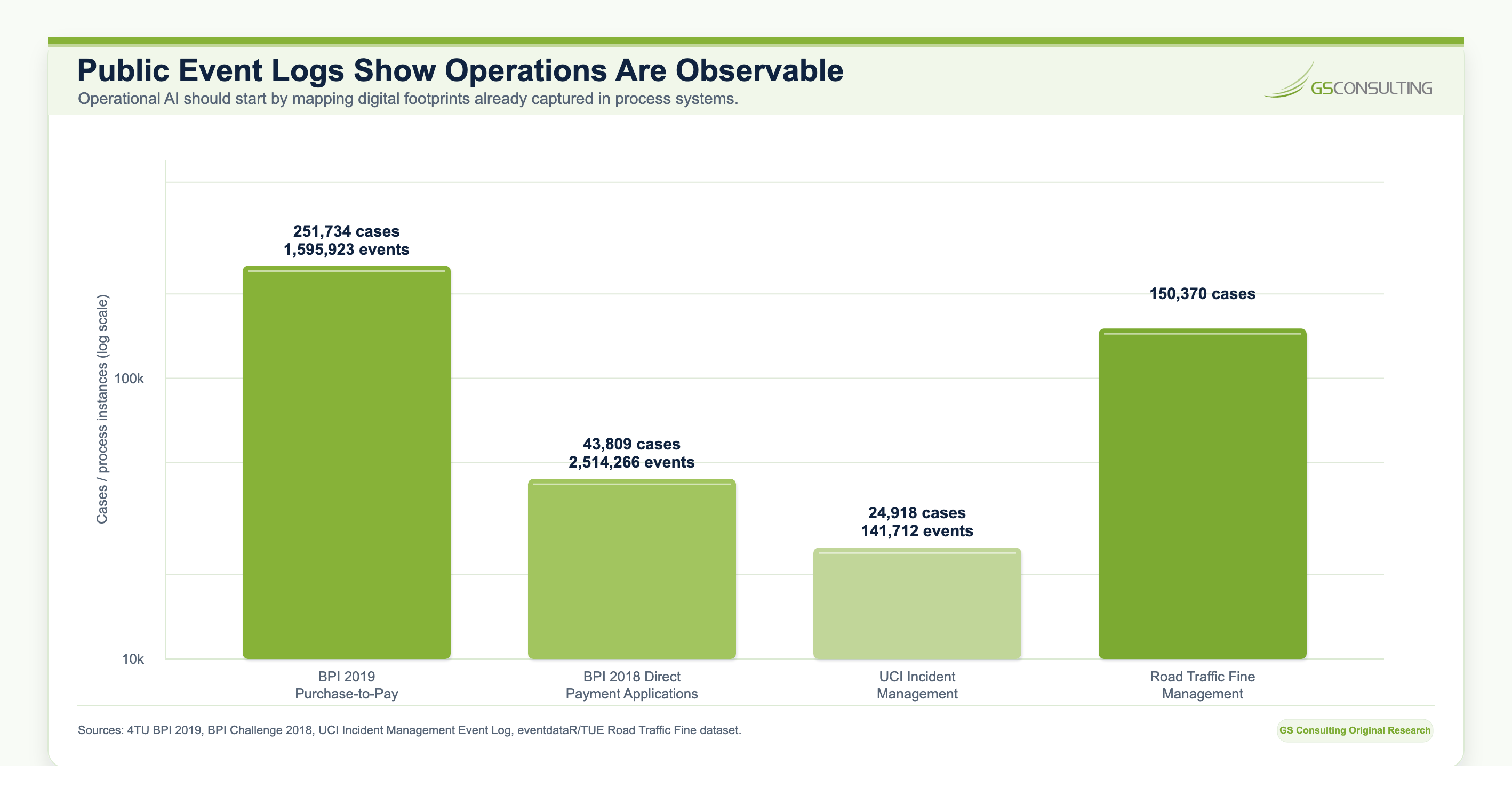
The research points to a simple starting point: begin where exception volume, reporting burden, and process evidence overlap.
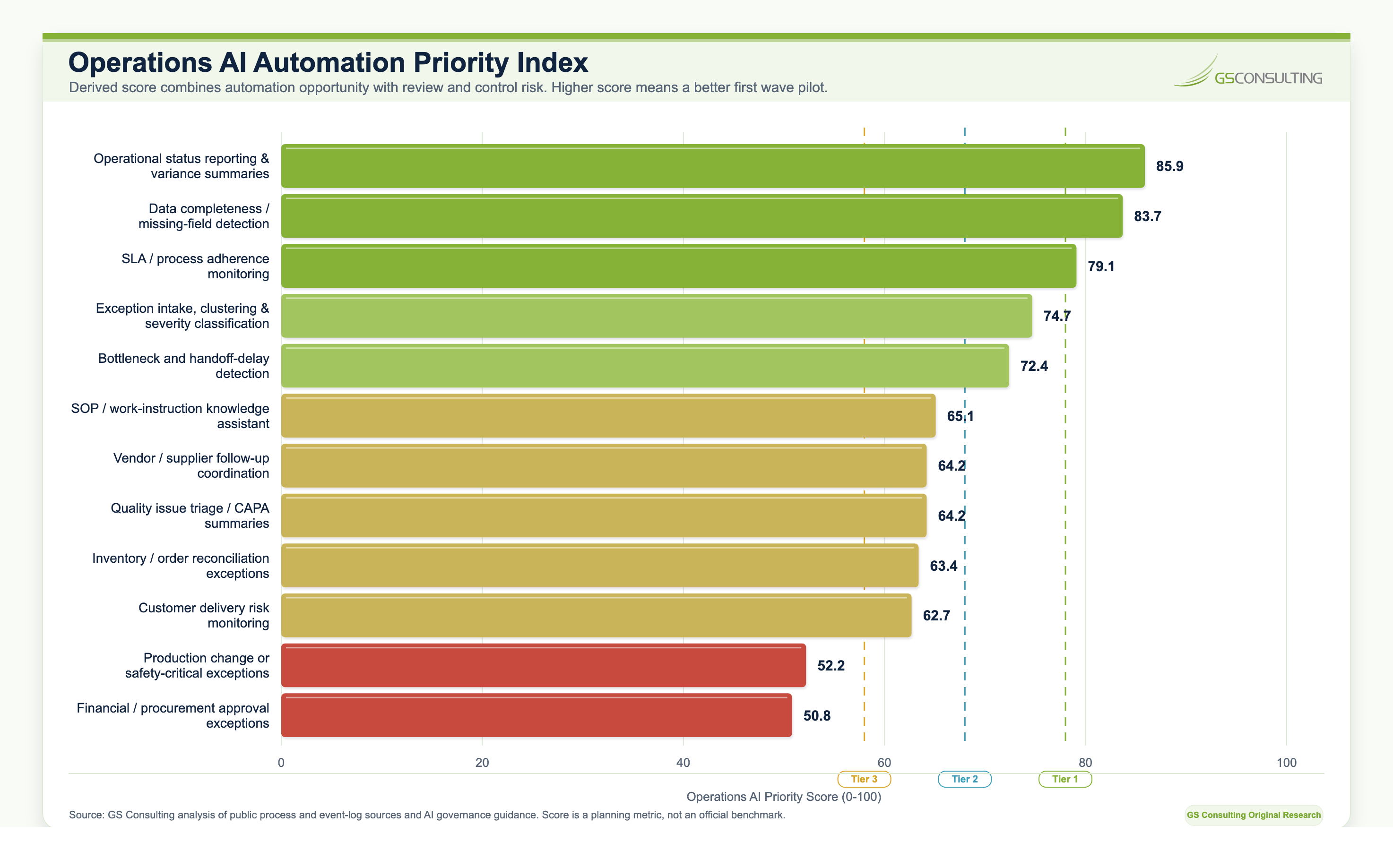
GS Consulting analyzed public process mining event log sources, AI governance guidance, and common operations workflows to create an Operations AI Automation Priority Index. The pattern was practical. The best first pilots are not the dramatic ones. They are the workflows where AI can monitor, summarize, classify, compare, and route without taking final operational control.
The highest priority first pilots were operational status reporting and variance summaries, data completeness and missing field detection, SLA and process adherence monitoring, exception intake and severity classification, and bottleneck or handoff delay detection.
Methodology and caveat
The Operations AI Priority Score, Evidence Burden Score, and Opportunity Risk Matrix are GS Consulting derived planning tools. They are not official benchmarks, compliance determinations, legal conclusions, or guarantees of project ROI. The exception economics model is illustrative and should be replaced with each client's actual transaction volume, exception rate, handling time, labor cost, adoption rate, and AI assisted reduction assumptions.
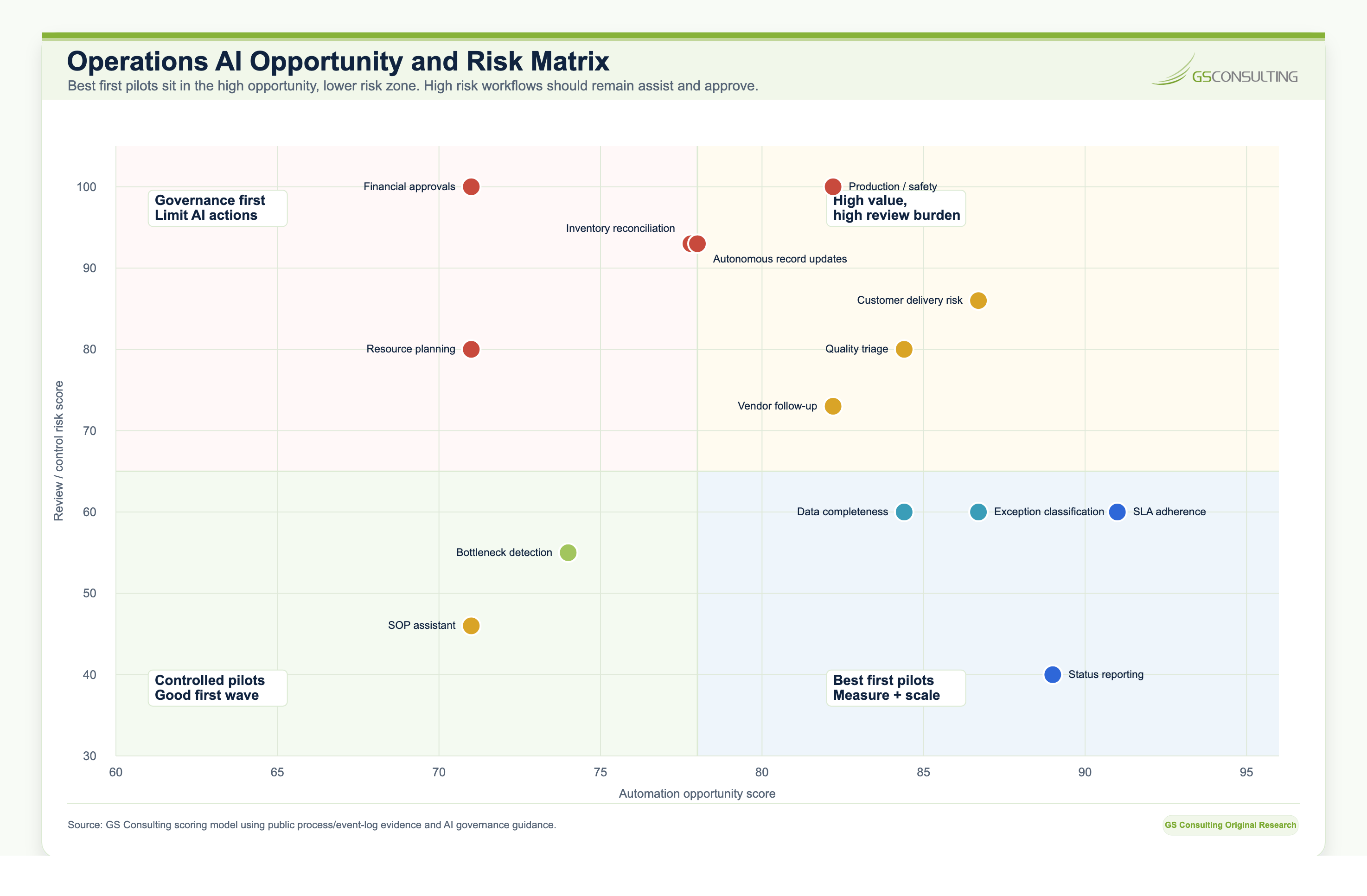
The practical takeaway is simple: operations AI should start with visibility and control before it moves toward automation. Status reporting, variance summaries, missing field detection, SLA monitoring, exception classification, and bottleneck detection are better first pilots than autonomous commitments or system updates.
The Best Operations Workflows for AI Automation
The best operations AI use cases are boring in the right way.
They repeat often. They have measurable outcomes. They depend on multiple data sources. They create exceptions. They waste coordination time. And they improve when humans see the right problem sooner.
- Good first candidates include: exception management, operational reporting, process adherence monitoring, status summaries, demand and resource planning, quality issue triage, vendor follow up, customer delivery risk monitoring, data completeness checks, bottleneck detection, and SOP guidance.
- Poor first candidates include: safety critical actions, major customer commitments, production changes, regulatory decisions, financial approvals, legal commitments, workforce decisions with major employee impact, or autonomous updates to systems of record.
High Value Operations AI Use Cases
The strongest operations AI use cases improve control without removing accountability.
AI should help teams monitor, summarize, classify, compare, route, draft, and recommend. It should not quietly become the person making commitments, changing production plans, approving money, or updating the system of record.
1. AI Exception Management
Exception management is the best first operations AI use case because exceptions are where operational value leaks out.
Delayed orders, missing approvals, failed transactions, quality issues, inventory mismatches, SLA breaches, late shipments, incomplete records, vendor delays, capacity constraints, customer escalations, and process deviations all create the same problem: someone has to notice, understand, prioritize, and act.
AI can help detect the exception, classify severity, group related issues, summarize context, suggest likely causes, identify the owner, draft follow up, and track recurrence. The human still decides what action is justified.
This does not remove human judgment. It focuses human judgment where it is needed.
2. AI Operational Reporting
Operational reporting is necessary. The way most teams produce it is not.
Too many managers still build status updates by pulling data from multiple systems, checking spreadsheets, chasing updates, rewriting narratives, and trying to explain variance after the fact.
AI can help summarize daily or weekly status, identify what changed, explain variance, highlight risks, draft executive updates, prepare customer ready summaries, and turn raw process signals into a usable operating narrative.
The human still owns the message. AI reduces the manual work required to produce it.
3. AI Process Control and Process Adherence
Operations leaders do not only need to know what happened. They need to know whether the process is still under control.
That means seeing skipped steps, missing approvals, work sitting in the wrong status, SLA drift, unauthorized workarounds, recurring bottlenecks, and places where the actual workflow no longer matches the intended process.
AI can help flag process drift faster. But process owners still need to validate the issue, decide whether it is acceptable, and update the process or the system of record.
4. Process Intelligence and Bottleneck Detection
Most operational bottlenecks do not announce themselves. They accumulate.
One approval queue slows down. One vendor response is late every week. One handoff creates rework. One required field is missing too often. One spreadsheet becomes the real process while the official system falls behind.
AI and process intelligence can help show where work waits, where rework starts, which variants perform better, which teams receive incomplete inputs, and which bottlenecks are quietly becoming normal.
5. AI Resource Planning and Scheduling Support
Resource planning is where AI should support tradeoffs, not make them.
Operations teams constantly balance capacity, demand, deadlines, skills, materials, equipment, vendors, employee constraints, and customer priorities. AI can help model scenarios, forecast demand, identify capacity constraints, detect schedule conflicts, and summarize staffing gaps.
The key is to treat AI as decision support. Operations leaders should still approve major resource tradeoffs, customer commitments, production changes, and staffing decisions.
6. AI Quality Issue Triage
Quality issues become expensive when they are treated as isolated events.
Inspection notes, customer complaints, service tickets, defect reports, audit findings, returns, warranty claims, field reports, and internal escalations often point to patterns. AI can classify issues, group similar defects, summarize incident details, identify recurring root cause themes, prioritize serious concerns, draft corrective action summaries, compare patterns across locations, and track follow up actions.
7. AI SOP and Operations Knowledge Assistants
Operations knowledge is useful only if people can find the right answer when the work is happening.
That knowledge is often scattered across SOPs, training decks, checklists, process maps, system guides, customer specific instructions, and historical issue logs. An operations knowledge assistant can support SOP search, work instruction guidance, troubleshooting steps, customer specific process rules, training support, policy Q&A, escalation guidance, onboarding, standard response drafting, and process change summaries.
The key is source control. AI should answer from approved, current documents and clearly show where the answer came from.
8. Vendor and Supplier Coordination
External parties can create internal exceptions.
Vendors, suppliers, logistics providers, subcontractors, service partners, and outsourced teams can all affect delivery. AI can summarize vendor updates, identify late responses, track open supplier actions, flag missing documentation, compare promised dates to actual performance, identify recurring vendor issues, draft follow up messages, monitor supplier risk signals, and prepare vendor performance summaries.
The Operations AI Automation Framework
1. Map the Operational Value Stream
Start with the workflow that determines delivery. Document what starts the process, which systems are used, what data is required, who performs each step, where handoffs occur, where approvals are required, where exceptions happen, what outputs are created, and what metrics define success.
2. Identify Exception and Reporting Hotspots
Look for repeated exceptions, manual reporting, frequent SLA misses, rework loops, late handoffs, customer escalations, status confusion, and operating decisions that require employees to manually reconcile data across systems.
3. Define the AI Role
Decide whether AI should monitor, summarize, classify, recommend, draft, route, or trigger an approved workflow. Most operations use cases should begin with monitoring, summarization, and recommendations before moving toward automation.
4. Connect Approved Data Sources
Operations AI may need data from ERP, CRM, workflow systems, ticketing tools, spreadsheets, BI dashboards, vendor portals, logistics systems, manufacturing systems, and email updates. Define source systems, data owners, permissions, refresh frequency, and data quality issues before launch.
5. Build Human Review and Escalation Paths
Human review should be required for customer commitments, financial impact, safety risk, regulatory decisions, major exceptions, production changes, and vendor or employee escalations. AI should make the review process easier by summarizing evidence and highlighting uncertainty.
6. Measure Operational Impact
Operations AI should be measured against cycle time, exception volume, SLA performance, reporting hours, rework, escalation accuracy, quality issues, customer impact, and the amount of time leaders recover from manual status gathering.
7. Scale Through Process Governance
After pilots prove value, create repeatable governance for AI use case intake, data access, process owners, approved actions, escalation rules, monitoring, model updates, vendor review, change management, and continuous improvement.
Metrics That Matter for Operations AI
What Operations Should Not Automate Too Quickly
The fastest way to damage trust in operations AI is to let it act where accountability is not clear.
Operations teams should be cautious with AI use cases involving safety critical actions, final customer commitments, regulatory determinations, production changes, financial approvals, major vendor decisions, legal commitments, workforce scheduling decisions with major employee impact, and actions that modify systems of record without review.
AI may assist in these workflows, but humans should remain accountable for decisions, approvals, exceptions, rollback, and accepted risk.
Common Operations AI Mistakes
Operations AI mistakes do not start with bad models. They start with bad process discipline.
Mistake 1: Automating before understanding the process. If the value stream is poorly mapped, AI may accelerate the wrong steps, route work to the wrong owners, or hide the real bottleneck behind faster status updates.
Mistake 2: Relying on stale or conflicting data. Operations AI depends on current status, accurate timestamps, clean ownership, reliable source systems, and clear rules for which system wins when records disagree.
Mistake 3: Measuring only time saved. Time saved matters, but operations AI should also measure quality, customer impact, process control, risk reduction, SLA performance, rework, and recurring issue prevention.
Mistake 4: Letting AI make commitments without approval. Customer delivery dates, vendor commitments, production changes, financial approvals, and major exceptions require accountable human review.
Mistake 5: Creating an AI side channel. If AI activity does not update the workflow, ticket, order, case, project, dashboard, or system of record, the business may get faster updates and worse control.
Mistake 6: Ignoring exception taxonomy. If teams do not agree on exception categories, severity, ownership, escalation rules, and closure criteria, AI classification will be inconsistent.
Mistake 7: Skipping rollback and override rules. Operations AI will be wrong sometimes. Teams need a clean way to override recommendations, correct records, pause automation, and recover from bad routing or bad updates.
Mistake 8: Scaling from a clean pilot into a messy operation. A pilot can work with a narrow dataset and motivated users. Expansion requires source system discipline, ownership, permissions, monitoring, governance, and support.
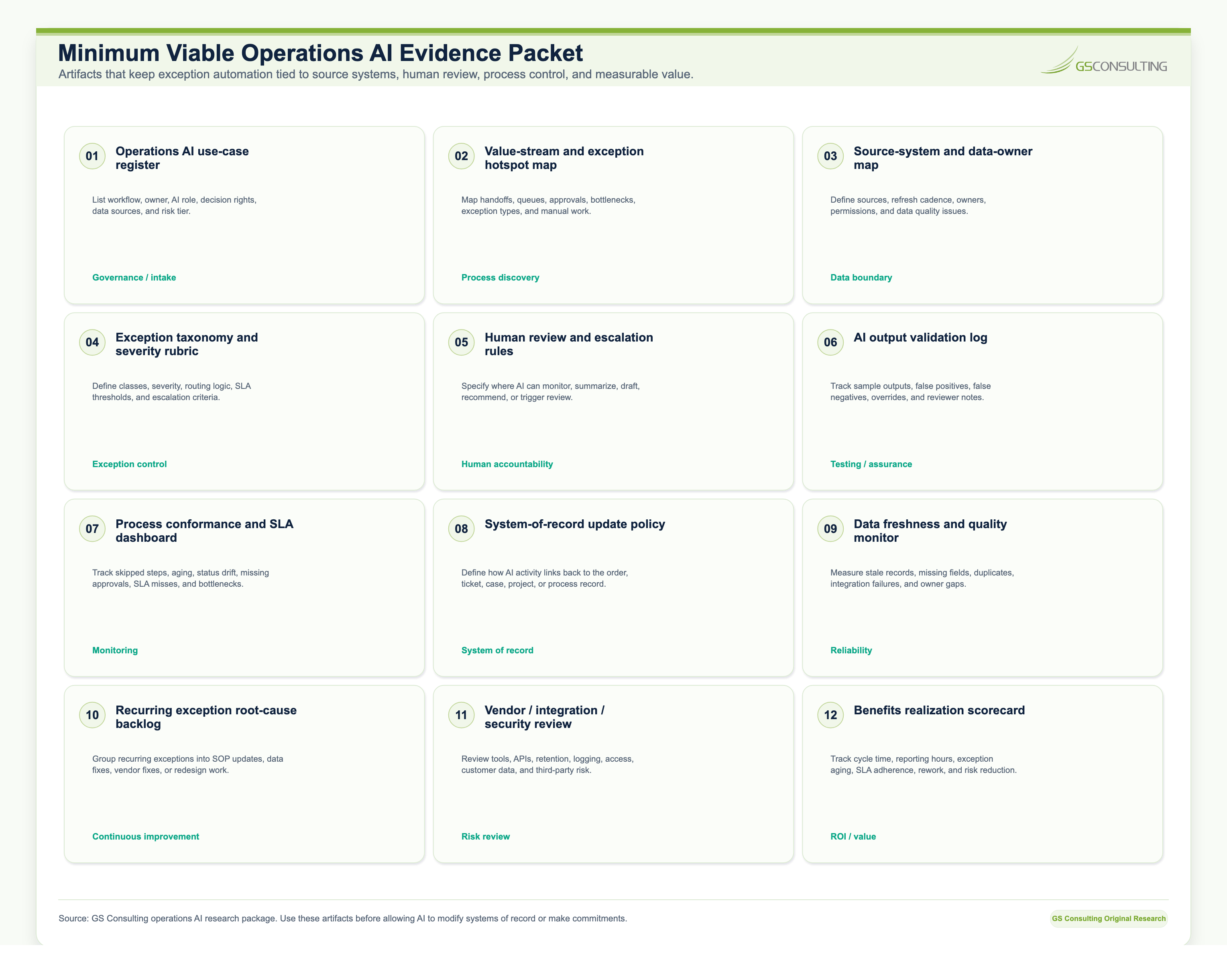
Minimum Viable Operations AI Evidence Packet
A useful operations AI pilot should produce evidence from day one.
The evidence packet should show what workflow is being monitored, which systems are authoritative, how exceptions are classified, when humans review output, what actions were taken, and how AI activity connects back to the order, case, ticket, project, dashboard, or system of record.
A 30 / 60 / 90 Day Operations AI Plan: Move From Exceptions to Control
Ninety days is enough time to stop guessing.
The goal is not to automate operations in one quarter. The goal is to find the exception heavy workflows, map the source systems, select controlled pilots, define the review model, and create evidence leadership can trust.
- Days 1 to 30Map operational friction.
Inventory exception heavy workflows, manual reports, recurring bottlenecks, SLA misses, late handoffs, rework loops, customer escalations, vendor delays, missing field issues, process owners, source systems, systems of record, current metrics, and shadow AI use.
- Days 31 to 60Design controlled pilots.
Select two or three pilots. Define approved data, source system rules, review requirements, escalation paths, metrics, integration needs, rollback, and ownership.
- Days 61 to 90Launch and measure.
Run pilots with approved data, approved users, clear exception taxonomy, human validation, and system of record rules. Track exception detection, reporting time, recommendation quality, adoption, cycle time, SLA impact, customer risk, override rate, and operational control.
By the end of 90 days, leadership should be able to answer eight questions without scrambling: Which workflows improved? Which exceptions are being found earlier? Which systems are authoritative? Who owns each escalation? What decisions still require humans? What evidence was created? What risks remain? Which use cases are ready to expand, redesign, pause, or stop?
What Operations Leaders Should Build Now
Operations leaders do not need a massive AI transformation program to start. They need enough structure to keep the first pilots useful, measurable, and controlled.
Build the basics first.
- Operations AI use case inventory and value stream maps.
- Exception heavy workflow shortlist.
- Operational reporting and variance summary pilot.
- Exception intake and severity classification pilot.
- SLA and process adherence monitoring pilot.
- Data source map and system of record rules.
- Process owner and data owner matrix.
- Exception taxonomy with severity, ownership, escalation, and closure rules.
- Human review, escalation, and approval model.
- Operations knowledge base and SOP cleanup plan.
- Process control dashboard and metrics scorecard.
- Vendor, security, and integration review checklist.
- Prompt and output logging and validation records.
- Rollback and override playbook.
- Benefits realization and KPI tracker.
- Continuous improvement rhythm for AI enabled operations.
The Bottom Line
Operations is one of the best places to apply enterprise AI because the work is measurable, repetitive, exception heavy, and directly tied to whether the business delivers.
But the value does not come from automating a messy process. The value comes from seeing exceptions earlier, understanding variance faster, routing work to the right owner, reducing handoff delays, keeping reports current, improving process control, and preventing customer surprises.
The strongest first pilots are practical: exception management, reporting automation, process adherence monitoring, bottleneck detection, resource planning support, quality triage, SOP guidance, vendor coordination, and customer delivery risk monitoring.
AI should help operations teams move faster without losing control of customers, money, safety, production, employees, systems of record, or accountability.
That is the standard: earlier exceptions, cleaner reports, clearer owners, tighter control, and fewer surprises.
How GS Consulting Helps
GS Consulting helps organizations use AI in operations where it improves control, not just output.
That means identifying operations AI opportunities, mapping value streams, finding exception heavy workflows, automating reporting, designing process control workflows, defining source system rules, calculating ROI, integrating AI with legacy systems, and expanding reliable AI process transformation across operations and enterprise support functions.
The goal is not to make operations sound more innovative. The goal is to help teams see problems earlier, act faster, reduce manual reporting, improve delivery reliability, and keep customers, systems, and commitments under control.
Research Sources and Caveats
The original research in this article uses GS Consulting derived planning metrics based on public process mining event log sources, operations workflow mapping, and AI governance references.
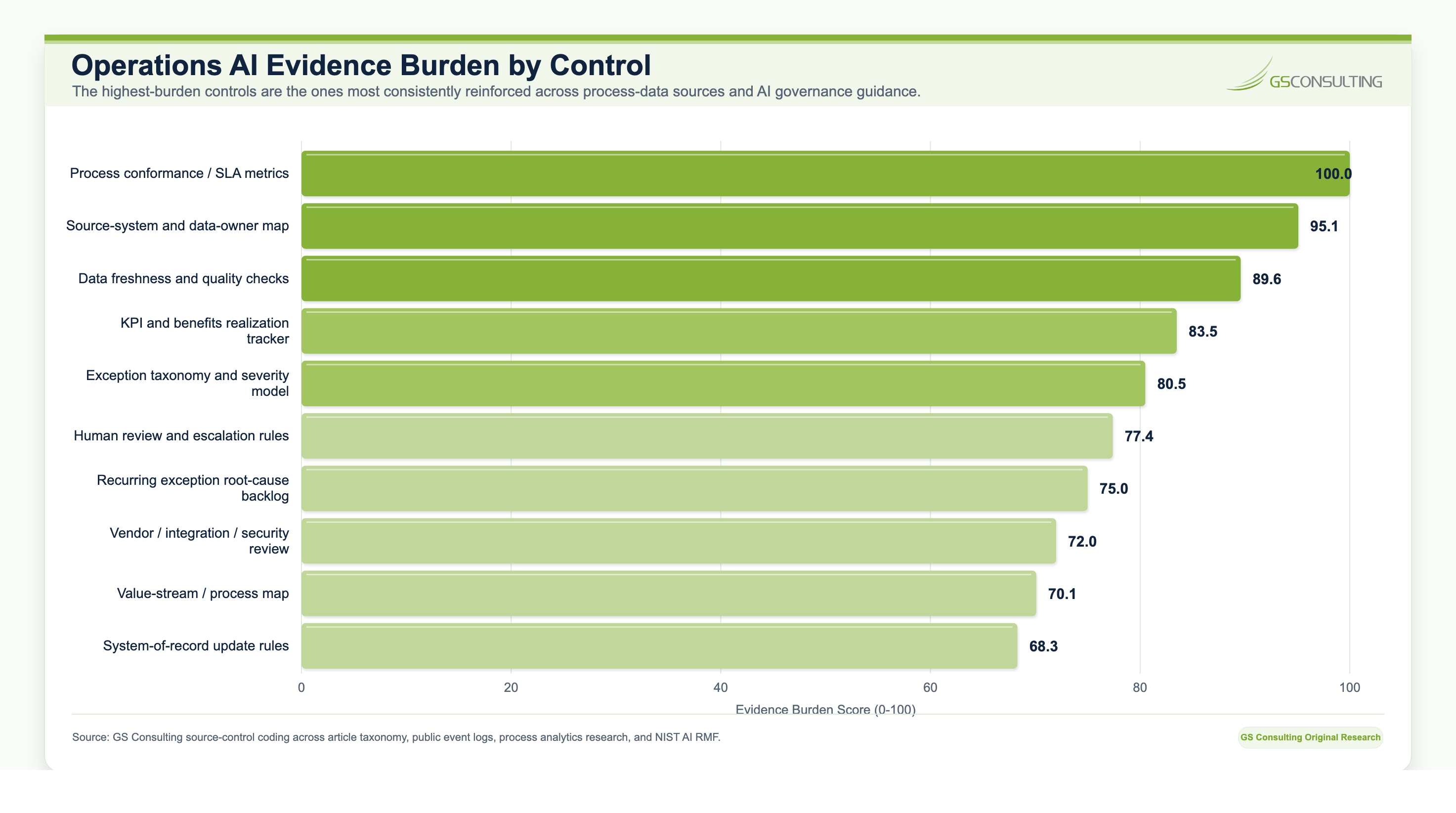
The Operations AI Priority Score, Evidence Burden Score, and Opportunity Risk Matrix are planning tools. They are not official benchmarks, compliance determinations, legal conclusions, or guarantees of project ROI.
The exception economics model is illustrative. Replace the assumptions with each organization's actual transaction volume, exception rate, handling time, labor cost, adoption rate, AI assisted reduction assumptions, integration cost, review burden, data quality, and realized operational outcomes.
- Process Mining, Event Data
- BPI Challenge 2019 purchase to pay dataset
- BPI Challenge 2018 direct payment applications
- UCI Machine Learning Repository, Incident management process enriched event log
- NIST AI Resource Center, AI RMF Core
- GS Consulting analysis of public event log signals, process evidence controls, operations workflow risk, and AI governance requirements.
Ready to use AI where operations actually lose control?
GS Consulting helps organizations map operational workflows, identify exception heavy processes, define source system rules, automate reporting, design human controlled escalation, calculate ROI, and launch controlled operations AI pilots that improve delivery without losing control.
Contact GS ConsultingFrequently Asked Questions About Operations AI
How does AI improve exception management in operations?
AI improves exception management by watching operational signals and surfacing what is late, missing, stuck, out of tolerance, or likely to affect a customer, SLA, cost, quality, or delivery commitment.
The value is not just detection. AI should summarize the context, classify severity, identify the owner, recommend the next step, route the issue for human review, and preserve the evidence in the workflow or system of record.
Can AI automatically update systems of record (like an ERP)?
Technically yes, but that is not where most organizations should start.
For critical enterprise operations, AI should begin by drafting, recommending, routing, summarizing, and preparing updates for human validation. Final updates to systems of record, such as changing a customer delivery date, approving a financial transaction, modifying a production schedule, closing a major exception, or changing a vendor commitment, should require accountable human approval, logging, and rollback.
What is the difference between RPA and Operations AI?
RPA is strongest when the task is stable, rules based, and predictable. It follows defined steps.
Operations AI is useful when the workflow includes ambiguity, unstructured updates, exception patterns, variance explanations, status summaries, vendor messages, customer risk signals, or recommendations that require context.
The two can work together. AI can detect, summarize, classify, and recommend. RPA can execute approved, rules based actions. The control point is deciding what requires human review before anything changes in the system of record.
Suggested Future Reading
- Enterprise AI Process Automation Framework: How to Move from AI Pilots to Measurable Business Transformation
- How to Identify the Best Workflows for AI Automation
- AI ROI Calculation: How to Measure the Business Case for Enterprise AI
- Legacy System Integration for Enterprise AI Automation
- AI Transformation for HR: Automating Employee Support and Onboarding
- AI Transformation for IT: Service Desk, Ticket Triage, and Knowledge Management