Enterprise AI | | 23 min read
Enterprise AI Process Automation Framework: How to Move from AI Pilots to Measurable Business Transformation

Key Takeaways
Scale AI through workflow design, integration, and measured outcomes.
Define and map the work
Set the business outcome and identify friction in the current process.
Choose a controlled pattern
Match the use case to data readiness, integration feasibility, risk, and human oversight.
Measure before expanding
Pilot against a baseline, account for full costs, and scale through an operating model.
Enterprise AI is no longer a technology experiment. It is becoming a business operating model.
Across industries, companies are using AI to summarize information, automate workflows, improve decision support, reduce manual effort, accelerate service delivery, and modernize back-office operations. But many organizations are still struggling to turn AI activity into measurable enterprise value.
That gap matters. Giving employees access to AI tools is not the same thing as building an enterprise AI transformation program. Real transformation happens when AI is embedded into priority workflows, connected to business systems, governed appropriately, measured against clear outcomes, and adopted by the people who actually perform the work.
Ready to move beyond disconnected AI pilots?
GS Consulting helps organizations identify high-value AI opportunities, map workflows, calculate ROI, design governance, integrate with legacy systems, and scale controlled automation across departments.
Request an AI Process Automation AssessmentThis article introduces a practical Enterprise AI Process Automation Framework that organizations can use to move from scattered AI pilots to reliable, measurable, scalable process transformation.
Why Enterprise AI Process Transformation Matters Now
Many companies have already passed the AI curiosity stage. Employees are using AI tools. Departments are testing copilots. Vendors are embedding AI features into software. Executives are asking for productivity gains. Boards are asking about AI strategy.
But the hard work is not access. The hard work is operationalization.
Enterprise AI process transformation requires a disciplined approach that answers five questions:
- ValueWhere can AI create measurable business improvement?
- WorkflowWhich processes should be redesigned, not just accelerated?
- SystemsWhat data, integrations, and system access are required?
- ControlWhat governance, oversight, and metrics will make it safe to scale?
Companies that answer those questions before they scale AI will be in a stronger position than companies that buy tools first and try to justify value later.
Original Research: The AI Process Automation Evidence-to-Scale Index
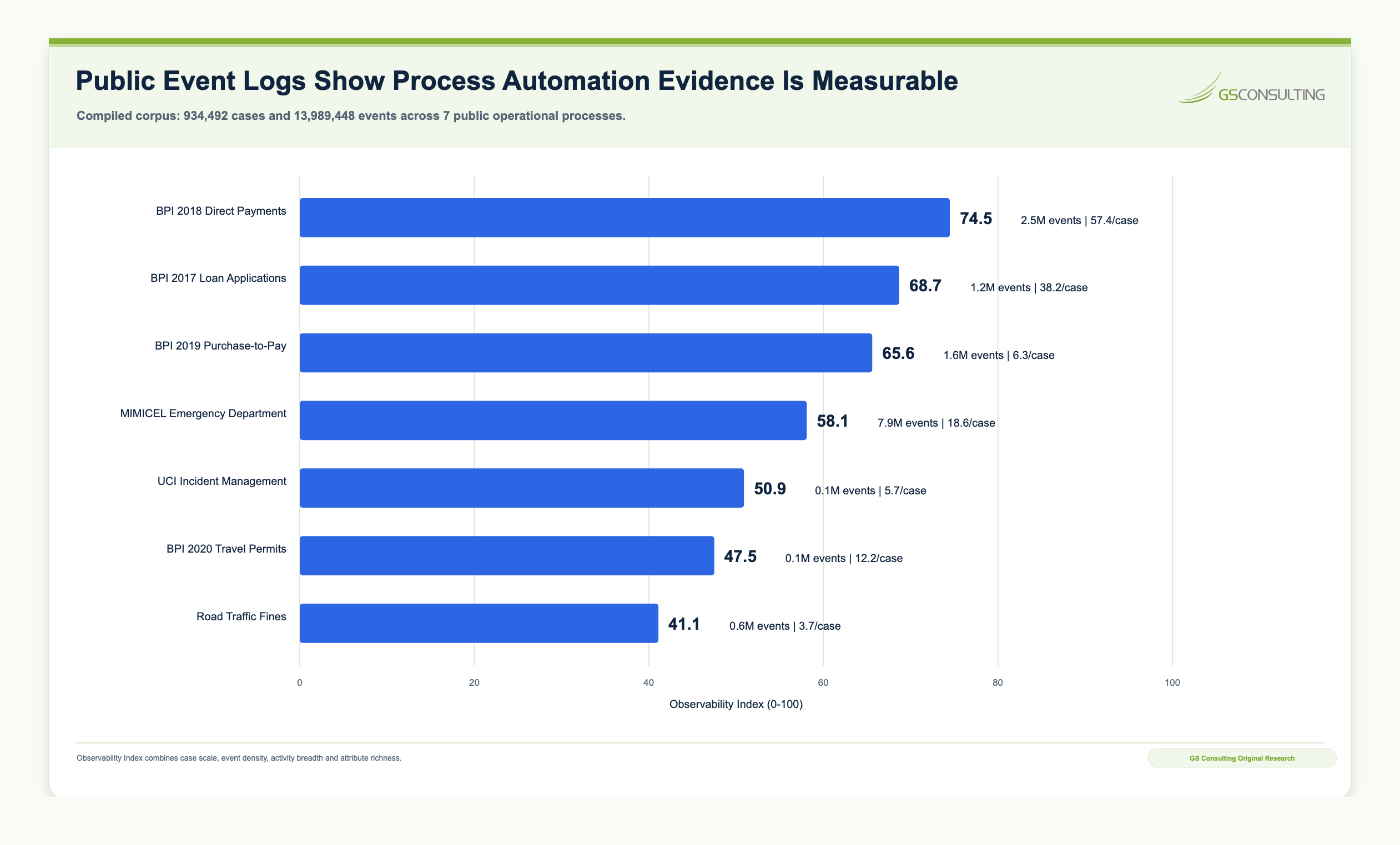
Original GS Consulting research shows that enterprise AI process automation is an evidence-to-scale problem. GS Consulting analyzed public enterprise AI adoption research, AI governance frameworks, process-mining sources, and seven public operational event-log datasets to identify where AI automation can move beyond pilots.
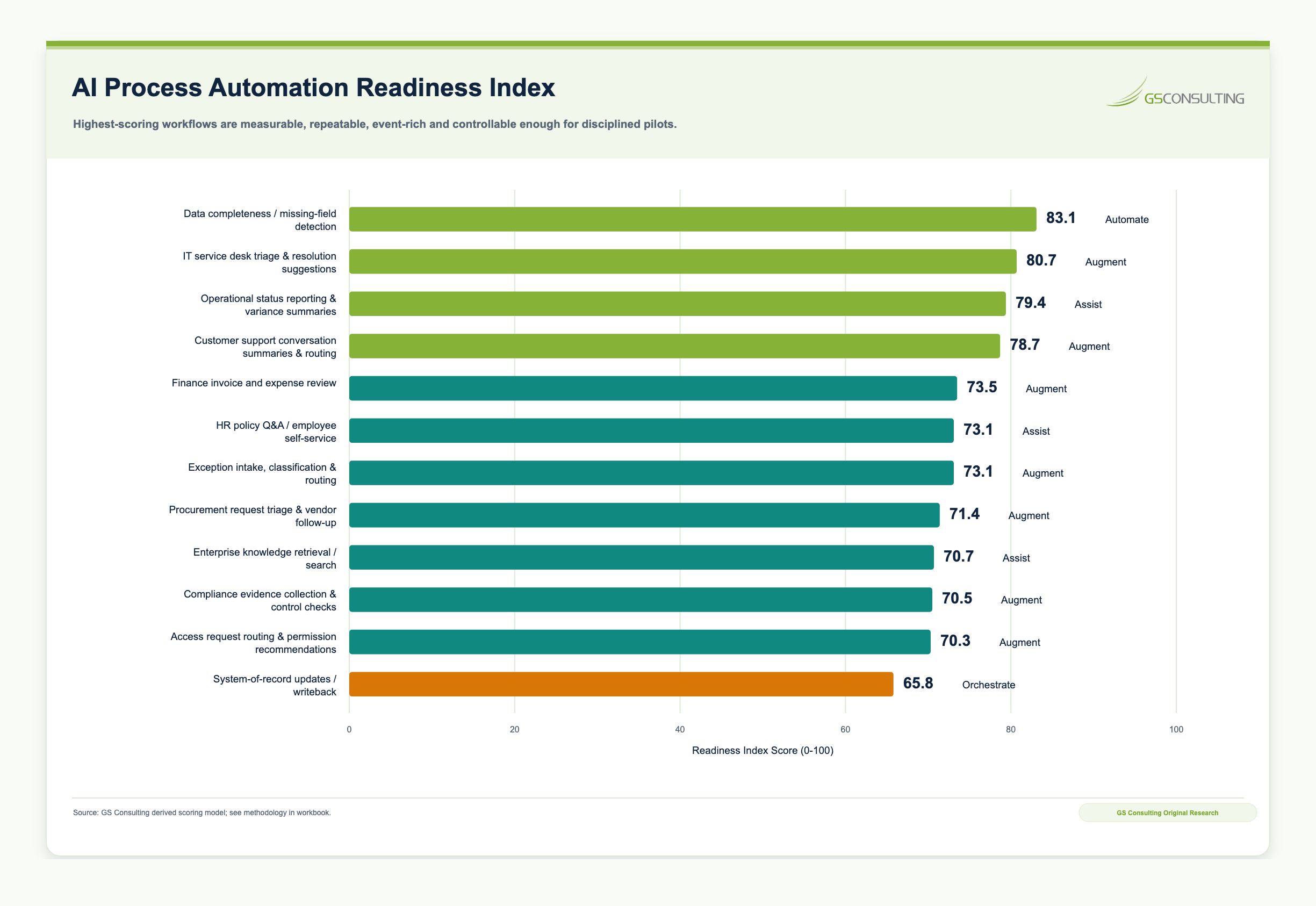
The analysis found that the highest-readiness workflows are measurable, repeatable, event-rich, and controllable: data completeness checks, IT service desk triage, operational status reporting, customer support routing, finance invoice review, HR self-service, exception intake, and procurement request triage.
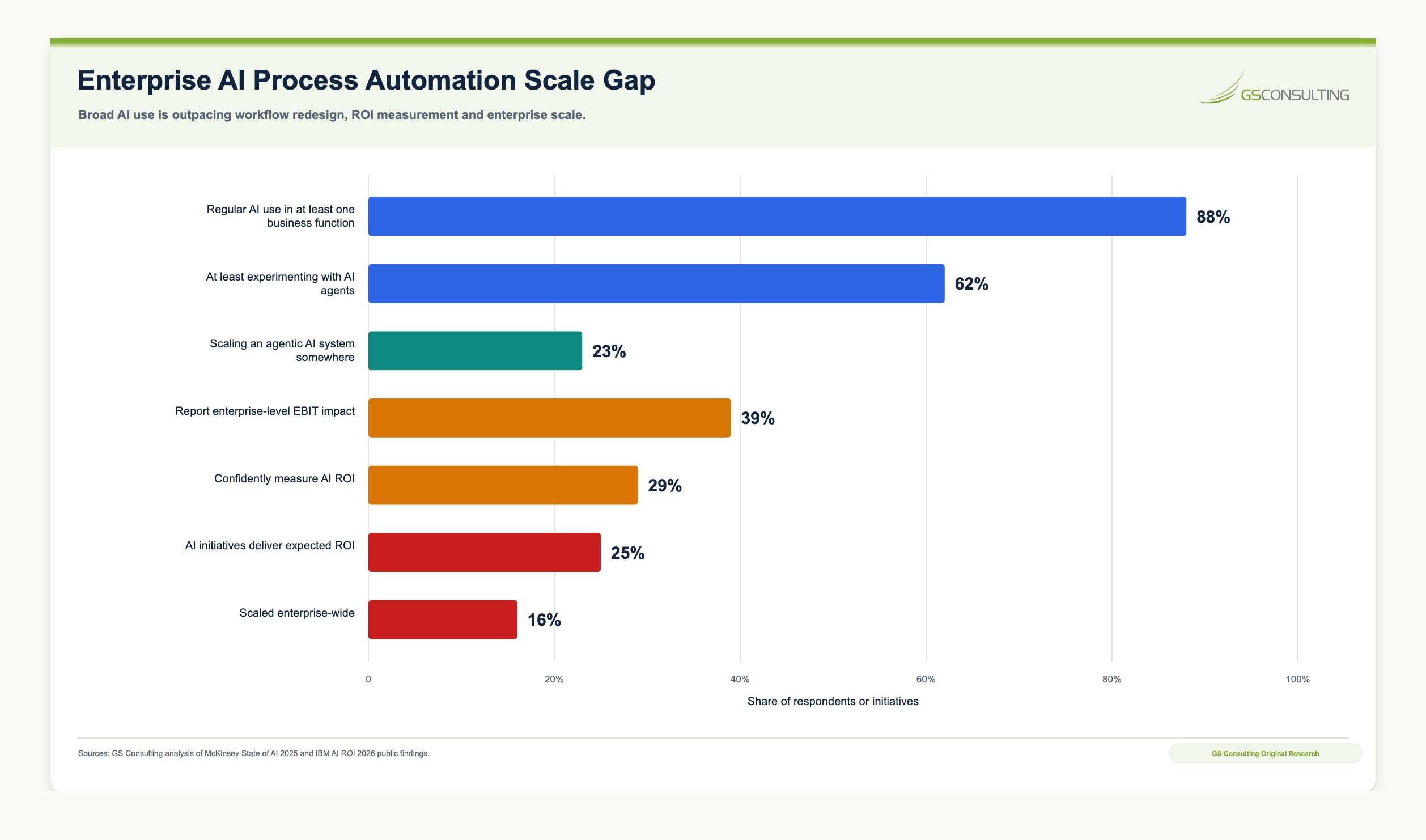
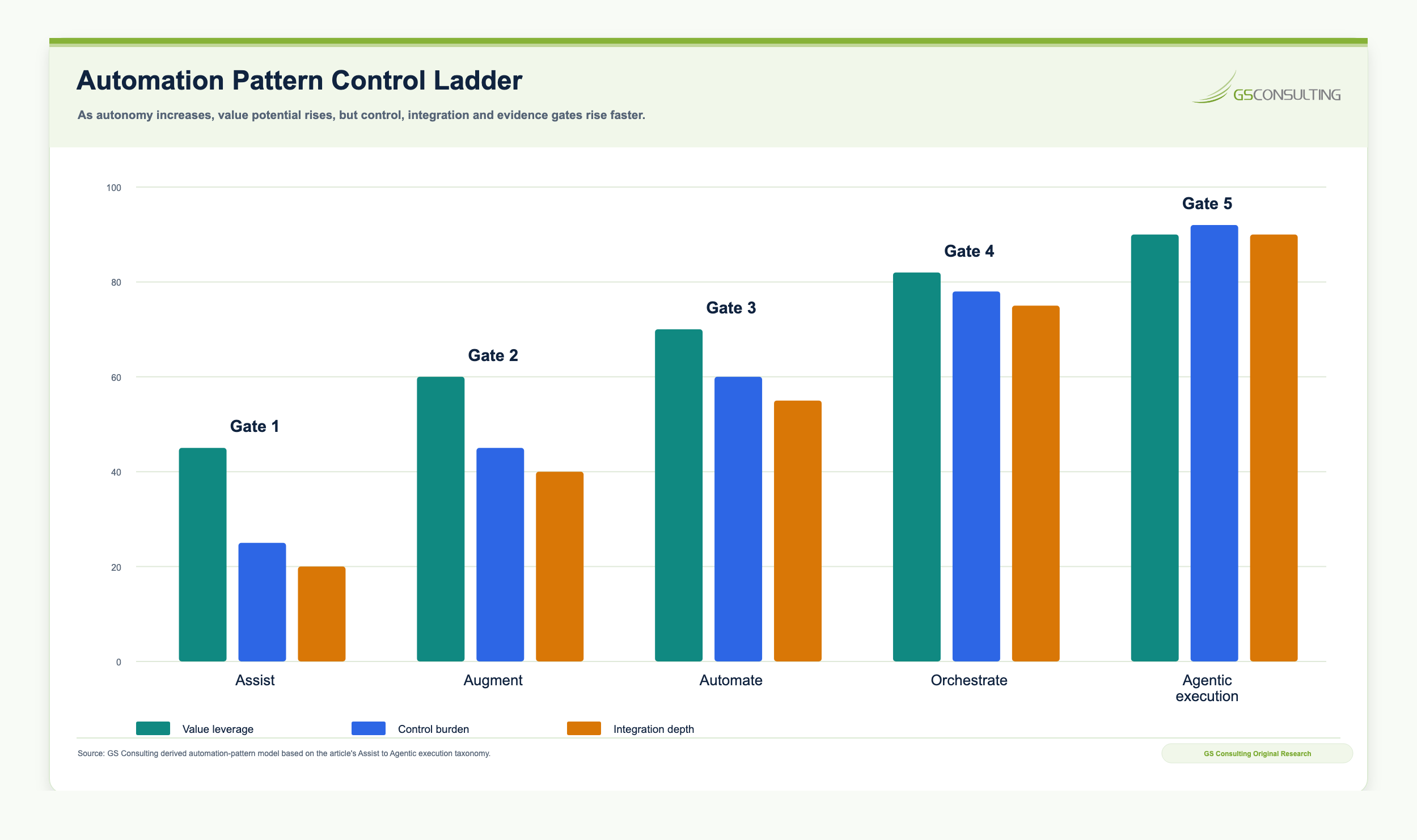
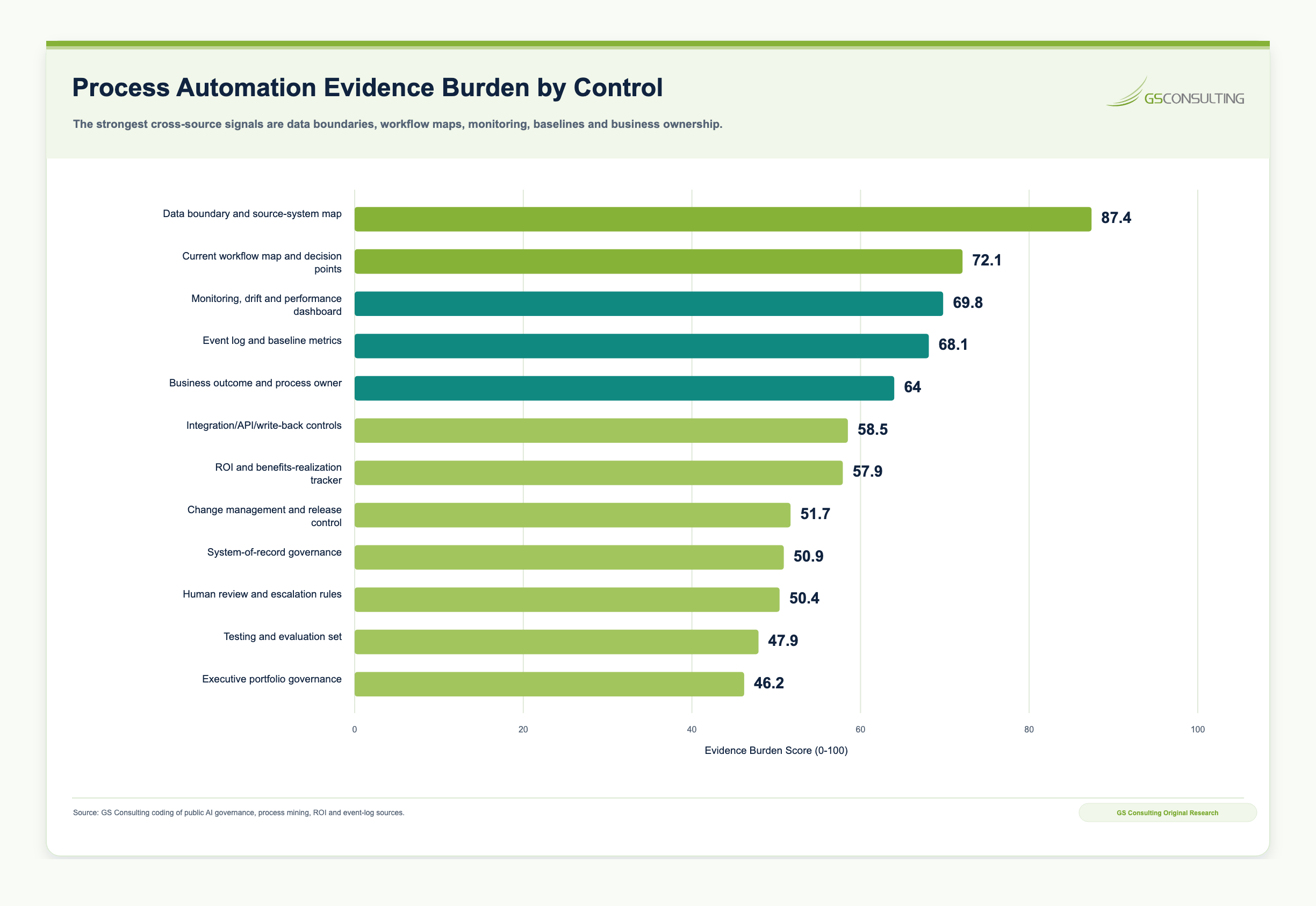
The research also shows why automation should not jump directly to high-autonomy agents. As workflows move from Assist to Augment to Automate to Orchestrate to Agentic execution, the value potential rises, but the control burden rises faster. Before scaling, organizations need evidence: workflow maps, baseline metrics, data boundaries, source-system inventories, integration permissions, human review rules, quality logs, monitoring dashboards, rollback procedures, and benefits-realization tracking.
The AI Process Automation Readiness Score, Process Observability Index, and Evidence Burden Score are GS Consulting-derived planning metrics. They are not official benchmarks, legal conclusions, audit findings, compliance determinations, or ROI guarantees. The event-log analysis uses public datasets from different domains, formats, and time periods to show that process automation should begin with observable workflow evidence: cases, activities, timestamps, attributes, owners, handoffs, outcomes, exceptions, and baseline metrics.
What Is Enterprise AI Process Automation?
Enterprise AI process automation is the use of artificial intelligence to improve, accelerate, augment, or automate business workflows across an organization.
It can include generative AI, machine learning, natural language processing, document intelligence, predictive analytics, robotic process automation, workflow orchestration, AI agents, intelligent search, and decision-support systems.
But the important word is not AI. The important word is process.
AI process automation is not simply giving employees a chatbot. It is not installing a new software feature. It is not running a pilot in one department and calling it transformation. It is the intentional redesign of work so that people, systems, data, and AI can operate together more effectively.
AI can improve self-service while preserving human review for sensitive personnel matters.
AI can reduce Tier 1 workload and improve service consistency when connected to ITSM workflows.
AI can help teams see bottlenecks and act before operational problems compound.
AI can reduce manual review effort while supporting stronger control evidence.
In each case, the business value comes from changing how work gets done, not simply adding AI on top of existing friction.
Why AI Pilots Fail to Scale
AI pilots often fail because they are designed as technology demonstrations instead of business transformation initiatives.
A team identifies a tool, tests it on a narrow task, sees some productivity improvement, and then struggles to scale it. The pilot may look promising, but it never becomes part of the operating model.
Common reasons include unclear business ownership, weak data access, poor system integration, lack of workflow redesign, no ROI baseline, limited employee adoption, security concerns, legal uncertainty, and no plan for monitoring after launch.
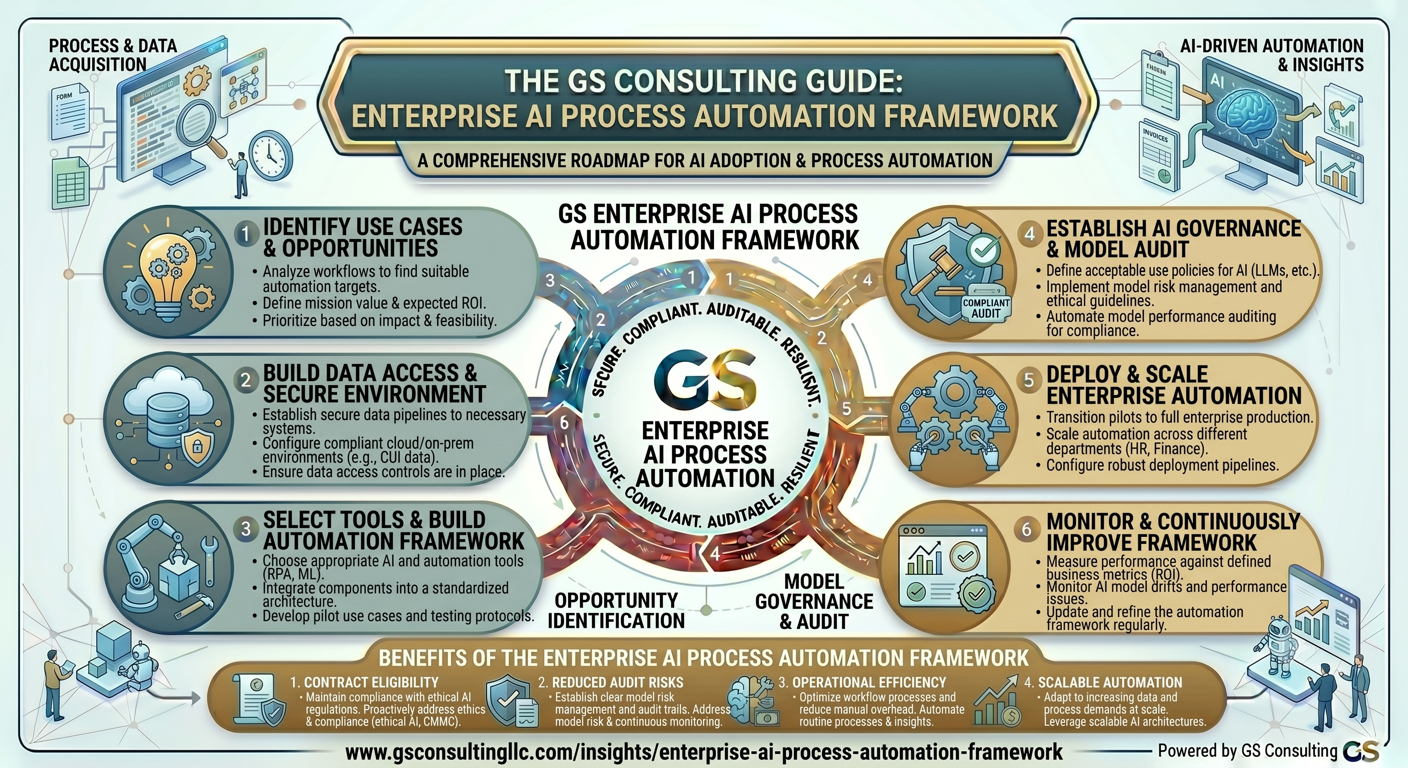
The Enterprise AI Process Automation Framework
A strong AI process automation program should move through ten stages.
1. Define the Business Outcome
Start with the outcome, not the tool. Before selecting an AI product or building a prototype, leadership should define what the organization is trying to improve. The outcome should be specific enough to measure.
Examples include reducing service desk ticket resolution time, decreasing manual invoice review effort, improving proposal or sales response speed, reducing onboarding cycle time, increasing first-contact resolution, improving compliance evidence readiness, reducing operational exceptions, and shortening contract review cycles.
A useful outcome statement sounds like this: "We want to reduce manual case triage time in HR by 40% while maintaining employee satisfaction and preserving human review for sensitive cases." That is more actionable than "We want to use AI in HR."
2. Map the Current Workflow
AI should not be applied to a workflow the organization does not understand. Before automating, map how the process works today. Identify the trigger, inputs, systems, users, decision points, handoffs, exceptions, approvals, outputs, and performance metrics.
This is where many AI opportunities appear. AI is especially useful where work involves high volumes of text, repeated decisions, document review, information search, classification, pattern detection, summarization, routing, forecasting, or exception handling.
Mapping also shows where AI is not the answer. Some problems require policy changes, better data quality, system consolidation, role clarity, or process simplification before AI will help.
3. Identify the Friction and Value Pools
Once the workflow is mapped, identify where value is trapped. Value pools usually fall into six categories: time savings, throughput, quality, speed, risk reduction, and revenue enablement.
AI projects become easier to justify when value pools are tied to operational metrics. "Reduce invoice processing time by 30%" is stronger than "use AI in finance." "Reduce Tier 1 IT ticket handling effort by 25%" is stronger than "deploy an IT chatbot."
4. Score Use Cases by Value, Feasibility, and Risk
Not every AI use case deserves the same investment. Enterprises should score opportunities across business value, implementation feasibility, and risk.
Move quickly into controlled pilots with clear metrics and a defined owner.
Worth investment when the use case can materially improve operations or competitive position.
Data cleanup, integration architecture, governance, and reusable components may unlock future value.
Do not let novelty pull resources away from workflows that can produce measurable results.
5. Choose the Right AI Automation Pattern
AI process automation is not one thing. Different workflows require different automation patterns.
- Assist: AI helps an employee complete work faster, but the employee remains fully responsible.
- Augment: AI recommends next steps, classifications, risks, or decisions for human review.
- Automate: AI completes a defined task within controlled rules and escalation paths.
- Orchestrate: AI coordinates multiple workflow steps across systems, often with human approval at key points.
- Agentic execution: AI agents perform multi-step tasks with tool access, memory, planning, and limited autonomy.
The rule is simple: use the lowest level of autonomy that achieves the business outcome.
6. Build the Data and Integration Layer
AI transformation depends on enterprise context. Generic AI tools can be useful for individual productivity, but process transformation usually requires integration with company data and systems.
That may include CRM, ERP, HRIS, ITSM, ticketing systems, document repositories, data warehouses, contract management systems, finance platforms, security tools, and operational databases.
Integration should define source systems, data ownership, access controls, API availability, write-back permissions, logs, audit trails, data freshness, and fallback paths when AI output is wrong.
7. Design Governance and Human Oversight
Enterprise AI requires governance from the beginning. Governance should define who owns each use case, which data AI can access, which systems AI can read from or write to, when human approval is required, how outputs are tested, how errors are reported, and how models, prompts, workflows, vendors, and integrations are changed.
Governance should not be designed to stop AI adoption. It should make adoption safe enough to scale.
8. Pilot With Real Metrics
A pilot should test a business hypothesis, not just a technical feature. A strong pilot includes a clearly defined workflow, baseline measurement, limited user group, approved data access, human review requirements, success metrics, risk controls, feedback loop, and go/no-go decision.
Useful pilot metrics include time saved per transaction, cycle time reduction, error rate reduction, rework reduction, ticket resolution improvement, employee adoption, customer satisfaction, cost per transaction, compliance evidence completeness, human override rate, and user trust.
9. Calculate AI ROI
AI ROI should include more than software cost. A practical AI ROI model should measure value, cost, adoption, and risk.
AI ROI = net benefit divided by total investment. Net benefit should account for financial value created, implementation cost, integration work, training, governance, monitoring, and the quality of AI output.
A realistic value estimate can include transaction volume, time saved per transaction, fully loaded labor cost, adoption rate, and a quality adjustment. The quality adjustment matters because not every AI output is usable. If AI saves ten minutes but requires five minutes of correction, the true savings are lower.
10. Scale Through an AI Operating Model
Scaling AI requires an operating model, not just more pilots. An enterprise AI operating model defines how opportunities are identified, prioritized, funded, built, governed, measured, and improved.
A practical operating model includes executive sponsorship, business process owners, AI product owners, data owners, security and privacy review, legal and compliance input, technology architecture, vendor management, change management, training, dashboards, reusable components, monitoring, and continuous improvement.
Department-Level AI Process Transformation Opportunities
Enterprise AI becomes more practical when leaders can see where it applies by function.
Use AI to reduce administrative load while preserving oversight for sensitive people decisions.
Use AI where workflows are measurable, structured, and already connected to operational systems.
Use AI to improve visibility and prioritize interventions before delays spread.
Use AI to reduce manual review while preserving controls over payments and reporting.
Use AI to help teams respond faster without weakening message quality or customer trust.
Use AI to improve consistency while keeping escalation paths clear.
Legacy System Integration: The Hidden Barrier
Many enterprise AI projects fail not because the model is weak, but because the workflow depends on legacy systems.
Legacy environments may include old ERP platforms, custom databases, shared drives, email-based approvals, disconnected spreadsheets, on-premise applications, manual reports, and systems with limited APIs.
AI transformation in this environment requires practical architecture choices: use APIs where available, use robotic process automation carefully where APIs do not exist, create secure data extraction pipelines, build governed knowledge layers for unstructured content, keep systems of record authoritative, avoid uncontrolled copies of sensitive data, create audit trails, limit write-back permissions until workflows are tested, and use human approval for high-impact actions.
Legacy integration should be treated as part of the business case. If integration is too difficult, start with AI assistance around the workflow before automating across systems.
The Enterprise AI Automation Maturity Model
Level 5 is an adaptive AI operating model, where AI becomes part of how the enterprise continuously improves. Processes are monitored, models are evaluated, workflows are updated, and business leaders use AI performance data to guide operating decisions.
Most organizations should not try to jump from Level 1 to Level 5. The practical path is to move from ad hoc usage to controlled, measurable workflow transformation.
Common Enterprise AI Process Automation Mistakes
The first mistake is starting with tools instead of processes. AI tools matter, but the business process determines value.
The second mistake is pursuing too many pilots. A large number of disconnected experiments can create the appearance of progress while diluting investment and attention.
The third mistake is ignoring integration. AI that does not connect to enterprise systems often remains an employee productivity aid rather than a business transformation capability.
The fourth mistake is failing to establish baselines. Without current performance data, leaders cannot prove whether AI improved the process.
The fifth mistake is underestimating change management. Employees need training, trust, clarity, and new workflows. AI adoption is not automatic.
The sixth mistake is over-automating too soon. Many workflows should begin with human-in-the-loop assistance before moving to partial automation or agentic execution.
The seventh mistake is ignoring governance until after deployment. AI governance is easier to build before scaling than after a risky workflow has already spread across the company.
The eighth mistake is treating AI as an IT project only. Enterprise AI process transformation requires business ownership.
A 90-Day Enterprise AI Process Automation Plan
- Days 1-30Discover current AI use and priority workflows.
Identify business pain points, current AI use, available data, existing systems, security constraints, executive objectives, and shadow AI risks.
- Days 31-60Prioritize use cases and define metrics.
Map workflows, estimate value pools, score opportunities by value, feasibility, and risk, and select two or three controlled pilots.
- Days 61-90Launch controlled pilots.
Use approved data, limited users, human review, success criteria, and defined governance. Track time savings, quality, adoption, risk issues, and feedback.
By the end of 90 days, leadership should be able to answer where the company already uses AI, which workflows have the strongest automation potential, what outcomes are targeted, what systems and data are required, what risks must be controlled, how ROI will be measured, and which pilots are ready to scale.
What Companies Should Build Now
A company that wants to scale AI process automation should build a practical transformation package.
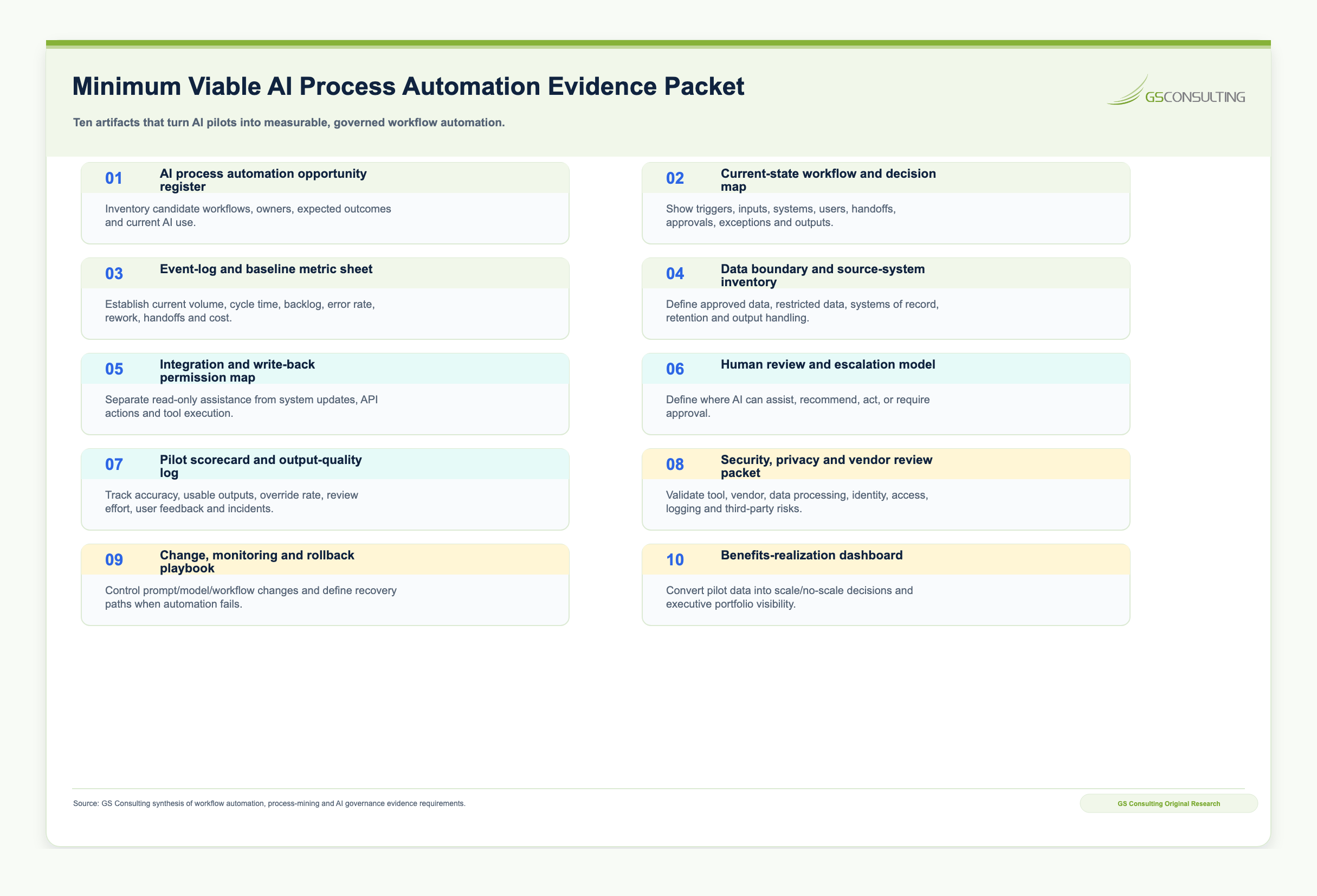
- AI opportunity inventory and workflow mapping template.
- Value and risk scoring model.
- Approved AI tool list and data access checklist.
- AI governance policy and human review model.
- Pilot success scorecard and AI ROI calculator.
- Vendor review, change management, and training plans.
- Model and workflow monitoring process.
- Executive AI transformation dashboard.
How GS Consulting Helps
GS Consulting helps organizations move from AI experimentation to enterprise process transformation. Our approach is shaped by experience in high-stakes government, defense, intelligence, and regulated environments where reliability, governance, security, and measurable execution matter.
We help companies identify high-value AI opportunities, map workflows, calculate ROI, design governance, assess data readiness, integrate AI with legacy systems, build controlled pilots, and scale automation solutions across departments such as HR, IT, operations, finance, compliance, and customer support.
The goal is not to chase AI hype. The goal is to redesign business processes so AI creates measurable value, improves reliability, reduces manual burden, and strengthens operational performance.
Ready to identify where AI can transform your business processes?
Contact GS Consulting for an Enterprise AI Process Automation Assessment.
Contact GS ConsultingFrequently Asked Questions About Enterprise AI Automation
How do you scale an AI pilot into a production workflow?
Scaling an AI pilot requires moving from a technology experiment to an operational model. This involves mapping the source data boundary, integrating the AI with systems of record such as an ERP or ITSM, defining strict human-in-the-loop review rules for exceptions, and establishing an ongoing ROI baseline.
Can AI process automation work with legacy enterprise systems?
Yes, but it requires careful architecture. For modern systems, AI connects via direct APIs. For older legacy systems without APIs, AI automation often relies on secure data extraction pipelines, RPA bridges, or governed knowledge layers that read the legacy data without granting the AI write access back to the core database.
What is the difference between AI augmentation and agentic AI?
AI augmentation assists a human worker by summarizing data or recommending next steps, leaving the final decision to the human. Agentic AI involves granting the AI limited autonomy to execute multi-step tasks across systems, such as updating a ticket or triggering an email, based on predefined parameters and memory.
Sources and Suggested Future Reading
- McKinsey: The State of AI: Global Survey 2025
- NIST AI Resource Center: AI RMF Core
- GAO: Artificial Intelligence Accountability Framework
- ISO/IEC 42001: Artificial intelligence management systems
- OWASP Top 10 for Large Language Model Applications
- ProcessMining.org: Event Data
- PhysioNet: MIMICEL Emergency Department Event Log
- How to Identify the Best Workflows for AI Automation
- AI ROI Calculation: How to Measure the Business Case for Enterprise AI
- Integrating AI Automations with Legacy GovCon ERPs
- Legacy System Integration for Enterprise AI Automation
- AI Transformation for HR: Automating Employee Support and Onboarding
- AI Transformation for IT: Service Desk, Ticket Triage, and Knowledge Management
- AI Transformation for Operations: Exception Management, Reporting, and Process Control