Enterprise AI Strategy | | 26 min read
Total Cost of Ownership for Secure Enterprise AI

Key Takeaways
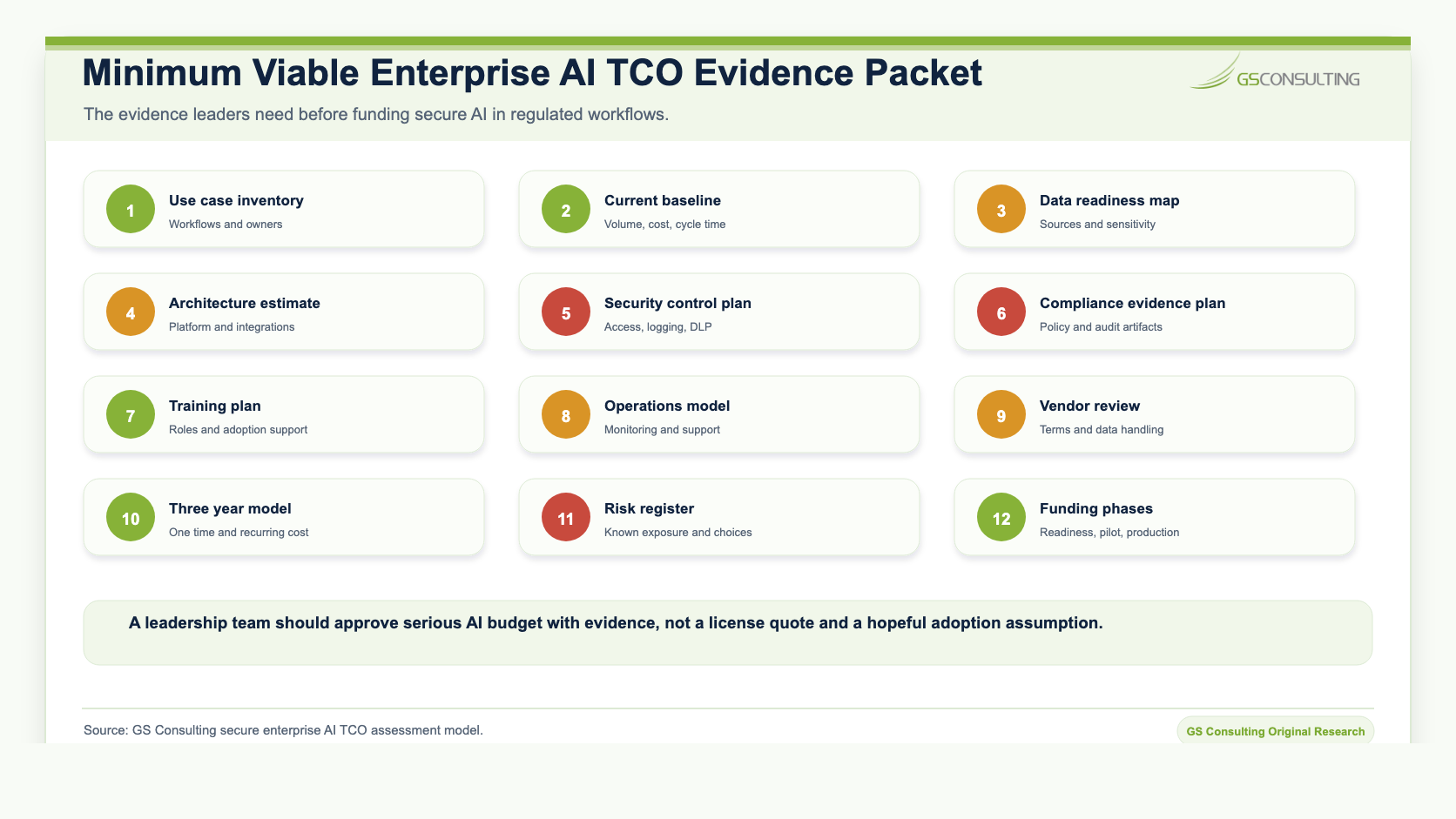
Enterprise AI cost includes the work required to operate it.
Go beyond the license
Budget for data engineering, integration, security, governance, testing, and support.
Plan spending by phase
Separate readiness, implementation, and recurring operations rather than funding only a demo.
Expose hidden ownership costs
Include technical debt, training, vendor management, and the people who keep the workflow running.
Most enterprise AI budgets are too small because they are built around the wrong number.
They start with the software license.
That is the mistake.
The license is not the cost of enterprise AI. It is one line item.
For regulated organizations, the real cost includes data cleanup, architecture, identity controls, security review, governance, compliance evidence, audit support, integration, monitoring, training, and the people required to keep the system working after launch.
If you only budget for the tool, you are not budgeting for enterprise AI. You are budgeting for a demo.
Need a realistic enterprise AI budget before selecting a platform?
GS Consulting helps CIOs, CFOs, and operations leaders model secure enterprise AI total cost of ownership across readiness, platforms, data, architecture, governance, compliance, implementation, and operations.
Request a TCO AssessmentThe Simple Truth About AI Cost
Cheap AI is usually cheap because it does not carry the full burden.
It may not handle sensitive data. It may not enforce document permissions. It may not support audit logs. It may not integrate with your systems. It may not preserve records. It may not support your compliance obligations. It may not give security enough control. It may not help you prove what happened later.
That may be fine for public content drafting or generic brainstorming. It is not fine for regulated workflows.
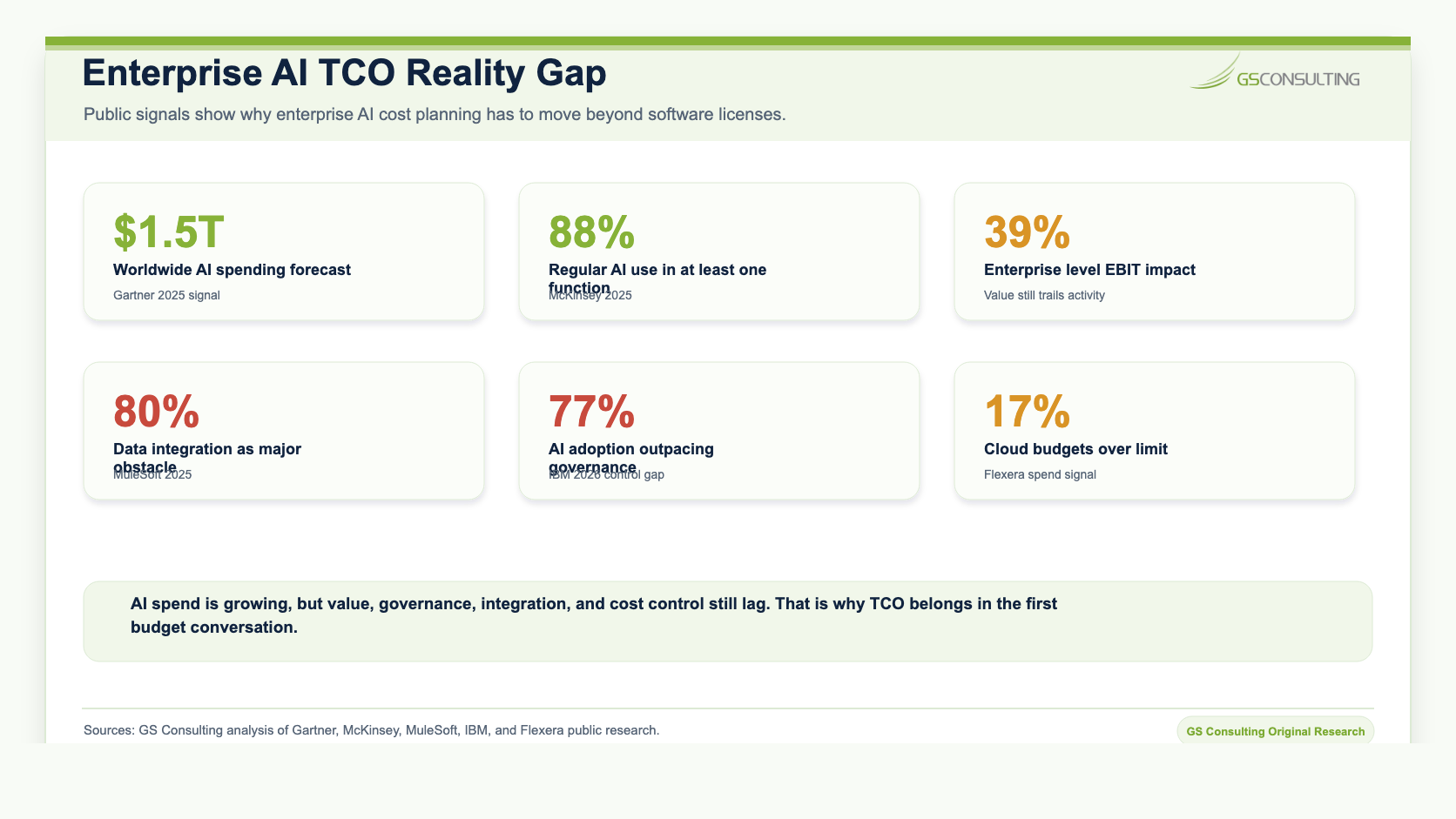
If AI touches customer records, employee data, contracts, CUI, PHI, financial records, compliance evidence, security alerts, or operational systems, the cost model changes.
The question is no longer, "What does the tool cost?"
The better question is: what does it cost to use this tool safely, at scale, inside our operating environment?
What Enterprise AI Total Cost of Ownership Means
Enterprise AI total cost of ownership is the full cost to design, deploy, govern, operate, secure, monitor, and improve AI across the organization.
It includes the obvious costs and the hidden ones.
The obvious costs are platform fees, model usage, cloud infrastructure, and implementation.
The hidden costs are data engineering, compliance review, legal review, security architecture, workflow redesign, audit evidence, user training, monitoring, support, change management, and vendor governance.
For regulated organizations, the hidden costs are often the most important ones. They are what make the system usable in production. They are also what separate secure enterprise AI from random tool adoption.
Original Research: The Secure Enterprise AI TCO Burden Index
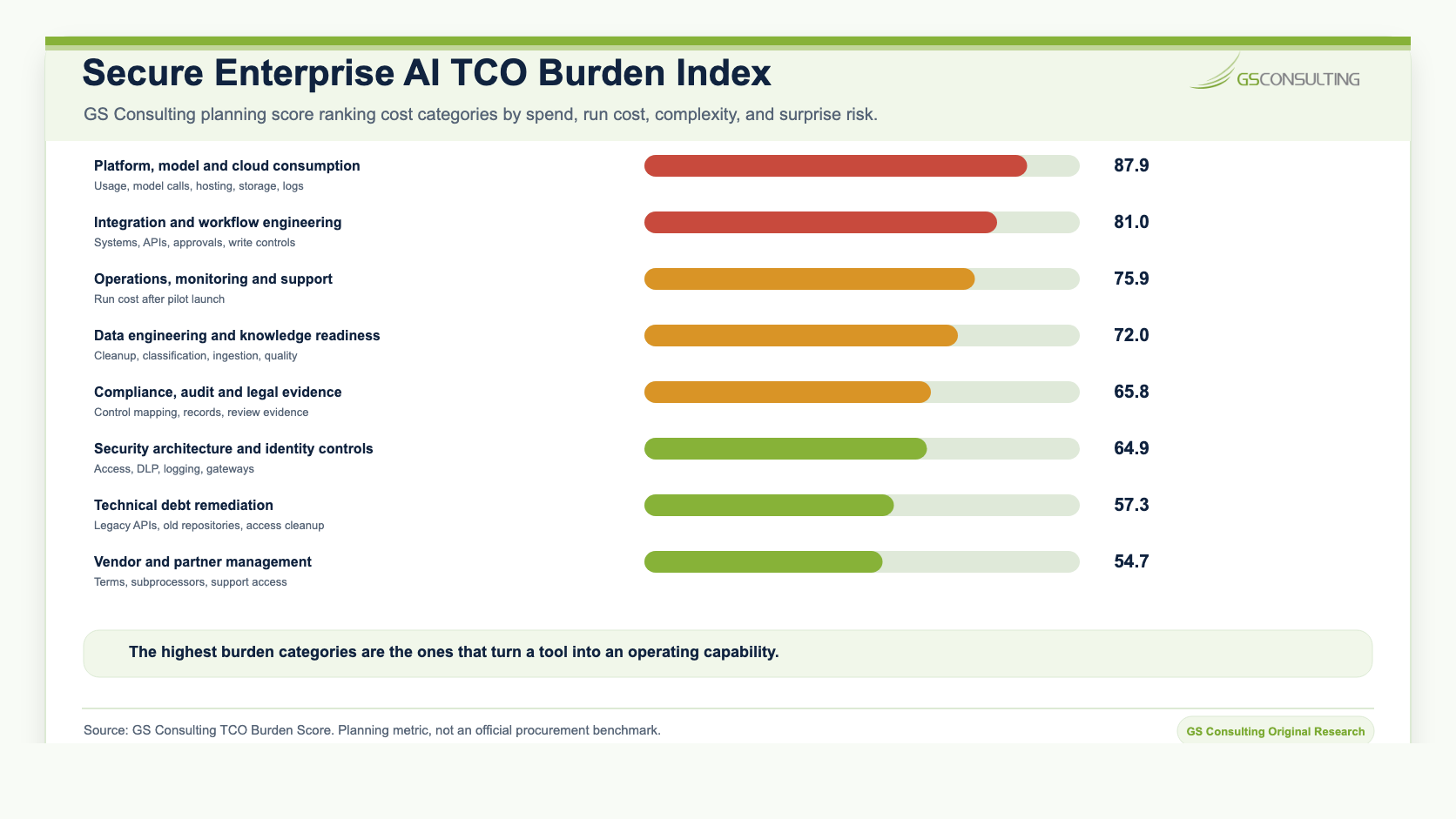
Original GS Consulting research shows that secure enterprise AI TCO is an operating capability problem, not a subscription problem.
GS Consulting analyzed public AI adoption, governance, integration, cloud cost, and cost management signals against the cost categories required to deploy AI in regulated workflows. The highest burden cost categories were platform, model, and cloud consumption; integration and workflow engineering; operations and monitoring; data engineering and knowledge readiness; compliance, audit, and legal evidence; and security architecture.
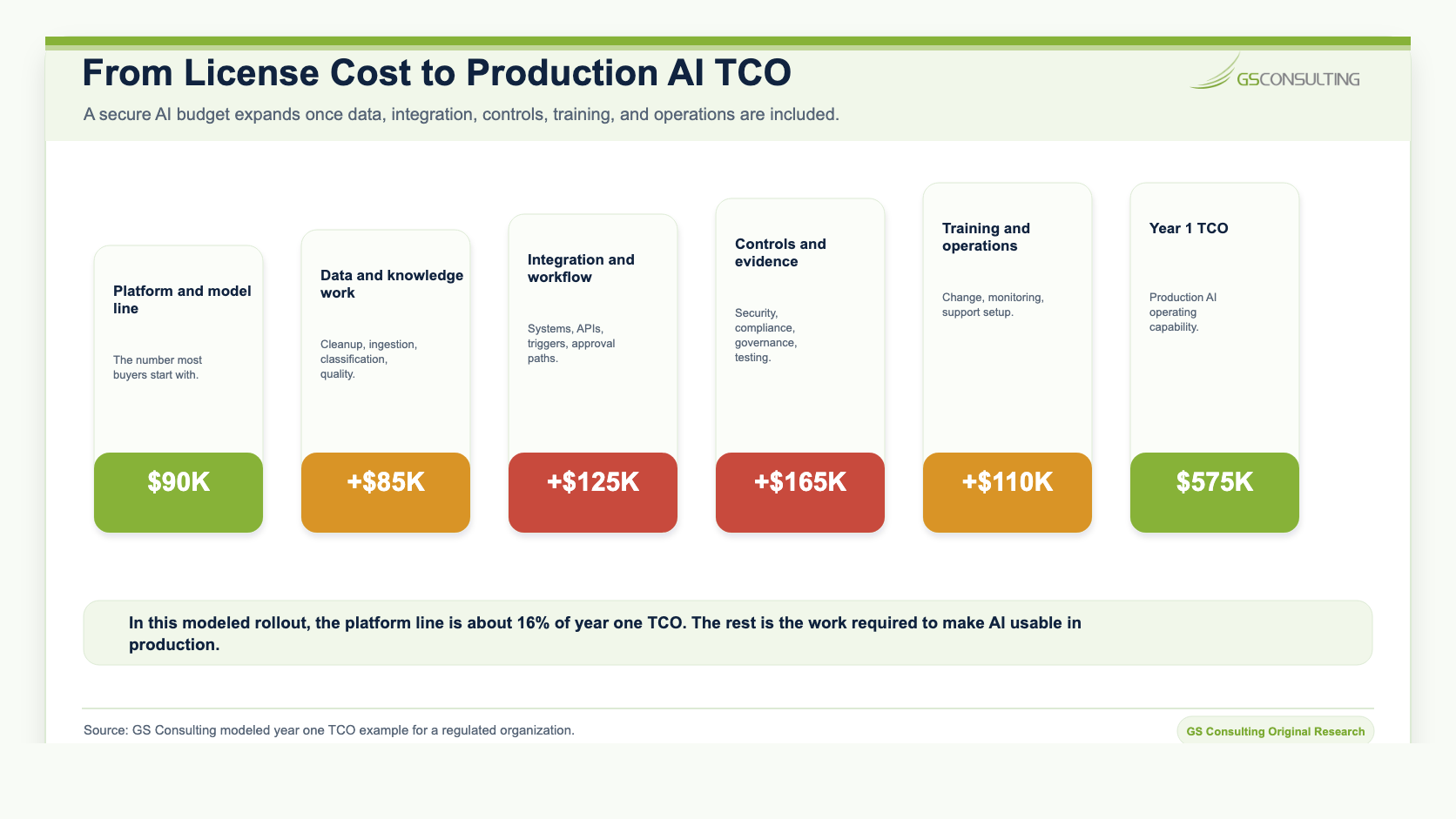
The research also shows why license only AI budgets are usually too low. In GS Consulting's modeled year one rollout for a regulated organization, the platform, model, and cloud line represented about 16 percent of first year TCO. The rest was the work required to make AI usable in production: data cleanup, integration, security architecture, compliance review, governance, testing, training, monitoring, support, and vendor management.
The practical takeaway is simple: do not ask what the AI tool costs. Ask what it costs to use the tool safely, at scale, inside the organization's operating environment.
The TCO Formula
A practical formula looks like this:
Enterprise AI TCO = strategy cost + platform cost + data cost + integration cost + security cost + compliance cost + governance cost + testing cost + training cost + operations cost + support cost
That is the full picture.
If your budget only includes platform cost, it is incomplete. If your budget includes implementation but not governance, it is incomplete. If your budget includes integration but not compliance evidence, it is incomplete. If your budget includes the pilot but not production support, it is incomplete.
This is where many AI programs get into trouble. The initial number looks attractive. The real cost shows up later.
The Cost Categories Leaders Need to Budget For
1. Strategy and Readiness
Before buying or building anything, leaders need to know where AI should actually be used. That takes assessment work.
A serious enterprise AI strategy should identify which workflows are worth improving, which workflows are not ready, where sensitive data exists, which systems need integration, which compliance obligations apply, which teams need training, which vendors need review, what architecture is required, what should be piloted first, and what should wait.
This is the cost of not guessing. For regulated organizations, guessing is expensive.
2. Platform and Model Costs
This is the number most buyers start with: AI platform licenses, model usage fees, token consumption, enterprise assistant seats, API usage, private model hosting, vendor support, premium security features, and additional workspace or tenant costs.
Platform cost matters, but it is not the full cost. It also needs to be matched to the use case. A low cost tool may work for public content. It may not work for sensitive contract review, CUI workflows, HR case support, finance records, or security alert summaries.
3. Data Engineering
This is where many AI budgets break. AI needs usable data. Most organizations do not have it ready.
Documents are scattered. Policies are outdated. Tickets are inconsistent. Contracts live in different repositories. Knowledge articles are duplicated. Security data has inconsistent fields. Customer records are incomplete. SOPs are old. Evidence folders are messy.
AI will not fix that by itself. Data engineering cost may include data inventory, classification, repository cleanup, metadata design, pipelines, document ingestion, data quality work, permission mapping, source ownership, retention review, normalization, index design, vector database preparation, and knowledge base cleanup.
4. Security Architecture
Secure AI needs architecture, not just access.
Security architecture may include identity integration, role based access, document level permissions, model gateways, private AI environments, network segmentation, secure connectors, data loss prevention, private API paths, prompt filtering, output controls, logging, SIEM integration, secrets management, endpoint controls, agent permission limits, and stop controls.
Without this, AI can become a shortcut around your security model.
5. Compliance and Audit Support
Regulated AI creates compliance work. That work has a cost.
It may include control mapping, policy updates, AI use policy, data handling rules, SSP updates for GovCon, CMMC evidence review, NIST SP 800 171 alignment, privacy review, legal review, records retention review, vendor documentation, customer responsibility matrices, audit trail design, compliance evidence collection, assessment support, and questionnaire response support.
If AI touches regulated data or compliance relevant workflows, the compliance team needs to be involved before production. Not after.
6. Integration
AI creates value when it connects to workflows. That means integration.
Integration cost may include connecting to document repositories, ticketing systems, CRM, ERP, HR systems, contract systems, finance systems, security tools, data warehouses, APIs, workflow triggers, approval steps, write back controls, monitoring, and legacy systems.
The highest cost usually comes from messy legacy environments, unclear system ownership, weak APIs, and manual workarounds that nobody documented.
7. Governance
Governance is not a committee for the sake of a committee. It is how the organization decides what AI is allowed to do.
Governance cost may include an AI governance charter, use case intake process, risk tiering, approved tool list, vendor review process, data handling policy, human review rules, escalation process, AI incident process, monitoring process, decision rights, documentation templates, and executive reporting.
8. Testing and Validation
AI testing is not the same as normal software testing. You need to test the workflow, the data, the permissions, the output quality, and the failure modes.
Testing cost may include prompt testing, source retrieval testing, permission testing, data leakage testing, output quality review, edge case testing, adversarial testing, human review testing, workflow testing, integration testing, logging validation, security testing, compliance evidence testing, and model change testing.
9. Training and Change Management
Training is not a soft cost. If users do not understand the workflow, they will misuse it or avoid it. Both outcomes reduce ROI.
Training may include general AI use training, role specific training, data handling training, prompt guidance, output verification training, manager review training, AI workflow training, policy acknowledgment, support materials, office hours, change communication, and adoption support.
10. Operations and Support
A pilot can survive on enthusiasm. Production cannot.
Ongoing operations may include workflow monitoring, user support, prompt updates, source updates, knowledge base review, access reviews, model performance review, cost monitoring, security monitoring, incident response, vendor management, policy updates, compliance evidence refresh, output quality review, retraining users, support tickets, and change management.
11. Technical Debt
Technical debt is the cost you pay because earlier systems were not built cleanly. For AI, technical debt shows up fast.
Legacy systems have poor APIs. Data fields are inconsistent. Documents are duplicated. Permissions are messy. Reports depend on spreadsheets. Business rules live in emails. Data owners are unclear. Security logs are incomplete. Knowledge bases are outdated.
AI does not erase technical debt. It often exposes it.
12. Vendor and Partner Management
AI vendors and implementation partners can become part of your risk surface.
Vendor management should review data retention terms, model training terms, prompt and output handling, subprocessors, support access, security documentation, audit logs, deployment options, incident reporting, data deletion, model updates, connector permissions, regulated data support, and implementation partner access.
The Cost of Not Doing It Securely
This is the part CFOs need to hear.
Secure enterprise AI has cost. Insecure enterprise AI has cost too. It just shows up later.
The cost of doing it badly can include data exposure, CUI leakage, customer trust loss, audit findings, compliance rework, legal review, incident response, tool replacement, workflow rebuild, vendor exit, regulator response, contract risk, employee misuse, shadow AI expansion, security team cleanup, and lost executive confidence.
That is why comparing secure AI against a cheap tool is the wrong comparison. Compare secure AI against the cost of unmanaged AI. That is the real choice.
A Practical TCO Example
Here is a simple example for a regulated organization launching secure AI across compliance operations, IT support, and contract review.
Assessment, use case prioritization, data review, risk review, and roadmap.
Target architecture, control model, deployment path, and integration planning.
Platform, model, cloud, usage, and support line items.
Repository cleanup, source preparation, permission mapping, and indexing.
Systems, APIs, workflow triggers, approvals, and monitoring.
Controls, privacy, legal, compliance, audit trail, and evidence work.
Use case intake, risk tiering, approved tools, data rules, and decision rights.
Role training, policy acknowledgment, support materials, and adoption support.
Usage monitoring, operational support, reporting, and support model setup.
Total year one cost: $575,000.
That number may look high if the organization expected a software subscription. It looks different if the organization expected a production AI operating capability.
Budgeting by Phase
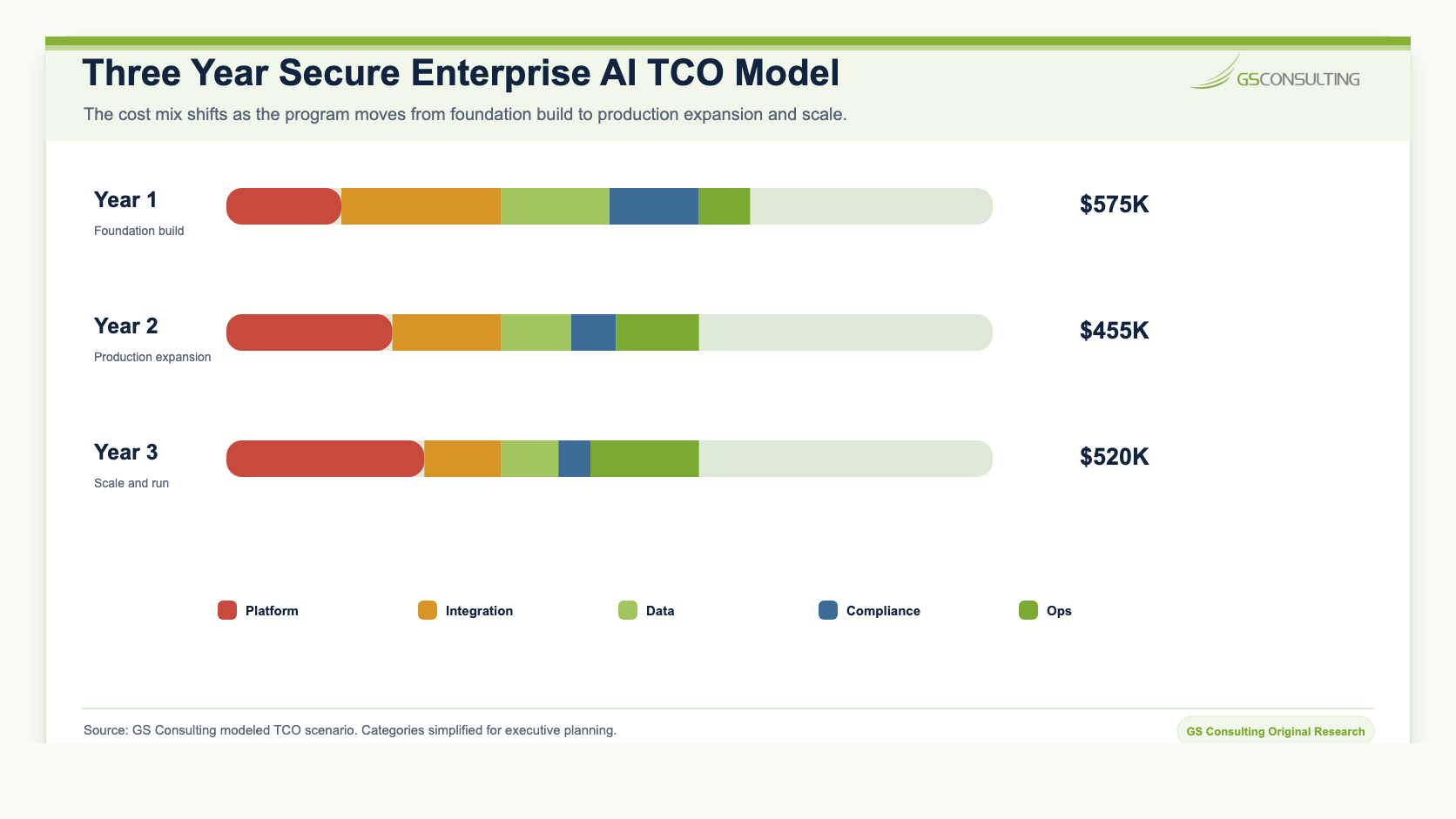
Do not ask for the full enterprise AI budget on day one if the organization is not ready. Use phases.
- Phase 1Readiness and roadmap.
Assessment, use case prioritization, data review, risk review, architecture recommendations, and budget planning. The goal is clarity.
- Phase 2Controlled pilot.
Implementation for one or two workflows, limited integration, security review, training, and pilot measurement. The goal is proof.
- Phase 3Production deployment.
Stronger architecture, integration with systems of record, logging, governance, monitoring, and support. The goal is control.
- Phase 4Scale.
Additional workflows, more integrations, expanded training, advanced monitoring, and continuous improvement. The goal is enterprise value.
This phased approach helps leaders avoid overbuying tools before the foundation is ready. It also filters out unrealistic budgets. If the organization will not fund the foundation, it is not ready for secure enterprise AI.
What CFOs, CIOs, and Operations Leaders Should Ask
What CFOs Should Ask
CFOs do not need to become AI experts. They need to ask better questions.
- What workflows will improve first?
- What costs are one time?
- What costs recur?
- What hidden compliance costs are included?
- What data cleanup is required?
- What integration work is required?
- What security controls are included?
- What audit evidence is required?
- What happens if we choose the cheaper tool?
- What is the cost of unmanaged AI use?
- What value will be measured after the pilot?
- What budget is needed to move from pilot to production?
If the AI proposal cannot answer those questions, it is not a budget plan. It is a sales pitch.
What CIOs Should Ask
CIOs need to focus on operational reality. Can this platform integrate with our systems? Can it enforce identity and permissions? Can it support sensitive data workflows? Can we monitor usage? Can we log prompts and outputs where needed? Can we route different data types to different environments? Can we support private or controlled deployment? Can we block unapproved AI use? Can we maintain it after launch? Can we scale without rebuilding everything?
The CIO's job is not to buy the most impressive tool. The CIO's job is to build the operating capability.
What Operations Leaders Should Ask
Operations leaders should focus on workflow value. Which processes are slow? Which reports take too long? Where do exceptions get missed? Where does rework happen? Which teams are overloaded? What work could AI prepare for human review? Where would faster cycle time matter? What data is required? What decisions still require people?
The operations case matters because enterprise AI should improve how work gets done. If the workflow does not improve, the technology does not matter.
Where TCO Usually Gets Underestimated
Most organizations underestimate cost in five places: data preparation, integration, governance, compliance evidence, and ongoing operations.
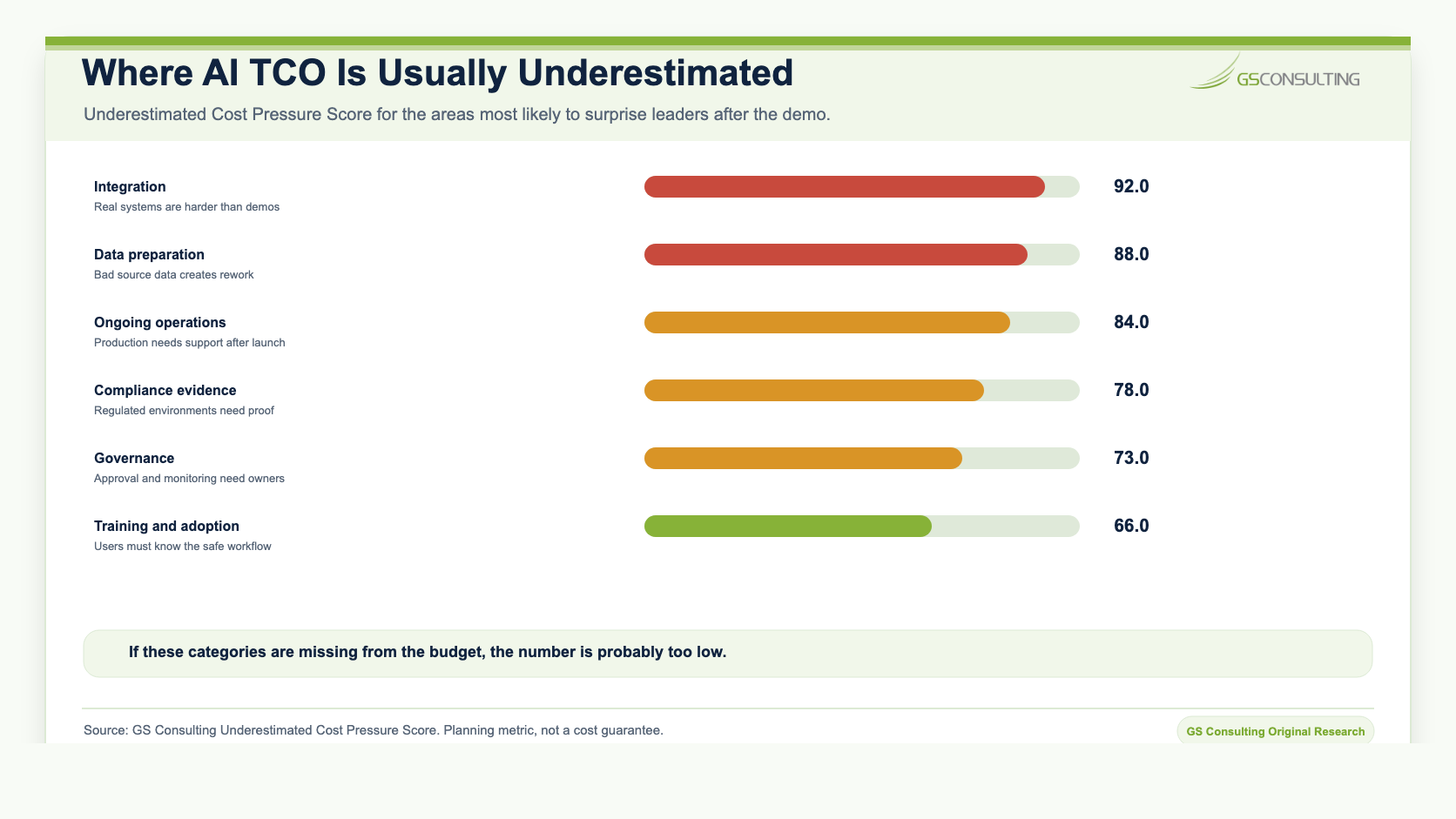
- Data preparation. Bad data makes AI expensive.
- Integration. Connecting AI to real systems is harder than connecting it to a demo.
- Governance. Someone has to approve, monitor, and manage AI use.
- Compliance evidence. Regulated environments need proof.
- Ongoing operations. AI needs care after launch.
If your budget ignores these five, it is too low.
How to Reduce TCO Without Cutting Corners
Reducing cost does not mean skipping security. It means sequencing the work correctly.
Start with a readiness assessment. Pick fewer pilots. Use approved source sets. Avoid broad system access. Reuse architecture patterns. Standardize governance templates. Use common connectors. Start with read only workflows. Keep humans in approval roles. Measure before scaling. Do not customize everything. Do not connect every system at once.
The cheapest secure AI program is usually the one that starts narrow, proves value, and reuses patterns. The most expensive one is the one that lets every team build its own version.
How This Supports Secure Enterprise AI Strategy
This article supports Secure Enterprise AI Strategy, which explains how GS Consulting helps regulated organizations connect business goals, AI roadmap, data strategy, security, compliance, architecture, workforce adoption, and measurable outcomes.
This page answers the financial planning question: what does secure enterprise AI actually cost when you include the work required to make it usable in a regulated environment?
A budget also needs a capacity view. The enterprise AI capacity planning guide joins demand, service targets, technical limits, human queues, resilience, and unit cost before scale.
That question connects directly to Enterprise AI Governance Frameworks for GovCon, Developing a Phased Secure AI Adoption Roadmap, Building the Business Case for Secure Enterprise AI, Measuring Enterprise AI ROI in Mission Critical Environments, Shifting from Point Solutions to Unified AI Platforms, Enterprise AI Readiness Assessment, Aligning AI Strategy with Legacy IT Modernization, What Is an Enterprise AI Strategy?, AI ROI Calculation for Enterprise Leaders, Enterprise AI Maturity Assessment, and Legacy System Integration for Enterprise AI Automation.
The Bottom Line
Enterprise AI total cost of ownership is not the license cost.
It is the full cost of making AI useful, secure, compliant, integrated, adopted, monitored, and defensible.
For regulated organizations, that includes governance, data engineering, security architecture, compliance review, audit evidence, integration, training, support, and ongoing operations.
If a budget does not include those costs, it is not a serious enterprise AI budget. It is a hope.
Ready to build a realistic enterprise AI budget before selecting a platform?
Contact GS Consulting for a Secure Enterprise AI Strategy and TCO Assessment.
Contact GS ConsultingResearch Sources and Caveats
The Secure Enterprise AI TCO Burden Score, three year TCO model, cost waterfall, and hotspot scores are GS Consulting derived planning tools. They are not official accounting conclusions, procurement benchmarks, audit findings, or ROI guarantees.
Actual TCO depends on the organization's workflows, data quality, security requirements, regulatory obligations, cloud architecture, vendor terms, integration complexity, user adoption, labor rates, model usage, monitoring needs, and appetite for risk.
- McKinsey: The State of AI 2025
- IBM: AI Control Gap Study
- Salesforce MuleSoft: Connectivity Benchmark 2025
- Flexera: Cloud Spend Management Report
- FinOps Foundation: State of FinOps 2026
- Gartner: Worldwide AI Spending Forecast
- Gartner: GenAI Project Abandonment Forecast
Frequently Asked Questions About Enterprise AI TCO
What is enterprise AI total cost of ownership?
Enterprise AI total cost of ownership is the full cost to design, deploy, govern, secure, integrate, monitor, support, and improve AI across the organization. It includes licenses and model usage, but also data engineering, integration, security, compliance, governance, testing, training, operations, support, and vendor management.
Why is the AI license not the real cost of enterprise AI?
The license is only one line item. Regulated organizations also need data cleanup, identity controls, architecture, compliance review, audit evidence, integration, monitoring, training, and ongoing support before AI can operate safely in production workflows.
What AI costs are most often underestimated?
The most underestimated AI costs are usually data preparation, integration, governance, compliance evidence, testing, training, and ongoing operations. These costs often show up after a pilot when the organization tries to move AI into real workflows.
How can organizations reduce enterprise AI TCO without cutting corners?
Organizations can reduce TCO by starting with readiness work, choosing fewer pilots, using approved source sets, avoiding broad access, starting with read only workflows, reusing architecture patterns, standardizing governance templates, measuring before scaling, and keeping humans in approval roles for higher risk work.
Related Reading
- Secure Enterprise AI Strategy
- Enterprise AI Governance Frameworks for GovCon
- Developing a Phased Secure AI Adoption Roadmap
- Building the Business Case for Secure Enterprise AI
- Measuring Enterprise AI ROI in Mission Critical Environments
- Enterprise AI Readiness Assessment
- Aligning AI Strategy with Legacy IT Modernization
- Shifting from Point Solutions to Unified AI Platforms
- What Is an Enterprise AI Strategy?
- AI ROI Calculation for Enterprise Leaders
- Enterprise AI Maturity Assessment
- Legacy System Integration for Enterprise AI Automation