Secure AI Automation | | 27 min read
Measuring ROI from Secure AI Automation

Key Takeaways
Secure AI ROI depends on captured workflow benefits and full costs.
Establish the baseline
Record volume, effort, cycle time, errors, and rework before changing the workflow.
Adjust for use and quality
Account for adoption, review effort, corrections, and whether saved time becomes usable capacity.
Include the operating burden
Budget for integration, security, governance, support, and ongoing measurement.
AI automation does not prove its value because people like using it.
It proves its value when the numbers change.
Less manual work. Faster cycle time. Fewer errors. Lower cost. Better compliance evidence. More throughput. Less rework. Faster response. Cleaner operations.
That is what matters.
A lot of organizations get this wrong. They launch an AI pilot, collect positive feedback, show a few impressive outputs, and call it success.
That is not ROI. That is a demo with good vibes.
Secure AI automation needs a better standard. If AI touches customer data, employee data, contracts, financial records, compliance evidence, CUI, PHI, security alerts, or operational decisions, the business case has to be clear.
Prove where secure AI automation creates real value.
GS Consulting helps regulated organizations build ROI models across workflow baselines, value capture, control cost, risk reduction, adoption, output quality, pilot scorecards, and executive reporting.
Request an ROI AssessmentSecure AI Automation ROI Is Different
Measuring ROI from normal automation is already hard. Measuring ROI from secure AI automation is harder because the value is not only speed.
Time savings matter. But secure AI automation also creates value by reducing risk, improving evidence, standardizing decisions, preventing errors, and making work easier to audit.
That matters because regulated organizations do not just need fast outputs. They need controlled outputs.
- A customer support draft that saves five minutes is not valuable if it creates a bad commitment.
- An invoice review assistant that speeds up finance is not valuable if it misses exceptions.
- A compliance evidence assistant that organizes files is not valuable if the evidence is stale or wrong.
- A security alert summary is not valuable if it hides the signal an analyst needed.
Secure AI automation ROI has to measure both sides: business value created and risk controlled. If you only measure speed, you will overstate the value. If you only measure risk, you will understate the opportunity.
Original Research: The Secure AI Automation ROI Capture Index
GS Consulting analyzed public AI adoption research, AI ROI research, productivity studies, and workflow benchmarks to create a Secure AI Automation ROI Capture Index. The index is a planning tool that ranks workflows by the likelihood that AI productivity can become measurable, controlled, production ready value.
The research supports a practical point: secure AI automation ROI is a value capture problem, not a demo performance problem. The question is not whether AI can save time. The question is how much of that improvement the organization can actually convert into controlled business value.
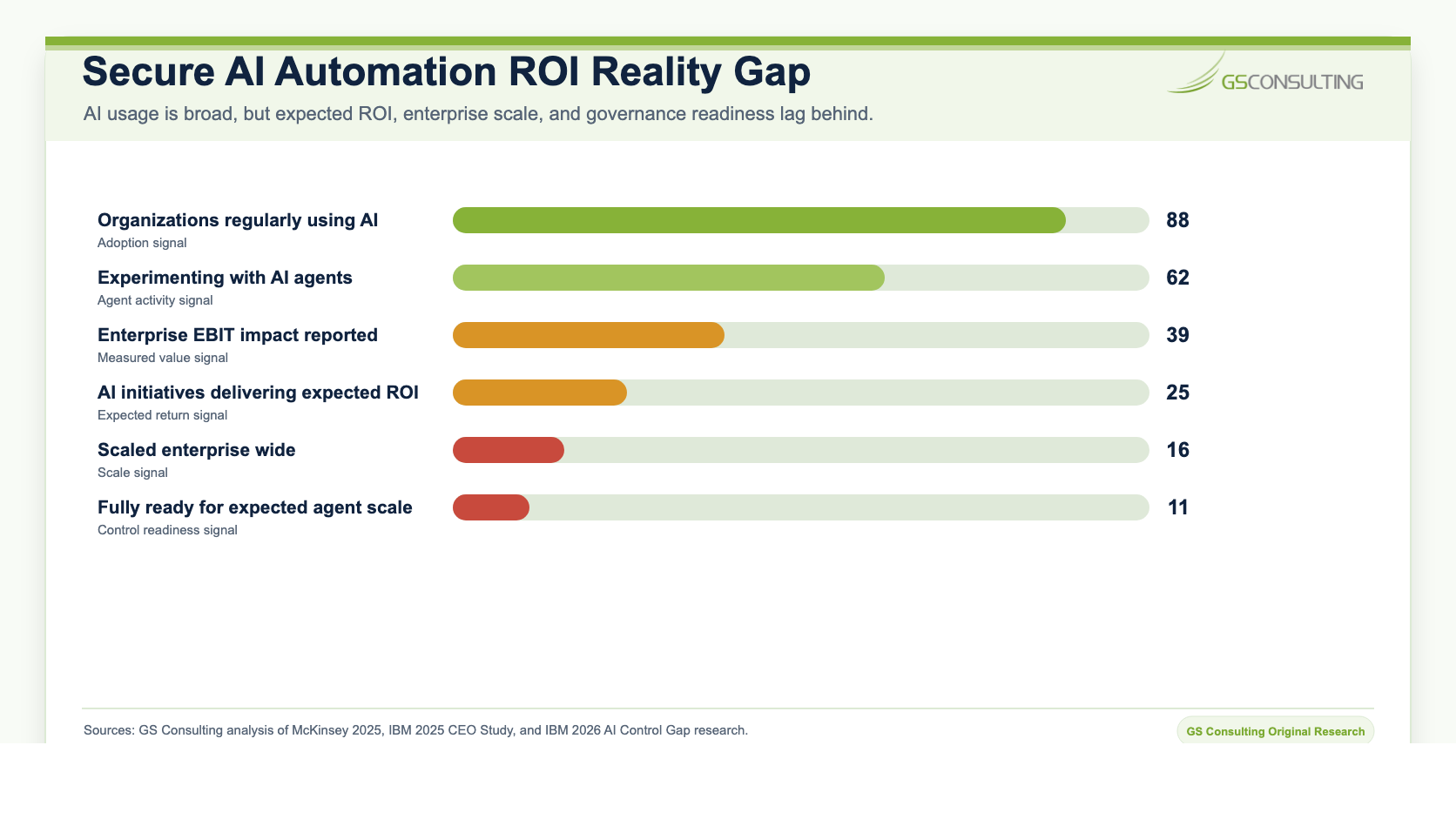
McKinsey's 2025 State of AI survey reports that 88% of respondents say their organizations regularly use AI, but only 39% report enterprise level EBIT impact, and nearly two thirds have not begun scaling AI across the enterprise. IBM's 2025 CEO study reports that only 25% of AI initiatives delivered expected ROI and only 16% scaled enterprise wide. IBM's 2026 control gap research reports that 77% of organizations say AI adoption is outpacing governance, 70% say technology is being deployed faster than IT can track, and only 11% feel fully ready for expected AI agent scale.
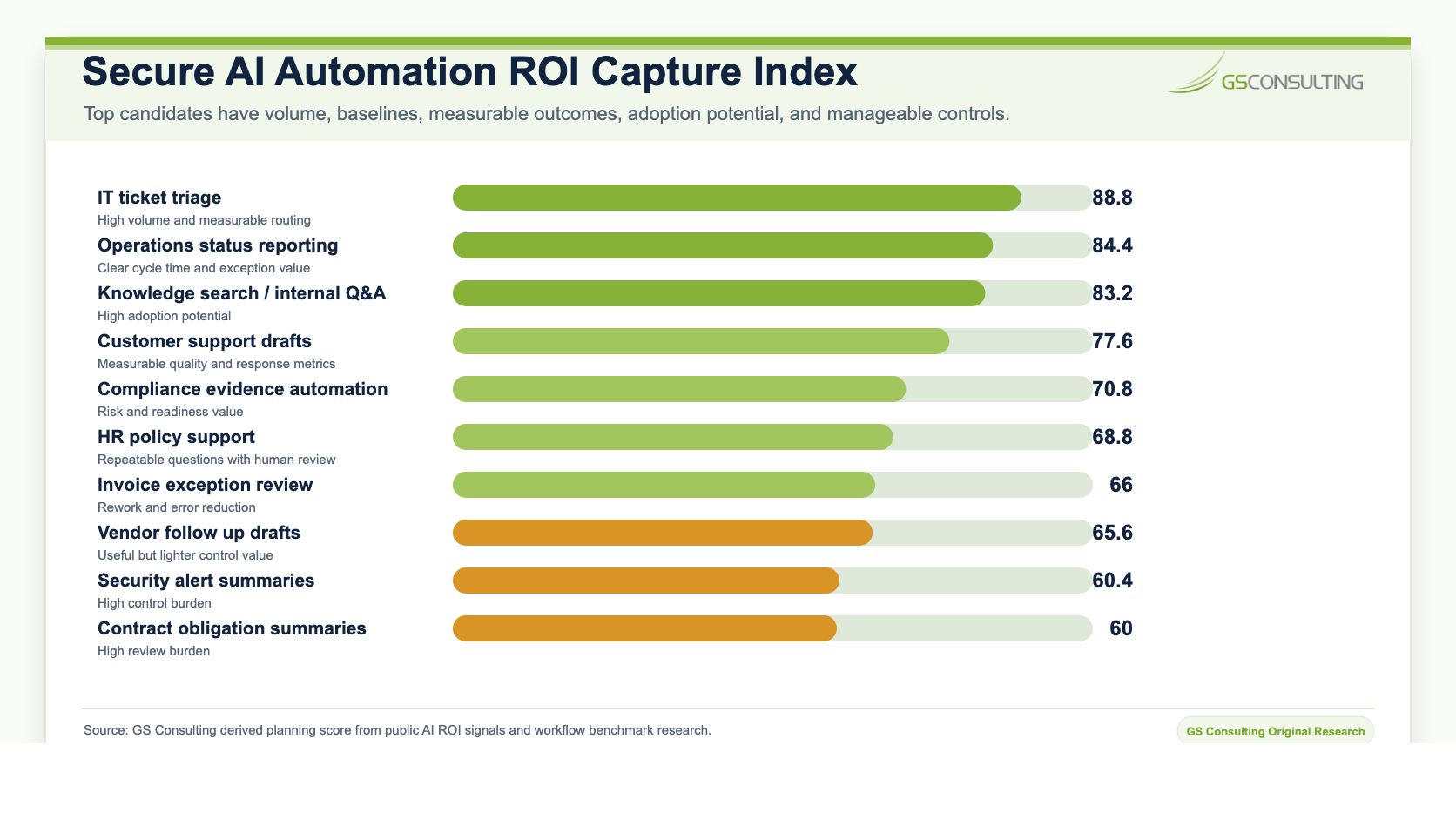
The top workflows in the GS Consulting ROI Capture Index were IT ticket triage, operations status reporting, knowledge search and internal Q&A, customer support drafts, compliance evidence automation, HR policy support, invoice exception review, vendor follow up drafts, security alert summaries, and contract obligation summaries.
These scores are not ROI guarantees. They are a disciplined way to decide where measurement is likely to work. Actual ROI should use the organization's real workflow volume, labor rate, cycle time, adoption rate, usable output rate, human review time, security cost, compliance cost, integration cost, monitoring cost, and realized production outcomes.
Start With the Workflow
Do not start with the AI tool. Start with the workflow.
The workflow is where value lives. You are not measuring the ROI of a model. You are measuring the ROI of improving a business process.
Good ROI candidates include IT ticket triage, invoice exception review, contract obligation summaries, compliance evidence collection, customer support response drafting, HR policy support, operations exception reporting, security alert summaries, vendor follow up, and knowledge search.
Each workflow has a current cost. It also has current friction. People spend time. Mistakes happen. Work gets delayed. Managers chase updates. Evidence gets lost. Customers wait. Employees get frustrated. Compliance teams clean up late. Skilled people do low value work.
That is what AI automation should improve.
You cannot prove improvement if you never measured the starting point. Before launching AI automation, capture volume, time per item, rework, error rate, number of handoffs, backlog, cycle time, current compliance evidence, escalation rate, current cost, and user frustration.
The Basic ROI Formula
The simple formula is this: ROI = net value divided by total cost.
Where net value = total benefit minus total cost.
That is easy to say. The hard part is defining total benefit and total cost honestly.
For secure AI automation, total benefit may include time savings, cost avoidance, error reduction, cycle time improvement, compliance efficiency, operational throughput, reduced rework, faster response, reduced backlog, better audit readiness, and reduced risk exposure.
Total cost may include software, model usage, cloud, implementation, architecture design, security review, compliance review, legal review, data cleanup, integration, testing, training, governance, monitoring, support, and ongoing improvement.
Do not count the benefit aggressively and the cost casually. That is how AI ROI turns into fiction.
Measure 1: Time Savings
Time savings are the easiest place to start. But not every minute saved becomes a dollar saved. Sometimes it becomes more capacity. Sometimes it reduces backlog. Sometimes it avoids hiring. Sometimes it lets skilled people focus on better work.
A practical formula is: annual time value = workflow volume times time saved per item times labor rate times adoption rate times quality rate.
If a service desk handles 60,000 tickets a year, AI saves four minutes per ticket, the loaded labor rate is $55 per hour, adoption is 80%, and outputs are usable 85% of the time, the annual productivity value is about $150,000.
Then ask the real question: what happens to that time? Does the team reduce overtime, avoid headcount, clear backlog faster, improve service levels, or shift staff to higher value work?
Measure 2: Cost Avoidance
Cost avoidance is often more useful than pure cost savings. AI automation may not reduce headcount, but it may help the organization avoid new cost.
Examples include avoiding additional support analysts, outsourcing manual document review, overtime during audit season, temporary invoice processing staff, extra compliance support, or manual reporting labor.
A practical formula is: cost avoidance = avoided labor or vendor cost minus AI operating cost.
Measure 3: Error Reduction
Errors are expensive. Sometimes the cost is obvious. Sometimes it is hidden in rework, delays, customer frustration, audit findings, missed obligations, or manual cleanup.
AI automation can reduce errors when it helps teams compare records, flag missing fields, identify stale evidence, detect exceptions, or standardize reviews. A practical formula is: error reduction value = errors avoided times average cost per error.
Measure 4: Compliance Efficiency
Compliance work is full of manual collection, review, mapping, reminders, evidence requests, screenshots, policy checks, and audit prep.
AI can help find evidence, flag stale documents, map artifacts to controls, draft readiness summaries, identify missing owners, create review packets, track open remediation items, and summarize policy gaps.
A practical formula is: compliance efficiency value = hours reduced times labor rate plus avoided external support plus avoided remediation cost.
Compliance ROI often shows up as reduced chaos. That still counts.
Measure 5: Cycle Time, Throughput, Rework, and Risk
Cycle time measures how long a workflow takes from start to finish. Throughput measures how much work the team can handle. Rework measures how much effort comes back because the intake, routing, summary, source, or output was wrong.
Risk reduction is harder to measure, but it may be the most important value. Track unapproved AI uses, sensitive data exposure events, audit findings, compliance gaps, policy violations, manual exports reduced, unauthorized access attempts, missing approvals, late escalations, customer complaints, and security exceptions.
If secure AI automation reduces risky workarounds, that is value. Do not ignore it just because it is not easy to put in a spreadsheet.
The ROI Scorecard
Use a simple scorecard for each AI automation workflow. The point is not to measure everything forever. The point is to know whether the workflow is actually improving.
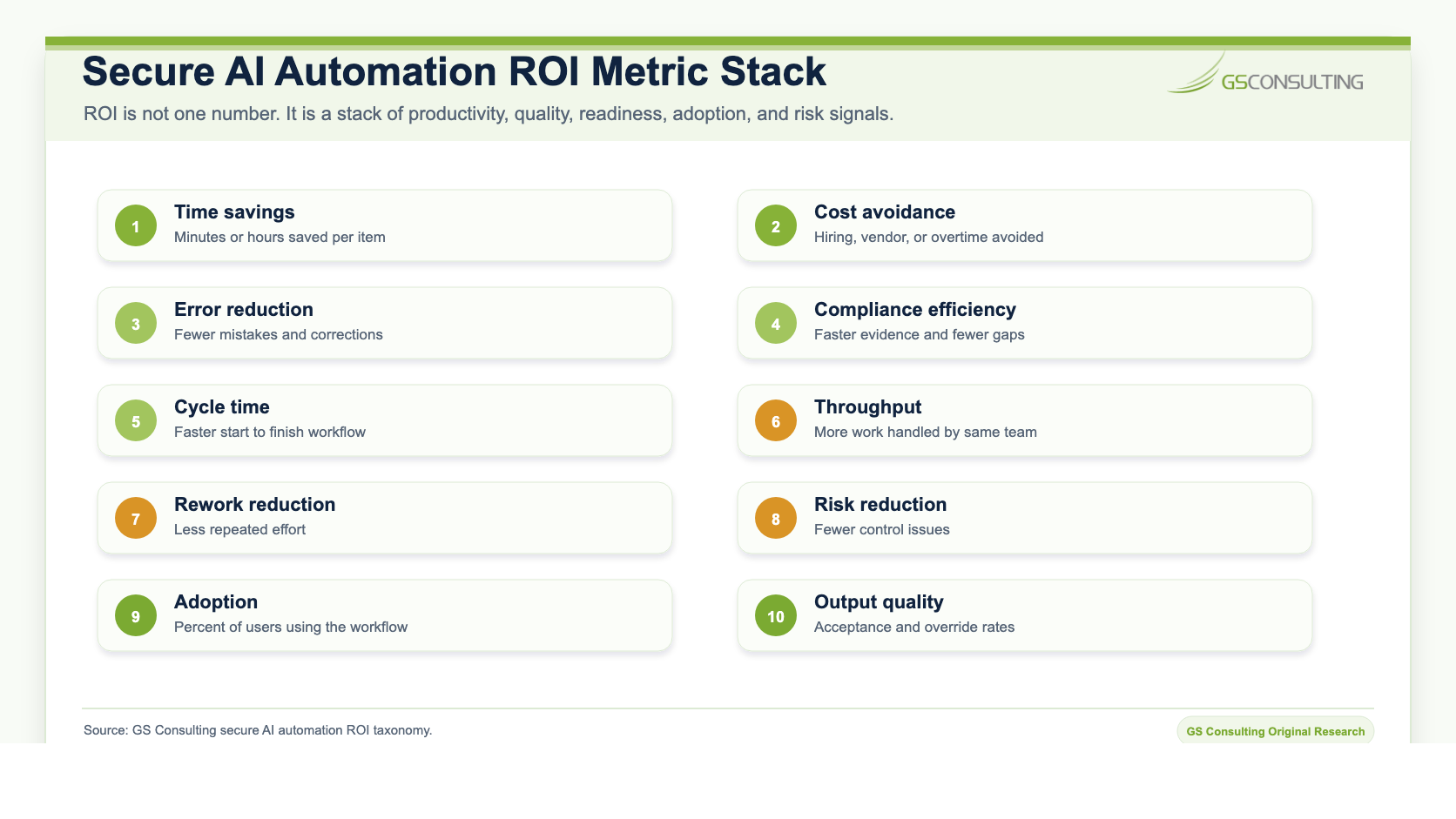
| ROI category | What to measure | Why it matters |
|---|---|---|
| Time savings | Minutes or hours saved per item | Shows productivity value |
| Cost avoidance | Hiring, vendor, or overtime avoided | Shows budget impact |
| Error reduction | Fewer mistakes and corrections | Shows quality improvement |
| Compliance efficiency | Faster evidence and fewer gaps | Shows readiness value |
| Cycle time | Faster start to finish workflow | Shows speed impact |
| Throughput | More work handled by same team | Shows capacity gain |
| Rework reduction | Less repeated effort | Shows process quality |
| Risk reduction | Fewer control issues | Shows secure adoption value |
| Adoption | Percent of users using the workflow | Shows whether value is real |
| Output quality | Acceptance and override rates | Shows whether AI is trusted |
Do not measure only one category. A workflow may not save a huge amount of time but may reduce audit risk. Another may not reduce risk much but may improve throughput. The right metrics depend on the workflow.
Adoption and Output Quality Are ROI Multipliers
A demo can look great with one user and five clean examples. ROI depends on adoption.
If employees do not use the workflow, the value does not show up. Track active users, usage by department, workflow volume through AI, manual bypass rate, user satisfaction, output acceptance rate, repeat usage, training completion, and reasons users reject or avoid the AI workflow.
Output quality matters just as much. If AI saves ten minutes but the user spends eight minutes correcting the result, the actual value is small. Track output acceptance rate, human edit rate, human override rate, rejected output rate, escalation rate, incorrect classification rate, wrong source rate, missing information rate, customer complaints, and reviewer confidence.
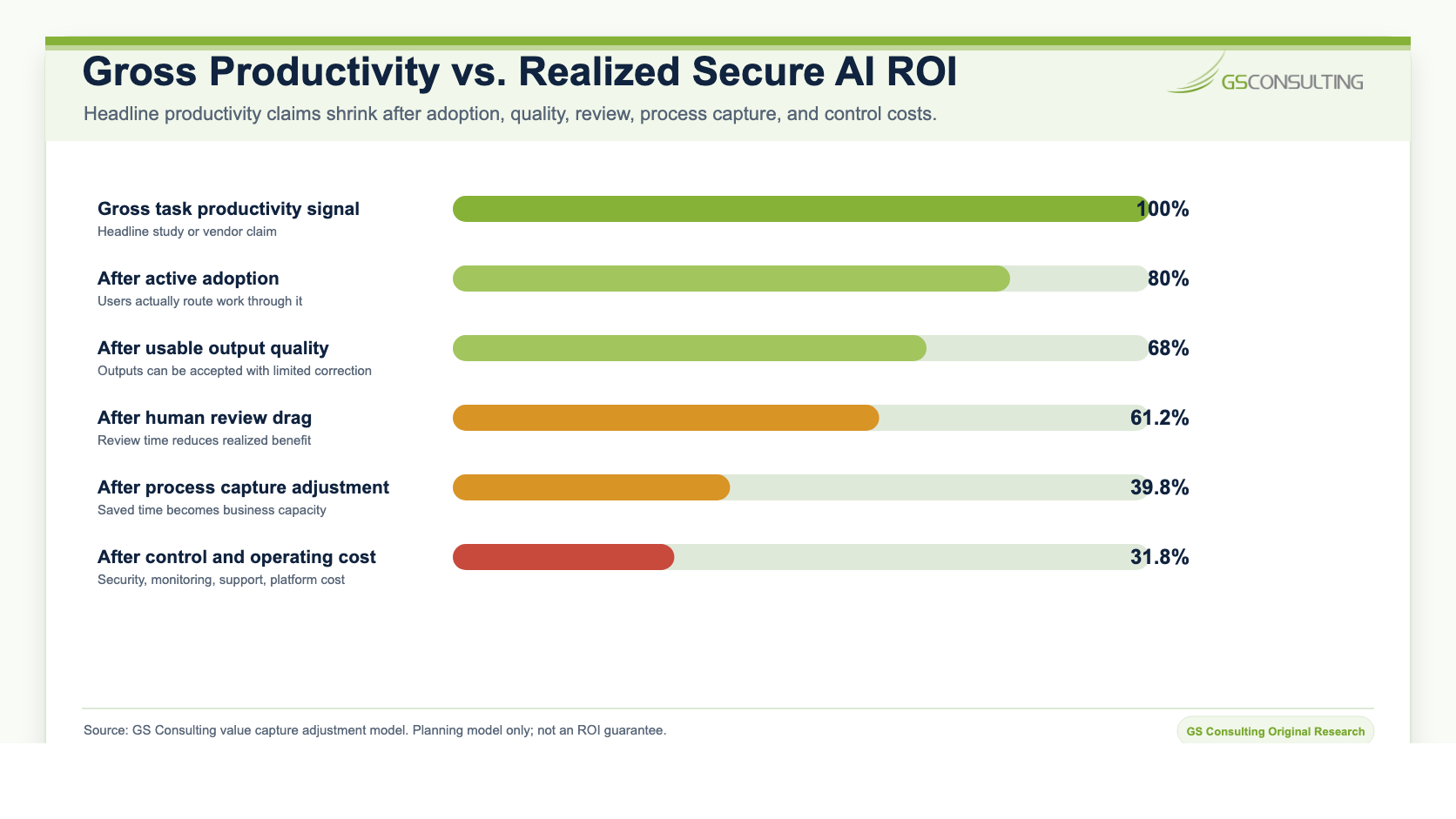
The GS Consulting value capture adjustment model starts with a 100% gross task productivity signal. After active adoption, usable output quality, human review drag, process capture, and control cost, the realized value in the model falls to 31.8%.
That does not mean AI automation is weak. It means the spreadsheet should reflect the way work actually happens.
Worked Examples
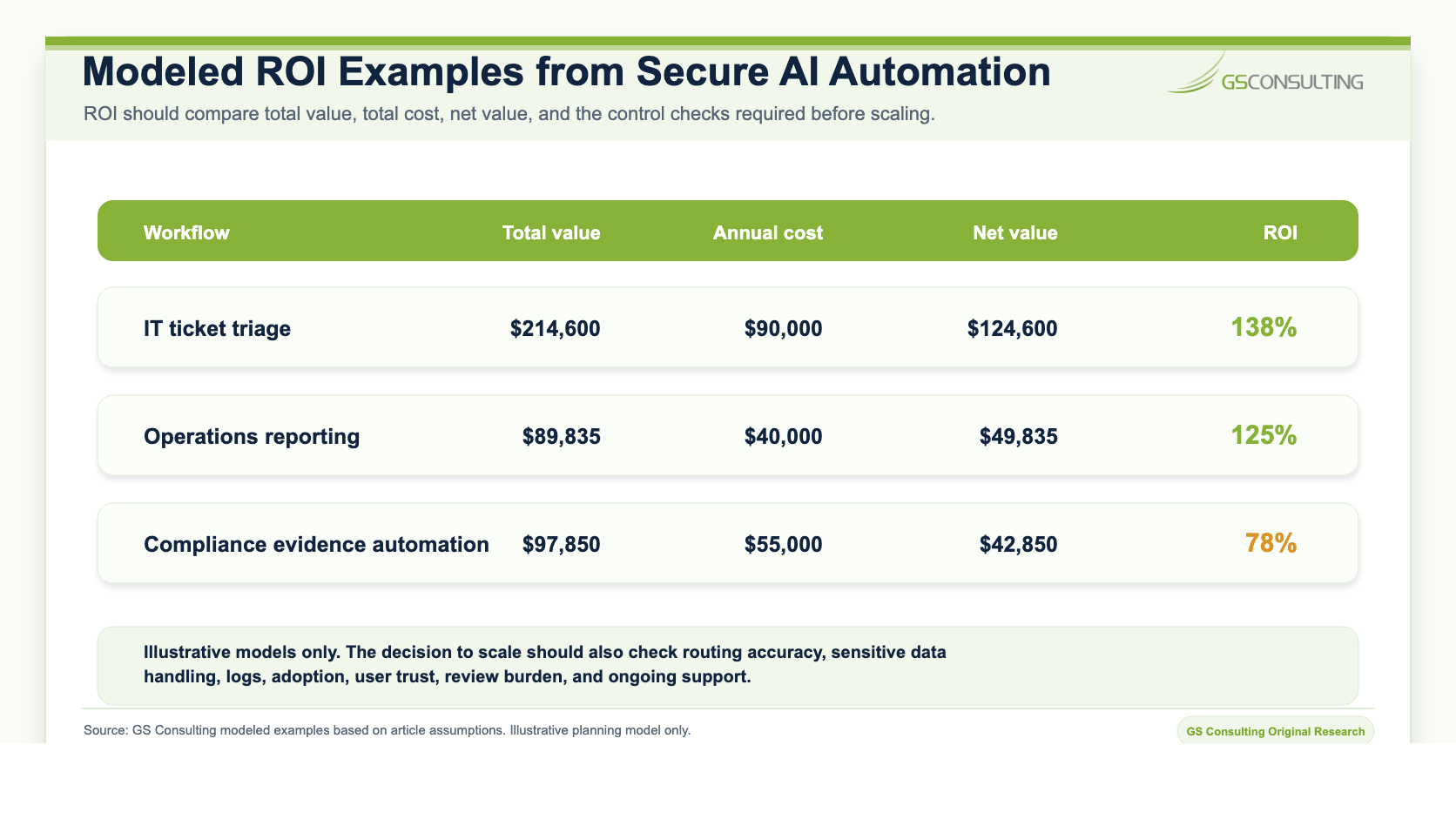
The strongest ROI models count total value and total cost before claiming success. The examples below are illustrative planning models, not benchmarks.
IT Ticket Triage
An IT team processes 80,000 tickets per year. Manual triage takes five minutes per ticket. AI saves three minutes per ticket. Loaded labor rate is $55 per hour. Adoption is 80% and usable output rate is 85%.
Time savings value is about $149,600. Add reduced misrouting worth $25,000 and reduced backlog overtime worth $40,000. Total value is $214,600. Annual cost is $90,000. Net value is $124,600. ROI is 138%.
Then check risk: did routing accuracy improve, did sensitive tickets route correctly, did security tickets require review, were logs captured, and did users trust the output?
Compliance Evidence Automation
A compliance team spends 600 hours per year collecting and organizing evidence. Loaded labor rate is $85 per hour. AI reduces manual evidence work by 35%.
Time savings value is $17,850. Add avoided outside support of $45,000, reduced audit scramble of $20,000, and avoided stale evidence remediation of $15,000. Total value is $97,850. Annual cost is $55,000. Net value is $42,850. ROI is 78%.
Operations Reporting
Five managers each spend four hours per week preparing status reports. That is 20 hours per week. At a loaded labor rate of $75 per hour, annual reporting cost is $78,000.
AI reduces report preparation by 50%. Adoption is 90% and usable output rate is 85%. Productivity value is $29,835. Earlier exception detection reduces missed deadlines worth $60,000 per year. Total value is $89,835. Annual cost is $40,000. Net value is $49,835. ROI is 125%.
The real value is not just faster reporting. It is earlier visibility.
Watch Out for Fake ROI
There are a few common ways AI ROI gets inflated.
- Counting all saved time as cash. If employees save time but the business does not use that time differently, the value may be productivity, not cash savings.
- Ignoring human review. If the workflow requires review, include review time.
- Ignoring security and compliance cost. Secure automation requires controls. Those controls cost something.
- Measuring the demo instead of production. A pilot with clean examples does not prove production value.
- Ignoring adoption. If only 20% of users use the workflow, the ROI will not match the spreadsheet.
- Ignoring errors. Fast wrong answers are expensive.
- Ignoring risk reduction. Some value comes from fewer control problems, better audit evidence, and reduced shadow AI.
The First 30 Days of ROI Measurement
Start simple. Pick one workflow. Do not try to measure every AI use case at once.
- Week 1: Define the workflow. Name the workflow, owner, current pain, expected improvement, and risk boundary.
- Week 2: Capture the baseline. Measure volume, time, cost, errors, rework, backlog, cycle time, and current control issues.
- Week 3: Define the value model. Decide which categories matter: time savings, cost avoidance, error reduction, compliance efficiency, cycle time, throughput, and risk reduction.
- Week 4: Launch measurement with the pilot. Track actual usage, output quality, time saved, human review, overrides, errors, and user feedback.
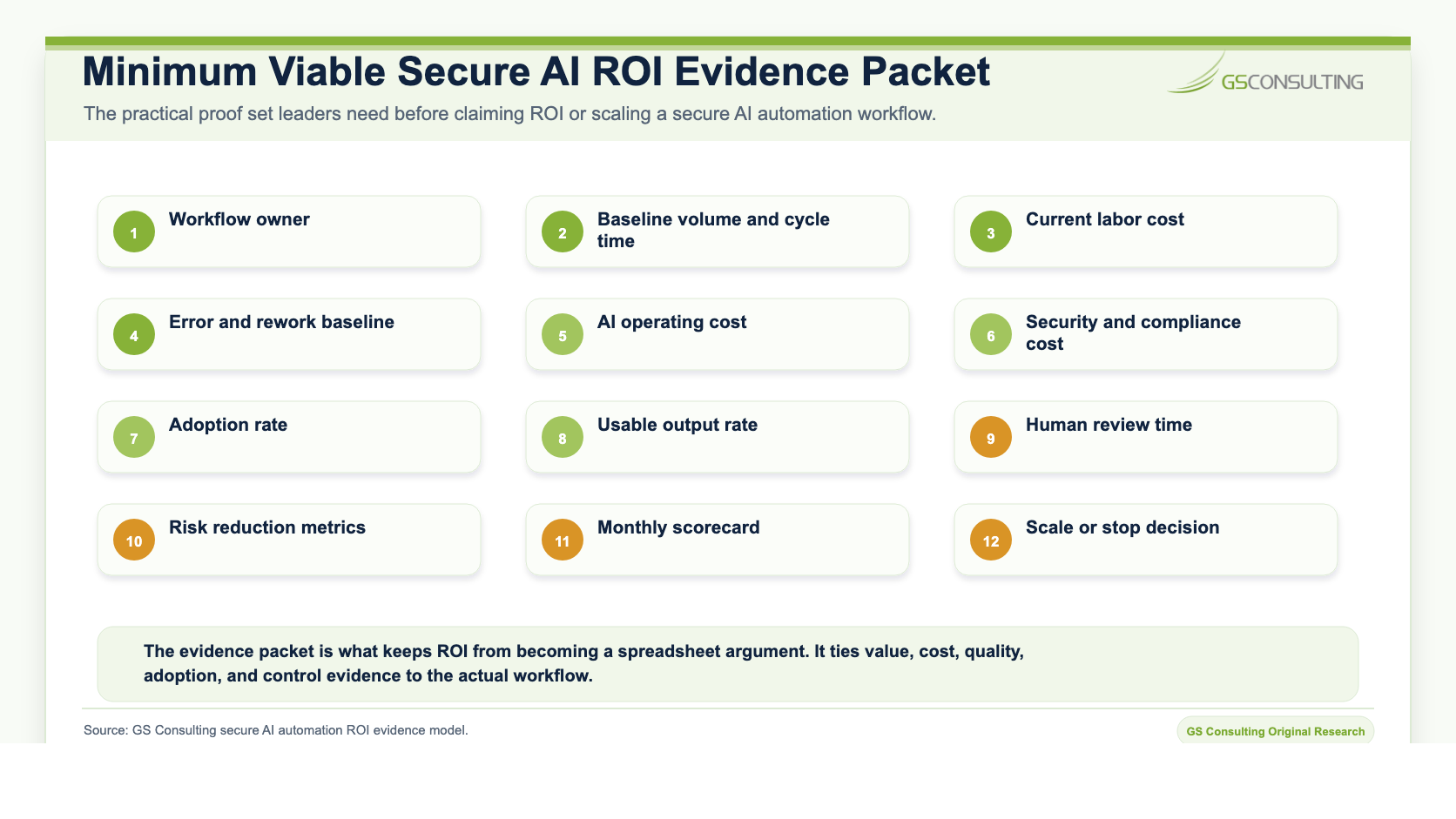
After 30 days, you will not know everything. But you will know whether the workflow is producing real value or just interesting outputs.
The Bottom Line
AI automation ROI is not about how impressive the output looks. It is about whether the workflow improves.
Measure time savings, cost avoidance, error reduction, compliance efficiency, cycle time improvement, operational throughput, rework reduction, risk reduction, adoption, and output quality. Start with a baseline. Count the real costs. Measure production behavior, not demo excitement.
The organizations that do this well will know which AI workflows deserve to scale. The ones that do not will end up funding tools they cannot defend.
Build a secure AI automation ROI model leaders can defend.
GS Consulting helps regulated organizations measure ROI from secure AI automation, including workflow baselines, value models, cost analysis, risk reduction, adoption metrics, pilot scorecards, and executive reporting.
Contact GS ConsultingRelated Reading
- Secure AI Automation for Regulated Organizations
- Secure AI Automation Readiness Assessment
- How to Identify Safe AI Automation Use Cases
- Secure AI Automation Implementation Roadmap
- AI Automation for Compliance Operations
- Common AI Automation Mistakes in Regulated Organizations
Sources
- McKinsey, The State of AI: Global Survey 2025
- IBM, 2025 CEO Study
- IBM, 2026 AI Control Gap Study
- NBER, Generative AI at Work
- MIT News, Study Finds ChatGPT Boosts Worker Productivity for Some Writing Tasks
- Harvard Business School, Navigating the Jagged Technological Frontier
- Fixify, 2026 IT Help Desk Benchmark Report