Enterprise AI Strategy | | 24 min read
Building the Business Case for Secure Enterprise AI

Key Takeaways
Defend AI investment with workflow value, controls, and full costs.
Identify the business burden
Connect the investment to risk, compliance work, cycle time, throughput, or modernization.
Include the control costs
Account for data, security, integration, governance, and operations in the budget request.
Fund a defined first phase
Specify the workflow, evidence, outcomes, and decision criteria before requesting broader investment.
The business case for enterprise AI should not start with productivity. That is the mistake.
Productivity matters. It just is not strong enough by itself to defend a serious enterprise AI investment, especially in a regulated organization or GovCon environment.
A better business case starts with a harder question: what risk, cost, delay, evidence burden, control gap, or operating drag does secure AI help the business reduce?
If the answer is only "people will save time," the case is thin. If the answer connects AI to risk reduction, compliance efficiency, workflow throughput, better evidence, safer data handling, and measurable capacity, the conversation changes.
Need to defend secure enterprise AI budget with more than a productivity story?
GS Consulting helps CIOs, CTOs, GovCon leaders, and regulated organizations build practical AI investment cases tied to workflows, data controls, governance, security, compliance, and measurable outcomes.
Build the AI Business CaseWhy Productivity Alone Is a Weak Budget Argument
Productivity is the easiest AI benefit to explain and the easiest one to overstate.
A team can say AI will save 30 percent of task time. That may be true for a narrow task. It may also collapse once leaders include adoption, output correction, human review, security approvals, vendor review, data preparation, integration, training, and support.
The board does not want a tool story. It wants a business story. For IT and security leaders, that means the business case needs to explain what the organization can do after the investment that it cannot do safely today.
Can it review compliance evidence faster? Can it reduce shadow AI exposure? Can it protect CUI and sensitive customer data more consistently? Can it speed ticket triage without giving users excessive access? Can it reduce manual reporting burden? Can it make audit trails stronger? Can it avoid hiring additional staff into a broken process?
Those are stronger budget arguments because they connect AI to operating outcomes. They also make the investment easier to defend after the first excitement fades.
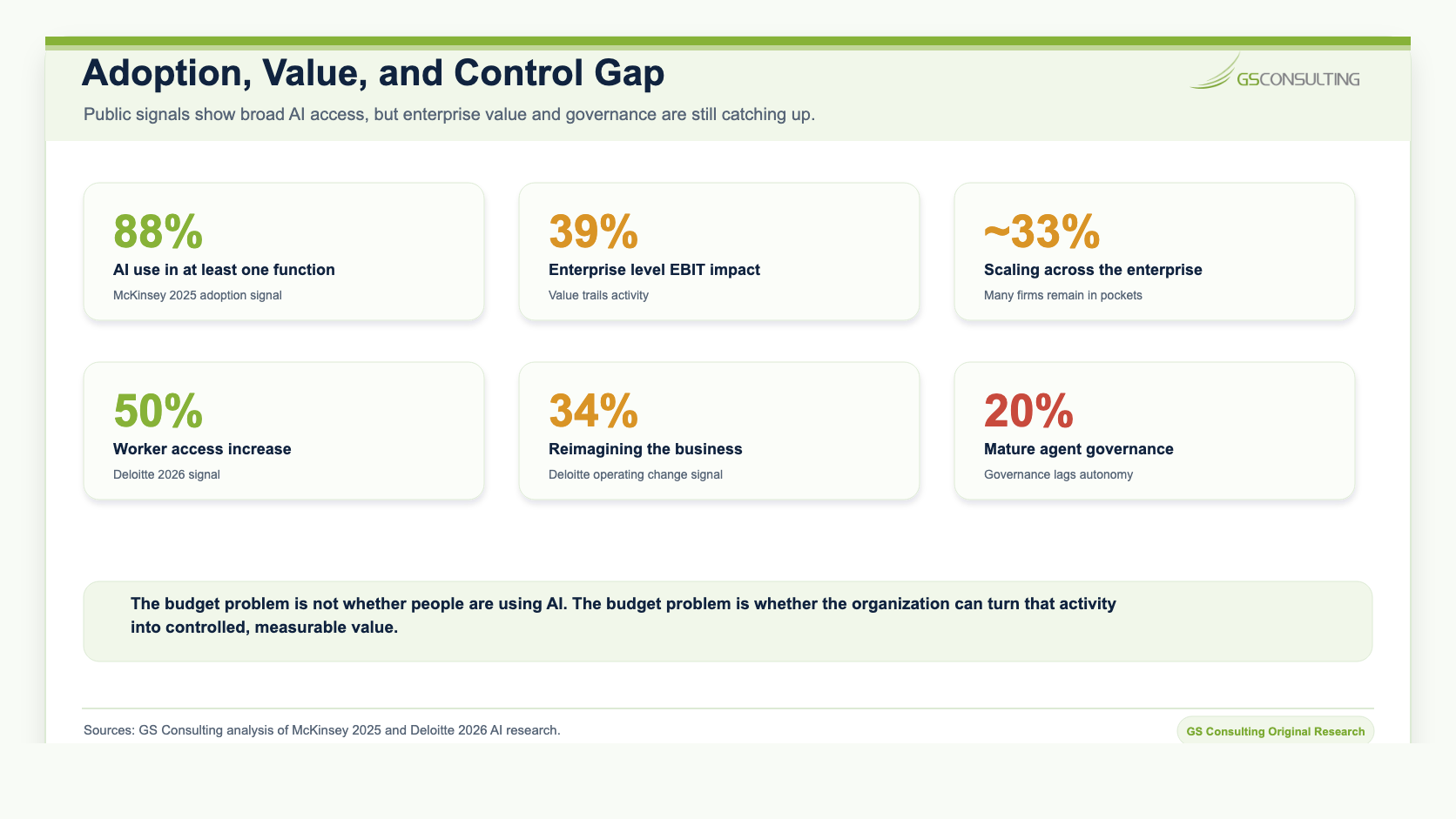
Original Research: The Unmanaged AI Exposure Gap
Original GS Consulting analysis shows that the strongest business case for secure enterprise AI is not only value capture. It is unmanaged exposure reduction.
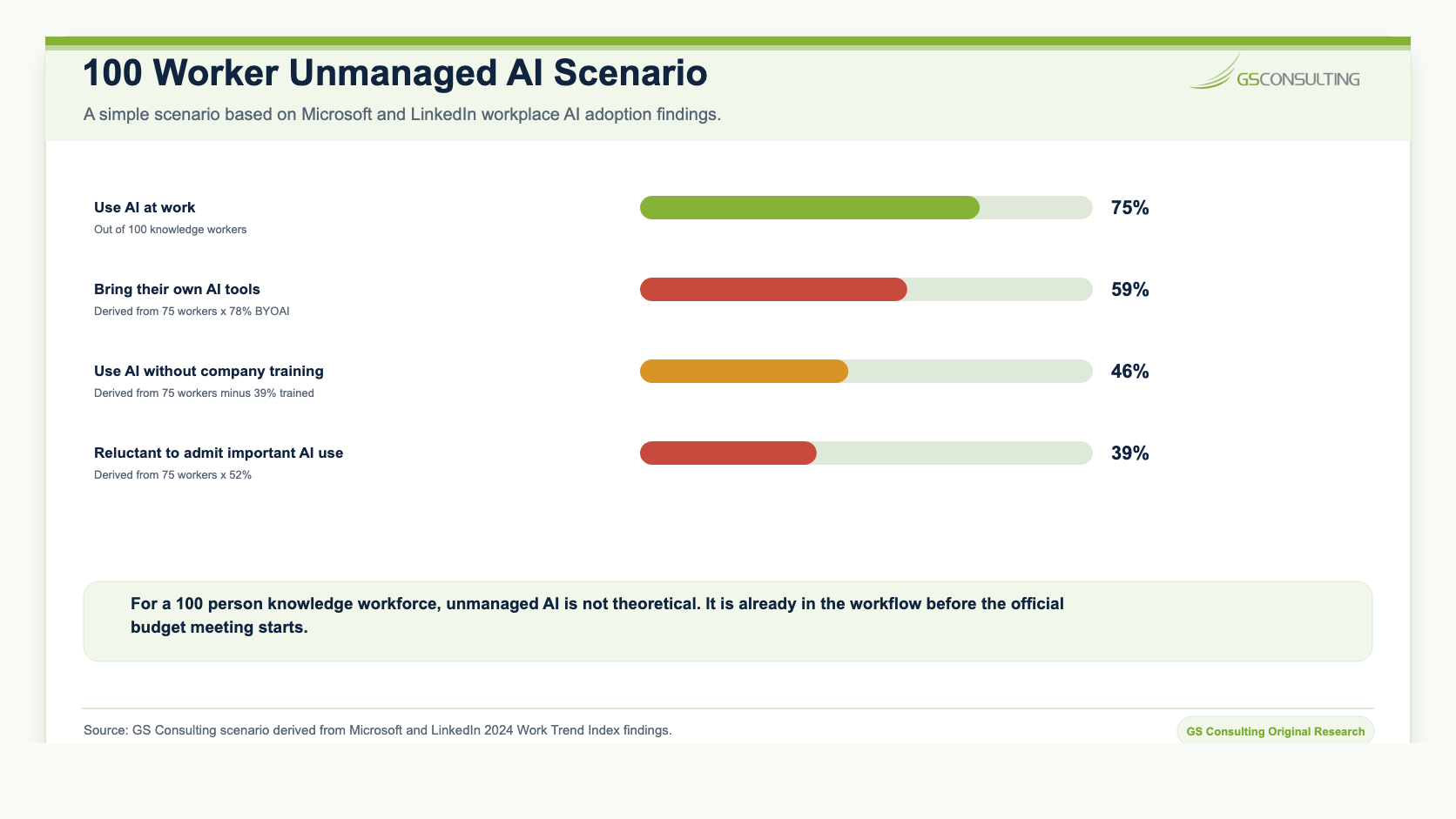
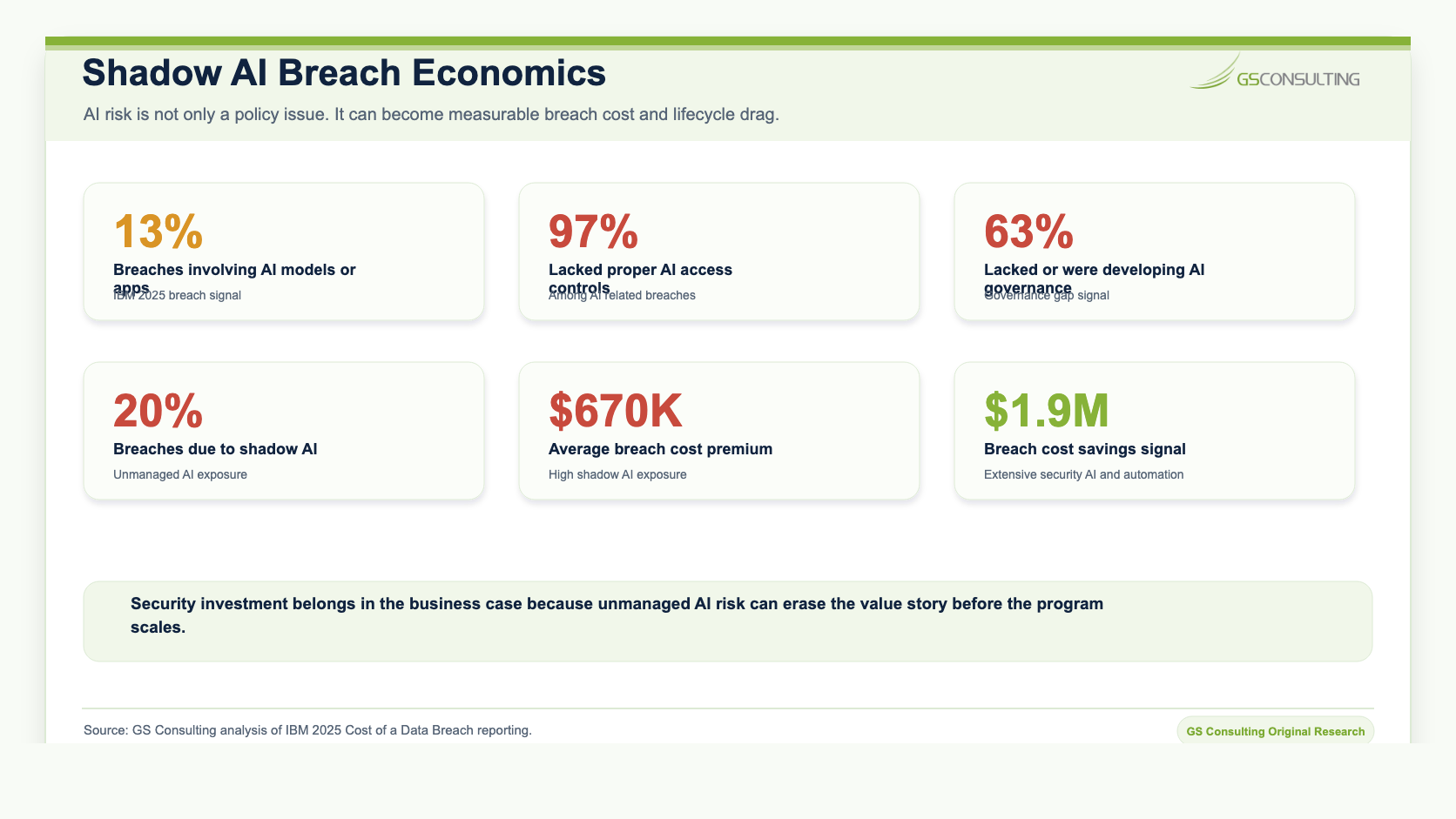
GS Consulting reviewed public AI adoption, workplace AI, privacy, data governance, and breach research to compare AI use against governance, training, data control, and breach signals. The research is cross industry, not a GovCon only dataset. That matters. There is no public source that cleanly measures how often workers paste CUI into public AI tools. So the safer conclusion is not to pretend the CUI number exists. The safer conclusion is that public enterprise data already shows enough unmanaged AI behavior to justify controls before regulated data is involved.
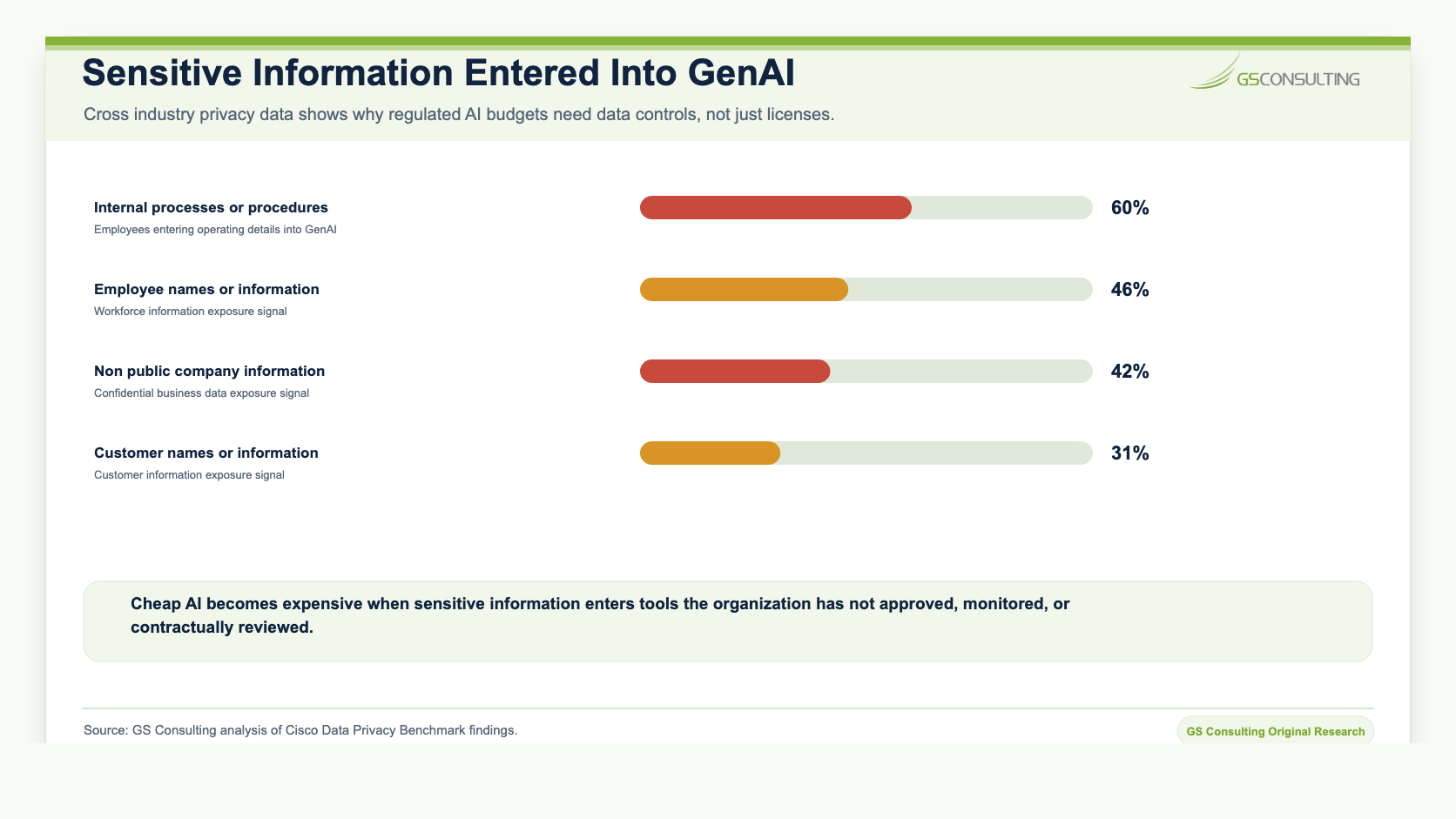
The pattern is blunt: employees are already using AI, many are bringing their own tools, sensitive information is entering GenAI systems, and AI access controls are immature in many breach scenarios. For GovCon and regulated organizations, that means the investment case should not be framed as "we want AI." It should be framed as "AI is already entering the operating environment, and we need a controlled way to capture value without creating avoidable exposure."
The Real Competitor Is Not Another AI Vendor
When leaders debate AI budget, they often compare vendors. That is useful, but it misses the real competitor.
The real competitor is unmanaged work.
Employees will use whatever helps them move faster. If the official path is unclear, slow, blocked, or missing, they will use unofficial tools. Sometimes they do it because they are careless. More often, they do it because the organization has not given them a safe way to solve the problem.
That changes the business case. Secure enterprise AI is not just a new tool purchase. It is a way to bring existing behavior into a controlled operating model with approved tools, clear data boundaries, human review, logging, vendor review, training, and measurable value.
For a GovCon business, this is especially important. CUI rules do not disappear because an employee wanted to move faster. GSA describes CUI as information the government creates or possesses, or that an entity creates or possesses for the government, that requires safeguarding or dissemination controls consistent with applicable law, regulation, and policy. If AI enters that data path, leaders need to know exactly what is happening.
The Business Case Should Have Six Pillars
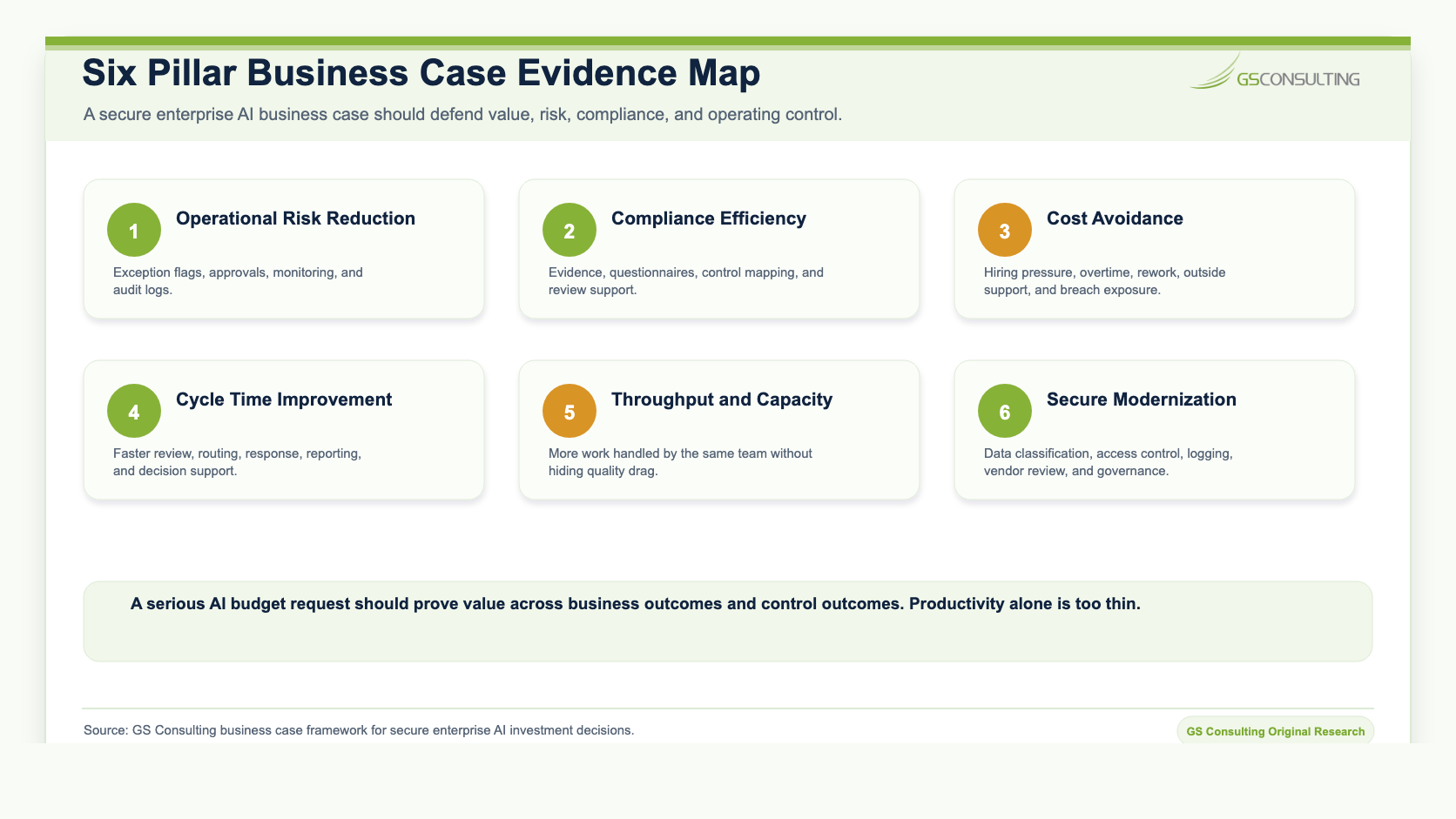
A serious business case for secure enterprise AI should have six pillars: operational risk reduction, compliance efficiency, cost avoidance, cycle time improvement, throughput and capacity, and secure modernization.
This is stronger than a generic ROI case because it explains both sides of the investment. AI should improve the business, and secure AI should reduce the risk of improving the business badly.
Pillar 1: Operational Risk Reduction
AI creates value when it reduces real operating risk. That may mean fewer missed exceptions, faster escalation, more consistent review, better routing, stronger monitoring, or clearer ownership.
The business case should explain which risks are reduced and how the organization will prove it. For example, if AI helps review security alerts, the case should include false positive reduction, escalation quality, analyst review time, audit logs, and human override rules. If AI helps compliance teams collect evidence, the case should include evidence completeness, review status, source traceability, and approval history.
Pillar 2: Compliance Efficiency
Compliance work often contains heavy manual review, repeated evidence requests, questionnaire response, control mapping, policy lookup, and status reporting. AI can help, but only if the workflow protects the evidence trail.
A good business case does not say AI will "automate compliance." It says AI will reduce the time required to collect, organize, summarize, and route compliance evidence while keeping humans accountable for interpretation, approval, and final representation.
That distinction matters. Regulated organizations should use AI to make compliance work faster and cleaner, not to pretend accountability has been delegated to a model.
Pillar 3: Cost Avoidance
Cost avoidance is often more defensible than fake labor savings. If AI lets a team absorb more volume without adding headcount, reduce overtime, lower outside support, avoid duplicated tools, or prevent rework, that belongs in the case.
Cost avoidance can also include risk cost. IBM's 2025 reporting tied high shadow AI exposure to higher average breach costs and found that extensive security AI and automation was associated with lower breach costs and shorter breach lifecycles. That does not mean secure enterprise AI guarantees savings. It does mean leaders should include unmanaged AI exposure in the cost side of the decision.
Pillar 4: Cycle Time Improvement
Cycle time is one of the cleanest AI value stories when it is measured correctly. AI may reduce the time required to review contracts, triage tickets, produce reports, respond to customer requests, prepare audit evidence, draft proposals, classify documents, or route exceptions.
But faster is not automatically better. The business case should explain what becomes faster, what remains under human review, what quality thresholds apply, and how leaders will track errors, rework, and exceptions.
Pillar 5: Throughput and Capacity
Capacity is where AI can make a real dent. A team may be able to handle more tickets, more documents, more reviews, more proposals, or more evidence requests without adding the same amount of staff.
The important phrase is "without hiding quality drag." If AI creates more output but also creates more correction work, the business case needs to show the net improvement.
Pillar 6: Secure Modernization
Secure enterprise AI can also justify foundational modernization. This includes data classification, identity cleanup, access control, logging, monitoring, vendor review, workflow mapping, knowledge management, and integration architecture.
Those investments are not always exciting, but they are often what make AI useful. A company that cannot classify data, enforce permissions, or trace outputs is not ready to connect AI deeply into regulated workflows.
How to Frame the Budget Ask
The budget request should not sound like this: "We need money for AI tools."
It should sound like this: "We need to fund a controlled enterprise AI program that reduces manual bottlenecks, protects sensitive data, improves compliance evidence collection, reduces unmanaged AI exposure, and creates measurable capacity in priority workflows."
That framing gives leadership something concrete to approve. It also prevents the conversation from becoming a license comparison detached from the operating model.
Internal champions should position GS Consulting as the partner that helps turn AI ambition into an accountable program. That means use case selection, readiness assessment, data and control review, implementation planning, pilot scorecards, governance design, ROI modeling, and secure workflow integration.
The Business Case Formula
The formula is simple. The discipline is in the inputs.
Secure enterprise AI value = captured business benefit + avoided risk + compliance efficiency + capacity gain - total cost of ownership
Captured business benefit may include time savings, faster cycle time, better throughput, fewer errors, reduced rework, improved customer response, stronger proposal output, better reporting, or revenue support.
Avoided risk may include reduced shadow AI exposure, better data controls, lower vendor risk, fewer policy violations, stronger access controls, better monitoring, and stronger incident response.
Compliance efficiency may include faster evidence collection, better control mapping, cleaner questionnaires, stronger audit trails, and less repeated manual work.
Capacity gain means the team can handle more work without adding the same amount of staff or outside support.
What to Include in Total Cost
Most weak AI business cases undercount cost. They include licenses and ignore the work required to make AI safe and useful.
A defensible total cost model should include software, implementation, integration, data preparation, data classification, security review, privacy review, legal and vendor review, governance design, workflow redesign, pilot support, user training, monitoring, logging, incident response updates, support, change management, and internal project time.
The point is not to make the project look expensive. The point is to make the decision honest.
The Case Against Cheap Tools
Cheap AI tools can be useful. They can also be underpriced risk.
The issue is not whether a cheaper tool can summarize, draft, classify, or search. Many can. The issue is whether the organization can answer basic operating questions once real business data enters the workflow.
What data is being processed? Is CUI, customer data, employee data, contract data, or non public company information involved? Are prompts and outputs retained? Are vendor terms acceptable? Are access controls enforced? Can outputs be logged? Can users be trained? Can sensitive data be blocked? Can incidents be investigated? Can the organization prove what happened?
If the answer is unclear, the cheap tool may not be cheap. It may simply move the cost into security, compliance, audit, legal, customer trust, or breach response.
Board Level Questions the Business Case Should Answer
A strong business case should be able to answer board level questions without hiding behind AI language.
- Why now? Because AI use is already entering workflows, and unmanaged use creates risk while competitors improve capacity and speed.
- Why not cheaper tools? Because the investment is not only model access. It is data protection, workflow integration, monitoring, governance, evidence, and accountability.
- What business outcomes will improve? Name the workflows, baselines, expected cycle time, throughput, quality, cost, and risk outcomes.
- How will we measure value? Use adoption, output quality, review time, process capture, risk events, compliance evidence, cycle time, and realized cost or capacity impact.
- What risks are reduced? Shadow AI, sensitive data leakage, weak access control, inconsistent review, missing evidence, and unmanaged vendor exposure.
- What risks remain? Model error, user misuse, vendor changes, prompt injection, access drift, output overreliance, and integration failures.
- What happens if we do nothing? Employees keep using AI anyway, but the organization lacks the visibility, controls, evidence, and measurement to manage it.
The Business Case Structure
The final business case should be direct and inspectable. It should include:
- Executive thesis.
- Business problem.
- Current state and unmanaged AI exposure.
- Priority workflows.
- Data and risk profile.
- Expected business outcomes.
- Security and compliance controls.
- Investment options.
- Total cost model.
- Value model.
- Pilot plan.
- Measurement plan.
- Governance model.
- Decision request.
This is how the conversation moves from "AI is important" to "these investments deserve funding because they reduce specific friction and create measurable control."
Common Mistakes
- Selling AI as a magic productivity layer. The better argument is that AI improves specific workflows under specific controls.
- Ignoring risk until procurement or security review. That makes the business case brittle. Bring security, privacy, legal, compliance, and data owners into the case early.
- Treating licenses as the investment. Licenses are only one line item. The real investment includes data, controls, workflows, change management, and measurement.
- Trying to fund everything at once. Leaders should fund the first controlled phase, prove value, and then scale what works.
The First Funded Phase
The first funded phase should be practical. Do not ask leadership to approve a broad transformation based on vague benefits.
Start with 30 to 60 days of discovery and business case development. Inventory current AI use. Identify unmanaged tools. Select priority workflows. Map data sensitivity. Review CUI, customer, employee, contract, and non public data exposure. Define approved tool paths. Estimate total cost. Build pilot scorecards. Create governance and measurement requirements.
Then fund two or three controlled pilots where value and risk can be measured. Good candidates often include compliance evidence collection, IT ticket triage, controlled knowledge search, document review support, proposal support, operations reporting, and security alert summarization.
That is enough to move from opinion to evidence.
How This Supports Secure Enterprise AI Strategy
This article supports the broader Secure Enterprise AI Strategy service. That service explains how GS Consulting helps organizations connect business goals, secure architecture, data governance, AI controls, workflow modernization, and measurable outcomes.
This page owns one specific question: how do leaders defend the budget for secure enterprise AI?
That question connects directly to Enterprise AI Governance Frameworks for GovCon, Establishing Guardrails for Enterprise Generative AI, Developing a Phased Secure AI Adoption Roadmap, Enterprise AI Readiness Assessment, Measuring Enterprise AI ROI in Mission Critical Environments, Total Cost of Ownership for Secure Enterprise AI, Aligning AI Strategy with Legacy IT Modernization, What Is an Enterprise AI Strategy?, AI ROI Calculation for Enterprise Leaders, Enterprise AI Maturity Assessment, AI Governance Framework for Regulated Organizations, and Preventing CUI Leakage in LLMs.
The Bottom Line
The business case for secure enterprise AI should be practical, not dramatic.
Do not ask leaders to fund AI because it is innovative. Ask them to fund a controlled operating capability that reduces risk, improves compliance efficiency, protects sensitive data, modernizes workflows, creates measurable capacity, and gives the organization a defensible way to use AI at scale.
That is the real case. Not AI as a shiny tool. AI as a managed business capability.
Ready to build a defensible AI investment case?
GS Consulting helps regulated organizations turn AI ambition into a controlled, measurable, fundable program.
Contact GS ConsultingResearch Sources and Caveats
The original research in this article uses GS Consulting planning analysis based on public cross industry AI adoption, workforce AI, privacy, data governance, and breach reporting. It is not a GovCon CUI incident dataset, a legal conclusion, an audit conclusion, a breach probability model, or a guarantee of AI ROI.
Actual business value and risk depend on each organization's workflows, data sensitivity, contracts, vendors, security controls, user behavior, compliance obligations, and implementation quality.
- McKinsey: The State of AI 2025
- Microsoft and LinkedIn: 2024 Work Trend Index Annual Report
- Cisco: Trust at Scale and the 2026 Data and Privacy Benchmark Study
- IBM: 2025 Cost of a Data Breach AI Findings
- GSA: Controlled Unclassified Information
Frequently Asked Questions About the Business Case for Enterprise AI
What should the business case for enterprise AI include?
A strong enterprise AI business case should include the target workflows, current baseline, expected benefits, total cost, risk reduction, security and compliance controls, adoption assumptions, human review model, measurement plan, and the first funded phase.
Why is productivity alone a weak AI budget argument?
Productivity is easy to claim and hard to prove. Leaders need to know whether saved time becomes capacity, cost avoidance, faster cycle time, better quality, lower risk, or revenue support. Without that connection, productivity can stay theoretical.
How should CIOs justify secure enterprise AI instead of cheaper tools?
CIOs should frame secure enterprise AI as a control, data, workflow, and evidence investment. Cheaper tools may look attractive until leaders account for sensitive data exposure, access control gaps, vendor risk, auditability, monitoring, training, and incident response.
How should enterprise AI ROI be measured?
Enterprise AI ROI should be measured through realized benefit minus total cost. Benefits can include time savings, cost avoidance, throughput, cycle time reduction, compliance efficiency, risk reduction, quality improvement, and revenue support. Costs should include software, implementation, integration, security, governance, data preparation, training, monitoring, support, and change management.
Related Reading
- Secure Enterprise AI Strategy
- Enterprise AI Governance Frameworks for GovCon
- Establishing Guardrails for Enterprise Generative AI
- Developing a Phased Secure AI Adoption Roadmap
- Measuring Enterprise AI ROI in Mission Critical Environments
- Total Cost of Ownership for Secure Enterprise AI
- Enterprise AI Readiness Assessment
- Aligning AI Strategy with Legacy IT Modernization
- What Is an Enterprise AI Strategy?
- AI ROI Calculation for Enterprise Leaders
- Enterprise AI Maturity Assessment
- AI Governance Framework for Regulated Organizations
- Preventing CUI Leakage in LLMs