AI Governance | | 17 min read
AI Governance Framework for Regulated Organizations

Key Takeaways
AI should move fast only where the organization can keep control.
Start With Real Value
Do not govern AI in the abstract. Prioritize use cases tied to measurable business, delivery, risk, cost, customer, or mission outcomes.
Draw the Data Boundary First
Decide what data AI can touch before teams select tools, connect systems, or let vendors turn on embedded AI features.
Make Accountability Visible
AI can draft, summarize, triage, recommend, and assist. A named person or role still owns the final decision.
Build Evidence, Not Theater
Policies are not enough. Keep inventories, approvals, testing records, monitoring logs, vendor reviews, and risk decisions.
AI governance is not a policy problem. It is an operating problem.
The policy matters, but it will not save the organization when employees, vendors, or business teams start using AI with real customer data, regulated workflows, security logs, contracts, employee records, or audit evidence.
A practical AI governance framework should answer five questions before AI scales: what is being used, what data it touches, who approved it, who reviews the output, and what evidence exists when leadership, customers, auditors, or regulators ask.
AI is already inside regulated workflows. It is answering customer questions, summarizing documents, triaging tickets, reviewing invoices, drafting reports, analyzing security alerts, organizing compliance evidence, and automating routine decisions.
That is not automatically a problem. The problem starts when nobody can explain which AI tools are approved, what data they process, whether outputs affect customers or regulated decisions, who reviews the work, what vendors retain, and what evidence exists after the fact.
Regulated organizations do not need to be scared of AI. They need to stop treating it like a normal software rollout.
AI changes how data moves, how decisions are supported, how work is documented, how vendors create exposure, and how accountability is proven. A practical operating model gives teams a safe path to use AI without losing control of data, decisions, evidence, or trust.
Do not let AI scale before governance catches up.
GS Consulting helps regulated organizations define AI charters, use case intake, risk tiers, data rules, vendor controls, human review, documentation, monitoring, and evidence workflows that teams can actually use.
Request an AI Governance Framework AssessmentThe blunt version
A policy does not govern AI. People, workflows, approvals, data boundaries, testing, monitoring, and evidence govern AI. The policy should explain the system. It should not pretend to be the system.
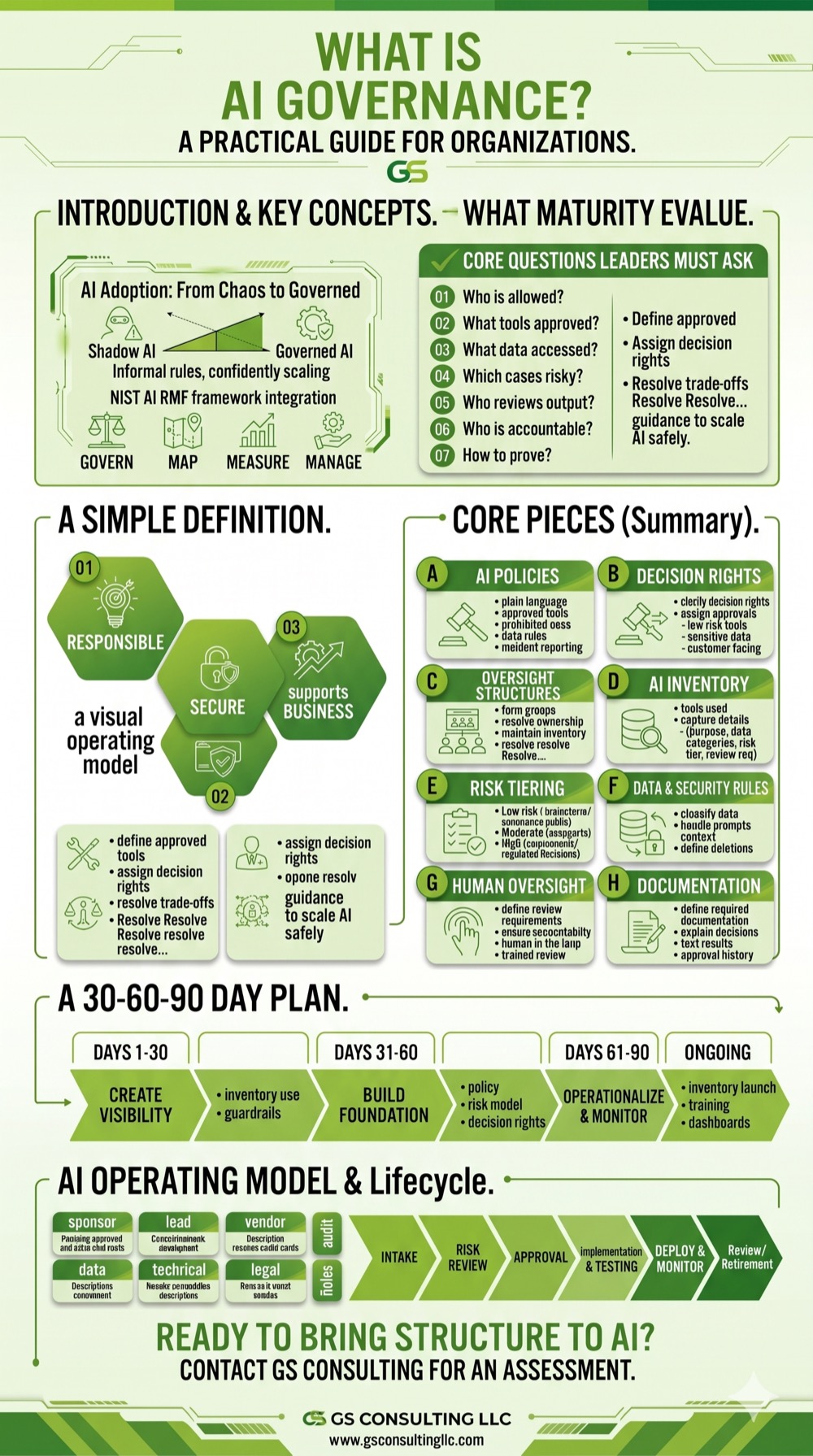
What Is an AI Governance Framework?
An AI governance framework is the operating system for AI inside the organization.
It defines who can approve AI use, which tools are allowed, what data AI can access, which use cases need deeper review, when human judgment is required, what records must be kept, how vendors are reviewed, how outputs are monitored, and what happens when AI creates a security, privacy, compliance, legal, or operational problem.
NIST's AI Risk Management Framework is useful because it organizes the work into plain operating functions: Govern, Map, Measure, and Manage. That is the right mental model. AI governance is not one document. It is a lifecycle.
Why Regulated Organizations Need a Stronger Model
Every organization needs some AI rules. Regulated organizations need something stronger because the consequences are different.
When AI touches customer data, employee data, patient data, financial records, government controlled information, intellectual property, audit evidence, cybersecurity data, or contract sensitive information, the organization may need to prove what happened later. That proof does not appear magically during an audit, incident, customer review, or regulator inquiry. It has to be designed into the workflow.
They may also need to prove how decisions were made. If AI summarizes a compliance issue, supports a hiring workflow, triages a cyber alert, drafts a customer response, reviews a loan file, analyzes claims, or prepares a regulated report, leadership may need to explain what the AI did, what data it used, who reviewed the output, and whether the result was accurate.
The regulatory environment is also moving toward more formal AI oversight. The EU AI Act uses an approach based on risk and phases in obligations for different AI categories and use cases. Even when a specific law does not apply directly, the direction is clear: organizations will be expected to know where AI is used and how risk is controlled.
Cybersecurity agencies are also warning organizations to be careful with more autonomous AI. Joint guidance on agentic AI highlights risks related to broad access, autonomy, integrations, and the need to align AI adoption with existing security models and risk posture.
Original Research: AI Governance Is Becoming an Evidence Burden
The strongest AI governance signal is not "write a policy." It is "produce evidence."
GS Consulting analyzed 13 public AI governance, security, legal, and sector regulator sources against 18 AI governance controls. The pattern was clear: regulated organizations are being pushed toward records, logs, approvals, testing evidence, monitoring, vendor documentation, data controls, and audit trails.
That matters because evidence is what leadership, customers, auditors, regulators, boards, and incident response teams ask for when something goes wrong, or when they need confidence that something will not.
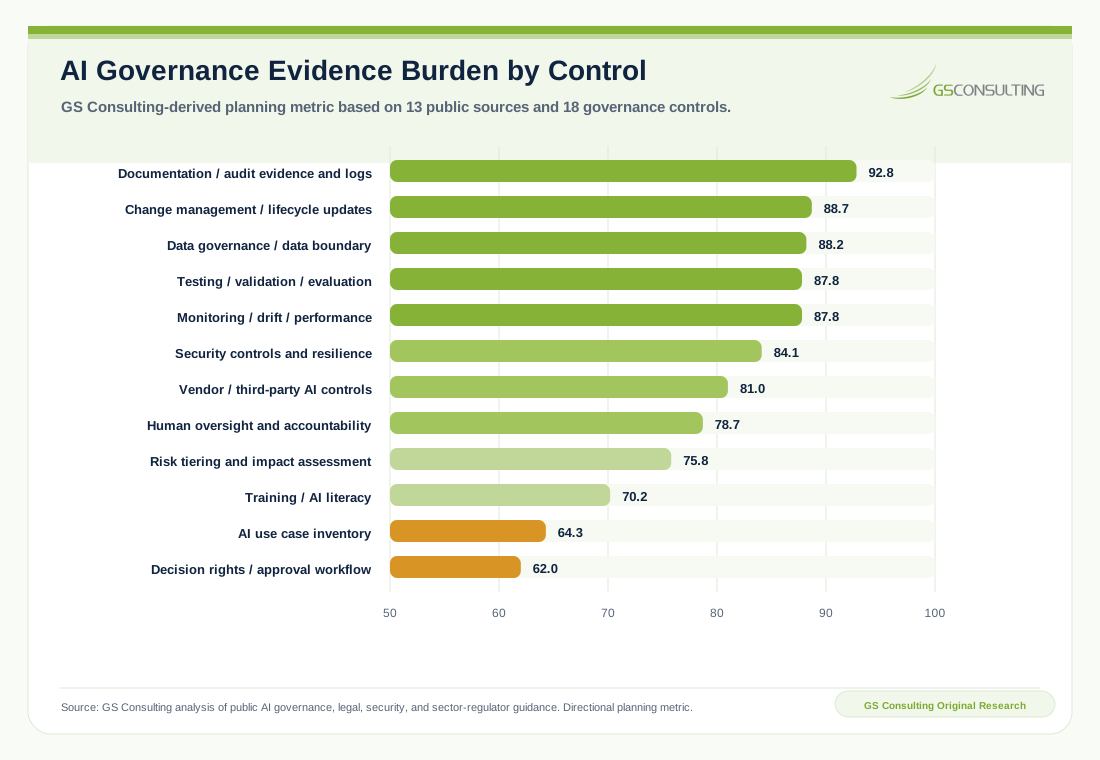
The strongest signal is not simply "write an AI policy." It is "produce evidence." Documentation and audit evidence scored highest because regulators, auditors, customers, boards, and incident response teams need records that explain how AI systems were approved, tested, changed, monitored, and controlled.
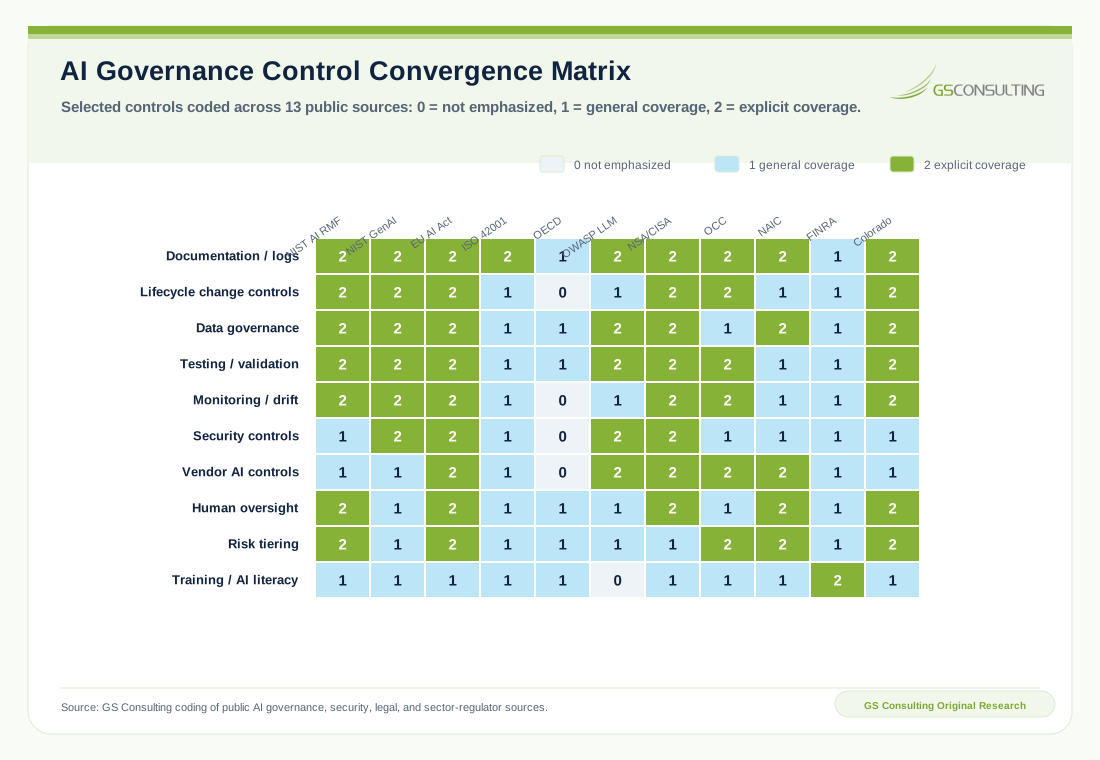
What this means for regulated organizations
AI governance maturity is going to be measured less by whether the organization has a policy and more by whether it can prove how AI is approved, tested, changed, monitored, and controlled.
That means the AI inventory is only the beginning. Higher risk use cases need deeper evidence for data governance, security testing, human oversight, vendor review, monitoring, audit documentation, and change management.
Methodology and caveat
Sources included NIST AI RMF, the NIST Generative AI Profile, the EU AI Act, ISO/IEC 42001 public information, OECD AI Principles, OWASP Top 10 for LLM Applications, NSA/CISA/allied AI security guidance, OCC model risk management guidance, NAIC insurance AI guidance, FINRA generative AI guidance, and Colorado ADMT legislation. Each source control intersection was coded from 0 to 2 and converted into a weighted 0 to 100 Evidence Burden Score. The score is a GS Consulting derived planning metric, not an official compliance score, legal conclusion, certification standard, or substitute for counsel specific to the sector.
Core Components of an AI Governance Framework
A useful AI governance framework does not need to be complicated. It needs to answer the questions that matter before AI gets too deep into the workflow.
These are the components regulated organizations should build.
1. AI Governance Charter
The charter explains why the framework exists, what it covers, who owns it, and how decisions get made. It should make one thing clear: AI governance is not owned by innovation alone. It has to connect business leadership, cybersecurity, privacy, legal, compliance, audit, procurement, data governance, and enterprise risk.
The charter should make one point explicit: governance applies not only to internally built AI systems, but also to AI features inside vendor platforms. AI may already be embedded in HR systems, CRM tools, cybersecurity platforms, collaboration tools, productivity suites, service desk tools, finance systems, and customer support platforms.
2. AI Use Case Inventory
You cannot govern what you cannot see. The AI use case inventory is a central record of AI tools, pilots, vendor AI features, internally developed models, workflows facing customers, internal workflows, contractor use, and AI agents or automation tools with system access.
For each use case, capture the business owner, technical owner, vendor or model provider, purpose, users, workflow supported, data categories, systems connected, risk tier, human review requirements, approval status, monitoring requirements, and next review date. The first inventory will be messy. That is fine. A messy inventory is better than a clean fiction.
3. AI Risk Tiering
Not every AI use case deserves the same review. Treating everything as high risk slows the business down. Treating everything as low risk creates exposure the organization may not see until it is too late.
Use approved tools, basic rules, and user guidance.
Require approved data boundaries, human review, logging, and owner approval.
Require stronger testing, documentation, oversight, monitoring, and risk acceptance.
Some uses should be prohibited or restricted, such as entering regulated data into unapproved public AI tools, allowing AI to make final employment decisions without human review, giving AI agents broad access to sensitive systems, or using legal or compliance conclusions generated by AI without qualified review.
4. AI Policy and Acceptable Use Rules
The AI policy should be written for employees, not for a binder.
People need to know which tools are approved, which tools are prohibited, what data can be entered, what data cannot be entered, when outputs must be checked, when use facing customers needs approval, how incidents are reported, and who can answer questions.
Vague instructions such as "use AI responsibly" are not enough. A useful policy gives concrete examples, especially for customer records, employee records, protected health information, financial account data, government controlled information, security logs, source code, contract sensitive information, and confidential business information.
5. Decision Rights and Approval Workflow
AI governance breaks down when nobody knows who can say yes.
The framework should define who approves low risk use, who approves tools and integrations, who reviews personal data, who reviews regulated workflows, who reviews use facing customers, who accepts high risk use, and who can stop a use case when risk changes.
A practical intake form should ask what problem the team is solving, what AI tool or vendor will be used, who will use it, what data it will access, whether it affects customers, employees, regulated decisions, or contractual obligations, whether it connects to enterprise systems, whether AI output will be used in final decisions, where human review will occur, what value is expected, and what could go wrong.
6. Oversight Structure
The oversight group does not need a fancy name. It needs a real job.
Call it an AI governance board, steering committee, responsible AI council, or AI risk committee. The name matters less than whether the group can set direction, resolve tradeoffs, approve higher risk use cases, maintain standards, and monitor the portfolio.
The group should include the right mix of business and control functions: executive sponsor, business leaders, IT, cybersecurity, data governance, privacy, legal, compliance, internal audit or risk, procurement or vendor management, and major AI using functions such as HR, finance, operations, or customer support.
7. Data Governance for AI
AI governance is data governance with a faster failure mode.
Prompts, outputs, summaries, embeddings, logs, generated records, and retrieval indexes can all carry risk. Regulated organizations need to define what data AI can use, where that data can go, who can access it, how long it is retained, whether vendors can train on it, and how outputs inherit sensitivity from source data.
This is especially important for AI tools connected to internal repositories. A user should not be able to retrieve sensitive information through AI that they could not access directly. Retrieval that respects permissions is not optional in regulated environments.
8. Security Controls for AI Systems
AI does not replace normal security work. It adds new ways for normal security failures to become harder to see.
Weak access, excessive permissions, vendor exposure, data leakage, insecure plug ins, prompt injection, improper output handling, and excessive agency all need to be part of the security review.
Controls should include identity and access management, access control based on role, least privilege, privileged access management, data loss prevention, encryption, prompt and output logging where appropriate, secure API design, restrictions on plug ins and external tools, secure retrieval and vector database controls, monitoring for unusual use, testing for prompt injection, output validation before downstream execution, incident response procedures, and vendor security review.
9. Human Oversight and Accountability
"Human in the loop" is not enough.
A useful framework defines who reviews AI outputs, when review happens, what reviewers check, whether they can override the AI, whether review is documented, and who owns the final decision. Without that detail, "human review" becomes a phrase people use to avoid answering the harder question: who is accountable?
For high risk workflows, review should be formal. If AI supports a hiring decision, financial decision, legal conclusion, regulated report, cybersecurity action, medical workflow, or customer eligibility decision, the organization should define exactly where human judgment applies. AI can assist, recommend, draft, and summarize. Accountability should stay with a named person or role.
10. Documentation and Auditability
Regulated organizations need records because AI decisions often have to be explained later.
For moderate and high risk use cases, documentation should show what the system does, who owns it, what data it uses, how it was approved, how it was tested, how vendors were reviewed, how humans remain accountable, how changes are managed, and how monitoring works.
Useful records include the use case description, business owner, technical owner, vendor or model provider, risk tier, data categories, data sources, connected systems, human oversight model, testing results, known limitations, approval history, security review, privacy review, compliance review, vendor review, monitoring plan, incident response plan, and change history.
Auditability matters because AI use may need to be explained later. If a regulator, auditor, customer, board member, contracting officer, patient, employee, or executive asks how AI was used, the organization should be able to answer clearly.
11. Vendor and Third Party Risk Management
A lot of AI risk will arrive through tools the organization already bought.
Vendors are adding AI features to HR systems, CRMs, cybersecurity platforms, collaboration tools, finance systems, service desks, and customer support platforms. That does not mean those features are approved for regulated data.
Vendor review should address what data the vendor processes, where data is stored, whether prompts and outputs are retained, whether customer data is used for model training, whether vendor staff can access customer content, subprocessors, logs, access based on role, data deletion, security documentation, contractual terms, incident reporting, and how model or product changes are communicated.
The framework should also address AI embedded in existing vendor platforms. A vendor may add an AI feature to a product the organization already uses. That does not automatically mean the feature is approved for regulated data.
12. Testing, Evaluation, and Monitoring
AI governance does not end when the pilot works.
Testing should prove the use case is accurate, reliable, secure, explainable enough for the risk, and safe inside the workflow. Monitoring should prove it stays that way after launch, after vendor changes, after usage expands, and after the business starts relying on it.
Testing should cover accuracy, reliability, bias or fairness concerns where relevant, data leakage risk, prompt injection resilience, output quality, human review effectiveness, user acceptance, failure behavior, security controls, compliance requirements, and integration behavior.
Monitoring should track usage, errors, human override rates, output acceptance rates, user complaints, security events, unexpected outputs, vendor changes, model drift, cost spikes, policy violations, incident reports, and business value. A use case that was low risk during a pilot may become higher risk after integration expands.
13. AI Incident Response
AI incidents will not always look like classic security incidents.
They may involve sensitive data entered into an unapproved tool, content generated by AI sent to a customer without review, a prompt injection issue, an agent taking the wrong action, a vendor model change, a degraded workflow, or records the organization cannot explain.
The incident response process should define how employees report AI issues, who investigates, how evidence is preserved, when legal, compliance, security, privacy, or audit is notified, when external notification may be needed, how the AI workflow is paused or restricted, how remediation is tracked, and how lessons learned are fed back into governance.
14. Training and AI Literacy
Governance fails when employees have to guess.
Training should give employees practical rules: which tools are approved, what data is prohibited, when outputs need verification, when to escalate, how to report issues, and when not to use AI at all.
Managers need to know how AI affects workflows, when to escalate, and how to prevent shadow AI. Technical teams need AI security, integration, logging, data access, testing, and monitoring guidance. Legal, compliance, privacy, audit, and risk teams need to know how AI is being used and what evidence is required.
AI Governance Framework Structure
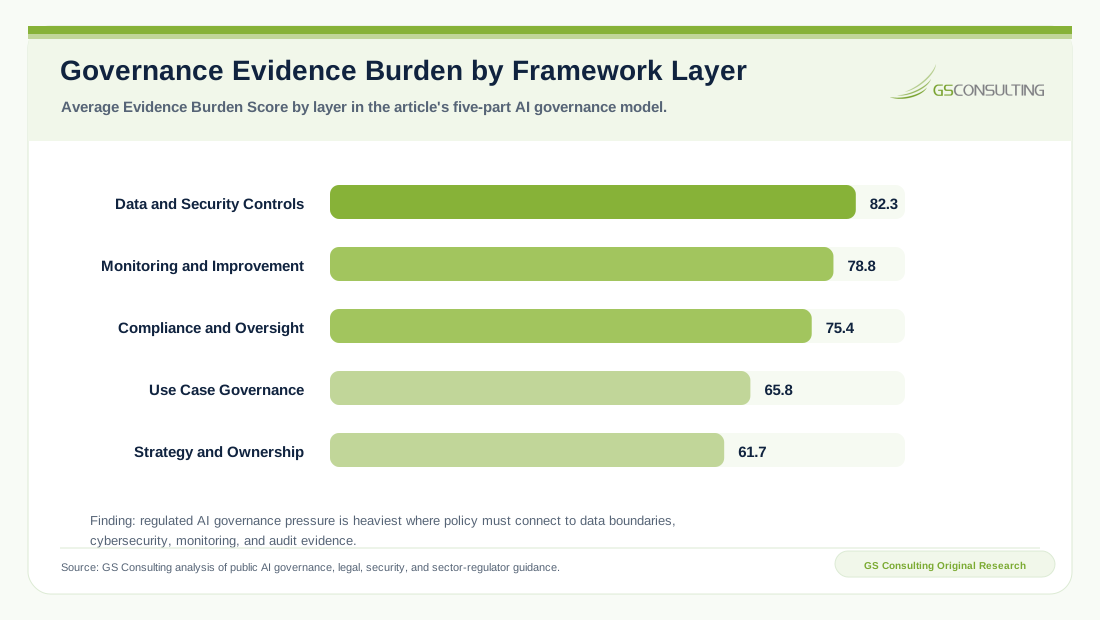
A practical framework can be organized into five layers. The layers are not academic categories. They are the operating model.
Each layer should produce artifacts the organization can use: ownership, intake, data rules, security controls, review checklists, evidence, monitoring, and escalation paths.
Key artifacts: AI charter, executive sponsor, operating model, decision rights.
Key artifacts: AI inventory, intake form, risk tiering model, review cadence.
Key artifacts: data rules, access controls, security review, logging expectations.
Key artifacts: review checklists, documentation, audit evidence, approval records.
Key artifacts: metrics, dashboards, incident process, change review, executive reporting.
Example: How the Framework Works in Practice
Imagine a regulated financial services company wants to use AI to help customer support representatives draft responses.
Without governance, the team might connect a generic AI tool to customer messages and start drafting replies. That sounds efficient for about five minutes. Then the real questions show up: What customer data is being processed? Does the vendor retain prompts or outputs? Are responses accurate? Are employees making commitments the company did not approve? Are outputs logged? Can compliance reconstruct what happened? What happens when the model is wrong?
With governance, the business owner submits the use case. The governance team classifies the risk. Privacy reviews customer data. Legal reviews customer communication exposure. Security reviews the vendor and access controls. Compliance defines the records that need to exist. The team limits AI to approved knowledge sources. AI drafts the response, a human approves before sending, outputs are logged in the customer support system, and metrics track accuracy, handling time, escalation rate, and customer complaints.
That does not block the use case. It makes the use case trustworthy.
Common Mistakes to Avoid
Most AI governance problems do not start with a bad model. They start with a bad assumption.
Mistake 1: Starting with a policy but no operating model. A policy can set expectations. It cannot approve use cases, review vendors, classify data, test outputs, monitor drift, or preserve evidence by itself.
Mistake 2: Treating all AI use cases the same. A public information summarization tool and an AI workflow that touches employment, healthcare, credit, legal, cybersecurity, safety, or customer eligibility decisions should not go through the same review.
Mistake 3: Ignoring AI embedded inside existing SaaS platforms. A vendor adding an AI feature does not automatically make that feature approved for regulated data, customer records, employee data, security logs, or contract sensitive information.
Mistake 4: Failing to maintain an AI inventory. If leadership cannot see where AI is being used, it cannot manage risk, answer customer questions, support audits, or stop shadow AI from spreading.
Mistake 5: Relying on "human review" without defining the review. Human review means very little unless the organization defines who reviews, what they check, when they escalate, how overrides work, and what evidence is kept.
Mistake 6: Skipping vendor and third party risk review. Many AI risks sit outside the organization's walls: model training, data retention, subprocessors, support access, logging, deletion, product changes, and incident notification.
Mistake 7: Keeping weak records for regulated workflows. If AI affects a regulated workflow, customer communication, security action, report, eligibility decision, or audit trail, assume someone may ask later how the work was done.
Mistake 8: Making governance so slow that teams avoid it. Bad governance creates shadow AI. The process has to be fast enough for low risk use and serious enough for high risk use.
30 60 90 Day Plan: Move From Guessing to Governing
Ninety days is enough time to stop guessing.
The goal is not to solve every AI governance issue in one quarter. The goal is to create visibility, set interim guardrails, define decision rights, build the first evidence packet, and get the highest risk use cases into a review process.
- Days 1 to 30Find the AI and set interim guardrails.
Inventory AI tools, pilots, vendor features, browser extensions, embedded AI, and shadow AI risks. Identify sensitive data categories. Issue interim rules. Assign an executive sponsor. Form a working group across business, IT, security, privacy, legal, compliance, procurement, audit, and risk.
- Days 31 to 60Build the governance foundation.
Create the AI charter, intake form, risk tiering model, approved tool list, prohibited use rules, data handling rules, vendor checklist, documentation template, and initial evidence requirements.
- Days 61 to 90Operationalize and monitor.
Review priority use cases, launch the AI inventory, train employees, define monitoring metrics, create AI incident response procedures, select controlled pilots, and establish an executive reporting cadence.
By the end of 90 days, leadership should be able to answer six questions without scrambling: Where are we using AI? What data does it touch? Which uses are approved? Who owns the risk? What evidence exists? What do we do when something goes wrong?
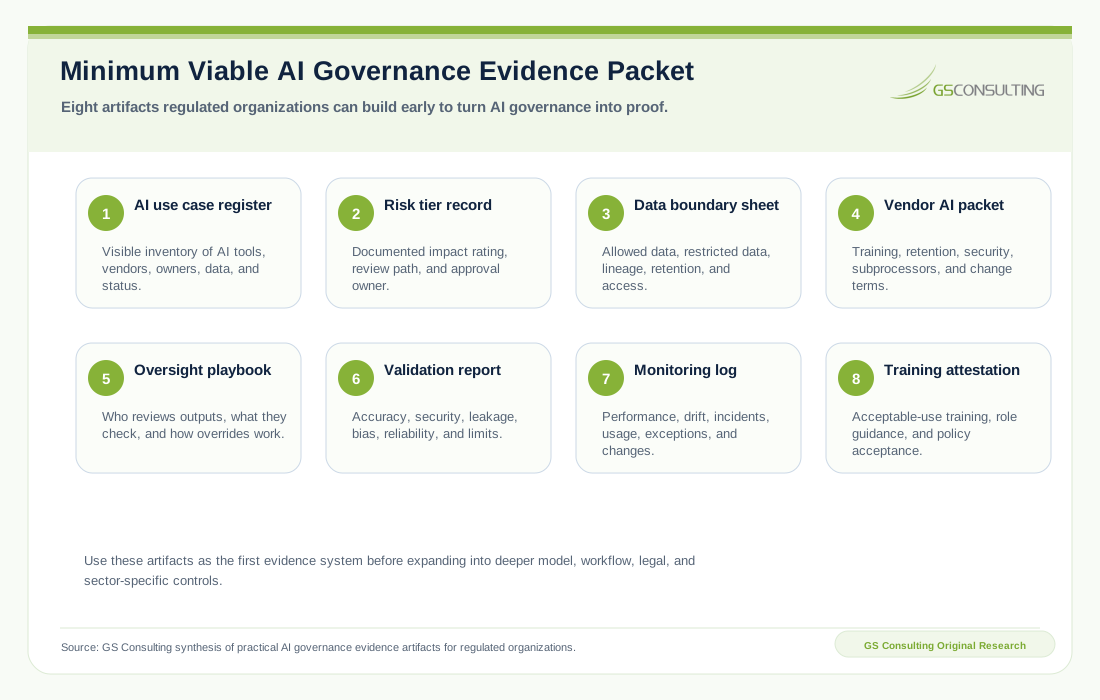
What the Framework Should Produce
A strong AI governance framework should leave behind artifacts people actually use.
If the framework only produces a policy, it is not enough. Regulated organizations need records, checklists, inventories, approvals, logs, training evidence, vendor documentation, and monitoring outputs that support audits, customer diligence, board oversight, incident response, and regulator questions.
- Charter
AI governance charter, executive sponsor, ownership model, scope, and decision rights.
- Policy
Approved tool list, prohibited use rules, acceptable use examples, and data entry restrictions.
- Inventory
AI use case register, intake form, risk tiering model, owner fields, and review cadence.
- Controls
Data handling matrix, security review checklist, access controls, logging expectations, and integration rules.
- Oversight
Human review standards, privacy and compliance checklists, approval records, and audit evidence model.
- Vendors
Vendor review checklist, contract requirements, model change review, data retention terms, and incident notification process.
- Monitoring
Dashboards, performance metrics, issue tracking, drift review, policy violations, and executive reporting cadence.
- Response
AI incident response process, remediation workflow, evidence preservation, escalation paths, and feedback loop from lessons learned.
The Bottom Line
Regulated organizations do not need to avoid AI. They need to stop pretending AI can be governed with informal rules and good intentions.
The best AI governance frameworks are built around clarity: what is allowed, what is prohibited, who owns decisions, what data can be used, how outputs are reviewed, how vendors are controlled, what evidence exists, and how the organization responds when something goes wrong.
That is not bureaucracy. That is how regulated organizations move faster without losing control.
AI governance should make the business more confident, not more confused. It should give employees a safe path to use approved tools, give leaders a clear view of risk, give security and compliance practical review points, and give auditors, customers, boards, and regulators evidence they can trust.
The advantage is not having the longest AI policy. The advantage is having cleaner answers.
GS Consulting helps regulated organizations design AI governance frameworks that connect policy, oversight, risk controls, documentation, security, compliance, vendor review, audit readiness, and practical AI adoption.
Ready to build AI governance your teams can actually use?
GS Consulting helps regulated organizations design AI governance frameworks that connect policy, ownership, data rules, security controls, vendor review, human oversight, audit evidence, monitoring, incident response, and practical AI adoption.
Contact GS ConsultingSources and Related Reading
- NIST: AI Risk Management Framework
- NIST AI Resource Center: AI RMF Playbook
- European Commission: AI Act
- CISA, NSA, and partners: Careful Adoption of Agentic AI Services
- ISO/IEC 42001: Artificial intelligence management systems
- OWASP Top 10 for Large Language Model Applications
- AI Governance, Risk, and Human Oversight
- NIST AI RMF Implementation Walkthrough
- What Is AI Governance?
- Enterprise AI Maturity Assessment