
AI Governance | | 18 min read
What Is AI Governance? A Practical Guide for Organizations

Key Takeaways
AI adoption has to move fast and stay controlled.
Start With Mission Value
Prioritize use cases tied to measurable business, delivery, or mission outcomes.
Protect the Data Boundary
Define what data AI tools can touch before selecting vendors or architectures.
Keep Humans Accountable
Use AI to support workflows while retaining trained review and escalation paths.
Document the Controls
Maintain inventories, testing evidence, monitoring plans, and risk decisions.
AI governance is one of those phrases that can sound bigger and more complicated than it needs to be. At its core, AI governance is how an organization makes sure AI is used responsibly, securely, and in a way that supports the business.
It answers the questions leaders eventually have to ask: who is allowed to use AI, what tools are approved, what data can AI access, which use cases are too risky, who reviews the output, who is accountable if AI makes a mistake, and how the organization proves what happened if a customer, auditor, regulator, employee, or executive asks.
That is AI governance. It is not about slowing the business down. It is about giving the business enough structure to use AI with confidence.
As AI moves from individual productivity into real workflows across customer support, HR, IT, finance, compliance, cybersecurity, sales, operations, and executive decision-making, informal rules are no longer enough. Organizations need policies, decision rights, oversight structures, documentation, risk controls, and clear accountability.
Need practical AI governance?
GS Consulting helps organizations define AI policies, decision rights, risk tiers, review procedures, vendor controls, human oversight, documentation, and secure operating models.
Request an AI Governance Assessment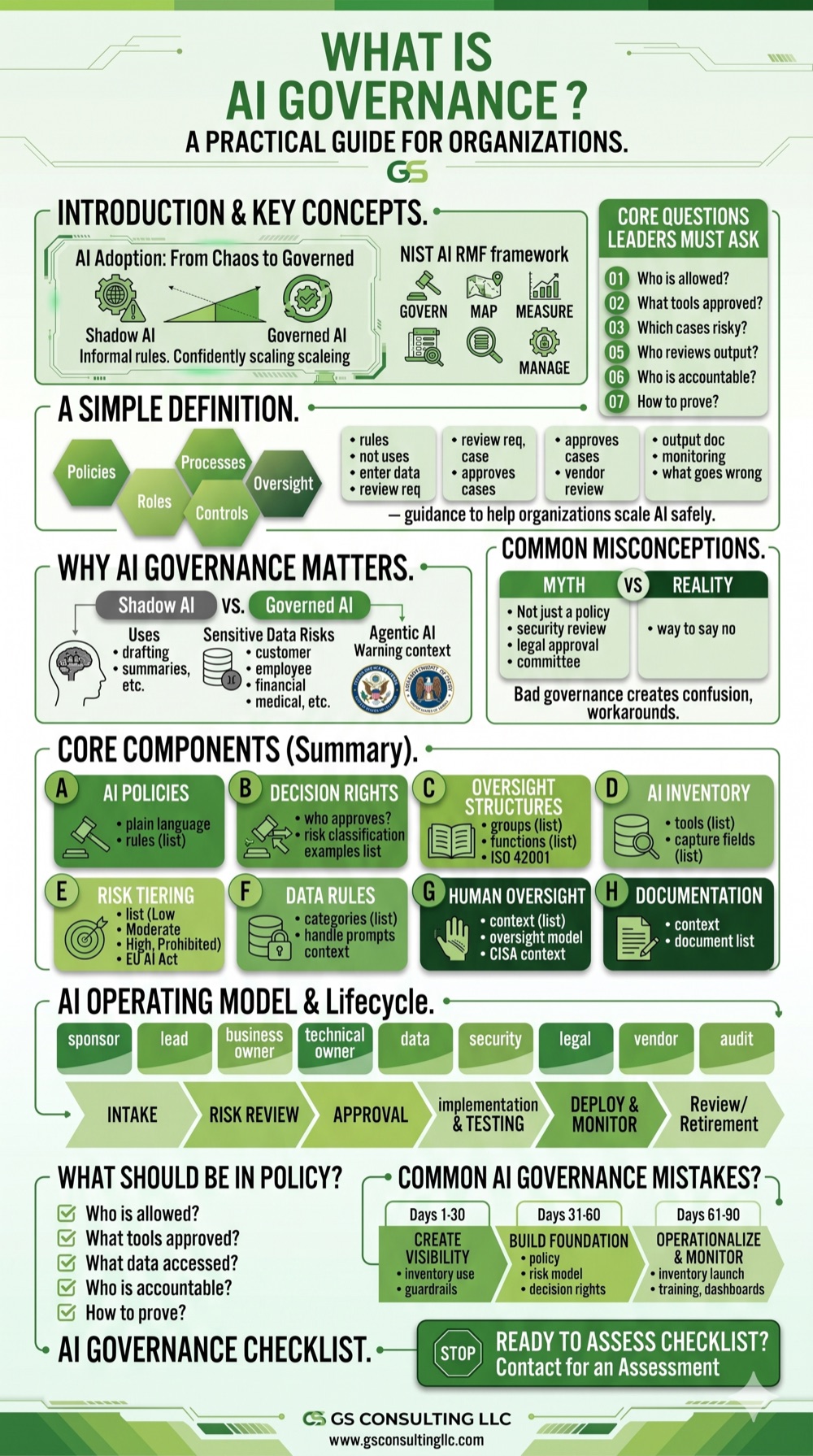
A Simple Definition of AI Governance
AI governance is the system of policies, roles, processes, controls, and oversight an organization uses to guide how AI is selected, built, deployed, monitored, and used.
In plain English: it is the operating model for AI.
A good AI governance program tells people what they can use AI for, what they should not use AI for, what data they can enter into AI tools, when human review is required, who approves higher-risk AI use cases, how vendors are reviewed, how AI outputs are documented, how AI systems are monitored after launch, and what happens when something goes wrong.
The goal is not to create bureaucracy for its own sake. The goal is to prevent avoidable mistakes while helping the organization scale AI safely.
Why AI Governance Matters
Most organizations already have more AI use than leadership realizes. Employees may be using public AI tools to draft documents, summarize meetings, write code, analyze spreadsheets, create presentations, research competitors, or troubleshoot problems. Departments may be testing AI features inside platforms they already own. Vendors may be adding AI capabilities into products without the business fully understanding what data is processed or retained.
Some of that usage may be harmless. Some of it may create risk. The risk grows when AI is used with sensitive data, customer records, employee information, financial data, security logs, proprietary business information, legal documents, government data, or regulated workflows.
NIST's AI Risk Management Framework describes AI risk management around four functions: Govern, Map, Measure, and Manage. That is a useful way to think about AI governance: define who owns AI, understand where and how it is used, test and measure the risks, and manage those risks over time.
AI governance matters even more as AI systems become more capable. AI can now retrieve information, classify requests, recommend decisions, call tools, trigger workflows, write back to systems, and operate with increasing autonomy. CISA and international partners have warned that agentic AI can introduce security challenges through autonomy, integrations, downstream use, excessive privileges, and accountability gaps.
What AI Governance Is Not
AI governance is not just a policy document sitting in a shared drive. It is not just an IT security review. It is not just legal approval. It is not just a committee. And it is not a way to say no to every AI idea.
Real AI governance is practical. It helps teams move faster because they know the rules. A marketing team knows what data it can use. An HR team knows which AI use cases require legal review. A service desk team knows when AI can draft a response and when a technician must approve it. A compliance team knows how AI outputs are stored and audited. Executives know who owns the risk.
Good governance gives AI a safe path into the business. Bad governance creates confusion, workarounds, and shadow AI.
The Core Pieces of AI Governance
A strong AI governance program usually includes ten practical components.
1. AI Policies
An AI policy explains how people in the organization are allowed to use AI. It should be written in plain language. Employees should not need to be lawyers, data scientists, or cybersecurity experts to understand it.
A practical AI policy should cover approved AI tools, prohibited AI tools, approved use cases, prohibited use cases, sensitive data rules, customer data rules, employee data rules, prompt and output handling, human review requirements, AI-generated content, customer-facing work, regulated or high-impact decisions, incident reporting, and consequences for unsafe use.
The policy should also make clear that AI output is not automatically correct. Employees should verify outputs before relying on them, especially in legal, compliance, customer, financial, HR, cybersecurity, or operational settings.
2. Decision Rights
Decision rights answer one of the most important AI governance questions: who gets to approve what?
Not every AI use case needs executive review. A low-risk tool that helps employees summarize public information should not go through the same process as an AI workflow that recommends hiring decisions, reviews financial transactions, analyzes medical records, or takes action inside production systems.
Decision rights should define who can approve low-risk AI tools, who reviews sensitive data use, who approves customer-facing AI, who approves AI that affects employees, who approves AI that writes back to enterprise systems, who approves AI vendors, who accepts residual risk, and who can pause or shut down an AI system.
3. Oversight Structures
AI governance needs an oversight structure, but it does not need to be complicated. A larger organization may create an AI governance council or responsible AI committee. A smaller organization may use a working group that includes leadership, IT, security, legal, compliance, data, and business owners.
The structure matters less than the function. The oversight group should review higher-risk AI use cases, approve AI policies and standards, maintain the AI inventory, resolve ownership questions, review AI incidents and exceptions, track regulatory and customer requirements, monitor AI performance and risk, set priorities for AI investment, and make sure AI is connected to business outcomes.
ISO/IEC 42001 provides a useful management-system approach here. ISO describes it as an international standard for establishing, implementing, maintaining, and continually improving an AI management system for responsible development, provision, or use of AI systems.
4. AI Use Case Inventory
An organization cannot govern AI it cannot see. An AI inventory is a list of where AI is being used, who owns it, what tool or model is involved, what data it touches, what workflow it supports, and what risks are associated with it.
The inventory should include internal AI tools, vendor AI features, pilots, automation workflows, chatbots, copilots, AI agents, machine learning models, generative AI tools, AI used by subcontractors or service providers, and AI embedded in SaaS platforms.
For each use case, capture the business owner, technical owner, vendor or model provider, purpose, users, data categories, risk tier, human review requirements, approval status, monitoring requirements, and renewal or review date.
5. Risk Tiering
Not all AI use cases carry the same risk. A practical governance program should classify AI use cases by risk level.
Requires basic rules, approved tools, and user guidance.
Requires approved data sources, human review, logging, and owner approval.
Requires stronger testing, documentation, monitoring, and risk acceptance.
Some uses may be prohibited or restricted, such as entering sensitive customer data into public tools, using AI to make final employment decisions without review, allowing AI to access systems with broad privileges, or treating AI output as final legal or compliance advice without qualified human approval.
The EU AI Act is one example of a formal risk-based regulatory approach. The European Commission says the AI Act entered into force on August 1, 2024, and is generally applicable on August 2, 2026, with some provisions applying earlier or later. Even if an organization is not directly subject to the EU AI Act, the risk-based mindset is useful.
6. Data Rules
AI governance is impossible without data governance. The most common AI governance failure is letting sensitive data flow into the wrong tool.
An AI policy should clearly define what data can and cannot be used with AI systems. Data categories may include public information, internal business information, confidential company data, customer data, employee data, financial data, legal data, health information, security logs, source code, trade secrets, government-controlled information, classified information, or highly restricted data.
The governance program should also define how prompts, outputs, logs, embeddings, and summaries are handled. This matters because AI output can become sensitive even if the output looks different from the source material.
7. Human Oversight
Human oversight is one of the most important parts of AI governance. The question is not simply whether a human is in the loop. The question is what the human is responsible for, when they review the output, and whether they have enough context to catch mistakes.
Human review should be required when AI affects customer commitments, legal or compliance conclusions, employment decisions, financial approvals, security enforcement, healthcare or safety decisions, regulated reporting, high-value transactions, access to sensitive systems, public communications, or contractual obligations.
A good oversight model defines whether AI can assist, recommend, draft, route, escalate, act only with approval, or act automatically in narrow low-risk cases. The more autonomy AI has, the stronger the oversight should be.
8. Documentation
AI governance needs documentation because people change, systems change, vendors change, and decisions need to be explainable later. Documentation should not be excessive, but it should be useful.
For important AI use cases, document the purpose of the AI system, business owner, technical owner, vendor or model provider, data sources, data sensitivity, user groups, human review requirements, known limitations, testing results, approval history, risk assessment, security controls, compliance review, monitoring plan, incident response process, and change history.
If an auditor, regulator, customer, board member, or executive asks why an AI tool was used, who approved it, what data it touched, and how it was monitored, the organization should be able to answer.
9. Security Controls
AI governance must include security controls. AI systems introduce familiar security risks and AI-specific risks. Familiar risks include data leakage, weak access controls, vendor exposure, insecure APIs, and excessive permissions. AI-specific risks include prompt injection, sensitive information disclosure, insecure plug-ins, model or data poisoning, and excessive agency.
OWASP's Top 10 for Large Language Model Applications identifies risks such as prompt injection, insecure output handling, sensitive information disclosure, supply chain vulnerabilities, data and model poisoning, and excessive agency.
Practical AI security controls include approved tool lists, identity and access management, least privilege, role-based access, logging and monitoring, prompt and output controls, data loss prevention, vendor security review, API security, secure retrieval and search, prompt injection testing, restrictions on agent tool access, incident response procedures, and regular access reviews.
10. Accountability
Accountability means someone owns the outcome. AI should not become a place where responsibility disappears.
If AI drafts a customer response, a human or team should own the final message. If AI recommends a hiring action, HR and the hiring team remain accountable. If AI summarizes a compliance issue, the compliance owner remains accountable. If AI triages a security alert, the security team remains accountable for investigation and response.
Accountability should be clear at three levels: business accountability for workflow outcomes, technical accountability for system performance and reliability, and risk accountability for security, legal, compliance, privacy, or risk review.
What AI Governance Looks Like in Practice
AI may answer basic PTO or benefits questions from approved documents. It should not make employment decisions.
AI may classify and route low-risk tickets. It should not grant privileged access or execute scripts without approval.
AI may extract fields and flag mismatches. It should not approve payment on its own.
AI may organize and summarize evidence. It should not make final compliance certifications.
The AI Governance Operating Model
A practical operating model does not need to be huge. It does need to be clear.
- Executive sponsor: sets direction and resolves major tradeoffs.
- AI governance lead: coordinates the governance process.
- Business owner: owns the workflow and business outcome.
- Technical owner: owns implementation, integrations, and system performance.
- Data owner: approves data access and data handling.
- Security owner: reviews cyber risk, access, logging, and monitoring.
- Legal and compliance owner: reviews regulatory, contractual, and policy exposure.
- Vendor or procurement owner: reviews AI vendors and contract terms.
- Internal audit or risk: validates governance effectiveness over time.
For smaller organizations, one person may wear multiple hats. That is fine. The important thing is that the roles are defined.
The AI Governance Lifecycle
AI governance should follow the full lifecycle of an AI use case.
- 1. IntakeCapture purpose, tool, users, data, value, and risk.
- 2. ReviewClassify the use case by data, automation, vendor, and business risk.
- 3. ApprovalApprove, reject, or revise the use case based on risk tier.
- 4. DeployBuild with approved data, access controls, review points, logging, and training.
- 5. MonitorTrack performance, adoption, errors, overrides, incidents, and vendor changes.
- 6. RetireUpdate, pause, or retire AI when performance, risk, or business need changes.
This lifecycle keeps AI governance practical and repeatable.
What Should Be in an AI Governance Policy?
A useful AI governance policy should include purpose and scope, definitions of AI tools and AI use, approved tools, prohibited tools, acceptable use rules, prohibited use rules, data classification rules, sensitive data restrictions, human review requirements, high-risk use case review process, vendor review requirements, documentation requirements, security controls, incident reporting process, monitoring and audit expectations, employee responsibilities, enforcement, and exceptions.
The policy should be supported by practical guides for departments. HR, IT, finance, legal, compliance, sales, and operations may need different examples. A single policy is helpful. Role-specific guidance is better.
Common AI Governance Mistakes
The first mistake is waiting too long. By the time leadership realizes AI needs governance, employees may already be using unapproved tools.
The second mistake is making the policy too vague. "Use AI responsibly" is not enough. Employees need examples.
The third mistake is treating all AI use the same. Low-risk drafting and high-risk decision support need different controls.
The fourth mistake is ignoring embedded AI. AI may already exist inside SaaS platforms, CRM tools, HR systems, security tools, and productivity suites.
The fifth mistake is skipping vendor review. AI vendors may retain prompts, use data for training, rely on subprocessors, change models, or introduce features that alter risk.
The sixth mistake is relying on human review without defining it. "Human in the loop" only works when the human knows what to check and has authority to act.
The seventh mistake is treating governance as a blocker. If governance is too slow or unclear, employees will find workarounds.
A 30-60-90 Day AI Governance Plan
Inventory current AI tools, AI-enabled vendor platforms, active pilots, and likely shadow AI use. Issue interim guidance for sensitive data.
Create an AI policy, use case intake process, risk-tiering model, approved tool list, vendor checklist, and data handling rules.
Launch the inventory, train employees, review priority use cases, create documentation templates, and start regular governance reviews.
AI Governance Checklist
Use this checklist as a starting point:
- Visibility
Do we know where AI is being used today?
- Approved tools
Do we have an approved AI tool list and prohibited use list?
- Data rules
Do employees know what data they can enter into AI tools?
- Risk tiers
Do we classify AI use cases by risk?
- Decision rights
Do we know who approves low, moderate, and high-risk AI use?
- Vendors
Do we review AI vendors before use?
- Oversight
Do we define human review requirements?
- Monitoring
Do we monitor AI performance after deployment?
- Incidents
Do we have an AI incident response process?
- Accountability
Do executives receive AI risk and value reporting?
If the answer to most of these questions is no, the organization does not need to panic. It needs to start building governance now.
The Bottom Line
AI governance is not about stopping AI. It is about making AI usable, safe, and accountable across the organization.
A good AI governance program gives employees clear rules, gives leaders visibility, gives security and compliance teams a review path, gives business owners ownership, and gives the organization a way to scale AI without losing control.
As AI becomes more embedded in daily work, governance will become less optional. The organizations that succeed will not be the ones that simply use the most AI. They will be the ones that know how to use AI responsibly, measure its value, and manage its risks.
GS Consulting helps organizations build practical AI governance programs, including AI policies, use case inventories, risk-tiering models, decision rights, oversight structures, vendor review processes, documentation templates, and secure AI operating models.
Ready to bring structure to AI use across your organization?
Contact GS Consulting for an AI Governance Assessment.
Contact GS ConsultingSources and Related Reading
- NIST AI Resource Center: AI RMF Core
- CISA: Guide to Secure Adoption of Agentic AI
- ISO/IEC 42001: Artificial intelligence management systems
- European Commission: AI Act
- OWASP Top 10 for Large Language Model Applications
- AI Governance, Risk, and Human Oversight
- Enterprise AI Maturity Assessment
- Secure AI Automation Readiness Assessment