Secure AI Automation | | 24 min read
AI Automation for Sensitive Data Workflows

Key Takeaways
Sensitive workflow automation starts by following the data.
Identify the data type
Distinguish the sensitivity and obligations of the records the workflow handles.
Control each data path
Map sources, model access, derived outputs, retention, and downstream systems.
Start with bounded support
Use approved sources and human review before granting authority over consequential decisions.
AI automation gets harder the moment sensitive data enters the workflow.
That is where a lot of organizations make the wrong move.
They see a repetitive process. They see manual effort. They see a team buried in documents, tickets, records, reports, cases, contracts, invoices, or customer requests. Then someone says, "AI can automate this."
Maybe it can.
But the real question is not whether AI can read the file, summarize the record, draft the response, or route the case. The real question is whether your organization can control what happens to the data before, during, and after AI touches it.
Sensitive data workflows are not normal automation projects. They involve information that can create security risk, privacy risk, compliance risk, contract risk, customer risk, employee risk, or audit risk if it is mishandled.
Need to automate sensitive workflows without losing control?
GS Consulting helps regulated organizations map sensitive data workflows, define AI boundaries, review vendors, design approval gates, build evidence packets, and launch controlled secure AI automation pilots.
Request a Sensitive Data AI AssessmentSensitive Data Is Not One Category
The first mistake is treating all sensitive data the same.
It is not the same.
CUI is not the same as PHI. PHI is not the same as employee data. Employee data is not the same as customer data. Customer data is not the same as financial records. Contract data is not the same as cybersecurity logs.
They may all be sensitive, but they do not carry the same rules, risks, owners, or handling requirements.
Controlled Unclassified Information is unclassified government information that still requires safeguarding or dissemination controls under law, regulation, or government wide policy. Protected Health Information is individually identifiable health information held or transmitted by a covered entity or business associate in any form or media. Personally Identifiable Information includes information that can distinguish or trace a person's identity, either by itself or when combined with other linked or linkable information.
That is why sensitive data automation starts with classification. Not with the AI tool.
The Main Rule: Follow the Data
When AI automation involves sensitive data, the workflow has to be designed around the data path.
- SourceWhere does the data come from, who owns it, and where is it stored?
- AccessWho can see it, what tool can read it, and what permissions apply?
- OutputWhere do prompts and outputs go, and does the output remain sensitive?
- EvidenceWho reviews it, what gets logged, and what happens when AI is wrong?
If the organization cannot answer those questions, it is not ready to automate the workflow.
The danger is not just the original file. The danger is everything AI creates from it. If AI summarizes a contract, patient record, personnel issue, CUI document, or security incident, the summary may still need the same controls as the source data.
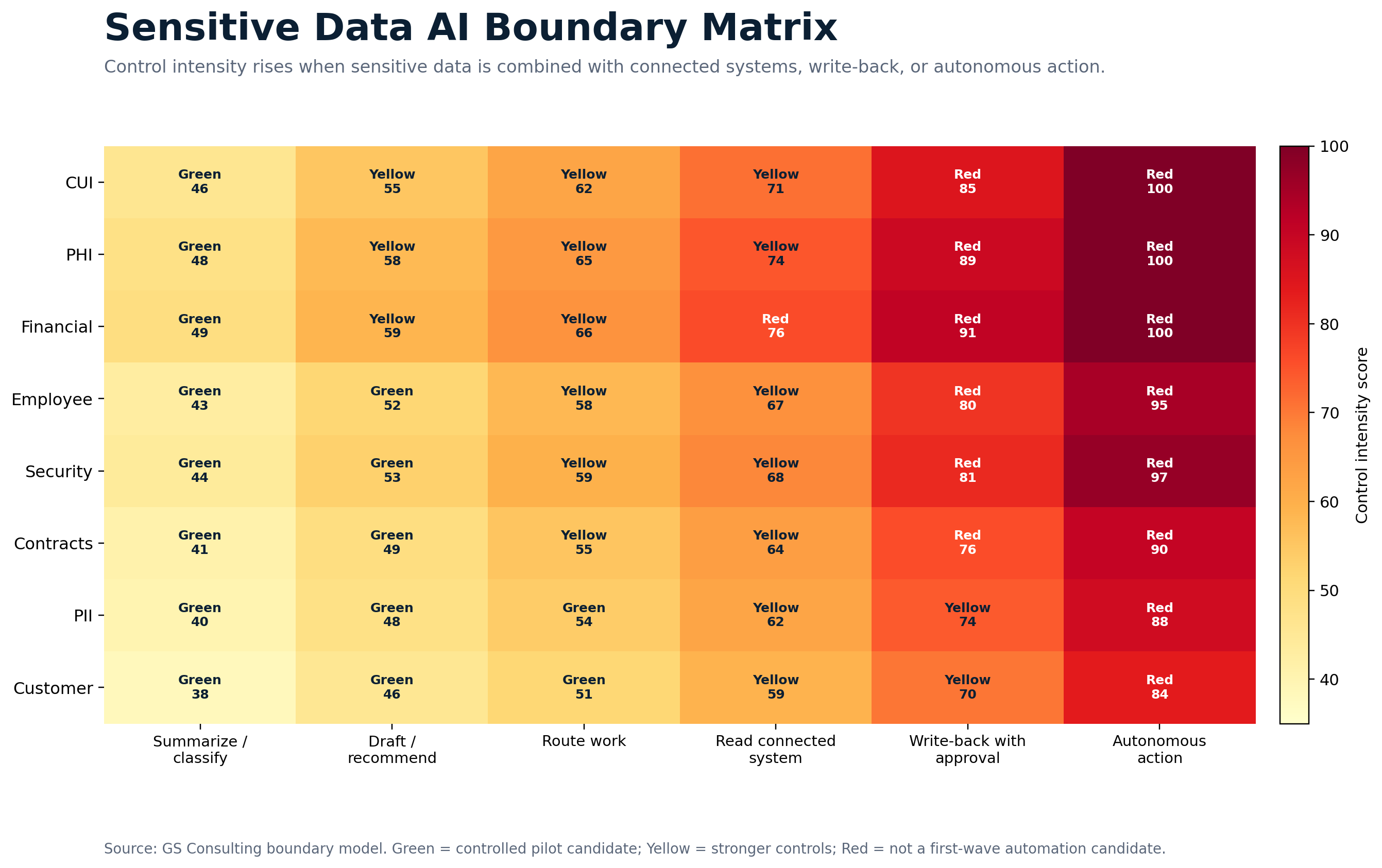
Original Research: The Sensitive Data AI Control Burden Index
Original GS Consulting research shows that sensitive data AI automation is a control burden problem.
GS Consulting analyzed public privacy, security, AI governance, service provider, and AI accountability sources to score common sensitive data categories and AI authority patterns. The source set included NARA CUI guidance, HHS HIPAA Privacy Rule materials, NIST's PII definition, the FTC Safeguards Rule, NIST AI RMF, the NIST Generative AI Profile, OWASP LLM Top 10, CISA and NSA agentic AI guidance, the EU AI Act, GAO's AI Accountability Framework, McKinsey's 2025 State of AI, IBM's 2025 CEO study, and IBM's 2026 AI control gap research.
The analysis produced three GS Consulting planning metrics: Sensitive Data Control Burden Score, AI Authority Control Burden Score, and Evidence Burden Score. These are planning tools, not official legal, regulatory, audit, privacy, HIPAA, CMMC, NIST, FTC, EU AI Act, GAO, CISA, or OWASP determinations.
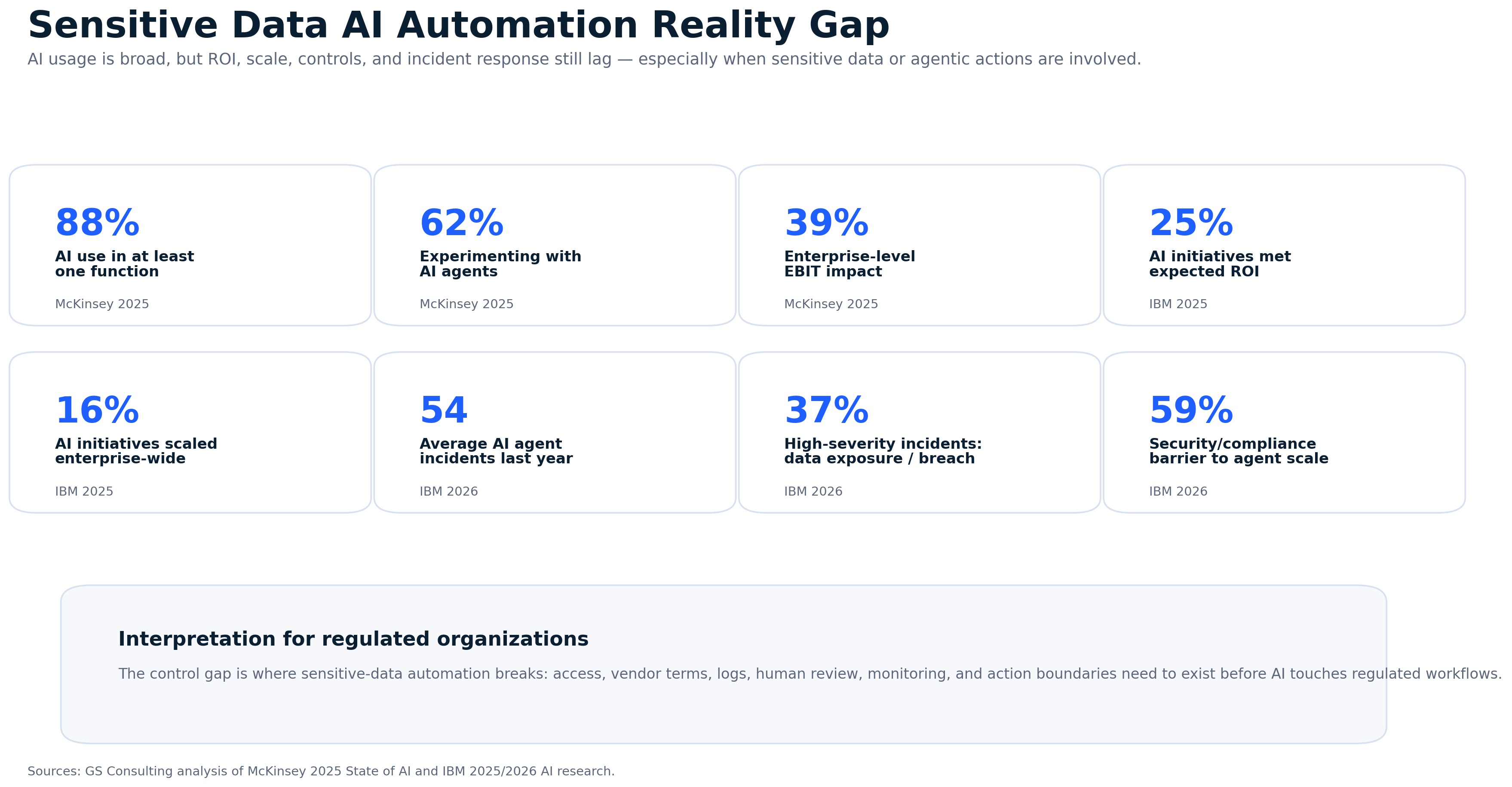
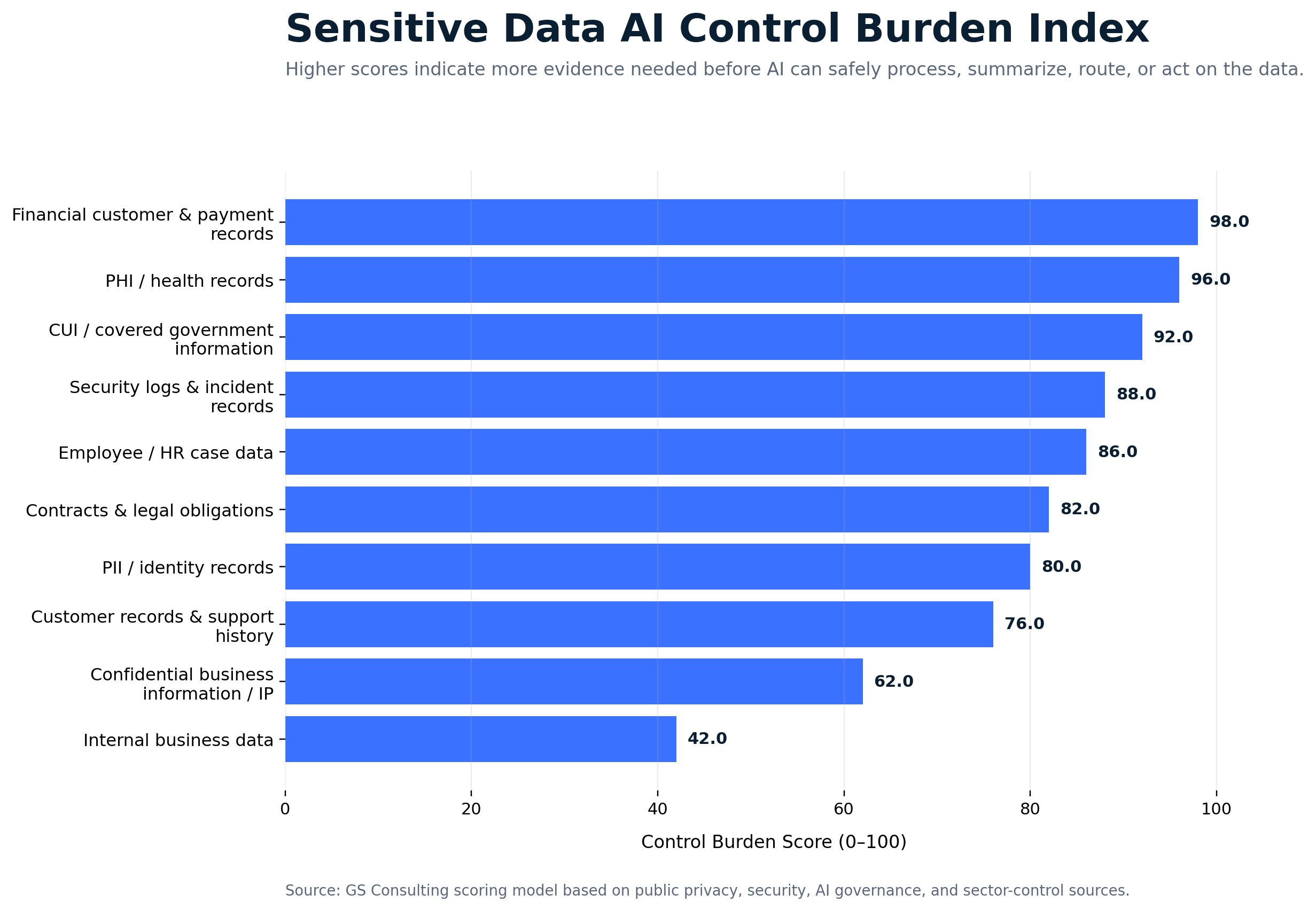
The practical message is direct: do not ask only whether the data is sensitive. Ask what AI is allowed to do with it.
Where AI Can Help Sensitive Data Workflows
There are good use cases here. Some of the best AI automation opportunities involve sensitive data because those workflows are usually manual, repetitive, expensive, and document heavy.
AI can help with document summaries, case intake, record classification, exception detection, draft responses, evidence organization, contract review support, invoice and payment exception review, customer request routing, employee support case triage, cyber alert summarization, compliance evidence checks, data quality cleanup, and workflow status reporting.
These are valuable use cases. But the AI role matters.
There is a big difference between AI preparing work for a human and AI making the final decision. For sensitive data, the safest first role is usually this: AI reads approved data, prepares a summary, classification, draft, flag, or recommendation, shows source context, and a trained person approves, edits, rejects, or escalates before anything meaningful happens.
Where AI Should Not Start
Some workflows are too risky for early AI automation. That does not mean AI will never support them. It means they should not be the first projects.
Be careful with AI that approves payments, changes vendor banking information, makes final hiring decisions, makes final discipline decisions, makes medical decisions, makes legal conclusions, certifies compliance, submits regulated reports, grants privileged access, changes production systems, sends customer commitments, publishes external statements, discloses sensitive information, or acts across systems without approval.
The issue is not that AI cannot assist. The issue is that final authority has to stay with an accountable person. For sensitive data workflows, AI should earn more authority over time. It should not start with broad access and final action.
The Sensitive Data Workflow Risk Model
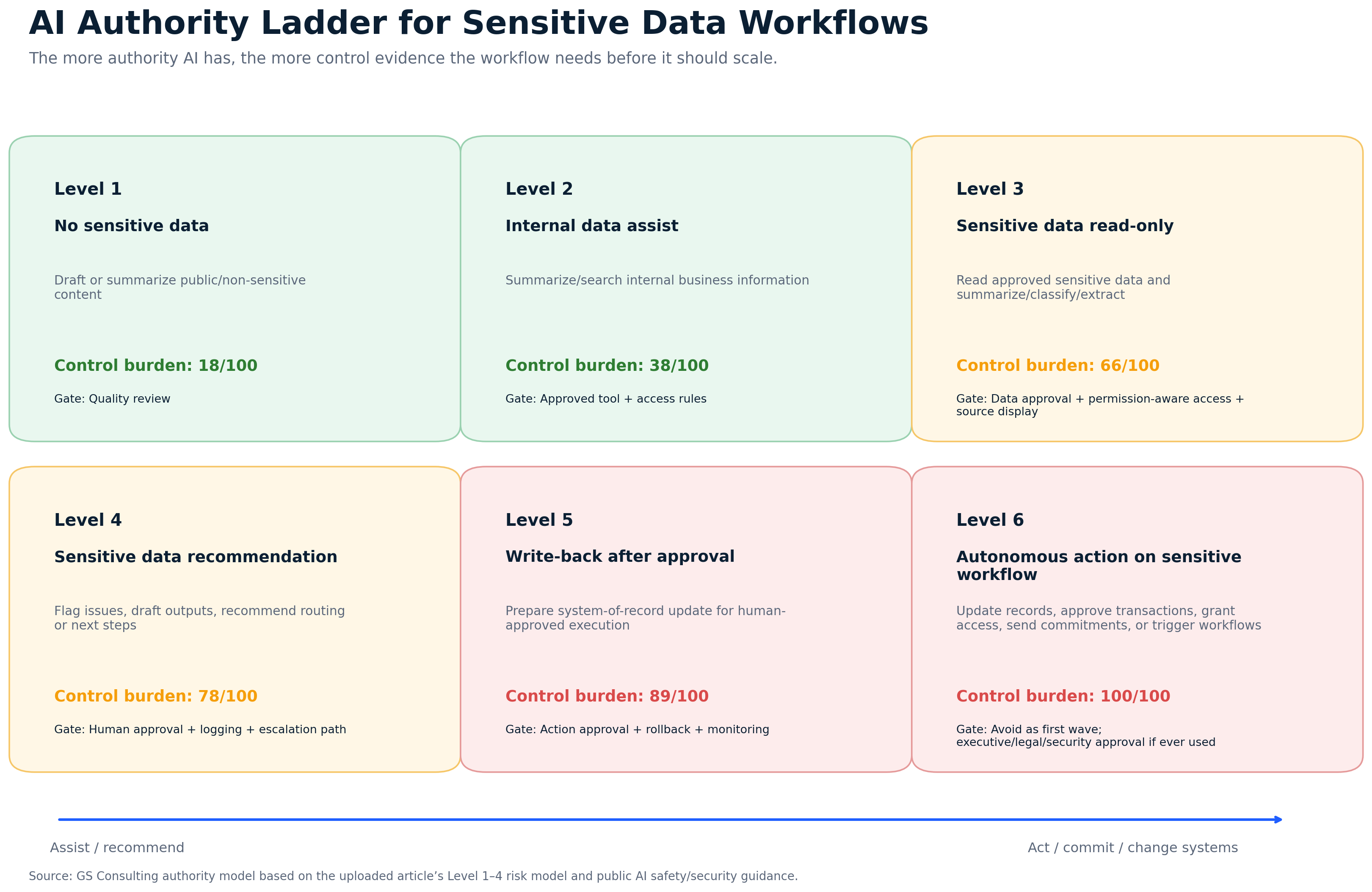
A practical way to review AI automation is to classify each workflow into four levels.
- Level 1AI sees no sensitive data.
Public research, general drafting, public policy summaries, generic training material, and public website content. AI can move faster here because data exposure is limited.
- Level 2AI sees internal business data.
Internal policies, internal procedures, project notes, business reports, and operational documents that are not public but are not heavily regulated. This needs approved tools, access control, and basic review.
- Level 3AI sees sensitive or regulated data.
CUI, PII, PHI, customer records, employee data, financial records, contract data, legal data, and security data. This requires data approval, vendor review, access control, logging, human review, retention rules, and compliance review.
- Level 4AI can act on sensitive systems or decisions.
AI agents that update records, approve transactions, grant access, send messages, change systems, or trigger workflows involving sensitive data. Most organizations should not begin here.
Sensitive Data Workflow Design
A safe AI workflow for sensitive data has to be designed in layers.
- 1Approved data source.
The AI should use approved data from approved systems, not random uploads, personal drives, screenshots, exported spreadsheets, or copied chat messages.
- 2Identity and access control.
Users should only get AI help with information they are allowed to access. AI should not become a shortcut around permissions.
- 3Data minimization.
Do not give AI more data than it needs. Smaller exposure usually means smaller risk.
- 4Controlled AI environment.
The tool has to be approved for the data type, including vendor terms, retention, training use, subprocessors, logs, deletion, and access control.
- 5Human review.
AI should prepare sensitive work. People should own sensitive decisions. The review role, criteria, and escalation path need to be explicit.
- 6Logging and evidence.
If AI touches sensitive data, the workflow should record who used it, what data was accessed, what AI produced, who reviewed it, and what changed.
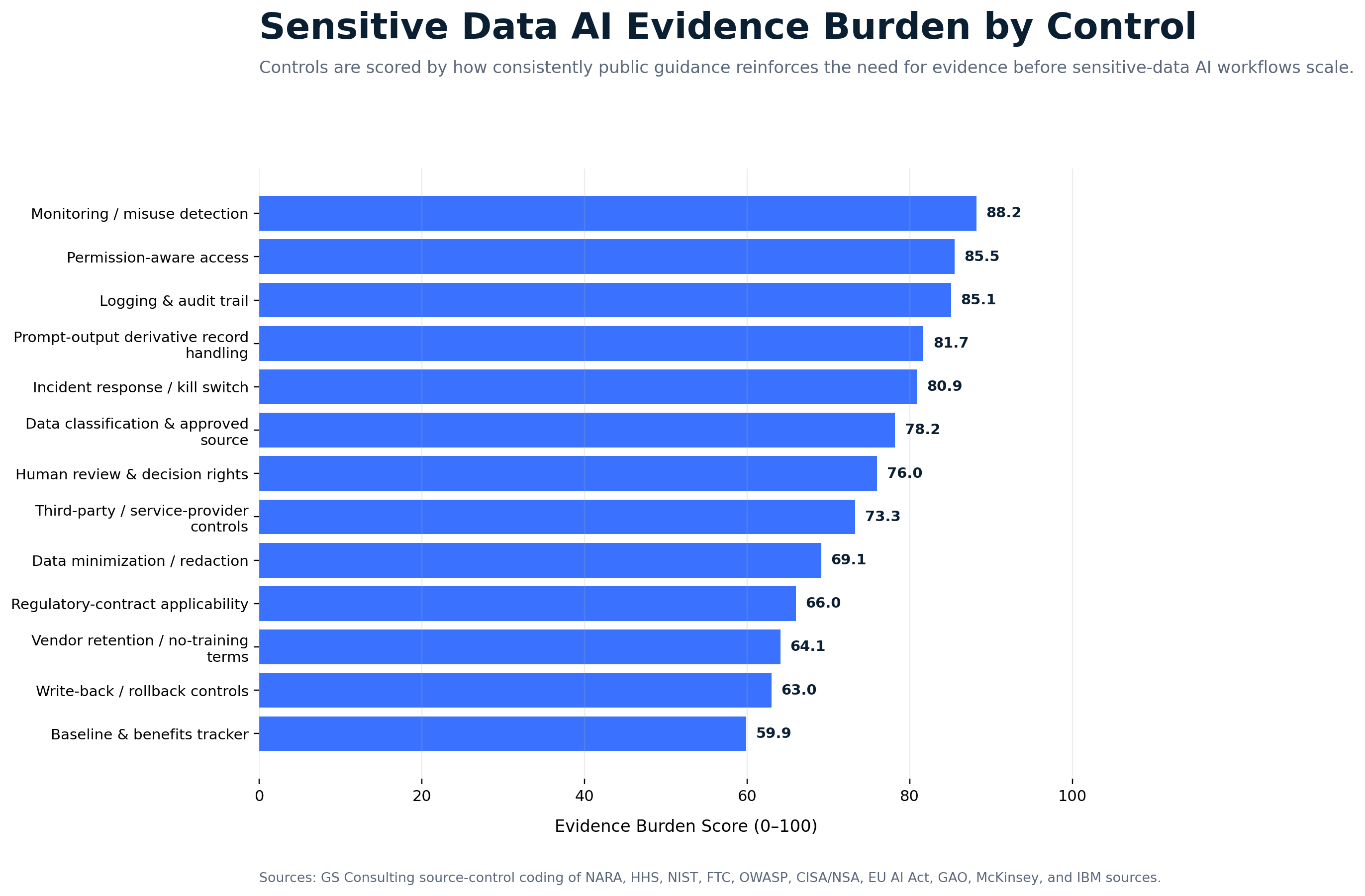
AI automation is not finished when it goes live. That is when management begins. Sensitive data workflows should be monitored for unusual access, prompt and output issues, human override rates, incorrect classifications, complaints, vendor changes, model performance changes, security events, and compliance concerns.
Examples by Data Type
Different data types need different boundaries. The question is not just what AI can do. The question is what it should be allowed to do first.
CUI workflows
Good first use cases include CUI document intake summaries in an approved environment, CUI evidence organization for compliance support, contract deliverable tracking, controlled document classification support, and draft summaries for human review. Use caution with public AI tools, broad shared drive access, unapproved document uploads, outputs that leave the controlled environment, and subcontractor use without flowdown controls.
PII workflows
Good first use cases include customer request classification, identity support case summaries, data quality cleanup, privacy request intake, and duplicate record detection. Use caution with unapproved vendor tools, unnecessary identifiers, data copied into prompts, outputs stored in general workspaces, and AI making final decisions about a person.
PHI workflows
Good first use cases include administrative intake summaries, appointment request routing, claim or case document organization, patient support draft responses for review, and policy and procedure search. PHI workflows need tight boundaries because health information can appear in electronic, paper, or oral form.
Financial record workflows
Good first use cases include invoice field extraction, expense exception summaries, payment support documentation, vendor record review, finance policy question support, and audit evidence organization. Use caution with payment approval, vendor banking changes, fraud determinations without review, and AI actions that bypass finance controls.
Contract workflows
Good first use cases include clause summaries, obligation extraction, contract intake routing, renewal date tracking, risk flag drafts, and deliverable tracking. Contracts create obligations. AI can help review them, but people still own interpretation and commitments.
Employee, customer, and security data workflows
Good first use cases include HR case intake classification, employee policy support, customer support summaries, complaint classification, security alert summaries, vulnerability prioritization support, log pattern summaries, and compliance evidence support. Use caution with people decisions, customer commitments, account status changes, security enforcement, breach declarations, and external notices.
Why Generic AI Tools Are Not Enough
Generic AI tools are useful for low risk work. They are not automatically appropriate for sensitive data workflows.
The reason is simple. Sensitive data workflows require controls that general tools may not provide by default. You need access rules, data retention rules, audit logs, vendor terms, human approval, output controls, monitoring, and a way to stop the workflow if something goes wrong.
OWASP lists sensitive information disclosure as a major risk for large language model applications, and it also highlights risks like prompt injection, insecure output handling, and excessive agency. That is why sensitive data automation is not just about picking a model. It is about designing the whole workflow.
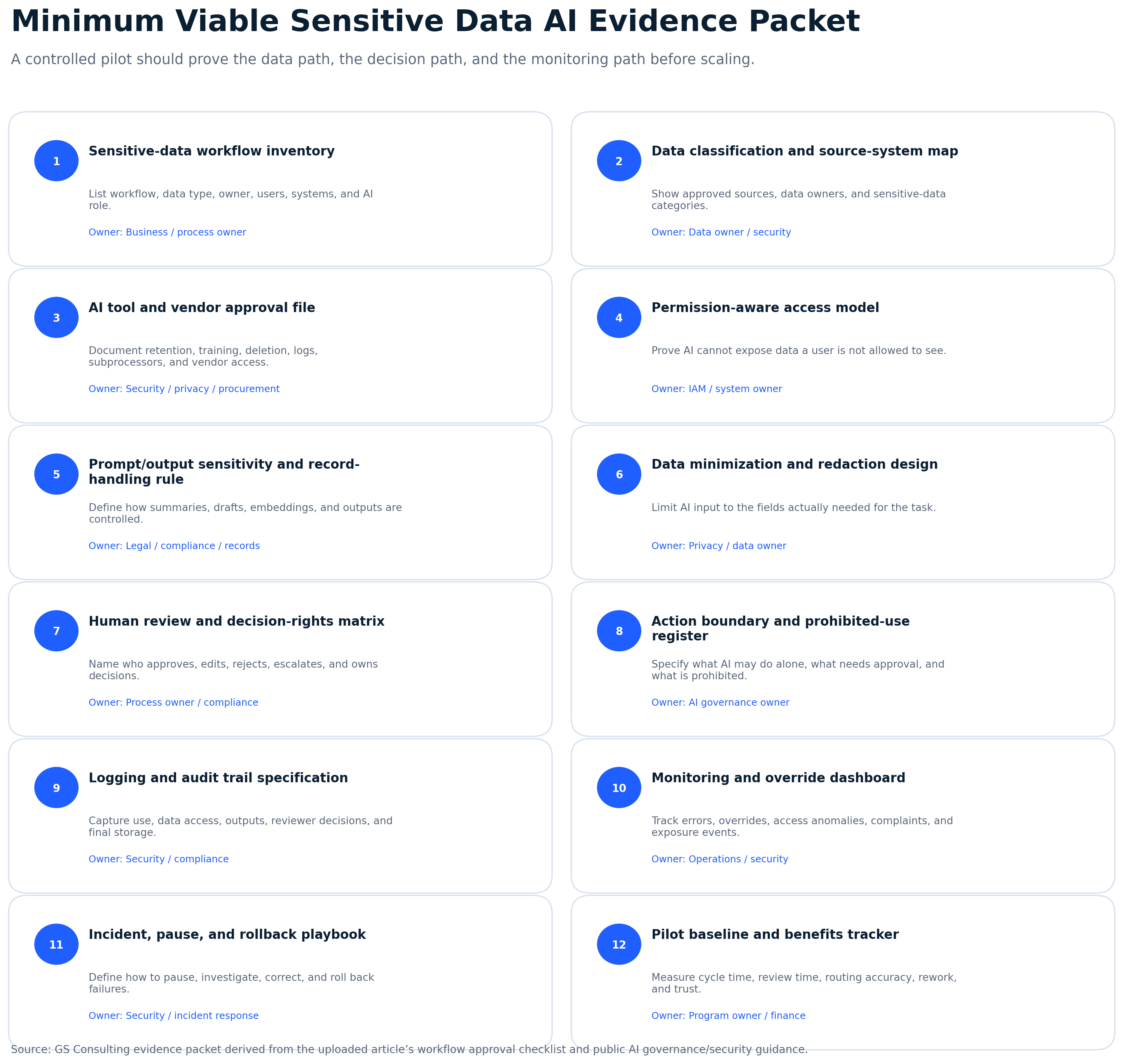
The Workflow Approval Checklist
Before automating a sensitive data workflow, leaders should be able to answer the operating questions.
- What sensitive data is involved?
- Who owns the data?
- Is the AI tool approved for this data?
- Does the vendor retain prompts or outputs?
- Can the vendor use the data for model training?
- Can users only access what they are allowed to see?
- What does AI produce?
- Is the output sensitive too?
- Who reviews the output?
- What can AI do without approval?
- What actions are prohibited?
- What gets logged?
- What happens when the AI is wrong?
- How will performance be monitored?
- Who can pause the workflow?
If the team cannot answer these questions, the use case is not ready.
A Simple Pattern for Safe Sensitive Data Automation
The safest pattern is not flashy. It works.
- 1AI reads approved data.
- 2AI prepares a draft, summary, classification, or recommendation.
- 3The workflow shows source context.
- 4A trained person reviews it.
- 5The person approves, edits, rejects, or escalates.
- 6The final output goes to the system of record.
- 7The workflow logs what happened.
- 8The workflow is monitored over time.
The Role of AI Governance
Sensitive data automation needs governance. Not a 60 page policy no one reads. A working governance model.
NIST's AI Risk Management Framework uses Govern, Map, Measure, and Manage to help organizations manage AI risks and responsibly develop and use trustworthy AI systems. For sensitive data workflows, that means defining who owns the workflow, mapping the data and vendors, measuring accuracy and risk, and managing the workflow after launch.
That is the difference between AI experimentation and AI automation you can defend.
A 30 Day Starter Plan
You do not need to automate everything at once. Start with one sensitive data workflow that has real value but manageable risk.
- Week 1Pick one controlled workflow.
Good candidates include contract obligation summaries, invoice exception review, compliance evidence organization, customer case summaries, HR onboarding support, and security alert summaries.
- Week 2Map the data path.
Document what data is involved, what system owns it, what tool will process it, what output AI creates, who reviews it, where the final output goes, and what gets logged.
- Week 3Build the control model.
Define approved sources, access rules, vendor terms, human review, prohibited actions, retention, monitoring, escalation, and rollback.
- Week 4Decide whether to pilot.
If the answers are clear, build a controlled pilot. If the answers are not clear, fix the foundation first.
What Success Looks Like
A successful sensitive data automation workflow does not just save time. It should also improve control.
You should see less manual copying, faster review, better routing, fewer missed steps, clearer ownership, better evidence, better visibility, fewer uncontrolled data exports, fewer shadow AI workarounds, and more consistent human review.
That is the real win. AI should not make sensitive data harder to control. It should make the workflow cleaner.
How This Supports Secure AI Automation
Secure AI Automation for Regulated Organizations explains how GS Consulting helps organizations use AI automation safely through workflow design, data controls, governance, security, compliance, and measurable outcomes.
This guide answers one specific question: how do we automate workflows that involve sensitive data without losing control of the data?
That is one of the most important questions regulated organizations need to answer. The value is real. So is the risk.
The Bottom Line
AI automation for sensitive data workflows is not about saying no to AI. It is about refusing to be careless.
Sensitive data changes the rules. You need to know what data is involved, where it goes, what AI does with it, who reviews the output, what gets logged, and who owns the final decision.
The safest first use cases keep AI in a support role. Summarize. Classify. Draft. Flag. Route. Recommend. Let people approve the parts that matter.
That is how regulated organizations get the benefit of AI automation without turning sensitive data into an uncontrolled experiment.
GS Consulting helps regulated organizations design AI automation for sensitive data workflows, including CUI, PII, PHI, financial records, contracts, employee data, customer data, security data, and other protected information.
Ready to automate sensitive data workflows without losing control?
Contact GS Consulting for a Secure AI Automation Assessment.
Contact GS ConsultingResearch Sources and Caveats
The Sensitive Data Control Burden Score, AI Authority Control Burden Score, Evidence Burden Score, and Boundary Matrix are GS Consulting planning tools. They are not official legal, regulatory, audit, privacy, HIPAA, CMMC, NIST, FTC, EU AI Act, GAO, CISA, or OWASP determinations.
Actual readiness depends on the organization's data, contracts, systems, vendors, jurisdictions, retention obligations, customer commitments, employee impact risk, security architecture, workflow design, and risk tolerance.
- National Archives: Controlled Unclassified Information
- HHS: Summary of the HIPAA Privacy Rule
- NIST CSRC: Personally Identifiable Information
- Federal Trade Commission: Safeguards Rule
- OWASP Top 10 for Large Language Model Applications
- NIST AI Risk Management Framework
- McKinsey: The State of AI
- IBM Newsroom: Enterprise AI Control Gap
- CISA: Secure Adoption of Agentic AI
- GAO Artificial Intelligence Accountability Framework
Frequently Asked Questions About Sensitive Data AI Automation
Can AI be used with sensitive data?
Yes, but only when the workflow has approved data sources, permission aware access, vendor terms, retention rules, human review, logging, monitoring, and an escalation path. Sensitive data does not become safe just because AI summarizes or rewrites it.
What sensitive data workflows are good first AI automation candidates?
Good first candidates usually keep AI in a support role. Examples include contract obligation summaries, invoice exception review, compliance evidence organization, customer case summaries, HR onboarding support, security alert summaries, and data quality cleanup with human review.
What should AI not do first in sensitive data workflows?
AI should not start by approving payments, changing vendor banking information, making hiring or discipline decisions, certifying compliance, granting privileged access, changing production systems, sending customer commitments, or acting across sensitive systems without accountable approval.