GovCon Cybersecurity | | 18 min read
What Is GCC High? Microsoft 365 for Defense Contractors

Key Takeaways
GCC High is a sovereign cloud for export data and Controlled Unclassified Information, not a default upgrade.
The Data Decides
Export controlled data and the contract flowdown drive the choice, not preference. GCC High exists for ITAR data and High authorization requirements, so match the cloud to the obligation.
Four Clouds, Not One
Commercial, GCC, GCC High, and GCC DoD differ on platform, authorization, and export eligibility. Knowing which floor you sit on prevents overbuying and underbuilding.
CMMC Does Not Mandate It
CMMC never names GCC High. Export data, a FedRAMP High requirement, or a prime flowdown is what forces the move, so read the contract before you buy seats.
Budget the Whole Stack
The license premium is the visible line. Security add ons, cross cloud migration, and ongoing operations decide the real total cost of the environment.
GCC High is where defense contractors put Microsoft 365 when the data they hold is too sensitive for the commercial cloud.
It is not simply a more secure version of Office you flip on.
GCC High is a separate, sovereign cloud built for the United States defense industrial base. It runs on isolated government infrastructure, carries a higher federal authorization, and is one of the few Microsoft 365 environments allowed to hold export controlled data. That power comes with cost, feature tradeoffs, and a migration that is a genuine project. The contractors who get this right start from the data and the contract, not from a sales pitch, and they move only when a real obligation requires it.
This guide gives you the honest map. What GCC High actually is, how it compares with GCC and Commercial Microsoft 365, when export data and Controlled Unclassified Information really require it, what a migration involves, and how to budget the full environment rather than just the seats.
Once the environment choice is clear, use the GCC High tenant configuration guide to secure identity, applications, sharing, logging, and recovery, then use the GCC High email security guide to control sender identity, message protection, forwarding, connectors, and mail evidence.
Decide the cloud from the data, not the sales deck.
GS Consulting helps defense contractors classify their data, read the contract flowdown, and choose and stand up the right Microsoft 365 environment without overbuilding.
Request a GCC High Fit ReviewWhat GCC High Is
GCC High, short for Government Community Cloud High, is a Microsoft 365 environment built for organizations that carry the strictest United States federal obligations. It runs on Azure Government, the isolated infrastructure that is physically separate from the commercial Azure most businesses use. It is authorized at the FedRAMP High baseline, the highest of the FedRAMP impact levels. Backend access is restricted to screened United States persons operating from United States data centers. And it is eligible to hold data controlled under the International Traffic in Arms Regulations and the Export Administration Regulations, which the commercial cloud is not.
Put those pieces together and the purpose is clear. GCC High exists so that defense contractors handling Controlled Unclassified Information and export controlled technical data can use familiar Microsoft 365 tools without breaching the rules that govern that data. It is a sovereign environment for a regulated mission, not a premium tier you choose for extra polish.
The Four Government Clouds
Microsoft does not offer one government cloud. It offers a ladder, and choosing the wrong rung is expensive in both directions. Commercial Microsoft 365, GCC, GCC High, and GCC DoD sit at different levels of isolation, authorization, and eligibility.
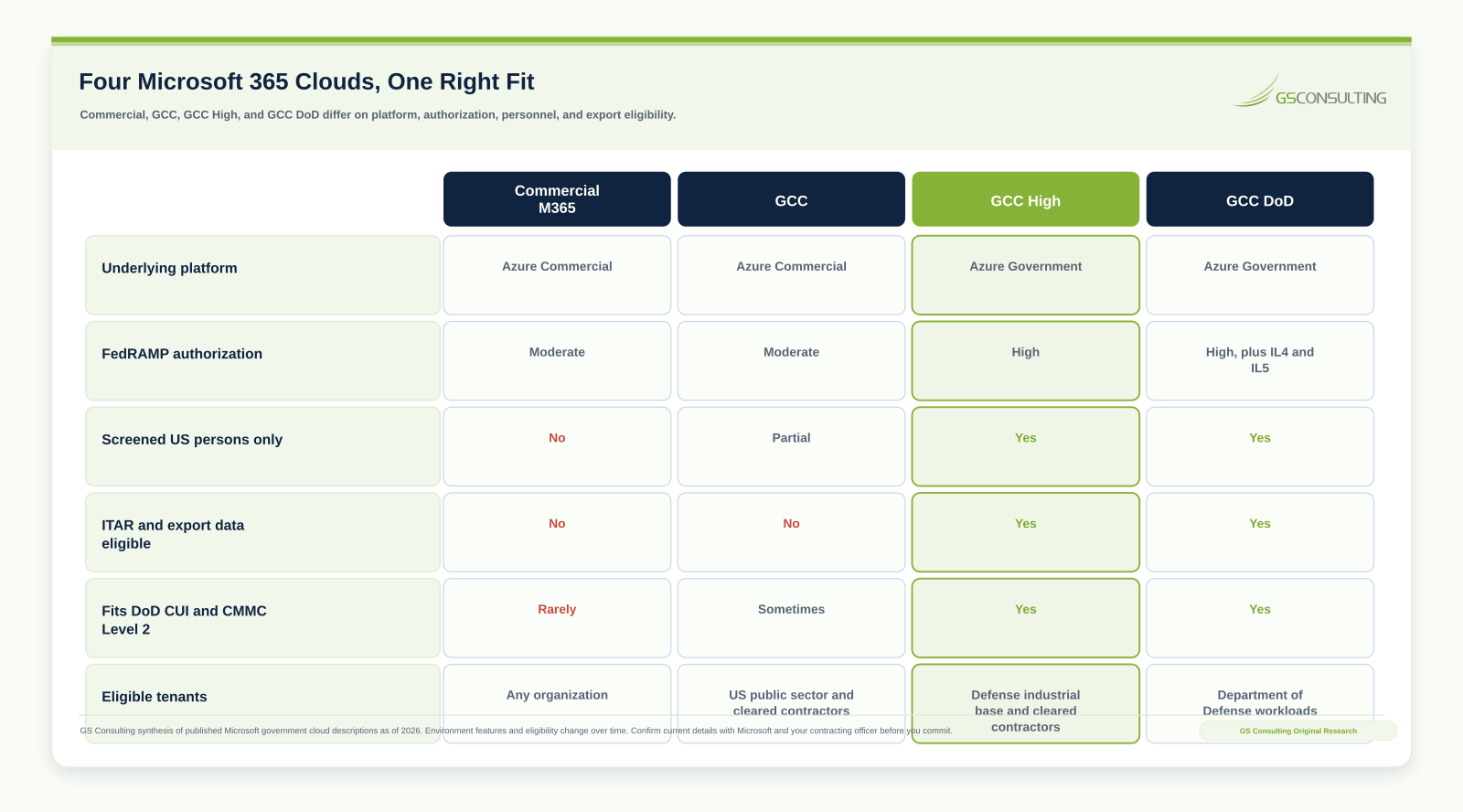
Commercial Microsoft 365 runs on commercial Azure and reaches FedRAMP Moderate, but it is not built for export data or United States persons only handling. GCC also runs on commercial Azure with added government controls and sits at FedRAMP Moderate, which can suit public sector work and some Controlled Unclassified Information that is not export controlled. GCC High moves onto the isolated Azure Government platform, reaches FedRAMP High, restricts operations to screened United States persons, and is eligible for ITAR and export controlled data. GCC DoD sits alongside GCC High on government infrastructure and is aimed at Department of Defense workloads at Impact Levels 4 and 5. For most defense contractors, the real choice is between GCC and GCC High, and it turns on export data and the authorization the contract demands.
Original Research: The GS GCC High Placement Score
The question contractors actually ask is not what GCC High is, but whether they need it. Marketing tends to answer yes by default. To replace that reflex with a structured view, GS Consulting built the GCC High Placement Score. We took the obligations that push an organization toward GCC High, from export data to contract flowdowns, and assigned each a relative pull weight scaled so the strongest driver reads 100. Reading the weights from top to bottom shows what should actually decide the move.
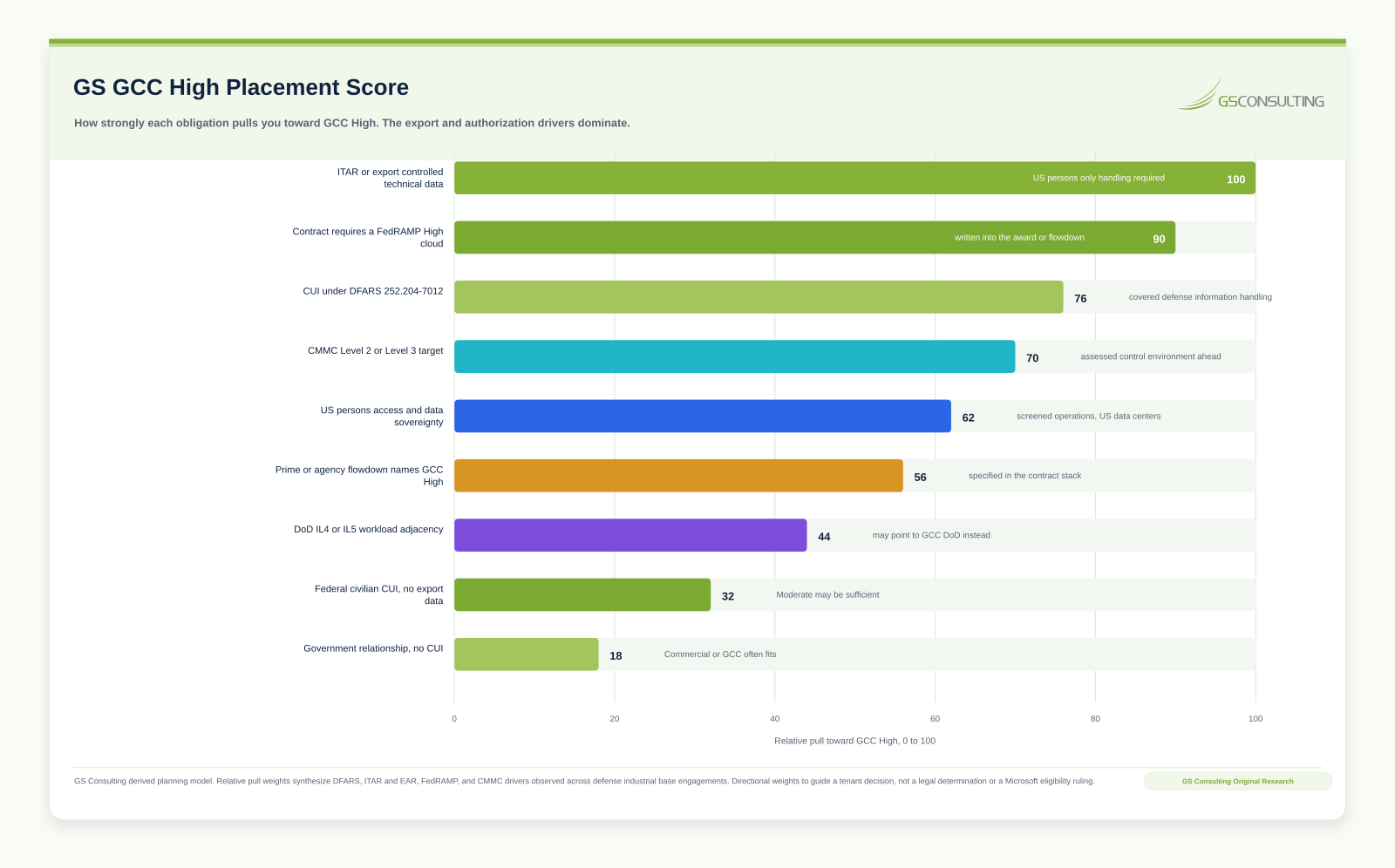
Export controlled technical data sits at the top, because ITAR and EAR require United States persons only handling that Commercial Microsoft 365 and GCC cannot provide. A contract that explicitly requires a FedRAMP High cloud comes next, since that language largely settles the decision. Controlled Unclassified Information under DFARS 252.204-7012 and a CMMC Level 2 or Level 3 target follow, but with an important caveat: those obligations point at a FedRAMP Moderate equivalent bar, so on their own they do not force GCC High. Lower down sit softer signals such as data sovereignty preferences and civilian Controlled Unclassified Information with no export dimension, where GCC or even Commercial may be the honest fit. The pattern is the takeaway. The strongest reasons to move are export data and an explicit High requirement, and if neither is present you should scrutinize the move rather than assume it.
This is also where the standard behind the controls matters. The obligation to protect Controlled Unclassified Information comes from NIST SP 800-171, and the way that data moves through your environment decides how much of it lands in scope. Our NIST SP 800-171 explainer covers the control set, and a tight boundary is what keeps the GCC High footprint from growing larger than it needs to be.
Which Microsoft 365 Cloud You Need
The placement score ranks the drivers. A decision gate turns them into an answer. Work the gates top to bottom, and the first one that matches your situation sets the floor for your tenant.
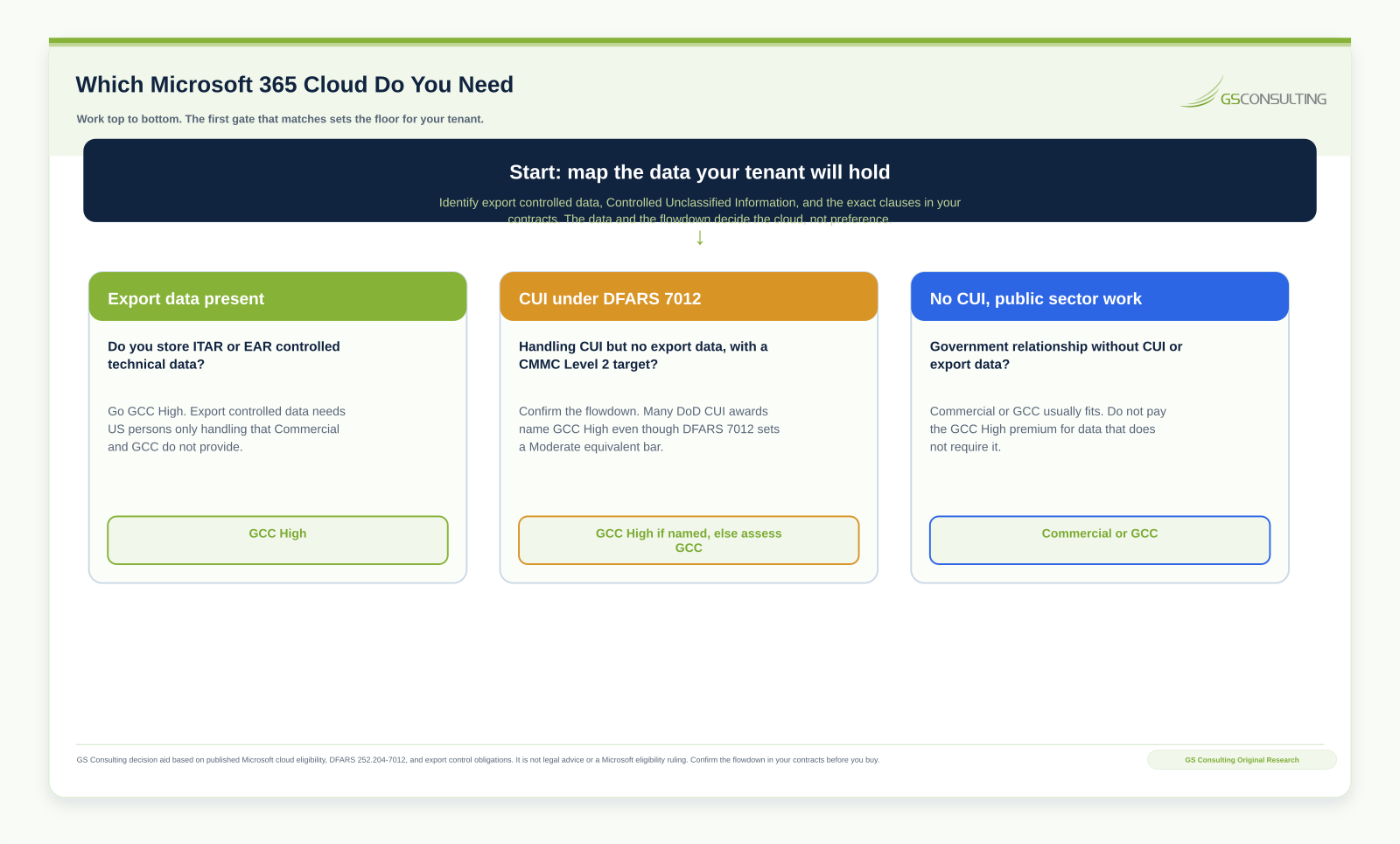
The first gate is export data. If you store ITAR or EAR controlled technical data, the answer is GCC High, because that data demands United States persons only handling. The second gate is Controlled Unclassified Information under DFARS 252.204-7012 without export data, on the way to a CMMC Level 2 assessment. Here the honest answer is to read the flowdown: many Department of Defense awards name GCC High even though the clause itself sets a FedRAMP Moderate equivalent bar, so confirm what your specific contract requires rather than assuming High. The third gate catches everything else. If you hold no Controlled Unclassified Information and no export data, Commercial or GCC usually fits, and paying the GCC High premium would be spending on protection the data does not require. If you are still designing the environment, our guide on secure cloud architecture for federal contractors handling CUI shows how these choices shape a real design.
The Migration Journey
Deciding on GCC High is the easy part. Getting there is a project. Because GCC High is a separate tenant on separate infrastructure, you do not reconfigure your way in. You move.
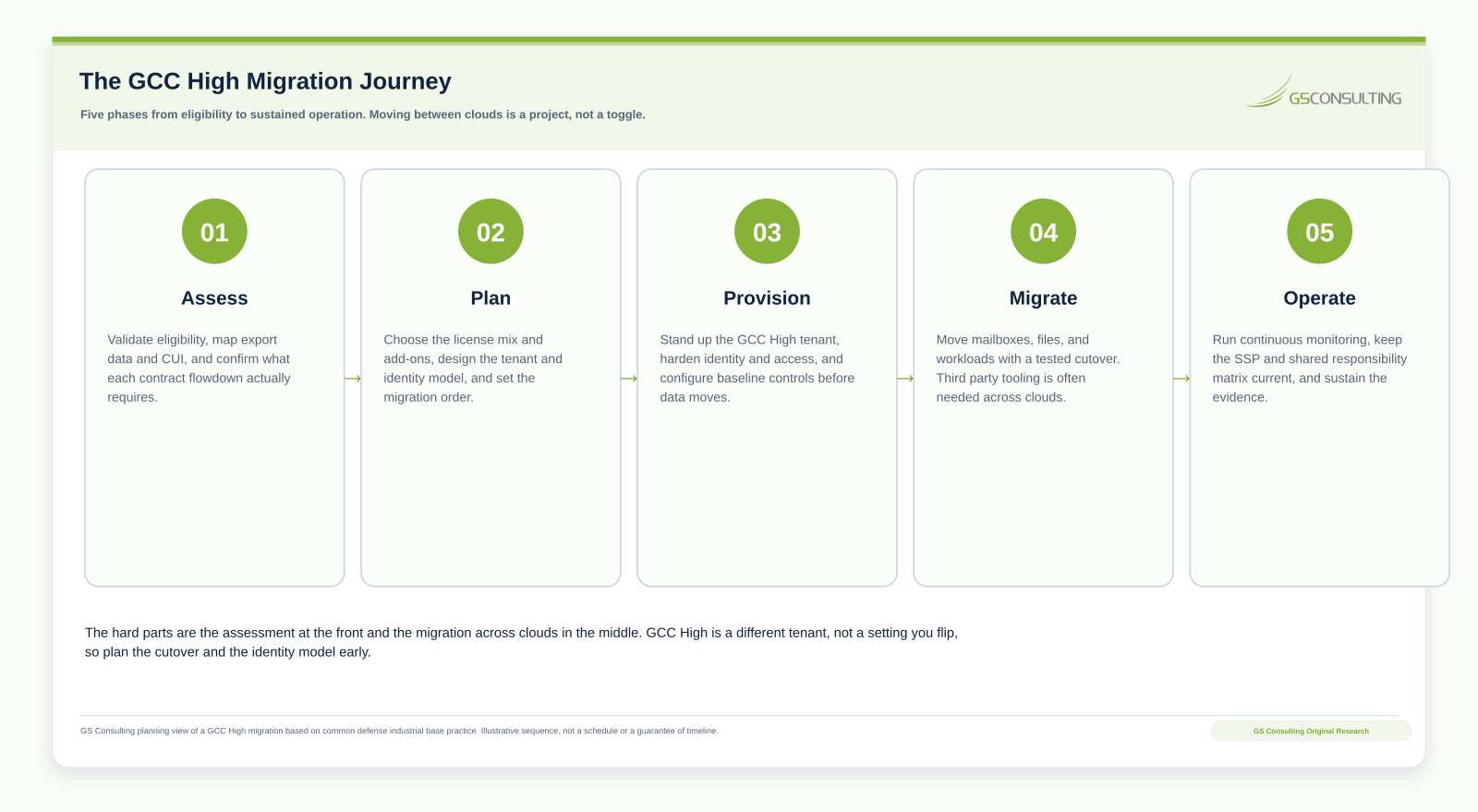
In the assess phase you validate eligibility, map where export data and Controlled Unclassified Information live, and confirm what each contract flowdown actually requires. In the plan phase you choose the license mix and add ons, design the tenant and the identity model, and set the order in which workloads move. In the provision phase you stand up the GCC High tenant and harden identity, access, and baseline controls before any production data arrives. In the migrate phase you move mailboxes, files, and workloads with a tested cutover, which usually calls for third party tooling because you are crossing between clouds. Then the operate phase begins and does not end: continuous monitoring, control upkeep, and keeping the System Security Plan and the shared responsibility matrix current. The heavy work is front loaded in assessment and concentrated again in migration, and the identity model deserves attention early because it is painful to change later. The GCC High migration planning guide turns those phases into a workload sequence, cost model, cutover test, and evidence packet.
The Cost Stack
The price of GCC High is not the number on the license page. That is the visible line. The real budget is a stack, and the parts below the license often add up to more than the seats.
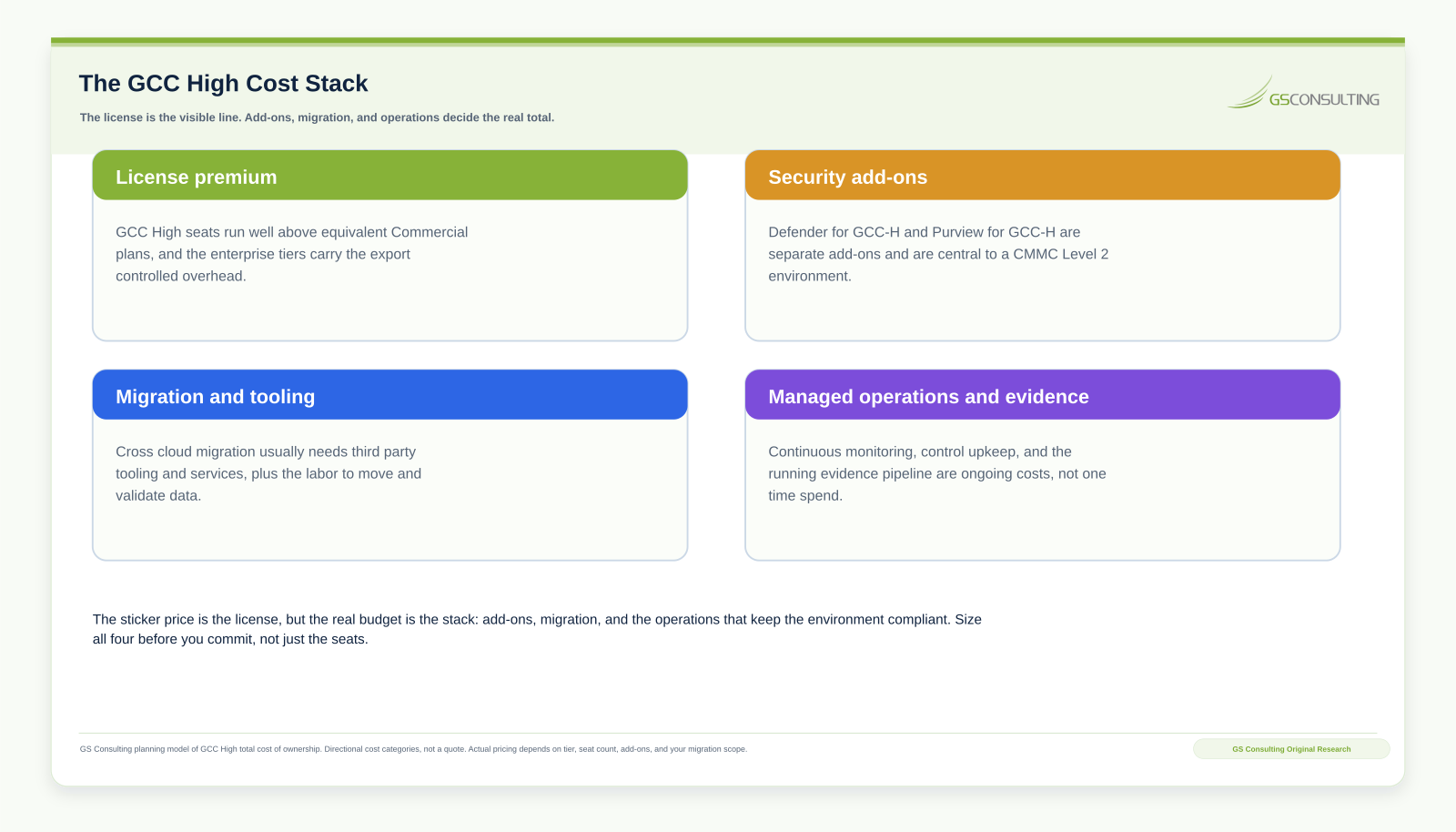
GCC High seats carry a premium over equivalent Commercial plans, reflecting the export controlled overhead and the isolated platform. On top of the base license sit security add ons: Defender for GCC-H and Purview for GCC-H are separate and are central to standing up a CMMC Level 2 environment. Then comes migration, where crossing between clouds usually requires third party tooling plus the labor to move and validate data. Finally, the layer that never stops: managed operations, control upkeep, and the running evidence pipeline that keeps the environment defensible. Microsoft has begun to ease the entry cost at the small end, with a GCC High Business Premium tier introduced for smaller defense contractors, but the discipline is the same at any size. Our current Microsoft GCC High pricing guide models Business Premium, G3, G5, and a smaller enclave across three years. Size all four layers before you commit, because a decision made on the seat price alone will be wrong. Keeping that evidence current is exactly the recurring work that rewards automation, the same case we make in automating NIST 800-171 compliance evidence.
The Readiness Checklist
Before you buy a single seat, a handful of things should already be settled. Rushing to procurement before the data work is done is how contractors end up with an oversized tenant and a migration that stalls.
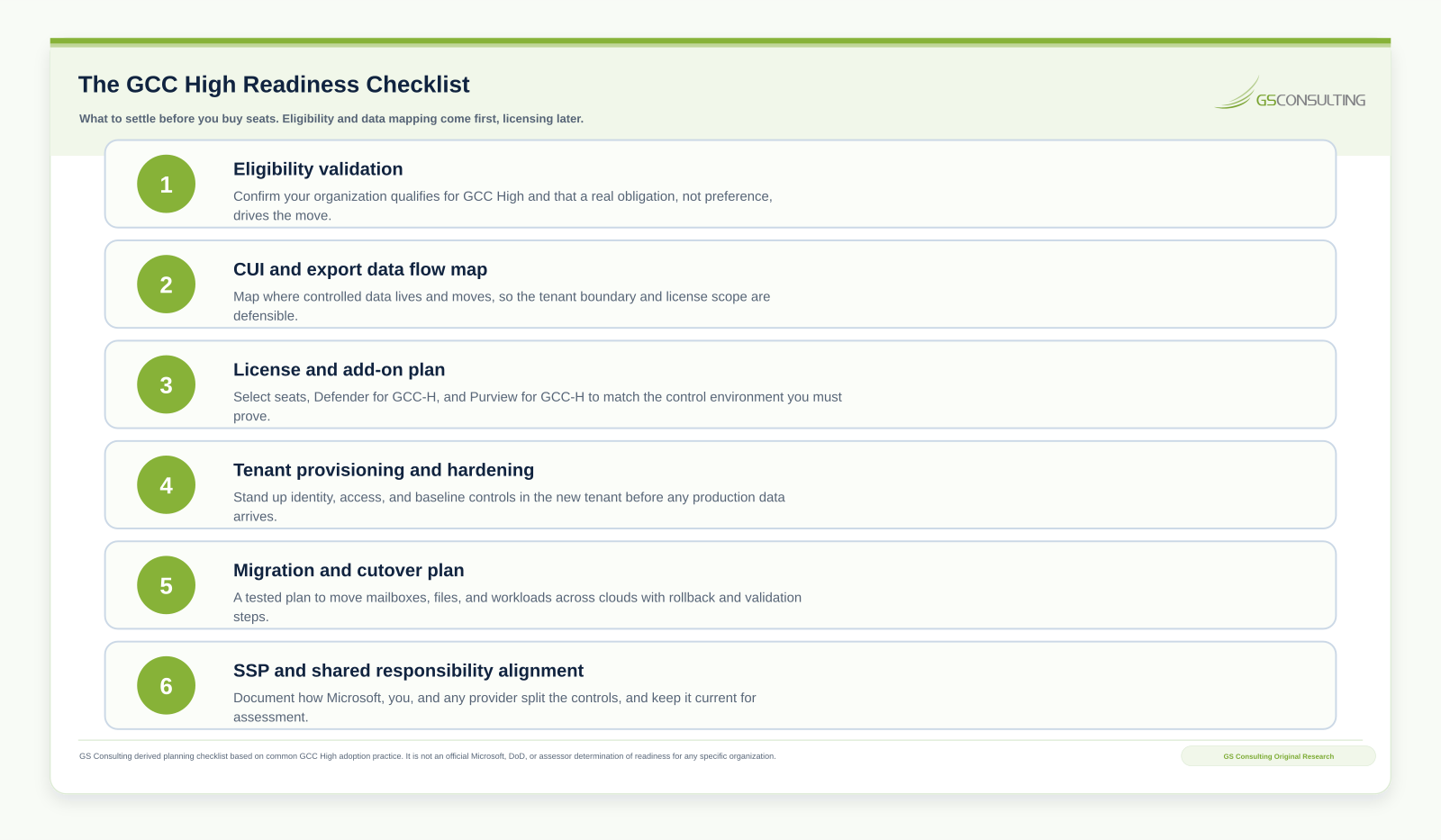
Start by validating eligibility and confirming that a real obligation, not preference, drives the move. Map where Controlled Unclassified Information and export data live and travel, so the tenant boundary and the license scope are defensible. Build the license and add on plan to match the control environment you must prove, including Defender for GCC-H and Purview for GCC-H where a CMMC Level 2 posture is the target. Provision and harden the tenant, standing up identity, access, and baseline controls before production data arrives. Plan the migration and cutover with rollback and validation steps. And align the System Security Plan and the shared responsibility matrix so it is clear how Microsoft, you, and any provider split the controls. Do the data work first and the platform decisions get easier, cheaper, and far more defensible. That is the standard worth holding: let the data and the contract choose the cloud, size the whole stack before you buy, and stand up the evidence before the data moves, not after.
Research Sources and Caveats
The GS GCC High Placement Score and the planning views in this guide are GS Consulting derived planning tools based on cited public sources and documented assumptions. They are not official Microsoft, FedRAMP, Department of Defense, assessor, legal, or audit determinations, and they are not a quote, an eligibility ruling, or a guarantee of compliance. The environment facts are drawn from published Microsoft government cloud descriptions and the regulations cited below. The pull weights, the cost framing, and the migration sequence are GS planning assumptions and will vary with your data, your contracts, and the current state of Microsoft's offerings.
Microsoft's government cloud features, tiers, and eligibility change over time. Confirm the current environment details, add ons, and eligibility with Microsoft and the specific requirements in your contract flowdown with your contracting officer before you plan a move.
- Microsoft: Microsoft 365 US Government GCC High
- DFARS 252.204-7012: Safeguarding Covered Defense Information
- Directorate of Defense Trade Controls: ITAR
- NIST SP 800-171: Protecting Controlled Unclassified Information
- FedRAMP program (FedRAMP.gov)
Frequently Asked Questions About GCC High
What is GCC High?
GCC High, short for Government Community Cloud High, is a Microsoft 365 environment built for the United States defense industrial base. It runs on Azure Government infrastructure that is physically separate from commercial Azure, is authorized at the FedRAMP High baseline, restricts backend access to screened United States persons in United States data centers, and is eligible to hold ITAR and export controlled technical data. It is designed for defense contractors handling Controlled Unclassified Information and export controlled data, not for general commercial use.
What is the difference between GCC High and GCC?
They are different clouds. GCC runs on commercial Azure with added government controls and is authorized at FedRAMP Moderate. GCC High runs on the isolated Azure Government platform, is authorized at FedRAMP High, and is eligible for ITAR and export controlled data, which GCC is not. GCC can be a fit for public sector work and some Controlled Unclassified Information that is not export controlled, while GCC High is the environment defense contractors move to when export data or a High authorization requirement is in play.
Does CMMC require GCC High?
No. CMMC itself does not mandate GCC High. What pushes contractors toward it is the data and the contract: export controlled technical data under ITAR or EAR needs the United States persons handling that only GCC High and GCC DoD provide, and many defense contracts and prime flowdowns specify a FedRAMP High cloud or name GCC High directly. DFARS 252.204-7012 sets a bar equivalent to FedRAMP Moderate, so a Controlled Unclassified Information obligation on its own does not automatically require GCC High. Read the flowdown and classify the data before you decide.
Do I need GCC High for ITAR data?
For ITAR or EAR controlled technical data, GCC High is the practical Microsoft 365 answer for most contractors, along with GCC DoD for Department of Defense workloads. Export controlled data must be handled only by United States persons and kept within United States boundaries, and Commercial Microsoft 365 and GCC do not meet that requirement. GCC High is built to hold export controlled data, which is why export obligations are the single strongest signal that you need it.
How hard is it to migrate to GCC High?
It is a real project, not a setting you switch on. GCC High is a separate tenant on separate infrastructure, so data has to be moved and revalidated rather than reconfigured in place. Cross cloud migrations usually need third party tooling and careful planning of the identity model and the cutover. The heaviest work sits at the front, in confirming eligibility and mapping data, and in the middle, in moving mailboxes, files, and workloads without losing continuity. Plan the assessment and the identity design early.
Related Reading
- GCC High and Secure Cloud hub
- GCC High Migration Planning: Sequence, Cost, and Pitfalls
- Secure Cloud Architecture for Federal Contractors Handling CUI
- FedRAMP Compliance: The Complete Guide
- NIST SP 800-171 Explained: Requirements, Controls, and Compliance
- CMMC Compliance: The Complete Guide for Defense Contractors
- Secure AI Automation for Regulated Organizations