Secure AI Automation | | 23 min read
What Is a Private LLM?

Key Takeaways
AI adoption has to move fast and stay controlled.
Start With Mission Value
Prioritize use cases tied to measurable business, delivery, or mission outcomes.
Protect the Data Boundary
Define what data AI tools can touch before selecting vendors or architectures.
Keep Humans Accountable
Use AI to support workflows while retaining trained review and escalation paths.
Document the Controls
Maintain inventories, testing evidence, monitoring plans, and risk decisions.
A private LLM is not a product you buy.
It is a control decision.
That single distinction is where most teams get confused. They hear private LLM and picture a specific product, a locked down version of a chatbot they can purchase and switch on. So they go looking for the private button, do not find it, and either give up or convince themselves that a paid plan is the same thing.
It is not.
A private LLM is a large language model you run under your own controls. You decide where it runs, what network path it uses, whether prompts and outputs are retained, whether your data trains anyone else's model, and who is allowed to see any of it. The model is the easy part. The controls around the model are what make it private.
For regulated and GovCon teams, that reframing matters more than any benchmark. The question is never just how good is the model. The question is who controls the data it touches, and can you prove it.
Decide whether a private LLM is the right call.
GS Consulting helps regulated and GovCon teams classify their data, map the deployment options, and design private LLM environments their security teams and assessors can actually approve.
Request a Private LLM Readiness ReviewWhat a Private LLM Actually Is
Start with a plain definition. A large language model is a system trained on large amounts of text to predict and generate language. A private LLM is that same kind of model, run in a way where your organization controls the surrounding data path.
Control shows up in five practical places: where the model runs, what network the traffic crosses, whether prompts and outputs are stored, whether your inputs are reused to train a shared model, and who can read the logs. When you hold those five, the model is private in the way that matters. When a vendor holds them, it is not, no matter what the plan is called.
This is why a private LLM is best understood as a control boundary rather than a model. Two teams can use the exact same open model and end up in completely different places. One runs it inside an approved environment with retention off, identity aware access, and full logging. The other pastes the same prompts into a shared service with default retention. Same model. Very different exposure.
Why a Private LLM Is Not a Product You Switch On
The market makes this harder than it needs to be. Every vendor wants you to believe that private is a checkbox on their pricing page. So leaders assume that private means a single product they can license, and that the hard part is choosing the brand.
The reality is different. What actually decides whether an LLM is private is the data class it touches, the contract and regulatory duty attached to that data, and the residency and retention rules you have to honor. Those set the floor. The product is chosen after that, not before.
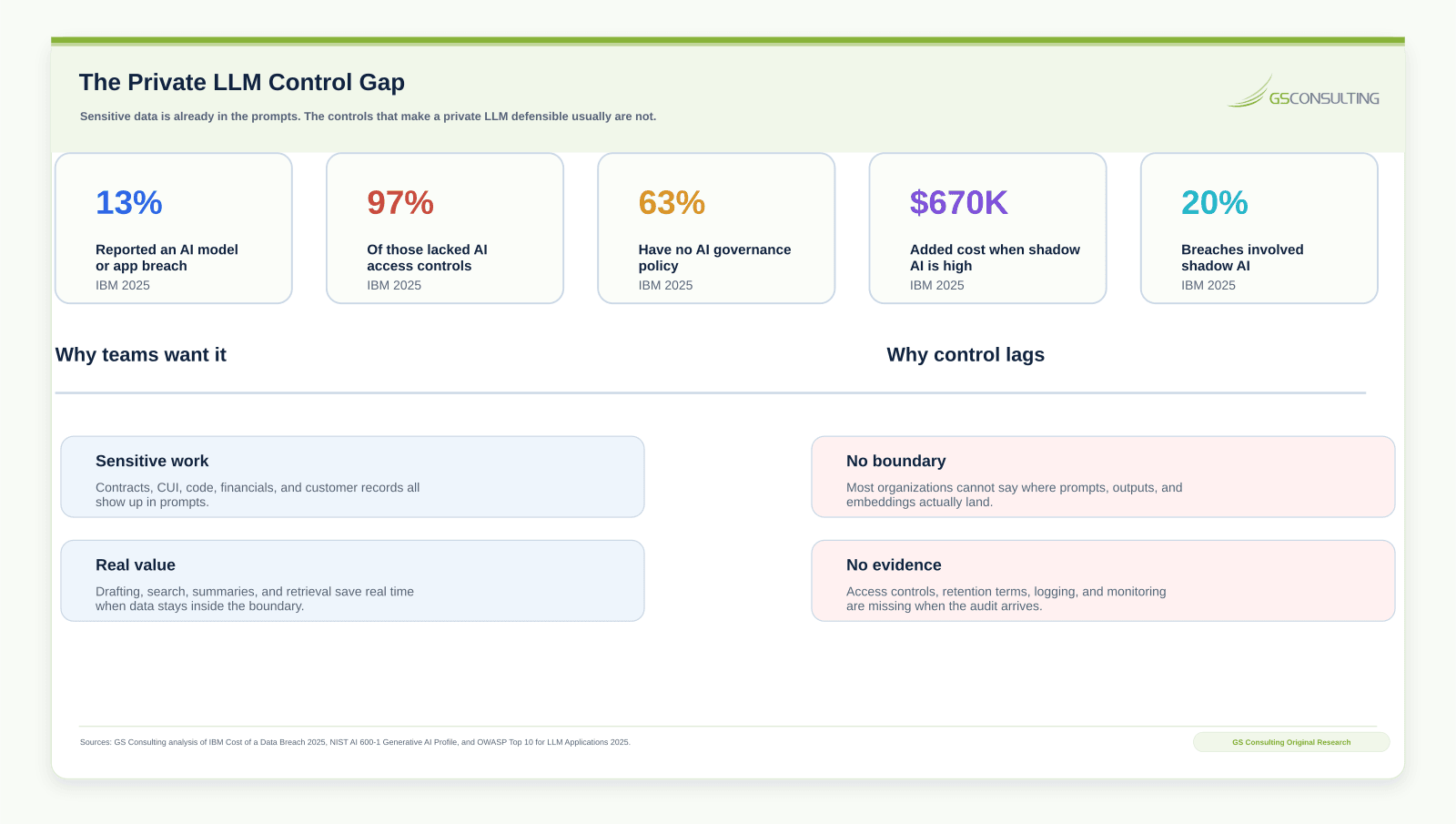
A paid enterprise plan can be part of a private setup. Terms like no training on your data and configurable retention are real and useful. But a plan tier by itself does not give you control of the environment, the network path, or the logs. You can pay more and still be a tenant on someone else's shared service, under their terms, in their region, with their retention defaults.
Private is the thing you can prove you control. That is the test.
Original Research: The Private LLM Data Suitability Index
Original GS Consulting research shows that the case for a private LLM is driven by data class and control burden, not by model quality.
GS Consulting reviewed public sources across breach economics, AI governance, LLM security, and controlled information policy, including IBM Cost of a Data Breach 2025, the NIST AI Risk Management Framework, the NIST Generative AI Profile, the OWASP Top 10 for LLM Applications 2025, and federal CUI policy under 32 CFR Part 2002 and NIST SP 800-171. From those sources GS Consulting coded public signals into two derived planning models: a Data Suitability Index that scores how strongly a data class calls for a private LLM, and a Control and Evidence Burden Score that ranks the controls that make a private LLM defensible.
These are GS Consulting derived planning tools. They are not official NIST, CMMC, DoD, CISA, OWASP, ISO, legal, audit, or regulatory determinations.
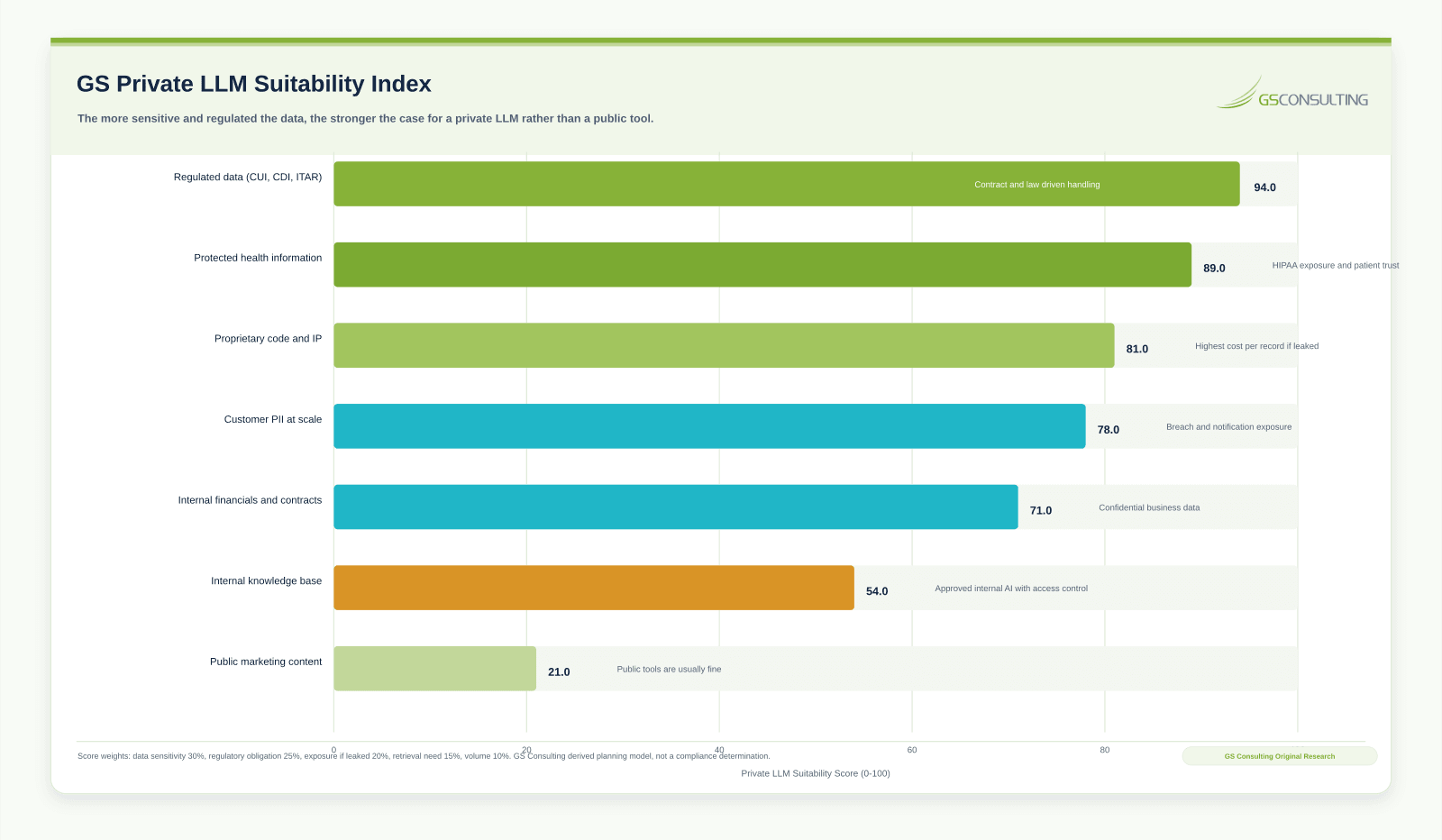
The pattern is clear. Regulated data such as CUI, controlled defense information, and export controlled information scored highest at 94.0, because the handling duty is set by law and contract rather than preference. Protected health information followed at 89.0, then proprietary code and intellectual property at 81.0, and customer personal information at scale at 78.0. Public marketing content scored lowest at 21.0, because almost nothing bad happens if it leaks.
That is the useful takeaway: you do not decide private or not for your whole company at once. You decide it per data class.
When You Actually Need a Private LLM
A private LLM is a real cost. Deciding you need one for everything is how teams stall for a year. The honest answer is that you need one where the data class and the duty attached to it justify the control burden, and not before.
You almost certainly need a private path when the model will touch CUI, controlled defense information, or export controlled data, because customer and regulatory duty sets the floor. You very likely need one for protected health information, proprietary source code, and customer data at scale, because the cost per record if it leaks is high and the trust damage is real. You probably do not need one to draft public blog posts, brainstorm names, or summarize an article that is already public.
The most common mistake is treating this as a single companywide switch. The better model is a set of lanes. High sensitivity work runs in a controlled private environment. General work can run in an approved commercial lane with sensible terms. The data class decides the lane.
The Controls That Make a Private LLM Defensible
Here is where most private LLM projects quietly fail. A team stands up a model in their own environment, declares it private, and moves on. Then their security team asks how they classify what goes in, how retrieval respects existing permissions, whether prompts are retained, and who gets alerted when something goes wrong. The model was the easy 20 percent. The controls are the other 80.
GS Consulting scored ten controls that separate a demo from a defensible private LLM, using weighted source convergence across AI governance, LLM security, and controlled information policy. The highest burden controls are the ones that hold the authorization boundary before, during, and after the model runs.
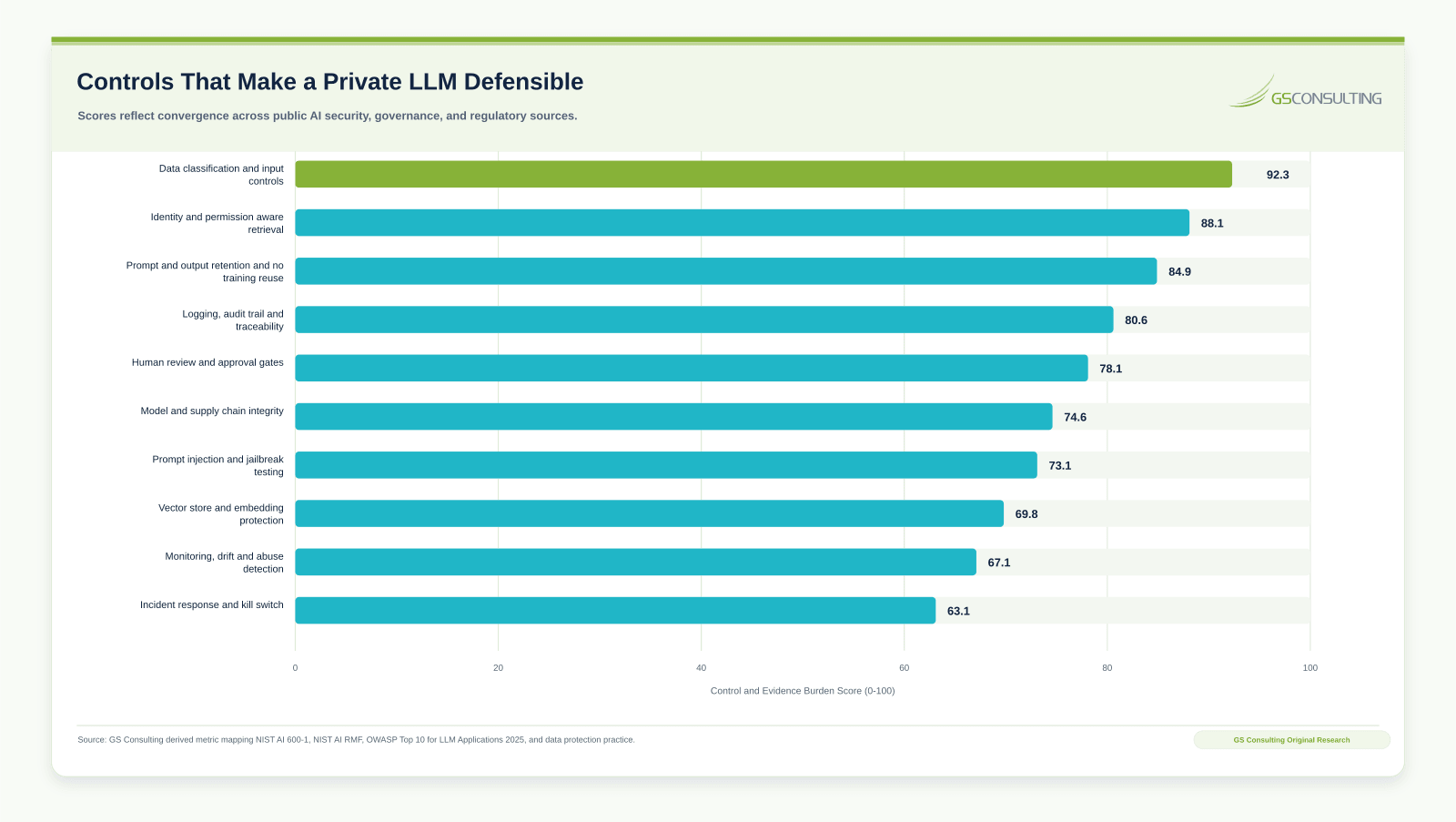
Data classification and input controls scored highest at 92.3, because a private LLM is only as private as the discipline that decides what is allowed to reach it. Identity and permission aware retrieval followed at 88.1, because the model should never receive content a given user is not allowed to see. Retention and no training reuse scored 84.9, because a private model with default retention and quiet training reuse is not private at all.
Further down the list sit the controls that keep the system honest over time: logging and audit trail, human review and approval gates, model and supply chain integrity, prompt injection testing, embedding protection, monitoring, and an incident response path with a kill switch. None of them are optional in a regulated setting. They are just less visible than the model.
Private Is a Spectrum, Not a Switch
Because private is about control, it is not binary. It runs along a spectrum, from a shared commercial service at one end to a fully on prem or air gapped deployment at the other. Each step gives you more control of the data path and asks more of your team in return.
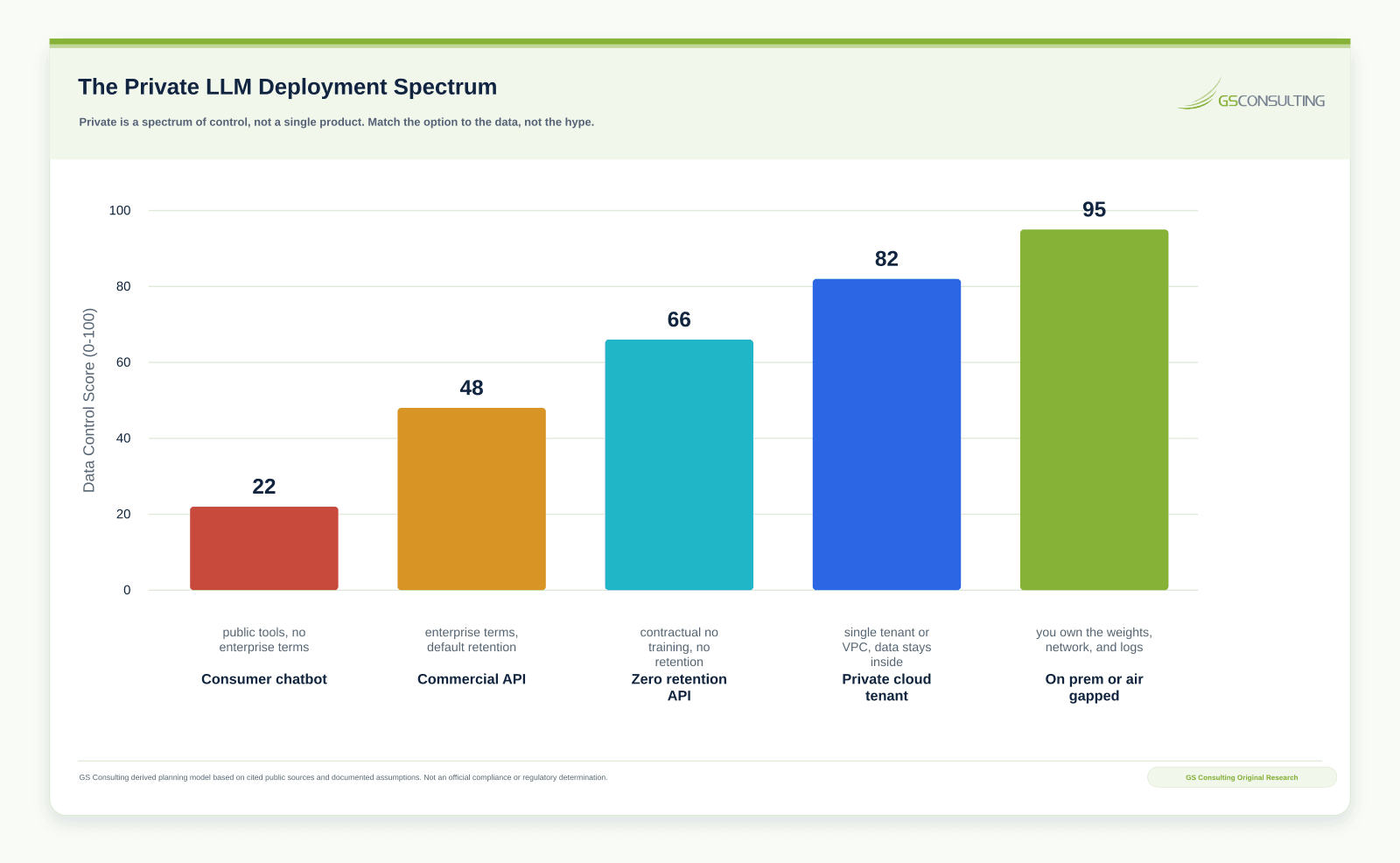
A commercial API is the lowest control option: fast, cheap, shared, and governed by default terms. A zero retention API lane adds contractual promises that your prompts are not stored or reused. A dedicated cloud tenant gives you isolation inside a provider you trust. A self hosted private cloud lets you run an open model inside your own environment. An on prem or air gapped deployment gives you the model weights, the network, and the logs, at the cost of hardware, facilities, and staff.
None of these is automatically right. The right point on the spectrum is the lowest control option that still satisfies the duty attached to your data class. That is a judgment, and it is the subject of the companion guide on private LLM deployment options, which walks through each option, what it controls, and what it costs to own. The open source vs commercial LLM guide adds the model license, artifact openness, operator burden, and exit decision.
Making the Decision: Data Sensitivity Meets Control
The clean way to make this call is to hold two things side by side: how sensitive the data is, and how much deployment control you actually need. Low sensitivity data with low control needs belongs in a commercial lane. High sensitivity data with high control needs belongs in a private environment. The interesting work is in the middle, where a dedicated tenant or a zero retention lane is often enough.
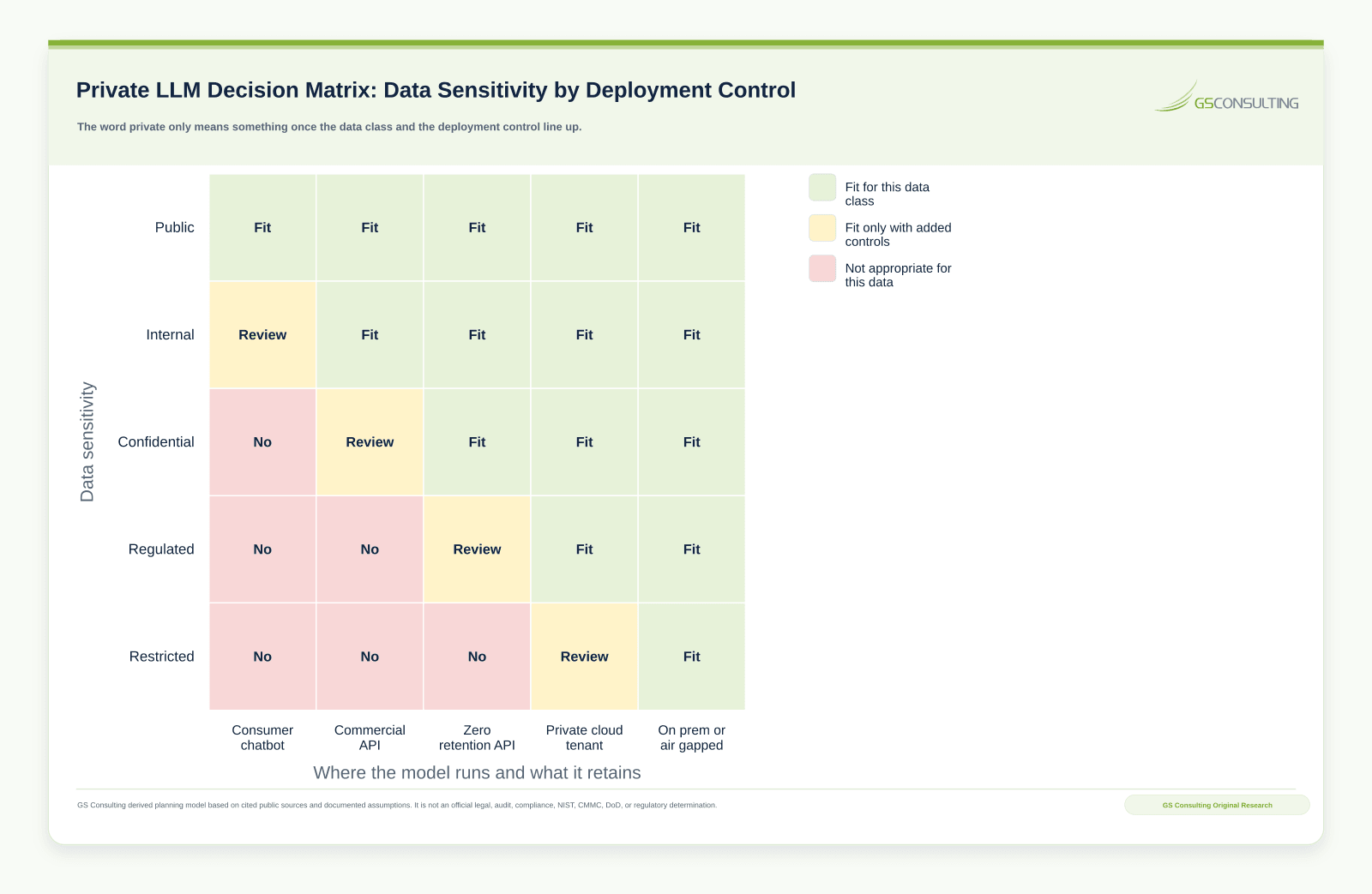
This matrix is a planning aid, not a rule. Your real answer depends on your contracts, your customer direction, your CUI scope, your identity provider, your vendor terms, and how your systems get assessed. But the shape holds: you are matching the deployment to the data, not shopping for the best model and hoping the compliance story works out later.
If you are still deciding between shared, private, and mixed environments at the strategy level, the comparison in private AI versus public AI versus hybrid AI is the right place to zoom out before you commit.
The Private LLM Evidence Packet
Calling an LLM private is a claim. In a regulated setting, an unproven claim is a finding waiting to happen. The way to turn the claim into something a leader, a security team, or an assessor can review is an evidence packet: the short list of artifacts that show the controls are real.
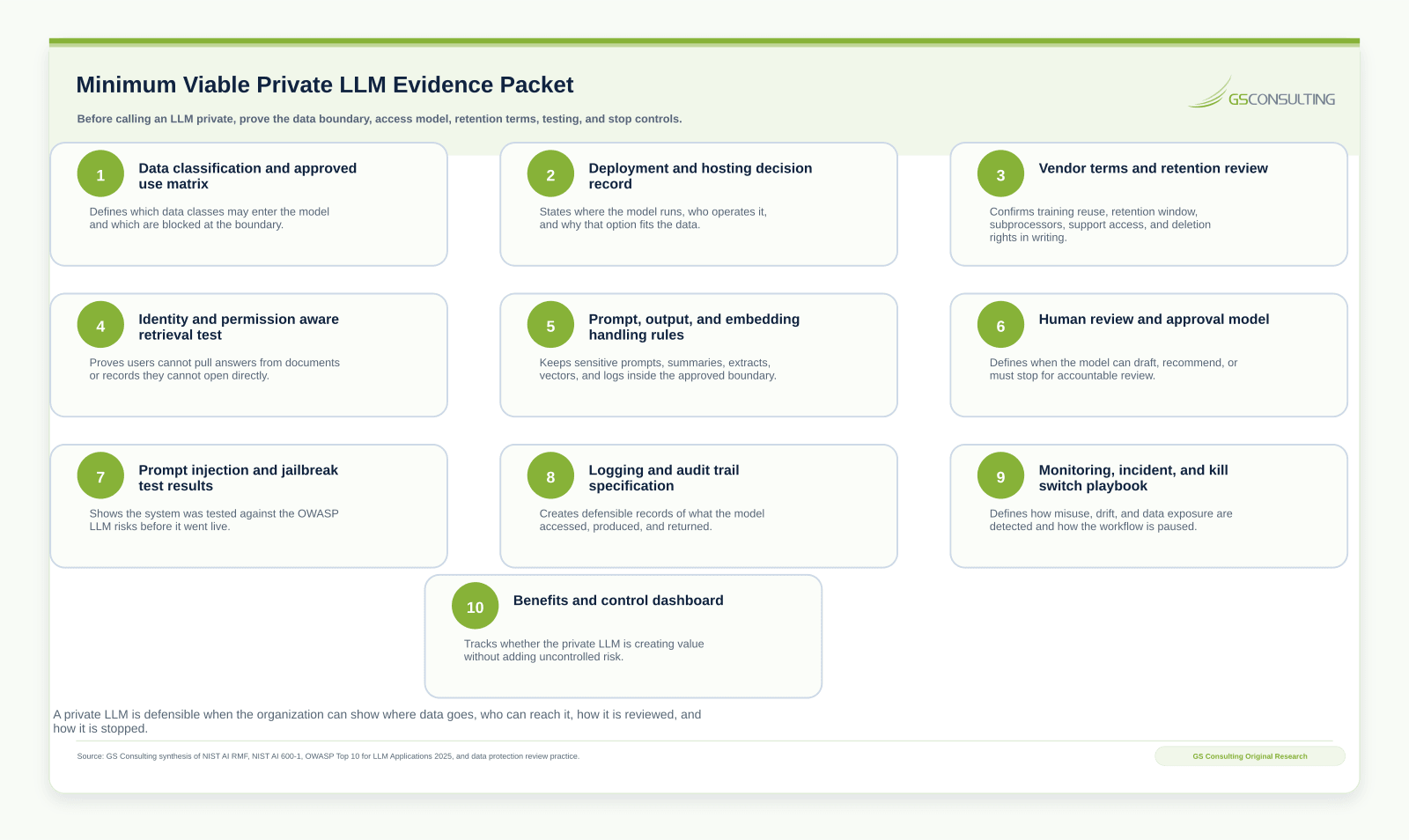
At minimum, the packet should include the data classification policy that decides what may reach the model, the record of the approved environment, the network path documentation, the retention and no training reuse terms, the identity and access mapping, the logging configuration, the human review workflow for high risk output, the monitoring plan, the incident response path with a kill switch, and the vendor terms. If the team cannot produce these, the system is not private in any way that will survive review. It is a demo that has not been tested yet.
This is exactly why a private LLM sits at the center of secure enterprise AI. It is the model environment that makes controlled workflows possible, and it pairs directly with the secure RAG design patterns for enterprise data, the secure RAG architecture for GovCon, and the controls for preventing CUI leakage in LLMs.
Where This Fits
A private LLM is one part of a larger secure AI picture. To see how the model environment, retrieval, leakage prevention, and deployment choices fit together, start from the Private LLM and Secure RAG hub, then move into the specific guides as your questions get more concrete. When you are ready to design and stand up a controlled environment, that work connects directly to Secure AI Automation for Regulated Organizations.
The Bottom Line
A private LLM is not a product, a plan tier, or a brand. It is a large language model you run under controls you can prove: your environment, your network path, your retention rules, your logs. The model is interchangeable. The control boundary is the point.
You do not need one for everything, and you should not try to. You need one where the data class and the duty attached to it justify the effort, and you should place it at the lowest control option that still satisfies that duty. Then you make the claim reviewable with an evidence packet.
Get that right and AI becomes something your security team can approve for real work. Skip it and you have a very capable tool that eventually becomes a very expensive incident.
Ready to decide whether a private LLM is the right call?
Contact GS Consulting for data classification, deployment option mapping, private LLM environment design, and the evidence packet your security team and assessors will ask for.
Contact GS ConsultingResearch Sources and Caveats
The Private LLM Data Suitability Index and the Control and Evidence Burden Score are GS Consulting derived planning tools based on cited public sources and documented assumptions. They are not official legal, audit, compliance, NIST, CMMC, DoD, CISA, OWASP, ISO, or regulatory determinations.
Actual private LLM need depends on your data classification, contracts, customer direction, CUI scope, identity provider, vendor terms, network architecture, retention obligations, and assessor or customer expectations. Use these models to structure the decision, not to replace legal, security, or compliance judgment.
- IBM Cost of a Data Breach Report 2025
- NIST AI Risk Management Framework
- NIST AI 600-1 Generative AI Profile
- OWASP Top 10 for LLM Applications
- 32 CFR Part 2002: Controlled Unclassified Information
- NIST SP 800 171 Rev. 3
Frequently Asked Questions About Private LLMs
What is a private LLM?
A private LLM is a large language model you run under your own controls, where you decide the hosting environment, the network path, the data retention rules, and who can see the prompts and outputs. It is defined by the controls around the model, not by a single product or vendor. A private LLM can be a self hosted open model, a dedicated cloud tenant, or a zero retention API lane, as long as your organization controls the data path.
Is a private LLM the same as ChatGPT Enterprise or a paid plan?
No. A paid consumer or enterprise plan may add useful terms such as no training on your data, but you are still using a shared service on someone else's terms. A private LLM is about who controls the environment, the data path, the retention, and the logs. Some enterprise offerings can be part of a private setup, but the plan tier alone does not make an LLM private.
Do I need a private LLM for every AI use case?
No. Public marketing content, general research, and low sensitivity drafting rarely justify the effort. A private LLM becomes worth the cost when the data is regulated, contract controlled, or high value, such as CUI, controlled defense information, protected health information, proprietary code, or customer data at scale.
Does a private LLM make my AI compliant?
No. A private LLM is an enabling control, not a compliance certificate. Compliance still depends on your data classification, access controls, logging, retention rules, contract terms, and how the system is assessed. A private LLM makes those controls possible, but it does not replace them.