Enterprise AI Strategy | | 24 min read
Shifting from Point Solutions to Unified AI Platforms

Key Takeaways
AI platform consolidation turns tool sprawl into control
Sprawl Is Architecture Risk
Every AI point solution adds a vendor, identity model, data path, contract, and audit problem leaders have to govern.
Savings Require Migration
Canceling tools before moving the work creates disruption and workarounds. Consolidation works when the use case migrates first.
One Platform Scales Controls
A unified AI platform gives leaders one access model, one audit trail, one data boundary, and one intake process for future use cases.
You did not decide to run a dozen AI tools. It happened one purchase order at a time. A marketing team bought an AI writer, a support team bought an AI assistant, an analyst expensed a chatbot subscription, and engineering wired an API into a workflow. Each decision made sense by itself. Added up, you now have a sprawl of single purpose AI tools, each with its own login, contract, data path, and control gap.
The pull toward enterprise AI platform consolidation is getting stronger for a concrete reason. Large organizations already run on the order of 660 SaaS applications against roughly $284 million in annual spend, and somewhere between a quarter and a third of SaaS spend is often wasted on unused or duplicate licenses. AI is now layering a second sprawl on top of the first, except this layer can touch sensitive data, create official output, and make workflow decisions.
This article is about the shift from AI point solutions to a unified AI platform, and why consolidation is a control decision as much as a cost decision. Consolidation done right is not about having fewer logos on a slide. It is about having one place to enforce access, one trail to prove what the AI did, one boundary for sensitive data, and one budget line leadership can actually account for.
The Core Problem: Sprawl Is a Governance Failure, Not a Shopping Habit
The reason point solution sprawl matters is that each tool is not just a feature. It is a new identity into your environment, a new place your data lands, a new vendor you are trusting, and a new thing your security team has to assess and your finance team has to track. One tool is manageable. Forty are not, especially when AI capabilities are buried inside SaaS platforms the organization already owns.
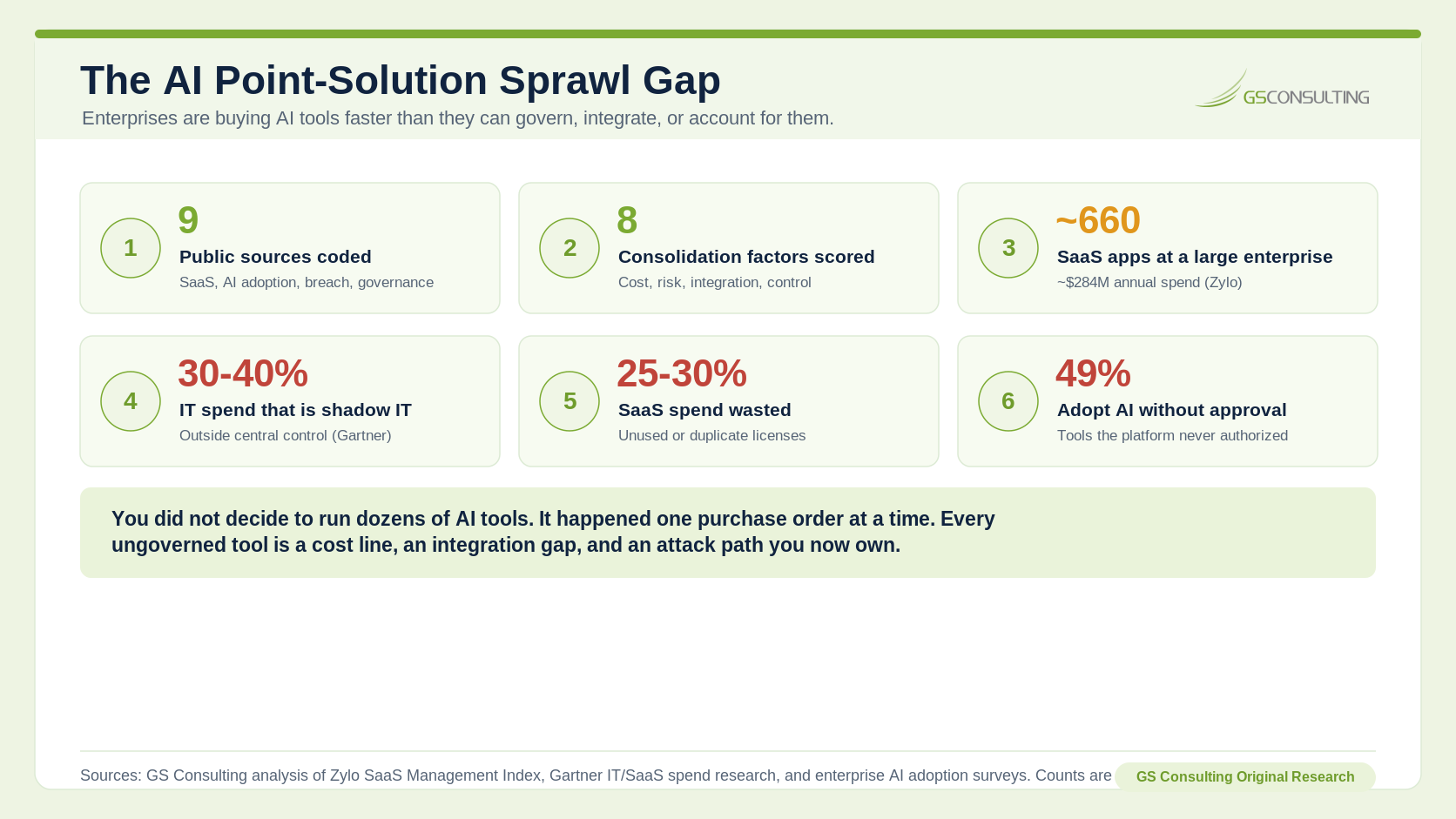
Three failure patterns follow from sprawl. The first is duplicate capability: three teams buy three different tools that do substantially the same thing, so you pay three times for one capability and govern it three different ways. The second is the ungoverned edge: tools get adopted faster than IT can review them, so a meaningful share of the AI footprint becomes shadow AI. The third is fragmented control: every sanctioned tool still has its own access model, logs, data residency, and vendor terms.
None of this is a tool quality problem. The individual tools may be excellent. The problem is architectural. You are buying AI capability the way you buy office supplies, one requisition at a time, with no platform underneath to hold it together.
Where Point Solutions Actually Cost You
Sprawl does not bill you in one obvious line item. It drains money and raises risk across several channels at once, which is why CFOs routinely underestimate it. GS Consulting scored the channels through which a sprawl of single purpose AI tools drives cost and exposure.
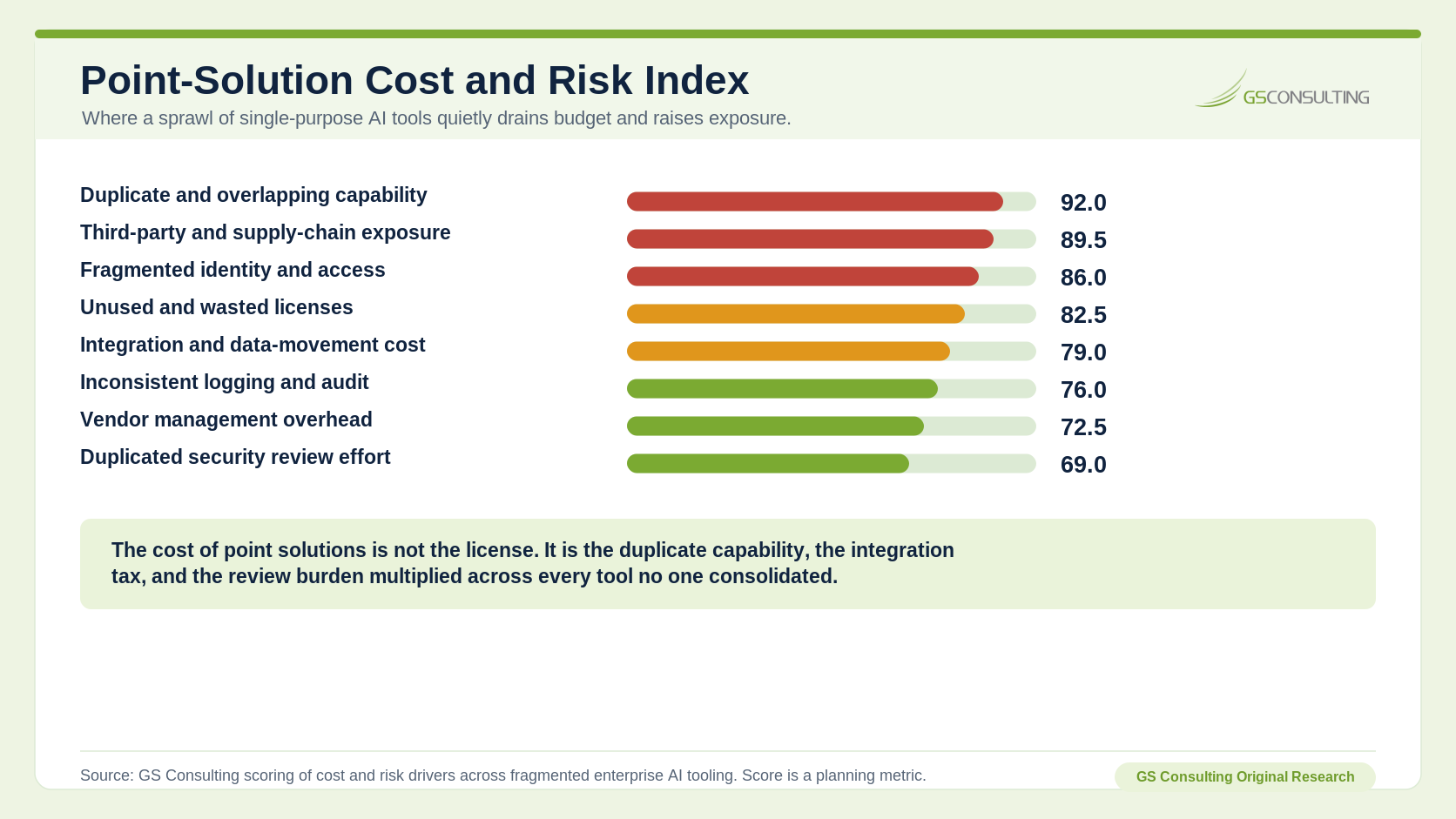
Duplicate and overlapping capability ranks first because it is common and invisible. Nobody set out to buy the same thing three times, but decentralized purchasing guarantees it. Third party and supply chain exposure ranks second because every AI vendor is a new dependency with potential access to your data. Fragmented identity and access ranks third because when every tool has its own login and permissions, there is no coherent answer to who can reach what.
A few numbers worth putting in front of a budget committee:
- ~660 SaaS applications at a large enterprise, against roughly $284 million in annual spend, per Zylo SaaS management data.
- 25-30% of SaaS spend commonly estimated as wasted on unused or duplicate licenses.
- 30-40% of IT spend running as shadow IT, outside central control, in Gartner research.
- ~30% of breaches involving a third party, roughly double the prior year, per the Verizon 2025 DBIR.
- ~49% of people adopting AI tools without organizational approval in recent adoption surveys.
(The Point Solution Cost and Risk Index is a GS Consulting derived planning metric. It is not an audit finding or a vendor evaluation.)
Drowning in AI tools you cannot govern?
GS Consulting helps CIOs and CFOs consolidate scattered AI point solutions onto a governed platform: tool inventory, overlap and spend analysis, identity standardization, unified audit logging, and a migration plan that retires redundant tools without breaking the work.
Request an AI Platform Consolidation AssessmentWhat Consolidation Actually Buys
The case for a unified platform is not fewer subscriptions. It is that consolidation moves control from a pile of disconnected tools to a single governed environment, and that is where the real returns live. GS Consulting scored the benefits an enterprise actually captures by moving from point solutions to a governed AI platform.
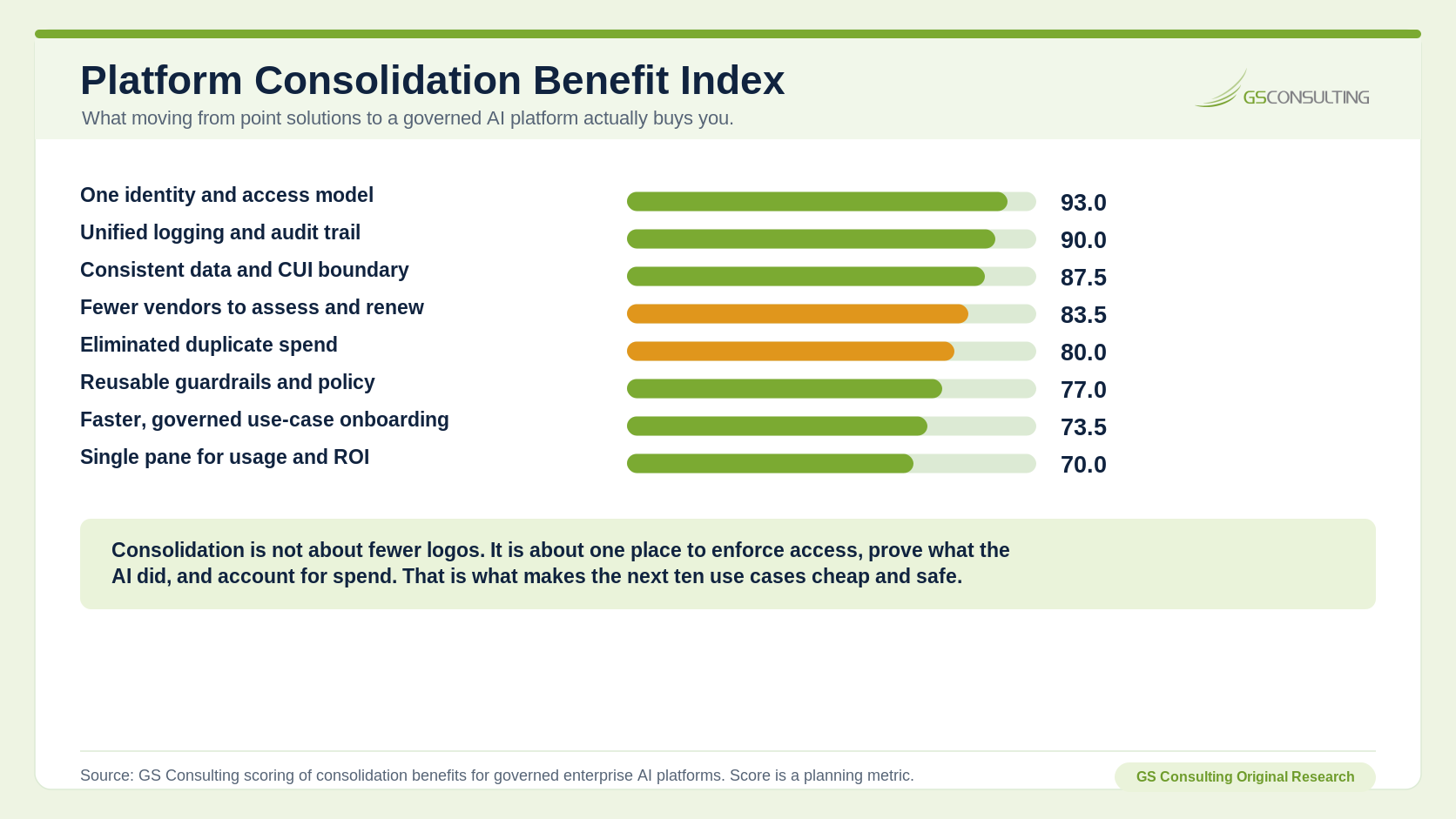
The highest value benefit is one identity and access model. When AI runs on a single platform, you control who and what can reach your data in one place instead of reconciling dozens of permission schemes. Unified logging and audit ranks just below because one trail across AI activity is the difference between proving what the AI did and hoping you can reconstruct it. A consistent data boundary rounds out the top tier because a single environment is something you can authorize, monitor, and keep sensitive data inside.
Notice what the benefits have in common. They are not features. They are the preconditions for governing AI at all: one access model, one audit trail, one boundary, and one set of guardrails. Build those once on a platform and every new use case inherits them. Rebuild them per tool and you never finish.
The Wrong Way to Consolidate
The wrong way is to treat consolidation as a procurement exercise: pick a winner, cancel the rest, and announce the savings.
It looks decisive. Leadership sees the bloated AI tool list and standardizes on one platform. A contract is signed. An email goes out telling teams the other tools will be cut at the end of the quarter. Then reality arrives. One team loses a workflow the new platform does not cover yet. Another team quietly keeps paying for the old tool because nobody mapped what it actually did. Six months later, the organization is paying for the new platform and most of the old tools. The savings never materialized because the work never migrated.
This is the trap behind the optimistic consolidation slide. The savings are real only if the migration is real, and the migration is real only if you understood what each tool was doing before you turned it off. Sprawl did not arrive through a single decision, and it will not leave through one either.
The Right Way: Migrate the Work, Then Cut the Tool
The right way treats enterprise AI platform consolidation as a sequenced migration with a governance gate at the end, so you retire scattered tools without breaking the work they were doing or letting the sprawl restart.
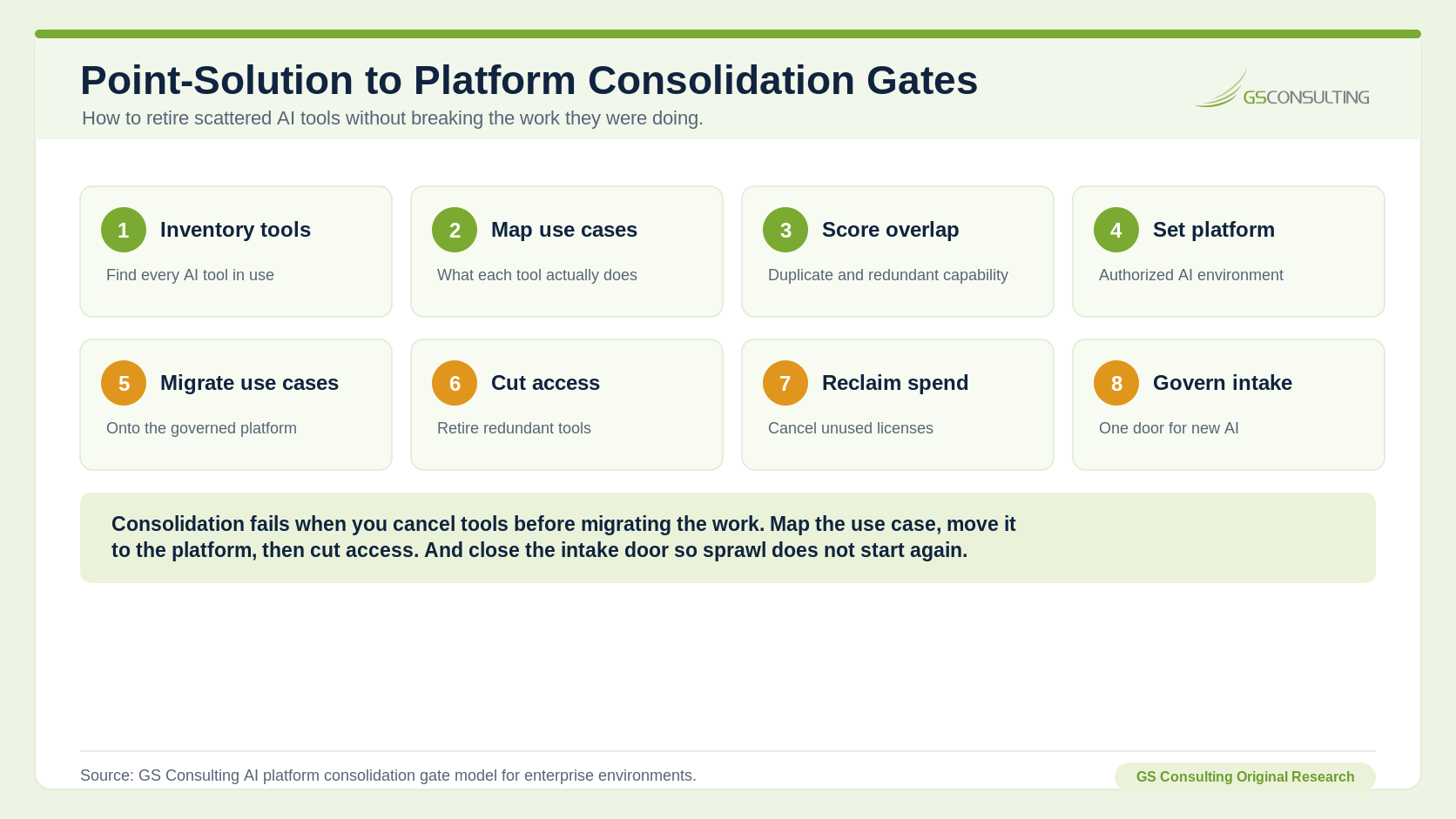
- Gate 1Inventory tools.
Find every AI tool actually in use, sanctioned or not, including the AI features inside SaaS you already own. You cannot consolidate what you have not found.
- Gate 2Map use cases.
For each tool, document what work it actually does. The goal is to understand the job, not the logo, because the job is what has to keep happening after the tool is gone.
- Gate 3Score overlap.
Identify where multiple tools do substantially the same thing. Overlap is where the fastest, least disruptive savings usually live.
- Gate 4Set the platform.
Choose the authorized AI environment that becomes the standard, with the access model, logging, and data boundary every migrated use case will inherit.
- Gate 5Migrate use cases.
Move the work onto the platform one use case at a time, starting with the highest overlap, lowest risk cases. The work continues; only the underlying tool changes.
- Gate 6Cut access.
Once a use case is running on the platform, retire the redundant tool and revoke its access. This turns migration into an actual decommission.
- Gate 7Reclaim spend.
Cancel unused and duplicate licenses and capture the savings. Done in order, the reclaimed spend can help fund the platform itself.
- Gate 8Govern intake.
Route every new AI request through one intake process. This is the gate that keeps sprawl from creeping back after the project ends.
A Little Math on the Sprawl Tax
The cost of sprawl compounds quietly, which is why it surprises finance teams when someone finally adds it up.
Take an organization spending a few thousand dollars per employee per year on SaaS, with AI tools now a growing slice of that. Industry data puts wasted SaaS spend at roughly a quarter to a third of the total. Before you evaluate a single AI use case, assume a meaningful share of AI tooling spend is buying capability you already have somewhere else, or licenses nobody uses. That is the duplicate capability tax, and it is pure waste.
Now add the part that does not show up on an invoice: every redundant tool is a vendor your security team assesses, a contract your legal team renews, a login your identity team manages, and a data path your compliance team has to account for. The labor cost of governing dozens of tools instead of one is large and self inflicted.
Platform consolidation changes the math. Inventory tells you the true count. Overlap scoring tells you which tools are buying the same capability. Migration moves the work onto one platform. Intake governance keeps it that way. You did not reduce what your people can do with AI. You stopped paying multiple times for the same capability and collapsed many governance problems into one.
Consolidation Moves, Ranked
Consolidation is a sequence of moves, and they are not equally valuable. GS Consulting scored the major moves on how much they cut cost and risk, how feasible they are, and how little they disrupt the work.
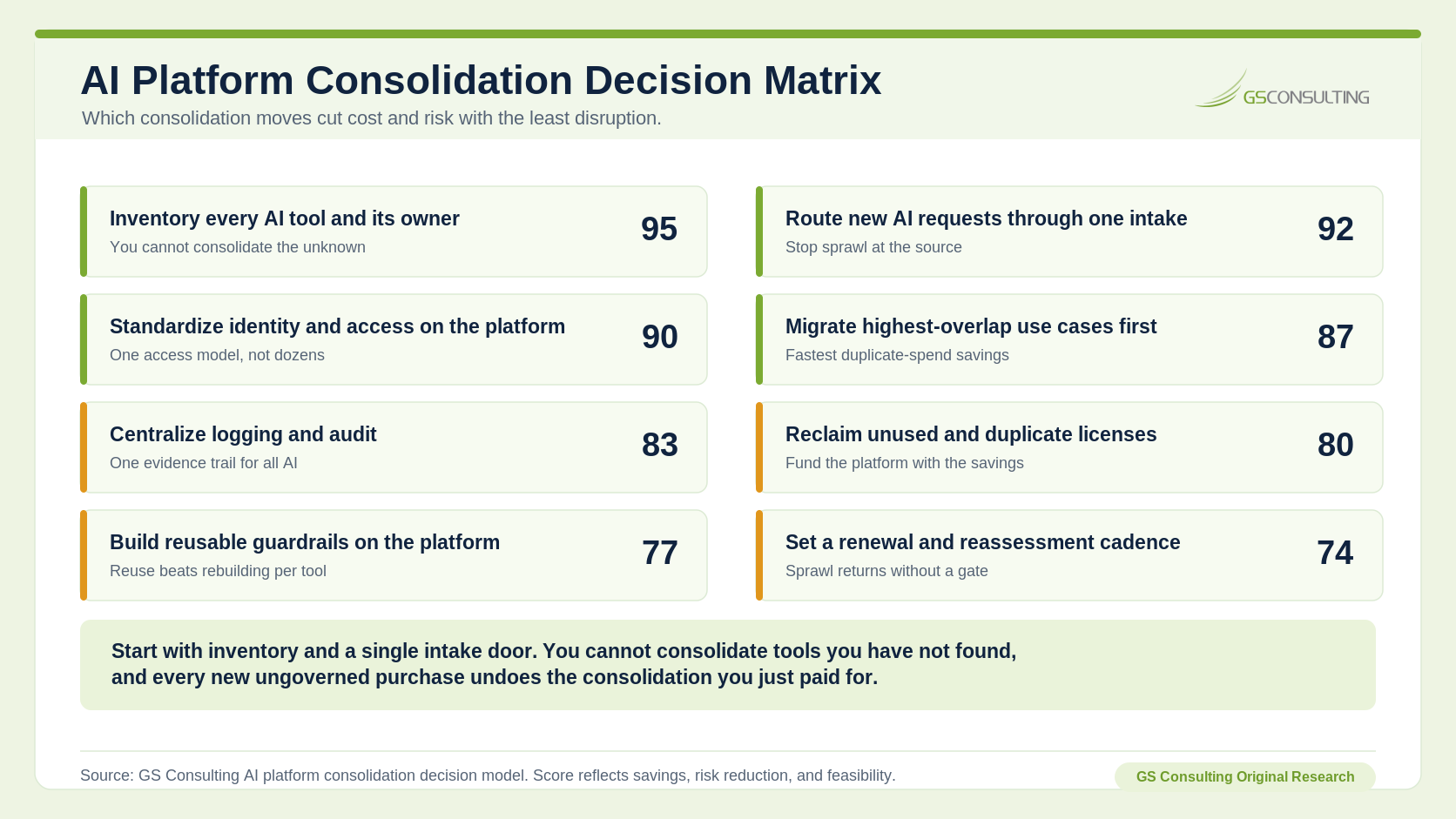
The highest scoring move is inventorying every AI tool and its owner, because it is the precondition for everything else. Routing new AI requests through one intake ranks just below because it stops the sprawl at the source. Standardizing identity and migrating high overlap use cases first round out the top tier because together they deliver control and savings with the least disruption.
The lower ranked moves, reusable guardrails and a renewal cadence, are what keep a consolidated platform consolidated. They matter, but they assume the inventory, intake, and migration are already moving. (The AI Platform Consolidation Decision Matrix is a GS Consulting derived planning model, not a product or vendor evaluation.)
The Evidence: What Consolidation Produces
A consolidation that cannot be shown is a consolidation no one will fund or trust. GS Consulting frames the output of a consolidation engagement as an evidence packet because a CFO, CIO, and security team will each ask for a different part of it before they sign off.
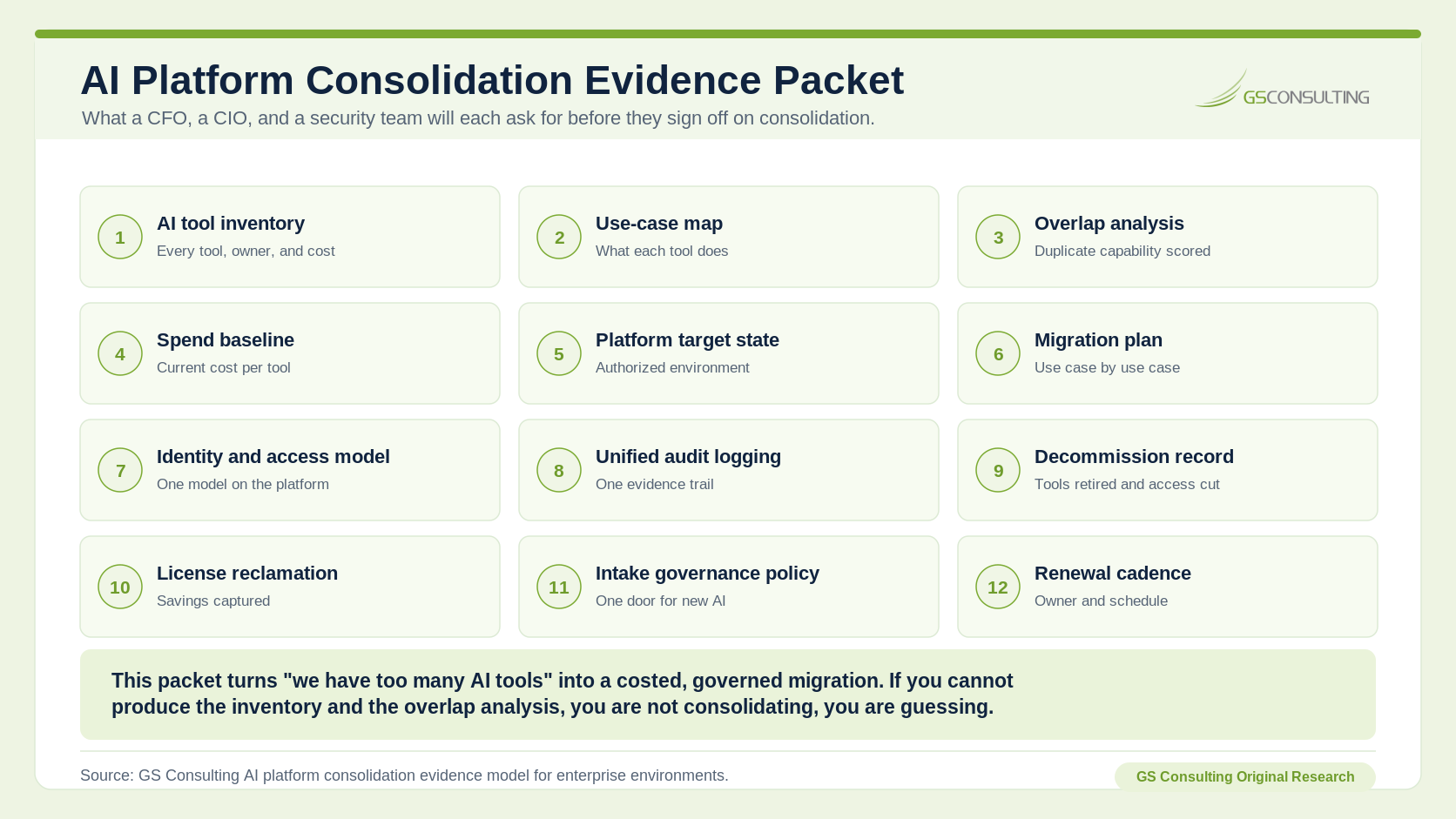
This packet shows what tools exist and what they cost, what each one does, where the overlap is, what the target platform is, how the work moves, how access is controlled, and how spend gets reclaimed. The CFO reads the spend baseline and reclamation. The security team reads the access model and audit logging. The CIO reads the migration and intake governance. If you cannot produce something like this, you are not consolidating. You are guessing.
The First 90 Days
If you are a CIO or CFO who suspects your AI footprint has outrun your ability to govern or account for it, here is a realistic sequence.
- Weeks 1-2Discover and stop new sprawl.
Inventory every AI tool in use, sanctioned or not, with its owner and cost. Stand up one intake process so no new sprawl starts during the project.
- Weeks 3-6Map work and choose the standard.
Document what each tool actually does, score overlap, and select the platform that will become the governed enterprise standard.
- Week 7+Migrate the first wave.
Move the highest overlap, lowest risk use cases onto the platform and begin cutting access to the tools they replace.
- Final stretchReclaim spend and harden controls.
Cancel redundant licenses, centralize logging, and set the renewal and reassessment cadence that keeps the footprint from creeping back.
Ninety days does not finish a full platform migration. It gives you a true inventory, a closed intake door, the first wave of duplicate tools retired, the savings flowing, and a repeatable process to migrate the rest.
Common Mistakes
- Canceling tools before migrating the work. The work stops, frustration builds, and the tools inevitably come back.
- Consolidating while the intake door is still open. New sprawl simply replaces the old sprawl.
- Standardizing without mapping what existing tools actually do. Critical edge case capabilities get lost in the transition.
- Chasing license savings while ignoring governance costs. The real cost of sprawl is governing fragmented access and audit trails, not just the software seats.
- Treating consolidation as a one time project. True platform consolidation is a standing, continuous governance function.
Every one of these is the same root error: treating AI sprawl as a shopping problem instead of an architecture and governance problem. A consolidated platform is migrated, governed, and gated at intake. A pile of point solutions is just spend and risk no one is accountable for.
How This Fits a Secure Enterprise AI Strategy
AI platform consolidation is where a Secure Enterprise AI Strategy becomes operationally real. The strategy decides which AI capabilities are worth pursuing and how they must be governed; a unified AI platform is the environment that lets leaders enforce those decisions with one access model, one audit trail, and one data boundary instead of relitigating them tool by tool.
It also depends on understanding the full economics, which is the subject of Total Cost of Ownership for Secure Enterprise AI. The license fee is the visible tip of the cost. Integration, governance, security review, and migration costs are the larger part, and they are exactly what sprawl multiplies and consolidation collapses.
This article also connects directly to AI Agent Lifecycle Management and Oversight, Managing AI Vendor Risk in Regulated Industries, Establishing Guardrails for Enterprise Generative AI, Measuring Enterprise AI ROI in Mission Critical Environments, and Enterprise AI Governance Frameworks for GovCon.
The Bottom Line
A sprawl of single purpose AI tools is not a productivity win that got a little messy. It is a governance failure with a price tag: duplicate capability you pay for repeatedly, fragmented access no one can explain, audit trails that do not connect, and a vendor footprint that grows faster than anyone can assess it.
A unified platform fixes the architecture by giving leaders one place to control access, one trail to prove what AI did, and one budget line they can defend. Get there by migrating the work before cutting the tools, scoring overlap so you save without breaking anything, and closing the intake door so sprawl cannot restart. Then let the use cases multiply on top of the platform, not the other way around.
Ready to turn AI sprawl into one accountable platform?
GS Consulting helps CIOs and CFOs consolidate scattered AI point solutions onto a governed platform, from tool inventory and overlap analysis through identity standardization, unified logging, migration, and intake governance.
Request an AI Platform Consolidation AssessmentResearch Sources and Caveats
This article draws on public 2024 through 2026 sources on enterprise software and AI adoption, including Zylo SaaS Management Index data on application counts and spend, Gartner research on shadow IT and wasted SaaS spend, the Verizon 2025 Data Breach Investigations Report on third party involvement in breaches, IBM Cost of a Data Breach research on supply chain and shadow AI breach costs, Gartner forecasts on AI governance and trust, risk, and security management, and Menlo Ventures State of Generative AI in the Enterprise research.
The Point Solution Cost and Risk Index, Platform Consolidation Benefit Index, and AI Platform Consolidation Decision Matrix are GS Consulting derived planning tools. They are scoring models built to help CIOs and CFOs prioritize AI consolidation work. They are not audit findings, vendor evaluations, or guaranteed financial outcomes, and the scores should be treated as planning inputs rather than certified measurements.
Frequently Asked Questions About AI Platform Consolidation
Isn't a single AI platform a single point of failure?
A governed platform is a single point of control, which is different from a single point of failure. Concentration risk should be managed with resilience practices, but a sprawl of ungoverned tools creates many independent failure, breach, and audit surfaces with no coherent oversight.
Won't AI platform consolidation slow down teams?
Only if leaders cancel tools before migrating the work. The right sequence maps what each tool does, moves each use case onto the platform, validates the workflow, and then retires the old tool. Teams keep the capability; the organization removes the ungoverned vendor surface.
How do we know which AI tools to consolidate first?
Start with overlap. Tools that duplicate capability are usually the lowest risk, highest savings consolidation targets because the work can often move without losing unique functionality. Unique, high value workflows should be migrated later and more carefully.
Do AI features inside SaaS applications count as point solutions?
Yes. Embedded AI features can touch data, create output, and introduce vendor risk just like standalone tools. A complete AI platform consolidation inventory includes sanctioned AI tools, shadow AI, and AI capabilities built into existing SaaS applications.
How do organizations keep AI sprawl from coming back?
They close the intake door. Every new AI request should go through one governance process that evaluates value, data exposure, security, contract terms, logging, ownership, and whether the use case belongs on the authorized platform.
Related Reading
- Secure Enterprise AI Strategy
- AI Agent Lifecycle Management and Oversight
- Total Cost of Ownership for Secure Enterprise AI
- Managing AI Vendor Risk in Regulated Industries
- Establishing Guardrails for Enterprise Generative AI
- Measuring Enterprise AI ROI in Mission Critical Environments
- Enterprise AI Governance Frameworks for GovCon
- Enterprise AI Readiness Assessment
- Developing a Phased Secure AI Adoption Roadmap