Enterprise AI Strategy | | 22 min read
Shadow AI Discovery and Remediation Strategy

Key Takeaways
What leaders need to know about shadow AI remediation
Discovery beats policy theater.
The first control is knowing which AI tools people actually use, through which accounts, and with what data.
The worst flows move first.
Sensitive data plus personal accounts plus poor visibility is the exposure path to contain before broad program design.
A sanctioned lane changes behavior.
Blocking without a useful approved alternative moves AI use out of sight instead of reducing risk.
Shadow AI is not a policy problem. It is a visibility problem with a compliance bill attached.
For the operating rules that discovery should enforce, use the AI governance hub. Connect each finding to an approved use case, data boundary, and remediation owner.
Most organizations already have a rule somewhere that says "do not put company data into unapproved AI tools." It is in the acceptable use policy, the security awareness deck, or an all-hands email someone sent after reading a headline. None of that matters, because the rule describes behavior nobody is watching. Your employees are already using consumer AI tools. They are pasting contracts, source code, customer records, and in regulated environments, controlled unclassified information into chatbots the organization has never seen, never inventoried, and cannot monitor.
The uncomfortable part is that the rule is not the thing protecting you. Discovery is. You cannot remediate, secure, or transition usage you have never found. So before you write another policy, the real question is simpler and harder: do you actually know which AI tools your people use, what data goes into them, and through which accounts?
Almost no one can answer that on day one. That gap is the whole problem.
What Shadow AI Actually Is
Shadow AI is any AI tool, model, or AI feature being used for work without the organization's review, approval, or oversight. It is broader than people think. It includes:
- The free version of a public chatbot, used through a personal login on a work laptop.
- AI features quietly switched on inside SaaS tools you already pay for.
- Browser extensions that summarize, rewrite, or "enhance" whatever is on the screen.
- Personal devices and home networks where employees do the work they were told not to do on the corporate network.
- Agentic tools and connectors that read from systems and act on their own.
This is not a fringe behavior by a few rule-breakers. In late-2025 research from UpGuard, more than 80% of workers reported using unapproved AI tools at work, and nearly 90% of security professionals admitted the same. Other surveys put the share of organizations with employees using unsanctioned AI at 98%. Netskope's 2025 cloud and threat research found the average organization now touches 9.6 generative AI apps, and the volume of data sent to those apps grew roughly 30-fold in a single year.
Read that last number again. Thirty times more data flowing to AI tools means thirty times more chances for something sensitive to walk out the door. And about half of employees say they would keep using their preferred AI tool even if the organization explicitly banned it.
The Point of a Shadow AI Strategy
A shadow AI discovery and remediation strategy should answer one question: how do we find the AI tools our people actually use, understand the risk, and move that work into something we can secure and defend?
Not "how do we ban AI." Banning AI is how you lose. Hard blocks without a sanctioned alternative push usage onto personal phones, personal accounts, and home networks, which is exactly where you have zero visibility and zero audit trail. The goal is not to stop people from using AI. The goal is to stop uncontrolled AI from leaking data you are legally required to protect.
Need to find out what AI your people are really using?
GS Consulting runs shadow AI discovery and remediation engagements for government contractors and regulated organizations: network and identity discovery, data exposure assessment, CUI risk triage, sanctioned tool transition, and the evidence package that proves it was done. The first phase is finding out what is actually happening. Request a Shadow AI Discovery Assessment.
Request a Shadow AI Discovery AssessmentWhy This Is a Discovery Problem First
Here is the part that should worry a CISO. The tools you already own were not built to see this.
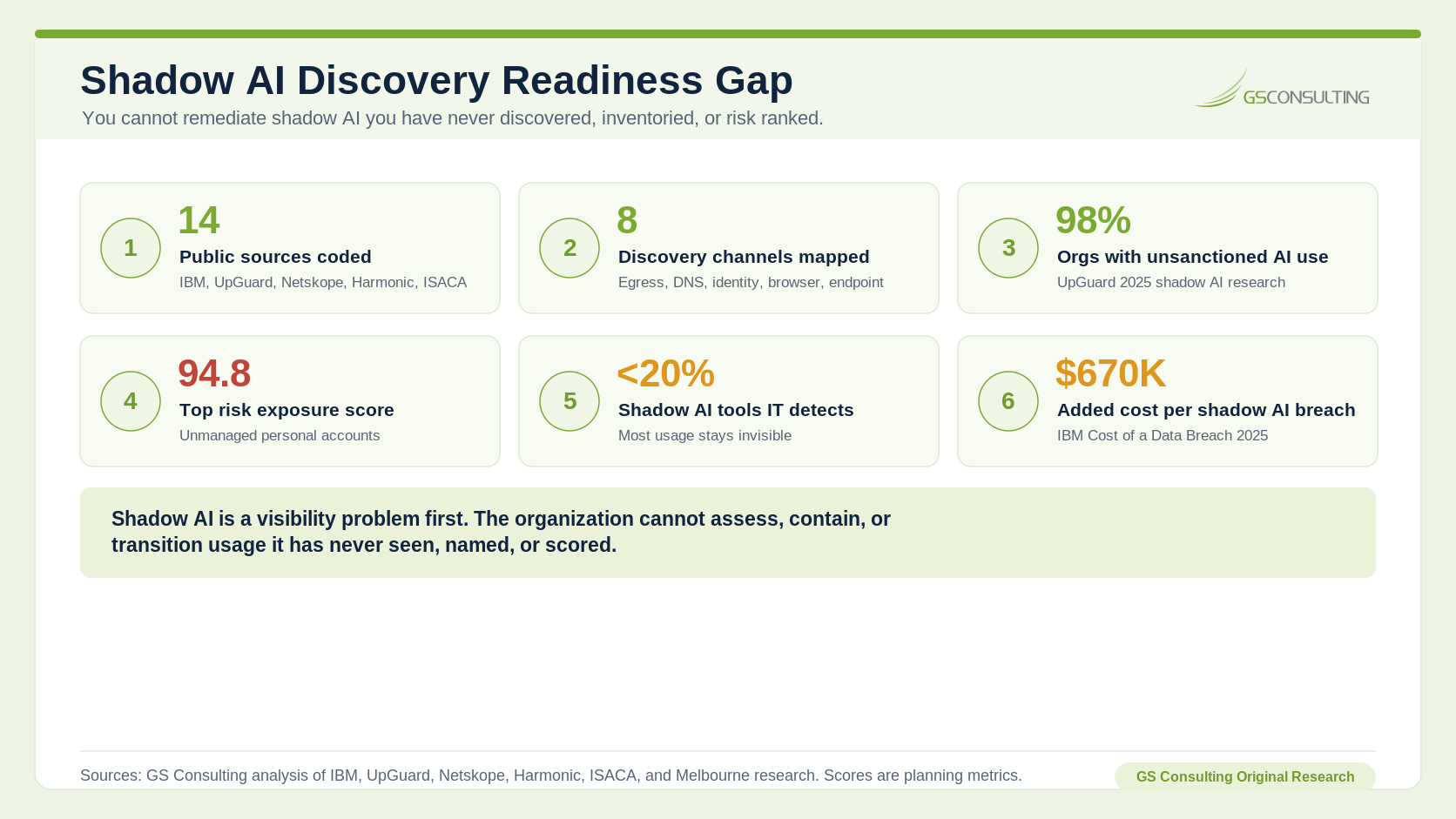
When an employee opens a browser, logs into a personal AI account, and pastes a paragraph of a contract into the chat box, that action does not look like an attack. It does not trip a data loss prevention rule designed for email and file transfers. It is encrypted HTTPS traffic to a domain that looks like every other SaaS domain. By most estimates, IT teams detect fewer than 20% of the AI tools actually in use. The other 80% is the shadow.
This is why GS Consulting treats shadow AI as a discovery and inventory problem before it is a governance problem. You can write the best AI policy in the world, but if you cannot see the usage, the policy is theater. The first job is to turn invisible activity into a named, scored, defensible inventory.
Original Research: The Shadow AI Risk Exposure Index
To make this concrete, GS Consulting scored the most common shadow AI exposure paths against four drivers: how prevalent the behavior is, how likely it is to involve sensitive or regulated data, how hard the channel is to detect, and how difficult it is to remediate once it is entrenched. The result is the Shadow AI Risk Exposure Index, a planning tool for deciding where to point discovery and containment first.
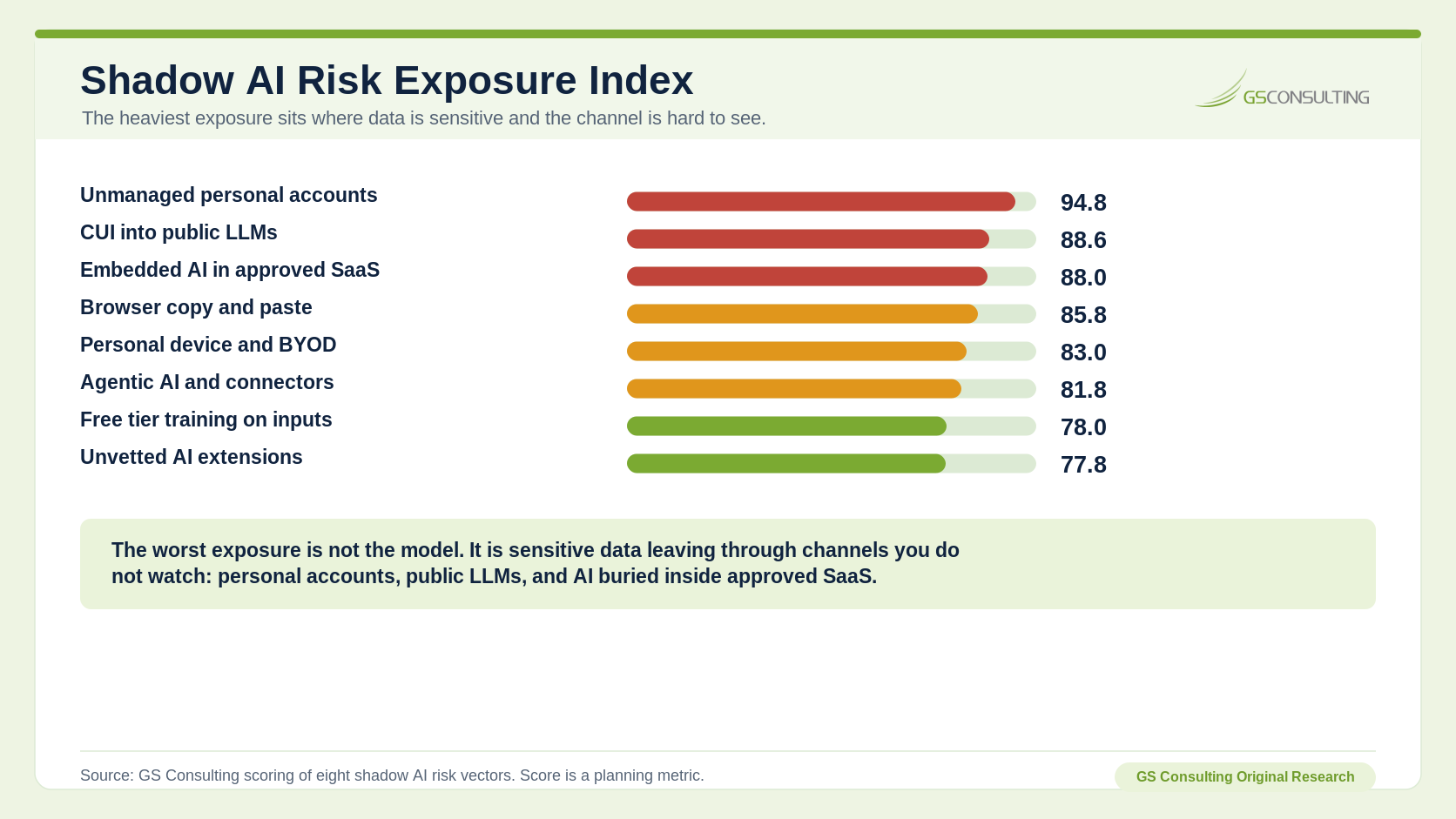
The ranking lines up with what the public data shows. Security firm Harmonic, analyzing more than a million prompts, found that 77% of employees who used generative AI at work had copied or pasted company data into it, and 82% of those pastes came from unmanaged personal accounts. Earlier behavioral research found the average AI user makes about 6.8 pastes a day, and more than half of those contain sensitive corporate data. Generative AI chat has now become the single largest channel for unauthorized data movement, accounting for roughly a third of it, surpassing both email and cloud storage for the first time.
A few numbers worth keeping in front of the board:
- 94.8 — top risk exposure score, for sensitive data leaving through unmanaged personal accounts.
- 88.6 — exposure score for CUI and regulated data going into public LLMs.
- 88.0 — exposure score for AI features embedded inside SaaS tools you have already approved.
- 77% — share of generative AI users who paste company data into chatbots (Harmonic).
- 32% — share of all unauthorized data transfers that now flow through generative AI (industry research).
The pattern is clear. The worst exposure is not the model itself. It is sensitive data leaving through channels you do not watch. (The Shadow AI Risk Exposure Index is a GS Consulting derived planning metric. It is not an official NIST, CISA, IBM, UpGuard, Netskope, Harmonic, audit, or risk-rating determination.)
The Wrong Way to Handle Shadow AI
The wrong approach is familiar because most organizations have already tried it.
Someone reads about a data leak. Leadership gets nervous. Security sends an email: "Do not use ChatGPT or any AI tool for company work." Maybe IT blocks one or two domains at the firewall. Everyone feels better for about a week.
Then nothing changes, except now the usage hides better. Employees switch to their phones. They use a slightly different tool that was not on the block list. They route around the proxy. The work still has to get done, and AI makes it faster, so the behavior continues. The only thing the ban accomplished was to move the activity somewhere the organization can no longer see it at all.
This is the trap. A ban without an alternative does not reduce shadow AI risk. It converts a visible risk into an invisible one. The data shows it plainly: organizations that block AI without providing a sanctioned option see only a 15% to 20% reduction in unauthorized use, and most of that is people getting better at hiding.
The Right Way: Discover, Assess, Transition
The right approach is staged and disciplined. First you find what is there. Then you understand what data is at risk. Then you contain the worst flows. Then you give people a sanctioned, approved tool that is good enough that they stop reaching for the consumer one. Then you close the unmanaged exits and watch for new ones.
That is the whole strategy in one line: see it, score it, contain it, replace it, monitor it.
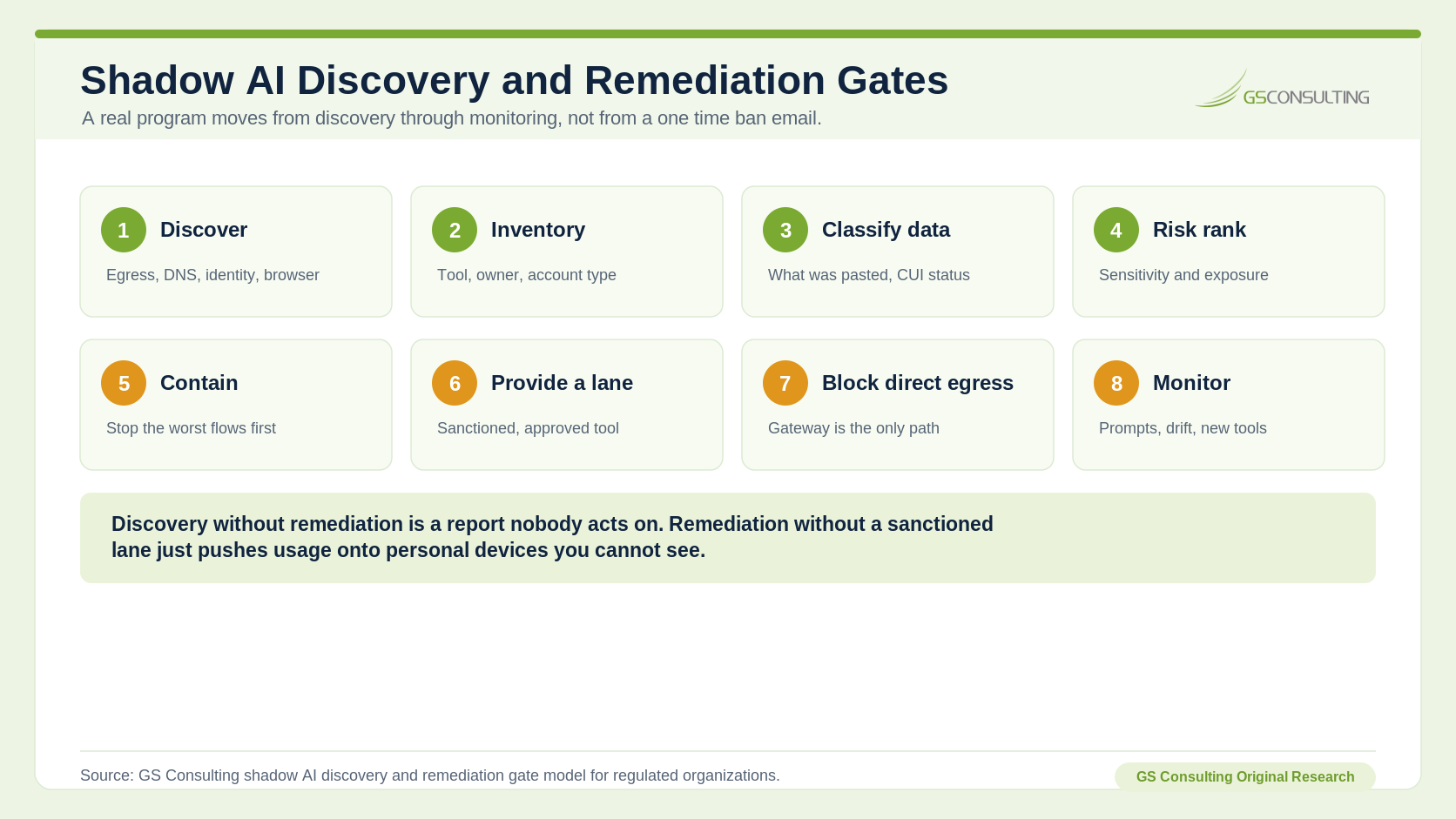
These are gates, not a checklist you do once. Do not move to the next gate until the previous one produces something you could put in front of an auditor or a customer. Discovery without remediation is a report nobody acts on. Remediation without a sanctioned alternative just pushes usage onto personal devices you cannot see.
- Gate 1Discover.
You cannot manage what you cannot see, so discovery comes first, and it should be technical, not a survey. Asking employees to self-report their AI usage produces a polite, incomplete, and optimistic picture. Watch the network and the identity layer instead.
- Gate 2Inventory.
Every tool you find gets a record: what it is, who is using it, and critically, whether they are logged in through a managed corporate account or a personal one. The personal-account usage is where most of the sensitive data is going, because that is the data that never touches an enterprise agreement, retention control, or audit log.
- Gate 3Classify the data.
The risk of shadow AI is not the tool. It is the data going into it. For each significant usage path, the real question is what kind of data is being pasted or uploaded. Public marketing copy is one thing. A contract, a customer record, source code, or controlled unclassified information is another thing entirely.
- Gate 4Risk rank.
Not every shadow AI use is an emergency. Triage. The combination of sensitive data plus a hard-to-see channel plus a personal account is the fire. A handful of people using a public chatbot to rewrite their internal meeting notes is a smaller fire. Rank them so you fix the right things first.
- Gate 5Contain.
Stop the worst flows before you build the perfect program. If you find regulated data going into a public tool through personal accounts, that is a containment action this week, not a roadmap item for next quarter.
- Gate 6Provide a sanctioned lane.
This is the move that actually works. When organizations give employees a real, enterprise-grade AI option, unauthorized tool use has been shown to drop by as much as 89%. People are not using shadow AI to be reckless. They are using it because it helps and the approved path is slow or nonexistent. Give them a fast, sanctioned path and most of the problem solves itself.
- Gate 7Block direct egress.
Once a sanctioned lane exists, make it the only path the organization allows to AI providers. Route AI traffic through a controlled gateway and block direct connections to provider domains. Blocking is fair and effective only after you have given people somewhere legitimate to go.
- Gate 8Monitor.
Shadow AI is not a one-time cleanup. New tools launch every month. Employees change habits. Vendors add AI features to software you already use. Monitoring for new tools, prompt patterns, and data drift is the difference between a program and a press release.
Where to Actually Look for Shadow AI
Discovery only works if you point it at the right signals. Some detection channels see almost everything. Others, including the one most programs forget, see almost nothing, which is exactly why shadow AI hides there.
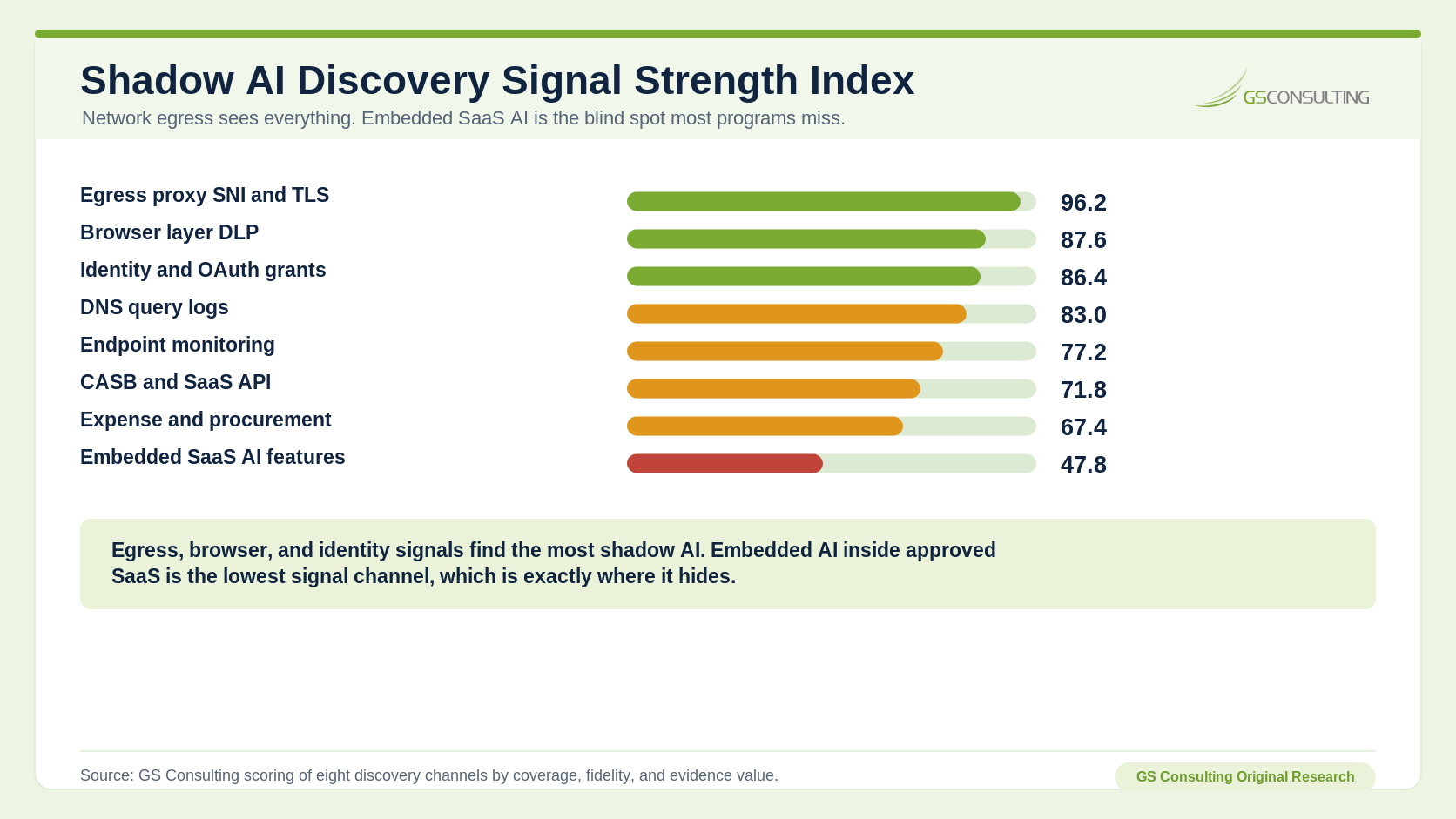
The highest-fidelity signal is the corporate egress point. Every connection to a known AI provider domain shows up in the SNI hostname and TLS metadata at the proxy, regardless of which application started it. DNS logs are a close, cheaper proxy for the same thing. Identity and OAuth grants reveal which AI apps employees have connected to your environment. Browser-layer controls can catch the paste and upload itself, which is the actual leak event.
The blind spot, scoring lowest by a wide margin, is AI embedded inside SaaS you already approved. When an AI feature runs through API calls inside a tool your firewall already trusts, it does not generate distinct network traffic to a suspicious domain. Traditional network and proxy discovery walks right past it. That is precisely why it is the channel that surprises organizations during an assessment, and why discovery has to include reviewing the AI features inside your existing software stack, not just hunting for rogue chatbots.
The GovCon and CUI Problem
For government contractors and regulated organizations, shadow AI is not just a data-hygiene issue. It is a compliance exposure.
If your organization handles controlled unclassified information, you are obligated under NIST SP 800-171 and, increasingly, CMMC to control where that information lives and who can access it. The CMMC program moved into active enforcement in 2025, with third-party assessments verifying adherence to the 110 security requirements in NIST SP 800-171. None of those controls contemplate a copy of CUI sitting in the training pipeline of a consumer chatbot reached through an employee's personal Gmail login.
When an employee pastes a paragraph of a CUI document into a public LLM to "clean up the wording," several things can happen at once, and all of them are bad. The information leaves your authorization boundary. It may be retained by the provider. On a free tier, it may be used to train the model. There is no audit trail. And you may have just created a reportable incident under your contract without anyone in the organization knowing it occurred.
This is why CUI exposure deserves its own line in the discovery effort. The question is not abstract. It is: did controlled unclassified information leave our boundary through an AI tool, and can we prove whether it did or did not? In a regulated environment, "we are not sure" is not an acceptable answer to an assessor or a contracting officer.
Remediation: Replace, Do Not Just Restrict
Once you can see the usage, remediation becomes a set of decisions. GS Consulting scored the common remediation moves on three things: how much risk they actually reduce, how feasible they are to implement, and how durable they are over time.
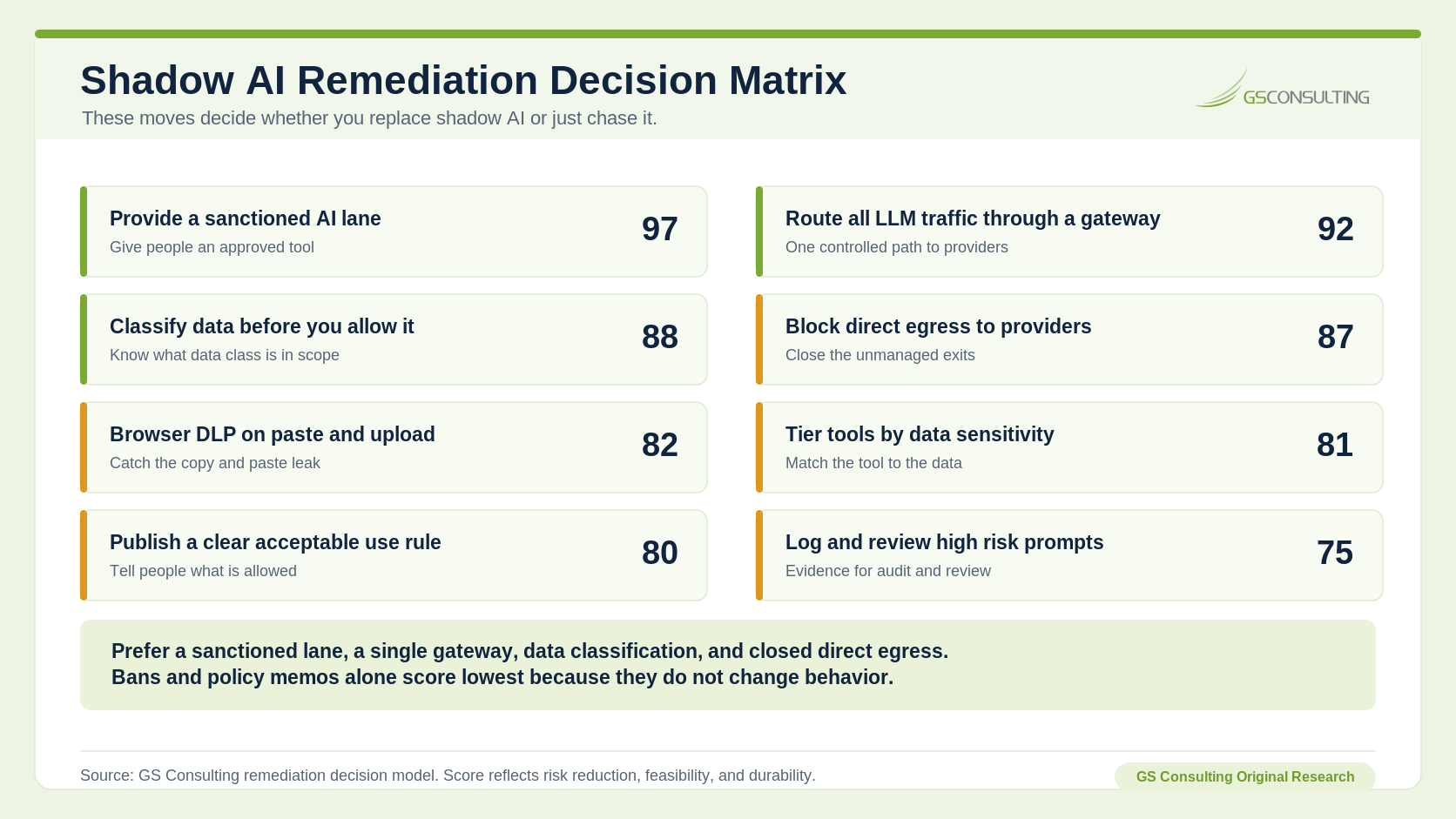
The highest-scoring move is providing a sanctioned AI lane, because it is the only one that changes behavior instead of fighting it. Routing all AI traffic through a single controlled gateway and classifying data before you allow it round out the top tier. Notice what scores lowest: publishing an acceptable use rule and logging prompts. Those are not useless, but on their own they do not change what people do. The lesson is blunt. Bans and policy memos score low because they do not change behavior. A sanctioned lane plus a controlled gateway score high because they do.
There is hard evidence behind this ordering. Deploying an enterprise AI tool without a shadow AI program produces only a 15% to 20% reduction in unauthorized use. Deploying that same enterprise tool combined with a real shadow AI policy and containment program achieves a 60% to 75% reduction within 90 days. The tool is not the strategy. The strategy is the tool plus the discovery, the gateway, the classification, and the monitoring around it. (The Shadow AI Remediation Decision Matrix is a GS Consulting derived planning model, not an official compliance or product evaluation.)
A Little Math on the Cost
Leaders move when the number is concrete, so here is the back-of-the-envelope version.
Take a 300-person regulated business. If 80% use AI tools, that is 240 people. If even half are doing it through unmanaged personal accounts on the worst-exposure path, that is 120 people moving company data outside any control you can audit. Behavioral research suggests the average AI user pastes sensitive data into a chatbot several times a day. Across 120 people, that is hundreds of uncontrolled sensitive-data events per day, none of them logged.
Now the downside. IBM's 2025 Cost of a Data Breach report found that breaches involving shadow AI cost organizations about $670,000 more than breaches without it, and that one in five breached organizations had a security incident tied to shadow AI. Among those AI-related incidents, 97% of the organizations lacked proper AI access controls, and 63% had no AI governance at all. Shadow AI breaches were also more likely to compromise personal information and intellectual property.
You do not need a perfect model to see the asymmetry. The cost of finding out what your people are using is small. The cost of finding out from a breach notification is not.
The Evidence: What "Done" Looks Like
In a regulated environment, doing the work is not enough. You have to be able to prove you did it. GS Consulting frames the output of a remediation effort as an evidence packet, because that is what an assessor, a customer, or your own board will eventually ask for.
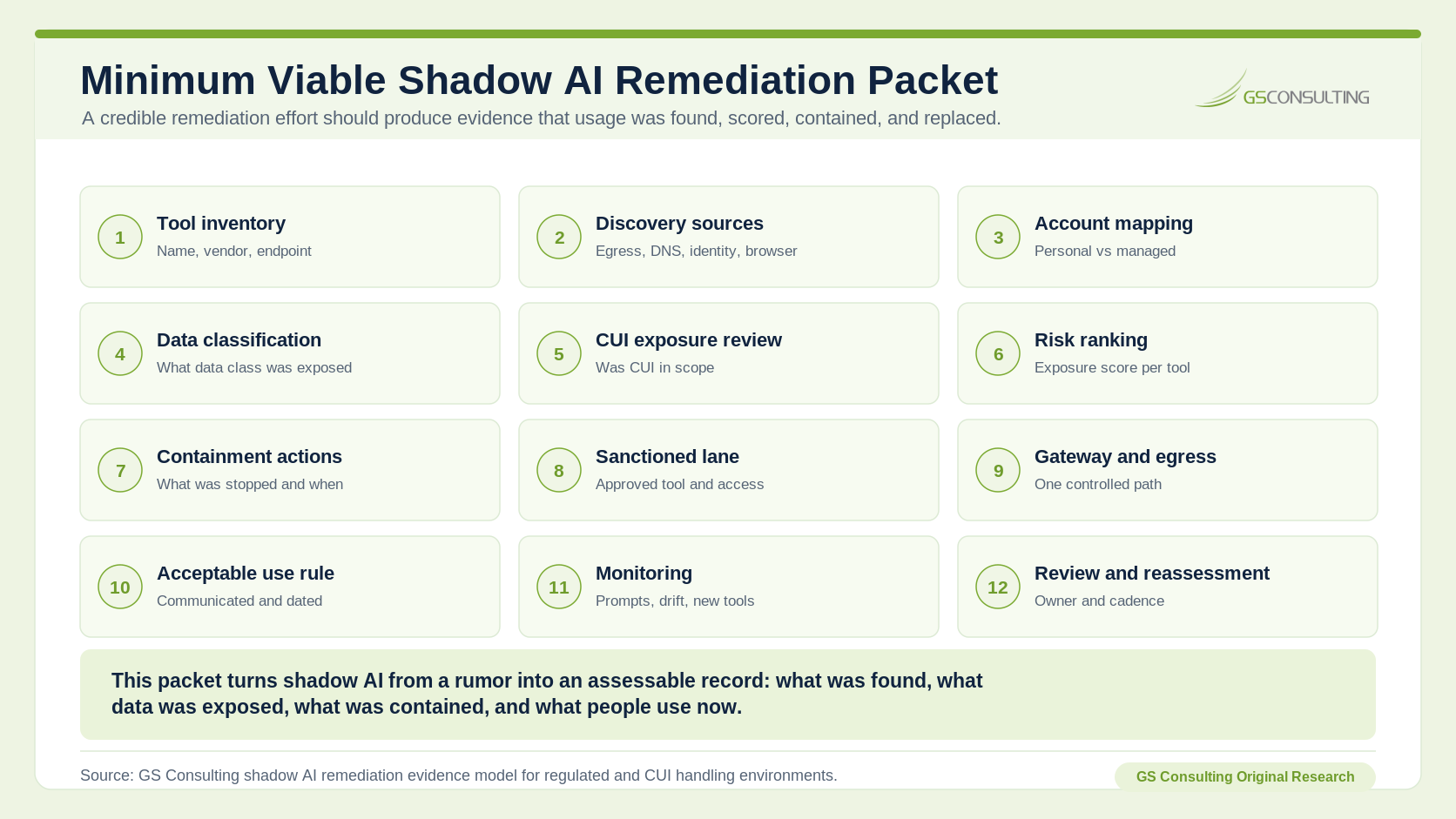
This packet is what turns shadow AI from a rumor into an assessable record. It shows what was found, what data was exposed, what was contained, what people use now, and who owns keeping it that way. If you cannot produce something like this, you do not have a remediation program. You have a hope.
The First 90 Days
If you are a CISO or IT leader starting from zero, here is a realistic sequence.
- Weeks 1 to 2Stand up discovery and inventory.
Start technical discovery at the egress and identity layers, begin building the inventory, and frame the work as giving people a safe AI path rather than hunting wrongdoers.
- Weeks 3 to 6Classify data and rank risk.
Classify the data flowing into the top tools, run the CUI exposure review, rank the risks, and contain anything involving regulated data immediately.
- Week 7Select the sanctioned lane.
Choose an enterprise grade AI option that is secure enough to approve and useful enough that employees will actually move to it.
- Weeks 8 to 13Control egress and monitor.
Route AI traffic through a controlled gateway, close direct egress to providers, publish specific allowed use rules, and stand up ongoing monitoring.
Ninety days does not get you to perfect. It gets you from blind to seeing, from exposed to contained, and from "we have a policy" to "we have control and evidence."
Common Mistakes
- Banning AI and calling it a strategy. Usage goes underground when the organization blocks tools without giving people a sanctioned alternative.
- Surveying employees instead of watching technical signals. Self reported AI use is usually polite, incomplete, and optimistic.
- Buying an enterprise AI tool and assuming shadow use ends. Unauthorized use barely moves unless the tool is paired with discovery, containment, gateway control, and monitoring.
- Ignoring embedded AI inside approved SaaS. Existing vendors can add AI features that create data exposure without obvious new network traffic.
- Skipping the evidence packet. When an assessor asks what happened to CUI, "we are not sure" is not a defensible answer.
Every one of these comes back to the same root cause: treating shadow AI as a one time announcement instead of an operating discipline of discovery, containment, replacement, and monitoring.
How This Fits a Secure Enterprise AI Strategy
Shadow AI discovery is not a standalone project. It is the ground truth that everything else depends on. You cannot build a credible Secure Enterprise AI Strategy on top of an environment where you do not know what AI is already in use and what data it has already seen. Discovery is the assessment phase that tells you where you actually stand.
It also feeds directly into tool decisions. The sanctioned lane you stand up during remediation has to be chosen on purpose, against real criteria for security, data handling, and compliance fit. That connects directly to Shifting from Point Solutions to Unified AI Platforms. Discovery tells you what you are replacing. Platform strategy tells you what to replace it with.
The Bottom Line
Your employees are using AI right now, on tools you have not approved, through accounts you cannot see, with data you are responsible for. That is true at almost every organization, including the ones with a policy that says otherwise. The policy is not the control. Discovery is.
The organizations that handle this well do not start by banning AI. They start by finding out what is actually happening, scoring the risk, containing the worst of it, and giving people a sanctioned tool good enough that the consumer version stops being worth the trouble. Then they prove it with evidence. The ones that handle it badly send an email, block a domain, and find out the rest from a breach notification.
Pick the first one. And start with discovery, because you cannot fix what you have never seen.
Ready to find out what AI your people are actually using?
GS Consulting runs shadow AI discovery and remediation engagements for government contractors and regulated organizations, from technical discovery and CUI exposure assessment through sanctioned tool transition and the evidence package that proves it was done. Request a Shadow AI Discovery Assessment.
Request a Shadow AI Discovery AssessmentResearch Sources and Caveats
This article draws on public 2025 research, including IBM's Cost of a Data Breach 2025, UpGuard's shadow AI research, Netskope's 2025 cloud and threat reporting, Harmonic Security's analysis of generative AI usage, ISACA's AI governance findings, and the University of Melbourne's 2025 workplace AI study, alongside NIST SP 800-171 and CMMC program guidance.
The Shadow AI Risk Exposure Index, the Shadow AI Discovery Signal Strength Index, and the Shadow AI Remediation Decision Matrix are GS Consulting derived planning tools. They are scoring models built to help leaders prioritize discovery and remediation. They are not official NIST, CISA, IBM, UpGuard, Netskope, Harmonic, ISACA, Gartner, legal, audit, compliance, or product-rating determinations, and the scores should be treated as planning inputs, not certified measurements.
Frequently Asked Questions
What is shadow AI remediation?
Shadow AI remediation is the process of discovering unauthorized AI tools employees use for work, assessing the data and compliance risk, containing the highest risk usage, and transitioning that work onto secure, sanctioned enterprise AI tools the organization can monitor and audit. It pairs discovery with a replacement path rather than relying on bans alone.
How do you discover which AI tools employees are using?
The most reliable discovery method is technical, not a survey. Inspect outbound traffic at the corporate egress proxy for connections to known AI provider domains, review DNS logs, examine identity and OAuth grants for connected AI apps, and use browser layer controls to catch paste and upload events. Reviewing AI features inside already approved SaaS is essential, because that channel produces almost no distinct network signal.
Why not just block all unapproved AI tools?
Blocking without a sanctioned alternative pushes usage onto personal devices, personal accounts, and home networks where the organization has no visibility at all. Research shows blocking alone yields only a 15% to 20% reduction in unauthorized use, while providing an enterprise alternative alongside a containment program reduces it by 60% to 75% within 90 days.
What makes shadow AI a compliance problem for government contractors?
Organizations handling controlled unclassified information must control where that data resides under NIST SP 800 171 and CMMC. When CUI is pasted into a consumer AI tool through a personal account, it can leave the authorization boundary, be retained or used for training, and create a reportable incident with no audit trail.
How long does shadow AI remediation take?
A focused program can move an organization from blind to seeing and from exposed to contained within about 90 days: technical discovery and inventory first, then data classification and CUI risk triage, then standing up a sanctioned tool, closing direct egress, and beginning ongoing monitoring. Full maturity is continuous, because new AI tools and features appear constantly.