Cybersecurity Compliance | | 23 min read
Secure Cloud Architecture for Federal Contractors Handling CUI

Key Takeaways
A CUI cloud architecture needs documented boundaries and responsibilities.
Start with the contract
Identify the controlled data and applicable cloud requirements before selecting a platform.
Separate provider duties
Review cloud and managed service responsibilities and document inherited controls.
Prepare the evidence packet
Retain data maps, access rules, configuration evidence, agreements, and operating records.
Cloud platforms can help government contractors move faster, collaborate securely, reduce infrastructure burden, and support distributed teams. But when a federal contractor handles Controlled Unclassified Information, cloud adoption becomes more than an IT modernization decision. It becomes a compliance, cybersecurity, contract eligibility, and customer trust issue.
For GovCon companies supporting DoD, Intelligence Community, and federal missions, the wrong cloud architecture can create serious risk. Sensitive contract data may end up in an unapproved environment. CUI may be copied into commercial collaboration tools. Security logs may be stored in systems outside the assessment boundary. AI tools may process controlled information without review. Managed service providers may have privileged access without clear responsibility documentation.
The good news is that cloud can support GovCon compliance when it is designed deliberately. The key is to build a secure cloud architecture around the contract, the data, the system boundary, and the evidence required to prove controls are implemented.
Need to determine whether your cloud environment is CUI-ready?
GS Consulting helps government contractors design secure cloud architectures for CUI, evaluate FedRAMP and equivalency requirements, map cloud data flows, define CMMC scope, and build practical evidence packages.
Request a Cloud Readiness AssessmentThis article explains how federal contractors can design secure cloud architecture for CUI while aligning with DFARS 252.204-7012, CMMC, NIST SP 800-171, FedRAMP, DoD cloud expectations, and practical assessment readiness.
When the cloud service also supports department Zero Trust outcomes, use the DoD Zero Trust Target Level assessment guide to trace identity, device, data, policy, enforcement, telemetry, and recovery claims to current activity evidence.
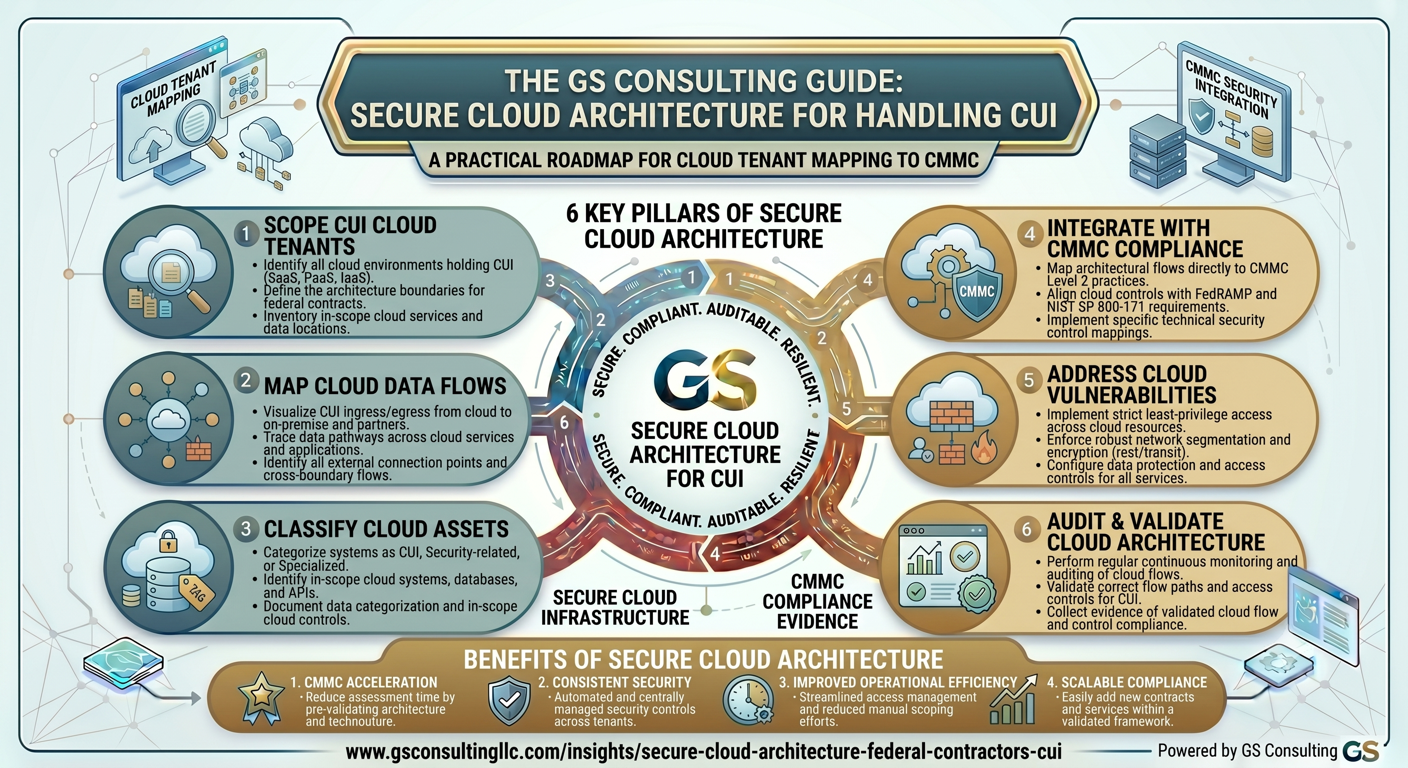
Why Secure Cloud Architecture Matters in GovCon
For contractors, cloud architecture is a business issue. A cloud environment that is convenient but poorly scoped may delay bids, complicate CMMC readiness, weaken SPRS support, create subcontractor problems, or introduce customer data risk.
A properly designed environment can help the company isolate CUI, reduce scope, improve monitoring, support evidence collection, and create a stronger posture for proposals and customer reviews.
NIST SP 800-171 requirements apply to nonfederal system components that process, store, or transmit CUI, as well as components that protect those systems. That means a cloud architecture is not judged only by where files are stored. Identity providers, endpoints, logging platforms, backup systems, managed security tools, AI services, and administrative access paths may all matter if they touch CUI or protect systems that contain it.
Start With the Contract and the Data
Before choosing a cloud platform, contractor leaders should answer four questions: what contracts or target opportunities drive the requirement, what data the environment will process, which clauses and flow-downs apply, and what CMMC level or assessment type the company must support.
For DoD contractors, DFARS 252.204-7012 is central. If a contractor uses an external cloud service provider to store, process, or transmit Covered Defense Information in contract performance, the contractor must require and ensure that the provider meets security requirements equivalent to the FedRAMP Moderate baseline and complies with incident reporting, malicious software, media preservation, forensic access, and damage assessment requirements.
Understand FedRAMP, FedRAMP Equivalency, and DoD Impact Levels
FedRAMP provides a standardized approach to security assessment, authorization, and continuous monitoring for cloud products and services. For contractors handling CUI under DoD contracts, the key issue is often whether the cloud service offering is FedRAMP Moderate authorized or meets FedRAMP Moderate equivalency requirements.
For current provider work, use the dedicated FedRAMP Moderate baseline guide to map the familiar Moderate term to Rev5 Class C controls, evidence, assessment, and transition rules. Use the FedRAMP continuous monitoring guide to connect cloud inventory, vulnerabilities, changes, incidents, service health, and recurring review after authorization.
FedRAMP Moderate equivalency is not the same as FedRAMP Moderate authorization. Authorization can be verified through FedRAMP channels. Equivalency requires the contractor to evaluate the provider’s body of evidence, and assessors may review that evidence during a CMMC assessment.
DoD cloud impact levels are a related but separate consideration. IL2 generally covers public or non-critical mission information, IL4 supports CUI or non-critical mission information on non-national security systems, IL5 supports higher-sensitivity CUI, mission-critical information, and national security systems, and IL6 supports classified SECRET national security systems.
The practical takeaway is that FedRAMP Moderate is not always the end of the analysis. The right cloud environment depends on the contract, the data, the customer, the mission, and whether DoD impact-level expectations apply.
Original Research: Where Cloud Architecture Expands CUI Scope
Original GS Consulting research shows that secure cloud architecture for CUI is an evidence problem, not just a platform decision.
GS Consulting analyzed FedRAMP Marketplace data, DFARS cloud clauses, CMMC scoping guidance, FedRAMP continuous monitoring guidance, and NIST CUI requirements to identify where cloud architectures most often expand CMMC scope and evidence burden.
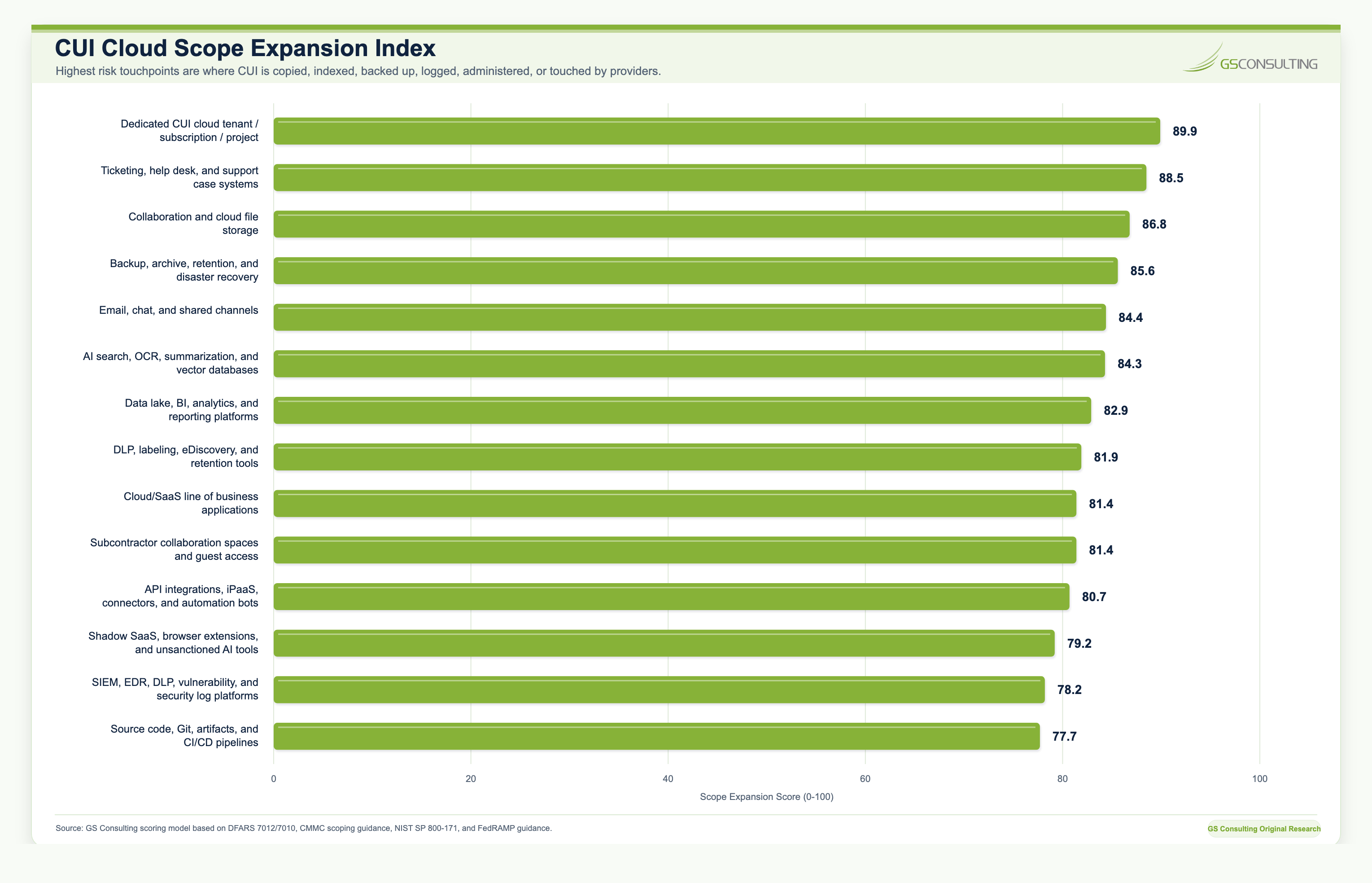
The highest priority touchpoints were dedicated CUI cloud tenants or subscriptions, ticketing and support systems, collaboration and cloud file storage, backups and archives, shadow SaaS and browser extensions, email and chat channels, AI search, OCR, summarization tools, and subcontractor collaboration spaces.
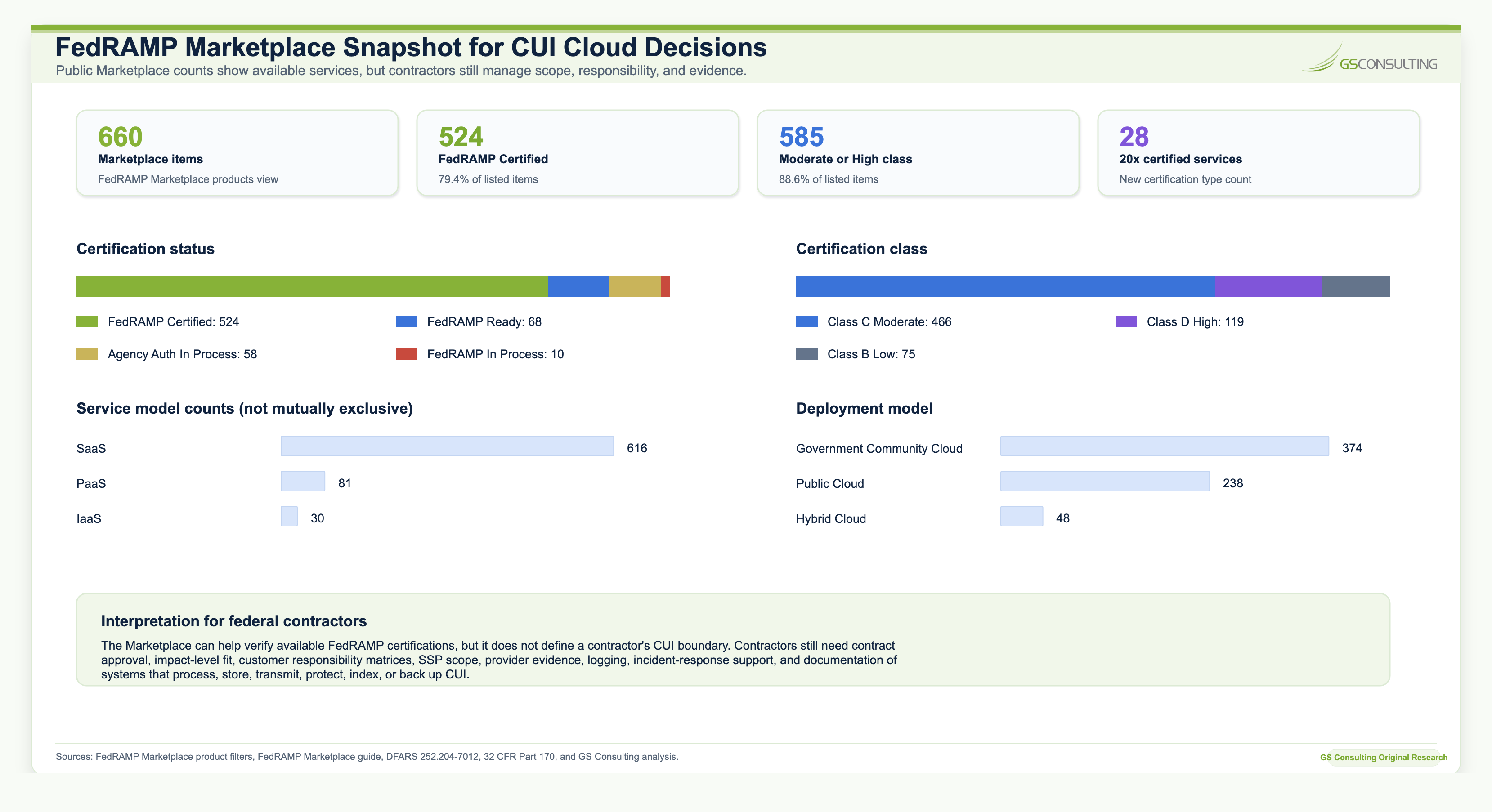
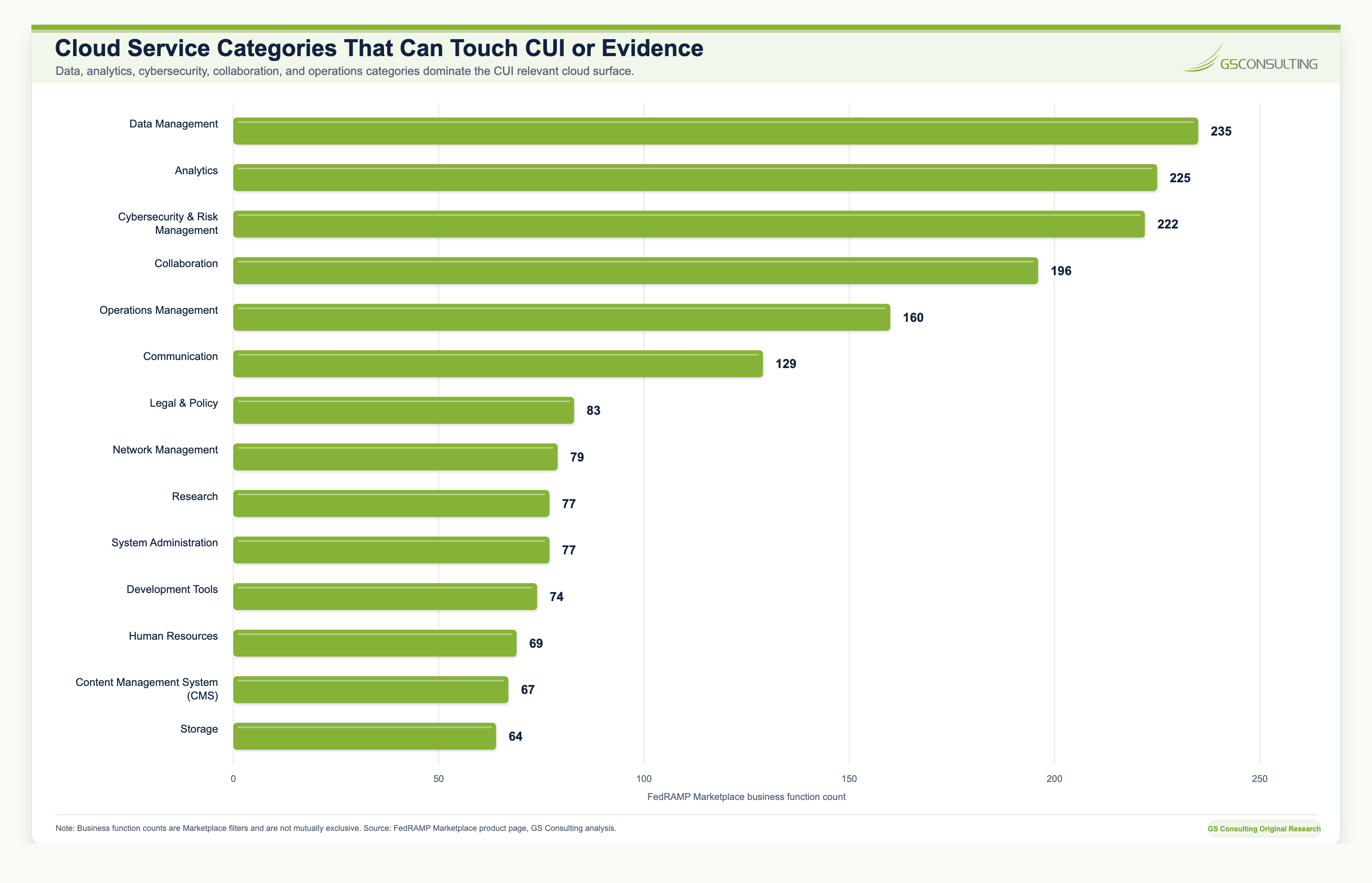
FedRAMP product view records reviewed for cloud decision signals.
Listed items in Moderate or High class counts from the analyzed view.
Dedicated CUI cloud tenants carried the highest scope pressure.
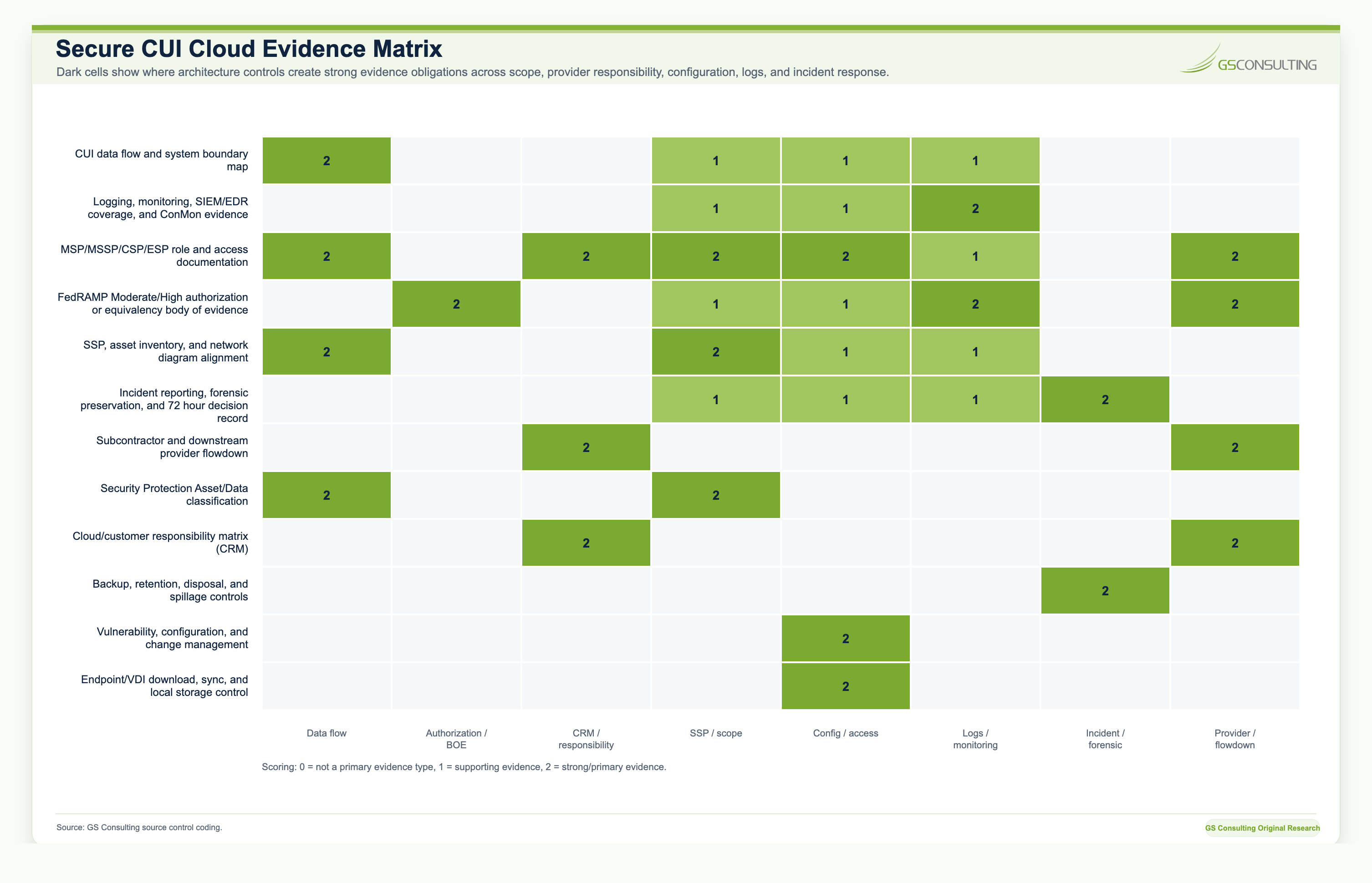
CUI data flow and boundary maps carried the highest evidence pressure.
The practical takeaway is clear: contractors should not ask only whether a cloud service is FedRAMP Moderate or High. They should ask whether the service processes, stores, transmits, logs, backs up, indexes, protects, administers, or derives information from CUI.
A defensible CUI cloud architecture should connect the contract driver, data flow, FedRAMP or equivalency evidence, customer responsibility matrix, SSP scope, access model, logging coverage, incident response, backup and retention controls, provider responsibilities, subcontractor flowdowns, and AI or SaaS approval records.
CMMC Cloud Requirements Contractors Need to Know
CMMC cloud requirements are tied to how contractors define scope and use external providers. For CMMC Level 2 certification assessments, a contractor may use a cloud environment to process, store, or transmit CUI when the cloud service offering is FedRAMP Authorized at the Moderate or higher baseline, or when it meets equivalent security requirements in accordance with DoD policy.
The contractor’s on-premises infrastructure connecting to the cloud offering can also be part of the assessment scope, and cloud responsibility matrix requirements should be documented or referenced in the SSP.
For Level 3, use of a cloud provider does not relieve the contractor of its obligation to implement the Level 3 requirements. If requirements are inherited from the cloud provider, the contractor must demonstrate that protection through customer implementation or responsibility documentation and a body of evidence.
CSP, MSP, MSSP, and ESP: Know Who Does What
Secure cloud architecture requires understanding the difference between cloud service providers and other external service providers. A CSP provides cloud services. An MSP may configure or administer a contractor’s cloud environment. An MSSP may monitor security activity. AI vendors, backup providers, compliance tools, and IT support providers may also touch CUI, security protection data, or systems that protect CUI.
What a provider is called matters less than what the provider does and what responsibilities it assumes. Contractors should document every external provider that has access to CUI systems, security tools, administrator credentials, logs, backups, tickets, endpoints, identity systems, or incident response workflows.
Review FedRAMP status, equivalency evidence, responsibility matrices, incident terms, support access, logging, retention, and subcontractors.
Review privileged access, security protection functions, service descriptions, response obligations, and how the provider appears in the SSP.
The Secure Cloud Architecture Model for CUI
A secure cloud architecture for CUI should be designed as a controlled environment, not as a loose collection of productivity tools. The goal is to create a defined boundary where CUI is processed, stored, transmitted, monitored, and protected with clear responsibilities and evidence.
1. A Dedicated CUI Boundary
The first design decision is whether to create a dedicated CUI enclave, tenant, project, subscription, or logically segmented environment. For many small and mid-sized contractors, a dedicated CUI boundary is easier to govern than allowing CUI to spread across the entire enterprise.
The boundary should be reflected in the SSP, network diagram, asset inventory, CUI data flow map, cloud responsibility matrix, and evidence repository. If Microsoft 365 is part of the design, use the Microsoft GCC High pricing model to compare a full tenant with a smaller enclave before buying seats.
2. Identity and Access Management
Identity is the control plane for cloud security. Contractors should design access around least privilege, role-based access, strong authentication, privileged account management, conditional access, and recurring access reviews.
The architecture should distinguish between standard users, program users, administrators, security administrators, break-glass accounts, service accounts, subcontractor users, guest users, and external provider access.
3. Endpoint and Device Control
Cloud security fails when uncontrolled endpoints can download, sync, print, copy, or transmit CUI outside the approved boundary. Contractors should define which devices may access the CUI environment and what those devices may do.
For some contractors, this means managed company laptops with endpoint detection, encryption, patching, device compliance checks, and restricted local storage. For others, properly configured virtual desktop infrastructure may be appropriate.
4. Controlled Storage and Collaboration
CUI should live only in approved repositories. The architecture should prevent uncontrolled data movement into personal drives, unmanaged file-sharing tools, unapproved chat channels, unauthorized AI tools, non-compliant ticketing systems, or unnecessary local downloads.
Contractors should configure labels, permissions, retention, sharing restrictions, external access controls, audit logs, and data loss prevention policies.
5. Network Segmentation and Secure Connectivity
Cloud environments should be segmented so CUI systems are separated from general corporate systems and unnecessary internet exposure. Contractors should review virtual networks, firewall rules, private endpoints, remote access methods, administrative access paths, API integrations, and interconnections with on-premises systems.
6. Encryption, Key Management, and Data Protection
Encryption is necessary, but it is not sufficient by itself. Contractors should protect CUI in transit and at rest, define who controls encryption keys, restrict administrative access to key management systems, and verify whether backups, logs, exports, search indexes, and AI-generated artifacts are also protected.
7. Logging, Monitoring, and Security Operations
Secure cloud architecture needs visibility. Contractors should collect and review logs for authentication, privilege changes, file access, sharing events, administrative actions, endpoint alerts, data movement, configuration changes, and suspicious behavior.
If a managed security provider or MSSP operates a SOC on behalf of the contractor, that provider may become a security protection asset or external service provider under CMMC.
8. Backup, Recovery, and Retention
Backups are often forgotten in cloud scoping. If CUI is backed up, replicated, archived, exported, or retained in another service, that location may also need to be included in the architecture and compliance boundary.
Contractors should document backup locations, encryption, access controls, retention periods, recovery testing, deletion procedures, and whether backup providers or administrators can access CUI.
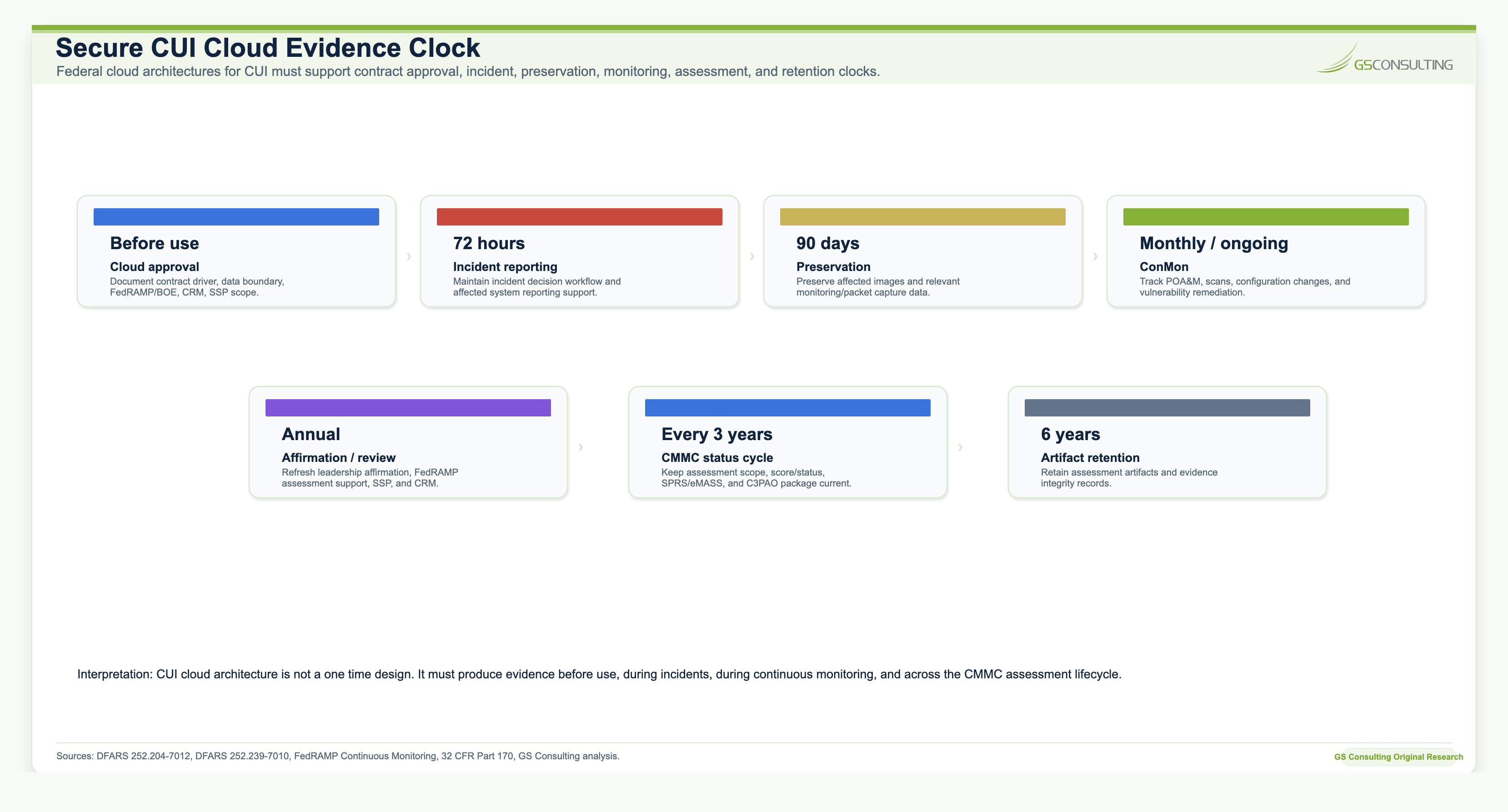
9. Incident Response and DFARS Reporting
Cloud incident response must be integrated with contract obligations. The contractor’s plan should define who detects, investigates, preserves evidence, contacts the cloud provider, reviews logs, determines data impact, notifies contracts leadership, and supports reporting decisions.
Cloud providers and MSPs should be contractually required to notify the contractor quickly enough for the contractor to meet its own obligations.
10. AI and Automation Controls
AI tools increasingly sit inside cloud workflows. They may summarize documents, search repositories, triage alerts, generate reports, analyze logs, support help desks, or assist with compliance evidence.
If an AI tool processes, stores, transmits, indexes, embeds, summarizes, or generates output from CUI, it should be treated as part of the CUI environment until reviewed and approved. Shadow AI should be treated as a cloud security risk.
Reference Architecture: The CUI Cloud Enclave
A practical CUI cloud enclave for a small or mid-sized contractor may include a dedicated tenant, subscription, project, or workspace for CUI; a verified FedRAMP Moderate authorized or equivalent cloud service offering where required; a documented system boundary and CUI data flow map; managed endpoints or controlled VDI access; MFA and conditional access; restricted administrative roles; approved collaboration tools; centralized logging; endpoint detection; vulnerability management; encrypted storage and backups; retention rules; subcontractor access controls; DLP and labeling; incident response procedures; a customer responsibility matrix; and an SSP that matches the real environment.
This architecture does not have to be overly complex. It does have to be intentional, documented, monitored, and aligned to the data.
Cloud Provider Review Checklist for Contractors Handling CUI
Before approving a cloud service for CUI, contractors should ask whether the service is a CSP, MSP, MSSP, another external service provider, or a combination; whether it will process, store, transmit, back up, index, scan, or log CUI; whether it is FedRAMP Moderate authorized or equivalent; and whether it can provide the body of evidence required for customer and assessment review.
- AuthorizationFedRAMP, equivalency, DoD impact-level fit, and contract approval.
Verify the service against the actual data type, customer, and workflow.
- ResponsibilityCustomer responsibility matrix, inherited controls, support access, and evidence.
Know what the provider does, what the contractor does, and how both sides prove it.
- OperationsIncident reporting, logs, retention, keys, vulnerabilities, and downstream providers.
Make sure the service can support DFARS, CMMC, and practical incident response expectations.
Common Cloud Architecture Mistakes in GovCon
The first mistake is using commercial cloud tools for CUI without verifying FedRAMP, equivalency, DFARS obligations, and contract-specific approval. A cloud product can be secure for commercial use and still be inappropriate for CUI.
The second mistake is assuming FedRAMP authorization solves everything. The contractor still has customer responsibilities, configuration duties, access controls, evidence requirements, and SSP obligations.
The third mistake is failing to define the CUI boundary. If CUI spreads across email, chat, file shares, ticketing systems, endpoints, backups, AI tools, and personal downloads, the company may unintentionally expand its CMMC scope.
The fourth mistake is ignoring external service providers. MSPs, MSSPs, IT support providers, AI vendors, backup providers, and compliance tools may all touch CUI systems or security protection data.
The fifth mistake is allowing shadow AI, shadow SaaS, and unmanaged browser extensions. These tools can quietly move CUI outside the approved boundary.
A 30-60-90 Day Cloud Security Action Plan
- First 30 DaysInventory the current cloud footprint.
Identify cloud platforms, SaaS tools, AI tools, MSPs, MSSPs, backup services, file-sharing tools, identity providers, endpoints, and collaboration systems that touch or protect CUI.
- Days 31-60Define the secure cloud boundary.
Update the CUI data flow map, asset inventory, SSP, network diagram, cloud responsibility matrix, provider review records, and contract clause inventory.
- Days 61-90Remediate high-risk gaps.
Remove CUI from unapproved tools, restrict sharing, enforce MFA, harden admin roles, centralize logging, review backups, validate incident response, and establish cloud and AI approval workflows.
By the end of 90 days, leadership should be able to answer which cloud systems touch CUI, which providers are FedRAMP Moderate authorized or equivalent, what the CUI cloud boundary is, which systems are in CMMC scope, what controls are inherited, what controls are the contractor’s responsibility, and what evidence supports compliance claims.
Minimum Viable Secure CUI Cloud Evidence Packet
A secure cloud architecture should leave behind evidence people can use during proposals, customer reviews, incident response, internal governance, and CMMC assessment preparation. The minimum packet should include the following artifacts.
- ScopeContract and cloud applicability register, CUI cloud data flow map, system boundary, SSP, asset inventory, and network diagram alignment.
- ProvidersFedRAMP authorization or equivalency body of evidence, customer responsibility matrix, inherited control tracker, and provider role documentation.
- OperationsIdentity, admin, guest, subcontractor, logging, monitoring, backup, retention, incident response, AI, SaaS, and change evidence.
Research Sources and Caveats
Sources included the FedRAMP Marketplace, FedRAMP Marketplace Quick Start Guide, FedRAMP continuous monitoring guidance, DFARS 252.204-7012, DFARS 252.239-7010, 32 CFR Part 170, DoD CMMC technical implementation guidance, NIST SP 800-171 Rev. 3, and NIST SP 800-53 Rev. 5.
Methodology and caveat
The CUI Cloud Scope Expansion Score, Cloud Architecture Evidence Burden Score, and evidence packet are GS Consulting derived planning tools. They are not official FedRAMP, DoD, CMMC, NIST, DFARS, legal, audit, or C3PAO determinations. FedRAMP Marketplace counts can change over time. Business function and service model counts are marketplace filters and may not be mutually exclusive. Actual cloud readiness depends on contract clauses, CUI categories, customer direction, impact level expectations, provider authorization status, equivalency evidence, system architecture, shared responsibility documentation, SSP scope, subcontractors, AI and SaaS usage, and assessor judgment.
The Bottom Line
Secure cloud architecture for federal contractors is not about moving everything to the cloud. It is about moving the right data into the right environment with the right controls, documentation, and evidence.
For contractors handling CUI, cloud decisions should be driven by contract clauses, data categories, CMMC scope, FedRAMP or equivalency requirements, DoD impact-level expectations, customer responsibility documentation, and incident reporting obligations.
GS Consulting helps government contractors design secure cloud architectures for CUI, evaluate FedRAMP and equivalency requirements, map cloud data flows, define CMMC scope, review MSP and MSSP responsibilities, update SSPs, assess AI and SaaS risk, and build practical evidence packages aligned to contract requirements.
Ready to determine whether your cloud environment is CUI-ready?
Contact GS Consulting for a GovCon Secure Cloud and CMMC Architecture Assessment.
Contact GS ConsultingFrequently Asked Questions About GovCon Secure Cloud Architecture
Does FedRAMP Moderate authorization guarantee CMMC compliance?
No. While a FedRAMP Moderate baseline satisfies the DFARS 252.204-7012 cloud requirement, the contractor is still responsible for configuring the environment securely, managing user access, mapping the Customer Responsibility Matrix, and ensuring DFARS incident reporting obligations are met.
What is the difference between FedRAMP Authorization and FedRAMP Equivalency?
FedRAMP Authorization means a cloud provider has been formally assessed and authorized by the government, such as through a JAB or agency ATO. FedRAMP Equivalency means the contractor has reviewed the provider's System Security Plan and body of evidence to confirm the offering meets the Moderate baseline, which shifts more documentation burden to the contractor during a CMMC assessment.
Do Managed Service Providers fall into the CMMC cloud assessment boundary?
Yes. Managed Service Providers and Managed Security Service Providers that configure, monitor, or protect CUI environments may be treated as Security Protection Assets or External Service Providers. Their access, controls, and responsibilities should be explicitly included in the SSP and CMMC assessment boundary.
Suggested Future Reading
- The DoD Zero Trust Strategy Explained for Contractors
- DoD Zero Trust Target Level Assessment
- DoD Zero Trust Resource Hub
- GovCon Cybersecurity & Compliance Hub: CMMC, NIST, CUI, Cloud, and AI-Enabled Readiness
- CMMC Readiness Checklist for Small and Mid-Sized Government Contractors
- NIST SP 800-171 Compliance: What GovCon Leaders Need to Know
- How to Build a CUI Data Flow Map for CMMC
- How DoD Contractors Can Use AI Without Putting CUI at Risk
- How AI Can Improve Threat Detection and Compliance Monitoring in GovCon
- FedRAMP Compliance: The Complete Guide
- FedRAMP Moderate Baseline: Controls, Evidence, and Effort
- FedRAMP Continuous Monitoring: Monthly Evidence That Matters
- What Is GCC High? Microsoft 365 for Defense Contractors