Secure AI Automation | | 25 min read
Secure AI Automation Implementation Roadmap

Key Takeaways
Move to production through evidence gates for one defined workflow.
Discover and select
Map the workflow, classify its data, and select a pilot with clear value and ownership.
Design the controls
Define risk, architecture, permissions, and human approval before implementation.
Test and operate
Validate the pilot, measure results, and retain monitoring and support responsibilities in production.
Most AI automation projects do not fail because the model is not smart enough.
They fail because the organization skips the hard parts.
- The workflow was not mapped.
- The data was not classified.
- The tool was not approved for the data.
- The human review step was vague.
- The system access was too broad.
- The logs were weak.
- Nobody knew who owned the decision.
The pilot looked good. Then production exposed the gaps.
AI automation is not just a technology rollout. It is a workflow change, a data movement change, a security change, and an accountability change.
Move AI automation from idea to production without losing control.
GS Consulting helps regulated organizations build secure AI automation roadmaps across workflow selection, data classification, architecture, security review, testing, deployment, measurement, and monitoring.
Request an Implementation RoadmapThe Roadmap in Plain English
A secure AI automation implementation roadmap should answer one basic question: how do we move from idea to working automation without creating unnecessary security, compliance, or operational risk?
That means the roadmap needs to cover more than tool selection. It should include discovery, workflow selection, workflow mapping, data classification, risk assessment, architecture design, security and compliance review, pilot build, testing, controlled deployment, measurement, production scale, and ongoing monitoring.
That may sound like a lot. It is not bureaucracy. It is the work required to keep AI automation from becoming an uncontrolled experiment.
Original Research: The Secure AI Automation Pilot to Production Gate Index
Original GS Consulting research shows that secure AI automation implementation is a pilot to production gate problem.
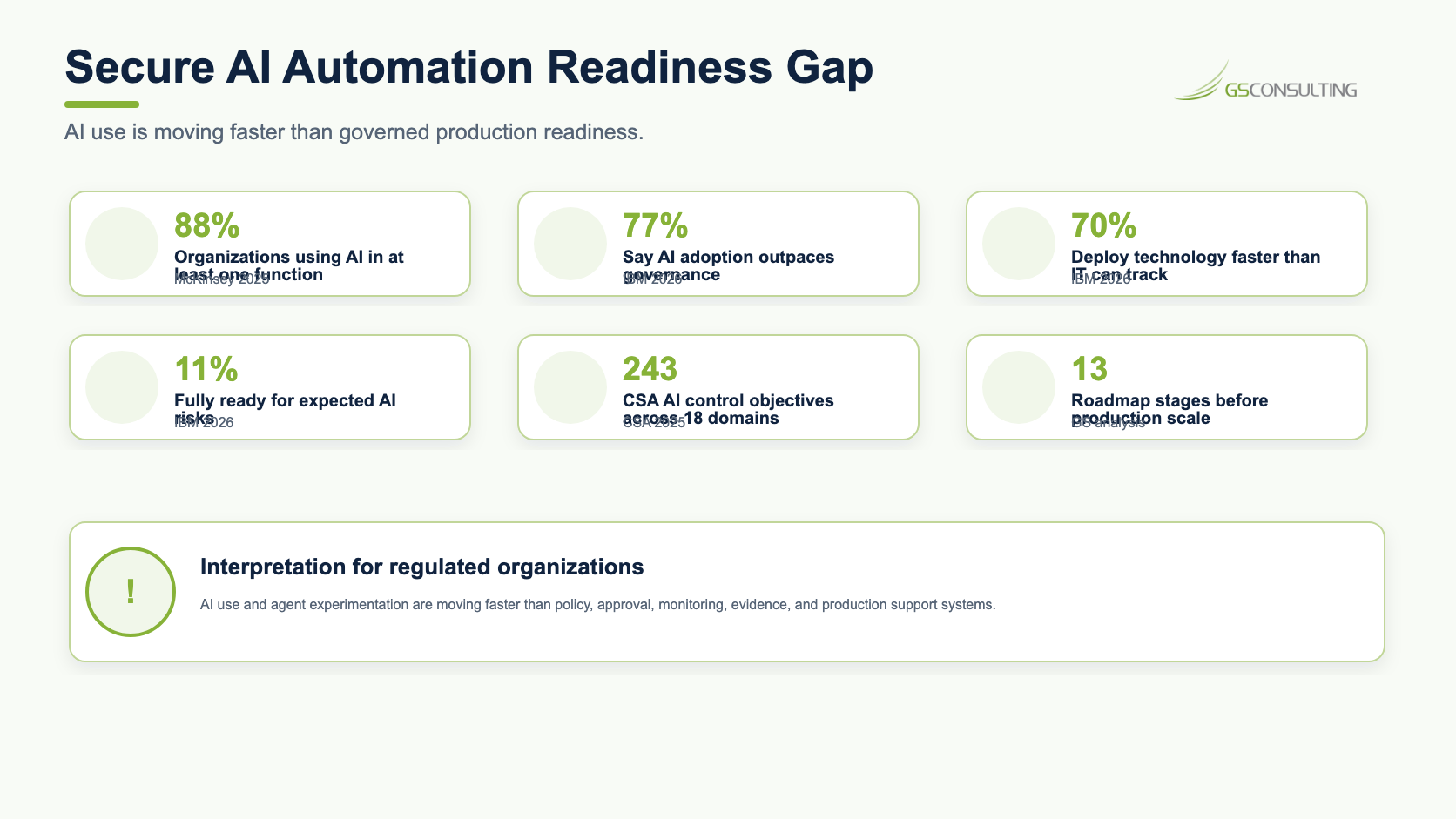
GS Consulting analyzed public AI adoption, governance, security, and control sources against the implementation stages in this roadmap. The source set included McKinsey's 2025 State of AI, IBM's 2026 AI Control Gap study, NIST AI RMF, NIST AI RMF Playbook, OWASP LLM Top 10, CISA and NSA agentic AI guidance, CISA, NSA, and FBI AI data security guidance, CSA AI Controls Matrix, and EU AI Act high risk obligations.
The analysis created three GS Consulting derived planning metrics: Stage Gate Burden Score, Workflow Pilot Readiness Score, and Test Coverage Depth Score. These are planning tools, not official NIST, CISA, OWASP, CSA, EU AI Act, IBM, McKinsey, legal, audit, or compliance determinations.

McKinsey's 2025 State of AI survey reported that 88 percent of respondents say their organizations regularly use AI in at least one business function, 62 percent are at least experimenting with AI agents, and 39 percent report enterprise level EBIT impact. IBM's June 2026 AI control gap research reported that 77 percent of surveyed organizations say AI adoption is outpacing current governance, 70 percent say technology is deployed faster than IT can track, and only 11 percent say they are fully ready for AI agent scale.
The practical takeaway is clear: do not measure success by whether the pilot demo works. Measure whether the workflow creates value, is controlled, and can be supported.
Phase 1: Discovery
Do not start with the tool. Start with the business.
Discovery is where you find the workflows that actually matter. Not the flashiest ideas. Not the vendor demo. Not the use case someone saw online. The workflows that matter are the ones with real friction.
Look for processes that are slow, repetitive, document heavy, error prone, expensive, or hard to track. Also ask where employees are already using unofficial AI. Shadow AI is often a sign that the workflow is painful. It is also a sign that the organization needs a safer path.
Phase 2: Workflow Selection
The first AI automation project should not be the riskiest one. It should be valuable enough to matter and controlled enough to learn from.
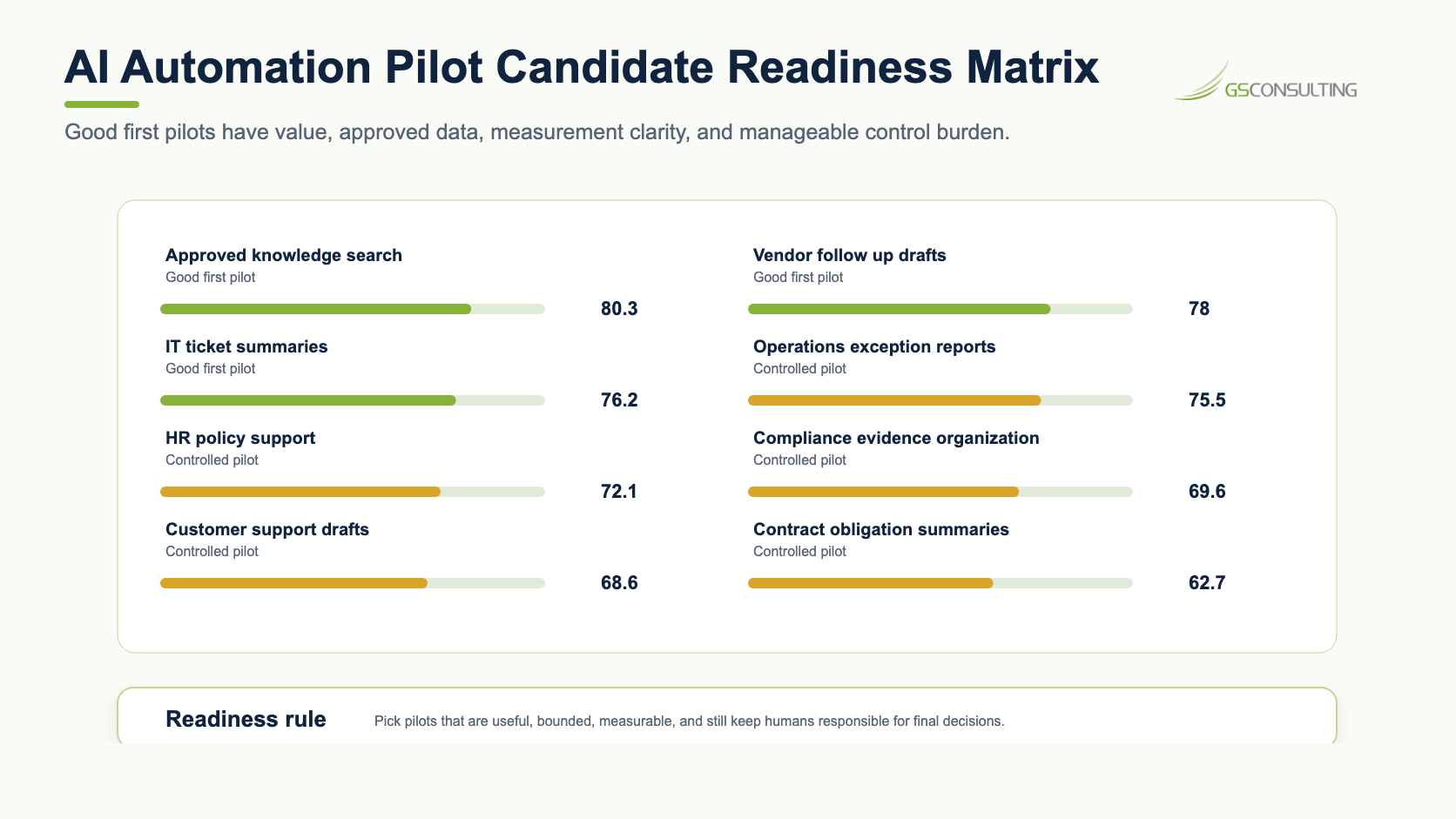
A good first workflow happens often, has a clear owner, uses data that can be approved, has a measurable baseline, and keeps humans responsible for the final decision.
Bad first workflows usually involve final hiring decisions, payment approval, legal conclusions, compliance certification, security enforcement, production system changes, or customer commitments. AI may support those later. It should not start there.
Phase 3: Map the Workflow
Before you automate the workflow, map it.
This is where organizations often get uncomfortable because the process is not as clean as they thought. That is the point. You need to see the real workflow before AI touches it.
Map what starts the workflow, who receives the request, what data is used, what systems are involved, who makes decisions, where approvals happen, where exceptions go, what outputs are created, where records are stored, what evidence is needed, and what happens when something goes wrong.
If the team cannot explain the workflow, do not automate it yet. A bad process with AI added to it is still a bad process. It just moves faster.
Phases 4 Through 7: Data, Risk, Architecture, and Review
Before AI connects to documents, tickets, records, systems, or reports, classify the data. Do not just say "documents." A document can be public, internal, confidential, regulated, or restricted. A ticket can contain a simple password issue, customer information, employee data, or a security incident.
The question is simple: is this AI tool approved for this data in this workflow? If the answer is unclear, stop.
- DataClassify what AI touches.
Identify public, internal, confidential, customer, employee, financial, contract, legal, PHI, PII, CUI, security log, audit evidence, source code, and restricted data.
- RiskAssess exposure and impact.
Review data exposure, decision impact, compliance obligations, system access, and failure modes before launch.
- ArchitectureDesign the control model.
Define the environment, data source, connector, identity model, permission model, API access, output location, approval gate, logging path, monitoring process, and stop mechanism.
- ReviewBring security and compliance in before launch.
Review least privilege, vendor terms, prompt and output handling, retention, monitoring, incident response, audit evidence, and customer or employee impact.
Phases 8 and 9: Build the Pilot and Test Before Launch
A pilot should be small enough to control and meaningful enough to prove value. Do not pilot with every user, connect every system, give AI broad access, or start with full autonomy.
A strong pilot has a named business owner, defined workflow, approved data, limited users, limited system access, clear human review, logging, success metrics, and a way to pause it.
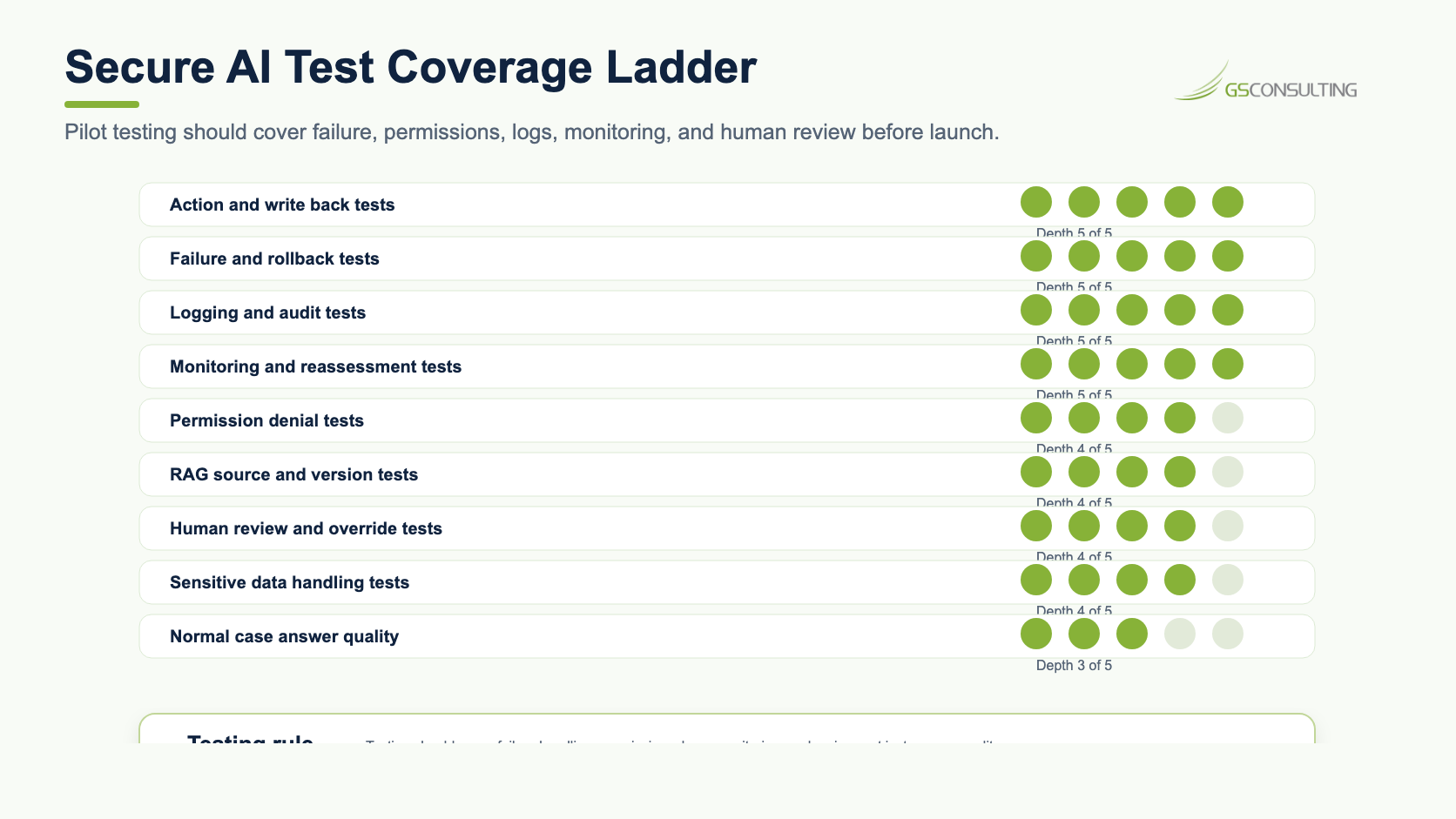
AI testing needs to be more than "does the answer look good?" Test the workflow, data access, permissions, outputs, approval process, logs, and failure behavior.
OWASP's LLM Top 10 reinforces why this matters. Prompt injection, insecure output handling, sensitive information disclosure, supply chain vulnerabilities, and excessive agency become real business risks once AI touches systems and tools.
Phases 10 Through 13: Deployment, Measurement, Production, and Monitoring
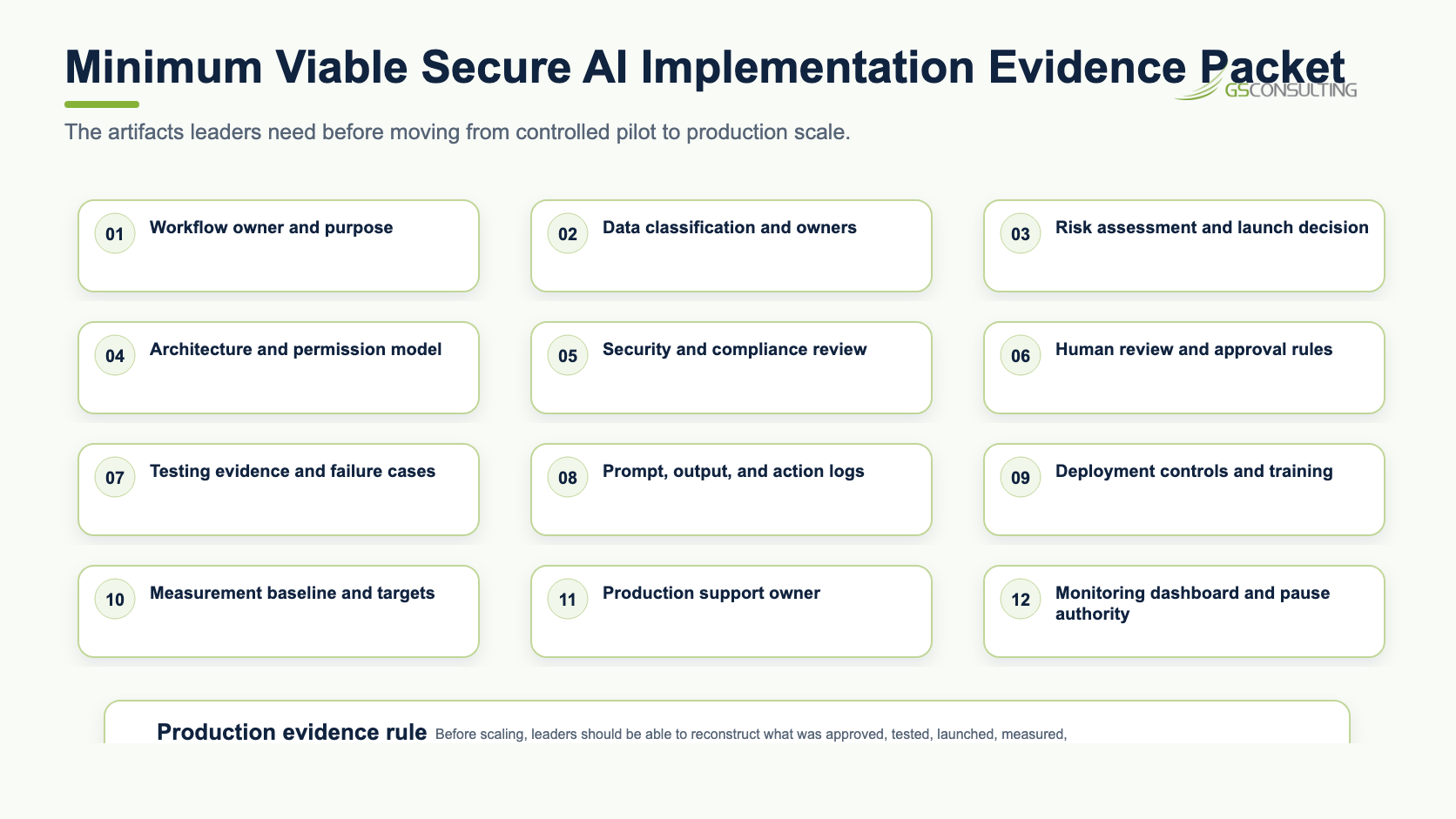
Deployment is not just turning the tool on. A controlled deployment includes user training, clear use instructions, data rules, human review rules, escalation paths, support ownership, monitoring ownership, feedback channels, known limits, and a stop process.
AI automation should be measured like a business process, not like a science project. Useful metrics include time saved, cycle time reduced, manual work reduced, error rate reduced, routing accuracy, output acceptance rate, human override rate, escalation rate, adoption, evidence quality, audit readiness, security events, cost per transaction, and backlog reduction.
A pilot becomes production only when it creates value, is controlled, and can be supported.
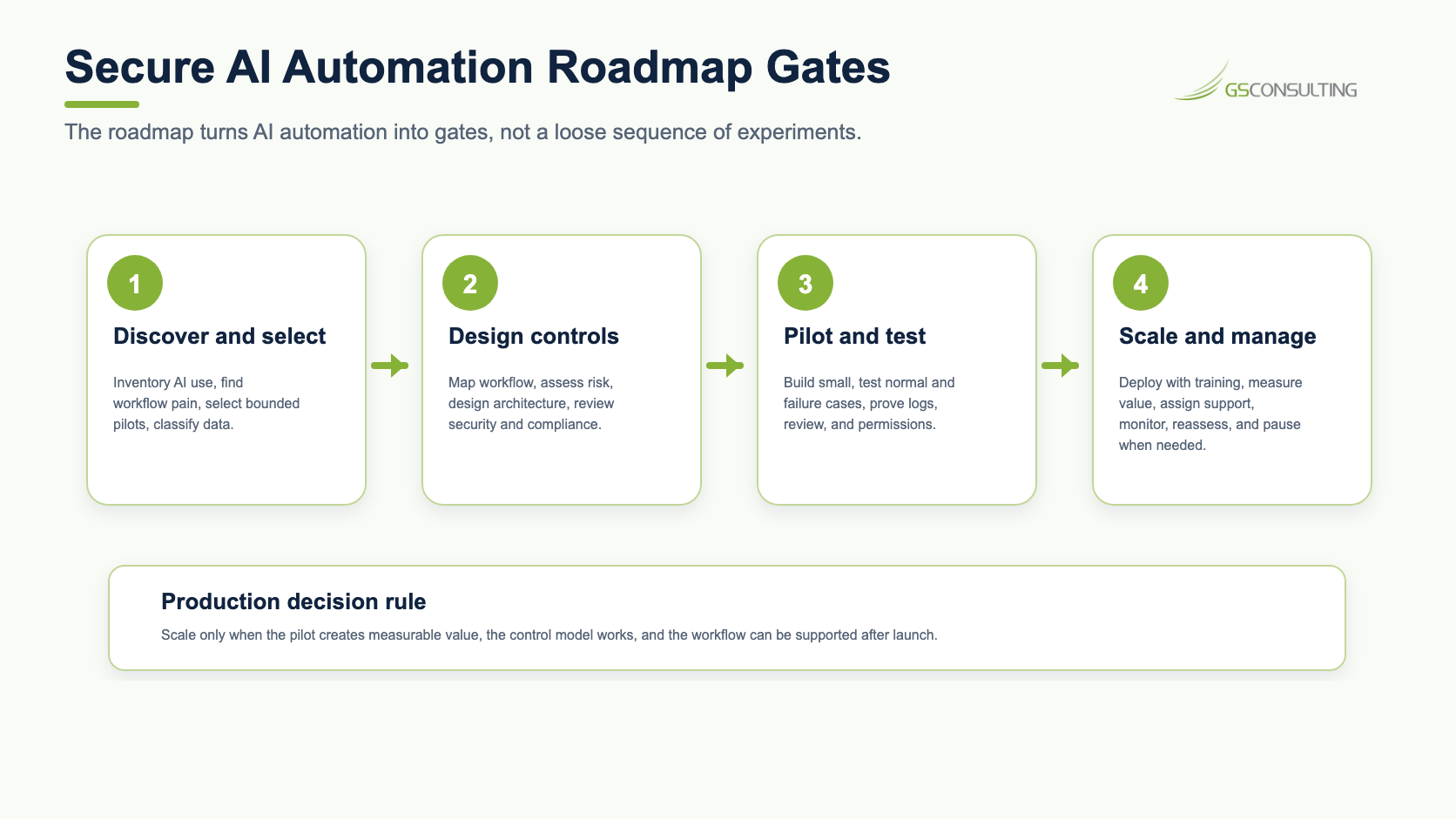
Value means the workflow improves in a measurable way. Controlled means the data, access, review, logs, and risk model work. Supported means the organization knows who owns the workflow, who monitors it, who fixes issues, who updates sources, and who can pause it.
The launch is not the finish line. It is the start of management.
A Practical 90 Day Plan
You can build the first secure AI automation implementation pattern in 90 days if the scope is disciplined.
- Days 1-30Discovery and selection.
Inventory current AI use, find shadow AI, identify workflow pain, select five candidate workflows, classify the data, score risk and value, and pick one or two pilots.
- Days 31-60Design and build.
Map the workflow, design the architecture, review data handling, security, and compliance, define human review and logging, set success metrics, build the controlled pilot, and train users.
- Days 61-90Test and deploy.
Test normal cases, failure cases, permissions, sensitive data handling, and logs. Launch with limited users, measure time saved, quality, adoption, errors, and overrides, then decide whether to scale, redesign, pause, or stop.
Common Implementation Mistakes
- Starting with the tool. Tools matter, but workflow comes first.
- Skipping data classification. If you do not know what data AI touches, you cannot secure the workflow.
- Giving AI too much access. Broad access makes demos easier and incidents worse.
- Treating human review as a checkbox. A reviewer needs context, authority, and clear criteria.
- Testing only the happy path. Failures are where risk lives.
- No logging. If you cannot reconstruct what happened, the workflow is not audit ready.
- Scaling because the pilot felt good. Scale because it worked, not because it impressed people.
- Forgetting production ownership. Someone has to own the workflow after launch.
The Executive Questions
Before approving production, leaders should ask practical questions.
- What workflow are we automating?
- Who owns it?
- What data does AI touch?
- Is the tool approved for that data?
- What can AI read?
- What can AI write?
- What requires human approval?
- What actions are prohibited?
- What happens if AI is wrong?
- Can we prove what happened later?
- What metrics show value?
- Who monitors it after launch?
- Who can pause it?
If those questions cannot be answered, production should wait.
How This Supports Secure AI Automation
This guide is part of a broader secure AI automation approach. Secure AI Automation for Regulated Organizations explains how GS Consulting helps organizations automate workflows with the right governance, architecture, data controls, security, compliance, and measurable outcomes.
This guide answers one implementation question: how do we move from AI interest to working automation without losing control?
The Bottom Line
Secure AI automation does not happen by accident.
It takes a roadmap: discovery, workflow selection, data classification, risk assessment, architecture, security review, testing, deployment, measurement, and monitoring.
Skip those steps and the organization may get a fast pilot, but not a reliable production workflow. Do the work in order and AI automation becomes something leaders can trust, employees can use, and regulated organizations can defend.
Ready to move AI automation from idea to production without losing control?
Contact GS Consulting for a Secure AI Automation Implementation Roadmap.
Contact GS ConsultingResearch Sources and Caveats
The Stage Gate Burden Score, Workflow Pilot Readiness Score, and Test Coverage Depth Score are GS Consulting derived planning tools. They are not official NIST, CISA, OWASP, CSA, EU AI Act, IBM, McKinsey, legal, audit, or compliance determinations.
Actual implementation readiness depends on the organization's workflows, data sensitivity, system architecture, contracts, vendors, security controls, approval model, monitoring maturity, and risk tolerance.
- McKinsey: The State of AI in 2025
- IBM: AI Control Gap Study
- NIST AI Risk Management Framework
- NIST AI RMF Playbook
- OWASP Top 10 for Large Language Model Applications
- CISA: Securing AI Data guidance announcement
- CISA: Guide to Secure Adoption of Agentic AI
- Cloud Security Alliance AI Controls Matrix
Frequently Asked Questions About Secure AI Automation Implementation
What is a secure AI automation implementation roadmap?
A secure AI automation implementation roadmap is a staged plan for moving an AI workflow from discovery to pilot to production. It covers workflow selection, data classification, risk assessment, architecture, security review, testing, deployment, measurement, production ownership, and monitoring.
What should happen before launching an AI automation pilot?
Before launch, the team should map the workflow, classify the data, confirm the AI tool is approved for that data, assess risk, design access controls, define human review, complete security and compliance review, create logs, and define success metrics.
When is an AI automation pilot ready for production?
An AI automation pilot is ready for production only when it creates measurable value, the data and access controls work, the review and logging model is proven, the workflow can be supported, and leaders know who monitors, fixes, updates, and can pause it.
What are good first secure AI automation pilots?
Good first pilots are useful, bounded, and measurable. Examples include approved knowledge search, IT ticket summaries, vendor follow up drafts, operations exception reports, HR policy support, compliance evidence organization, and customer support drafts with human approval.