Secure AI Automation | | 24 min read
Private LLM Deployment Options

Key Takeaways
AI adoption has to move fast and stay controlled.
Start With Mission Value
Prioritize use cases tied to measurable business, delivery, or mission outcomes.
Protect the Data Boundary
Define what data AI tools can touch before selecting vendors or architectures.
Keep Humans Accountable
Use AI to support workflows while retaining trained review and escalation paths.
Document the Controls
Maintain inventories, testing evidence, monitoring plans, and risk decisions.
There is no single private LLM you can buy.
There are deployment options.
This is the point most buying conversations miss. A team decides it needs a private LLM, then goes looking for the product called private LLM. It does not exist. What exists is a set of ways to run a model, each one trading how much control you hold against how much it costs to build and operate.
If you already know what a private LLM is at the concept level, this is the next question: which deployment option, and why. If the concept itself is still fuzzy, start with what a private LLM is, then come back here to choose.
For regulated and GovCon teams, choosing well on this spectrum is worth more than choosing the best model. The wrong option is either an exposure your security team will eventually shut down, or a cost you did not need to carry.
Choose the private LLM option that fits your data.
GS Consulting helps regulated and GovCon teams map deployment options against data class, estimate the real cost to own, and stand up private LLM environments their security teams can approve.
Request a Private LLM Deployment ReviewWhy There Is No Single Private Product
Leaders often assume the private decision is a purchase, and that the hard part is choosing the vendor. It is not. What actually decides the deployment option is the data class you are handling, the contract and residency duty attached to it, and the retention rules you have to honor. Those set the floor, and the option is chosen to clear that floor at the lowest reasonable cost.
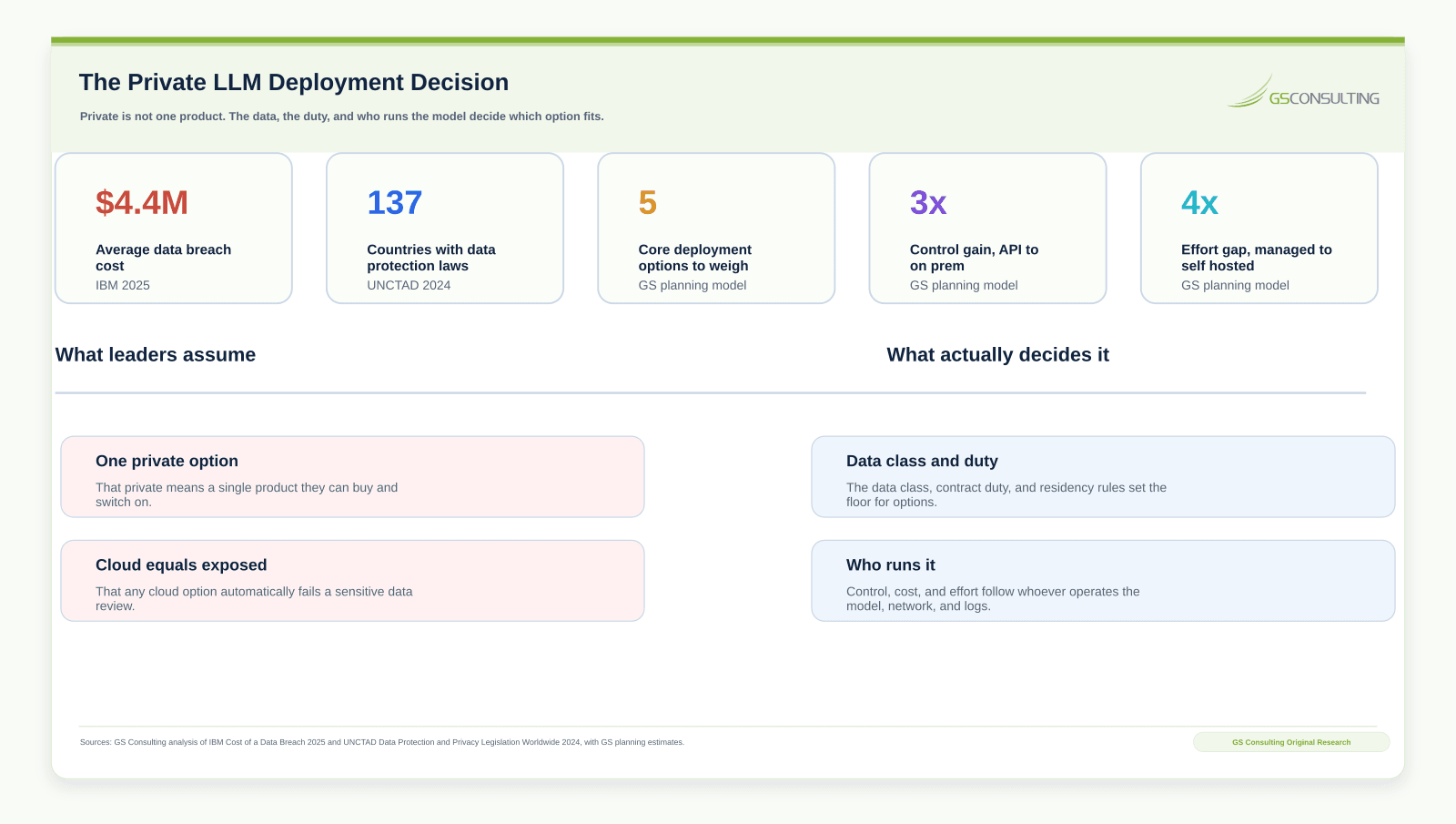
Once you accept that, the work becomes clear. You are not shopping for a private product. You are placing your workload on a spectrum of control, at the point where the duty attached to your data is satisfied and not a step further.
Original Research: The Deployment Control Index
Original GS Consulting research shows that private LLM deployment is a control and cost tradeoff, not a product choice.
GS Consulting reviewed public sources across breach economics, global AI governance, LLM security, and cloud security, including IBM Cost of a Data Breach 2025, UNCTAD analysis covering AI readiness across 137 economies, the NIST AI Risk Management Framework, the OWASP Top 10 for LLM Applications 2025, and the Cloud Security Alliance AI Controls Matrix. From those sources GS Consulting built two derived planning models: a Deployment Control Index that scores how much control and sovereignty each option gives you, and a Cost of Ownership Index that scores what each option costs to build and operate.
These are GS Consulting derived planning tools. They are not official NIST, CMMC, DoD, CISA, OWASP, CSA, ISO, legal, audit, or regulatory determinations.
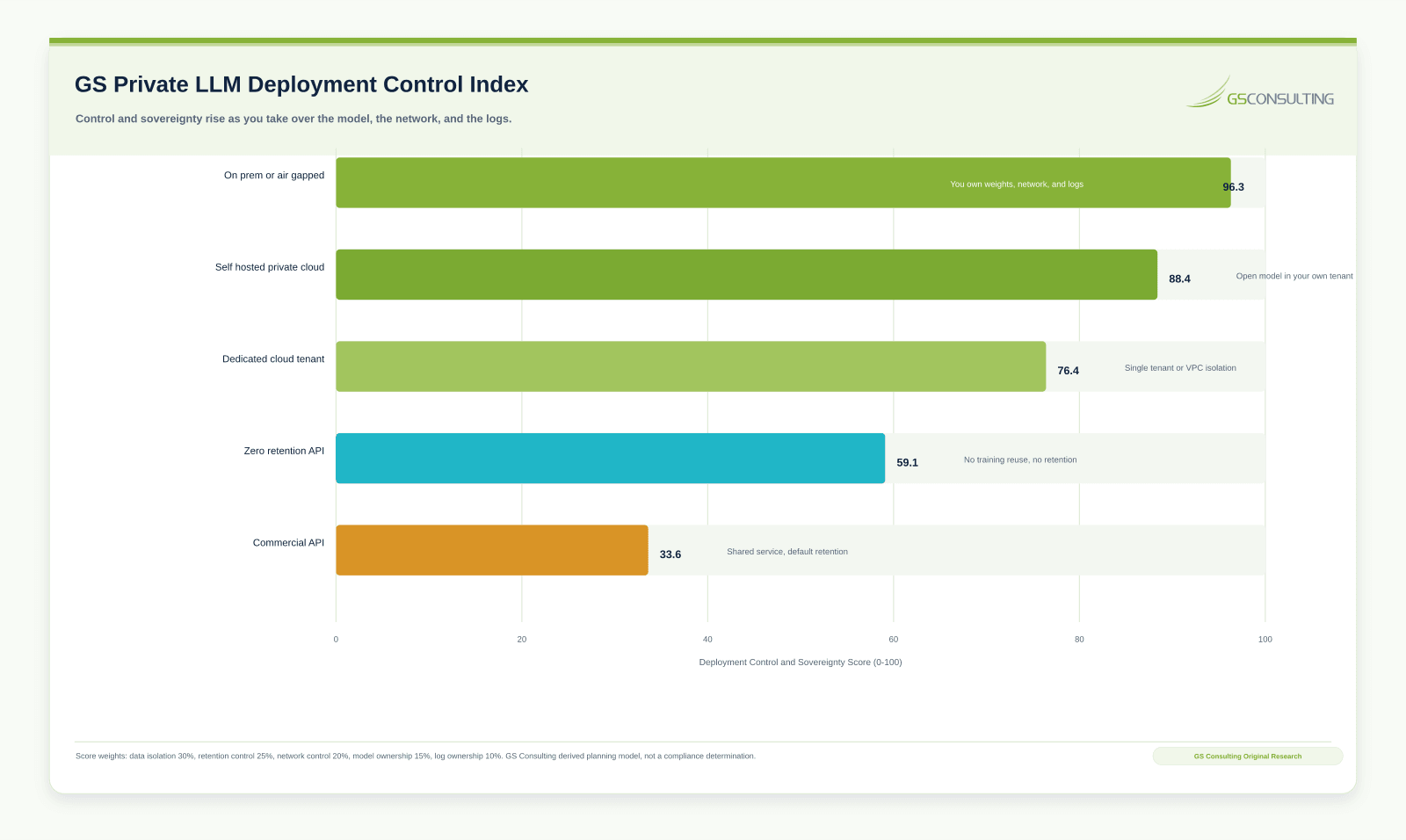
The index scores each option on data isolation, retention control, network control, model ownership, and log ownership. On prem or air gapped hosting scored 96.3 because you own the weights, the network, and the logs. Self hosted private cloud followed at 88.4, then a dedicated cloud tenant at 76.4, a zero retention API lane at 59.1, and a commercial API at 33.6. The gap between the top and bottom is the whole point: these are genuinely different levels of control, not marketing tiers.
What Each Level of Control Buys You
Control here is concrete, not abstract. Moving up the index means taking ownership of specific things: where the weights live, whether the network path is yours, whether prompts and outputs are retained, and who holds the logs. A commercial API gives you almost none of these. An on prem deployment gives you all of them. The middle options give you some, which is often exactly enough.
The mistake is assuming more control is always better. More control is more exposure removed, but also more cost and more operating burden. The right answer is the least control that still clears the duty attached to your data, which is why the cost side of the ledger matters just as much as the control side.
The Five Deployment Options
1. Commercial API
A commercial API is the shared service most teams start with. It is fast, cheap, and always current, but it runs on default terms in the provider's environment, often with retention on unless you change it. It is the right home for low sensitivity work and the wrong home for regulated data.
2. Zero Retention API
A zero retention API lane keeps the convenience of a managed service but adds contractual promises that your prompts and outputs are not stored or reused for training. It raises control meaningfully without asking your team to run infrastructure. For moderate sensitivity work with the right terms, it is often enough.
3. Dedicated Cloud Tenant
A dedicated cloud tenant gives you single tenant or virtual private cloud isolation inside a provider you already trust and may already have accredited. You get strong isolation and retention control without buying hardware. For many regulated teams, this is the practical sweet spot for sensitive data.
4. Self Hosted Private Cloud
A self hosted private cloud means running an open model inside your own environment. You own the model, the network path, and the logs, and you take on the work of running the platform. This is the first option where model ownership is fully yours, and it fits proprietary and high value data well.
5. On Prem or Air Gapped
On prem or air gapped hosting is the most control and the most cost. You run the model on your own hardware, in your own facility, sometimes with no external network at all. It is warranted when contract, residency, or air gap requirements demand it, and it is overkill when they do not.
What Each Option Costs to Own
Control is only half the decision. The other half is what the option costs to build and operate, and this is where teams routinely underestimate. The model license or API price is rarely the expensive part. The expensive part is everything around it.
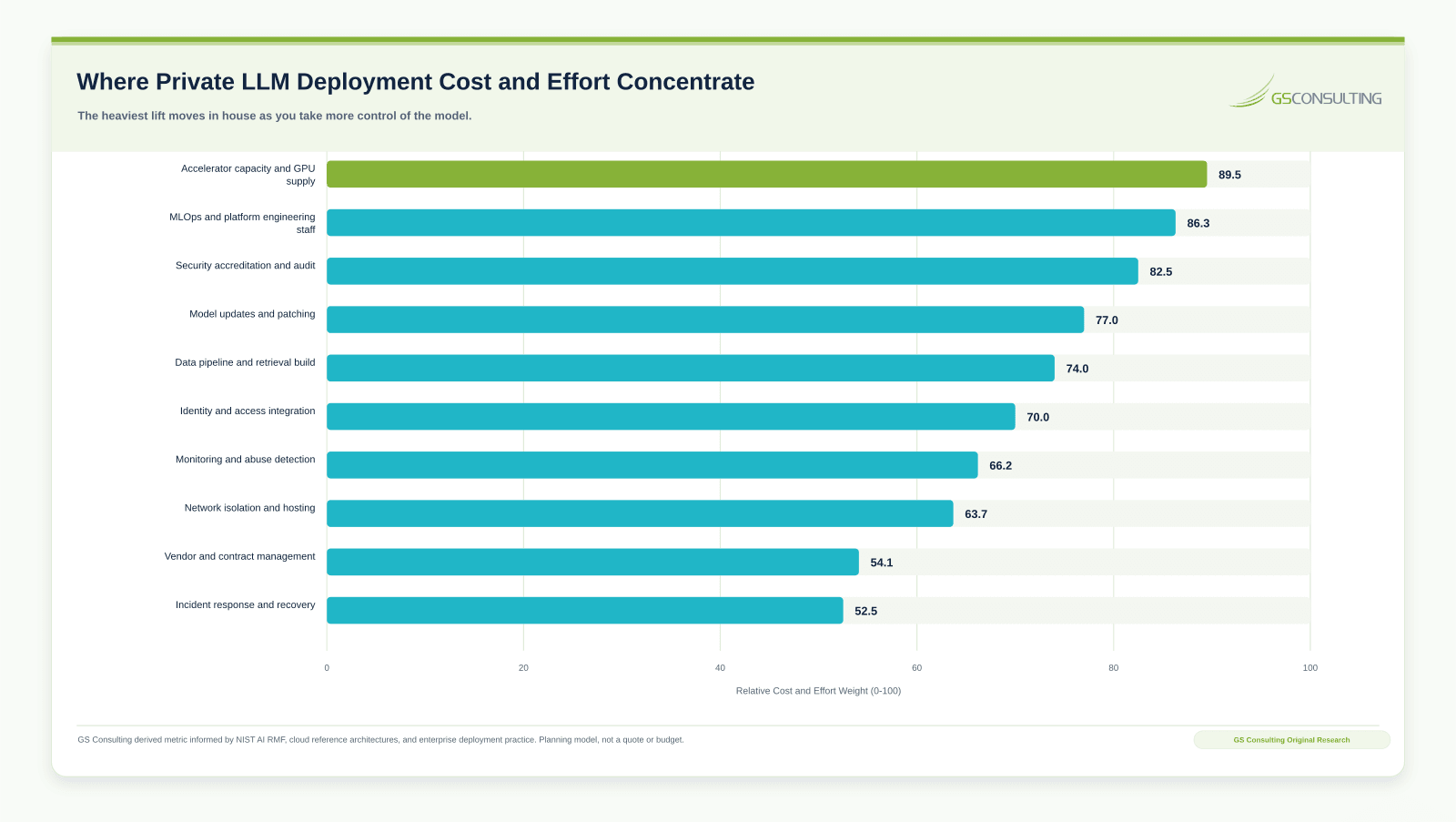
Accelerator and GPU capacity scored highest at 89.5, because compute is scarce and expensive and does not get cheaper just because you own the model. MLOps and platform engineering staff followed at 86.3, because a self hosted or on prem model is a system someone has to run every day. Security accreditation and audit scored 82.5, because control you cannot prove is not control that counts. Model updates, data pipeline build, identity integration, monitoring, network isolation, vendor management, and incident response fill out the rest.
Put the two indexes together and the tradeoff is unmistakable. Cost rises alongside control, and it rises fastest at the top of the spectrum. The open source vs commercial LLM guide extends this comparison to model transparency, update control, provider independence, security work, and exit.
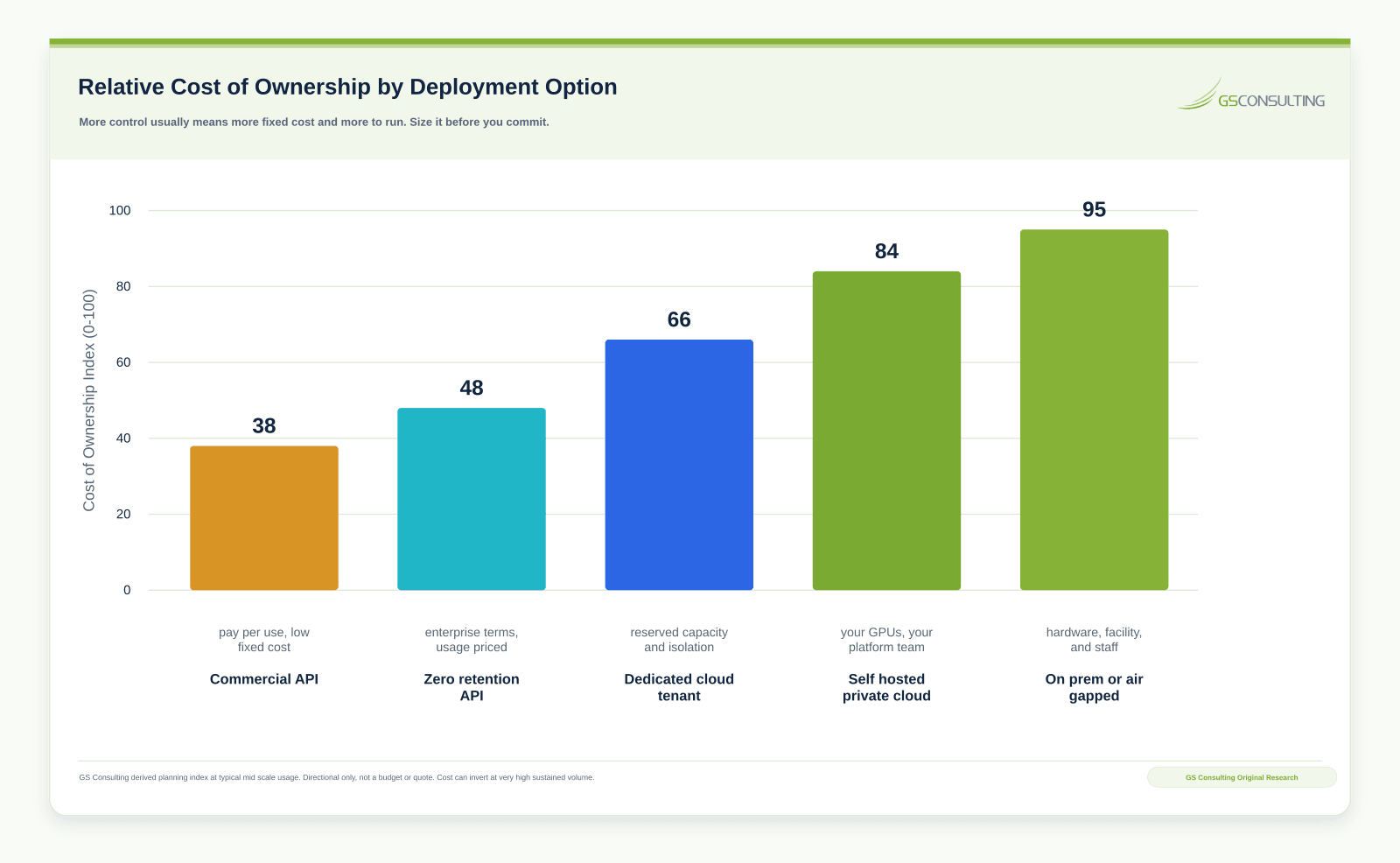
This is why the goal is not maximum control. It is the right control at a cost you can actually sustain, because a private LLM you cannot afford to operate well is not more secure. It is just neglected.
Matching the Option to Your Data
The decision comes together when you hold requirements against options. Some requirements, like keeping CUI inside an approved boundary or guaranteeing no training reuse, rule options in or out immediately. Others, like latency or cost ceilings, tilt the choice within the remaining set.
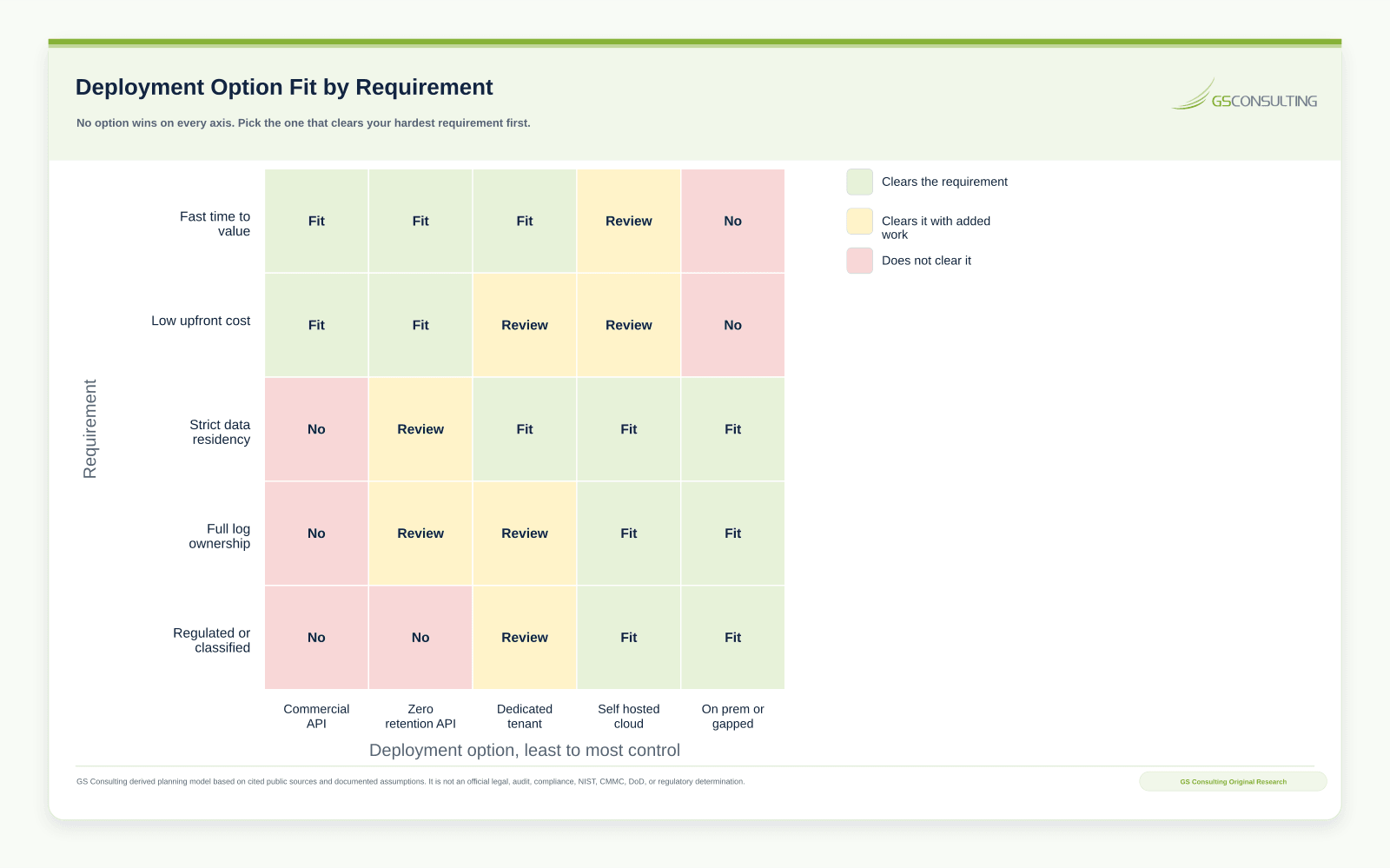
The practical pattern for most regulated teams is a set of lanes rather than a single choice. Regulated and high value data runs in a self hosted or dedicated environment. Moderate sensitivity work runs in a zero retention lane. Low sensitivity work runs in a commercial API. This lets you spend control where it is needed and save it where it is not, which is exactly the strategic tradeoff covered in private AI versus public AI versus hybrid AI.
Whichever option you choose, the model environment still has to work with the rest of the stack. The retrieval controls in secure RAG architecture for GovCon and the leakage controls in preventing CUI leakage in LLMs apply on top of every deployment option, not instead of them.
The Deployment Decision Packet
Choosing a deployment option is a decision your security team, your leadership, and your assessors will want to understand. The way to make it reviewable is a decision packet: the short set of artifacts that record what you chose and why.
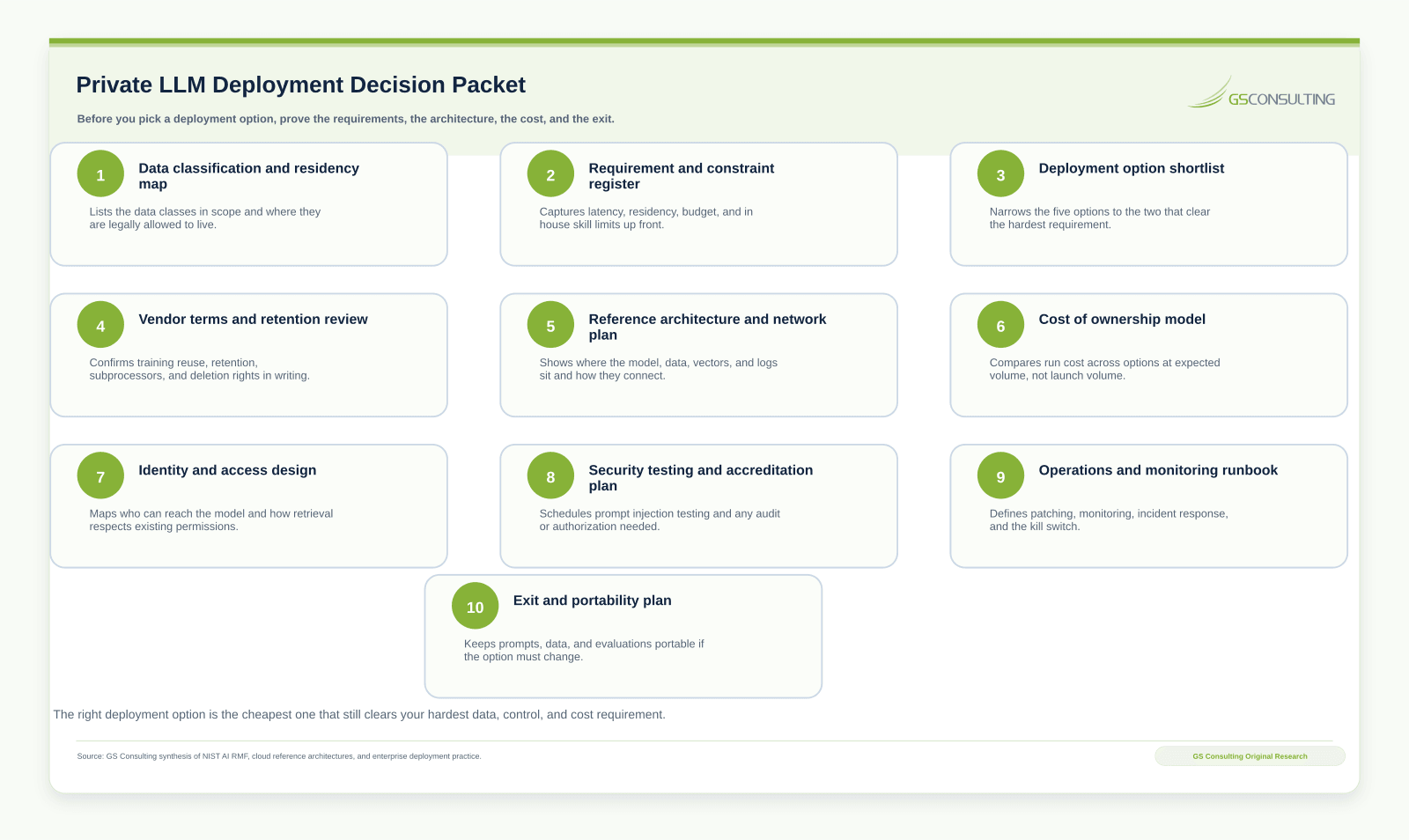
At minimum the packet should record the data class inventory, the requirement to option mapping, the control index scoring, the cost of ownership estimate, the residency and retention terms, the identity integration plan, the logging and monitoring design, the accreditation path, the vendor terms, and an exit plan. If you cannot produce these, you have not made a deployment decision. You have made a purchase and hoped.
To see how the deployment choice fits alongside the model concept, retrieval, and leakage prevention, start from the Private LLM and Secure RAG hub. Use the private LLM data residency architecture guide to separate storage, processing, access, transfer, recovery, and deletion for the exact lane. When you are ready to build, that work connects directly to Secure AI Automation for Regulated Organizations.
The Bottom Line
There is no single private LLM to buy. There are deployment options along a spectrum of control, from a commercial API through zero retention lanes, dedicated tenants, self hosted clouds, and on prem or air gapped hosting. Each step up in control is a step up in cost and operating burden.
The right option is the lowest control choice that still satisfies the duty attached to your data class, chosen deliberately and recorded in a decision packet you can defend. Most teams land on a dedicated tenant or self hosted environment for sensitive work, a zero retention lane for the middle, and a commercial API for everything else.
Choose by the data, cost the option honestly, and prove the control. That is how a private LLM deployment becomes a capability instead of a liability.
Ready to choose and stand up the right private LLM option?
Contact GS Consulting for deployment option mapping, cost of ownership modeling, environment design, and the decision packet your security team and assessors will ask for.
Contact GS ConsultingResearch Sources and Caveats
The Deployment Control Index and the Cost of Ownership Index are GS Consulting derived planning tools based on cited public sources and documented assumptions. They are not official legal, audit, compliance, NIST, CMMC, DoD, CISA, OWASP, ISO, or regulatory determinations.
Actual deployment fit and cost depend on your data classification, contracts, customer direction, CUI scope, residency and retention obligations, identity provider, existing accreditation, vendor terms, and compute availability. Use these models to structure the decision, not to replace legal, security, or procurement judgment.
- IBM Cost of a Data Breach Report 2025
- UNCTAD Technology and Innovation Report 2025
- NIST AI Risk Management Framework
- OWASP Top 10 for LLM Applications
- Cloud Security Alliance AI Controls Matrix
Frequently Asked Questions About Private LLM Deployment Options
What are the main private LLM deployment options?
The main private LLM deployment options are, in rising order of control: a commercial API, a zero retention API lane, a dedicated cloud tenant, a self hosted private cloud running an open model, and an on prem or air gapped deployment. Each option gives you more control of the model, the network, and the logs, and asks more of your team to build and operate.
Which private LLM deployment option is best?
There is no single best option. The best deployment option is the lowest control choice that still satisfies the duty attached to your data class. Regulated data such as CUI often needs a self hosted or on prem environment, while lower sensitivity work can run in a dedicated tenant or a zero retention lane. The data decides the option, not the other way around.
What drives the cost of a private LLM deployment?
The heaviest cost drivers are accelerator and GPU capacity, MLOps and platform engineering staff, and security accreditation and audit. Model updates, data pipeline and retrieval build, identity integration, monitoring, network isolation, vendor management, and incident response add further cost. As you take more control of the model, more of these costs move in house.
Do I need on prem hardware for a private LLM?
Not usually. On prem or air gapped hosting gives the most control but is the most expensive to own, and most regulated teams do not need it. A dedicated cloud tenant or a self hosted private cloud often provides enough control for CUI and other sensitive data at a far lower operating burden. On prem is warranted when contract, residency, or air gap requirements demand it.