Secure AI Automation | | 28 min read
Mapping AI Automations to NIST SP 800-171 Controls

Key Takeaways
AI workflows that affect CUI belong in the SSP review.
Map control impacts
Review access, audit, configuration, authentication, incident response, and protection controls.
Inventory AI components
Include models, connectors, retrieval stores, service identities, and relevant provider paths.
Check the applicable revision
Read the contract and current program direction before selecting the NIST requirements for the review.
AI agents do not sit outside your SSP.
That is the mistake.
A company builds an internal chatbot. Then it connects the chatbot to SharePoint. Then someone adds ticket summaries. Then it starts drafting compliance responses. Then the team wants it to summarize CUI. Then an engineer connects it to a workflow tool.
Everyone still talks about it like it is just an AI pilot.
It is not.
If the AI workflow processes, stores, transmits, retrieves, summarizes, protects, or acts on CUI, it affects your NIST SP 800-171 story. It may affect your system boundary, asset inventory, access control model, audit logs, incident response plan, risk assessment, vendor review, evidence package, and POA&M.
Need to update your SSP before AI agents touch CUI?
GS Consulting helps GovCon teams map AI automations to NIST SP 800-171 controls, update SSPs, assess CUI data flows, review AI architecture, validate vendor risk, and build evidence packages.
Request an AI SSP ReviewStart With the Current Compliance Reality
There is a version issue GovCon leaders need to understand.
NIST SP 800-171 Revision 3 was published in May 2024 and supersedes Revision 2. NIST says Revision 3 applies to components of nonfederal systems that process, store, or transmit CUI, or that provide protection for those components. NIST also says the requirements are intended for use in federal contracts and agreements with nonfederal organizations.
At the same time, the current DoD CMMC program page describes Level 2 as verifying compliance with the 110 security requirements in NIST SP 800-171 Revision 2, with assessment and annual affirmation requirements.
So the practical approach is straightforward: if you are supporting CMMC Level 2, keep your assessment story aligned to the current CMMC requirement and contract language. If you are modernizing your security program, track Revision 3 because it is the forward looking NIST baseline. If you are updating your SSP for AI, do not wait for a future rule change. Document the AI workflow now.
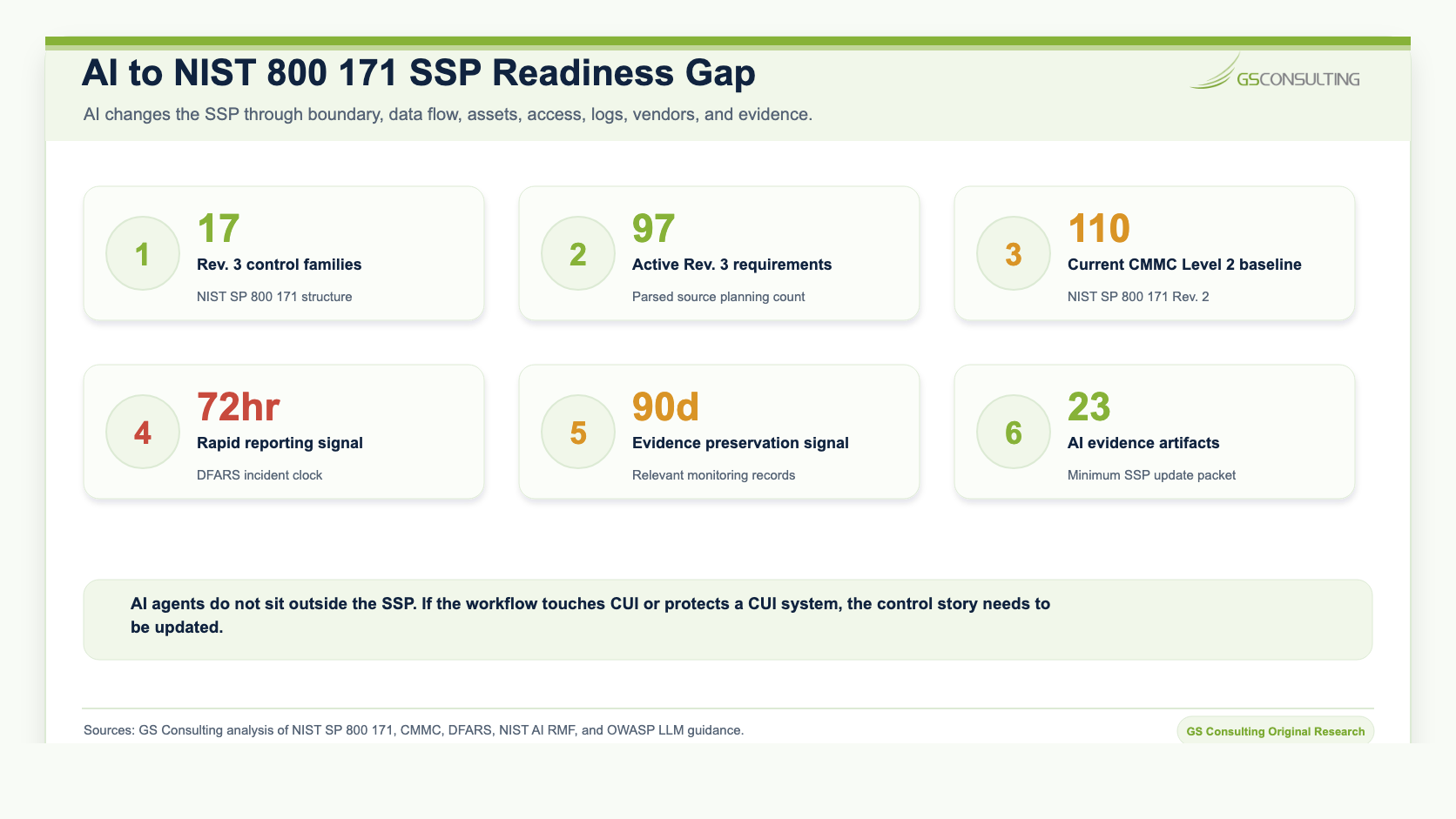
Original Research: The AI to NIST SP 800-171 SSP Impact Index
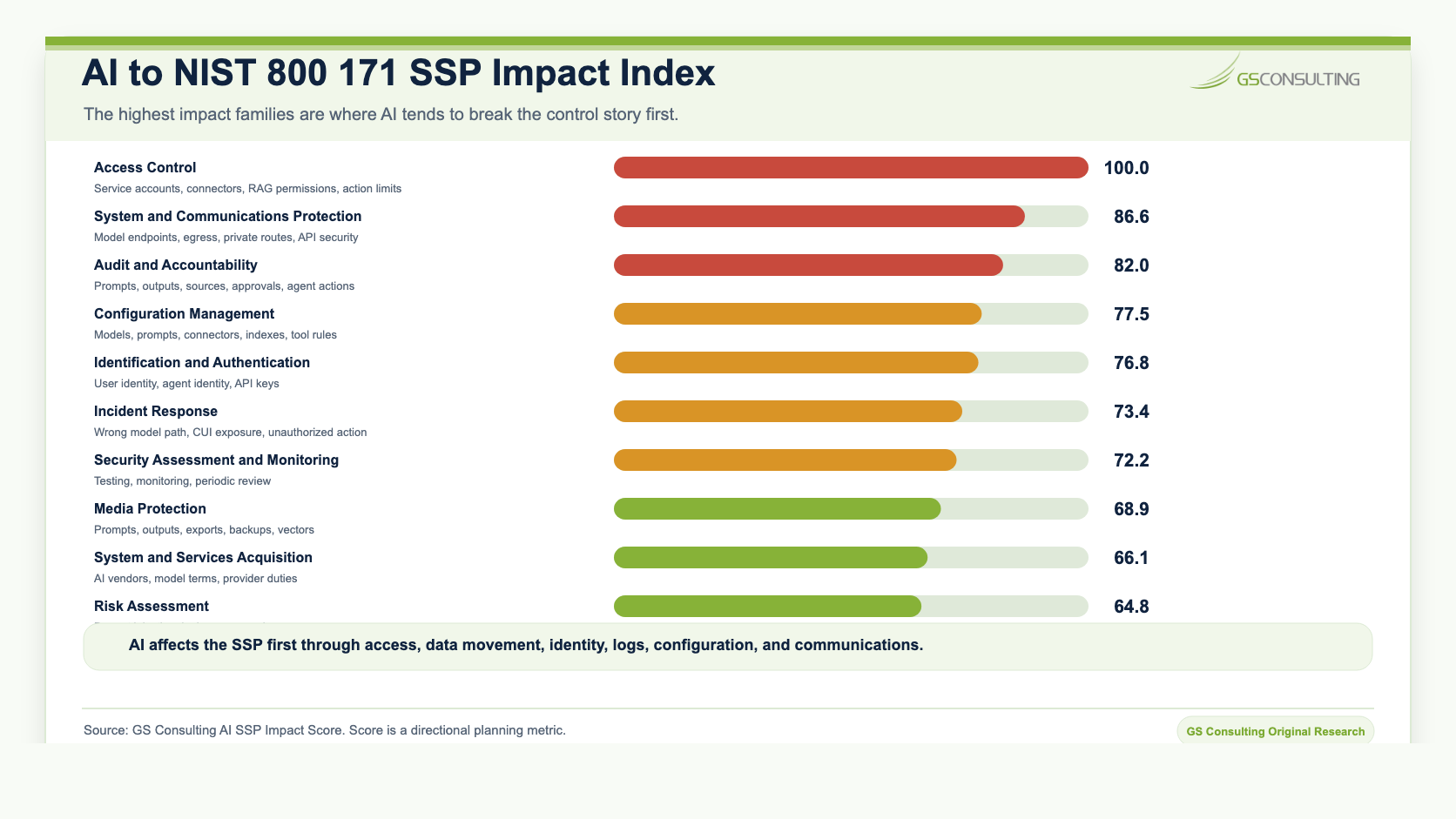
Original GS Consulting research shows that AI automation changes the NIST SP 800-171 SSP story first through access, data flow, audit logging, configuration, identity, system communications, and external services.
GS Consulting analyzed NIST SP 800-171 Rev. 3, current CMMC Level 2 requirements, DFARS 252.204 7012, AI risk guidance, LLM security guidance, and common AI architecture components to create an AI to NIST SP 800-171 SSP Impact Index.
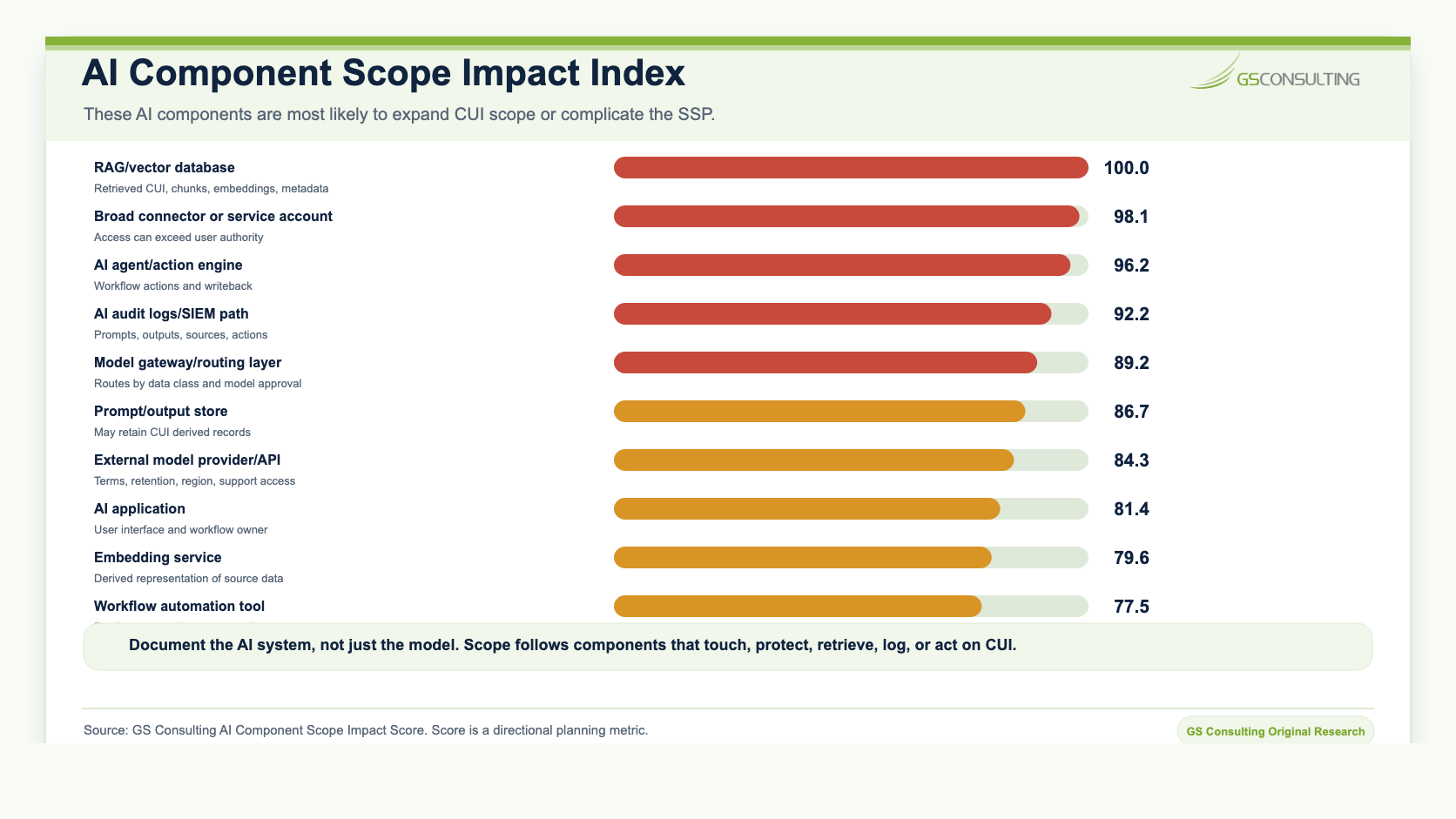
The research used two GS Consulting derived planning scores. The AI SSP Impact Score ranks NIST SP 800-171 families by Rev. 3 requirement load, current CMMC Rev. 2 evidence pressure, AI touchpoint breadth, CUI boundary impact, and assessment evidence complexity. The AI Component Scope Impact Score ranks AI components and data paths by how likely they are to expand CUI scope, create evidence requirements, or complicate the SSP.
The highest impact families were Access Control, System and Communications Protection, Audit and Accountability, Configuration Management, Identification and Authentication, Incident Response, Security Assessment and Monitoring, Media Protection, System and Services Acquisition, and Risk Assessment.
The AI SSP Impact Score, AI Component Scope Impact Score, and evidence packet are GS Consulting derived planning tools. They are not official NIST, DoD, CMMC, C3PAO, legal, audit, or assessment determinations.
Why AI Agents Change the SSP
A basic chatbot may feel harmless. An AI agent is different.
An agent may retrieve documents, call APIs, summarize records, route tickets, draft responses, search evidence, update fields, trigger workflows, create logs, and interact with systems of record.
That creates new SSP questions. What identity does the agent use? What systems can it access? Can it retrieve CUI? Can it write back to systems? Can it create outputs derived from CUI? Where are prompts stored? Are embeddings created? Is a vector database used? Are logs protected? Can the vendor retain data? Can the workflow be audited? Who can pause the automation?
If the current SSP does not answer those questions, it is behind the environment.
What Must Be Updated in the SSP
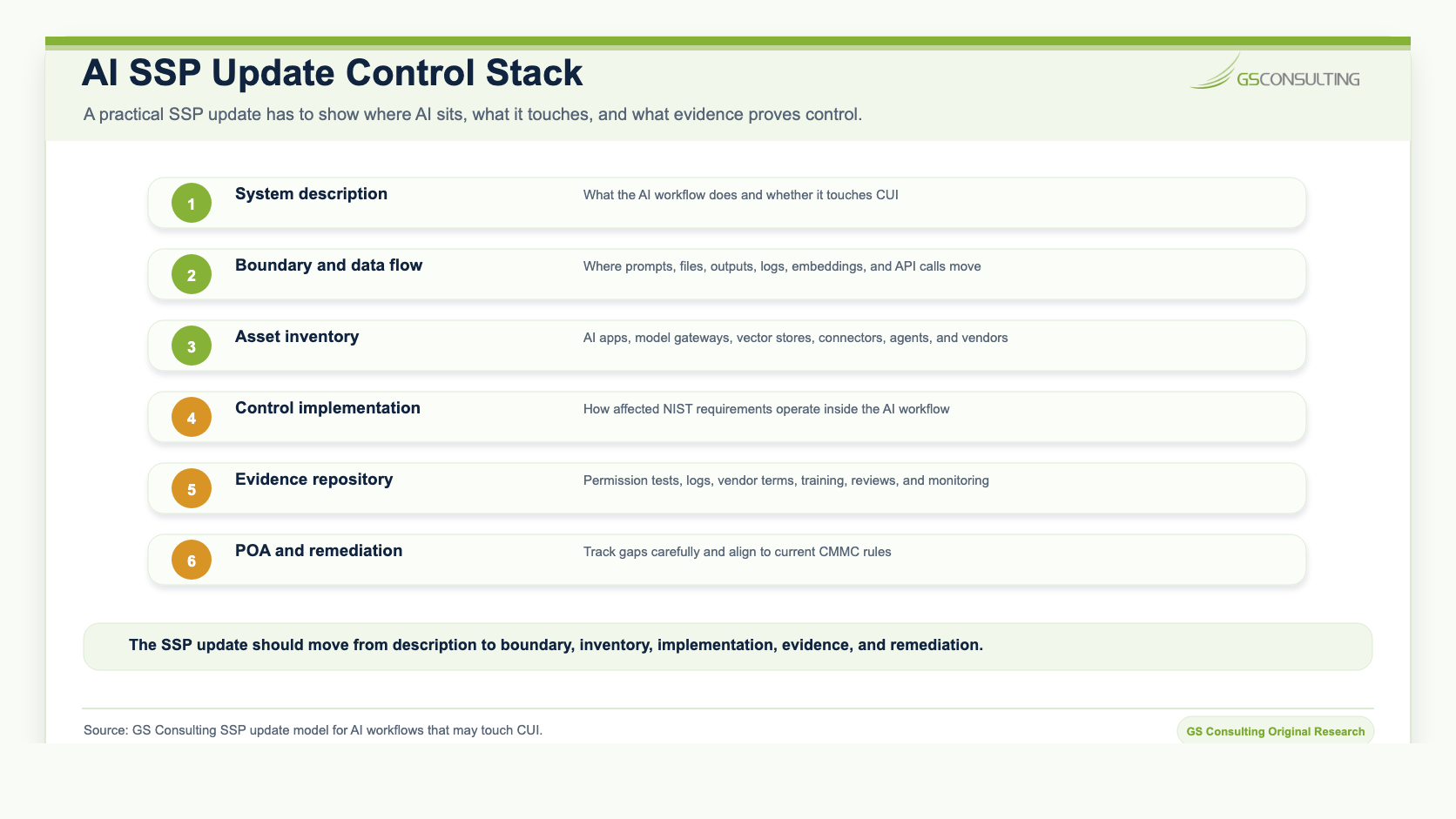
Before getting into the control crosswalk, update the SSP in five places.
- Update the system description: Explain what the AI workflow does, what business process it supports, and whether it touches CUI.
- Update the system boundary: Show whether the AI components are inside the CUI environment, protect the CUI environment, or remain out of scope.
- Update the data flow diagram: Show prompts, retrieved documents, outputs, embeddings, logs, API calls, and write back paths.
- Update the asset inventory: Include AI applications, model gateways, vector databases, connectors, service accounts, automation tools, and cloud services.
- Update the control implementation statements: Explain how each affected NIST SP 800-171 requirement is implemented for the AI workflow.
The Crosswalk: How AI Agents Map to NIST SP 800-171
This is not a substitute for a requirement by requirement assessment. It is a practical crosswalk for identifying where AI agents usually impact the SSP.
1. Access Control
Access control is the first place AI breaks things. Can the AI see more than the user is allowed to see?
Document user authentication, inherited permissions, document level access, service account limits, connector permissions, systems the agent can access, actions the agent can take, and actions that are blocked. For RAG, document whether retrieval is filtered before content reaches the model. Do not rely on the model to hide restricted content after retrieval.
2. Awareness and Training
Employees may paste CUI into prompts, upload controlled documents, ask AI to rewrite government provided material, or rely on outputs without review. Training should explain approved AI tools, prohibited AI tools, data that cannot be entered, output handling, human review, and suspected AI exposure reporting.
3. Audit and Accountability
AI workflows need traceability. You need to know who used the workflow, what they asked, what sources were retrieved, what output was generated, who reviewed it, and what action happened next. If logs contain CUI or derived CUI, protect the logs too.
4. Configuration Management
AI systems drift. Prompts change. Models change. Connectors change. Retrieval logic changes. Vector indexes change. API permissions change. Workflow actions change. Document approved models, endpoints, prompt templates, tool access, connector settings, RAG configuration, DLP settings, and approval rules.
5. Identification and Authentication
AI agents need identities. Do not let AI actions happen under vague or shared identities. Document user authentication, service account authentication, API key management, token lifetimes, secrets management, privileged identity controls, and how agent actions are linked back to users or system owners.
6. Incident Response
What happens if CUI enters the wrong model? What happens if AI retrieves a restricted document for the wrong user? What happens if an agent takes an unauthorized action? Define AI incident events, notification paths, evidence preservation, pause authority, vendor contact steps, exposure assessment, and reporting review.
7. System and Communications Protection
AI creates new communication paths. Prompts travel to model endpoints. Retrieved content travels to the model. Outputs return to users. Connectors pull from repositories. Agents call APIs. Logs move to monitoring systems. Document encryption, private endpoints, segmentation, egress restrictions, API security, model endpoint routing, and separation between public AI lanes and CUI approved AI lanes.
8. Risk Assessment and Monitoring
AI adds risks around CUI leakage, permission bypass, excessive agency, prompt injection, vector database exposure, stale source content, and output misuse. Update risk assessment, security assessment, monitoring, and testing procedures to include AI workflows.
AI Components to Add to the Asset Inventory
Do not document only the model. Document the AI system.
That can include the AI application, model gateway, model endpoint, embedding service, vector database, RAG ingestion service, document connector, ticketing connector, API gateway, workflow automation tool, prompt logging store, output repository, chat history store, monitoring tool, service account, AI agent identity, admin console, developer environment, test environment, implementation partner access, and vendor support path.
If any of those process, store, transmit, retrieve, summarize, protect, or act on CUI, they matter.
How AI Changes the POA and Milestones
AI may create new gaps. That is not a reason to hide it.
Common POA items include AI use policy not finalized, CUI data classification incomplete, AI access control testing incomplete, prompt and output logging not implemented, vector database backup controls incomplete, RAG permission filtering not tested, vendor terms not fully reviewed, incident response playbook not updated, AI training not completed, SSP not updated, and monitoring rules not deployed.
Be careful here. Official CMMC materials describe limited POA use and annual affirmation requirements. Do not assume every AI related gap can safely sit on a POA.
The AI Evidence Package
For AI compliance with NIST, build an evidence package before assessment.
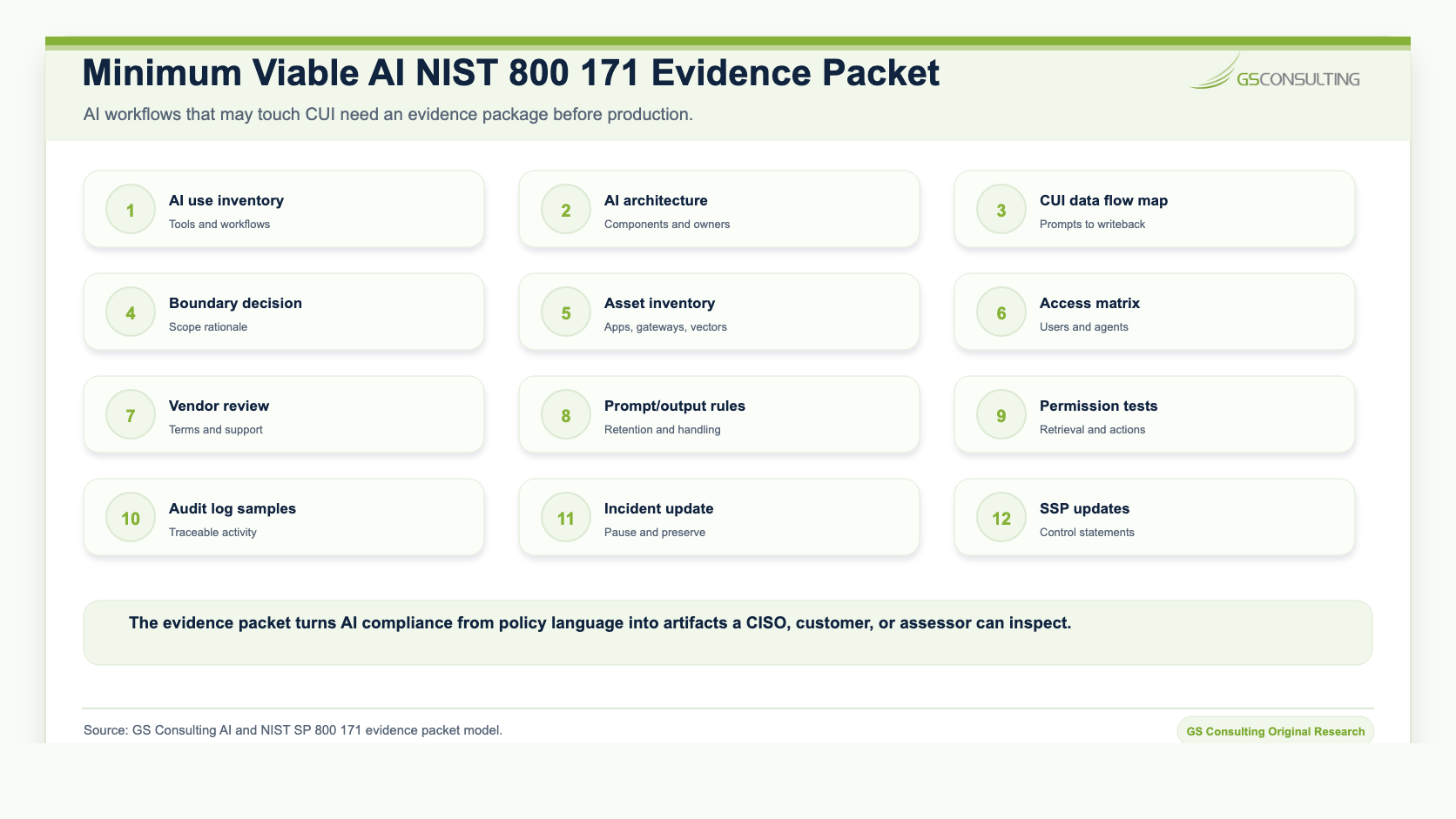
Include an AI use case inventory, AI architecture diagram, CUI data flow map, AI system boundary decision, AI asset inventory, AI access control matrix, service account inventory, vendor review records, prompt and output handling policy, model provider data terms, RAG source inventory, vector database security configuration, permission testing results, audit log samples, incident response update, AI user training records, configuration baseline, change management records, risk assessment, monitoring dashboard, human review procedure, and SSP updates.
This is the evidence compliance leaders and CISOs need before they tell leadership the AI workflow is ready.
Common Mistakes
- Treating AI as out of scope: If it touches CUI, the assumption that it is just a tool falls apart quickly.
- Updating policies but not the SSP: Policies matter, but assessors and customers will look for implemented controls and evidence.
- Ignoring prompts and outputs: If prompts or outputs contain CUI, they need controls.
- Forgetting embeddings and vector databases: A RAG index can become part of the CUI environment.
- Using broad service accounts: That can destroy the access control story.
- Relying on vendor marketing claims: Vendor terms and technical configuration matter.
A 30 Day SSP Update Plan
- Week 1Inventory AI Use.
Identify tools, pilots, agents, vendors, connectors, prompts, outputs, and workflows that may touch CUI.
- Week 2Map Data Flows.
Document where CUI enters the AI workflow, where it is retrieved, where outputs go, where logs are stored, and whether embeddings are created.
- Week 3Map Controls.
Start with access control, audit and accountability, configuration management, identification and authentication, incident response, risk assessment, security assessment, system and communications protection, and system integrity.
- Week 4Update Evidence.
Refresh the SSP, asset inventory, diagrams, risk register, vendor reviews, training, logging records, and POA items where appropriate.
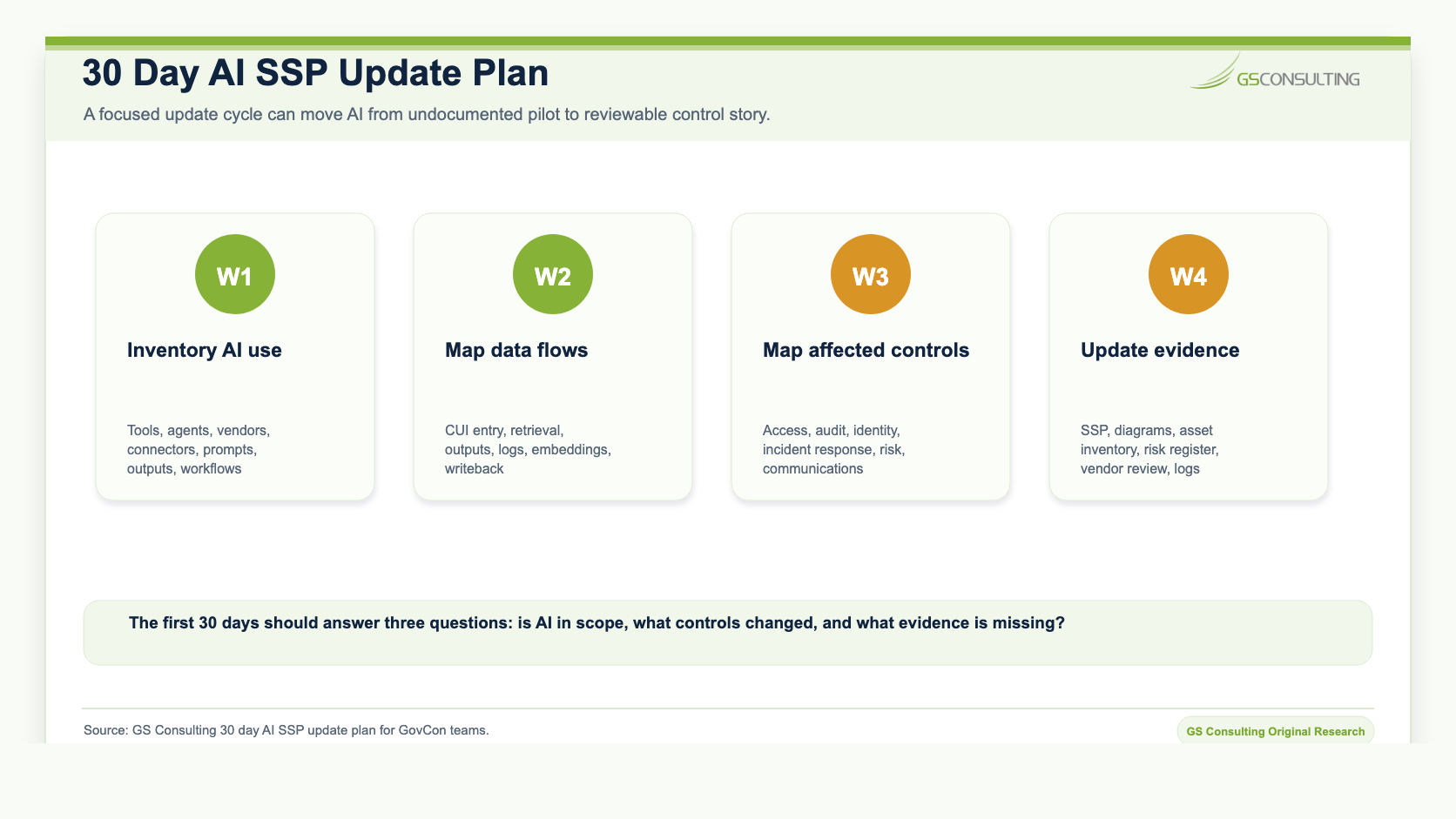
At the end of 30 days, you should know whether the AI workflow is inside scope, what controls are affected, and what evidence is missing.
How This Supports Secure AI Automation Consulting
Secure AI Automation for Regulated Organizations explains how GS Consulting helps organizations automate workflows with the right governance, architecture, data controls, security, compliance, and measurable outcomes.
This guide answers the compliance question: how does AI automation affect our NIST SP 800-171 control implementation and SSP?
That question connects directly to Preparing AI Systems for CMMC Assessment, Preventing CUI Leakage in LLMs, Secure RAG Architecture for GovCon, AI Audit Trails and Activity Logging, and NIST SP 800-171 Compliance for GovCon.
The Bottom Line
AI agents change your NIST SP 800-171 story.
They change where CUI moves. They change who can access it. They create prompts, outputs, logs, embeddings, and workflow actions. They introduce vendors, connectors, service accounts, and new audit requirements.
That means they belong in the SSP.
The companies that get this right will not treat AI as an exception to compliance. They will map AI automations to NIST SP 800-171 controls, update the SSP, collect evidence, and build secure AI workflows that can survive assessment.
Ready to update your SSP before AI agents touch CUI?
Contact GS Consulting for Secure AI Automation Consulting and NIST SP 800-171 Compliance Services.
Contact GS ConsultingResearch Sources and Caveats
The AI SSP Impact Score, AI Component Scope Impact Score, and evidence packet are GS Consulting derived planning tools. They are not official NIST, DoD, CMMC, C3PAO, legal, audit, or assessment determinations.
Actual control mapping depends on the contractor's contracts, CUI categories, CMMC scope, system architecture, AI deployment model, provider terms, RAG design, identity architecture, access model, incident response obligations, inherited controls, assessor expectations, and customer direction.
- NIST SP 800-171 Rev. 3
- NIST SP 800-171A Rev. 3
- DoD CIO: About CMMC
- DFARS 252.204-7012
- NIST AI RMF Core
- OWASP Top 10 for LLM Applications
Frequently Asked Questions About NIST SP 800-171 Controls for AI
Do AI automations belong in the NIST SP 800-171 SSP?
Yes, when the AI workflow processes, stores, transmits, retrieves, summarizes, protects, or acts on CUI, or when it protects a CUI system. The SSP should document the AI system boundary, data flow, assets, access controls, logs, vendors, incident response, and evidence.
Which NIST SP 800-171 control families are most affected by AI?
The highest impact families are usually Access Control, System and Communications Protection, Audit and Accountability, Configuration Management, Identification and Authentication, Incident Response, Security Assessment and Monitoring, Media Protection, System and Services Acquisition, and Risk Assessment.
Is an AI policy enough for NIST SP 800-171 compliance?
No. Policy helps, but compliance leaders also need implemented controls and evidence. AI workflows need access tests, data flow diagrams, asset inventory updates, vendor review records, prompt and output handling rules, audit logs, incident procedures, and SSP implementation statements.
How should contractors handle NIST SP 800-171 Rev. 2 and Rev. 3 for AI?
Contractors should align assessment language to the version required by their contract and current CMMC requirement while tracking Rev. 3 for forward planning. AI workflows should still be documented now because they may change scope, control implementation, evidence, and risk.
Related Reading
- Secure AI Automation for Regulated Organizations
- Preparing AI Systems for CMMC Assessment
- NIST SP 800-171 Compliance: What GovCon Leaders Need to Know
- Preventing CUI Leakage in LLMs
- Secure RAG Architecture for GovCon
- AI Audit Trails and Activity Logging
- AI Access Controls and Permission Design
- How DoD Contractors Can Use AI Without Putting CUI at Risk
- How to Build a CUI Data Flow Map for CMMC