Cybersecurity Compliance | | 25 min read
NIST SP 800-171 Compliance: What GovCon Leaders Need to Know

Key Takeaways
NIST SP 800-171 readiness must match the CUI environment.
Start with contract and revision
Confirm the applicable requirements before planning control work.
Prove implementation
Connect the SSP, owners, scope, and recurring evidence to the actual systems.
Control supporting AI
Use AI to assist compliance work without outsourcing conclusions or exposing controlled information.
For government contractors, NIST SP 800-171 is one of the most important cybersecurity standards in the federal marketplace. It affects how contractors protect Controlled Unclassified Information, how they prepare for CMMC, how they support DoD contract requirements, and how they prove cybersecurity readiness to customers, primes, and assessors.
But many GovCon leaders still misunderstand what NIST SP 800-171 actually is. It is not just an IT checklist. It is not just a CMMC preparation document. It is not something that can be solved with a software tool alone.
NIST SP 800-171 is a set of security requirements for protecting the confidentiality of CUI when that information resides in nonfederal systems and organizations. For contractors, that means NIST SP 800-171 compliance is a business issue. It affects contract eligibility, proposal readiness, subcontractor relationships, cloud architecture, security operations, executive risk, and customer trust.
Need to understand your NIST SP 800-171 posture?
GS Consulting helps government contractors map CUI, define the system boundary, review DFARS and CMMC requirements, assess SSPs and POA&Ms, evaluate cloud and AI tool risk, and build practical remediation roadmaps.
Request a NIST Readiness AssessmentThis guide explains what GovCon leaders need to know about NIST SP 800-171, how it connects to CMMC and DFARS, and what contractors should build now to support continuous compliance.
Why NIST SP 800-171 Matters in GovCon
NIST SP 800-171 matters because government contractors often handle information that is not classified but still requires protection. That information may include controlled technical information, engineering data, acquisition information, export-controlled information, source selection information, privacy information, or other CUI categories.
The Controlled Unclassified Information program standardizes how the executive branch handles unclassified information that requires safeguarding or dissemination controls under law, federal regulation, or government-wide policy.
That creates a practical obligation for contractors: if your company receives, creates, stores, transmits, or processes CUI under a federal contract, your cybersecurity program has to be designed around that data.
Original Research: The NIST SP 800-171 Evidence Pressure Index
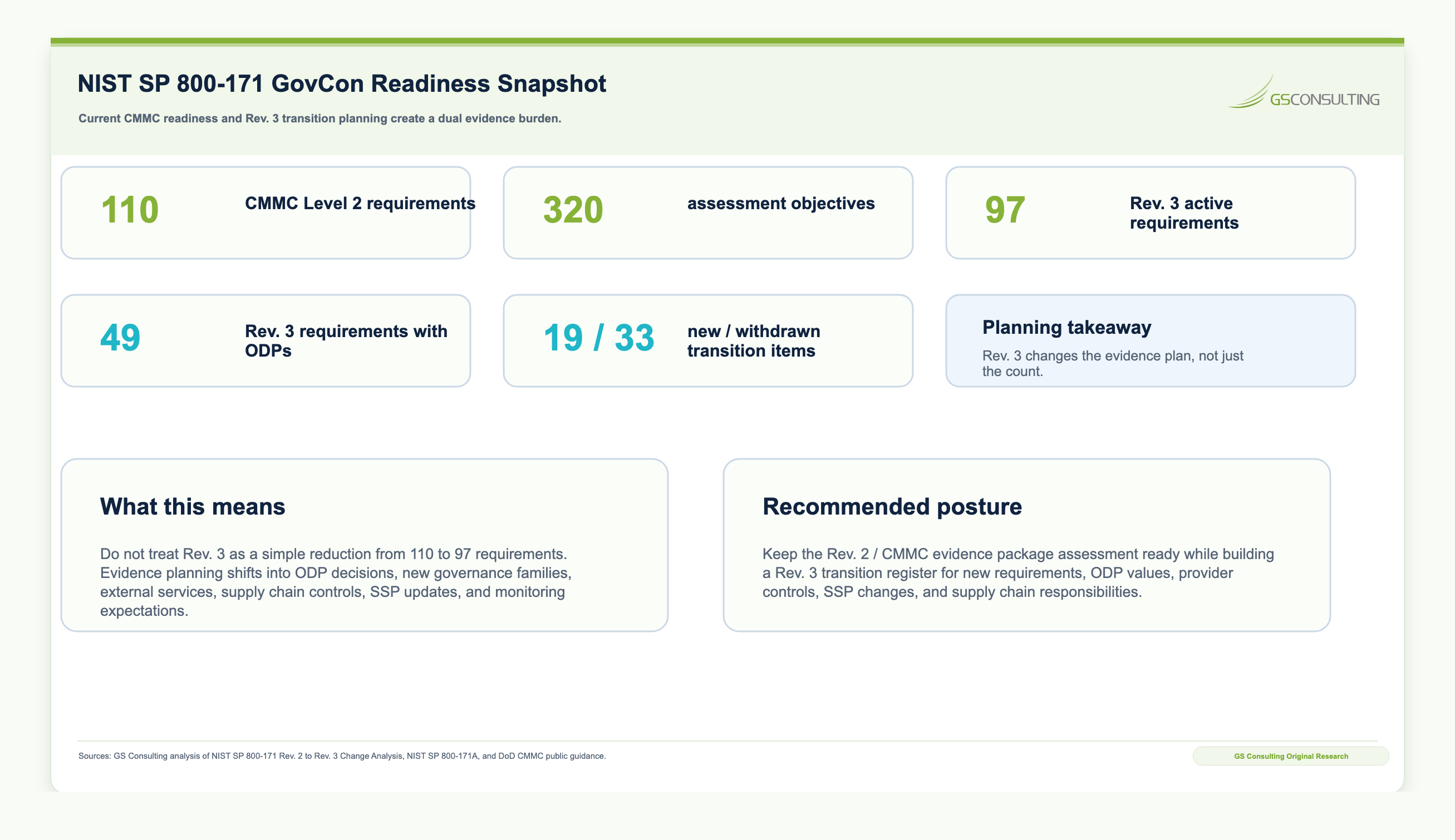
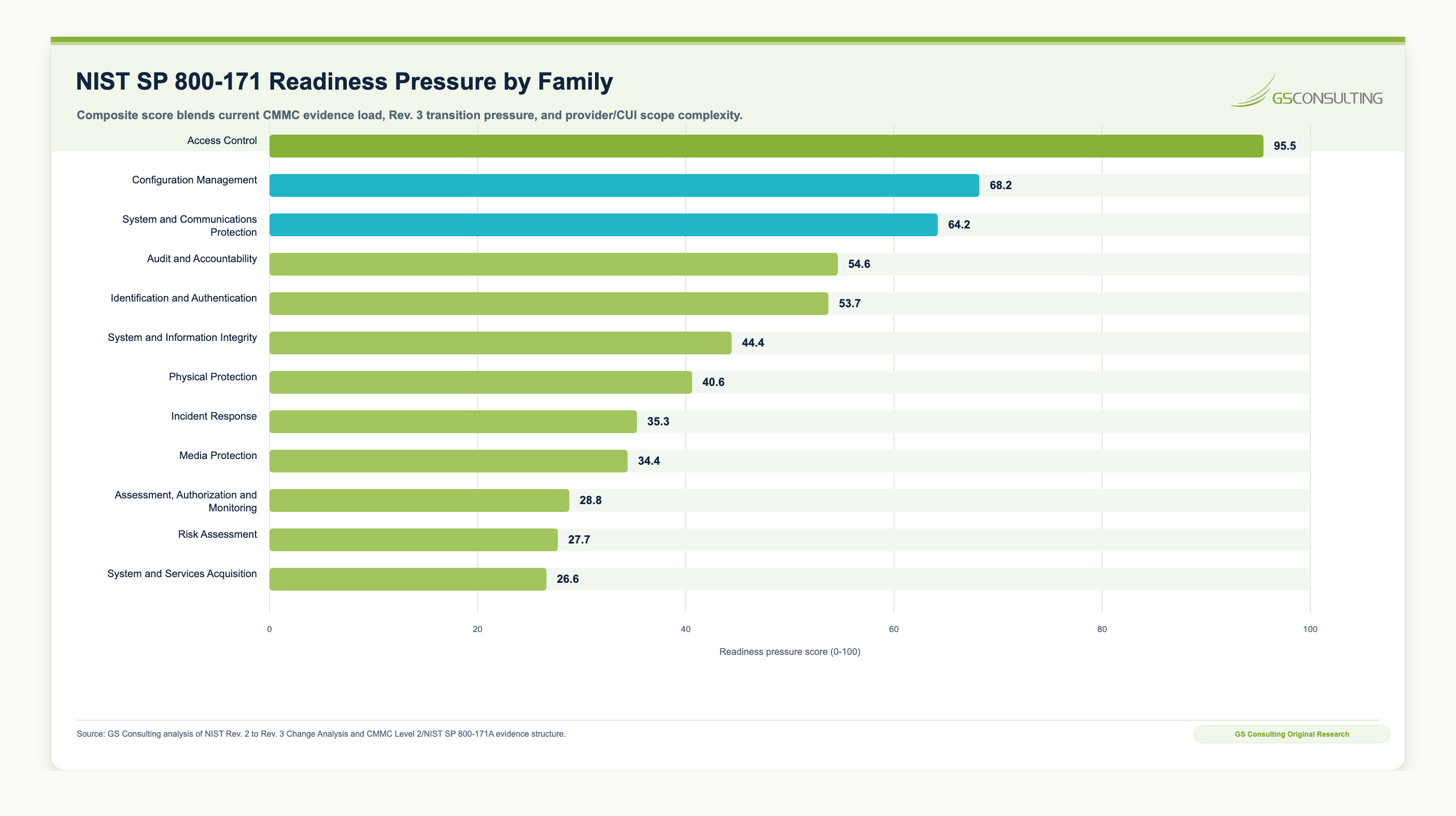
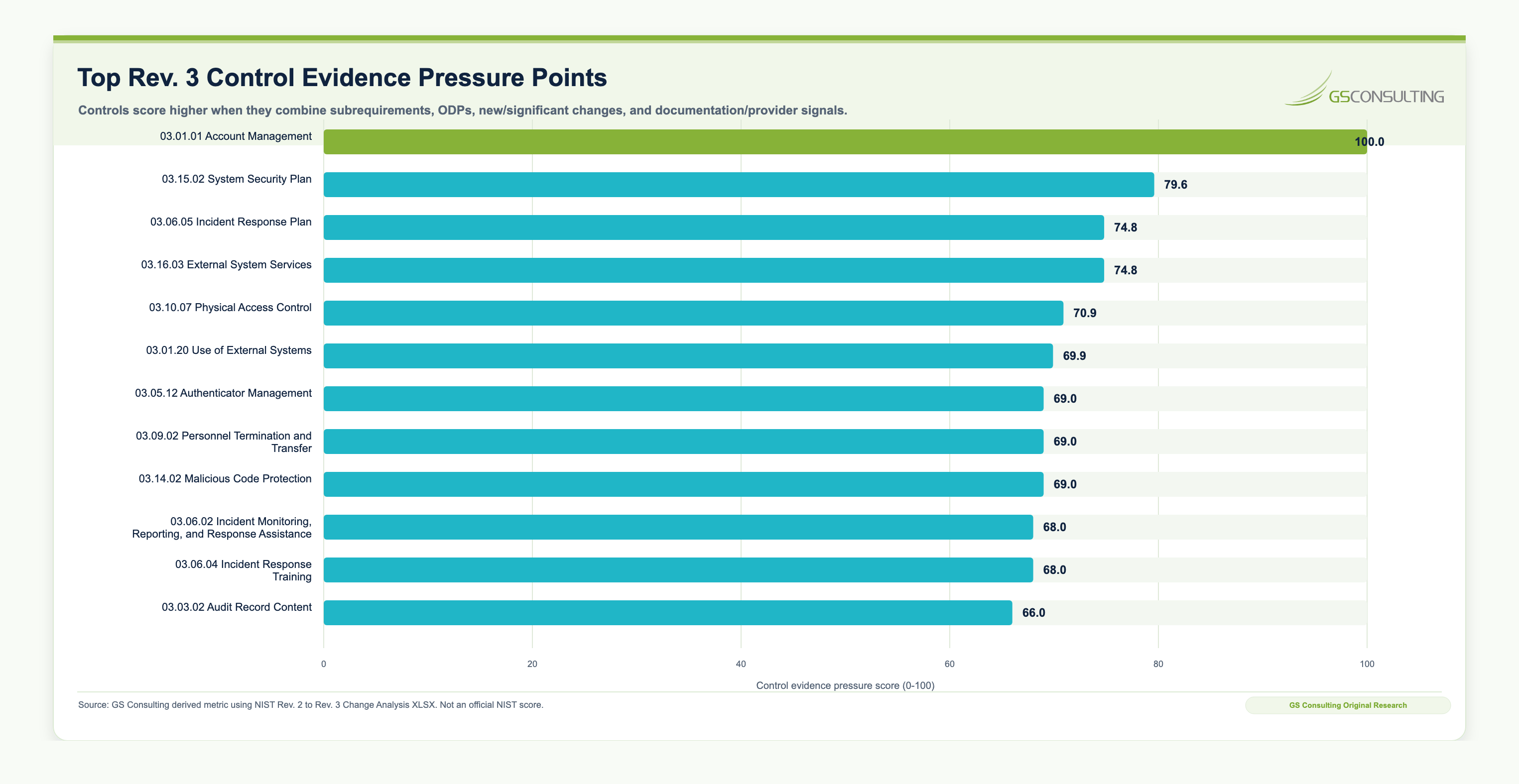
Original GS Consulting research shows that NIST SP 800-171 readiness is now a dual-baseline evidence challenge. GS Consulting analyzed public NIST, DoD, CMMC, and DFARS sources to compare the current Rev. 2 and CMMC evidence burden with the Rev. 3 transition workload.
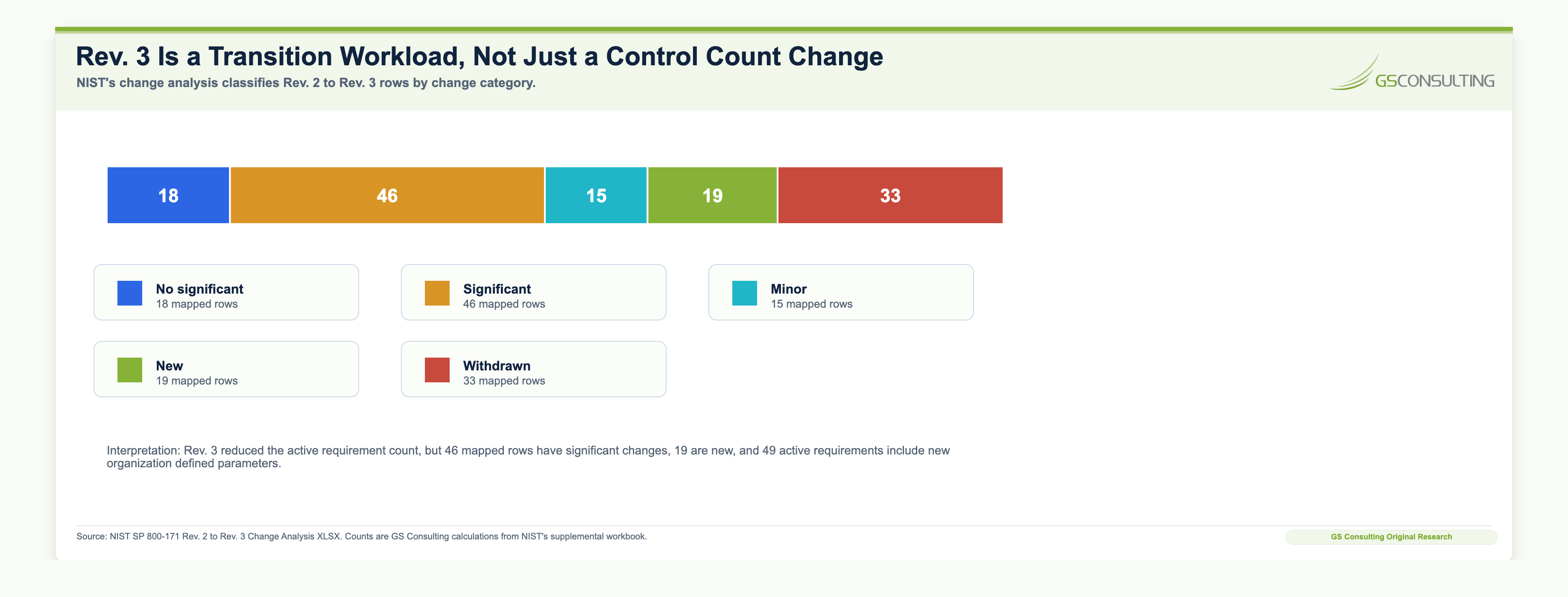
The analysis found that contractors should maintain an assessment-ready evidence package for the current 110 Rev. 2 and CMMC Level 2 requirements while preparing for 97 Rev. 3 active requirements, 49 requirements with organization-defined parameter decisions, 19 new requirements, and 33 withdrawn or restructured requirements.
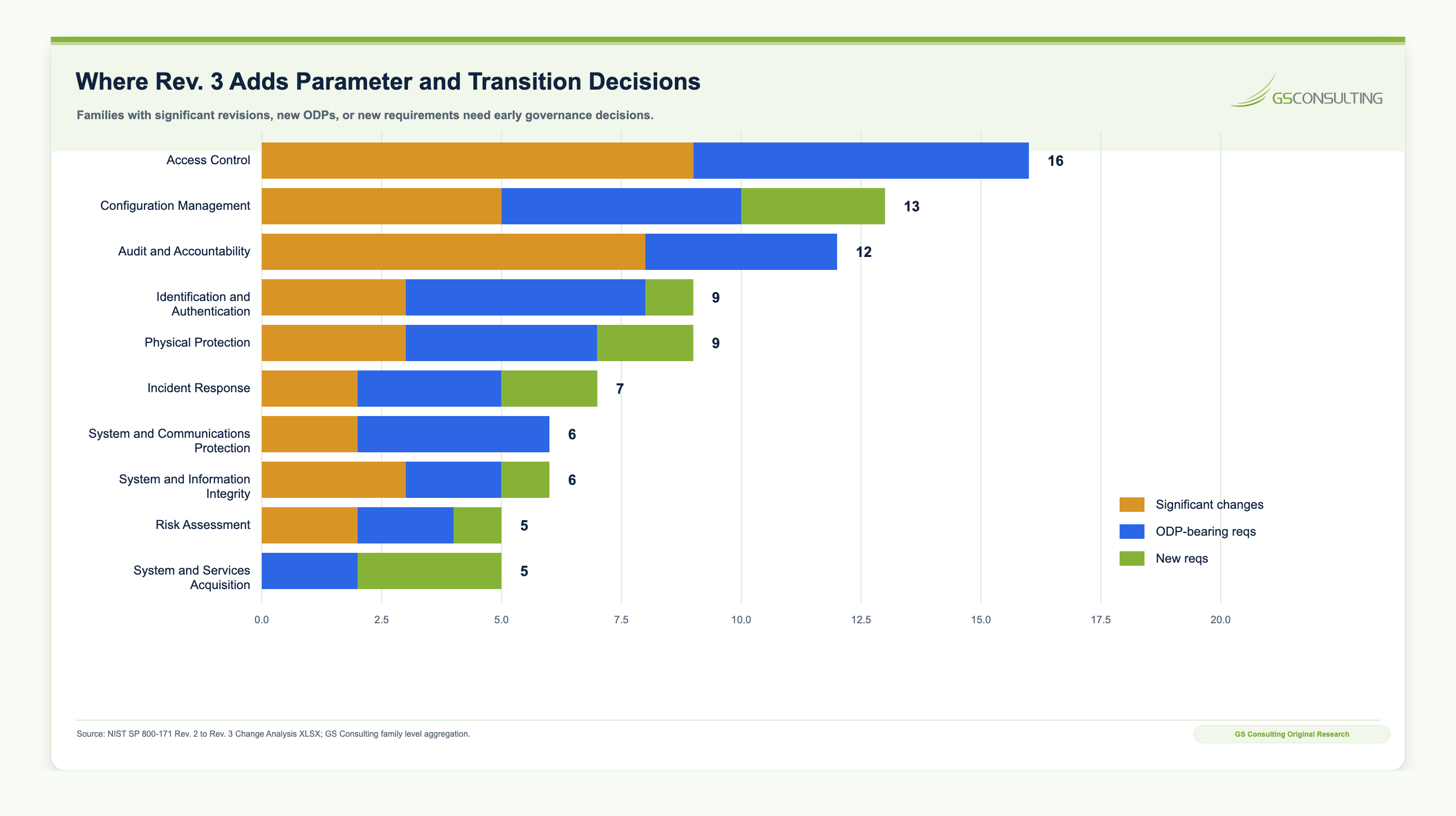
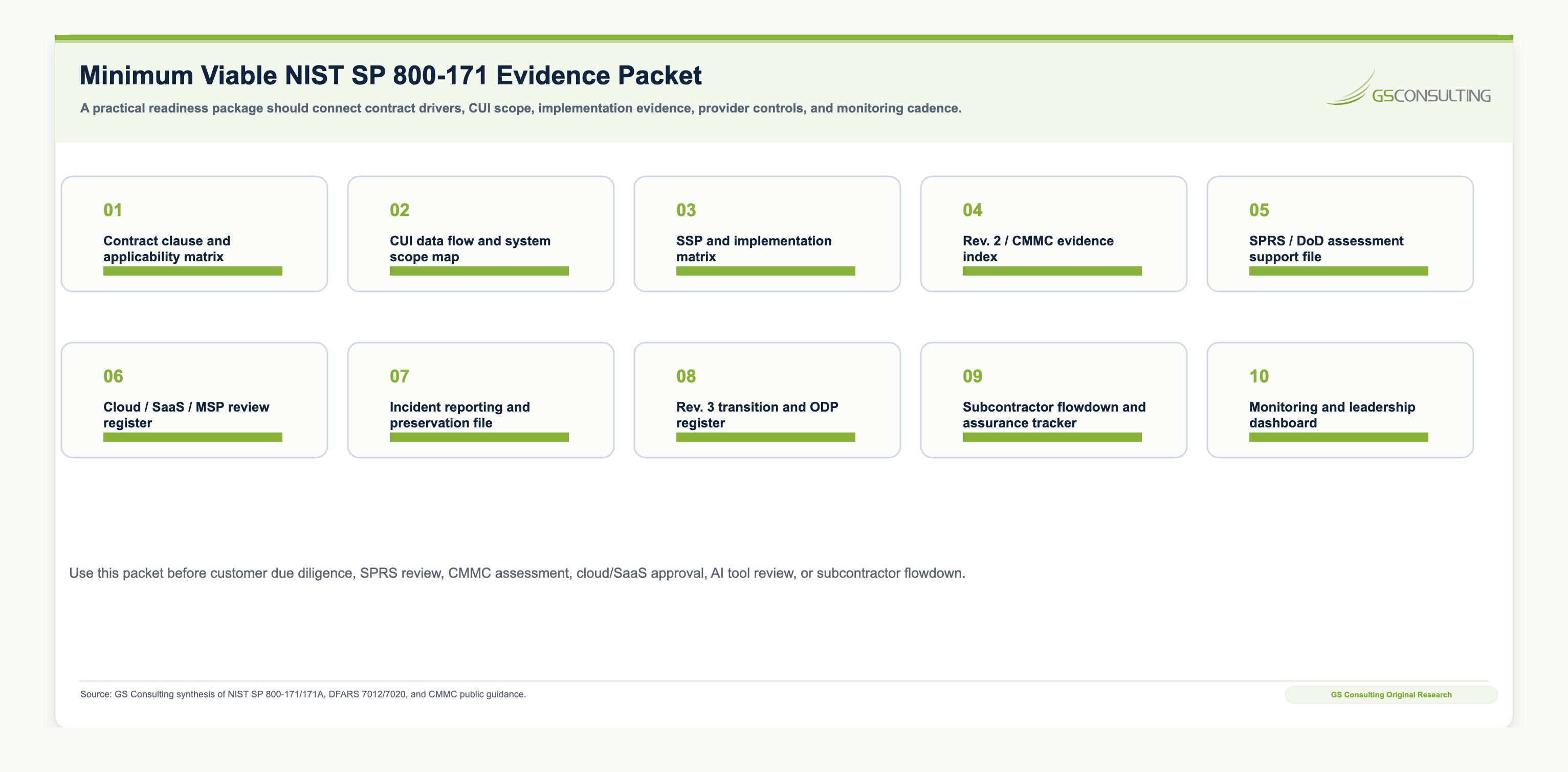
The highest-pressure readiness families were Access Control, Configuration Management, System and Communications Protection, Audit and Accountability, and Identification and Authentication. The practical takeaway is clear: contractors should not treat NIST SP 800-171 compliance as a one-time checklist. They need a living evidence system that connects CUI scope, SSP implementation, control owners, cloud/SaaS/MSP responsibility, subcontractor flowdown, incident reporting, SPRS assessment support, Rev. 3 transition planning, and continuous monitoring.
The NIST Readiness Pressure Score, Control Evidence Pressure Score, and evidence packet are GS Consulting-derived planning tools. They are not official NIST scores, CMMC scores, legal conclusions, SPRS scores, or C3PAO assessment determinations. The 320 assessment objectives and evidence-object references are analytical planning proxies; NIST SP 800-171A notes that potential assessment methods and objects are not mandatory artifact requirements.
NIST SP 800-171 Is About CUI, Not Just Cybersecurity
A common mistake is treating NIST SP 800-171 as a general security standard for the entire company. It is more specific than that. It is focused on protecting the confidentiality of CUI in nonfederal systems.
That does not mean the rest of the company can be ignored. Systems that protect CUI systems may also be in scope. Identity providers, endpoint protection tools, logging platforms, cloud services, managed service providers, backup systems, AI tools, and security monitoring tools may all matter if they process, store, transmit, or protect CUI.
- DataWhere does CUI enter, live, move, and leave?
- AccessWho can access it and under what conditions?
- SystemsWhich platforms process, store, transmit, or protect it?
- ProvidersWhich cloud, SaaS, MSP, or AI tools touch it?
Until those questions are answered, a contractor cannot accurately define its NIST SP 800-171 scope.
NIST SP 800-171, FAR, DFARS, and CMMC: How They Fit Together
NIST SP 800-171 does not operate in isolation. It sits inside a larger GovCon cybersecurity compliance stack.
Contractors that handle only FCI may focus on basic safeguarding. Contractors that handle CUI need deeper NIST SP 800-171 implementation.
DoD contractors must provide adequate security and address cloud, subcontractor, cyber incident, and forensic support obligations.
Assessment scores can become visible to DoD through SPRS and affect customer confidence, awards, options, and extensions.
CMMC Level 2 currently builds on the 110 security requirements in NIST SP 800-171 Revision 2, plus assessment and annual affirmation expectations.
Revision 2 vs. Revision 3: What Leaders Should Understand
NIST published final versions of SP 800-171 Revision 3 and SP 800-171A Revision 3 in May 2024. Revision 3 refines the requirements, aligns more closely with SP 800-53 Revision 5, introduces organization-defined parameters, and provides more outcome-oriented guidance.
For GovCon leaders, the key point is not to get lost in the version debate. The practical posture should be straightforward: comply with the requirement in your contract and solicitation, prepare for CMMC Level 2 under the current CMMC baseline, and track Revision 3 because it represents where CUI protection expectations are moving.
Contractors should read the actual solicitation, contract clauses, prime flow-downs, and customer direction carefully. Do not assume every opportunity is governed by the same version or assessment path.
What NIST SP 800-171 Compliance Requires in Practice
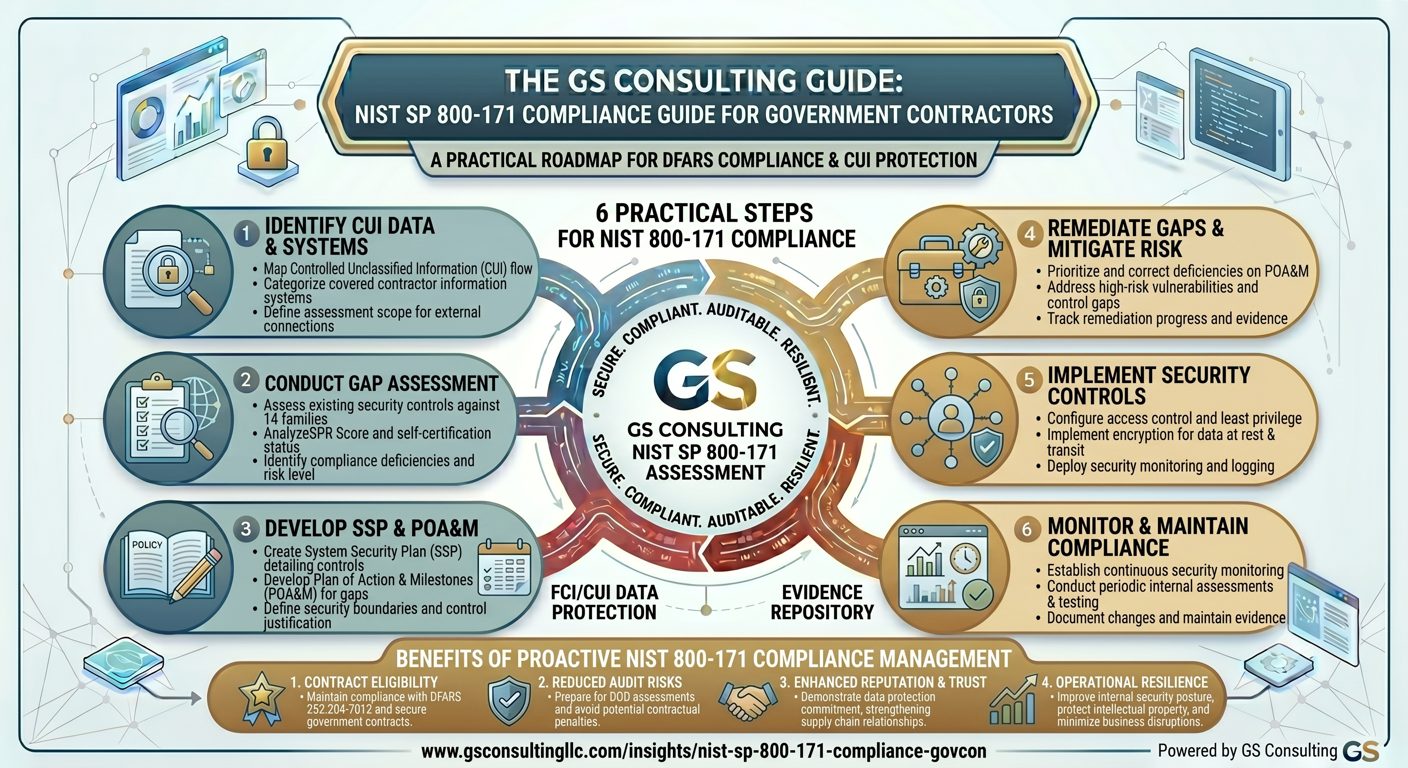
NIST SP 800-171 compliance is not achieved by buying a tool. It requires a functioning cybersecurity management system.
A contractor needs to know its assets, users, data flows, security boundary, cloud services, external service providers, policies, technical controls, evidence, and remediation plan. The company also needs leadership involvement because cybersecurity claims may be submitted to customers, primes, assessors, or government systems.
1. CUI Identification and Data Mapping
The first step is identifying whether the company handles CUI. Contractors should review contracts, task orders, attachments, CDRLs, DD Form 254s where applicable, customer markings, agency guidance, CUI category references, prime flow-downs, and internal work products.
Once CUI is identified, contractors should map where it goes. This should include email, file shares, Microsoft 365 or Google Workspace, engineering repositories, ticketing systems, endpoint devices, collaboration tools, CRM systems, proposal repositories, backup systems, AI tools, cloud platforms, managed service providers, and subcontractor environments.
- Where CUI is received, stored, processed, and transmitted.
- Who has access and which external providers touch it.
- How it is protected, archived, and destroyed.
- Which systems protect the CUI environment.
2. System Security Plan
The System Security Plan, or SSP, is the central document that explains how the contractor protects CUI. It should describe the system boundary, architecture, assets, users, data flows, external services, inherited controls, and implementation of each requirement. Our NIST SSP guide shows how to build those sections in the order an assessment can review them.
The SSP cannot be generic. It needs to match the real environment. An outdated SSP is a serious risk because leadership may be making inaccurate compliance claims if the document does not match current architecture, tools, cloud services, or data flows.
3. Policies, Procedures, and Actual Implementation
Policies are necessary, but they are not enough. Assessors and customers care whether controls are actually implemented.
A company may have an access control policy, but that does not prove accounts are reviewed. It may have an incident response plan, but that does not prove the team can execute it. It may have a vulnerability management policy, but that does not prove scans are run, tickets are tracked, and remediation happens.
Evidence should show that controls are operating, not just described in policy.
Evidence should be current, organized, and mapped to the applicable requirement.
4. SPRS Score and DoD Assessment Readiness
For DoD contractors, NIST SP 800-171 readiness often connects to the Supplier Performance Risk System, or SPRS. Contractors should not submit or rely on a score based on assumptions, outdated documentation, or a generic template.
- Which SSP the score is tied to.
- Which CAGE codes are included.
- Which system boundary was assessed.
- Which version of NIST SP 800-171 was used.
- What evidence supports the score.
- Which gaps remain and whether completion dates are realistic.
5. Cloud, SaaS, MSP, and AI Tool Review
Many NIST SP 800-171 problems come from external services. Contractors may have strong internal controls but still create risk through unreviewed cloud platforms, file-sharing tools, managed service providers, ticketing systems, AI tools, transcription tools, or browser extensions.
If those tools touch CUI or protect systems that contain CUI, they may affect the compliance boundary. Contractors should document tool name, vendor, data types processed, hosting environment, access controls, logging, retention, data training terms, incident obligations, FedRAMP status where applicable, customer responsibility matrix, and CUI approval status.
6. Continuous Monitoring and Remediation
NIST SP 800-171 compliance is not a one-time project. Systems change. Contracts change. Tools change. Users change. Threats change. Cloud providers update services. AI vendors update models. Subcontractors change workflows.
A practical compliance rhythm should include recurring access reviews, vulnerability scans, log reviews, endpoint checks, training updates, incident response exercises, SSP updates, cloud provider reviews, subcontractor reviews, AI tool reviews, and leadership reporting.
The Leadership View of the NIST SP 800-171 Families
Leaders do not need to memorize every requirement, but they should understand the major control areas. From a leadership perspective, the requirements answer practical business questions.
This is why NIST SP 800-171 cannot be delegated entirely to IT. It requires coordination among leadership, contracts, operations, security, HR, legal, finance, program management, business development, subcontract management, and external providers.
Common NIST SP 800-171 Mistakes
The first mistake is assuming the company does not have CUI because documents are not clearly marked. If there is uncertainty, contractors should review the contract, customer instructions, CUI Registry categories, and ask the government contracting activity for clarification.
The second mistake is treating the SSP as a template exercise. A generic SSP that does not describe the real system is not useful for assessment, remediation, or leadership decision-making.
The third mistake is failing to control cloud and SaaS tools. CUI often leaks into unapproved file-sharing platforms, ticketing systems, AI tools, meeting transcription tools, and personal productivity applications.
The fourth mistake is submitting or relying on an outdated SPRS score. If the score does not reflect the current system boundary, it may create proposal, audit, and customer trust risk.
The fifth mistake is assuming CMMC preparation and NIST SP 800-171 implementation are separate projects. For DoD contractors handling CUI, they are tightly connected.
Where AI Can Help NIST SP 800-171 Compliance
AI can become a major differentiator in NIST SP 800-171 compliance when it is used carefully. AI-enabled workflows can help contractors organize evidence, summarize policy gaps, compare SSP language to implemented controls, triage security alerts, analyze vulnerability trends, flag unusual access patterns, and prepare leadership dashboards.
But AI must be governed. If the AI tool processes CUI, security logs, vulnerability data, network diagrams, SSPs, incident data, or customer-sensitive information, it may create additional compliance risk. The same data protection questions apply: what does the tool touch, where does it store information, who can access it, whether prompts and outputs are retained, and whether data can be used to train models.
- Public Data AIPublic research and non-sensitive drafting.
Use for public research, training content, and general planning where no CUI or restricted data is involved.
- Internal Business AIControlled company workflows.
Use for internal business operations, excluding CUI unless specifically reviewed and approved.
- CUI-Capable AIApproved controlled environments.
Use only where hosting, access, logging, retention, incident response, and contract requirements support CUI use.
A Practical NIST SP 800-171 Readiness Package
Every GovCon company that handles CUI should build a readiness package before the next customer request. The goal is not to create paperwork. The goal is to make cybersecurity compliance visible, defensible, and repeatable.
- Contract clause inventory and CUI data map.
- System boundary diagram and asset inventory.
- Current SSP, control implementation matrix, and POA&M where applicable.
- Policies, procedures, and evidence mapped to requirements.
- SPRS score support documentation.
- Cloud and external service provider review records.
- Subcontractor flow-down documentation.
- Incident response procedures and AI tool governance rules.
- Leadership review and affirmation process.
A 90-Day NIST SP 800-171 Action Plan
- Days 1-30Discover contracts, CUI, systems, and providers.
Identify contracts, clauses, CUI categories, CAGE codes, systems, users, cloud tools, AI tools, subcontractors, external service providers, and existing documentation.
- Days 31-60Define scope and assess gaps.
Build or update the SSP, data flow map, asset inventory, network diagram, cloud responsibility matrix, evidence repository, and SPRS review.
- Days 61-90Remediate and operationalize compliance.
Prioritize access control, MFA, logging, vulnerability management, endpoint protection, incident response, cloud configuration, CUI storage, AI restrictions, and subcontractor flow-downs.
By the end of 90 days, leadership should be able to answer: Do we handle CUI? Where does it live? Which systems are in scope? What version and requirements apply? What is our current SPRS posture? What evidence supports our compliance? What gaps remain? Who owns remediation? Which cloud, SaaS, MSP, and AI tools touch CUI?
The Bottom Line
NIST SP 800-171 compliance is not just a cybersecurity task. It is a GovCon growth requirement.
Contractors that understand their CUI, define their system boundary, maintain a current SSP, manage SPRS accurately, control cloud and AI tools, prepare evidence, and operate a continuous compliance program will be better positioned to compete for DoD and federal work.
GS Consulting helps government contractors assess NIST SP 800-171 readiness, map CUI, review DFARS and CMMC requirements, build SSPs and POA&Ms, evaluate cloud and AI tool risk, prepare evidence packages, and create practical remediation roadmaps aligned to contract requirements.
Ready to understand your NIST SP 800-171 compliance posture?
Contact GS Consulting for a GovCon Cybersecurity & NIST Readiness Assessment.
Contact GS ConsultingFrequently Asked Questions About NIST SP 800-171
What is the difference between NIST SP 800-171 Rev. 2 and Rev. 3?
Revision 3 updates requirements to align more closely with NIST SP 800-53 Rev. 5, introduces organization-defined parameters that force contractors to set specific operational thresholds, and restructures several control families. However, the current CMMC Level 2 baseline remains anchored to Revision 2.
Does NIST SP 800-171 apply to my entire company network?
Not necessarily. It applies to covered contractor information systems that process, store, or transmit Controlled Unclassified Information, as well as systems that provide security protection for those assets. Proper CUI data flow mapping and network segmentation can significantly reduce the assessment boundary.
What is a NIST SP 800-171 DoD Assessment Score in SPRS?
Under DFARS clauses 252.204-7019 and 252.204-7020, DoD contractors must calculate a score reflecting their implementation of the 110 NIST SP 800-171 requirements and post summary-level assessment information to the Supplier Performance Risk System before contract award when required.
Sources and Suggested Future Reading
- NIST CSRC: SP 800-171 Rev. 3, Protecting Controlled Unclassified Information
- NIST SP 800-171A Rev. 3: Assessing Security Requirements for CUI
- DoD CIO: CMMC Program Information
- Acquisition.gov: DFARS 252.204-7012 Safeguarding Covered Defense Information and Cyber Incident Reporting
- Acquisition.gov: DFARS 252.204-7020 NIST SP 800-171 DoD Assessment Requirements
- NIST 800-171 & CUI hub
- NIST SP 800-171 Explained: Requirements, Controls, and Compliance
- GovCon Cybersecurity & Compliance Hub: CMMC, NIST, CUI, Cloud, and AI-Enabled Readiness
- CMMC Readiness Checklist for Small and Mid-Sized Government Contractors
- Mapping AI Automations to NIST SP 800-171 Controls
- How DoD Contractors Can Use AI Without Putting CUI at Risk
- AI Disclosure in Federal Contracts: What GovCon Firms Should Prepare For
- How to Build a CUI Data Flow Map for CMMC
- CMMC Compliance hub
- CMMC Compliance: The Complete Guide for Defense Contractors