Cybersecurity | | 25 min read
NIST 800-171 Access Control: A Practical Implementation Guide

Key Takeaways
Access Control has to connect the decision to the enforced result
Sixteen requirements form one operating system
Accounts, privilege, sessions, remote access, wireless, mobile devices, external systems, and public content are connected. A gap in one path can defeat a clean identity configuration elsewhere.
Account Management carries the largest proof load
It scores 98.0 in the GS model because it combines twenty two assessment statements, six parameter decisions, broad system reach, and recurring lifecycle evidence.
Test allowed and denied behavior
A successful logon proves only that one path works. Access proof also has to show that blocked users, stale accounts, forbidden flows, and unapproved remote paths fail as designed.
NIST 800-171 Access Control is not an identity tool setting. It is the operating system for who can reach CUI, what they can do, where the data can move, and how the contractor proves every decision.
A clean directory does not settle the question. Access can also live in an application role, a local administrator account, a cloud console, a remote support tool, a service account, a wireless network, a mobile device, or an external system. If the review sees only the identity provider, it sees only part of the control.
The practical standard is direct: define the authorization, enforce it everywhere that matters, review effective access, remove stale rights, and test both the allowed and denied result.
For the current CMMC Level 2 Revision 2 objective set, use the CMMC Access Control evidence guide to map all 22 requirements to current source records, interviews, and repeatable allowed and denied tests.
The NIST 800-171 and CUI Security hub connects this guide to the full program. Use the Revision 2 and Revision 3 comparison before changing the baseline, the Identification and Authentication guide to connect identity lifecycle and authenticators to access, the NIST assessment guide to design proof, and the system security plan guide to document the implementation. GS Consulting applies the same discipline through secure AI automation.
Authorization also depends on the surrounding state. The Media Protection guide follows access decisions onto paper, devices, backups, and transported copies. The Configuration Management guide connects privileged change, approved settings, software, and drift to the same access record.
Make every access decision visible.
GS Consulting helps contractors map CUI access, set parameter decisions, repair privilege drift, automate review evidence, and test the real enforcement path.
Plan the Access ReviewNIST 800-171 Access Control: The Short Answer
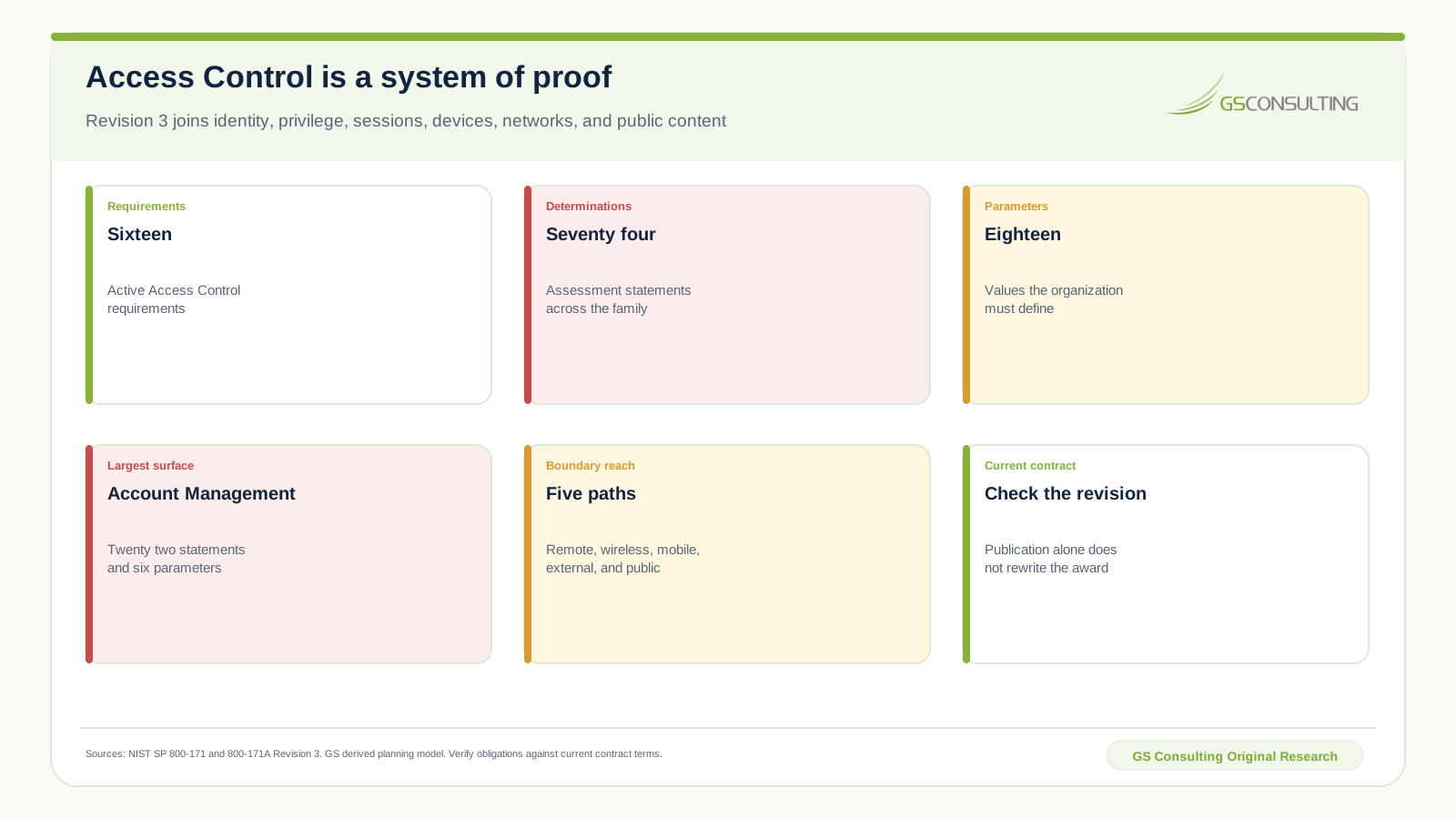
NIST SP 800-171 Revision 3 contains sixteen active requirements in the Access Control family. They cover Account Management through Publicly Accessible Content. The family reaches identity, applications, networks, endpoints, remote services, providers, and the CUI boundary.
GS counted seventy four determination statements and eighteen organization defined parameters in the official NIST SP 800-171A Revision 3 assessment procedures. The count matters because one requirement name can hide many separate decisions and tests. Account Management alone contains twenty two determination statements and six parameter decisions.
Implementation needs five connected records: the access decision, the enforcement point, the current effective right, the review action, and the test result. If one is missing, the team has a claim rather than complete proof.
Let the Contract Set the Revision
NIST publication does not rewrite an award by itself. The current DFARS 252.204-7012 clause refers to the NIST publication in effect when the solicitation was issued or a version authorized by the contracting officer. The actual solicitation, contract, subcontract, modifications, and customer direction determine the baseline.
Current DoD timing adds another layer. As of August 6, 2026, the DoD CMMC program page says Phase II is suspended while Phase I self assessments continue, and its Level 2 description still uses the 110 Revision 2 requirements. That pause does not remove a live safeguarding or assessment duty already present in an award.
Keep one applicability record. Name the award, clause, required publication, revision, system, information, customer direction, due date, and decision owner. Treat Revision 3 preparation as preparation until the governing source makes it an obligation.
The Sixteen Access Control Requirements
| Requirement | Operating question | Proof to expect |
|---|---|---|
| 03.01.01 Account Management | Which accounts may exist, who owns them, and what triggers action? | Inventory, approval, lifecycle events, review, disablement, and removal |
| 03.01.02 Access Enforcement | Do systems enforce approved logical rights to CUI and resources? | Authorization map, configuration, effective access report, and test |
| 03.01.03 Information Flow Enforcement | Can CUI move only through approved internal and connected paths? | Data flow, rule set, interface approval, blocked path test, and logs |
| 03.01.04 Separation of Duties | Which duties must remain divided and how is that enforced? | Duty matrix, role design, approvals, exception, and conflict test |
| 03.01.05 Least Privilege | Does each person, service, and process have only needed access? | Role basis, entitlement review, privilege record, removal, and test |
| 03.01.06 Privileged Accounts | Are privileged accounts limited to approved roles? | Privileged inventory, owner, approval, use record, and review |
| 03.01.07 Privileged Functions | Can ordinary users execute privileged functions or see sensitive output? | Function restriction, denied test, log, alert, and exception |
| 03.01.08 Unsuccessful Logon Attempts | What limit and response apply to failed logons? | Approved values, configuration, alert, lock behavior, and test |
| 03.01.09 System Use Notification | Does the user see the approved notice before access? | Approved text, deployed screen, affected systems, and test |
| 03.01.10 Device Lock | When does a device lock and what hides on the display? | Approved values, policy, configuration, endpoint report, and test |
| 03.01.11 Session Termination | Which conditions end a session automatically? | Trigger decision, configuration, session log, and test |
| 03.01.12 Remote Access | Which remote paths are allowed, monitored, routed, and privileged? | Remote inventory, approval, route, encryption, logs, and test |
| 03.01.16 Wireless Access | Which wireless connections are approved and protected? | Wireless inventory, approval, authentication, scan, and test |
| 03.01.18 Mobile Device Access | Which mobile devices can handle CUI and under what restrictions? | Device inventory, approval, configuration, container, and test |
| 03.01.20 External Systems | When may an outside system handle CUI or connect to the environment? | Terms, security conditions, approval, connection record, and review |
| 03.01.22 Publicly Accessible Content | Who may publish and how is accidental CUI exposure corrected? | Publisher list, review, scan, removal record, and notification |
Revision 3 withdraws several former Access Control identifiers because outcomes moved or were incorporated elsewhere. Do not read a missing number as permission to discard the underlying behavior. Use the official mapping, preserve the destination, and update the evidence index.
GS Access Control Proof Load Index
GS Consulting built a derived planning model across the sixteen active Revision 3 Access Control requirements. The two public inputs are the NIST SP 800-171A determination statement count and organization defined parameter count for each requirement. The model adds four one to five analyst ratings for cross system reach, recurring evidence demand, privilege impact, and boundary dependency.
The base model weights determination count at 20 percent, parameter count at 10 percent, cross system reach at 25 percent, recurring evidence at 20 percent, privilege impact at 15 percent, and boundary dependency at 10 percent. Counts are divided by the family maximums of twenty two statements and six parameters. The sensitivity case shifts five points from statement count to privilege impact.
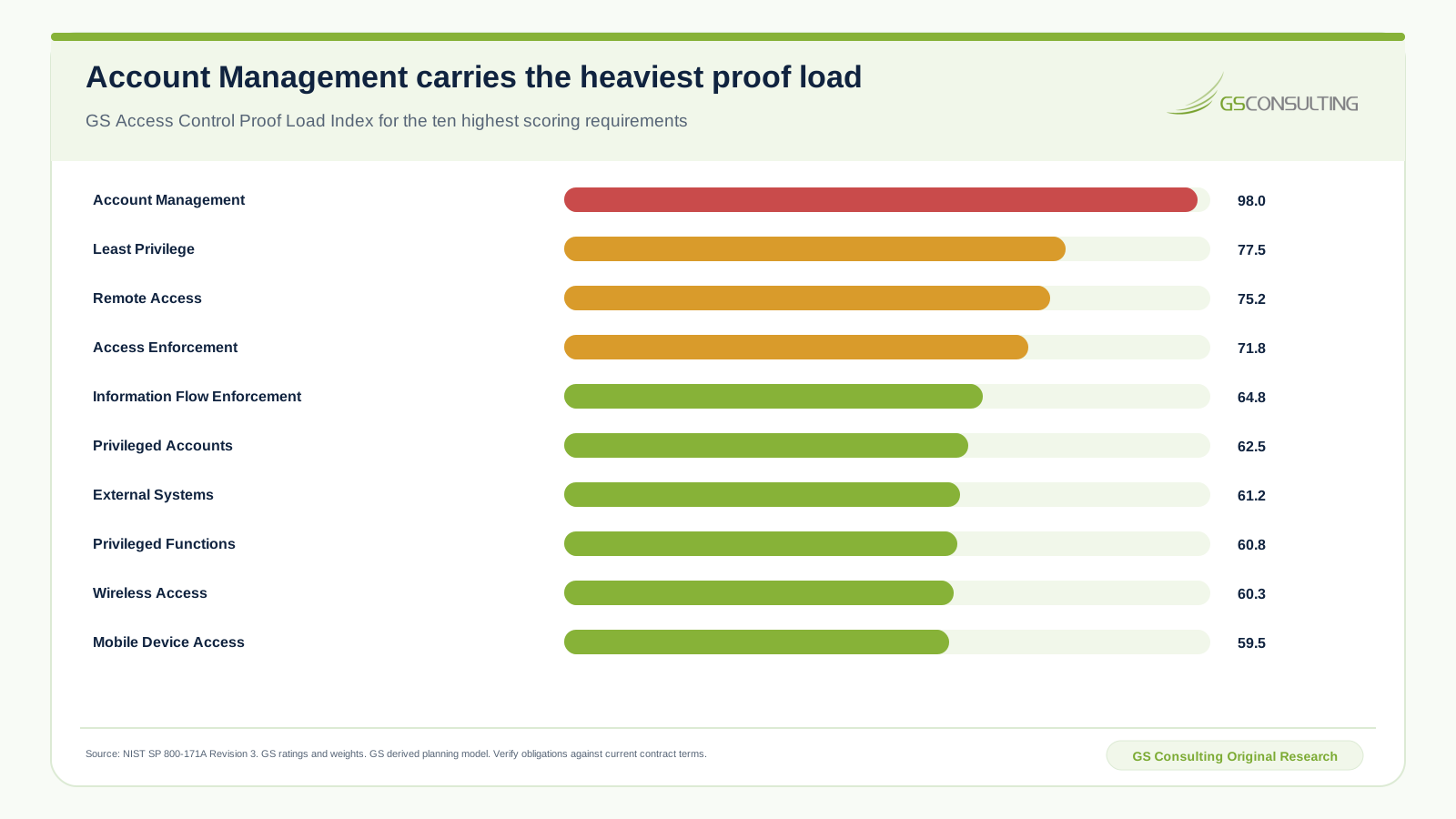
Account Management scores 98.0. Least Privilege scores 77.5. Remote Access scores 75.2. Access Enforcement scores 71.8, and Information Flow Enforcement scores 64.8. Account Management stands apart because it combines the largest formal assessment surface with broad lifecycle and system reach.
The result does not measure security importance or predict an assessment result. A weak Publicly Accessible Content process can still disclose CUI. The index estimates proof coordination load so a contractor can sequence owners, records, tests, and automation.
The sensitivity case keeps the same top three. No score moves by more than five points. The stable operating conclusion is to build the account lifecycle first, then privilege and remote access, while keeping enforcement and information flow tied to the same authorization model.
This is a GS Consulting derived planning model, not a NIST score or compliance determination. The source register, public observations, ratings, formulas, sensitivity analysis, workbook, figure data, and editable SVGs are preserved in the article research package.
Build One Account Lifecycle
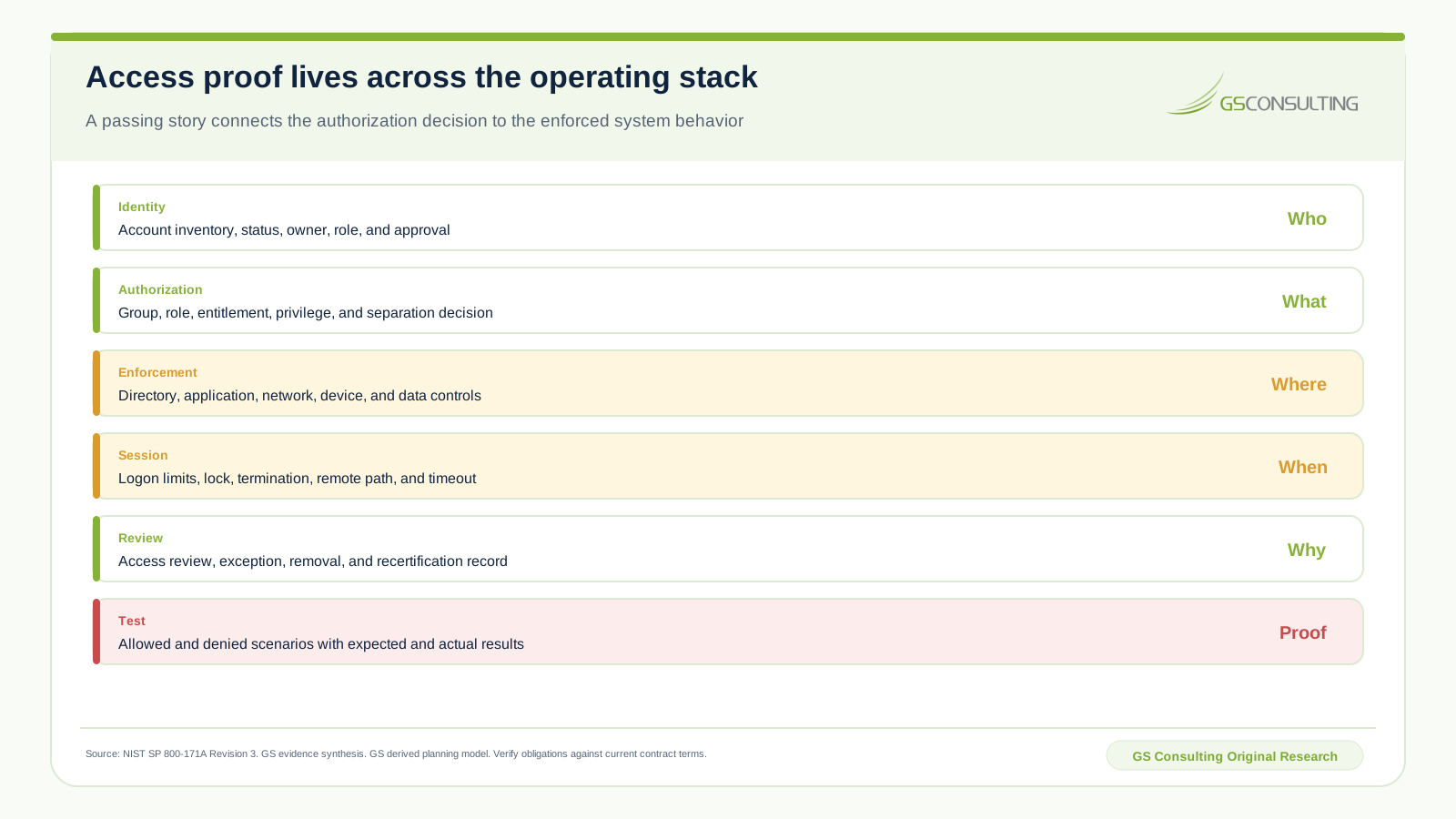
Start with an account inventory that covers people, administrators, service accounts, devices, applications, local accounts, emergency access, vendor access, and other nonperson identities. Each row needs a current owner, purpose, system, type, status, privilege, approval, review date, and removal trigger.
Joiner work should begin from an approved role and named system need. Mover work should remove old rights before or with new rights. Leaver work should identify every enforcing system, not only the central directory. A disabled identity can leave a live application token, local account, cloud role, remote credential, or shared secret behind.
Use event records to prove the cycle. An access ticket should show the request, business basis, system, role, approver, separation check, provisioned right, verification, date, and operator. A removal record should show the trigger, every affected system, completion time, verification, exception, and approval.
Review effective access, not only group membership. Nested groups, inherited rights, direct grants, local roles, provider consoles, and application logic can create an authorization that the identity record does not show.
Control Privilege, Separation, and Information Flow Together
Least privilege is an operating decision. A role name does not prove that the rights are necessary. Record the task, data, function, system, duration, approver, and reason for every elevated right. Remove privilege when the task, project, support window, or role ends.
Separate ordinary activity from privileged activity where the implementation requires it. Administrative accounts should not become the daily path for email, browsing, document work, or collaboration. Service accounts need owners, bounded functions, protected credentials, review, logging, and a replacement plan when ownership changes.
Separation of duties belongs in the same model. Identify conflicting actions such as requesting and approving access, changing and reviewing a security setting, creating and releasing public content, or developing and deploying code. Then test whether the system prevents or detects the conflict.
Information flow enforcement asks a different question from user access: even when a user is authorized, can CUI move only through approved paths? Map internal zones, cloud connections, email, file transfer, application interfaces, print, removable media, remote sessions, and provider exchanges. Test a blocked path. A diagram without a denied result is incomplete.
Treat Remote, Wireless, Mobile, External, and Public Paths as Boundary Controls
Remote access: inventory every path, including support tools and provider consoles. Record approval, entry point, encryption, authentication, route, privileged handling, session logging, monitoring, termination, and exception. One unmanaged support path can bypass an otherwise sound design.
Wireless access: name approved networks and devices, the authentication method, encryption, segmentation, configuration owner, discovery method, and response to an unapproved connection. Guest wireless near the CUI environment needs an explicit separation basis.
Mobile devices: decide whether a device may process, store, or transmit CUI. Then enforce the approved container, local storage rule, encryption, screen lock, application list, remote action, backup, transfer, and disposal behavior. A management enrollment record is not proof that CUI cannot escape the approved path.
External systems: define the security conditions before allowing CUI or a connection. Record the system owner, purpose, agreement, authorization, controls, data, duration, evidence access, incident contact, review, and removal. Provider marketing language is not a responsibility matrix.
Public content: limit publishers, require review before release, search public locations for exposed CUI, remove improper content, notify the right roles, and preserve the record. This is access control at the last boundary, not a communications task detached from security.
A Five Stage Access Control Implementation Path
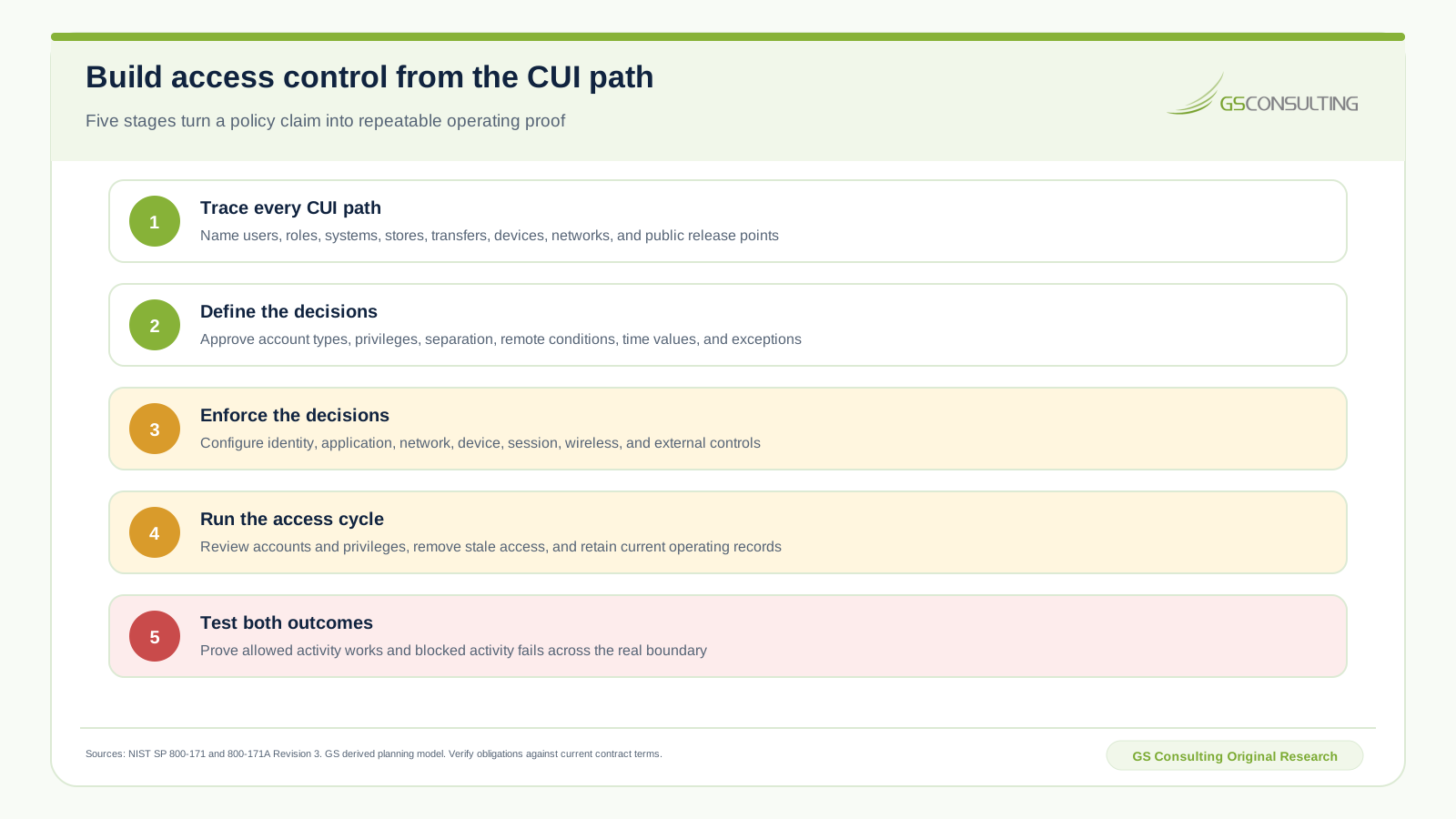
- Trace every CUI path. Name users, roles, applications, stores, devices, networks, remote routes, transfers, providers, and public release points.
- Define the decisions. Approve account types, role rights, separation, privilege, remote conditions, time values, device rules, external terms, and exceptions.
- Enforce the decisions. Configure the identity source, application, network, endpoint, session, wireless, mobile, remote, and external controls that implement the rule.
- Run the access cycle. Process joiners, movers, leavers, privilege grants, reviews, exceptions, alerts, and removals through accountable records.
- Test both outcomes. Show that approved use succeeds and forbidden use fails across the real boundary. Record the setup, expected result, actual result, capture, defect, and retest.
Six Access Control Failures to Stop
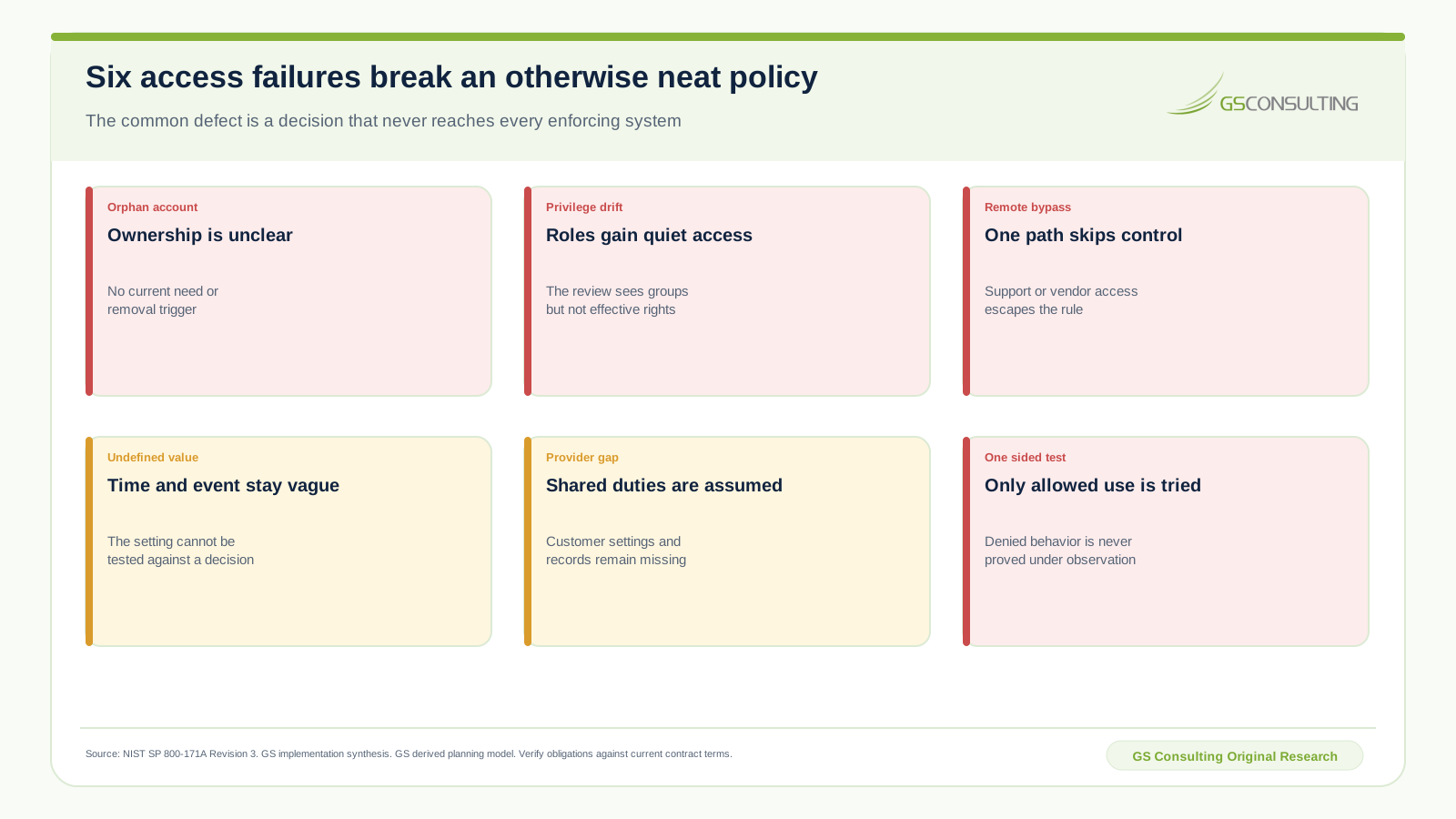
Orphan account. The account has no current owner, business need, review, or removal trigger.
Privilege drift. Nested groups, direct grants, temporary rights, or application roles create access that the formal role no longer explains.
Remote bypass. A vendor, support, emergency, or alternate remote path avoids the normal entry control and logging.
Undefined value. A time, event, condition, or scope remains vague, so policy, configuration, and assessment use different criteria.
Provider gap. A service performs part of the control, but customer configuration, records, review access, exceptions, and assessment support remain unclear.
One sided test. The team proves that an approved user can enter but never demonstrates that a forbidden user, path, function, or flow is blocked.
A Practical 60 Day Access Control Plan
Days 1 through 10: confirm the governing revision, map the CUI boundary, inventory access paths, list every identity and account type, and assign owners for all sixteen requirements.
Days 11 through 20: create the parameter register, role and privilege model, separation matrix, remote inventory, mobile decision, external system register, and public release process.
Days 21 through 35: reconcile effective rights across directories, applications, local accounts, cloud roles, network devices, remote tools, and provider consoles. Remove obvious stale rights and document exceptions.
Days 36 through 48: update procedures and configurations, connect joiner and leaver triggers, schedule reviews, improve log coverage, and make every provider duty explicit.
Days 49 through 60: run allowed and denied tests for account, privilege, flow, logon, lock, session, remote, wireless, mobile, external, and public content scenarios. Fix defects and issue a signed access decision with remaining work.
Sixty days is a control sequence, not a promise that a complex environment can close every access defect in two months. Provider changes, architecture work, data flow changes, and contract decisions need their real implementation time.
The Minimum Access Control Evidence Packet
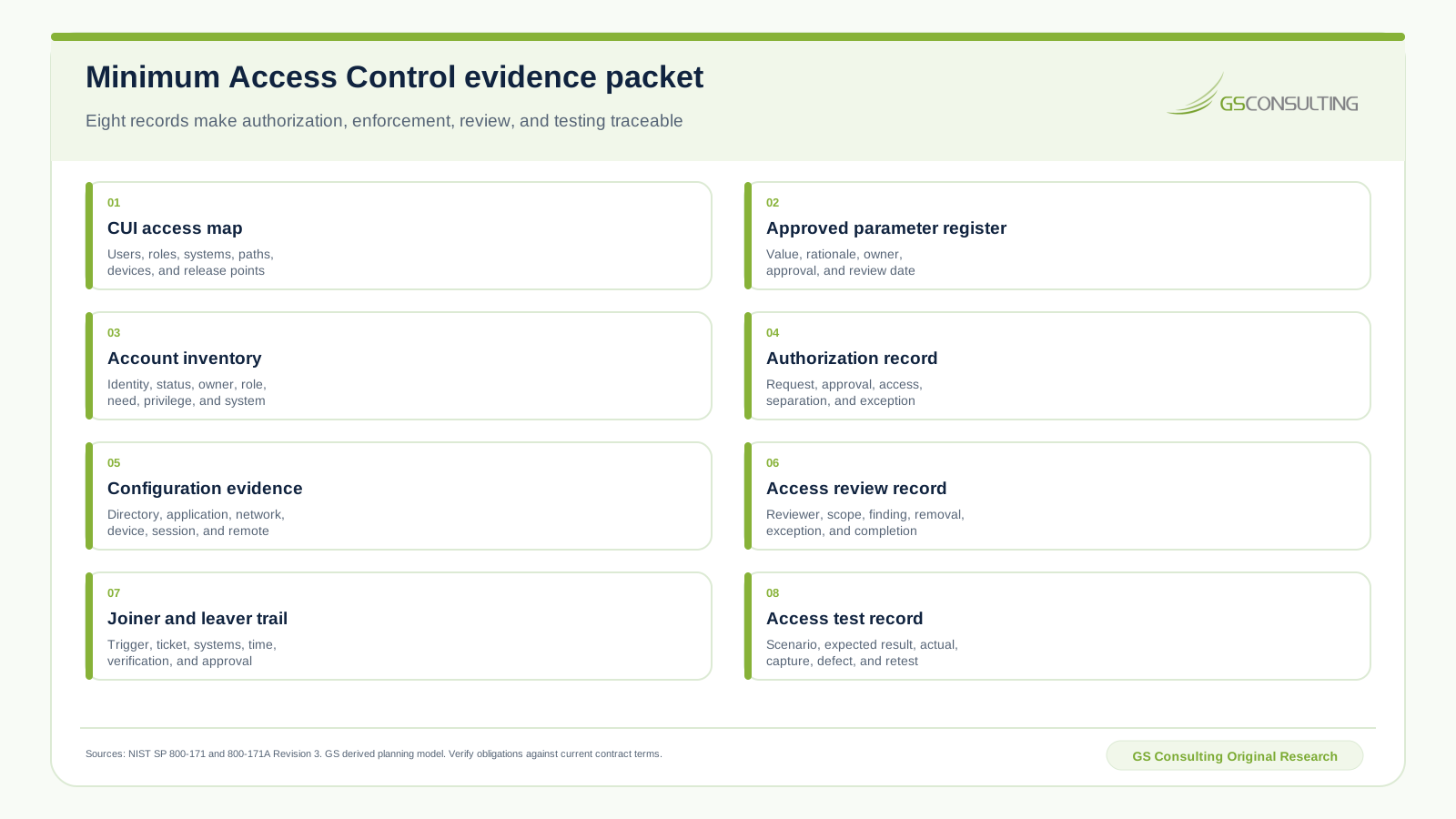
- CUI access map: users, roles, applications, systems, devices, networks, stores, transfers, remote paths, providers, and release points.
- Approved parameter register: requirement, value, unit, event, rationale, scope, owner, approver, date, evidence, and review trigger.
- Account inventory: identity, account, type, system, status, owner, purpose, role, privilege, approval, review, and removal trigger.
- Authorization record: request, business need, role, system, separation check, approver, effective right, date, and exception.
- Configuration evidence: identity, application, network, endpoint, session, wireless, mobile, remote, and external settings tied to the approved rule.
- Access review record: scope, effective right, reviewer, finding, removal, exception, completion, and approval.
- Joiner and leaver trail: trigger, ticket, affected systems, operator, completion time, verification, exception, and approval.
- Access test record: scenario, setup, expected result, actual result, capture, defect, action, retest, and approval.
Research Method and Sources
The research package separates public observations from GS analyst assumptions. It includes the source register, public signal table, model inputs, derived scores, sensitivity analysis, data dictionary, figure data, methodology, workbook, PNG renders, and editable SVG figures.
- NIST SP 800-171 Revision 3
- NIST SP 800-171A Revision 3
- NIST Protecting CUI Publications
- DFARS 252.204-7012
- DoD CMMC Program Information
GS Consulting Original Research. The GS Access Control Proof Load Index is a derived planning tool based on cited public sources and documented assumptions. It is not a NIST score, legal advice, contract interpretation, assessment result, security approval, or compliance determination. Verify obligations and timing against current contract terms and agency direction.
Frequently Asked Questions
What is NIST 800-171 Access Control?
NIST SP 800-171 Access Control is the requirement family that governs accounts, logical authorization, information flow, separation of duties, least privilege, logon behavior, sessions, remote and wireless access, mobile devices, external systems, and publicly accessible content for systems that process, store, transmit, or protect CUI.
How many Access Control requirements are in NIST 800-171 Rev 3?
Revision 3 contains sixteen active Access Control requirements. GS counted seventy four determination statements and eighteen organization defined parameters in the official NIST SP 800-171A Revision 3 assessment procedures for those requirements.
What evidence proves NIST 800-171 Access Control?
Useful evidence includes the CUI access map, approved parameter register, account inventory, authorization records, effective privilege reports, configuration exports, access reviews, joiner and leaver records, remote access records, exceptions, and tests that demonstrate both allowed and denied behavior.
Does an identity provider satisfy Access Control by itself?
No. An identity provider can support authentication, groups, and account lifecycle, but effective access can also exist in applications, local accounts, network devices, cloud roles, remote tools, service accounts, shared resources, and provider consoles. The contractor has to prove the complete authorization and enforcement path.
How often should access be reviewed?
Use the frequency required by the applicable requirement, approved organization defined parameter, contract, risk decision, or company policy. Also review access after role changes, termination, provider changes, boundary changes, privilege grants, and other events that can make authorization stale.
Does CMMC currently use NIST 800-171 Rev 3 Access Control?
Current DoD CMMC materials still describe Level 2 against the 110 requirements in NIST SP 800-171 Revision 2. Contractors should verify the exact publication and revision required by the current solicitation, contract, subcontract, customer direction, and assessment path before treating Revision 3 as the governing baseline.
Related Reading
- NIST 800-171 and CUI Security Hub
- NIST SP 800-171 Explained
- NIST 800-171 Revision 2 and Revision 3 Comparison
- NIST SP 800-171A Assessment Guide
- NIST 800-171 Incident Response Guide
- Automating NIST 800-171 Evidence
- Secure AI Automation
Operate access as one evidence system.
The standard is decisive: name every identity and path, approve every right, enforce every decision, review effective access, remove stale privilege, and prove both the allowed and denied result.
Build the Access Evidence