Enterprise AI Strategy | | 24 min read
Managing AI Vendor Risk in Regulated Industries

Key Takeaways
You are not buying an AI feature. You are buying a set of data terms.
The demo is not the product
A polished interface tells you almost nothing about retention, training use, model chains, data residency, or evidence. The contract does.
Data terms beat feature lists
The risk that matters is whether your inputs are retained, trained on, sent through undisclosed processors, or stored outside your authorized boundary.
Buy with evidence
A signed data processing agreement, no training clause, audit rights, attestations, deletion terms, and review cadence turn a sales promise into something defensible.
The AI vendor problem is not that the tool might be insecure.
It is that the tool can look completely secure and still be a problem.
A vendor gives a clean demo. The interface is fast. The security page lists encryption, SSO, and a SOC 2 badge. Procurement feels comfortable. Security sees familiar control language. The tool gets approved.
Then the problem shows up in the terms. The vendor reserves the right to use inputs to improve its services. Your contract drafts, engineering notes, case files, CUI adjacent documents, or internal operating data can become training material for a model you do not control.
That is the real shape of AI vendor risk management. It is not mostly a question of whether the vendor encrypts data in transit. It is a question of what the vendor is contractually allowed to do with your data once it arrives.
For regulated organizations, that distinction is the whole game. You can be fully encrypted and still be out of bounds because your data left the boundary, got retained indefinitely, or was used to train a shared model.
Need to audit an AI vendor before you sign?
GS Consulting helps CISOs, procurement leaders, and compliance teams evaluate AI vendors: reading the data terms, mapping processor chains, verifying FedRAMP and CUI boundaries, demanding evidence, and negotiating no training and audit clauses before the contract is signed.
Request an AI Vendor AuditThe Point of AI Vendor Risk Management
AI vendor risk management should answer one question:
When this third party AI tool processes our data, what is it actually allowed to do with it, and can we prove that?
Everything else is detail. Encryption matters. Access controls matter. Uptime matters. But for regulated organizations, the controlling question is data control: retention, training use, processor chains, residency, deletion, and audit evidence.
The reason this gets missed is simple. Traditional vendor reviews were built for software that stores your data. AI tools do something different. They read your data, reason over it, generate new outputs, and in many cases retain it or learn from it. A questionnaire designed for a file sharing app will not catch that.
Where Third Party AI Risk Actually Lives
Third party AI risk concentrates in a few places, and almost none of them show up in a demo.
The first is training use. If your inputs and outputs are used to train or improve the vendor's models, your proprietary data is now part of a system you do not control. You cannot get it back, and you cannot guarantee it will not influence another customer's output later.
The second is retention. Many AI tools retain prompts and outputs by default, sometimes for trust and safety, sometimes for debugging, sometimes with no clear end date. Retention you did not approve is data exposure you did not plan for.
The third is the processor chain. The vendor you signed with often is not the company running the model. A SaaS product may call a model provider, which runs on a cloud host, which uses its own processors. Your data can travel further than the sales deck implies.
The fourth is the boundary. For CUI, FedRAMP, data residency, privacy, and contract obligations, where the data physically and logically goes is a compliance fact. An AI feature that routes data to a general purpose endpoint can quietly move it outside the authorized path.
Original Research: The AI Vendor Due Diligence Burden Index
GS Consulting original research shows that AI vendor risk is a data terms problem, not a security badge problem.
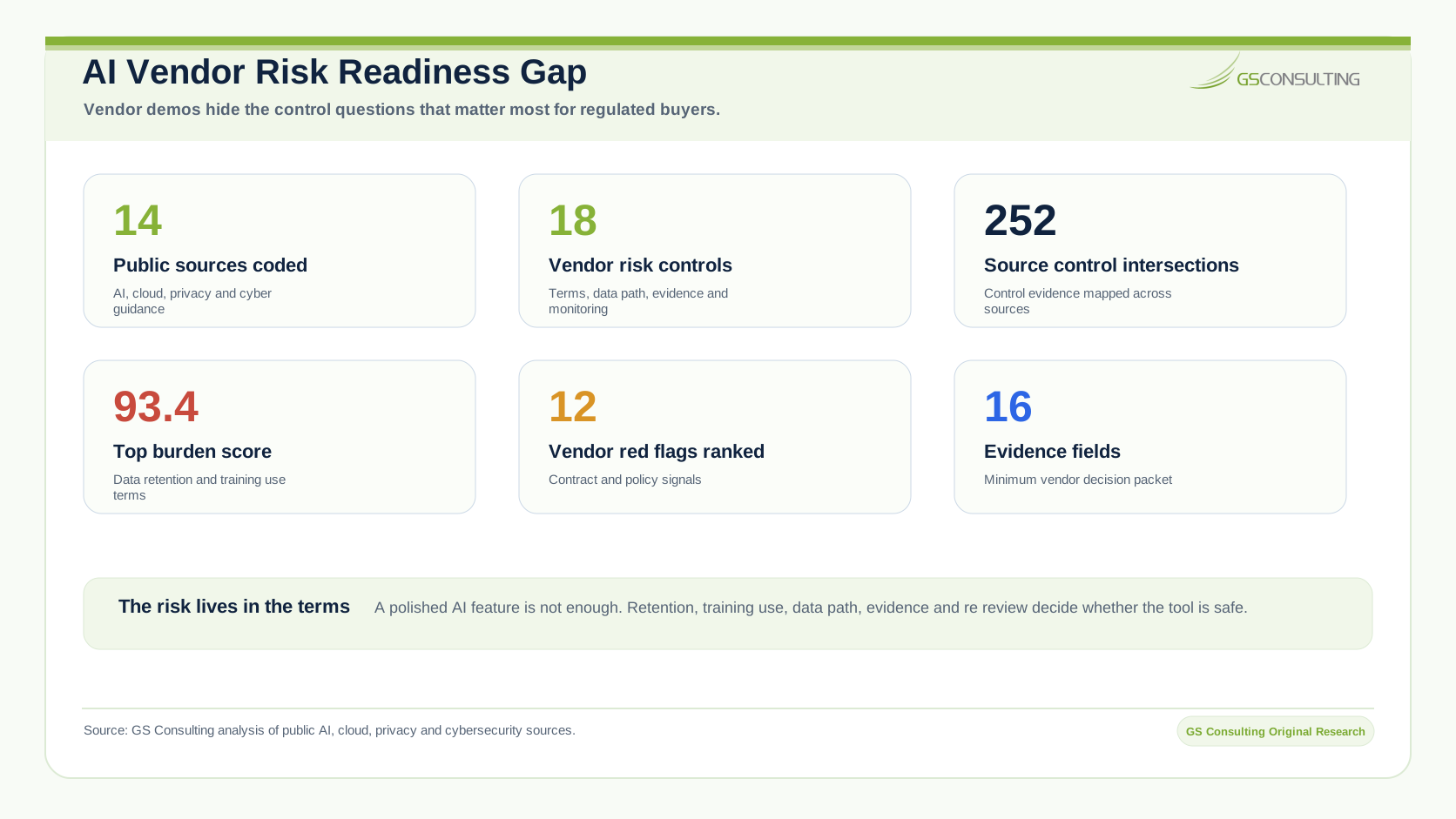
GS Consulting coded 14 public AI, cloud, privacy, and cybersecurity sources against 18 vendor risk controls, producing 252 source control intersections, and scored where the evidence burden concentrates. The heaviest burden sits in the data terms: retention and training use, the processor and model chain, data residency and the CUI boundary, and contractual deletion. The lighter burden sits where vendors are usually prepared to show evidence: uptime, encryption, and incident response.
The pattern is consistent. The controls that are hardest to verify, and most likely to be skipped, are exactly the ones that decide whether your data stays yours. A vendor will gladly send you a SOC 2 report. Getting a clear contractual answer on training use and retention takes real work.

The Vendor Due Diligence Burden Index, Vendor Risk Gate Index, red flag model, and evidence packet are GS Consulting derived planning tools. They are not official NIST, ISO, FedRAMP, CISA, CSA, OWASP, legal, audit, or certification determinations.
The Wrong Way to Buy AI Software
The wrong approach is familiar because many organizations are doing it right now.
A business team finds an AI tool that solves a real problem. They run a trial with real data. The trial works. Procurement runs the standard checklist. Security confirms encryption and SSO. The contract uses the vendor's standard terms. The tool is approved.
Nobody asked whether the trial data was retained. Nobody asked whether it was used for training. Nobody mapped the processor chain. Nobody checked whether the data left the authorized boundary. The review measured the things that were easy to measure and skipped the things that carry the real risk.
That is how a regulated organization ends up with a clean approval trail for a flawed decision.
The Vendor Risks That Actually Bite
Not every vendor risk is equal. Some are inconvenient. A few can trigger a breach response, create a contract issue, or put a federal obligation in jeopardy. Those are the ones worth ranking and gating.

The top risk is training on customer data by default. It is hard to reverse because once your data is in a model, you cannot cleanly extract it. Right behind it are failures that move data somewhere you did not approve: silent processor changes, consumer tier tools used for regulated work, and data crossing the CUI or FedRAMP boundary.
Notice what is not at the top: minor downtime, feature gaps, or a clunky admin console. Those are real issues. They are not the risks that usually show up in an incident report, audit finding, or customer trust problem.
A Practical AI Vendor Evaluation Stack
You do not need a 90 page framework to do this well. You need a repeatable sequence that runs from inventory through monitoring, and you need to finish it before signing.
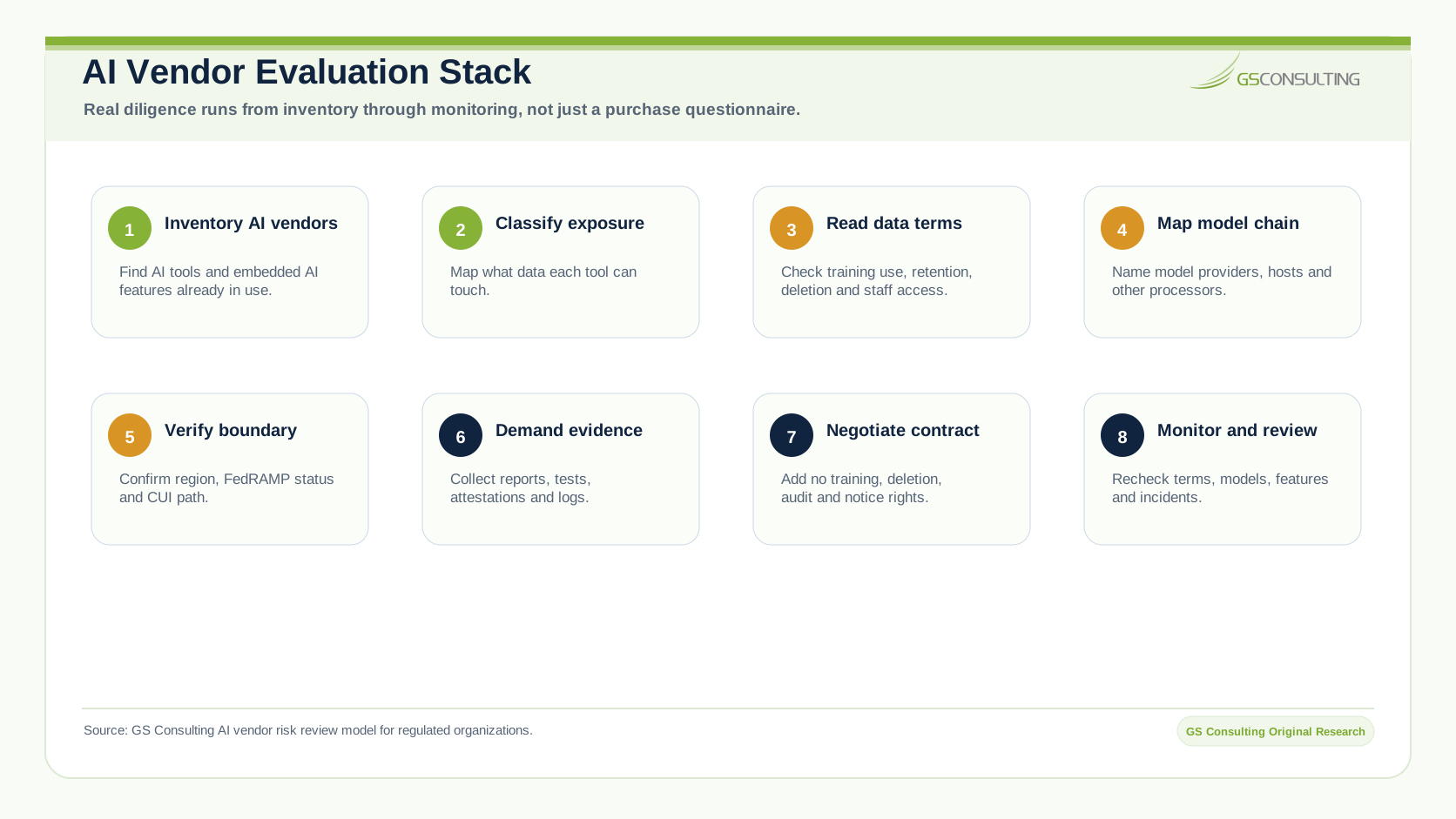
The first half of the stack is discovery: know which AI tools you have, what data each one can touch, what the data terms say, and where the data actually goes. The second half is enforcement: verify the boundary, demand evidence, negotiate the contract, and set a review cadence.
The most common mistake is stopping after the terms review. Teams read the terms, feel reassured, and never map the model chain or verify the boundary. The data path is where the surprises live.
Reading the Data Terms Like They Matter
This is the part many reviews skip, and it is the part that decides everything.
Start with training use. You want an explicit contractual statement that your inputs and outputs are not used to train or improve the vendor's models, or any other models. "We do not sell your data" is not the same as "we do not train on your data." Vague phrasing about improving services should be treated as a yes until proven otherwise.
Then retention. You want a defined window, not "as long as necessary." Some vendors retain prompts for a fixed period for abuse monitoring. That may be acceptable if it is bounded, disclosed, and compatible with your obligations. Indefinite or undefined retention is not.
Then deletion and data return. What happens when the contract ends? You want a contractual commitment to delete or return data, with a timeline, not a verbal assurance.
Then the processor list. The vendor should name the model providers and hosting providers in the chain and commit to notifying you before that list changes. A silent swap of the underlying model is a silent change to your data path.
FedRAMP, CUI, and the Boundary Question
For organizations handling federal data, AI vendor risk has a hard compliance edge that the commercial market does not.
Cloud services handling federal information generally need FedRAMP authorization at the appropriate impact level. FedRAMP's AI work and FedRAMP 20x effort are meant to accelerate cloud authorization paths, but "the vendor has FedRAMP somewhere" is not the same as "this AI service is in scope." The marketplace listing and authorization package tell you what is actually covered.
For CUI, DFARS 252.204-7012 and NIST SP 800-171 make the boundary question practical. An AI feature added to an existing tool does not automatically inherit the right posture. If that feature routes CUI to a general purpose model endpoint, the data path may have changed without a formal decision.
The practical rule is simple: for regulated data, confirm that the specific AI service, not just the parent company, sits inside the approved boundary, and that the data path does not exit it. FedRAMP AI vendor claims should be checked against the marketplace and contract package, not the sales deck.
Contract and Policy Red Flags
Some signals are reliable enough that they should slow down or stop a purchase on their own. None of them require a security background to spot. They require reading the terms.
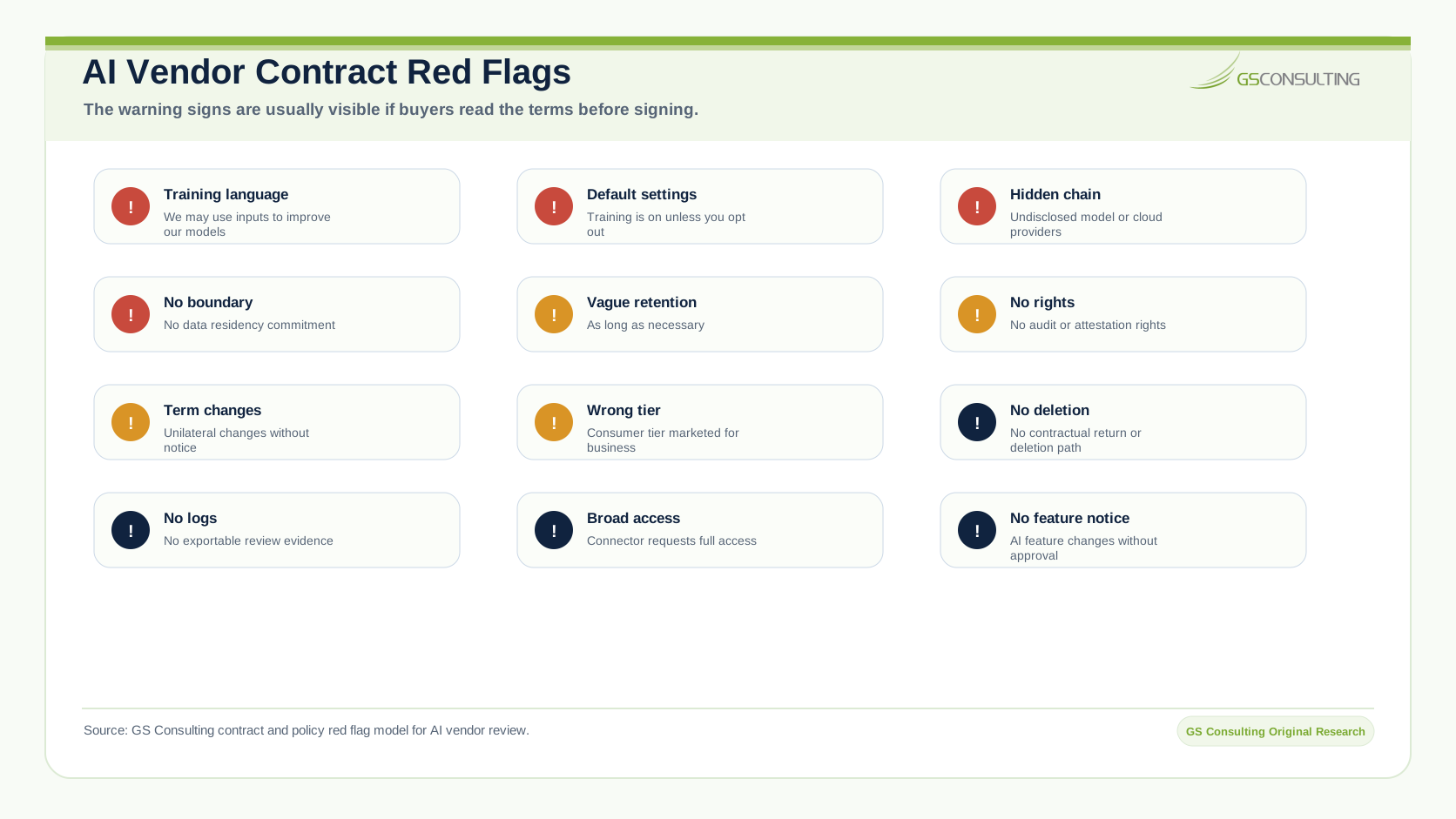
The worst offender is vague improvement language paired with training that is on by default. If the opt out exists but is buried, unavailable on your tier, or written so broadly that it is hard to enforce, the default tells you what the vendor wants to do with your data.
The other reliable red flag is a consumer tier marketed for business use. Free and personal tiers usually carry the weakest data protections and the broadest training rights. They are exactly where shadow AI happens, and they are not where regulated data should live.
Auditing the SaaS AI Tools You Already Use
Most organizations do not have a clean slate. They have AI tools already in use, and AI features that vendors switched on inside software the organization already bought.
That second category is quiet. A document platform, CRM, help desk, meeting tool, code tool, or analytics platform may have added an AI assistant that reads your content under updated terms. The tool was approved years ago. The AI feature was not.
This is where the numbers get uncomfortable. Verizon's 2025 DBIR found third party involvement in roughly 30% of breaches, double the prior year. IBM's 2025 research found shadow AI added about $670,000 to average breach cost. Menlo Security reported that many employees use free tier AI through personal accounts, with sensitive data being entered into those tools.
Auditing it uses the same evaluation stack: inventory where AI runs, classify what it can touch, reread the current terms, request evidence, and decide what gets kept, constrained, or removed. The goal is not to ban AI. It is to know what you are running and on what terms.
What the Evidence Packet Should Contain
A defensible vendor decision produces evidence. If the only artifact from your review is an approval email, you cannot defend the decision later, and you cannot recheck it when the vendor changes its terms.

The packet does not need to be heavy. It needs to be real: the inventory and data classification that scope the risk, the contractual terms that control it, the evidence that verifies it, and the review schedule that keeps it current.
The AI Vendor Risk Scorecard
Track vendor risk with a simple scorecard. No scoring theater. No 200 question survey nobody reads.
| Area | What to verify |
|---|---|
| Inventory | AI tools and embedded AI features actually in use. |
| Data exposure | What data class each tool can touch. |
| Training use | Contractual exclusion of inputs and outputs from training. |
| Retention | Defined retention window and deletion timeline. |
| Processor chain | Named model and hosting providers with change notice. |
| Residency and boundary | Region, FedRAMP status, and CUI boundary. |
| Evidence | SOC 2 or ISO report and recent penetration test summary. |
| Contract rights | Data processing agreement, audit rights, deletion, and breach SLA. |
| Incident | Notification timeline and responsibilities. |
| Review cadence | Schedule to catch model, feature, and term changes. |
Common AI Vendor Risk Mistakes
- Trusting the security page instead of the contract. Badges describe controls. Terms describe rights. Read the terms.
- Accepting standard terms as written. The vendor's default terms are written for the vendor. No training and audit rights are negotiable more often than buyers assume.
- Ignoring the processor chain. The company you signed with often is not the one running the model. Map the chain.
- Treating embedded AI as already approved. An AI feature switched on inside existing software is a new vendor decision.
- Letting consumer tiers handle real data. Free and personal tiers usually carry the weakest protections and broadest training rights.
- Reviewing once and never again. Vendors change models, terms, processors, and features. A review with no cadence expires quickly.
- Confusing FedRAMP at the company with FedRAMP for the service. Confirm the specific AI service is in scope, not just the parent.
The First 90 Days
- Days 1 to 30Inventory and classify.
Find every AI tool in use, including AI features inside existing software. Classify what data each can touch and flag anything touching CUI, regulated, customer, employee, security, or otherwise sensitive data.
- Days 31 to 60Read the terms and map the path.
For priority tools, review training use, retention, deletion, processors, model providers, and residency. Verify the boundary for regulated data. Request SOC 2 or ISO reports and penetration test summaries.
- Days 61 to 90Fix the contracts and set the cadence.
Negotiate no training and audit clauses where needed, retire or constrain the worst offenders, build the evidence packet, and schedule periodic review.
At the end of 90 days, you should know exactly which AI vendors touch your data, on what terms, and which ones still need to be fixed or replaced.
How This Supports Secure Enterprise AI Strategy
Secure Enterprise AI Strategy explains how GS Consulting helps regulated organizations connect business goals, AI roadmap, data strategy, security, compliance, architecture, workforce adoption, and measurable outcomes. Vendor risk management is where that strategy meets the contract: the point at which data control either holds or quietly leaks. It also connects to AI platform consolidation, because every unreviewed point solution expands the vendor surface leaders have to govern.
This article connects directly to AI Vendor Evaluation for Regulated Enterprises, Enterprise AI Governance Frameworks for GovCon, AI Disclosure on Federal Contracts, AI Automation in Sensitive Data Workflows, AI Access Controls and Permission Design, AI Audit Trails and Activity Logging, and Developing a Phased Secure AI Adoption Roadmap.
The Bottom Line
AI vendor risk is not exotic. It is procurement discipline applied to a new kind of product, one that reads your data and may learn from it.
Stop evaluating only the demo. Evaluate the data terms. Find out whether your inputs are trained on, how long they are kept, who sits in the processor chain, where the data goes, and what evidence the vendor can produce. Negotiate the clauses that protect you, gather the evidence that proves it, and review on a schedule.
That is how regulated organizations adopt third party AI without handing proprietary data to a model they do not control.
Ready to evaluate an AI vendor before you commit?
Contact GS Consulting for AI vendor audit and technology selection advisory support.
Contact GS ConsultingResearch Sources and Caveats
The Vendor Due Diligence Burden Index, Vendor Risk Gate Index, red flag model, and evidence packet are GS Consulting derived planning tools. They are not official NIST, ISO, FedRAMP, CISA, CSA, OWASP, legal, audit, or certification determinations.
Actual vendor risk depends on the organization's data sensitivity, contracts, regulatory exposure, the specific AI service in scope, the vendor's current terms and processors, and the boundary requirements that apply. Vendor terms change; confirm them at purchase and on a review cadence.
- Verizon: 2025 Data Breach Investigations Report
- IBM: Cost of a Data Breach Report 2025
- Menlo Security: 2025 Shadow AI Findings
- FedRAMP: Artificial Intelligence
- NIST: AI Risk Management Framework
- ISO/IEC 42001: Artificial Intelligence Management System
- DFARS 252.204-7012: Safeguarding Covered Defense Information
Frequently Asked Questions About AI Vendor Risk
What is AI vendor risk management?
AI vendor risk management is the process of evaluating and controlling the risk created when a third party AI software vendor processes your data. It looks past the product demo to the data terms: whether inputs are used to train models, how long data is retained, which processors and model providers touch it, where it is stored, and what audit evidence the vendor can produce.
How do you know if an AI vendor trains on your data?
Read the data processing terms, not the marketing page. Look for an explicit no training commitment that excludes your inputs and outputs from model training and product improvement. Watch for vague language like improving services, training that is on by default, buried opt outs, and undisclosed processors.
Do AI vendors need to be FedRAMP authorized to handle government data?
It depends on the data and the agency. Cloud services handling federal information generally need FedRAMP authorization at the appropriate impact level, and contractors handling CUI under DFARS 252.204-7012 need the required cloud security posture and NIST SP 800-171 controls. Confirm the specific AI service is in scope.
How do you audit a SaaS AI tool you already use?
Start by inventorying where AI already runs, including AI features inside existing software. Classify what data each tool can touch, review current data terms for training use, retention, processors, and residency, request evidence such as SOC 2 or ISO reports, confirm deletion and audit rights, and set a review cadence.
Related Reading
- Secure Enterprise AI Strategy
- Shadow AI Discovery and Remediation Strategy
- AI Agent Lifecycle Management and Oversight
- Managing Change and Adoption in Secure AI Rollouts
- AI Vendor Evaluation for Regulated Enterprises
- Enterprise AI Governance Frameworks for GovCon
- AI Disclosure on Federal Contracts
- AI Automation in Sensitive Data Workflows
- AI Access Controls and Permission Design
- AI Audit Trails and Activity Logging
- Developing a Phased Secure AI Adoption Roadmap