GovCon Cybersecurity | | 21 min read
FedRAMP Compliance: The Complete Guide

Key Takeaways
FedRAMP compliance is an authorization you maintain, not a certificate you buy.
The Level Is Set for You
A FIPS 199 categorization maps your data to Low, Moderate, or High. Most federal software lands at Moderate and its 323 controls. The data decides, not preference.
Effort Is Not Evenly Spread
A handful of control families carry most of the work. Access control, system protection, and integrity dominate, so sequence them first rather than spreading effort thin.
Authorization Is the Start
The Authority to Operate is a milestone, not the finish line. Continuous monitoring is a permanent operating cost that keeps or loses the authorization every month.
Moderate Is the Common Bar
DFARS 252.204-7012 points at requirements equivalent to FedRAMP Moderate, not High. Know your real target before you overbuild or underbuild.
FedRAMP compliance is the price of admission for selling cloud software to the federal government.
It is not a logo you earn once and forget.
The Federal Risk and Authorization Management Program is how a cloud service proves it can safely hold federal data. Behind that simple idea sits a real program: a control baseline drawn from NIST SP 800-53, an independent assessment, an agency decision, and a monitoring commitment that never ends. Providers who treat FedRAMP as a certificate to acquire tend to underfund the parts that actually decide the outcome, which are implementation and the recurring work of staying authorized.
This guide gives you the honest map. What FedRAMP is, how the impact levels and baselines work, where the authorization effort concentrates, the paths to get authorized, the lifecycle from preparation through continuous monitoring, and the evidence an agency reviewer expects to see.
Plan FedRAMP as an operating commitment, not a one time project.
GS Consulting helps cloud providers scope the boundary, model the control effort, and build the evidence pipeline that keeps an authorization current.
Request a FedRAMP Readiness ReviewWhat FedRAMP Is
FedRAMP is a governmentwide program that standardizes how cloud services are assessed and authorized to handle federal information. Instead of every agency running its own security review of the same cloud product, FedRAMP creates one rigorous authorization that agencies can reuse. That reuse is the whole point: do the hard work once, then let multiple agencies rely on it.
The program was codified by the FedRAMP Authorization Act, which put the effort on a permanent legal footing and established a governing board. The mechanics rest on a few fixed pieces: a security categorization from FIPS 199, a control baseline from NIST SP 800-53, an independent test by an accredited assessor, an authorization decision by a federal agency, and ongoing continuous monitoring. Get those five right and you have a defensible authorization. Miss the last one and you can lose it.
Impact Levels and Control Baselines
FedRAMP compliance is not one standard. It scales with how sensitive the data is. A FIPS 199 categorization rates the confidentiality, integrity, and availability of the information, and the highest rating sets the impact level. That level then determines which control baseline you have to implement.
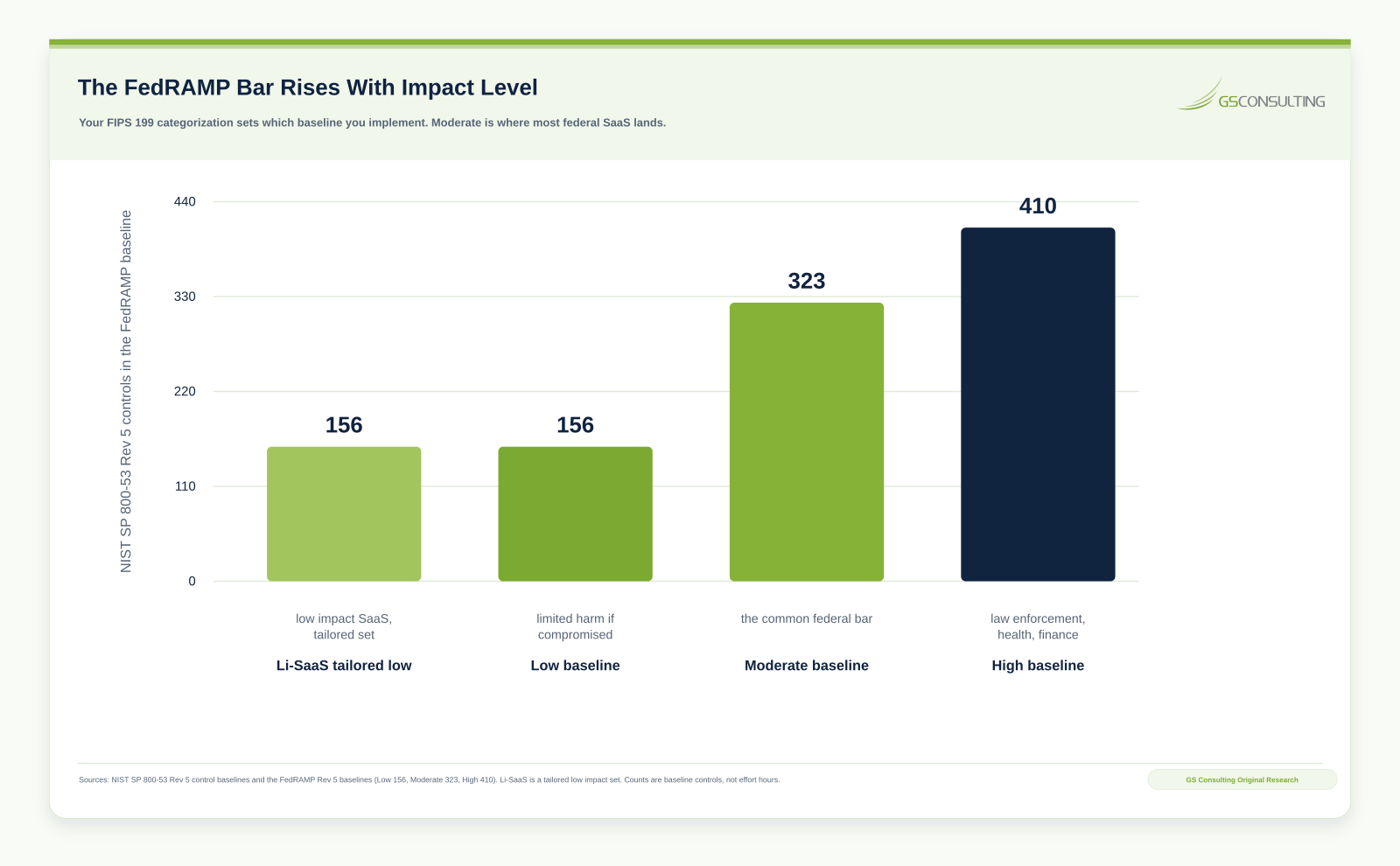
The Low baseline covers systems where a compromise would cause limited harm, and uses 156 controls. There is also a tailored Low path called Li-SaaS for low impact software with a narrow footprint. The Moderate baseline is the common federal bar, with 323 controls, and it is where the majority of federal software services sit. The High baseline, at 410 controls, is reserved for the most sensitive workloads such as law enforcement, emergency services, and health or financial data where a breach could cause severe or catastrophic harm.
The 323 figure describes the legacy 2023 Rev5 Moderate baseline. Current 2026 rules use certification classes for package assurance, where GS counted 155 Rev5 Class B controls and enhancements, 322 in Class C, and 409 in Class D. The FedRAMP class selection guide explains why those classes do not map directly to agency system impact. The Class C baseline guide covers the current list, annual assessment subset, Security Decision Record, and transition.
One point trips up defense contractors constantly. DFARS 252.204-7012 requires that a cloud service handling Covered Defense Information meet security requirements equivalent to the FedRAMP Moderate baseline. That is a Moderate equivalence requirement, not a demand for High. A High authorization exceeds the requirement, but the obligation itself points at Moderate. If your work touches Controlled Unclassified Information in the cloud, our guide on secure cloud architecture for federal contractors handling CUI shows how that equivalence plays out in a real design.
Original Research: The FedRAMP Authorization Effort Index
Control counts tell you how many requirements you face. They do not tell you where the work actually lands. To close that gap, GS Consulting built the FedRAMP Authorization Effort Index. We took the NIST SP 800-53 Rev 5 control families in the Moderate baseline and, using baseline control counts, evidence depth, and the continuous monitoring burden as anchors, assigned each family a relative effort weight. The weights are scaled so the heaviest family reads 100, which makes the proportions easy to see at a glance.
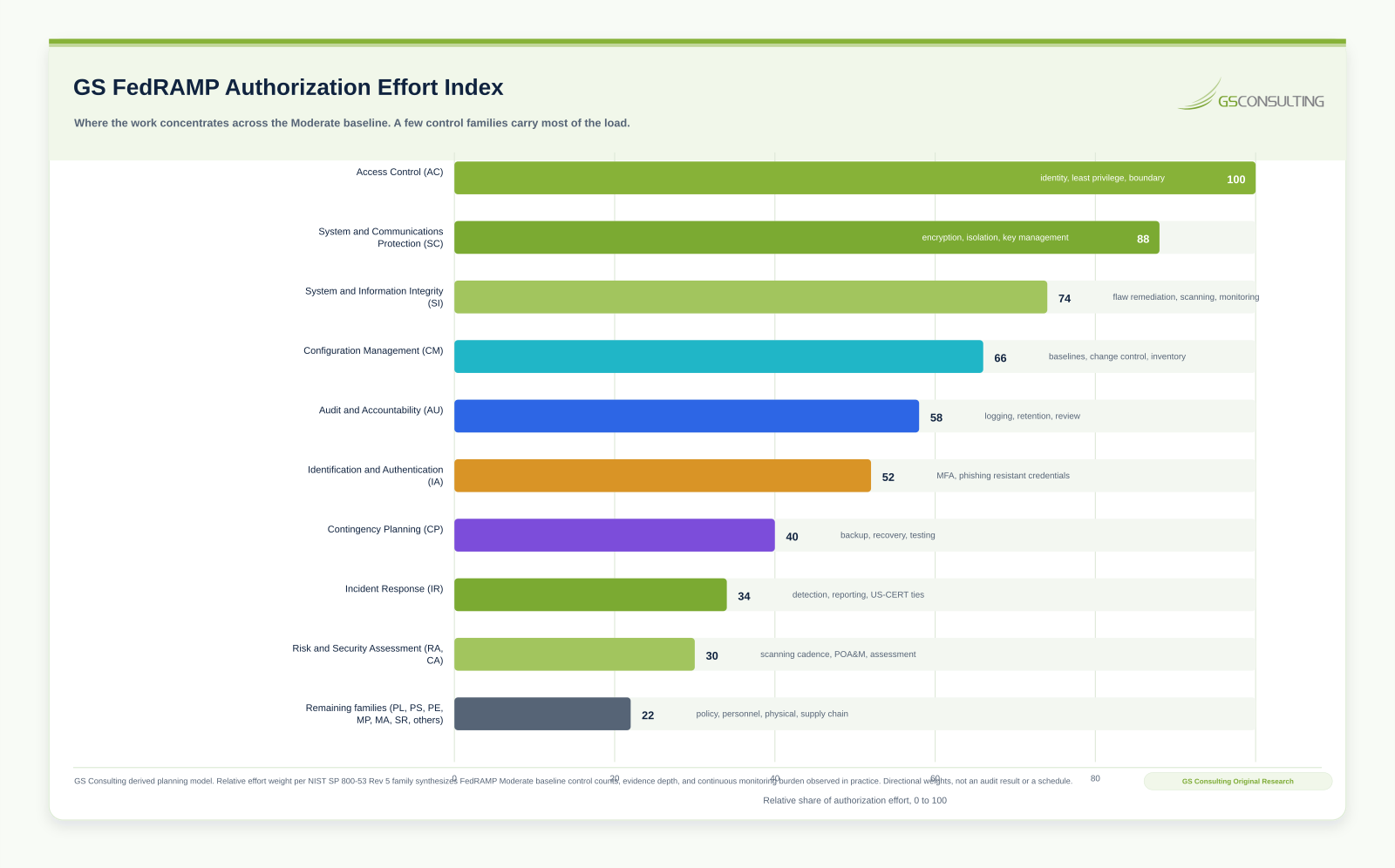
The ranking is the takeaway. Access Control sits at the top because identity, least privilege, and boundary enforcement touch every component and generate the most evidence. System and Communications Protection follows close behind, since encryption, isolation, and key management are architecture level decisions that are painful to retrofit. System and Information Integrity comes next, because flaw remediation, scanning, and monitoring feed the continuous monitoring engine you will run forever. Configuration Management, Audit and Accountability, and Identification and Authentication fill the heavy middle. The remaining families, from planning and personnel to physical and supply chain, matter for completeness but carry less of the build effort.
Read the index top to bottom and the strategy writes itself. Do not treat 323 controls as a flat checklist. Concentrate early effort on identity, system protection, and integrity, because those families both carry the most work and set the foundation everything else depends on. If you are approaching this from the standard behind the controls, our NIST SP 800-171 explainer shows how the same control thinking maps to the defense side.
Authorization Paths and Levels
Two questions decide your FedRAMP route: which level applies, and how you get authorized. The level, as covered above, is set by the data. The path has shifted with the program's modernization, so it is worth being current.
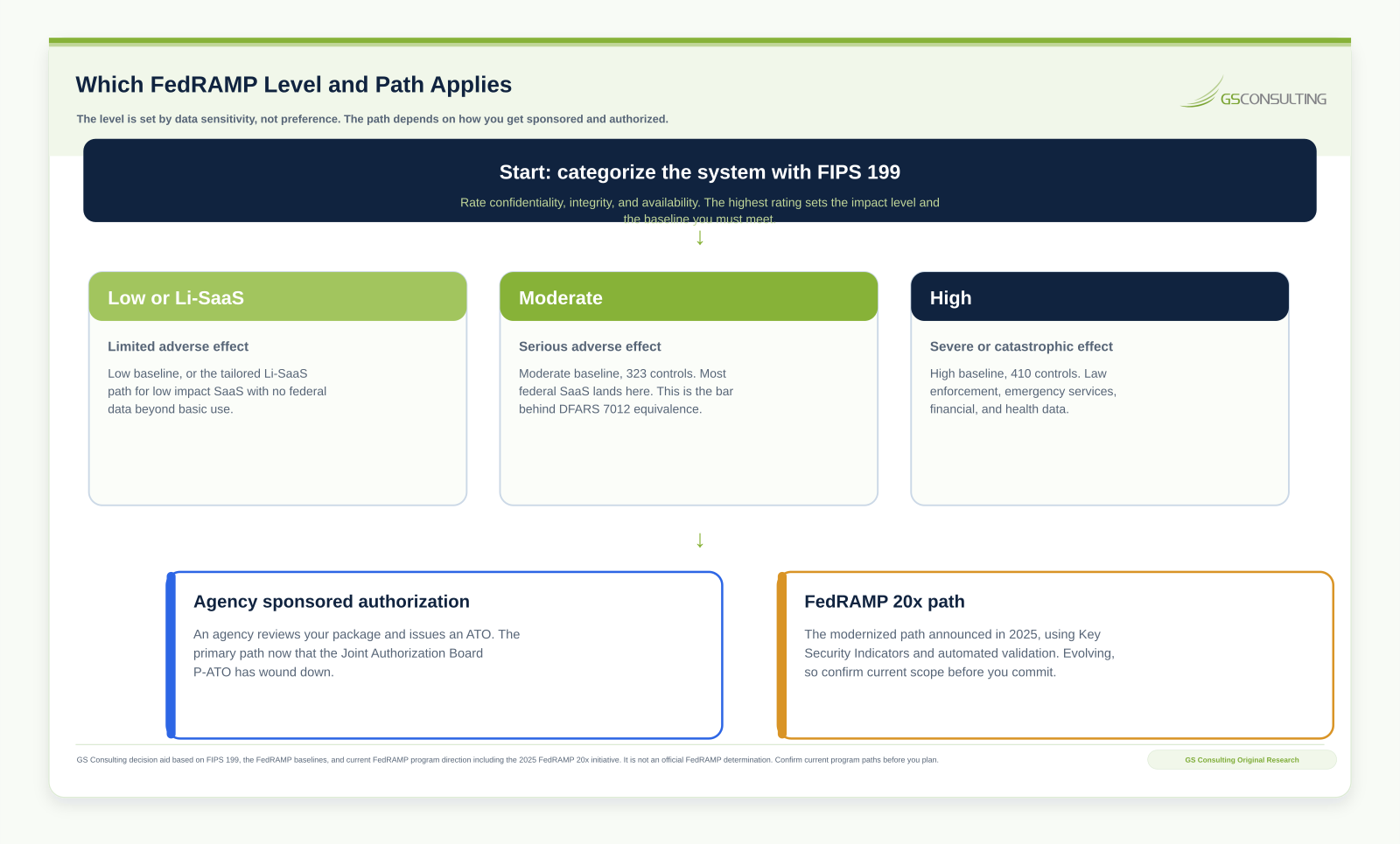
Current paths separate FedRAMP 20x from Rev5. FedRAMP 20x now uses the Program Certification path for Classes A, B, and C. Rev5 Class B and C use limited Program paths or generally required Agency paths, while Rev5 Class D uses the Agency path. The FedRAMP 20x guide explains the Key Security Indicators, automated methods, metric history, Security Decision Record, annual independent review, and reusable package. The FedRAMP authorization package guide shows how to reconcile current overview, decision, assessment, customer duty, and ongoing records. Confirm the path before building the evidence because 20x and Rev5 ask for different proof.
The Authorization Journey
FedRAMP authorization moves through a predictable lifecycle. Knowing the shape of it prevents the classic mistake of pouring everything into passing the assessment and nothing into what comes after.
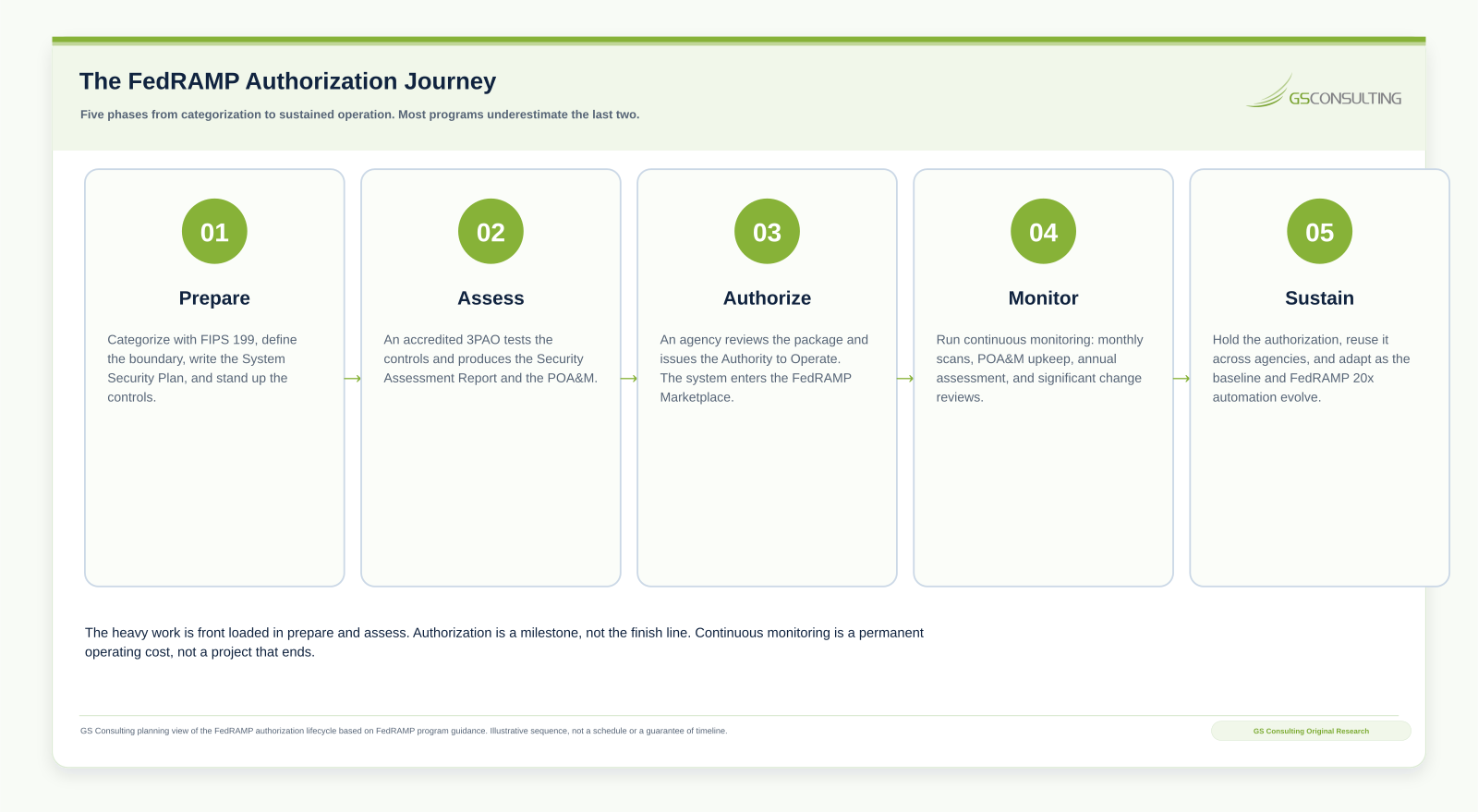
In the prepare phase you categorize the system, define the authorization boundary, write the System Security Plan, and implement the controls. In the assess phase an accredited third party assessment organization tests those controls and produces the Security Assessment Report and the Plan of Action and Milestones. In the authorize phase an agency reviews the package and issues the Authority to Operate, and the service is listed in the FedRAMP Marketplace so other agencies can reuse it. Then the work that never ends begins: the monitor phase runs continuous monitoring, and the sustain phase carries the authorization forward, reusing it across agencies and adapting as the baseline and the FedRAMP 20x automation evolve. Most programs underestimate the effort in those last two phases by a wide margin.
Continuous Monitoring
If FedRAMP has a hidden cost, this is it. Authorization is not the finish line. It is the moment your recurring obligations begin, and those obligations are what keep the authorization valid.
The 2026 framework is broader than the legacy monthly package and generally calls the operating model Ongoing Certification. The FedRAMP continuous monitoring guide maps the faster vulnerability clocks, monthly reconciliation, quarterly report and review, change history, service health, and annual independent assessment. The FedRAMP significant change guide maps the routine, adaptive, transformative, emergency, and class change paths that keep service changes connected to certification data.
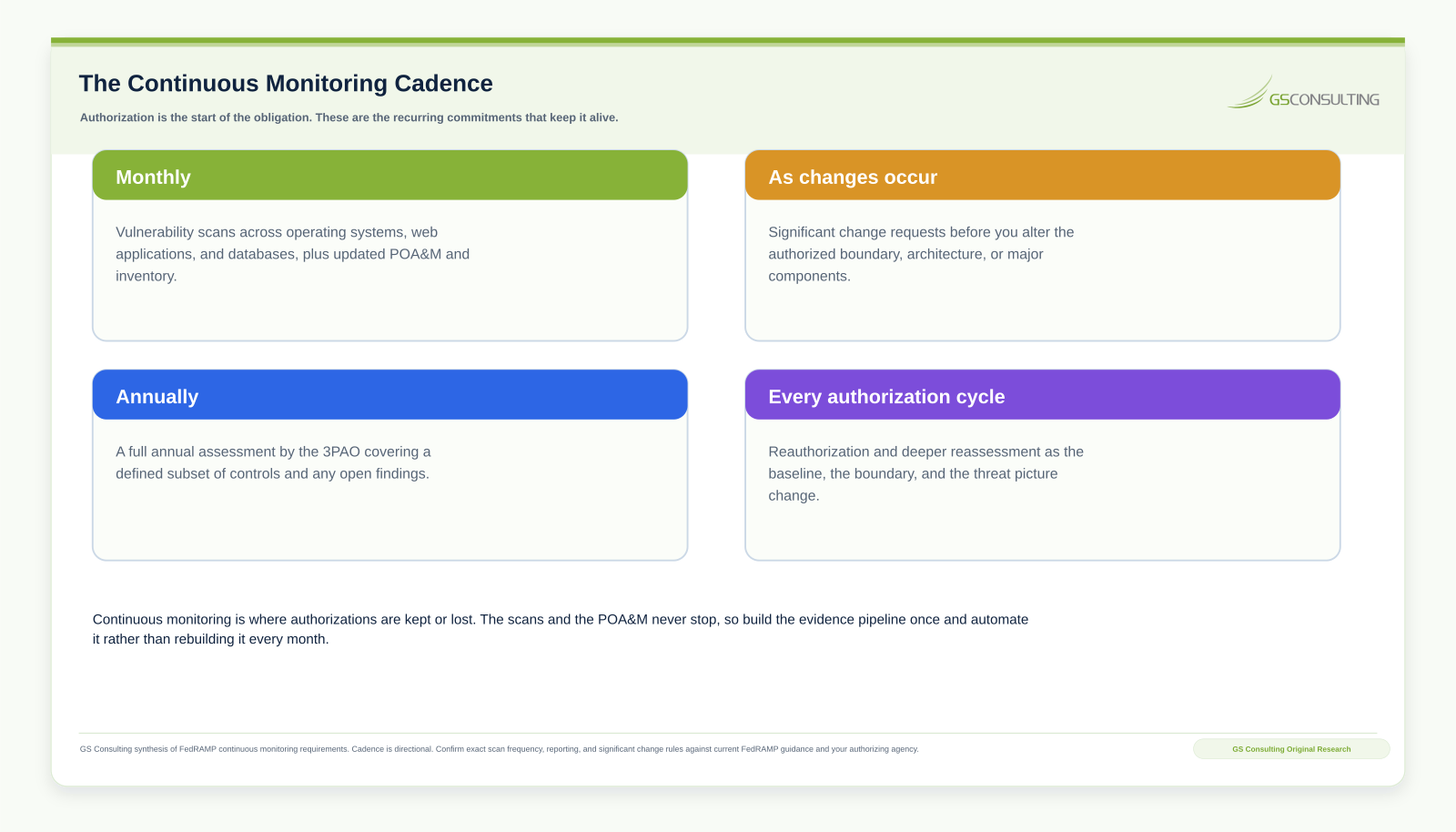
Every month you run vulnerability scans across operating systems, web applications, and databases, and you keep the Plan of Action and Milestones current with every open finding, its owner, and its target date. Whenever you plan to alter the authorized boundary or a major component, you submit a significant change request before making the change. Once a year the third party assessor performs an annual assessment covering a defined subset of controls. And each authorization cycle brings a deeper reassessment as the baseline, the boundary, and the threat picture change. This is exactly the kind of recurring evidence work that rewards automation, the same argument we make in automating NIST 800-171 compliance evidence. Build the pipeline once and the monthly cadence becomes a background task instead of a scramble.
The Authorization Evidence Packet
An agency reviewer and a third party assessor expect a specific set of artifacts. Assembling them well is most of what separates a smooth authorization from a stalled one.
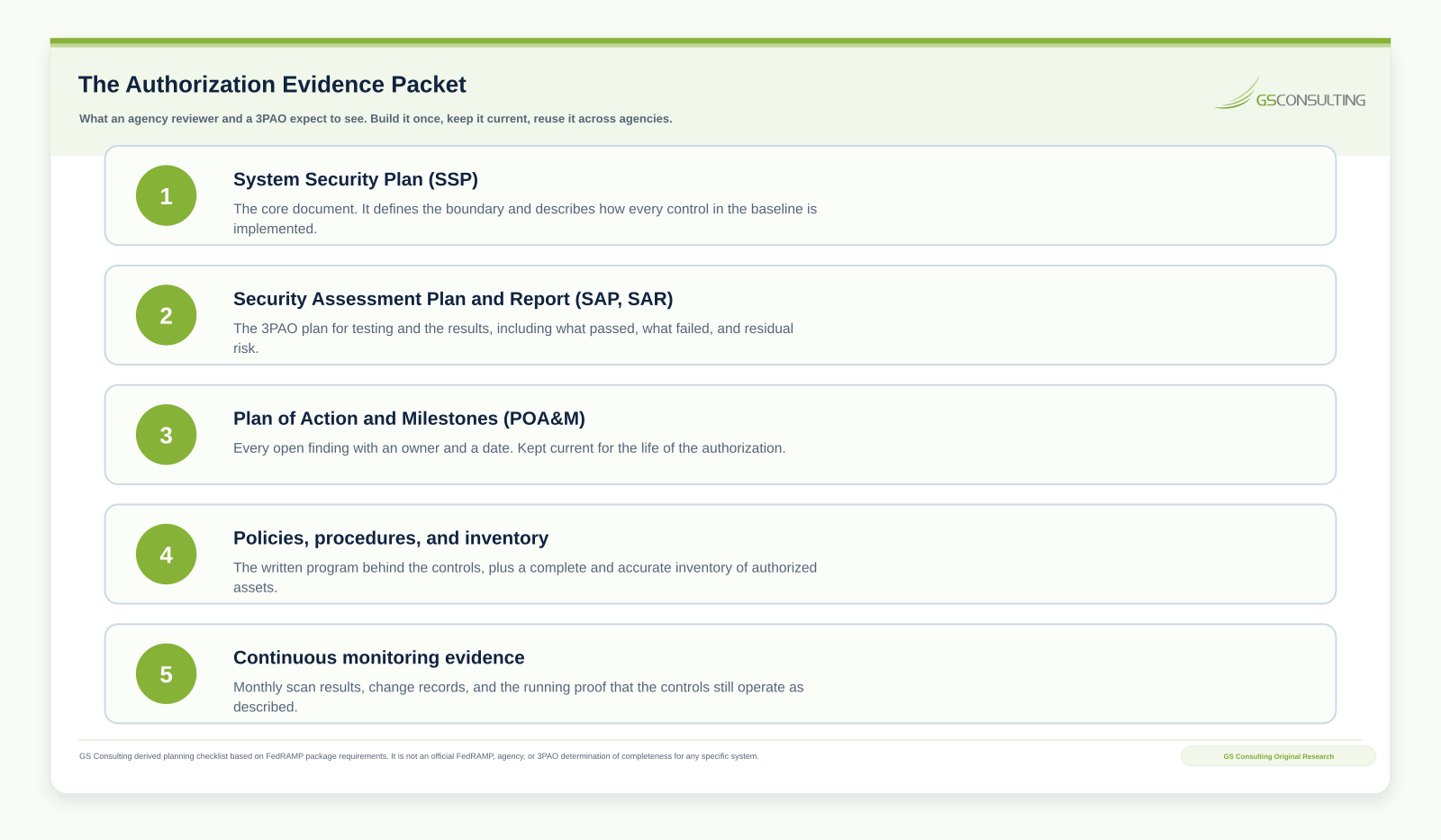
The System Security Plan is the spine of the package. It defines the authorization boundary and describes how every control in your baseline is implemented. The Security Assessment Plan and the Security Assessment Report capture how the assessor tested the controls and what they found, including residual risk. The Plan of Action and Milestones tracks every open finding with an owner and a date, and it stays live for the entire authorization. Around those sit the policies, procedures, and a complete asset inventory that show the program is real, plus the running continuous monitoring evidence that proves the controls still operate. The best way to keep controlled data out of the wrong hands while you build all of this is a disciplined boundary and a governed platform, which is where secure AI automation for regulated organizations and a tight cloud architecture pay off.
Done in this order, FedRAMP becomes a managed program with a predictable rhythm rather than an open ended scramble. That is the standard worth holding: categorize honestly, sequence the heavy control families first, build the package once, and treat continuous monitoring as the permanent operating commitment it is.
Research Sources and Caveats
The GS FedRAMP Authorization Effort Index and the planning views in this guide are GS Consulting derived planning tools based on cited public sources and documented assumptions. They are not official FedRAMP, agency, third party assessor, NIST, DoD, legal, or audit determinations, and they are not a schedule, a quote, or a guarantee of authorization. The control counts and program facts are drawn from the sources below. The effort weights, the lifecycle framing, and the monitoring cadence are GS planning assumptions and will vary with your boundary, your architecture, your authorizing agency, and the current state of the FedRAMP program.
FedRAMP launched the Consolidated Rules for 2026 and finalized 20x Classes A, B, and C. The rules still include staged effective dates, transition paths, and future Class D work, so confirm current package, path, assessment, and Ongoing Certification requirements before you plan.
- FedRAMP program (FedRAMP.gov)
- NIST SP 800-53 Rev 5: Security and Privacy Controls
- FIPS 199: Standards for Security Categorization
- FedRAMP Authorization Act (FY2023 NDAA)
- DFARS 252.204-7012: Safeguarding Covered Defense Information
Frequently Asked Questions About FedRAMP Compliance
What is FedRAMP compliance?
FedRAMP is the Federal Risk and Authorization Management Program. It supplies reusable security assurance for cloud services used by federal agencies. Current certification can follow 20x or Rev5 paths and includes defined scope, implementation evidence, independent assessment, a program or agency certification decision, and Ongoing Certification. Agencies still document their own authorization decisions for actual use.
What are the FedRAMP impact levels?
Federal systems still use FIPS 199 Low, Moderate, and High impact categories. FedRAMP now uses certification Classes A through D for package specifications, and says there is no direct correlation between class and impact. GS counted 155, 322, and 409 current Rev5 items in Classes B, C, and D. The agency use case and authorizing official decision still control the fit.
How long does FedRAMP authorization take?
There is no reliable universal duration. The 20x and Rev5 paths ask for different records, measures, assessment work, and history. Time depends on service scope, architecture, evidence maturity, automated validation, independent review, finding closure, package quality, and the applicable program or agency decision path.
Is FedRAMP the same as the DFARS requirement for defense contractors?
Not exactly, and the distinction matters. DFARS 252.204-7012 requires that a cloud service used to handle Covered Defense Information meet security requirements equivalent to the FedRAMP Moderate baseline. That is a Moderate equivalence requirement, not a mandate for FedRAMP High. A service authorized at High exceeds it, but the obligation itself points at Moderate. Confirm what your specific contract and data require before assuming a level.
What does continuous monitoring involve under FedRAMP?
Continuous monitoring is the recurring work that keeps an authorization alive. It includes monthly vulnerability scans across operating systems, web applications, and databases, keeping the Plan of Action and Milestones current, submitting significant change requests before altering the authorized boundary, and completing an annual assessment by the third party assessor. The monitoring never stops, which is why building an automated evidence pipeline early is worth more than any single control.
Related Reading
- FedRAMP Compliance hub
- FedRAMP Low vs Moderate vs High
- FedRAMP 20x: What Cloud Teams Need to Prove
- FedRAMP Moderate Baseline: Controls, Evidence, and Effort
- FedRAMP Continuous Monitoring: Monthly Evidence That Matters
- FedRAMP vs CMMC vs NIST 800-171
- Secure Cloud Architecture for Federal Contractors Handling CUI
- NIST SP 800-171 Explained: Requirements, Controls, and Compliance
- CMMC Compliance: The Complete Guide for Defense Contractors
- What Is GCC High? Microsoft 365 for Defense Contractors
- Automating NIST 800-171 Compliance Evidence
- Secure AI Automation for Regulated Organizations