Cybersecurity Compliance | | 24 min read
CMMC Readiness Checklist for Small and Midsized Government Contractors

Key Takeaways
CMMC readiness connects the contract, boundary, controls, and evidence.
Confirm the live requirement
Read the solicitation and current program direction before choosing a level or assessment path.
Trace FCI and CUI
Map data flows, systems, providers, and subcontractors so the scope matches reality.
Affirm what evidence supports
Keep the SSP, operating proof, SPRS records, gap owners, and affirmation review aligned.
A CMMC readiness checklist connects your contract requirement to FCI and CUI data flows, the assessment boundary, implemented controls, operating evidence, SPRS records, and an accountable affirmation.
Start with one contract and the systems that support it. Use the checklist below to identify missing evidence, assign owners, and decide what must be fixed before claiming readiness. The detailed sections explain each part of the review.
Program status reviewed October 11, 2026: the official CMMC program page reports that Phase II requirements were suspended on July 13, 2026, while Phase I self assessment requirements remain in place. Do not treat the originally planned November 2026 transition as an active deadline. Read the live solicitation, contract, amendments, and current government direction to confirm your required level and assessment path.
CMMC readiness checklist: start with these six checks
- Confirm the obligation. Record the contract, applicable clauses, required CMMC level, assessment type, and date the status is needed. See contract drivers.
- Locate FCI and CUI. Trace receipt, storage, processing, transmission, and derived records. Include provider and subcontractor paths. See data identification.
- Define the boundary. Reconcile the asset inventory, data flow map, network diagram, and provider responsibilities. Explain exclusions. See assessment scope.
- Review implementation and gaps. Match the SSP to the real environment. Give each gap an owner and remediation plan; separately verify whether it is eligible for conditional POA&M treatment.
- Test and index the evidence. Link requirements and assessment objectives to dated records, interviews, and tests. Use the evidence register example below.
- Review SPRS and the affirmation. Confirm the correct system identity, applicable status, and current records. Have leadership review scope, evidence, and unresolved gaps before affirming.
This is a readiness planning checklist, not the complete set of assessment objectives or an official determination of compliance. Use the level reference and applicable assessment guide for the full requirements.
For related controls, start with the CMMC compliance hub and the GovCon cybersecurity guide. Build the boundary with the CUI data flow mapping guide.
Do not wait for the solicitation to find out you are not ready.
GS Consulting helps government contractors identify FCI and CUI, define CMMC scope, review SSPs and POA&Ms, validate SPRS readiness, evaluate cloud, SaaS, MSP, and AI tool risk, and prepare evidence packages aligned to contract requirements.
Request a CMMC Readiness AssessmentCMMC readiness is no longer something contractors can push into the future.
For small and midsized government contractors, the risk is practical: the opportunity appears, the prime asks for status, the solicitation requires a CMMC level, the contracting officer checks SPRS, or leadership is asked to affirm compliance, and the company realizes the SSP is stale, the CUI boundary is unclear, the evidence is scattered, the cloud responsibilities are undocumented, and subcontractor status is unknown.
That is not a cybersecurity nuisance. That is a business problem.
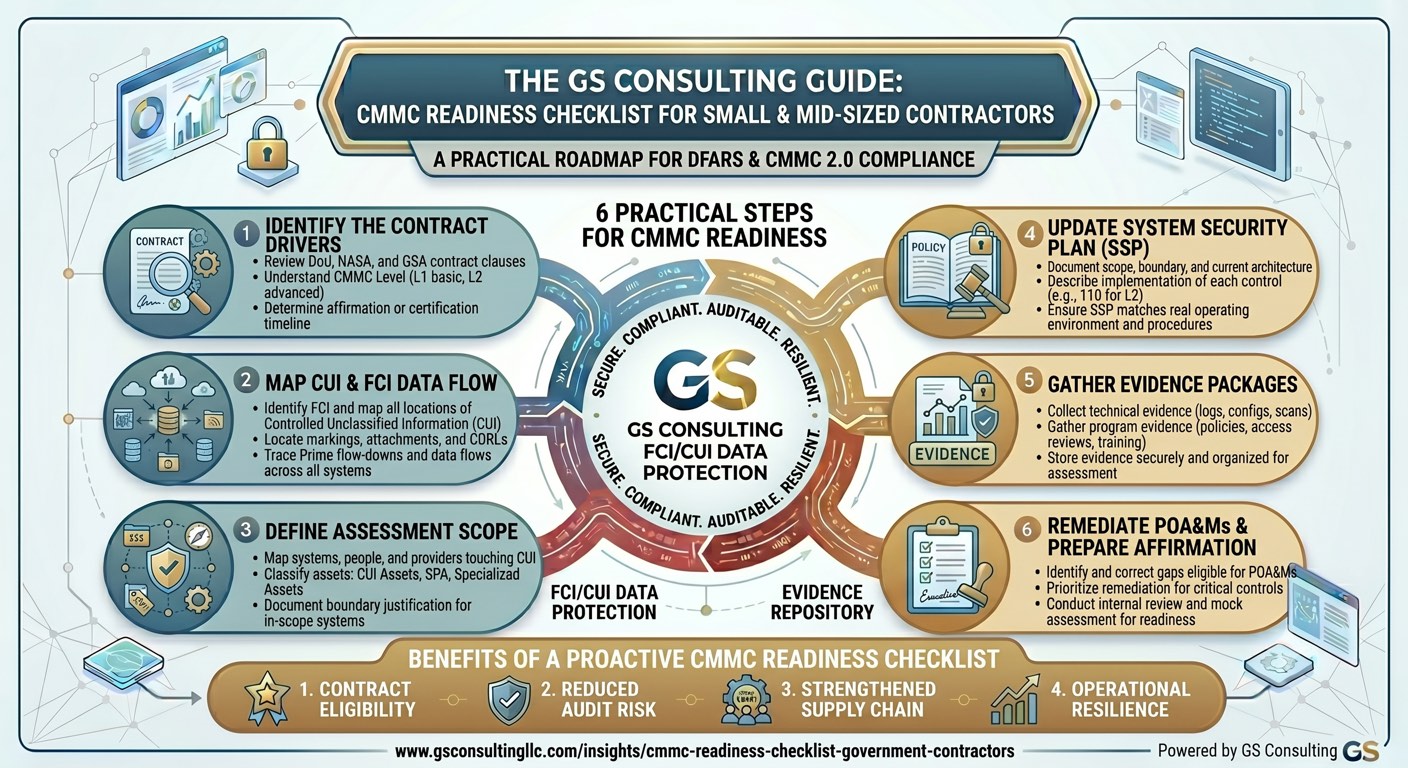
CMMC readiness should answer five basic questions before the pressure hits: What contracts drive the requirement? Where do FCI and CUI live? Which systems and providers are in scope? What evidence proves the controls are implemented and operating? Who is willing to affirm that the status is accurate?
If those answers are not ready, the company is not ready.
Why CMMC Readiness Matters Now
CMMC is not just a cybersecurity framework. It is becoming a contract gate.
DFARS 252.204-7025 states that the required CMMC level, or higher, is required prior to award for each contractor information system that will process, store, or transmit FCI or CUI during contract performance. It also states that an offeror will not be eligible for award if it does not have the required current CMMC status and a current affirmation of continuous compliance entered in SPRS.
That changes how contractors should manage cybersecurity. CMMC readiness is not something the IT team can clean up after the bid or no bid decision. It has to be part of capture, contracts, program delivery, vendor management, subcontracting, cloud architecture, AI tool governance, and executive risk management.
If the company cannot show the required current CMMC status, current affirmation, and supporting evidence when the opportunity requires it, the technical solution may never matter. The company may not get to compete.
Original Research: The CMMC Evidence Burden
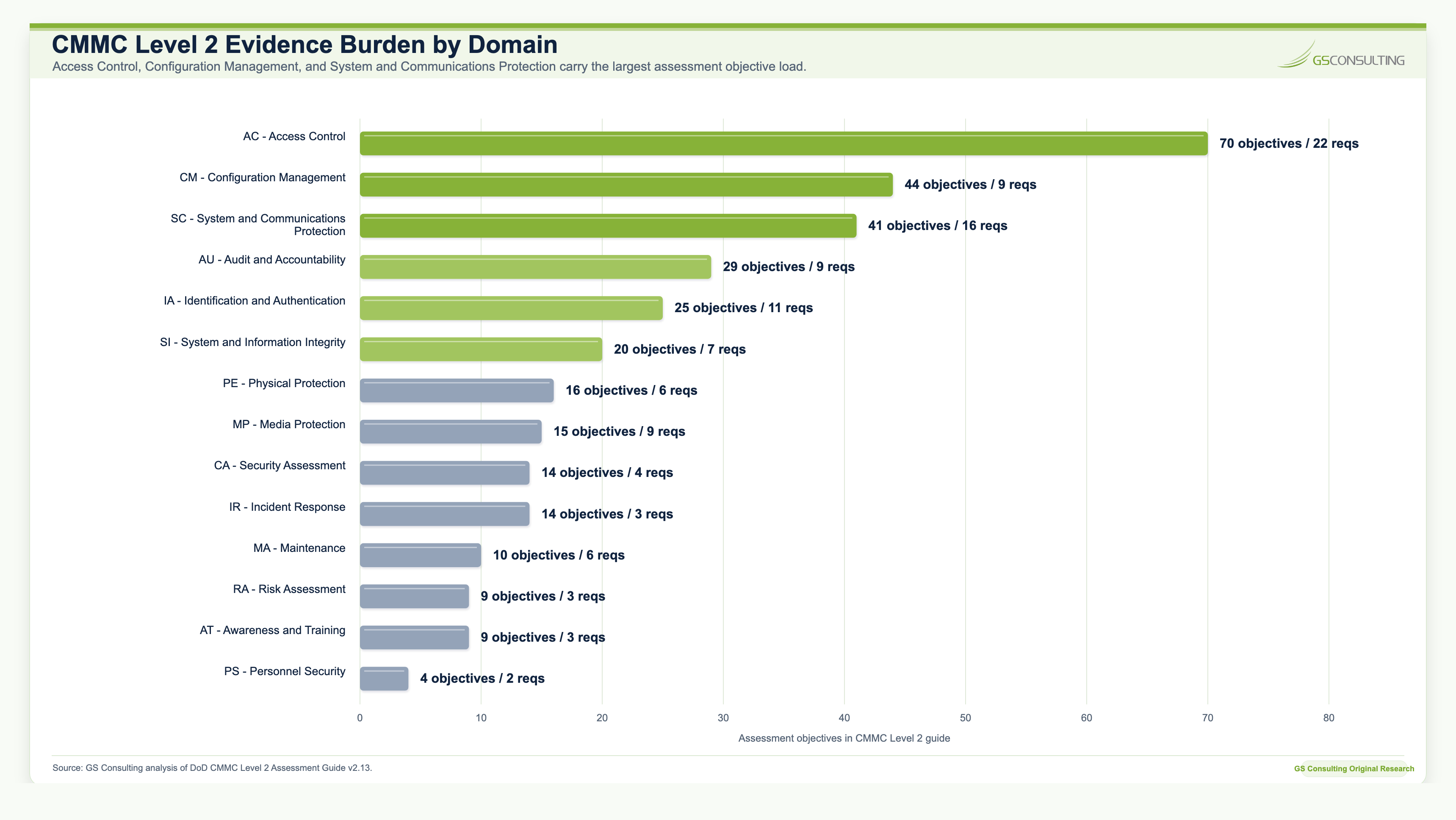
The hardest part of CMMC readiness is not reading the control list. It is proving implementation in a way that matches the scope, the SSP, the evidence, and the actual environment.
GS Consulting analyzed the DoD CMMC Level 2 Assessment Guide and mapped all 110 Level 2 requirements to 320 assessment objectives and 1,557 potential assessment evidence object references. Level 2 readiness creates an evidence burden across requirements, assessment objectives, interviews, tests, diagrams, configurations, logs, tickets, provider responsibilities, and recurring operating records.
Methodology and caveat
The CMMC Evidence Burden Score is a GS Consulting derived planning metric. It is not an official CMMC score, legal conclusion, certification result, or C3PAO assessment determination. The 1,557 evidence object references are an analytical proxy derived from potential assessment object lists in the DoD guide and should not be interpreted as a required artifact count.
The practical takeaway is simple: do not build evidence after the assessment is scheduled. Build the evidence system while you define the scope, update the SSP, close gaps, and prepare leadership to affirm.
CMMC Level Quick Reference
Confirm the level and assessment path required by the live contract. The reference below describes the program structure; the Phase II suspension means the original rollout schedule alone does not establish a current certification obligation.
A company that handles only FCI has a different readiness path than a company that processes, stores, or transmits CUI. A company targeting Level 2 C3PAO assessed work has a different evidence burden than a company preparing for Level 1 self assessment.
Annual self assessment and annual affirmation against the 15 requirements in FAR 52.204-21. POA&Ms are not permitted.
Self assessment or C3PAO assessment every three years, as specified in the solicitation, plus annual affirmation against the 110 NIST SP 800 171 Revision 2 requirements.
Final Level 2 status is required first, followed by a DIBCAC assessment every three years and annual affirmation against selected NIST SP 800 172 requirements.
What CMMC Is Not
CMMC is not a tool purchase.
It is not a one time policy project. It is not a score in SPRS that nobody has reviewed in two years. It is not an SSP that was accurate before the company moved to a new cloud environment. It is not a POA&M that keeps slipping. It is not a subcontractor spreadsheet nobody updates.
CMMC readiness means the company can connect the contract requirement to the data, the data to the systems, the systems to the controls, the controls to the evidence, and the evidence to the affirmation.
That is the work.
Checklist 1: Identify the Contract Drivers
The first step is to understand what is actually driving your cybersecurity requirement. Too many contractors start with tools before reading the contract.
That is backwards. The contract tells you what data matters, which clauses apply, what level may be required, when status must be current, and what obligations flow to subcontractors.
Review current and target contracts for FAR 52.204-21, DFARS 252.204-7012, DFARS 252.204-7019, DFARS 252.204-7020, DFARS 252.204-7021, DFARS 252.204-7025, agency specific CUI instructions, DD Form 254 requirements where applicable, prime contractor flow downs, and cloud or incident reporting obligations.
For defense work, DFARS 252.204-7012 is especially important because it defines Covered Defense Information, covered contractor information systems, controlled technical information, and the requirement to provide adequate security.
The goal is to connect each target opportunity to the actual cybersecurity requirement before anyone buys another tool or updates the wrong SSP.
- Do we know which clauses apply to each contract?
- Do we know which CMMC level is required for each target opportunity?
- Do we know whether the requirement applies at proposal, award, option period, or subcontract award?
- Do we know which systems will support performance?
- Do we know whether our prime contractor has additional cybersecurity flow down requirements?
Checklist 2: Identify FCI, CUI, and Covered Defense Information
CMMC scoping starts with data. If the company cannot find FCI and CUI, it cannot scope the environment honestly.
This is where many contractors get exposed. CUI may not live only in the obvious secure folder. It may show up in email, Teams or Slack, SharePoint, Google Drive, file shares, laptops, ticketing systems, CRM tools, proposal repositories, engineering folders, subcontractor exchanges, cloud backups, or AI prompts and outputs.
Start by identifying where FCI, CUI, Covered Defense Information, controlled technical information, export controlled information, source selection information, PII, government furnished information, and customer sensitive materials enter your business.
The CUI Registry includes categories across areas such as Defense, Export Control, Intelligence, Privacy, Procurement and Acquisition, Critical Infrastructure, and Proprietary Business Information. Contractors should use the registry, contract markings, customer instructions, and agency guidance to determine what must be protected.
The first useful CUI map will probably be messy. That is fine. A messy map is better than a clean fiction.
- Do we know which contracts involve FCI only?
- Do we know which contracts involve CUI or Covered Defense Information?
- Do we know where CUI enters, moves through, and leaves the company?
- Do we know whether CUI appears in email, collaboration tools, file shares, laptops, ticketing systems, cloud storage, CRM tools, proposal repositories, or subcontractor systems?
- Do employees understand how to recognize CUI markings and handling requirements?
Checklist 3: Define the CMMC Assessment Scope
Scoping is where CMMC programs either become manageable or become expensive fiction.
If the scope is too broad, the company may spend money securing systems that do not need to be in scope. If the scope is too narrow, the company may exclude systems that actually process, store, transmit, or protect FCI or CUI.
For Level 1, systems that process, store, or transmit FCI are in scope. For Level 2, CUI assets, security protection assets, contractor risk managed assets, and specialized assets must be handled according to CMMC scoping rules.
External service providers are not a footnote. Cloud providers, MSPs, MSSPs, SaaS platforms, endpoint tools, AI tools, and security monitoring services can all affect the boundary, inherited controls, evidence package, and SSP narrative.
- 1Identify data and contracts.
- 2Map systems and providers.
- 3Classify asset categories.
- 4Document what is in and out of scope.
- Have we defined our CMMC assessment boundary?
- Do we have an asset inventory for in scope systems?
- Do we know which systems provide security protection for CUI assets?
- Have we documented cloud providers, managed service providers, SaaS tools, AI tools, and other external service providers?
- Can we justify which systems are out of scope?
Checklist 4: Build or Update the System Security Plan
The SSP should describe the real environment, not the environment leadership wishes existed.
A weak SSP creates risk because it forces assessors, primes, customers, and executives to infer how the system works. A strong SSP shows the boundary, architecture, data flows, users, asset categories, controls, inherited responsibilities, cloud services, external providers, and how each requirement is implemented in practice.
If the SSP does not match the asset inventory, CUI flow map, network diagram, provider matrix, and evidence repository, fix the mismatch before anyone treats the document as ready.
- Do we have a current SSP?
- Does the SSP match the real operating environment?
- Does it include cloud services and external service providers?
- Does it describe inherited controls and customer responsibilities?
- Does it include CUI data flows and network diagrams?
- Has leadership reviewed the SSP before making any affirmation?
Checklist 5: Review SPRS, Scores, and Affirmations
SPRS is not a parking lot for old scores. It is part of the contract readiness record.
Contractors need to know what is posted, which CAGE codes are tied to the record, whether the score or status matches the correct SSP and boundary, and who is authorized to submit or affirm information.
Summary level NIST SP 800 171 DoD Assessment scores are posted in SPRS to provide DoD Components visibility into those scores. CMMC status is also tied to affirmations of continuous compliance. For Final Level 1, status and the corresponding affirmation must not be older than one year. For Final Level 2 self assessments and Final Level 2 C3PAO assessments, status can be valid for three years when conditions are met, with affirmations not older than one year.
- Do we know what is currently posted in SPRS?
- Are our CAGE codes accurate?
- Is our score tied to the correct SSP and system boundary?
- Do we know who is authorized to submit and affirm?
- Do affirmations match the company's actual compliance posture?
- Do we have evidence supporting the score or status submitted?
Checklist 6: Close High Risk Technical Gaps
CMMC readiness is not only documentation. Controls need to be implemented and working.
For many small and midsized contractors, the most common gaps include weak multifactor authentication coverage, incomplete asset inventory, unmanaged endpoints, inadequate logging, inconsistent vulnerability scanning, undocumented configuration baselines, weak access reviews, poor incident response testing, uncontrolled cloud storage, and unclear separation between business data and CUI.
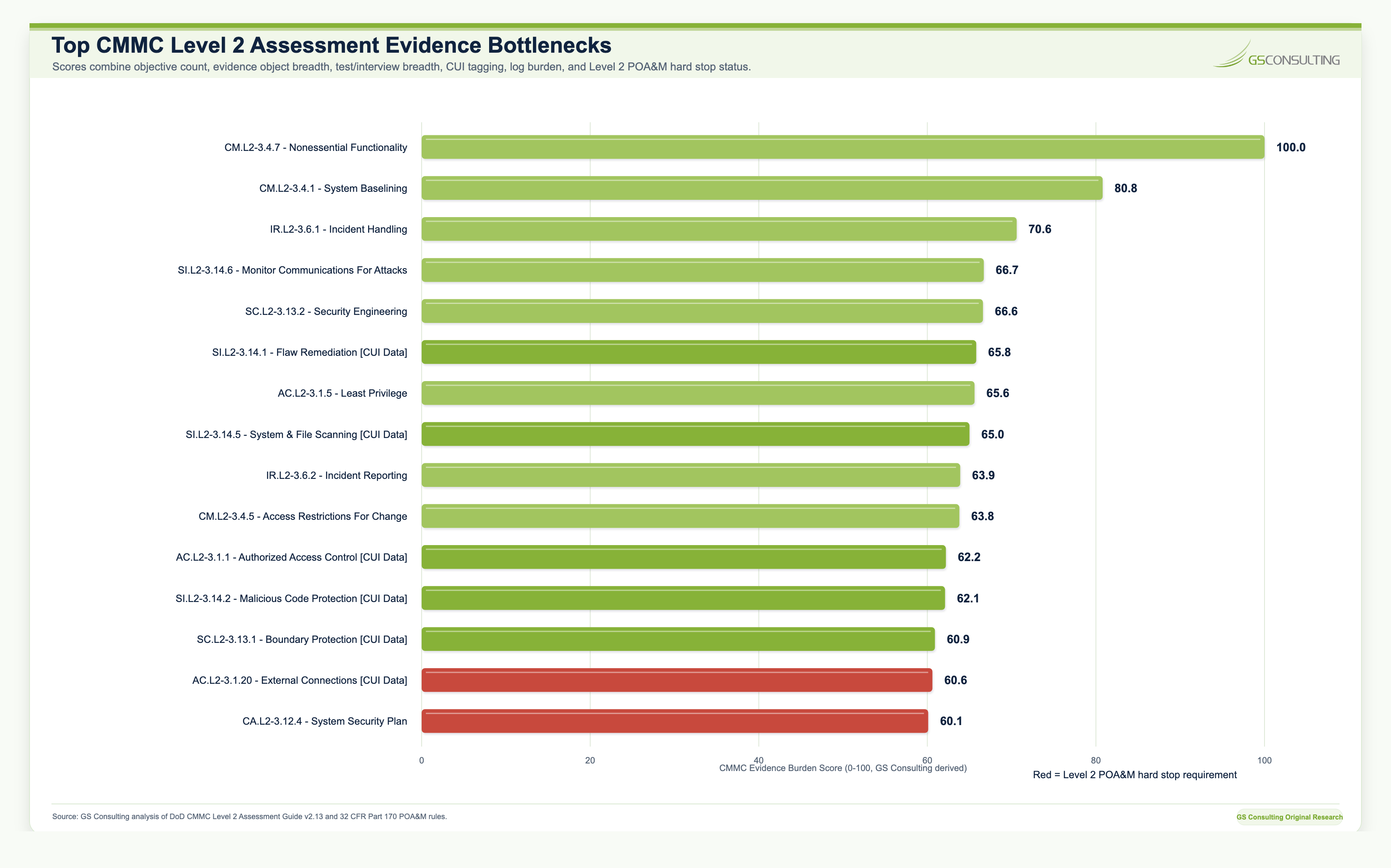
Confirm that users, devices, remote access paths, and administrator roles are controlled and reviewed.
Show that security activity is monitored, prioritized, remediated, and tested with evidence.
- Is multifactor authentication implemented where required?
- Are endpoints protected and monitored?
- Are vulnerabilities scanned, prioritized, and remediated?
- Are audit logs collected and reviewed?
- Are backups protected and tested?
- Are unauthorized cloud, file sharing, and AI tools blocked or governed?
Checklist 7: Prepare Evidence Before the Assessment
A company may have decent security practices and still fail readiness because it cannot prove implementation.
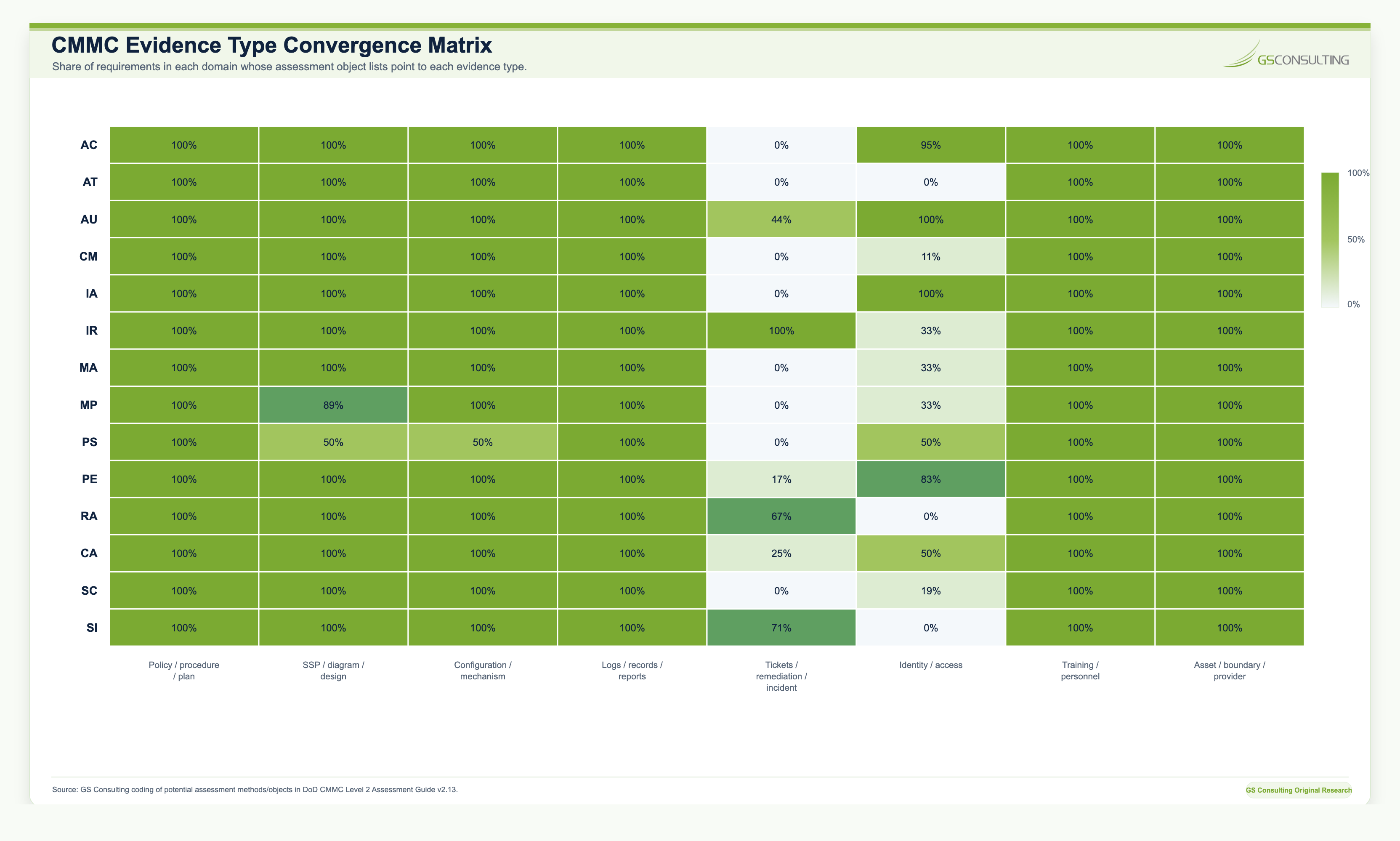
CMMC readiness requires evidence that is organized, current, tied to the correct requirement, and consistent with the SSP, CUI flow map, scope, providers, and actual operating environment.
Your evidence repository should include policies, procedures, screenshots, configuration exports, access reviews, training records, vulnerability scan results, remediation tickets, incident response exercise records, cloud responsibility matrices, logs, diagrams, asset inventories, and proof of recurring security activities.
- Do we have evidence mapped to each applicable requirement?
- Is the evidence current?
- Does the evidence match the SSP?
- Can we show that controls are operating, not just documented?
- Can we explain inherited controls from cloud or managed service providers?
- Is evidence stored securely and organized for review?
A CMMC evidence register example
Create one row per applicable assessment objective, with references to controlled evidence rather than copies of sensitive records. The fictional entries below illustrate review discipline. They are not client findings, an assessor approved template, or a complete evidence set for either requirement.
On a small screen, scroll the table horizontally to read the verification and next action column.
| Requirement and scope | Owner and evidence | Verification and next action |
|---|---|---|
| AC.L2-3.1.1 CUI enclave access | Identity owner; approved user register, access configuration export, and review record dated October 5, 2026. | Reviewer compares authorized users with actual access and tests an unauthorized account. Record the result and evidence reference for each relevant objective. |
| CA.L2-3.12.4 System Security Plan | Compliance owner; SSP version 4, asset inventory, network diagram, and provider responsibility map. | A new backup provider is absent from the SSP. Keep the gap open, assign an update owner, and verify the revised boundary before treating the requirement as met. |
Add the objective identifier, evidence location and version, test date, reviewer, result, and next review date to your working register. A screenshot proves a point in time; recurring controls also need records showing they operated during the relevant review period. A planned fix is not evidence of implementation.
Use the CMMC assessment findings guide to separate a readiness gap, an assessment finding, and an eligible conditional closeout item. Keep evidence access restricted to authorized reviewers.
Checklist 8: Manage POA&Ms Correctly
POA&Ms can be useful, but they are not a substitute for readiness. Contractors should understand when POA&Ms are allowed, which requirements cannot be placed on a POA&M, and how quickly remediation must be closed.
Level 1 POA&Ms are not permitted. Level 2 and Level 3 allow limited use of POA&Ms, but the closeout assessment must confirm closure within 180 days of the Conditional CMMC Status Date; otherwise, the conditional status expires.
For Level 2, contractors should treat the System Security Plan, external connections, public information controls, and certain physical access requirements as items to fix before assessment rather than safe candidates for deferral.
- Do we know which gaps are eligible for POA&M treatment?
- Do we know which gaps must be remediated before assessment?
- Do we have owners, due dates, and budget assigned to each POA&M item?
- Can we close POA&M items within the 180 day window?
- Are we avoiding overreliance on POA&Ms as a substitute for implementation?
Checklist 9: Review Cloud, SaaS, MSP, and AI Tools
Cloud and outsourced services are often the biggest hidden CMMC risk. Many contractors rely on Microsoft 365, AWS, Azure, Google Workspace, file sharing tools, CRM systems, ticketing platforms, managed service providers, AI tools, endpoint management tools, and security monitoring providers.
If a contractor uses an external cloud service provider to store, process, or transmit Covered Defense Information in contract performance, the contractor must require and ensure that the provider meets security requirements equivalent to the FedRAMP Moderate baseline and complies with applicable incident reporting and related requirements.
AI tools need the same level of scrutiny. If an AI tool processes CUI, summarizes CUI, indexes controlled repositories, stores prompts or outputs containing CUI, analyzes vulnerability data, or supports security monitoring, it may affect the CMMC boundary and evidence package.
- Do we know which cloud and SaaS tools process FCI or CUI?
- Do we have customer responsibility matrices?
- Do agreements address security, incident reporting, access, retention, and data handling?
- Do AI tools process contract data, CUI, security data, or customer sensitive information?
- Are prompts, outputs, logs, and embeddings controlled if they contain CUI?
- Have we documented inherited controls in the SSP?
Checklist 10: Train Employees on CMMC, CUI, and Safe Workflows
CMMC readiness fails when employees do not understand what is expected of them.
Security controls need to show up in everyday behavior: where people store data, what tools they use, how they report incidents, how they handle CUI, and whether program and proposal teams understand contract impact.
Training should cover FCI, CUI, approved systems, prohibited tools, phishing, password and MFA expectations, incident reporting, removable media, cloud storage, AI tool restrictions, remote work, visitor handling, physical security, and subcontractor communication.
- Do employees know what FCI and CUI are?
- Do employees know where CUI may and may not be stored?
- Do employees know how to report suspected incidents?
- Do employees know which AI tools are approved and prohibited?
- Do program managers and proposal teams understand when CMMC status may affect bid eligibility?
- Do executives understand what they are affirming in SPRS?
Checklist 11: Flow Requirements to Subcontractors
CMMC readiness does not stop at the prime contractor's boundary.
If subcontractors process, store, or transmit FCI or CUI, the prime needs to know what data flows down, what level is required, whether status is current, what tools subcontractors use, and whether their cloud, SaaS, MSP, or AI environment creates risk.
Prime contractors should not discover during a proposal, assessment, or incident that a subcontractor used an unapproved system to process contract data.
- Do we know which subcontractors receive FCI or CUI?
- Do subcontracts include the right cybersecurity flow downs?
- Do subcontractors have the required CMMC status before award?
- Do we verify subcontractor SPRS or CMMC status when required?
- Do subcontractors use cloud, SaaS, MSP, or AI tools with our contract data?
- Do we have a process to reassess subcontractors during performance?
Checklist 12: Create a Continuous Compliance Rhythm
CMMC is not a one time project. It is an operating rhythm.
The environment changes after assessment: users change roles, providers change terms, tools get added, cloud settings drift, vulnerabilities appear, subcontractors change systems, AI tools spread, evidence goes stale, and the SSP falls behind reality unless someone owns the update cycle.
A practical continuous compliance rhythm should include monthly vulnerability reviews, quarterly access reviews, recurring SSP updates, annual policy reviews, incident response exercises, subcontractor reviews, cloud provider reviews, AI tool reviews, and leadership level compliance reporting before any affirmation is submitted.
The goal is simple: leadership should never be asked to affirm compliance based on stale evidence, outdated scope, or assumptions nobody has checked.
- Do we have recurring control owners?
- Do we review compliance monthly or only before proposals?
- Do we update the SSP when systems or providers change?
- Do we track evidence continuously?
- Does leadership receive clear reporting before affirming compliance?
- Do we know what would cause our current status to lapse or become inaccurate?
Red Flags That Your Company Is Not CMMC Ready
Your company may not be ready if the basic facts are still unclear or the evidence does not match the environment.
If CUI may be in email, file shares, cloud drives, ticketing systems, proposal folders, laptops, AI tools, or subcontractor systems and nobody has mapped it, the scope is not ready.
If the score, status, CAGE codes, system boundary, or affirmation owner is unclear, leadership may be relying on information that no longer matches the environment.
If the SSP omits cloud providers, MSPs, SaaS platforms, AI tools, data flows, external connections, inherited controls, or current architecture, it is not ready for serious review.
If proof lives across screenshots, spreadsheets, tickets, exports, emails, policies, and individual employee folders, the company may not be able to show control implementation cleanly.
A POA&M can manage eligible remediation. It cannot replace readiness, technical ownership, funding, or closure discipline.
If subcontractors receive FCI or CUI and the prime cannot verify flow downs, required status, or tool use, the readiness story has a gap.
If executives are asked to affirm compliance without understanding the scope, evidence, gaps, and risks, the readiness process is broken.
A 30 / 60 / 90 Day CMMC Readiness Plan: Move From Guessing to Evidence
Ninety days is enough time to stop guessing.
The goal is not to become fully certified in one quarter. The goal is to establish visibility, define scope, identify the highest risk gaps, organize evidence, and give leadership a clear picture of what is ready, what is not, and what needs funding.
- Days 1 to 30Establish visibility.
Identify applicable contracts, clauses, target opportunities, CAGE codes, SPRS records, CMMC UID status, FCI, CUI, Covered Defense Information, current systems, cloud services, SaaS platforms, MSPs, MSSPs, AI tools, external service providers, subcontractors, existing policies, existing SSPs, current POA&Ms, and known technical gaps.
- Days 31 to 60Define scope and gaps.
Build or update the system boundary, asset inventory, CUI data flow map, network diagram, provider responsibility matrix, subcontractor flow down tracker, SSP, SPRS review, control matrix, gap assessment, POA&M eligibility review, and evidence repository.
- Days 61 to 90Remediate and prepare evidence.
Prioritize gaps involving access control, MFA, endpoint protection, audit logging, vulnerability management, incident response, cloud configuration, CUI storage, AI tool use, backups, training, subcontractor flow downs, and leadership affirmation readiness.
By the end of 90 days, leadership should be able to answer seven questions without scrambling: What CMMC level do we need? Where do FCI and CUI live? Which systems and providers are in scope? What does SPRS currently show? Which gaps block readiness? What evidence supports the compliance claim? Who is accountable for the affirmation?
Minimum Viable CMMC Readiness Evidence Packet
A practical readiness packet should make CMMC evidence easy to find, explain, update, and defend.
The goal is not to create a giant binder. The goal is to create a current evidence packet that connects contract drivers, data flows, scope, controls, providers, subcontractors, SPRS records, and leadership affirmations.
- Contract driver matrix showing applicable FAR, DFARS, agency, prime, and subcontractor requirements.
- CMMC level and assessment type for current and target opportunities.
- CAGE code, SPRS, and CMMC UID status summary.
- FCI, CUI, and Covered Defense Information data map.
- Scoped system boundary with in scope, out of scope, security protection, contractor risk managed, specialized, and provider assets.
- Asset inventory for systems, users, endpoints, cloud services, SaaS platforms, MSPs, MSSPs, AI tools, and external service providers.
- Current SSP that matches the actual environment.
- CUI data flow map and network diagram.
- Control matrix tied to requirements, owners, implementation status, and evidence.
- Evidence repository with policies, procedures, screenshots, configuration exports, logs, tickets, scans, access reviews, training records, incident response evidence, and backup testing records.
- POA&M register with eligibility review, owners, dates, funding, evidence, and closure status.
- Cloud, SaaS, MSP, MSSP, and AI tool responsibility matrix.
- Subcontractor flow down and status tracker.
- Employee training and CUI handling evidence.
- Leadership affirmation owner, review cadence, and signoff record.
This packet is especially important for small and midsized contractors because CMMC readiness is becoming a proposal and award readiness system, not a one time IT project.
The Bottom Line
CMMC readiness is not just about passing an assessment. It is about protecting contract eligibility.
Small and midsized contractors that prepare early can define scope calmly, close the right gaps, organize evidence, review cloud and AI tools, manage subcontractors, validate SPRS, and help leadership understand what it is affirming.
Companies that wait for a solicitation, prime request, contracting officer, or assessor to force the issue may end up solving scoping, documentation, technical controls, provider responsibility, POA&M, SPRS, AI tool, and subcontractor problems all at once.
That is a bad way to run a readiness program.
The standard is simple: know the contract, find the data, define the boundary, prove the controls, and affirm only what the evidence supports.
How GS Consulting Helps
GS Consulting helps government contractors turn CMMC readiness from a vague compliance project into a practical contract readiness plan.
That means identifying FCI and CUI, reviewing contract drivers, defining the assessment boundary, updating SSPs and POA&Ms, evaluating cloud, SaaS, MSP, MSSP, and AI tool risk, validating SPRS readiness, preparing evidence packages, supporting subcontractor flow down reviews, and building remediation roadmaps aligned to contract requirements.
The goal is not to make the binder look better. The goal is to help the company explain its scope, prove its controls, support its affirmations, and stay eligible for the opportunities it wants to pursue.
Research Sources and Caveats
The original research in this article uses GS Consulting derived planning metrics based on public CMMC program rules, acquisition clauses, the DoD CMMC Level 2 Assessment Guide, and assessment objective evidence mapping.
The CMMC Evidence Burden Score is a planning tool. It is not an official CMMC score, legal conclusion, certification result, C3PAO assessment determination, or substitute for contract specific review.
Actual evidence needs depend on the contractor's scope, architecture, implementation, providers, inherited controls, assessment boundary, clauses, FCI and CUI data flows, assessor judgment, and customer or prime requirements.
- Official CMMC program status, reviewed October 11, 2026
- 32 CFR Part 170, CMMC Program
- DoD CMMC Level 2 Assessment Guide
- DFARS 252.204-7025
- DFARS 252.204-7021
- Federal Register DFARS final rule analysis
Ready to find out what your CMMC evidence actually proves?
GS Consulting helps government contractors identify FCI and CUI, define CMMC scope, review SSPs and POA&Ms, validate SPRS readiness, evaluate cloud and AI tool risk, organize evidence, and build a practical remediation roadmap before the next solicitation or prime request.
Contact GS ConsultingFrequently Asked Questions About CMMC Readiness
Can we use a POA&M to pass a CMMC Level 2 assessment?
A POA&M can support Conditional Level 2 status only when the eligibility and scoring conditions in 32 CFR 170.21 are met. It is not a general pass or permission to defer any gap. Level 1 does not permit POA&Ms. A closeout assessment must confirm eligible remediation within 180 days of the Conditional CMMC Status Date, or that conditional status expires.
Do CMMC requirements apply to subcontractors?
Yes, when subcontractors process, store, or transmit FCI or CUI in support of contract performance.
Prime contractors should identify which subcontractors receive FCI or CUI, flow down the right cybersecurity requirements, verify required CMMC status when applicable, review subcontractor use of cloud, SaaS, MSP, and AI tools, and reassess subcontractor risk during performance.
What is the difference between FCI and CUI in CMMC scoping?
FCI is information that is not public and is provided by or generated for the government under a contract. It generally drives Level 1 basic safeguarding.
CUI is information that requires safeguarding or dissemination controls under law, regulation, or government wide policy. It generally drives Level 2 or Level 3 requirements, depending on the contract and sensitivity.
The practical difference is scope and evidence. CUI usually requires stronger controls, more detailed scoping, more evidence, and more disciplined provider and subcontractor management.
Suggested Future Reading
- GovCon Cybersecurity & Compliance Hub: CMMC, NIST, CUI, Cloud, and AI Enabled Readiness
- How DoD Contractors Can Use AI Without Putting CUI at Risk
- AI Disclosure in Federal Contracts: What GovCon Firms Should Prepare For
- NIST SP 800 171 Compliance: What GovCon Leaders Need to Know
- Secure Cloud Architecture for Federal Contractors Handling CUI
- CMMC Compliance hub
- CMMC Compliance: The Complete Guide for Defense Contractors
- CMMC 2.0 Levels Explained: Level 1, 2, and 3 Requirements