Enterprise AI Strategy | | 22 min read
Managing Change and Adoption in Secure AI Rollouts

Key Takeaways
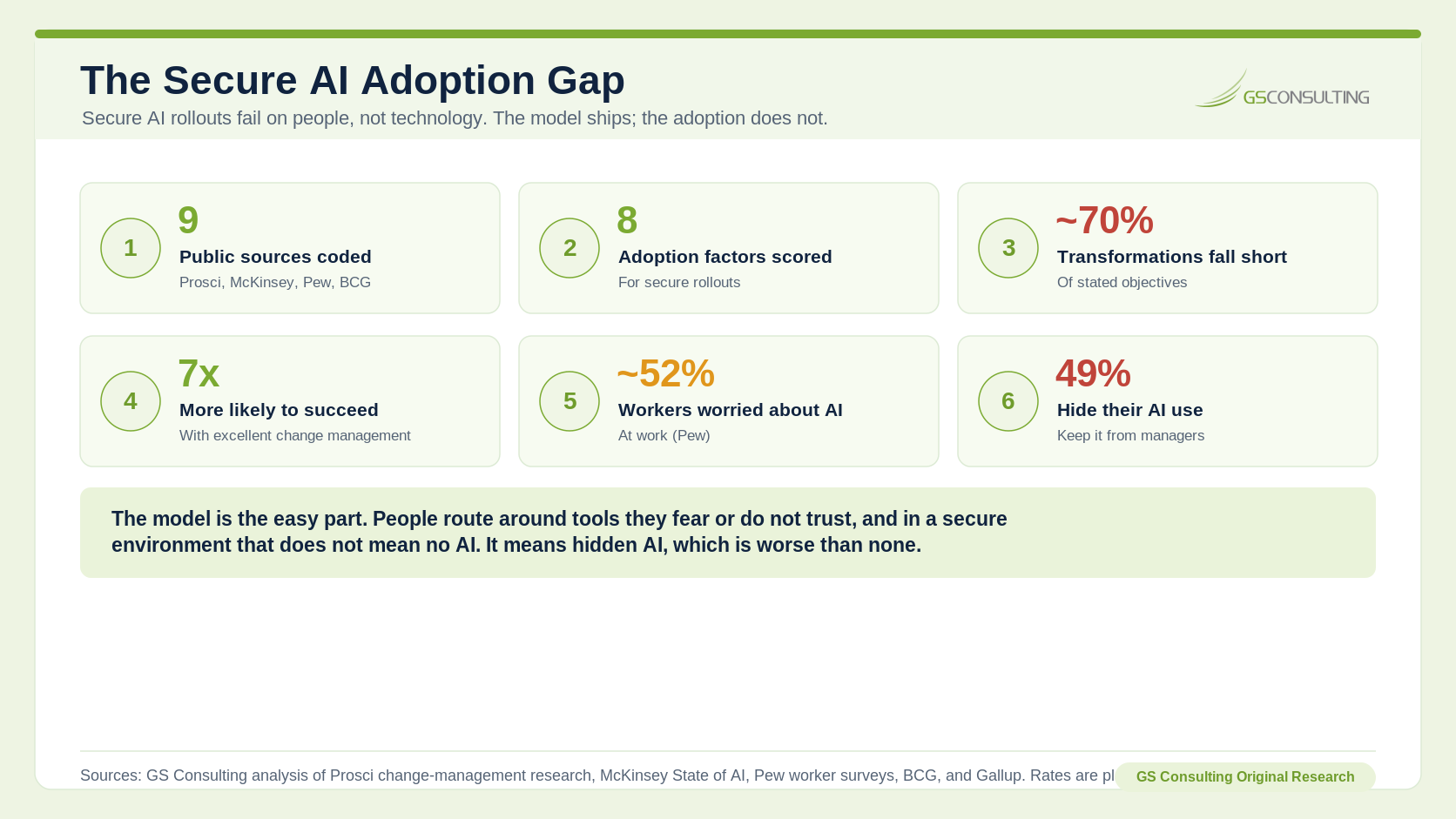
A secure AI rollout is a behavior change, not a software install
Launch is not adoption
A secure platform can pass review and still become shelfware if people fear it, distrust it, or find it harder than the tools they already use.
Bad adoption creates hidden AI
When users avoid the sanctioned tool, they often move to unapproved AI on personal accounts. That turns adoption failure into a data control problem.
The secure path has to be easy
Change management works when it names the why, addresses fear, redesigns the workflow, builds confidence, and makes the approved tool the path of least resistance.
The model is the easy part.
You can procure a secure AI platform, wire it into the environment, pass the security review, and launch it. You can still get almost nothing for it because the people it was built for quietly decide not to use it the way you intended.
That is the trap in secure AI rollouts. The organization treats a change in how people work as if it were a software install. A secure AI rollout is a behavior change wearing a technology costume, and behavior does not change because someone sent an announcement.
In a normal company, poor AI adoption means people keep doing things the old way. That is wasteful, but usually not a breach. In a regulated or mission critical environment, people who do not trust or do not know how to use the sanctioned tool may use whatever AI they can reach from their browser, on a personal account, with whatever data the task requires.
This article is about closing that gap: getting people to actually adopt the secure tool instead of routing around it. Change management is not a communications plan bolted onto the end of a project. It is designed from the start: name why the change is happening, address the fear honestly, redesign the work, build confidence through training, lead by example, and make the secure path the easy path.
Launching secure AI but worried no one will use it?
GS Consulting helps program managers and operations leaders drive adoption of secure AI: stakeholder and fear mapping, workflow redesign, role specific training, leadership engagement, and adoption measurement that proves the rollout landed and shadow AI is shrinking.
Request a Secure AI Adoption AssessmentWhat Actually Stops Adoption
Resistance is not random. It comes from specific barriers, and knowing which ones dominate tells leaders where to put effort.
Fear that AI threatens jobs ranks first because it is powerful and rarely spoken out loud. A person who suspects a tool is there to replace them will not help it succeed. No training or confidence ranks second because it is common and fixable. Distrust of output ranks third because users have seen AI be confidently wrong, and a tool people cannot trust for important work gets used only for trivial work.
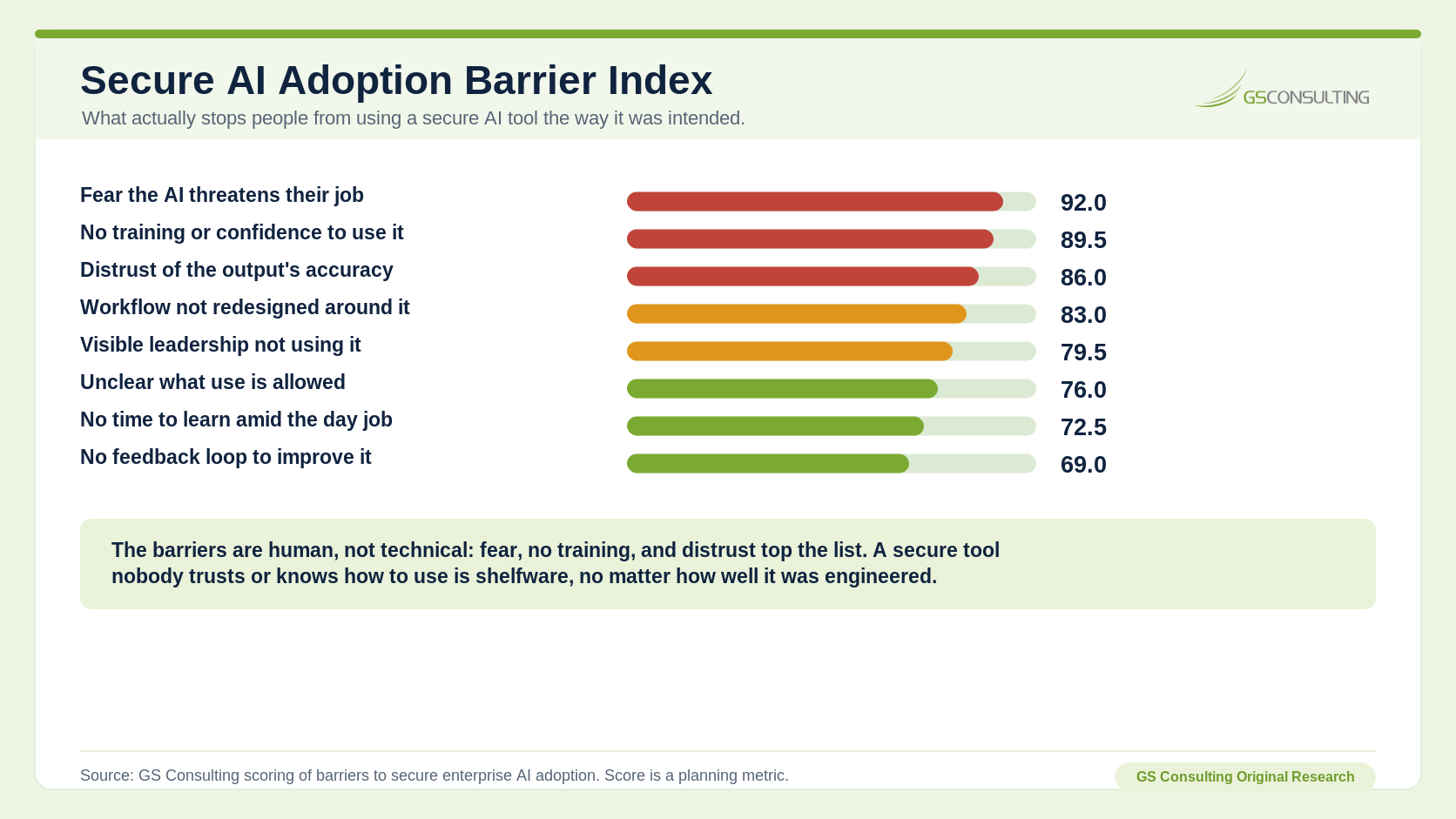
The Secure AI Adoption Barrier Index is a GS Consulting derived planning metric. It is not a measurement of any specific workforce.
What Poor Change Management Actually Costs
The cost of botching adoption in a secure environment is not just a wasted tool. It is a set of compounding harms, several of which are security problems.
The worst cost is shadow AI replacing the secure tool. When the sanctioned tool is too hard, too distrusted, or too feared, people do not stop using AI. They use something else, without the security controls the organization built. Downstream from that is sensitive data leaving through hidden tools, which turns an adoption failure into a data exposure event.
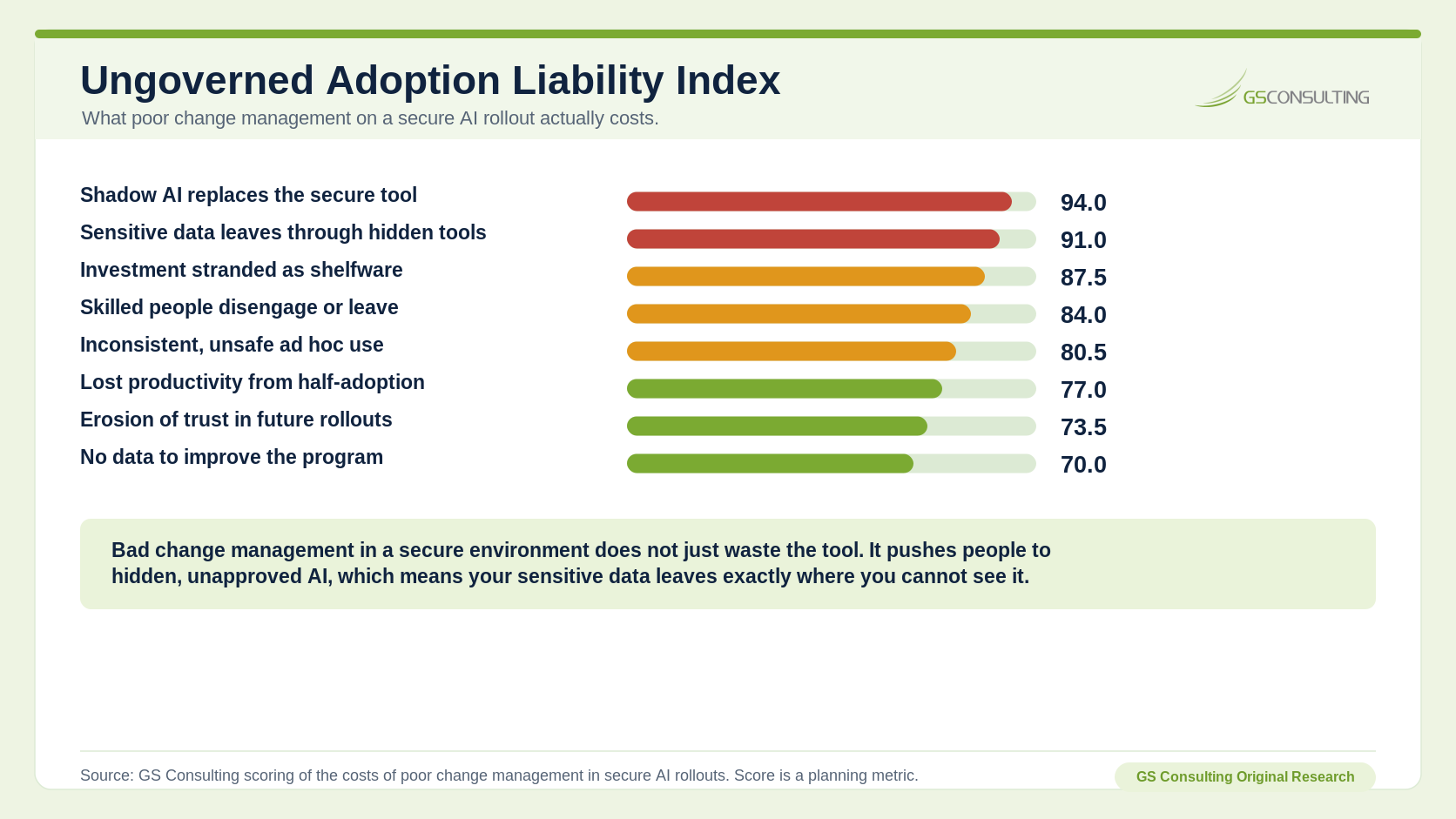
That inversion is what makes adoption a security discipline and not just an HR concern. A secure tool nobody uses can create the exact shadow AI problem it was meant to prevent. The Ungoverned Adoption Liability Index is a GS Consulting derived planning model, not a risk determination.
The Wrong Way to Roll Out Secure AI
The wrong way is to treat launch as the finish line.
The sequence is familiar. A team spends months selecting and securing an AI platform. The project plan treats go live as the goal. On launch day there is an announcement, a link to the tool, a recorded training video, and a policy document everyone is asked to acknowledge.
Then the project team moves on. A few enthusiasts adopt the tool. Most people open it once, find it unfamiliar, feel uncertain about what is allowed, do not trust the first answer, and quietly go back to the old workflow or the consumer AI tool they already know. Nobody reports this because nobody asks.
Months later, usage data shows a handful of active users, sensitive prompts are turning up in unapproved tools, and leadership concludes that the workforce is not ready for AI. In reality, the rollout was never managed past launch.
The Right Way: Design Adoption from the Start
The right way treats adoption as something engineered into the rollout from the beginning, with gates that address human barriers before they harden into resistance and workarounds.
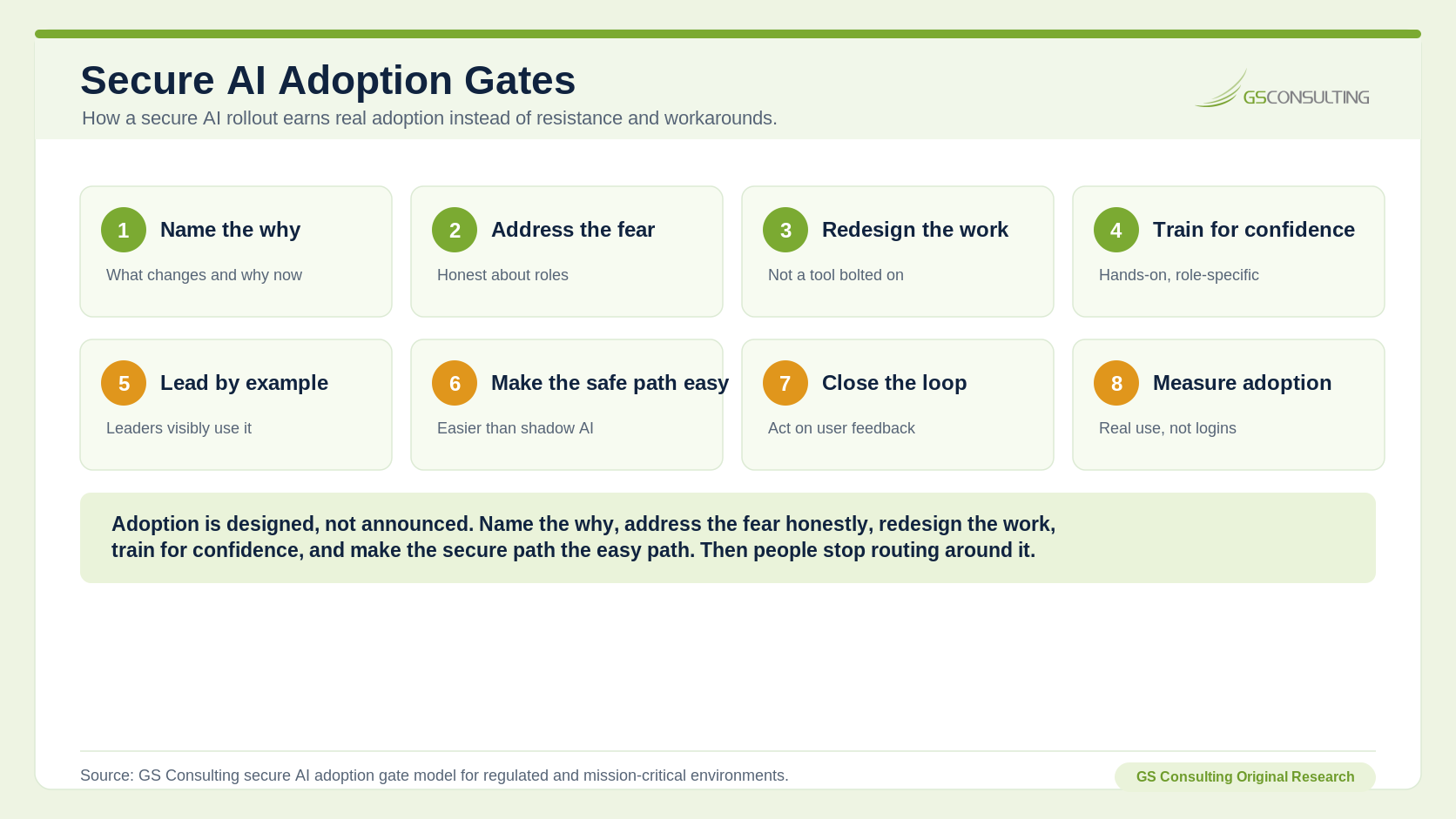
- Gate 1Name the why.
Tell people what is changing and why now, in terms of their work, not an executive strategy slide.
- Gate 2Address the fear.
Speak directly to the unspoken job security question. Avoiding it creates silent resistance.
- Gate 3Redesign the work.
Change the workflow around the tool instead of bolting AI onto the old process.
- Gate 4Train for confidence.
Deliver hands on, role specific training. Confidence turns curiosity into daily use.
- Gate 5Lead by example.
Get leaders visibly using the tool. A tool the boss ignores is a tool the team ignores.
- Gate 6Make the safe path easy.
Make the approved tool easier than the shadow alternative. Friction decides behavior.
- Gate 7Close the loop.
Collect user feedback and visibly act on it so the rollout improves instead of stalls.
- Gate 8Measure adoption.
Track real workflow use, not just accounts provisioned or launch activity.
A Little Math on the Adoption Multiplier
The economics of change management are direct because the same technology produces different returns depending on adoption.
Take a secure AI tool with a real potential to save one hour a day per user. If 80 percent of the team adopts it into daily work, the organization captures most of that potential. If the same tool launches with no change management and 20 percent adopt it, the organization captures a fraction of the value while paying the same license and implementation cost.
Same tool. Same security. Same license cost. The return differs by a factor of four or more, and the only variable is whether anyone managed adoption.
Now add the secure environment problem. In the poorly managed rollout, the users who did not adopt the secure tool may move to shadow tools. The bad rollout captures less value and creates a security liability. The managed rollout captures more value and shrinks shadow AI by giving people a secure path they actually prefer.
Change Management Moves, Ranked
Driving adoption is a set of moves, and they are not equally decisive. GS Consulting scored major change management moves on how reliably they turn a secure rollout into real adoption, how feasible they are, and how durable the effect is.
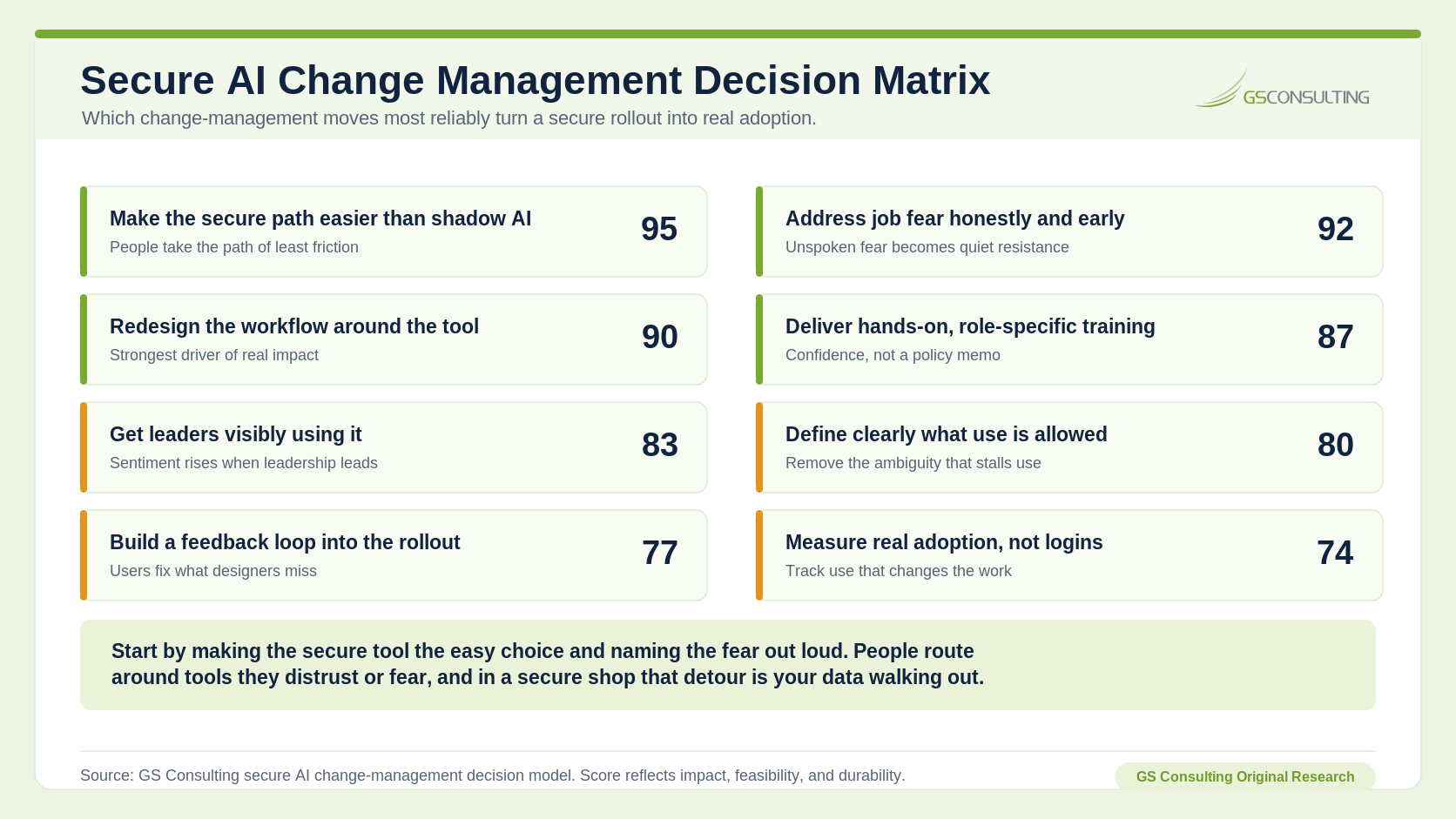
The highest scoring move is making the secure path easier than shadow AI because friction decides behavior. Addressing job fear honestly and early ranks just below it because unspoken fear is the largest source of silent resistance. Redesigning the workflow rounds out the top tier because it makes the tool feel like help instead of overhead.
The Secure AI Change Management Decision Matrix is a GS Consulting derived planning model, not a determination of outcomes.
The Evidence: What Managed Adoption Produces
A rollout that claims success without evidence of adoption is a launch deck, not a result. GS Consulting frames the output of a change management engagement as an evidence packet because a sponsor or program board will ask for proof that the rollout is actually landing.
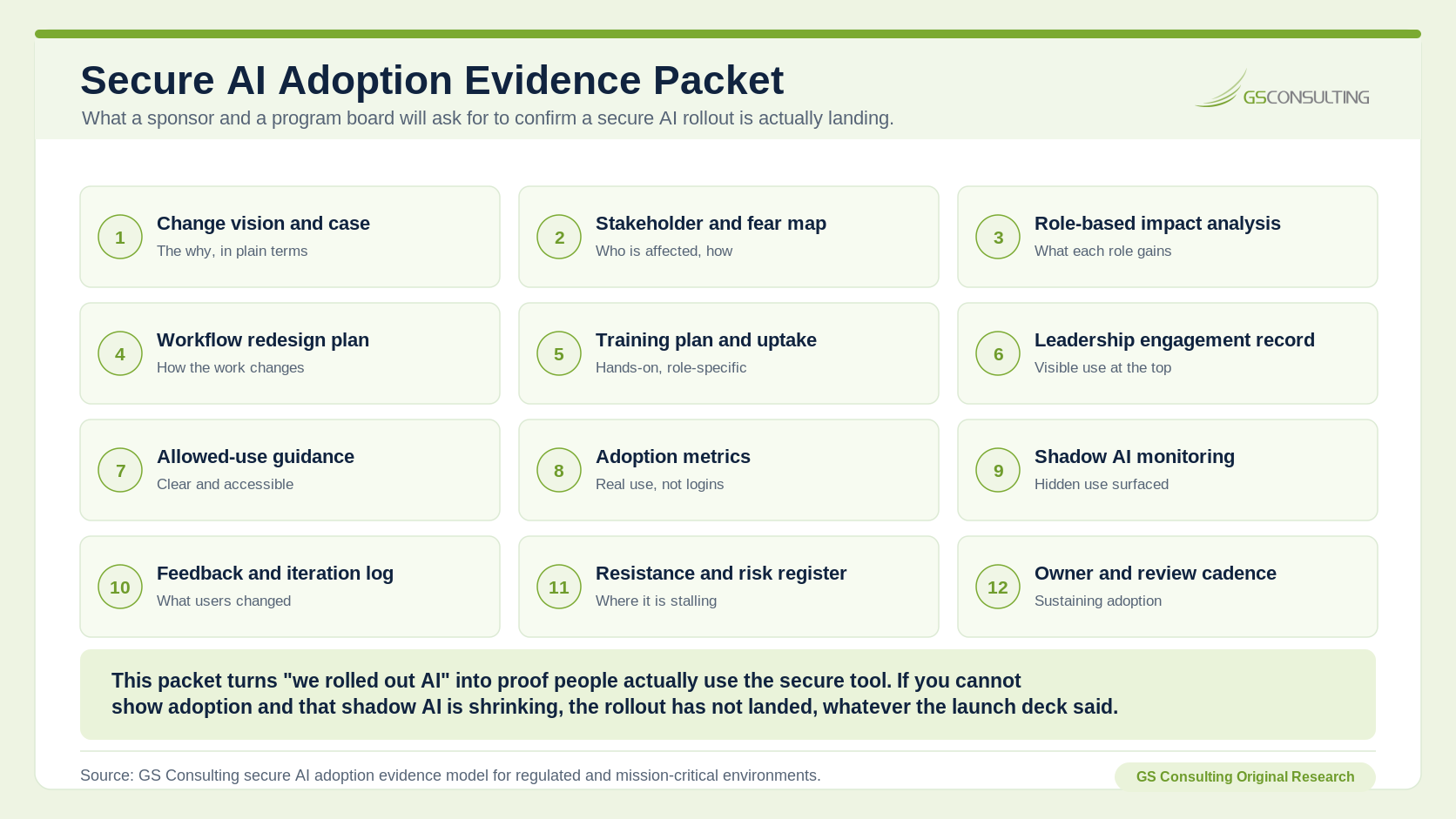
This packet shows the case for change, who was affected, how fears were addressed, how work was redesigned, who was trained, whether leadership modeled the behavior, how adoption is trending, and whether hidden AI use is going down. If adoption is not rising and shadow AI is not falling, the rollout has not landed.
The First 90 Days
- Days 1 to 14Map stakeholders and barriers.
Identify who is affected, where job fear exists, where friction will appear, and what the plain language case for change needs to say.
- Weeks 3 to 6Redesign work and train users.
Redesign priority workflows around the tool, deliver role specific training, and get leaders visibly using the same secure path.
- Week 7Make the safe path easy.
Remove friction, publish clear allowed use guidance, and make the sanctioned tool easier than the consumer alternative.
- Weeks 8 to 13Measure and improve.
Track real adoption, monitor shadow AI signals, open a feedback loop, act on the first round of input, and assign an owner for review cadence.
Ninety days does not complete the cultural shift. It gets the rollout past the failure points that decide whether it lives or dies.
Common Mistakes
- Treating go live as the finish line. Adoption work matters most after launch, when people either build the habit or route around it.
- Never addressing job fear. Silent resistance grows when leaders avoid the question everyone is already asking.
- Bolting AI onto unchanged workflows. If the tool feels like extra work, people will abandon it.
- Making the secure tool harder than a consumer app. Friction routes users and data toward shadow AI.
- Measuring seats instead of real use. Accounts provisioned do not prove the workflow changed.
How This Fits a Secure Enterprise AI Strategy
Change management is what makes a Secure Enterprise AI Strategy real in practice rather than on paper. The strategy decides which AI capabilities the organization will deploy and how. Change management gets people to actually use them, so the strategy produces adoption instead of shelfware and shadow AI.
It is also the human side of Developing a Phased Secure AI Adoption Roadmap. The roadmap sequences which capabilities go live in which order. Change management determines whether each phase is adopted or abandoned.
This article also connects to Enterprise AI Governance Frameworks for GovCon, Managing AI Vendor Risk in Regulated Industries, Enterprise AI Readiness Assessment, Measuring Enterprise AI ROI in Mission Critical Environments, and Building the Business Case for Secure Enterprise AI.
The Bottom Line
A secure AI rollout succeeds or fails on people, not technology.
You can deliver a fully secured platform and capture almost none of its value because the people it was built for fear it, distrust it, were never trained on it, or find it harder than what they already do. In an ordinary company that means wasted spend. In a secure environment it can mean something worse: users route around the sanctioned tool and sensitive data leaves through the channel the platform was supposed to close.
Change management prevents that. Name the why, address fear honestly, redesign the work, train for confidence, lead by example, and make the secure path the easy path. The technology sets the ceiling. Change management decides how close you get and whether your data stays inside the boundary on the way there.
Ready to make secure AI the tool people actually use?
GS Consulting helps program managers and operations leaders drive adoption of secure AI, from stakeholder and fear mapping through workflow redesign, role specific training, leadership engagement, and the adoption and shadow AI measurement that proves the rollout landed.
Request a Secure AI Adoption AssessmentResearch Sources and Caveats
This article draws on public 2024 through 2026 sources on change management and AI adoption, including Prosci research on change management effectiveness, long running transformation failure findings associated with major consulting research, McKinsey State of AI research on workflow redesign and high performers, Pew Research Center surveys on worker attitudes toward AI, Gallup polling on AI and jobs, and survey data on workers concealing AI use from managers.
The Secure AI Adoption Barrier Index, Ungoverned Adoption Liability Index, and Secure AI Change Management Decision Matrix are GS Consulting derived planning tools. They are scoring models built to help program managers and operations leaders prioritize change management work on secure AI rollouts. They are not measurements of any specific workforce, guaranteed outcomes, behavioral determinations, HR advice, or legal advice.
Frequently Asked Questions
Why do secure AI rollouts fail on adoption?
Secure AI rollouts fail on adoption because using a new tool is a behavior change, not a software install. People respond to fear, trust, habit, friction, and confidence. If the sanctioned AI tool feels risky, confusing, threatening, or harder than the old path, users either ignore it or route around it.
Why is secure AI adoption a security issue?
Secure AI adoption is a security issue because users who do not adopt the sanctioned tool may use unapproved AI tools instead. That can move sensitive data, CUI adjacent content, customer data, or internal records into tools the organization cannot see, govern, monitor, or audit.
Is training enough to drive secure AI adoption?
Training is necessary, but it is not enough. Training builds confidence, but it does not solve job fear, workflow friction, leadership signals, unclear allowed use, or weak feedback loops. Adoption improves when training is paired with workflow redesign, honest messaging, visible leadership use, and clear measurement.
How should organizations measure whether a secure AI rollout worked?
Organizations should measure real workflow adoption, not just seats, logins, or launch activity. Useful metrics include recurring active use by role, workflows changed, time saved, user confidence, training uptake, feedback closure, approved tool usage, and whether shadow AI use is shrinking.
Related Reading
- Secure Enterprise AI Strategy
- Shadow AI Discovery and Remediation Strategy
- Developing a Phased Secure AI Adoption Roadmap
- Enterprise AI Governance Frameworks for GovCon
- Enterprise AI Readiness Assessment
- Measuring Enterprise AI ROI in Mission Critical Environments
- Building the Business Case for Secure Enterprise AI
- Managing AI Vendor Risk in Regulated Industries