Enterprise AI Strategy | | 24 min read
Aligning Enterprise AI Strategy with CMMC and NIST

Key Takeaways
AI that touches CUI becomes a compliance system
AI Moves CUI
An AI system that reads, summarizes, or generates CUI creates a data path your SSP has to describe and your controls have to cover.
The Boundary Matters
CUI handling AI belongs inside an authorized environment, with scoped access, logging, output handling, and control mapping.
Evidence Decides
Assessors need records: inventory, data classification, control mapping, logs, SSP entries, vendor evidence, and review cadence.
Your AI strategy and your CMMC certification are not two separate programs. Most contractors treat them as if they are. The AI initiative lives with a CIO or innovation team chasing productivity, and CMMC lives with a compliance lead chasing a certificate. Then the AI tool everyone likes starts touching Controlled Unclassified Information, and the two programs collide.
The uncomfortable truth is simple: the moment an AI system can read, summarize, or generate CUI, it is no longer only an AI question. It is a System Security Plan question. It lands inside the same NIST SP 800 171 controls your assessor is going to grade.
This matters because the clock is real. The CMMC acquisition rule took effect in November 2025, and the requirement is rolling into DoD contracts on a phased schedule that runs through 2028. Many contractors will need Level 2 certification to keep handling CUI. At the same time, enterprise AI and shadow AI are spreading through work that compliance teams may not even know exists.
Aligning AI with CMMC means designing your AI rollout so every system touching CUI is mapped to the right controls, documented in your SSP, and ready to defend in an assessment before it goes live. Done right, AI strategy and compliance reinforce each other. Done the common way, the AI program quietly creates findings that reset your certification timeline.
The Core Problem: AI Moves CUI, and Your SSP Has to Know
The reason AI and CMMC cannot stay in separate lanes is that AI is a new data pathway. An enterprise AI system reads from repositories, processes what it finds, produces new content, and often sends data somewhere to do it. Every one of those steps is something NIST SP 800 171 has an opinion about.
The standard has 110 security requirements and 320 assessment objectives across 14 control families in the revision CMMC currently assesses against. A meaningful share of those requirements are about precisely the things AI changes: who can access CUI, whether you can prove what happened to it, and whether it stayed inside an authorized boundary.
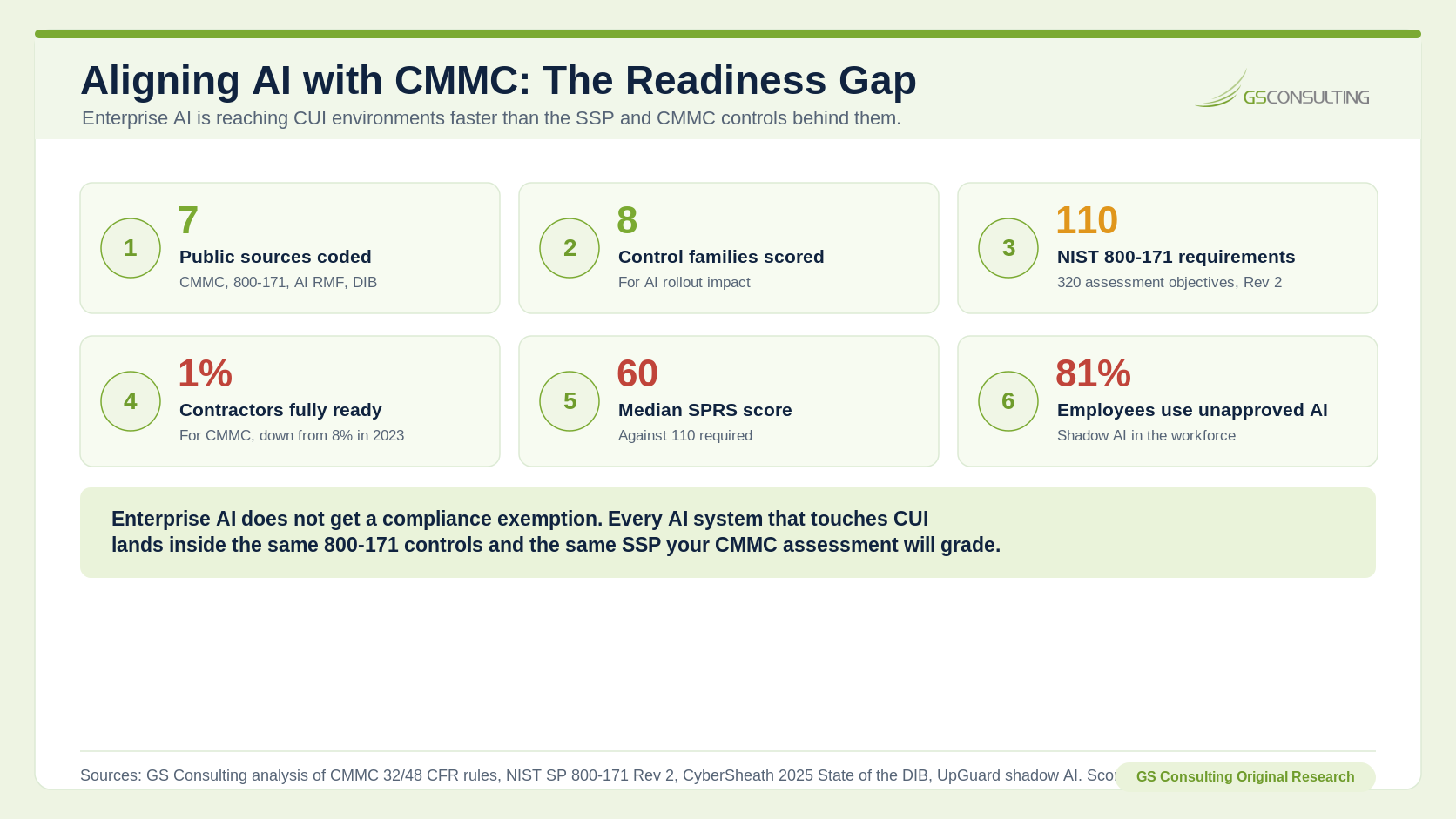
Three failure patterns follow from treating AI as separate from compliance. The first is boundary leakage: CUI flows into an AI tool that runs in an environment your authorization never covered. The second is the invisible system: AI tools get adopted faster than security documents them, so the SSP no longer matches reality. The third is CUI propagation: the AI produces a summary, analysis, or draft derived from CUI, and that output is itself CUI, but nobody marks or handles it that way.
None of these is a model problem. They are alignment problems. They come from running the AI program and the compliance program as if they were strangers.
Which Controls AI Actually Disturbs
Not every control family feels an AI rollout equally. Some are hit hard because AI directly changes how they work; others are barely touched. GS Consulting scored the NIST SP 800 171 control families by how much a typical enterprise AI deployment disturbs them.
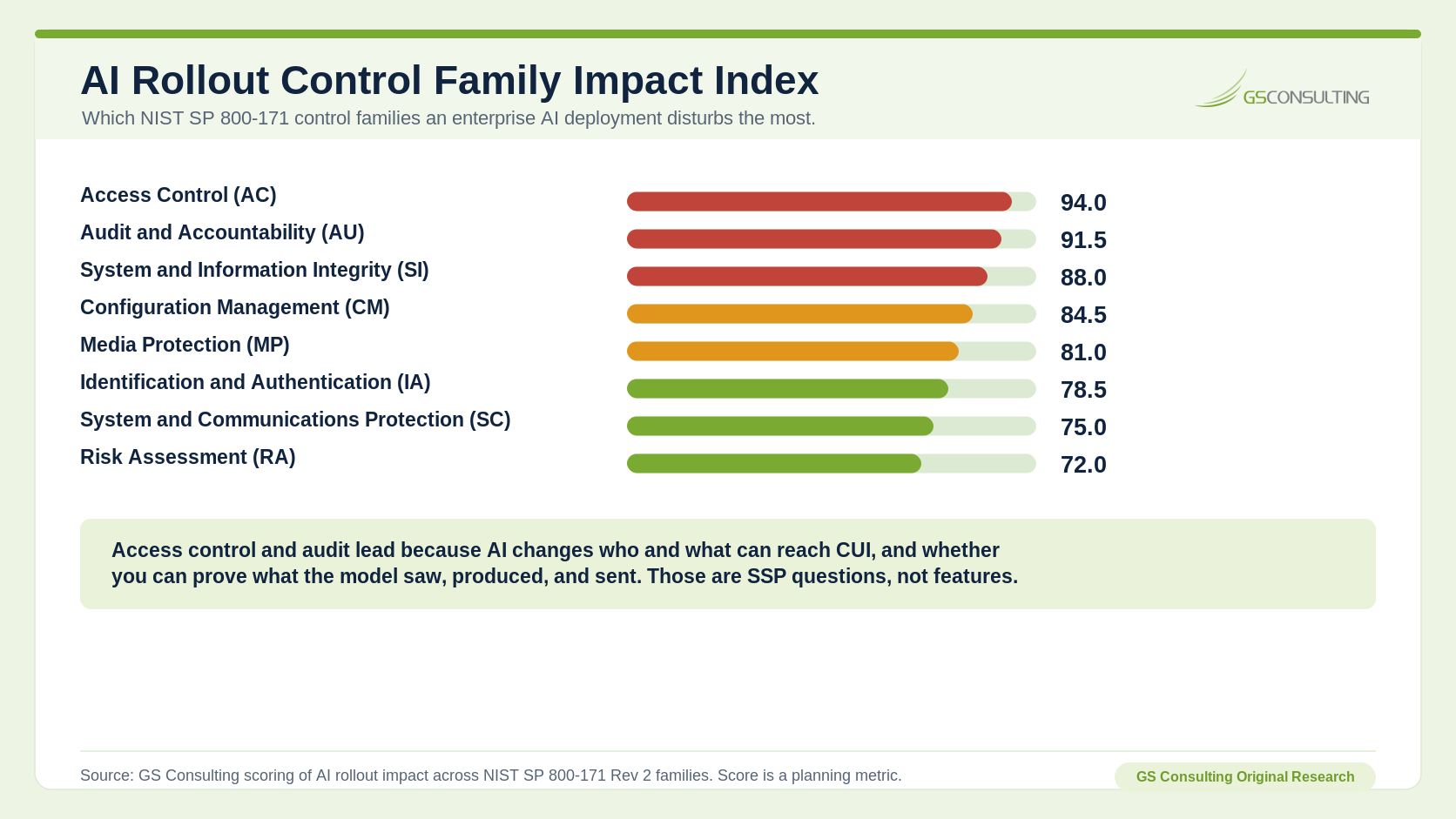
Access Control ranks first because AI fundamentally changes who and what can reach CUI. An AI system is a new non human actor with its own access, and a poorly scoped model can read across repositories far more broadly than any single user should. Audit and Accountability ranks second because AI breaks the assumption that you can reconstruct what happened unless prompts, sources, outputs, and actions are logged. System and Information Integrity ranks third because AI introduces new ways for information to be wrong, manipulated, or trusted too quickly.
A few numbers worth putting in front of a compliance committee:
- 110 security requirements in NIST SP 800 171 Rev 2, with 320 assessment objectives behind them.
- 94.0 control family impact score for Access Control, the family an AI rollout disturbs most.
- About 1 percent of contractors reporting full readiness for CMMC in recent DIB research.
- About 60 median self reported SPRS score in the DIB, against the 110 the standard requires.
- About 81 percent of employees using AI tools the organization has not approved.
(The AI Rollout Control Family Impact Index is a GS Consulting derived planning metric. It is not an official NIST, DoD, or CMMC determination.)
Rolling out AI while preparing for CMMC?
GS Consulting helps government contractors align enterprise AI with NIST SP 800 171 and CMMC: AI system inventory, data boundary design, control family mapping, SSP integration, and the audit evidence assessors require.
Request an AI Compliance Alignment AssessmentWhat Ungoverned AI Actually Costs Your Certification
The risk of running AI outside your compliance program is not abstract. It shows up as specific conditions that accumulate until an assessor or an incident surfaces them. GS Consulting scored the conditions that most threaten an SSP and a CMMC timeline once AI is in the environment.
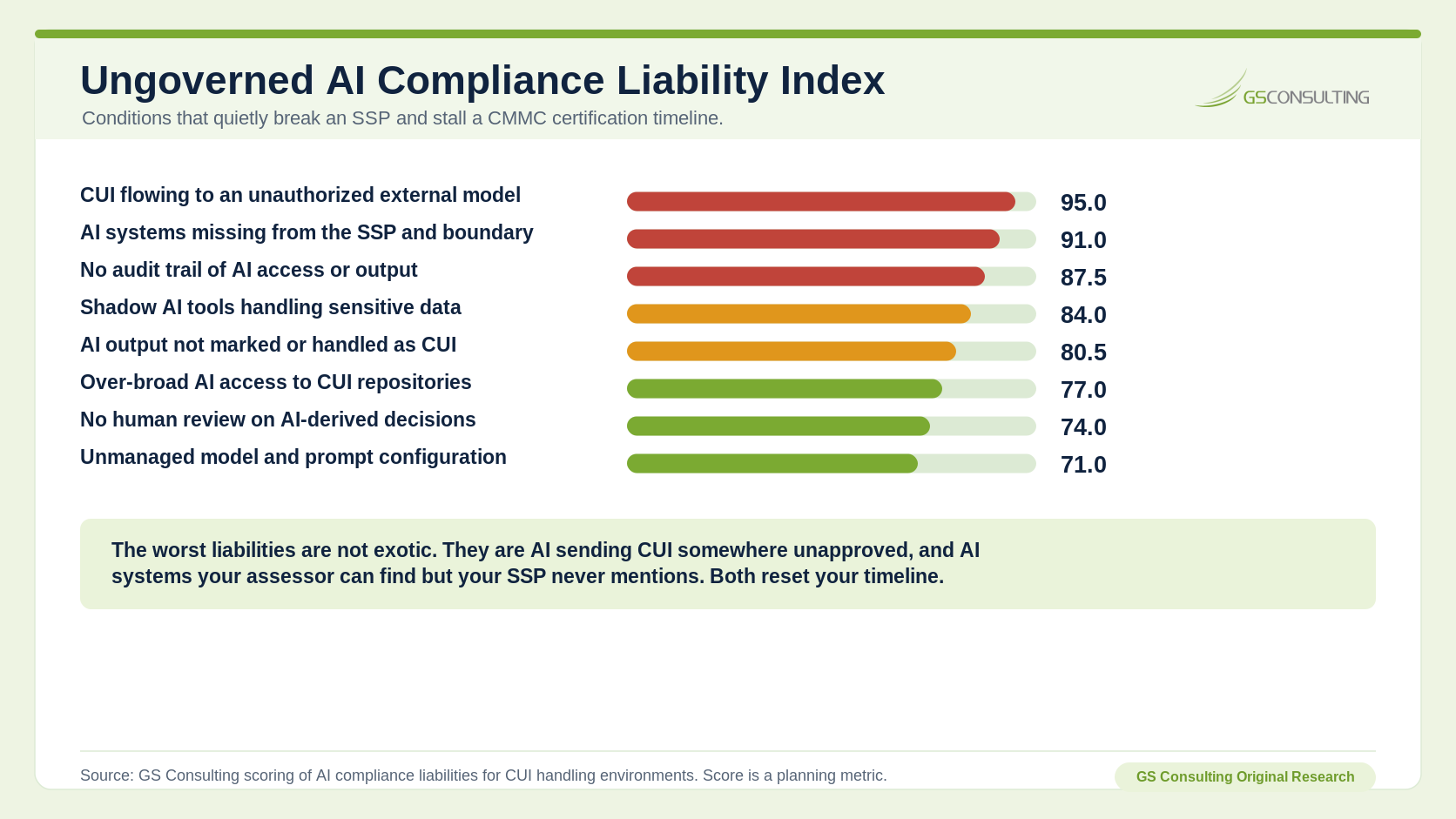
The worst condition is CUI flowing to an unauthorized external model. The instant CUI enters a commercial AI tool outside your boundary, that data has left your authorized environment and entered another party's system. Close behind is AI systems missing from the SSP, because an SSP that does not describe systems an assessor can find is inaccurate by definition. The absence of an audit trail ranks third, because without it you cannot prove any of your AI controls are actually working.
The top liabilities are not about AI being unintelligent. They are about AI being unmapped: sending data where it should not, existing where the SSP does not look, and acting without a record. That is the part alignment controls.
The Wrong Way to Combine AI and Compliance
The wrong way is to run them on separate tracks and hope they never meet. They always meet.
An innovation team pilots a useful AI tool against real work. To make the demo land, they feed it real documents, some of which are CUI. The tool runs in a commercial environment that was never part of any authorization boundary. Nobody tells the compliance lead, because the team thinks this is an AI project, not a CUI project. The pilot succeeds, so it spreads. Six months later, the assessor asks about AI tools employees are using. None of them are in the plan. Some have been sending CUI to an external model the whole time.
The certification that looked on track is now blocked behind spillage review, system discovery, and an SSP rewrite. That is the most expensive moment to learn what AI was running.
The Right Way: Align Each AI Use Case to the Controls First
The right way treats every AI use case as something that must earn its place inside the CUI boundary by passing through alignment gates before it touches sensitive data, and by staying aligned afterward.
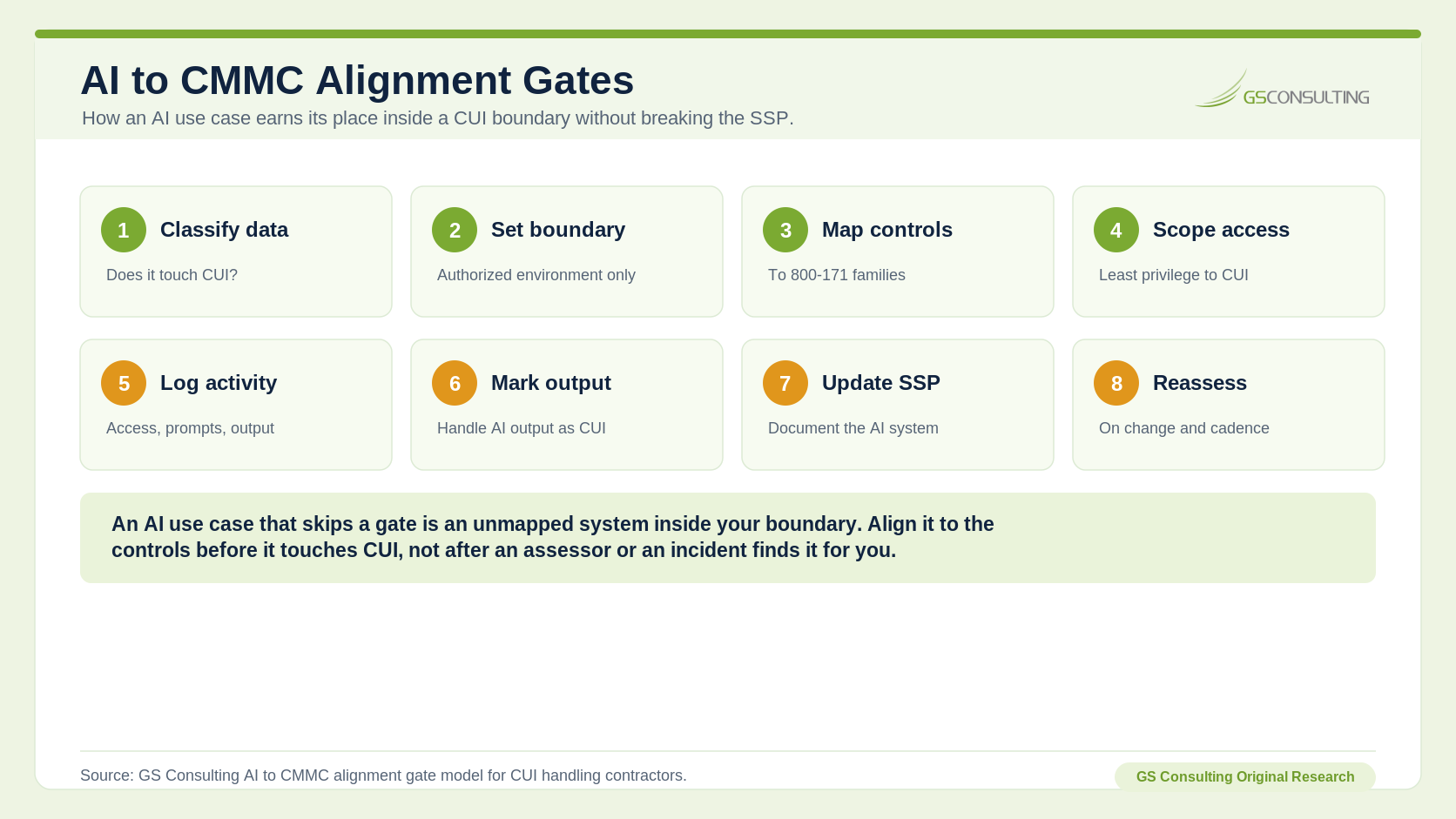
- Gate 1Classify data.
Determine whether the use case touches CUI before tool selection or pilot design. The answer changes every downstream control decision.
- Gate 2Set the boundary.
If the use case touches CUI, run it only inside an authorized environment your boundary covers.
- Gate 3Map controls.
Map the use case to the NIST SP 800 171 families it implicates, starting with access control, audit, integrity, and configuration management.
- Gate 4Scope access.
Give the AI system least privilege access to CUI, scoped to exactly what the task requires.
- Gate 5Log activity.
Log access, prompts, sources, outputs, and actions with enough detail to reconstruct what happened.
- Gate 6Mark output.
Mark and handle AI output derived from CUI as CUI so sensitive data does not propagate into unprotected places.
- Gate 7Update the SSP.
Document the AI system in the SSP, including where it runs, what it accesses, and how it is controlled.
- Gate 8Reassess.
Review alignment on a set cadence and whenever the model, data, workflow, vendor, or use case changes.
A Little Math on the Hidden Compliance Exposure
The exposure from unaligned AI compounds, which is why it surprises organizations at the worst moment.
Take a contractor with five teams, each quietly using two or three unapproved AI tools. That is a dozen or more AI systems touching company data, several of them almost certainly brushing up against CUI, none of them in the SSP. If those tools run in commercial environments and nobody logs what goes in or out, every CUI document an employee pastes is a potential spillage event with no record.
Now apply alignment. Inventory means you know the tools exist. Data classification tells you which ones actually touch CUI. Boundary control pulls those back into authorized environments. Logging makes access reconstructable. SSP integration makes the plan match reality. You did not slow the AI program to a crawl. You turned invisible liabilities into a known, bounded, documented set of systems.
Alignment Moves, Ranked
Aligning AI to CMMC is a series of moves, and they are not equally valuable. GS Consulting scored the major alignment moves on how much they protect the SSP and timeline, how feasible they are, and how durable the benefit is.
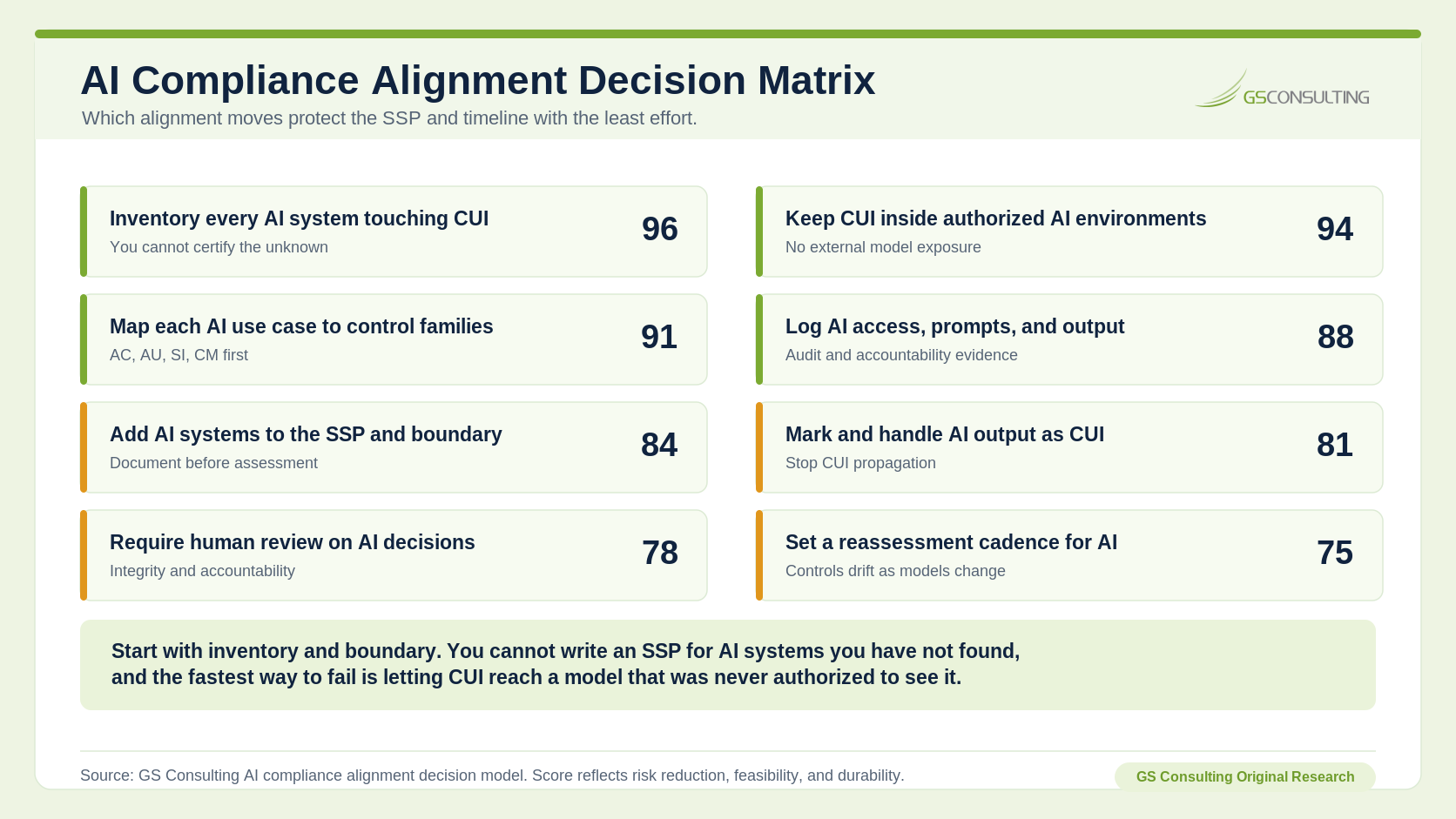
The highest scoring move is inventorying every AI system that touches CUI, because it is the precondition for everything else. Keeping CUI inside authorized environments ranks just below because it prevents the most damaging liability. Control mapping and logging round out the top tier because together they make every AI system both compliant by design and provable in an assessment.
The Evidence: What Alignment Produces
In a CMMC environment, doing AI well is not enough; you have to be able to show it. GS Consulting frames the output of an alignment engagement as an evidence packet because that is what a C3PAO assessor and a prime contractor's security team will ask for before they accept AI inside a CUI boundary.
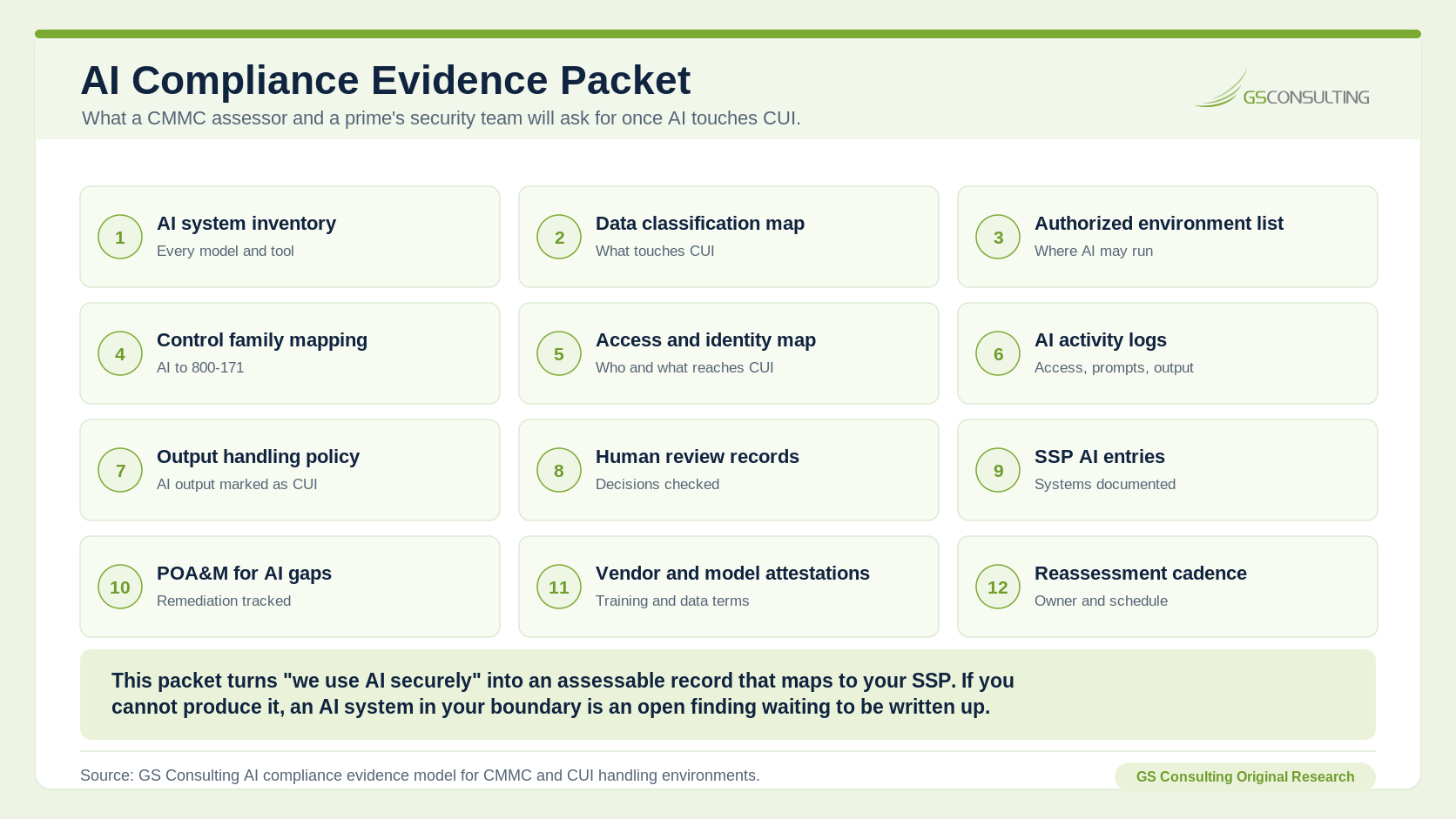
This packet shows what AI systems exist, which touch CUI, where they run, what they access, how they are logged, how their output is handled, and how the whole thing stays current. If you cannot produce something like this, an AI system inside your boundary is not an asset. It is an open finding waiting to be written up.
The First 90 Days
If you are a CISO or executive who suspects your AI footprint has outrun your compliance documentation, here is a realistic sequence.
- Weeks 1 to 2Discover and inventory.
Find every AI tool in use, sanctioned or not, and flag which ones could plausibly touch CUI.
- Weeks 3 to 6Classify and bound.
Classify the data each tool handles, pull CUI touching tools into authorized environments, and shut down the worst external exposure paths.
- Week 7+Log and map controls.
Turn on logging for AI systems that remain in the boundary and map each one to its NIST SP 800 171 control families.
- Final stretchUpdate SSP and cadence.
Document AI systems in the SSP, open POA&M items for gaps, and define the reassessment cadence that keeps alignment current.
Ninety days does not create a fully mature certified AI program. It gives you a known, classified, bounded AI footprint with the worst compliance liabilities closed and the rest documented in the SSP.
Common Mistakes
- Running AI and CMMC on separate tracks. The two only meet during assessment prep, when the cleanup is most expensive.
- Piloting AI on real CUI in commercial environments. Fast demos can create spillage risk and boundary violations.
- Letting the SSP drift away from reality. AI tools adopted faster than documentation become systems the plan does not describe.
- Treating AI output as ordinary content. Output derived from CUI can inherit CUI handling requirements.
- Assuming existing policies cover unapproved AI. Policy language does not control tools security has never inventoried or logged.
Every one of these is the same root error: treating AI as an innovation project rather than a change to how CUI moves through the organization. An aligned AI use case is mapped, bounded, logged, and documented before it touches sensitive data.
How This Fits a Secure Enterprise AI Strategy
Aligning AI with CMMC is the compliance backbone of a larger program. It is where a Secure Enterprise AI Strategy stops being an aspiration and becomes defensible in front of an assessor. The strategy decides which AI capabilities are worth pursuing, and CMMC alignment is how each one is mapped to controls, kept inside the boundary, and documented in the SSP.
It also depends on knowing where you actually stand, which is the subject of Enterprise AI Readiness Assessment. Readiness tells you what your data, controls, and evidence can support. CMMC alignment wires the approved use cases into your compliance posture without creating findings.
This article also connects directly to AI Agent Lifecycle Management and Oversight, CMMC Readiness Checklist for Government Contractors, Preparing AI Systems for CMMC Assessment, Mapping AI Automations to NIST SP 800 171 Controls, AI Access Controls and Permission Design, and AI Audit Trails and Activity Logging.
The Bottom Line
Enterprise AI and CMMC are not separate programs. The moment an AI system touches CUI, it lands inside your SSP and the same NIST controls your assessor will grade, whether or not anyone documented it. Run the two programs blind to each other and AI quietly creates spillage, undocumented systems, missing audit trails, and timeline risk.
Alignment closes that gap by making every AI use case earn its place in the boundary: classified, scoped, logged, mapped to controls, documented in the SSP, and reassessed as it changes. Do that, and your AI program becomes evidence of a mature environment. Skip it, and you are running undocumented data pathways through CUI that an assessor will eventually find.
Ready to make your AI program a CMMC asset instead of a finding?
GS Consulting helps government contractors and regulated organizations align enterprise AI with NIST SP 800 171 and CMMC, from AI system inventory and boundary design through control mapping, logging, SSP integration, and assessment evidence.
Request an AI Compliance Alignment AssessmentResearch Sources and Caveats
This article draws on public 2024 through 2026 sources on CMMC and NIST compliance, including the CMMC 32 CFR program rule, the 48 CFR acquisition rule and phased rollout, NIST SP 800 171 Rev 2 and Rev 3, the NIST AI Risk Management Framework, DoD guidance on AI and CUI handling, the CyberSheath 2025 State of the DIB report, and industry reporting on shadow AI usage.
The AI Rollout Control Family Impact Index, Ungoverned AI Compliance Liability Index, and AI Compliance Alignment Decision Matrix are GS Consulting derived planning tools. They are not official NIST, DoD, CMMC, C3PAO, legal, or audit determinations. Treat the scores as planning inputs, not certified measurements.
Frequently Asked Questions About Aligning AI with CMMC
Does using AI change my CMMC obligations?
AI changes which systems are in scope, not the standard itself. When an AI system can access, process, or generate CUI, it becomes part of the environment your SSP must describe and your assessment will evaluate against NIST SP 800 171.
Can we use a commercial AI tool with CUI?
Not unless the tool is inside an authorized environment and covered by the required security, contract, and data handling controls. CUI entered into a public or commercial AI endpoint outside the approved boundary can create a spillage event and reporting obligation.
Is AI output considered CUI?
Often, yes. If an AI system produces a summary, analysis, or draft derived from CUI, that output generally inherits the sensitivity of the source data and needs the same marking, handling, access control, and retention discipline.
Which NIST SP 800 171 control families does AI affect most?
AI most directly affects access control, audit and accountability, system and information integrity, configuration management, identification and authentication, system and communications protection, media protection, and risk assessment.
Should contractors pause AI if their SPRS score is low?
Not necessarily, but they should align it before scaling. Inventory AI use, classify data, pull CUI handling tools into the boundary, add them to the SSP, log their activity, and convert approved use cases into evidence of a maturing program.
Related Reading
- Secure Enterprise AI Strategy
- AI Agent Lifecycle Management and Oversight
- Enterprise AI Readiness Assessment
- CMMC Readiness Checklist for Government Contractors
- Preparing AI Systems for CMMC Assessment
- Mapping AI Automations to NIST SP 800 171 Controls
- AI Access Controls and Permission Design
- AI Audit Trails and Activity Logging
- Preventing CUI Leakage in LLMs