Enterprise AI Strategy | | 27 min read
Aligning AI Strategy with Legacy IT Modernization
Key Takeaways
Sequence AI around the legacy foundations each workflow needs.
Find the workflow constraint
Map the systems and handoffs behind the operational problem before selecting an AI tool.
Repair the foundations
Address data quality, permissions, integrations, and security before scaling AI.
Modernize selectively
Use the modernization ladder to fix the dependencies that block the chosen workflow.
You cannot layer modern AI on top of broken legacy systems and expect transformation.
Use the enterprise AI process transformation hub to connect the modernization sequence to workflow delivery. The legacy system integration service supports assessment and implementation of the dependencies that need attention.
You may get a demo. You may get a pilot. You may get a chatbot that answers a few questions.
But you will not get secure enterprise AI at scale.
AI strategy and legacy IT modernization are not two separate conversations. They are the same conversation. If your systems are fragmented, your data is unreliable, your permissions are messy, your integrations are brittle, and your security controls are inconsistent, AI will not magically fix that.
It will expose it.
Need to know which legacy systems are blocking your AI strategy?
GS Consulting helps CIOs, enterprise architects, and GovCon leaders align AI strategy with legacy modernization, workflow mapping, data readiness, integration design, secure architecture, and implementation roadmaps.
Request an AI Modernization AssessmentThe Real Problem Is Not AI
Most AI strategy discussions start in the wrong place.
They start with the model. Which platform should we use? Which assistant should we deploy? Which vendor has the best demo? Should we build or buy? Should we use public AI, private AI, or hybrid AI?
Those are useful questions later.
The first question should be simpler: can our current systems support secure AI without creating more risk than value?
For many organizations, the honest answer is no.
The data is spread across old systems, shared drives, email, spreadsheets, custom apps, disconnected cloud tools, and department specific repositories. Some systems do not have clean APIs. Some do not support modern identity controls. Some have poor logging. Some contain mixed sensitivity data. Some depend on people who know how the process works because the system itself does not.
That is not an AI problem. That is a modernization problem.
Why Legacy Systems Break AI Strategy
Legacy systems break AI strategy in predictable ways.
They trap data. They weaken access control. They make integration expensive. They create duplicate records. They hide business rules. They limit audit trails. They increase security risk. They make workflows harder to measure. They force employees into manual workarounds.
AI depends on clean data, controlled access, reliable integration, and traceable workflows. Legacy systems often provide the opposite.
That does not mean every legacy system must be replaced before AI starts. That is not realistic. But it does mean CIOs and enterprise architects need to sequence AI and modernization together.
If the AI roadmap ignores legacy architecture, it will eventually hit a wall.
Original Research: The Legacy to AI Modernization Dependency Index
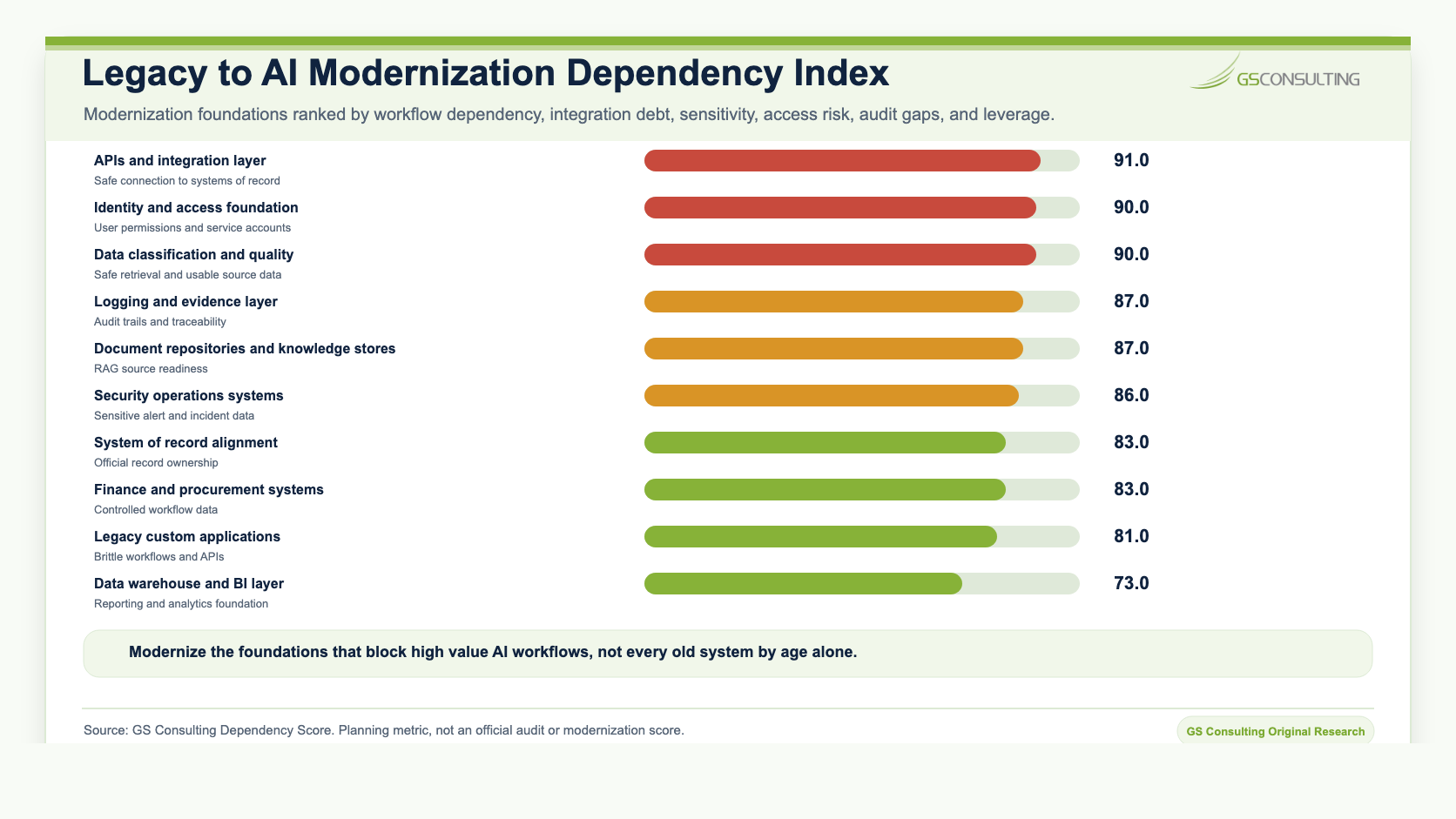
Original GS Consulting research shows that legacy modernization for AI should be sequenced by workflow dependency, not system age.
GS Consulting analyzed public legacy modernization, AI adoption, integration, cybersecurity, and governance sources to create a Legacy to AI Modernization Dependency Index. The highest scoring modernization foundations were APIs and integration, identity and access, data classification and quality, logging and evidence, document repositories and knowledge stores, security operations systems, system of record alignment, finance and procurement systems, and legacy custom applications.
The research reinforces a practical point: AI strategy does not fail only because the model is weak. It fails when the environment underneath AI cannot support clean data, controlled access, reliable integration, source ownership, audit trails, CUI boundaries, system of record updates, and monitoring.
Wrapping a legacy system with AI can buy time, but it is not the same as modernizing the foundation.
This Is Not Theoretical
Legacy modernization is a real operating issue in government and regulated environments.
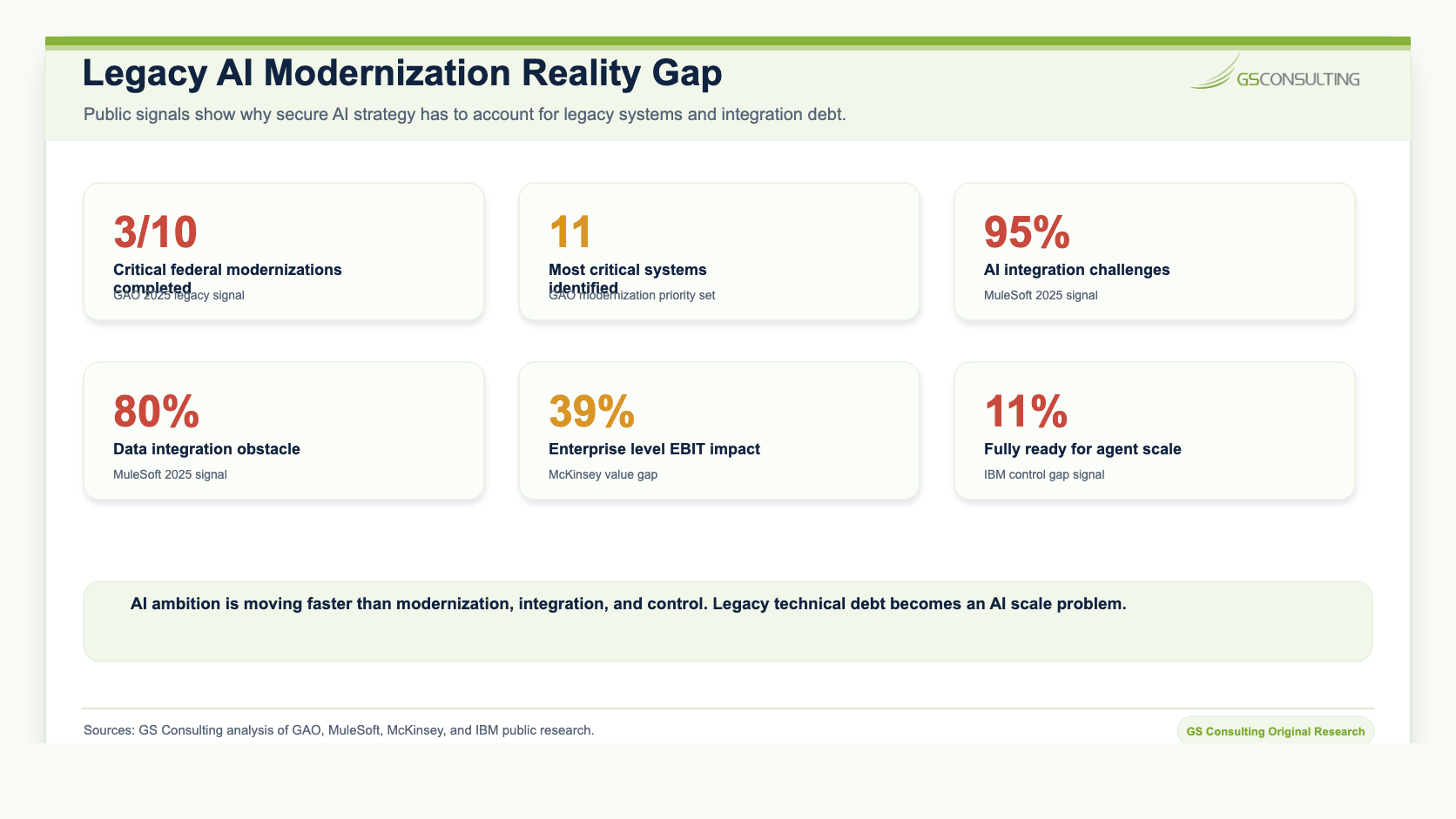
GAO reported in July 2025 that federal agencies had completed only three of ten critical legacy IT modernizations originally identified in 2019. GAO also reviewed 69 additional legacy systems submitted by major federal agencies and identified 11 most in need of modernization based on factors such as age, vendor support, cybersecurity risk, legacy programming languages, and operating costs.
That matters for GovCon because contractors often operate inside or around these same kinds of environments. They inherit customer data constraints, interface limitations, manual reporting requirements, legacy integrations, and security expectations.
CISA's Secure by Design guidance also reinforces that software, including AI software, should be designed with security built in rather than bolted on later. In plain English: do not bolt AI onto weak architecture and call it innovation.
The Wrong Way to Approach AI Modernization
The wrong approach is easy to recognize. A leader wants AI adoption. A vendor shows a tool. The team connects the tool to documents, tickets, or records. Employees start using it. The system produces useful summaries.
Then the questions arrive.
- What data did it access?
- Can it see CUI?
- Can it see employee data?
- Can it retrieve restricted records?
- Does it respect document permissions?
- Where are prompts and outputs stored?
- Can the vendor use the data?
- Can we audit what happened?
- What system owns the final record?
- Who approves the AI output?
If those questions come after deployment, the strategy is already behind.
The Right Way: Sequence the Work
AI modernization should be sequenced in a way that protects the business. Not every system needs to be rebuilt first. But every AI use case should be matched to the maturity of the systems and data it depends on.
Stage 1: Find the Workflow Pain
Start with the workflow, not the technology. Good candidates often include IT ticket triage, contract review support, compliance evidence collection, operations reporting, customer support drafts, invoice exception review, security alert summaries, HR policy support, proposal content search, and vendor questionnaire response.
The goal is to identify workflows where people are wasting time, errors are happening, decisions are delayed, or compliance evidence is hard to prove.
Stage 2: Map the Systems Behind the Workflow
Once you pick a workflow, map the systems it touches. Contract review may touch the contract repository, SharePoint, email, CRM, finance, legal records, and customer folders. IT ticket triage may touch the ticketing system, identity provider, asset inventory, endpoint tools, knowledge base, and change records.
This map matters because AI value depends on integration. If the data is locked in systems that cannot connect safely, the AI use case may require modernization first.
Stage 3: Assess Legacy System AI Readiness
Every system in the workflow should be assessed for AI readiness. Does it have clean APIs? Does it support modern identity integration? Does it enforce user permissions? Does it have reliable audit logs? Does it separate sensitive data? Does it contain duplicate or stale records? Does it support safe export? Does it have a clear owner?
If the answer is no across most of these, the system is not AI ready.
Stage 4: Fix the Foundation Before Scaling
If the system foundation is weak, do not skip straight to enterprise AI. Fix the pieces that matter: data classification, repository cleanup, identity integration, permission cleanup, API development, logging improvements, data quality, system owner assignment, workflow standardization, knowledge base cleanup, security control updates, cloud migration planning, CUI boundary definition, and system of record clarification.
Stage 5: Deploy AI Where the Architecture Can Support It
Once the foundation is good enough, deploy AI in a controlled way. Start with support roles. AI can summarize, classify, extract, draft, recommend, route, and prepare review packets. Do not start with broad autonomous action.
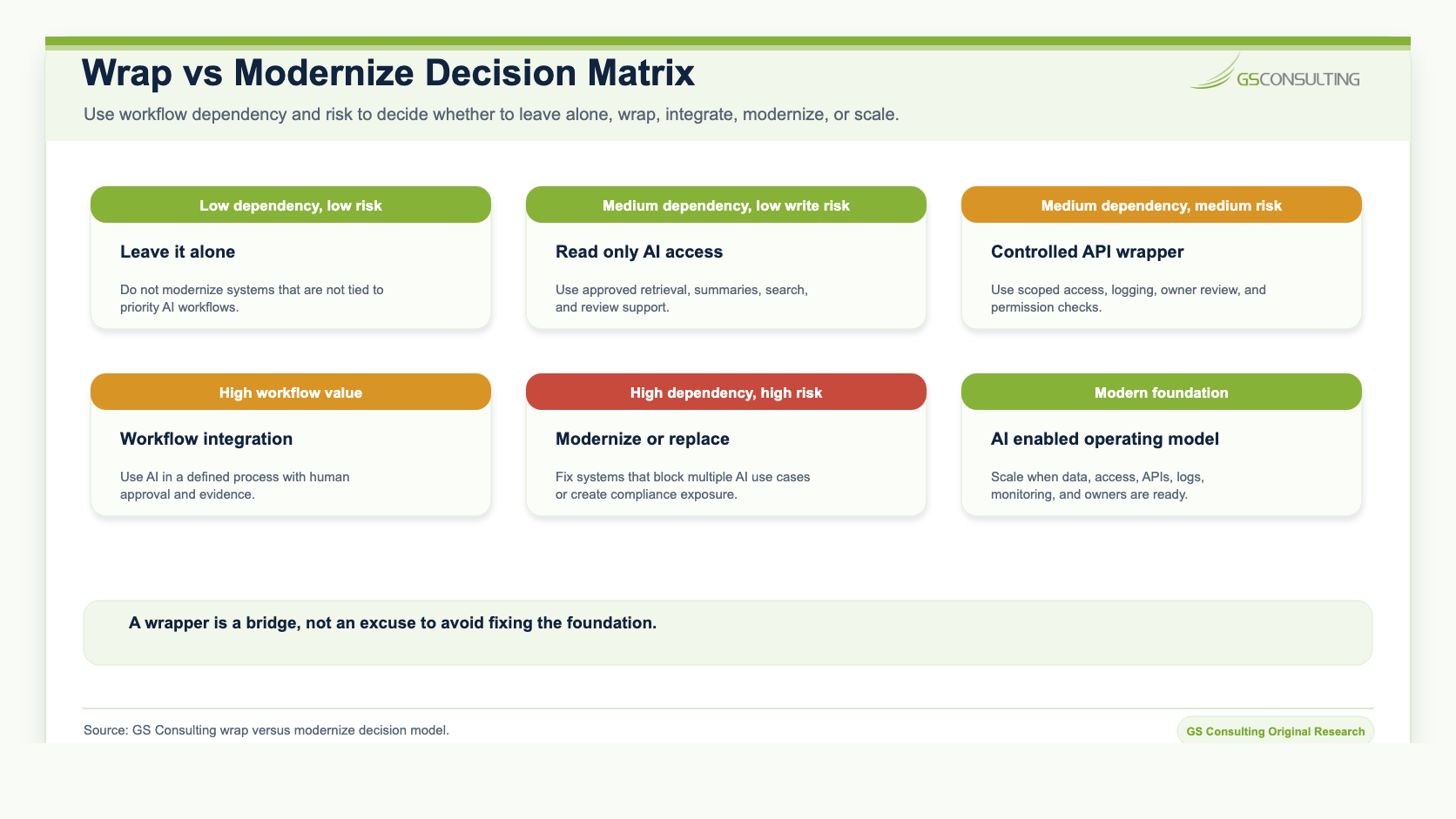
The Legacy System Modernization Ladder
Not every legacy system requires the same treatment. Use a ladder.
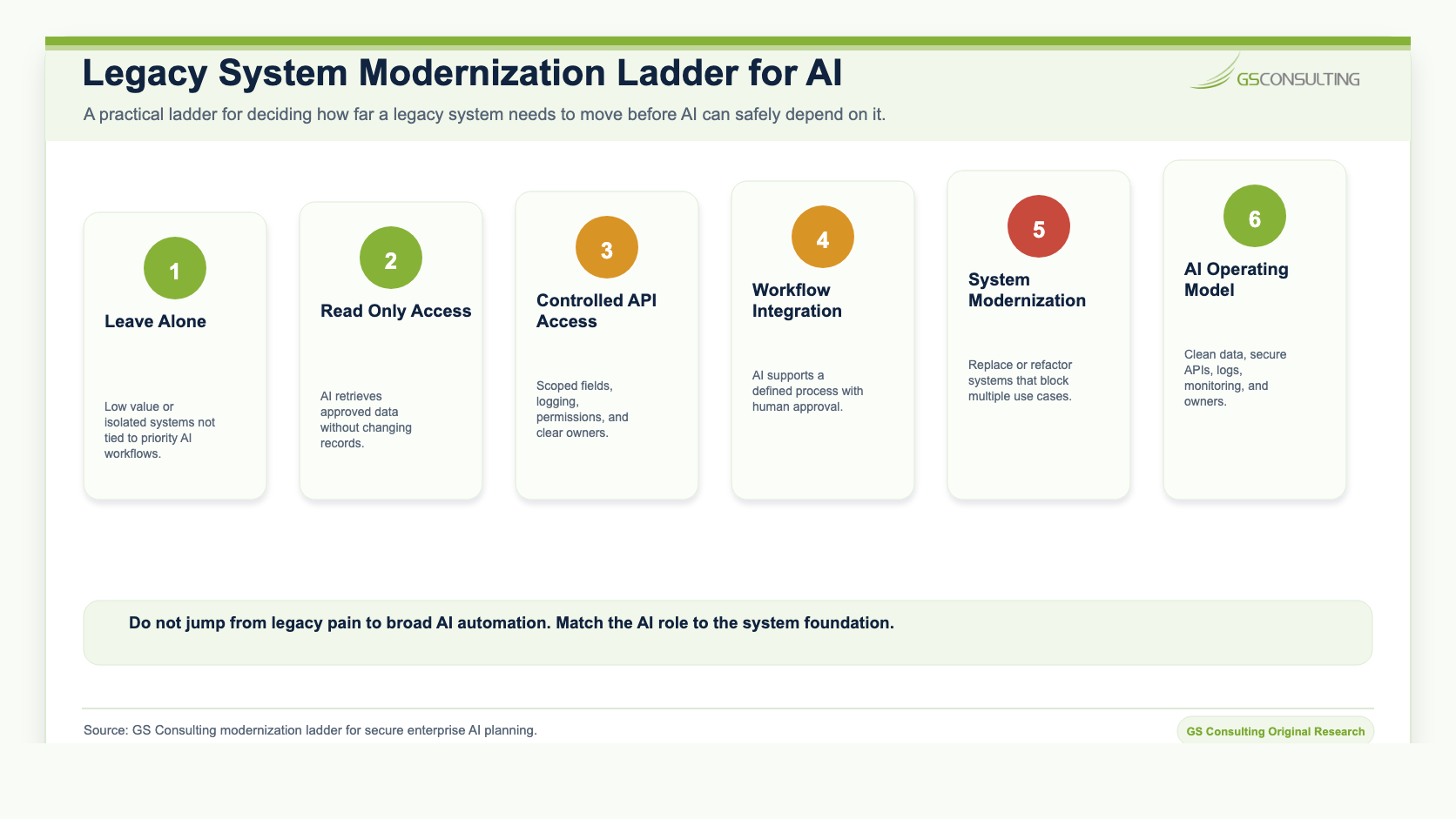
- Leave it alone. Some systems are low value, isolated, or not part of priority workflows.
- Read only access. AI can retrieve approved data but cannot change records.
- Controlled API access. AI can access specific fields through scoped APIs.
- Workflow integration. AI supports a defined workflow with human approval.
- System modernization. The legacy system is modernized, replaced, or wrapped with a stronger platform.
- AI enabled operating model. AI becomes part of the workflow architecture with clean data, secure APIs, identity controls, audit logs, and monitoring.
Do not jump to level six from level one. That is how projects fail.
What CIOs Should Modernize First
CIOs do not need to modernize everything at once. They need to modernize the parts that block AI value and create risk.
If identity is weak, AI access will be weak.
If data is not classified, AI cannot safely process it.
Bad document management creates bad RAG.
AI that cannot connect safely becomes a side tool.
If legacy systems cannot show access, changes, or decisions, AI makes audit gaps worse.
AI should not become a shadow system.
Why GovCon IT Transformation Is Different
GovCon IT transformation is not just about efficiency. It is about control.
A commercial company may modernize legacy systems to improve customer experience or reduce cost. GovCon companies also need to think about CUI, NIST SP 800 171, CMMC, DFARS obligations, contract flowdowns, customer trust, and audit evidence.
An AI assistant that searches proposal content may touch proprietary material. An AI workflow that summarizes deliverables may touch CUI. An AI compliance assistant may touch SSPs, POA items, audit evidence, and security documentation. An AI security assistant may touch logs and vulnerability data.
In GovCon, AI modernization must be connected to the compliance boundary. If AI touches controlled data, it belongs in the architecture, SSP, risk review, and evidence story.
The AI Modernization Architecture
A secure AI modernization architecture usually needs six layers.
- Identity layer: enterprise identity, role based access, least privilege, and service account controls.
- Data layer: classified data, clean sources, metadata, ownership, retention rules, and data quality.
- Integration layer: controlled APIs, connectors, gateways, and workflow tools.
- AI layer: approved model paths, private or controlled environments, RAG, model gateway, prompt controls, and output controls.
- Governance layer: use case approval, risk tiering, data handling rules, human review, vendor review, and escalation.
- Monitoring layer: audit logs, activity monitoring, quality review, cost monitoring, access review, and incident response.
If any layer is weak, the AI strategy inherits that weakness.
Do Not Confuse Wrapping With Modernizing
A lot of teams try to wrap legacy systems with AI and call it modernization.
Sometimes wrapping is useful. A controlled API wrapper can help. A RAG layer over approved documents can help. A workflow tool can reduce manual handoffs.
But wrapping is not the same as fixing the system. If the source data is bad, AI will retrieve bad data. If permissions are broken, AI may expose restricted content. If logs are weak, AI cannot create a clean audit trail. If business rules are undocumented, AI cannot reliably support decisions.
A wrapper can buy time. It should not become an excuse to avoid modernization forever.
The Sequencing Model
Here is the practical sequence for CIOs and enterprise architects.
- AI readiness assessment. Evaluate workflows, data, systems, security, compliance, and governance.
- Use case prioritization. Pick workflows with real value and manageable risk.
- Legacy dependency map. Identify which legacy systems block those use cases.
- Foundation fixes. Clean data, fix permissions, define owners, improve logging, and build APIs.
- Controlled AI pilot. Deploy AI in a support role with limited scope.
- Measure results. Track time saved, errors reduced, cycle time, user adoption, and control performance.
- Modernize based on value. Use pilot results to decide which systems justify deeper modernization.
This avoids the two common extremes: trying to modernize everything before using AI, or trying to use AI without modernizing anything.
Common Mistakes
- Treating AI as a front end fix. AI can make old systems easier to query. It cannot fix broken data, weak access, or poor process ownership.
- Connecting AI to messy repositories. If the repository has outdated files, duplicate versions, and mixed sensitivity data, AI will surface the mess.
- Ignoring identity. If users have too much access, AI will make that access easier to exploit.
- Assuming APIs are enough. APIs are useful only when they enforce the right data, roles, actions, and logs.
- Forgetting the system of record. AI should not become a shadow system where work happens without updating the official record.
- Modernizing without a business case. Modernize systems because they block high value workflows or create unacceptable risk, not because they are old.
- Letting every team build its own AI path. That creates more fragmentation, not less.
- Skipping compliance review. For GovCon, AI modernization and compliance cannot be separated.
What Leaders Should Ask Before Funding AI
Before approving an AI initiative, leaders should ask which workflows will improve, which legacy systems those workflows depend on, what data quality issues exist, what access control issues exist, what integration gaps exist, what compliance obligations apply, what logging and evidence gaps exist, which systems need modernization first, which systems can be wrapped temporarily, which AI use cases can launch safely now, and which use cases should wait.
If the AI proposal cannot answer those questions, it is not ready for budget.
The First 90 Days
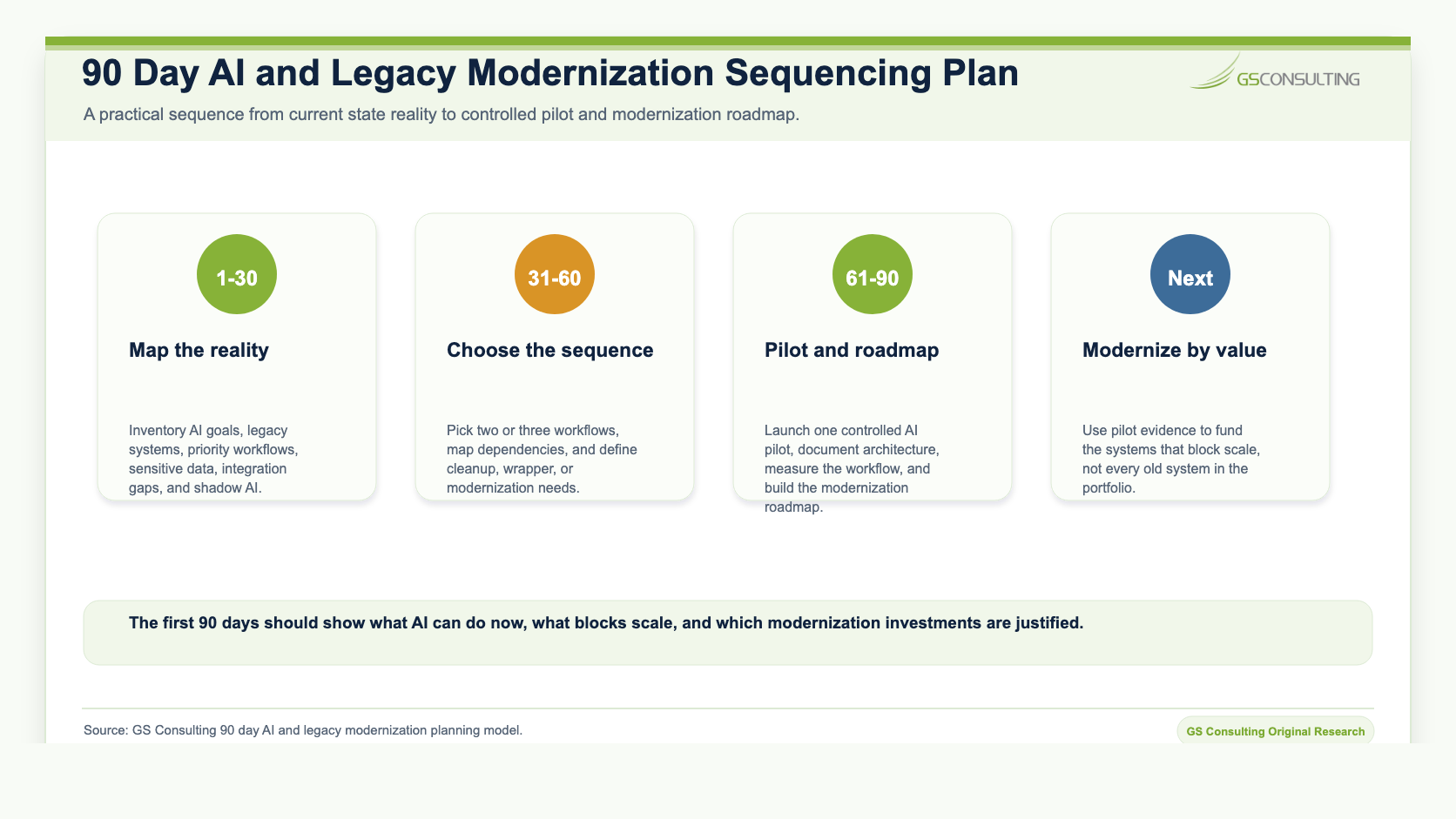
- Days 1 to 30Map the reality.
Inventory AI goals, legacy systems, priority workflows, sensitive data, known integration gaps, and shadow AI use. Identify where legacy systems block AI value.
- Days 31 to 60Choose the sequence.
Pick two or three AI workflows. Map their system dependencies. Decide which systems need cleanup, wrapping, or modernization.
- Days 61 to 90Launch a controlled pilot and modernization plan.
Build one controlled AI pilot, document the architecture, measure the workflow, and use the pilot to support the modernization roadmap.
How This Supports Secure Enterprise AI Strategy
This article supports Secure Enterprise AI Strategy, which explains how GS Consulting helps regulated organizations connect business goals, AI roadmap, data strategy, security, compliance, architecture, workforce adoption, and measurable outcomes.
This page answers the architecture question: how do we align AI strategy with the legacy systems that actually run the business?
That question connects directly to Enterprise AI Governance Frameworks for GovCon, Developing a Phased Secure AI Adoption Roadmap, Enterprise AI Readiness Assessment, Legacy System Integration for Enterprise AI Automation, Total Cost of Ownership for Secure Enterprise AI, Building the Business Case for Secure Enterprise AI, What Is an Enterprise AI Strategy?, and Enterprise AI Maturity Assessment.
The Bottom Line
AI strategy without legacy modernization is mostly wishful thinking.
You cannot build secure enterprise AI on top of fragmented systems, messy data, weak permissions, missing logs, and undocumented workflows.
That does not mean you need to replace every legacy system before using AI. It means you need to sequence the work.
Find the workflow pain. Map the systems. Assess readiness. Fix the foundation. Launch controlled pilots. Modernize the systems that block scale.
That is how regulated organizations turn AI from a demo into an operating capability.
Ready to find out which legacy systems are blocking your AI strategy?
Contact GS Consulting for an Enterprise AI Readiness Assessment and legacy modernization roadmap.
Contact GS ConsultingResearch Sources and Caveats
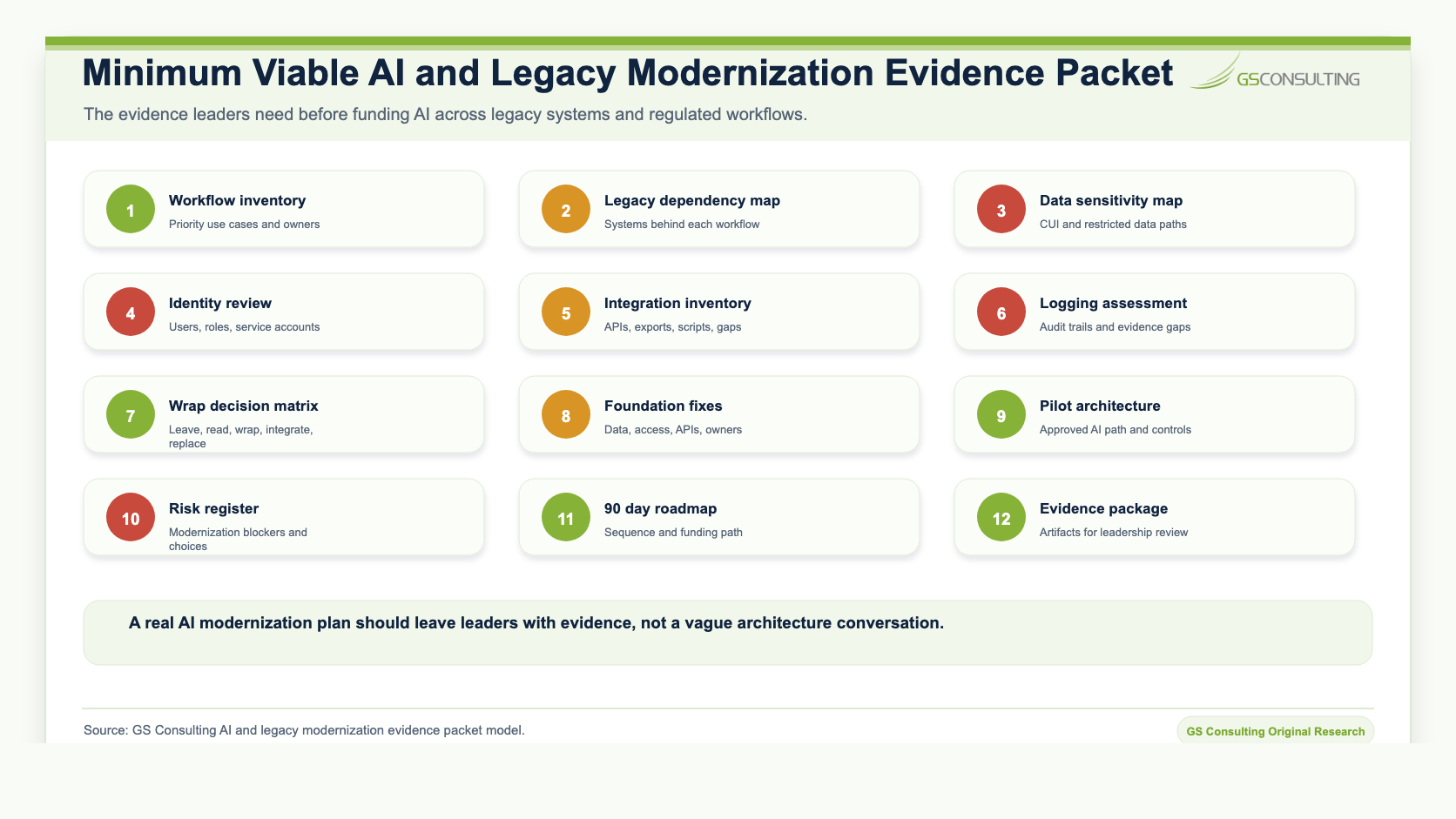
The Legacy to AI Modernization Dependency Score, Wrap vs Modernize Decision Matrix, and evidence packet are GS Consulting derived planning tools. They are not official GAO, CISA, NIST, IBM, McKinsey, MuleSoft, legal, audit, cybersecurity, or modernization determinations.
Actual modernization priority depends on the organization's workflows, data sensitivity, CUI scope, system architecture, vendor contracts, integration maturity, identity model, compliance obligations, security posture, operating budget, and risk tolerance.
- GAO: Agencies Need to Plan for Modernizing Critical Decades Old Legacy Systems
- Salesforce MuleSoft: Connectivity Benchmark 2025
- McKinsey: The State of AI 2025
- CISA: Software Must Be Secure by Design, and Artificial Intelligence Is No Exception
- NIST: Cybersecurity Framework 2.0
Frequently Asked Questions About AI and Legacy IT Modernization
Why does legacy IT modernization matter for enterprise AI?
Legacy IT modernization matters because enterprise AI depends on clean data, controlled access, reliable integration, audit logs, system owners, and measurable workflows. Fragmented systems, weak permissions, poor APIs, and messy repositories make AI harder to secure and scale.
Do organizations need to replace every legacy system before using AI?
No. Organizations should sequence modernization by workflow dependency and risk. Some systems can be left alone, some can support read only AI access, some can be wrapped with controlled APIs, and some need modernization or replacement because they block high value AI workflows or create unacceptable risk.
What should CIOs modernize first for AI readiness?
CIOs should usually start with identity and access, data classification, document repositories, APIs and integration, logging and evidence, and systems of record that support priority AI workflows. These foundations determine whether AI can use data safely and produce defensible outcomes.
How is GovCon AI modernization different?
GovCon AI modernization has to account for CUI, NIST SP 800 171, CMMC, DFARS obligations, flowdowns, customer trust, data boundaries, SSP impact, audit evidence, and incident response. AI modernization and compliance cannot be separated when controlled data or contract evidence is involved.
Related Reading
- Secure Enterprise AI Strategy
- Enterprise AI Governance Frameworks for GovCon
- Developing a Phased Secure AI Adoption Roadmap
- Enterprise AI Readiness Assessment
- Legacy System Integration for Enterprise AI Automation
- Total Cost of Ownership for Secure Enterprise AI
- Building the Business Case for Secure Enterprise AI
- What Is an Enterprise AI Strategy?
- Enterprise AI Maturity Assessment