Secure AI Automation | | 25 min read
AI Vendor Evaluation for Regulated Enterprises

Key Takeaways
Evaluate AI vendors against your workflow and required evidence.
Define the intended use
Specify the data, workflow, actions, and risks before judging a vendor demo.
Inspect the control evidence
Review security, data handling, access, governance, integration, and operating responsibilities.
Use a due diligence scorecard
Record gaps and red flags, then resolve material questions before signing.
The wrong AI vendor can create more risk than value.
That is the part buyers need to take seriously.
A vendor demo can look great. The assistant answers questions. The platform summarizes documents. The workflow builder routes tickets. The model drafts responses. The implementation partner says they can connect everything.
Then the real questions start.
- Where does the data go?
- Can the vendor use prompts for training?
- Can vendor staff see customer content?
- Does the tool respect user permissions?
- Can it process regulated data?
- Can it connect to systems without broad access?
- Can the organization see what the AI did later?
- Can the workflow be paused if it breaks?
That is what matters.
The issue is not whether the vendor has impressive AI. The issue is whether the vendor can support secure AI automation in your environment.
Evaluate AI vendors before they touch sensitive workflows.
GS Consulting helps regulated organizations assess AI platforms and implementation partners for security, data handling, access control, auditability, integration risk, agent controls, and production readiness.
Request an AI Vendor Evaluation AssessmentThe Vendor Demo Is Not the Due Diligence
Demos are built to show what works. Due diligence is built to find what breaks.
A vendor can show a clean workflow where AI reviews a document, summarizes the answer, and routes the output. That does not prove the platform is ready for employee data, customer records, financial information, CUI, PHI, contracts, security logs, audit evidence, or other sensitive data.
The demo does not tell you whether permissions are enforced. It does not tell you whether prompts are retained. It does not tell you whether outputs are classified. It does not tell you whether the model can be changed without notice. It does not tell you whether the implementation partner understands your compliance obligations.
That is why AI vendor evaluation has to go deeper than features.
Start With the Workflow, Not the Vendor
Do not start by asking, which AI platform should we buy?
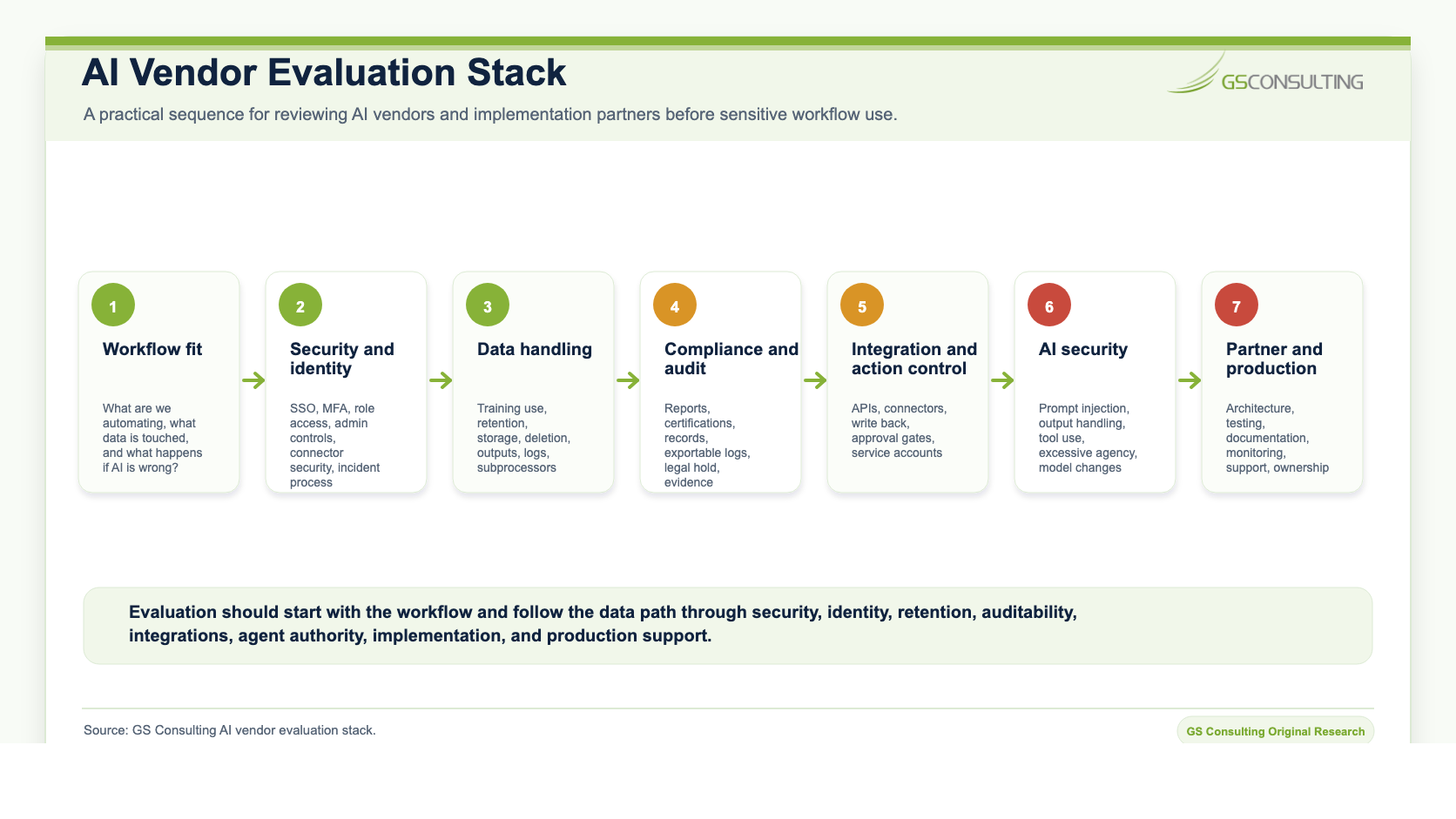
Start by asking: what workflow are we trying to automate, what data will it touch, and what happens if the AI is wrong?
That question changes the evaluation. A vendor used for public content drafting does not need the same controls as a vendor supporting compliance evidence review. A platform used for general internal writing does not need the same controls as a platform connected to HR cases, security alerts, contracts, or customer records.
NIST's AI Risk Management Framework uses the functions Govern, Map, Measure, and Manage. That is a useful way to think about vendor evaluation because buyers need ownership, use case context, testing, and ongoing management before AI becomes part of business operations.
Original Research: The AI Vendor Due Diligence Evidence Burden Index
GS Consulting analyzed public AI governance, security, agentic AI, auditability, and enterprise adoption sources against twelve AI vendor evaluation areas. The research shows that AI vendor evaluation is now an evidence burden problem, not a demo comparison exercise.
The source set included NIST AI RMF, NIST AI RMF Playbook, ISO IEC 42001 public materials, OWASP Top 10 for LLM Applications, CISA and allied agentic AI guidance, CSA AI Controls Matrix, EU AI Act policy materials, GAO AI Accountability Framework, NIST SP 800-53, McKinsey's 2025 State of AI survey, IBM's 2026 AI control gap research, and Microsoft's 2025 Digital Defense Report.
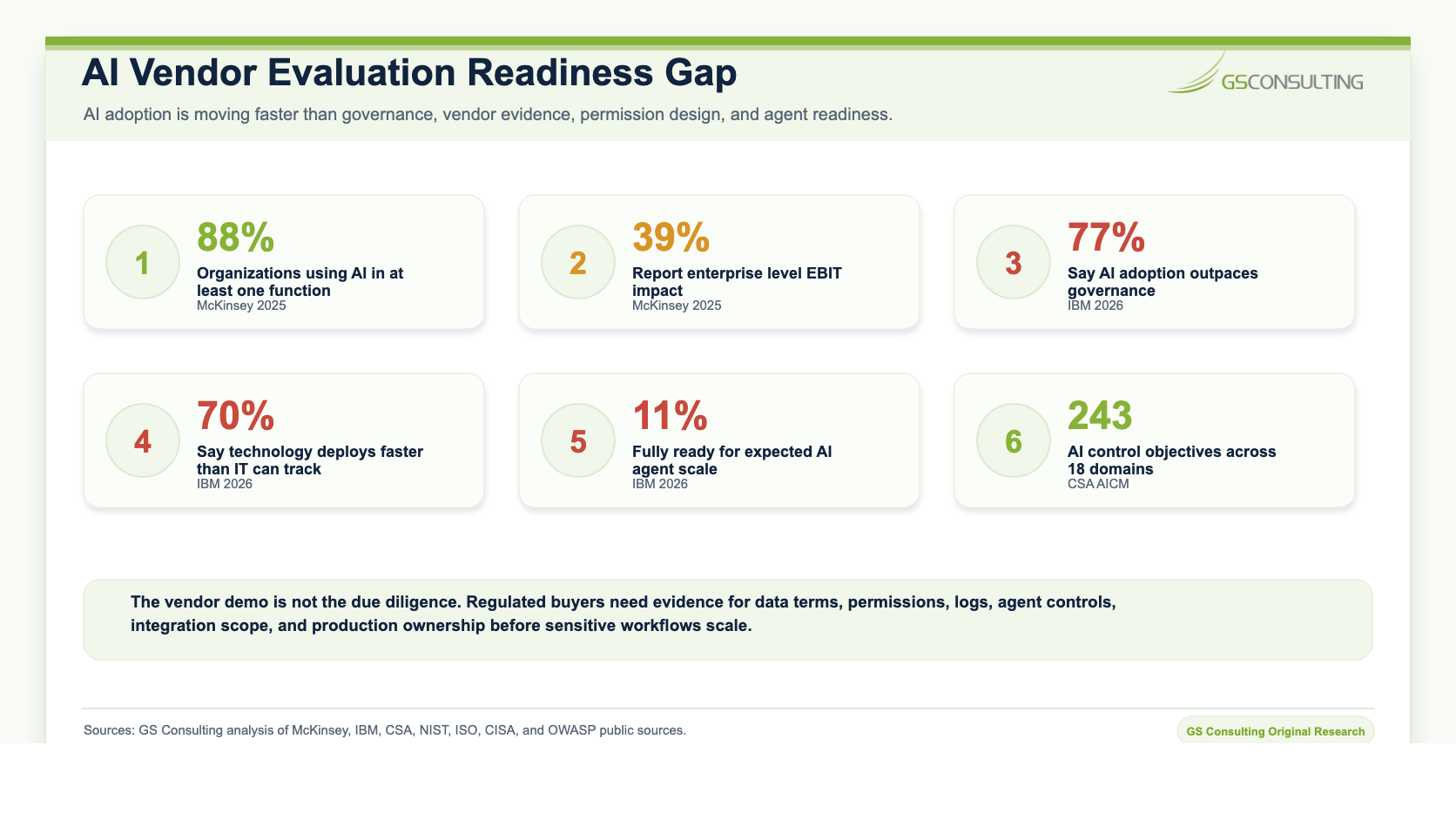
The highest burden areas were data handling and retention, security posture, identity and permission design, auditability and logging, AI specific security risk, agent and automation controls, compliance support, and integration capability.
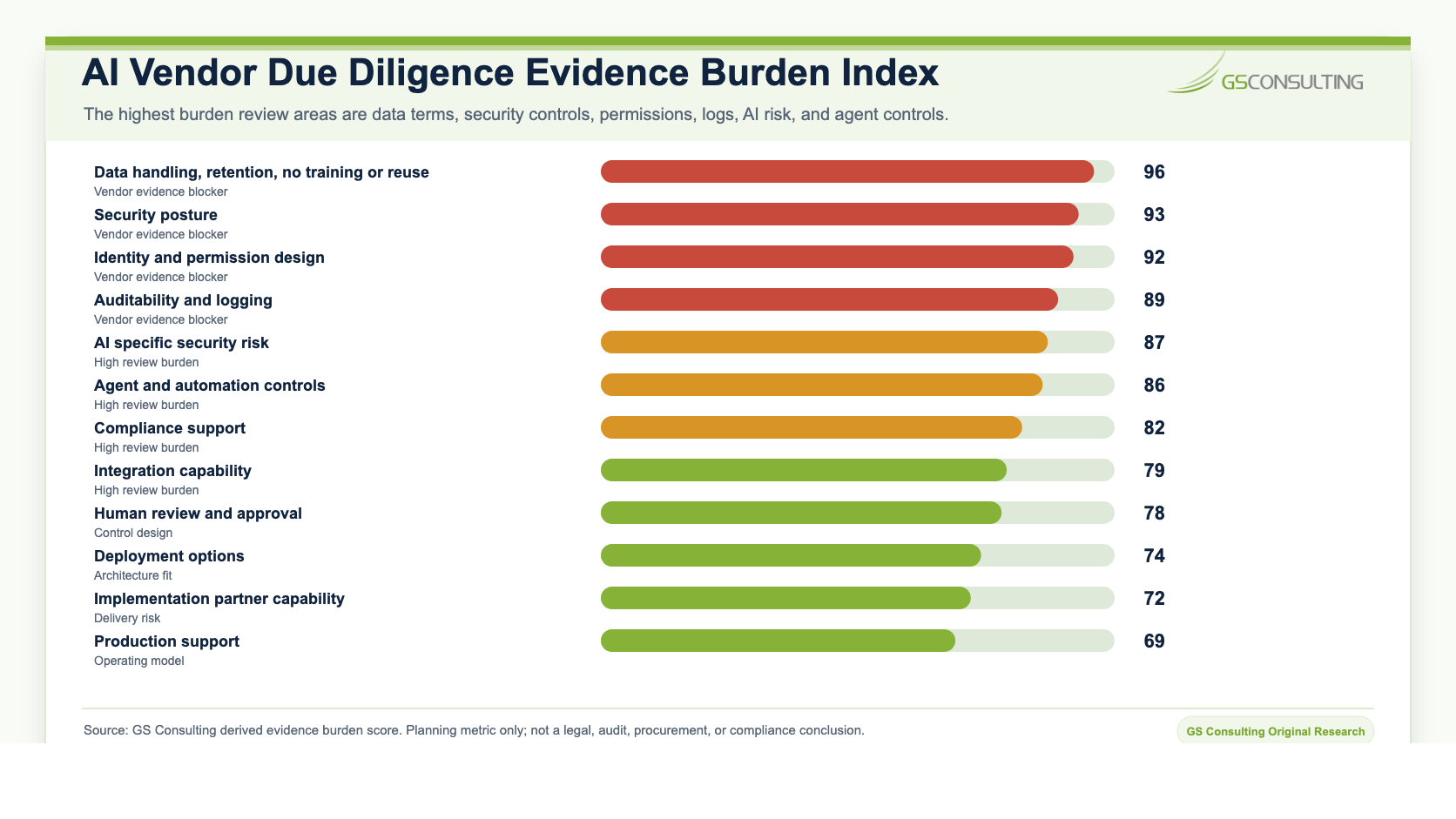
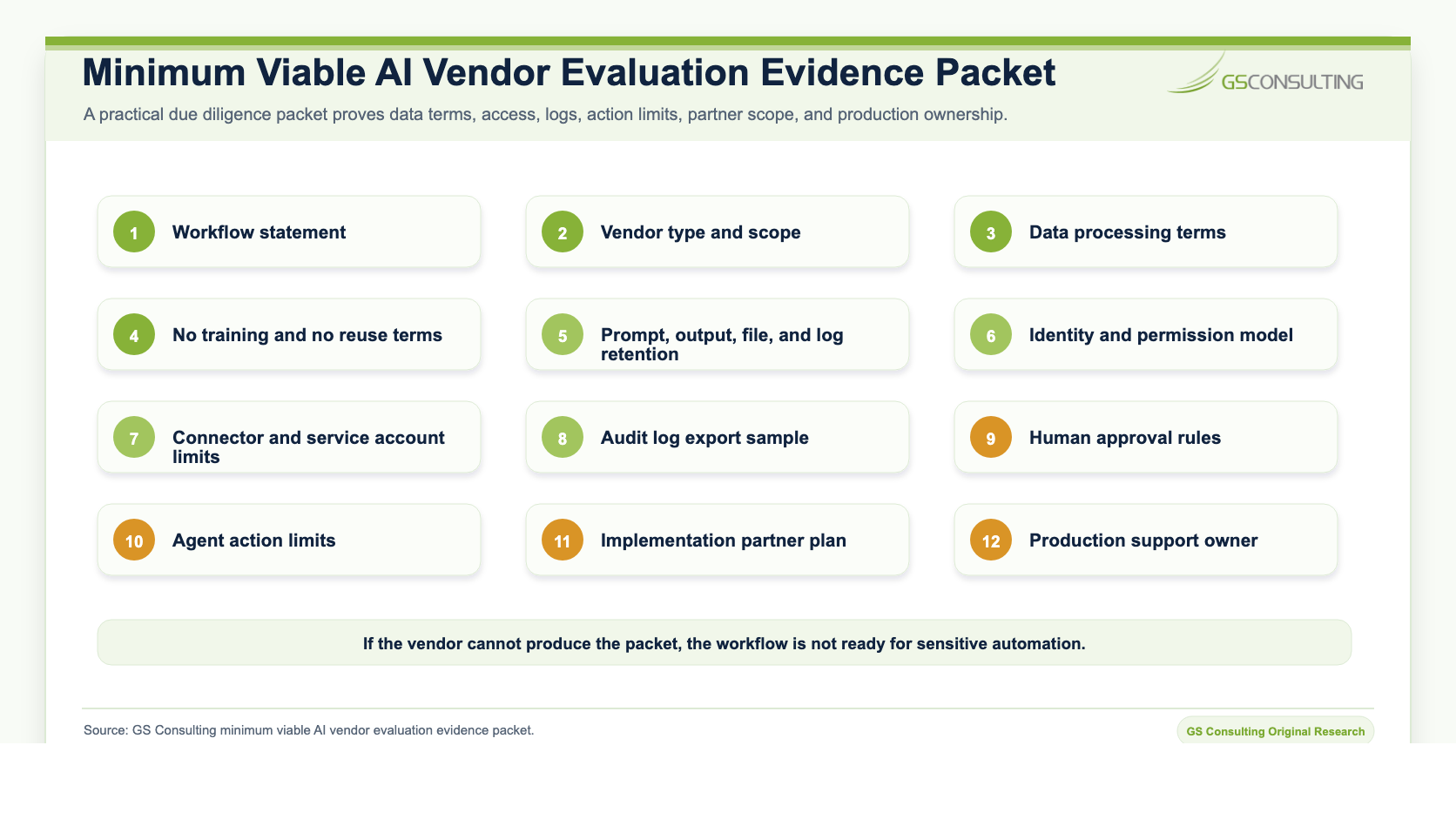
The practical takeaway is simple: do not let the vendor demo become the due diligence. Before a vendor touches regulated workflows, collect evidence for data terms, no training and no reuse commitments, prompt and output retention, user permissions, connector scope, service account limits, source references, exportable logs, approval gates, action limits, model change notices, incident support, and production ownership.
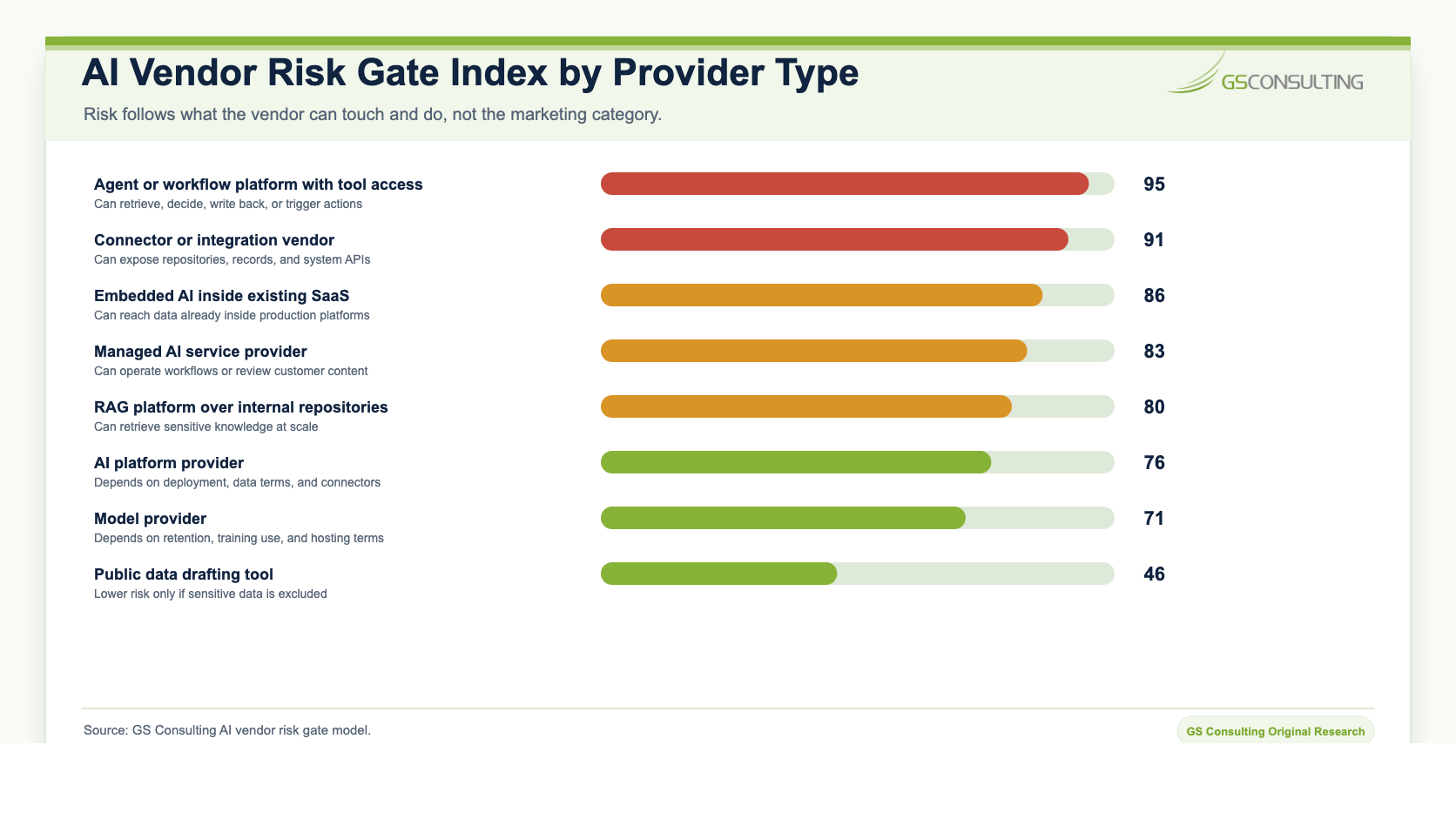
The Five Vendor Types You May Need to Evaluate
Most organizations talk about AI vendors like they are all the same. They are not.
- 1AI platform providers.
Tools employees use to ask questions, summarize documents, automate workflows, build assistants, or connect to internal knowledge.
- 2Model providers.
Vendors that provide the underlying models, hosting terms, retention rules, and training use commitments.
- 3Implementation partners.
Consultants, integrators, or technical teams that design and build the workflows.
- 4Connector and integration vendors.
Vendors that connect AI to document libraries, ticketing systems, CRM, ERP, HR, finance, and security tools.
- 5Managed service providers.
Providers that may operate, monitor, support, or modify AI workflows for the organization.
The Core Evaluation Areas
Every AI vendor review should come back to one question: can this vendor support our security, compliance, data, workflow, and audit requirements without forcing us to accept risk we cannot control?
If the answer is no, the vendor may still be useful for low risk work. It should not be used for sensitive automation.
- 1Security posture.
Review SSO, MFA, admin roles, API security, connector security, vulnerability handling, incident reporting, log protection, and revocation.
- 2Data handling.
Clarify storage, retention, training use, product improvement use, staff access, subprocessors, deletion, and output protection.
- 3Compliance support.
Check audit evidence, certifications, records retention, legal hold, exportable logs, data segregation, and regulated data support.
- 4Deployment options.
Understand public cloud, private cloud, dedicated tenant, region restrictions, private networking, on premise, and hybrid options.
- 5Permission design.
Confirm identity integration, user context retrieval, document access, record access, role based access, and service account limits.
- 6Auditability.
Log prompts, source documents, outputs, workflow version, actions, approvals, rejected outputs, escalations, exports, and retention.
- 7Integration capability.
Review APIs, connectors, write back controls, field limits, action limits, system of record behavior, and integration monitoring.
- 8Human review.
Require approval gates, source references, edit and reject paths, escalation paths, approval history, and risk based review rules.
- 9AI security risk.
Ask about prompt injection, sensitive data leakage, tool limits, output validation, retrieval security, embeddings, and model updates.
- 10Agent controls.
Limit tool access, action scope, read only mode, approval gates, step logs, pause, disable, and customer controlled restrictions.
- 11Partner capability.
Evaluate data classification, workflow mapping, permission design, logging, failure testing, documentation, training, and production transition.
- 12Production support.
Define who handles incidents, model changes, connector failures, permission issues, user training, cost monitoring, and audit requests.
OWASP identifies risks for large language model applications, including prompt injection, insecure output handling, training data poisoning, supply chain vulnerabilities, sensitive information disclosure, and excessive agency. Those risks matter more when vendors connect AI to internal knowledge, APIs, tools, tickets, customer records, or security systems.
CISA and partner agencies have also warned that agentic AI introduces security challenges tied to autonomy, tool use, integrations, and broad access. Vendors that support agents, tool calls, workflow actions, API write back, or autonomous routing need a separate action control review.
The AI Vendor Evaluation Scorecard
Use a simple scoring model. Score each vendor from 1 to 5 in each area. A vendor does not need to score perfectly in every area, but if the workflow is sensitive, weak scores in data handling, permissions, auditability, or security should be a blocker.
| Evaluation area | What to look for |
|---|---|
| Security posture | Identity, access, encryption, vulnerability handling, incident process. |
| Data handling | Retention, training use, storage, deletion, subprocessors. |
| Compliance support | Audit evidence, certifications, records, regulated data support. |
| Deployment options | Public, private, hybrid, region control, tenant separation. |
| Permission design | User access, document access, record access, service accounts. |
| Auditability | Prompts, outputs, sources, approvals, actions, exportable logs. |
| Integration capability | APIs, connectors, write back controls, workflow approvals. |
| Human review | Approval gates, edits, rejections, escalations. |
| AI security risk | Prompt injection, output handling, data leakage, excessive agency. |
| Agent controls | Tool limits, action limits, approval, pause, logs. |
| Partner capability | Workflow design, governance, security, documentation. |
| Production support | Monitoring, changes, incidents, user support, cost control. |
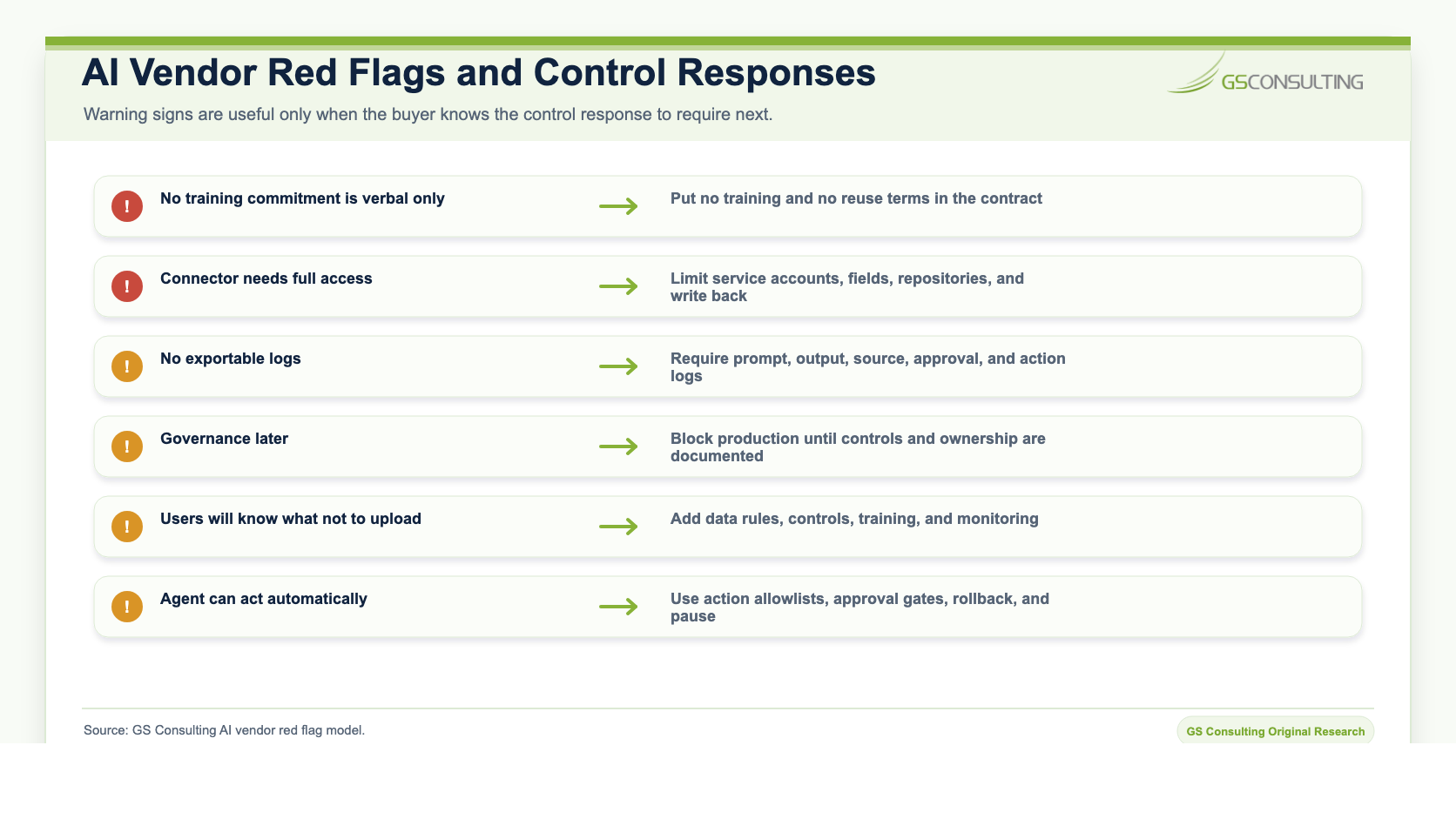
Red Flags
Walk away or slow down when the vendor answers critical questions with slogans instead of evidence.
- "We do not use your data for training" but it is not in the contract.
- "We are secure" but they cannot explain prompt, output, and file retention.
- "Our connector needs full access."
- "We can integrate with everything" but there is no permission model.
- "You do not need logs."
- "The AI can approve that automatically."
- "We can build it fast and figure out governance later."
- "Users will know what not to upload."
- "The customer owns compliance."
- "We do not have documentation for that."
Questions Buyers Should Ask Before Signing
Before signing with an AI vendor or implementation partner, ask direct questions and ask for evidence.
- What data can the platform process, and what data is prohibited?
- Can prompts, files, outputs, or logs be used for training?
- Where is data stored, and who can access customer data?
- Can users access only what they are allowed to see?
- Can connectors, service accounts, and write back actions be limited?
- Can the workflow require human approval?
- Can logs, source references, approvals, and actions be exported?
- Can environments be separated by data sensitivity?
- Can workflows be paused or disabled quickly?
- Can the implementation partner document the architecture and support production?
- What happens when the model changes?
- What happens when the vendor has an incident?
The Bottom Line
AI vendor evaluation is not about who has the best demo.
It is about who can support your data, your workflows, your security model, your compliance obligations, your audit needs, and your production reality.
Regulated enterprises should evaluate AI vendors and implementation partners based on security, data handling, compliance support, deployment options, permission design, auditability, integration capability, human review, agent controls, and production support.
The best vendor is not the one that promises AI can do everything. The best vendor is the one that helps you decide what AI should do, what it should not do, and how to prove the difference.
Review AI vendors before the risk is inside production.
GS Consulting helps regulated enterprises evaluate AI platforms and implementation partners for secure AI automation, including security review, data handling, compliance support, deployment options, auditability, access control, integration design, and production readiness.
Contact GS ConsultingFrequently Asked Questions About AI Vendor Evaluation
How should regulated enterprises evaluate AI vendors?
Regulated enterprises should evaluate AI vendors by workflow fit, security posture, data handling, compliance support, deployment options, permission design, auditability, integration controls, human review, AI security risk, agent controls, partner capability, and production support.
What is the biggest risk in AI vendor evaluation?
The biggest risk is trusting a vendor demo without evidence for data retention, training use, user permissions, connector scope, logs, human approval, action limits, model changes, incident support, and production ownership.
What AI vendor red flags should buyers watch for?
Red flags include vague data terms, verbal no training promises, connectors that require full access, no exportable logs, no permission model, automated approvals without review, governance deferred until later, and weak implementation documentation.
Should implementation partners be evaluated separately from AI platforms?
Yes. A weak implementation partner can make a strong AI platform risky if they skip data classification, permission design, logging, failure testing, human review, documentation, user training, or production support planning.
Related Reading
- Secure AI Automation for Regulated Organizations
- Secure AI Architecture Patterns for Enterprises
- AI Access Controls and Permission Design
- AI Audit Trails and Activity Logging
- Private AI vs Public AI vs Hybrid AI
Research Sources and Caveats
Sources included NIST AI RMF Core, ISO 42001 public materials, OWASP Top 10 for LLM Applications, CISA and allied agentic AI guidance, Cloud Security Alliance AI Controls Matrix, McKinsey's 2025 State of AI survey, IBM's 2026 AI control gap research, Microsoft's 2025 Digital Defense Report, NIST SP 800-53, EU AI Act policy materials, and GAO AI Accountability Framework. The AI Vendor Due Diligence Evidence Burden Score, Vendor Risk Gate Score, and red flag model are GS Consulting derived planning tools. They are not official legal, procurement, audit, NIST, ISO, CISA, CSA, EU AI Act, OWASP, IBM, McKinsey, Microsoft, or compliance determinations.