Cybersecurity Compliance | | 23 min read
How AI Can Improve Threat Detection and Compliance Monitoring in GovCon

Key Takeaways
Use AI monitoring to support analysts and preserve control evidence.
Separate detection from compliance
A useful security signal and proof of control operation answer different questions.
Keep response authority explicit
Use AI for analysis and preparation while retaining human decisions for consequential actions.
Protect the monitoring path
Control security data, model access, logs, integrations, and evidence retention.
Government contractors are under pressure to do two things at the same time: strengthen cybersecurity and prove compliance.
For small and mid-sized GovCon firms, that is not easy. Security teams are often lean. IT environments are more complex than leadership realizes. CUI may be spread across cloud platforms, endpoints, email, collaboration tools, subcontractor systems, and external service providers. CMMC readiness requires documentation, evidence, monitoring, affirmations, and ongoing control ownership.
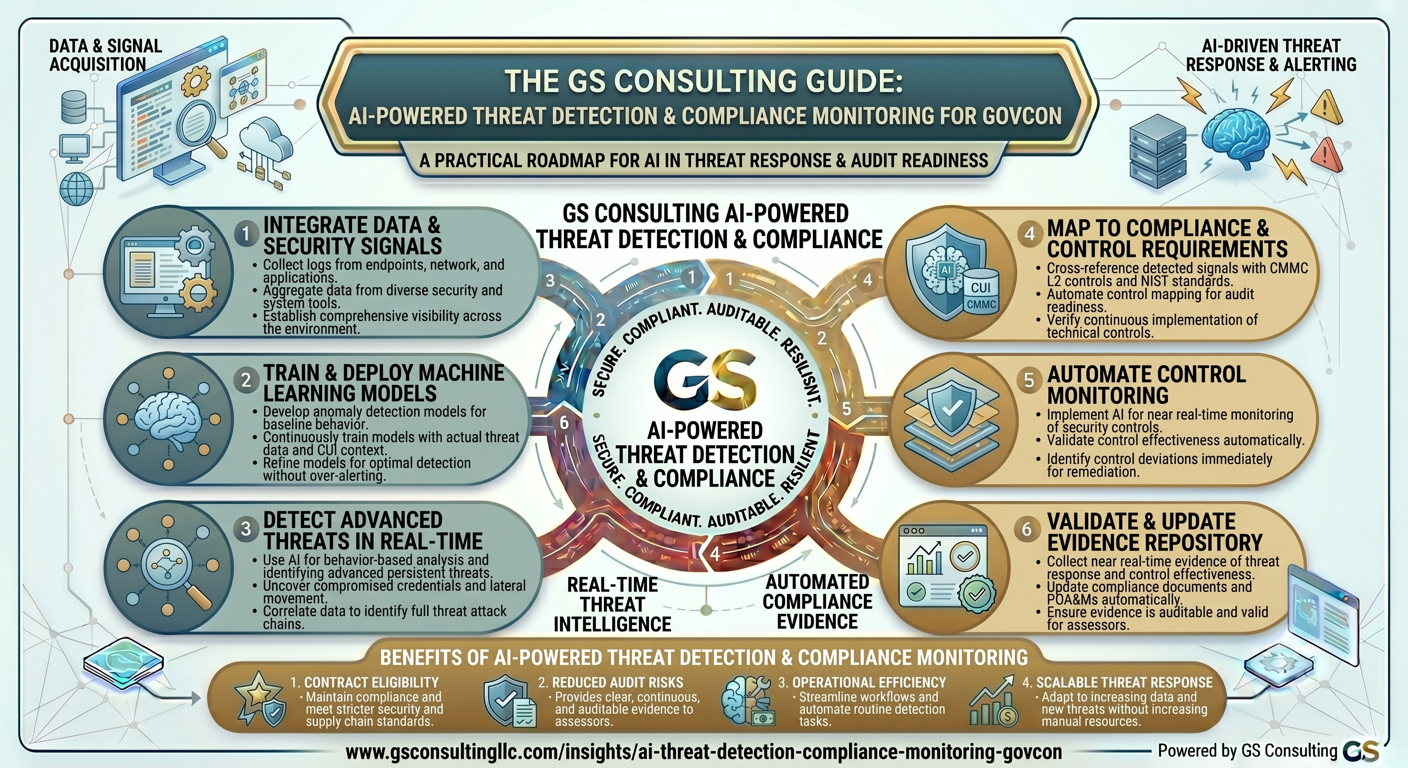
This is where artificial intelligence can help. AI is not a replacement for CMMC, NIST SP 800-171, cybersecurity professionals, assessors, or executive accountability. But AI can become a powerful support layer for threat detection and compliance monitoring, alert triage, vulnerability prioritization, evidence management, CUI monitoring, and continuous readiness.
Need controlled AI automation for cybersecurity compliance?
GS Consulting helps government contractors assess AI-enabled cybersecurity opportunities, evaluate tool risk, map CUI and security data flows, strengthen CMMC evidence, and design practical monitoring workflows.
Request an AI Cybersecurity AssessmentThe key is to use AI carefully. In GovCon, AI-enabled cybersecurity must be designed around contract requirements, data sensitivity, CMMC scope, evidence needs, and human oversight. If an AI tool processes CUI, Covered Defense Information, security logs, vulnerability data, incident records, network diagrams, or SSP content, it may become part of the compliance environment.
Why AI Matters for GovCon Cybersecurity
Cybersecurity compliance is becoming more continuous. Contractors cannot treat cybersecurity as a once-a-year documentation exercise. They need repeatable control monitoring, current evidence, accurate system boundaries, vulnerability management, incident response readiness, and leadership visibility before making compliance claims.
NIST SP 800-171 requirements apply to nonfederal system components that process, store, or transmit CUI, as well as components that protect those systems. That makes visibility essential. If a contractor does not know which systems touch CUI, which alerts matter, which vulnerabilities affect in-scope assets, or which evidence supports each control, compliance becomes guesswork.
Original Research: Where AI Cyber Monitoring Should Start in GovCon
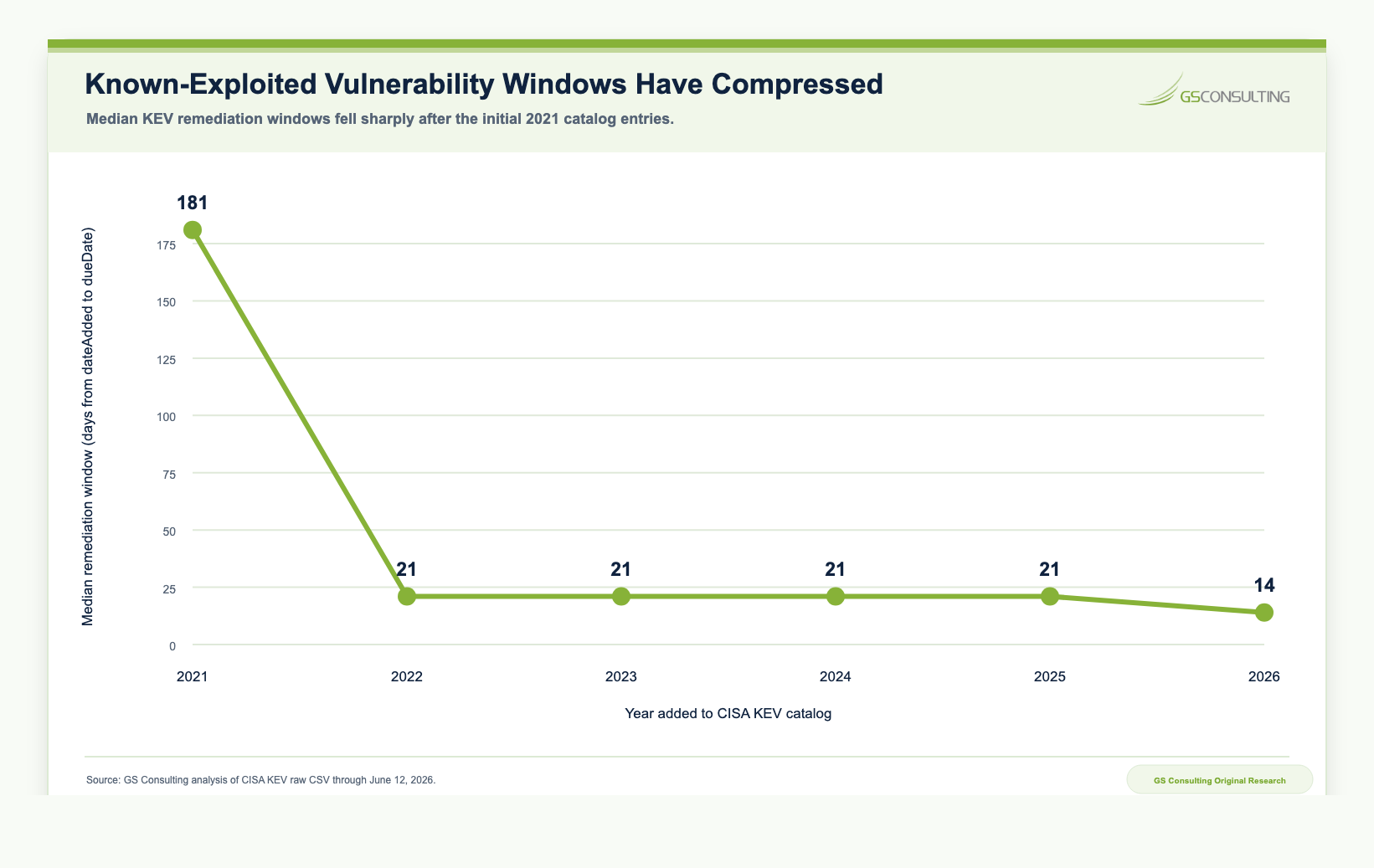
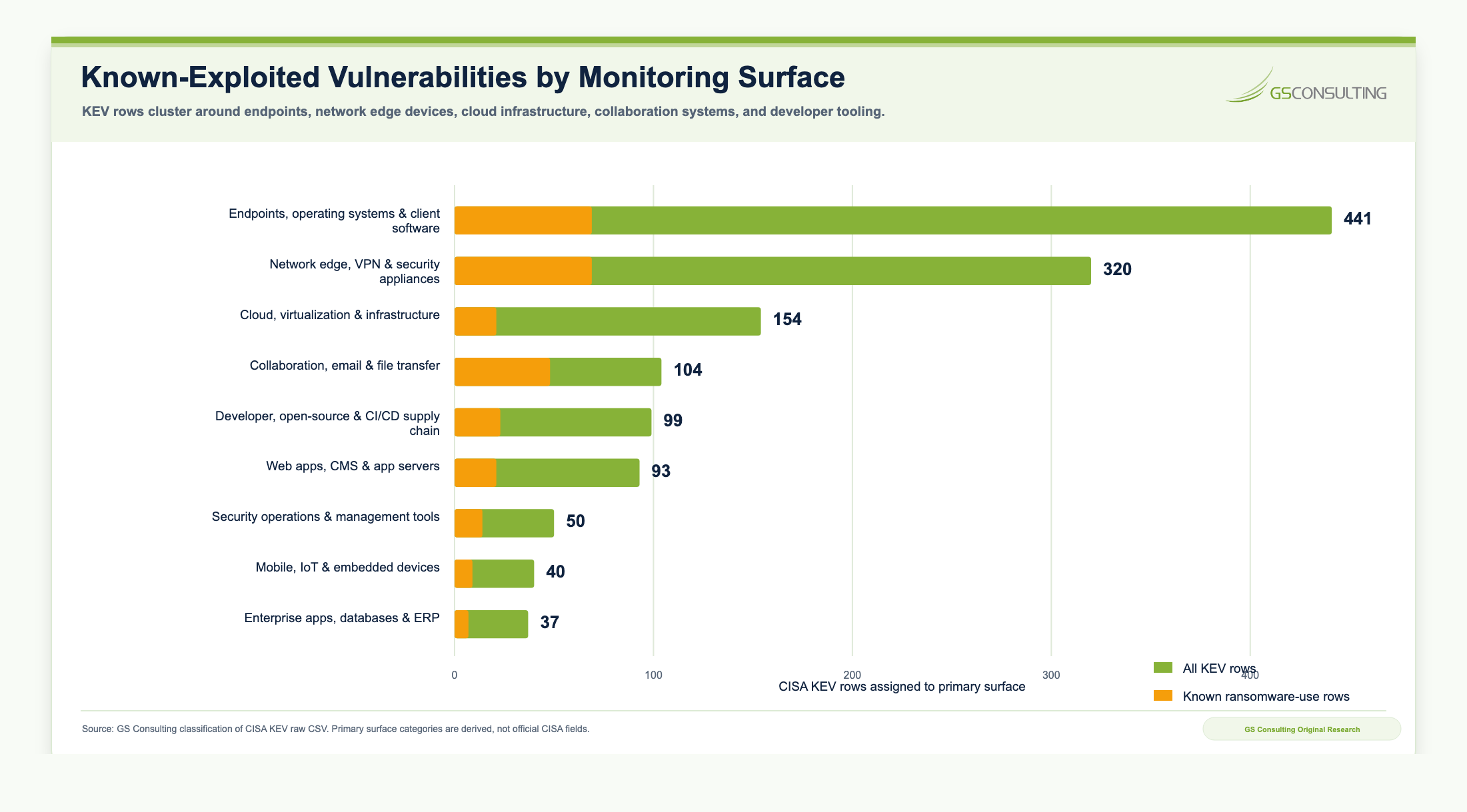
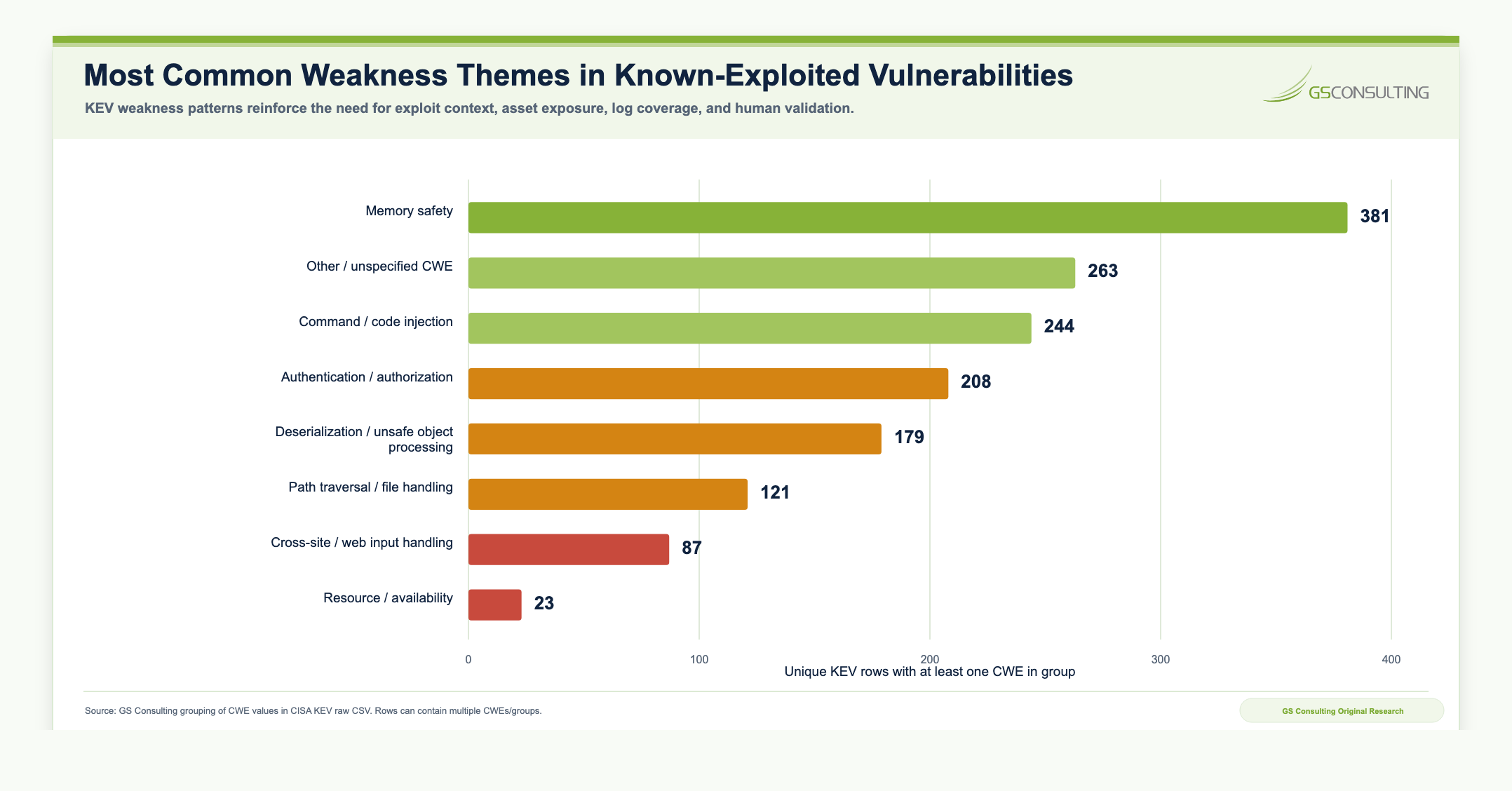
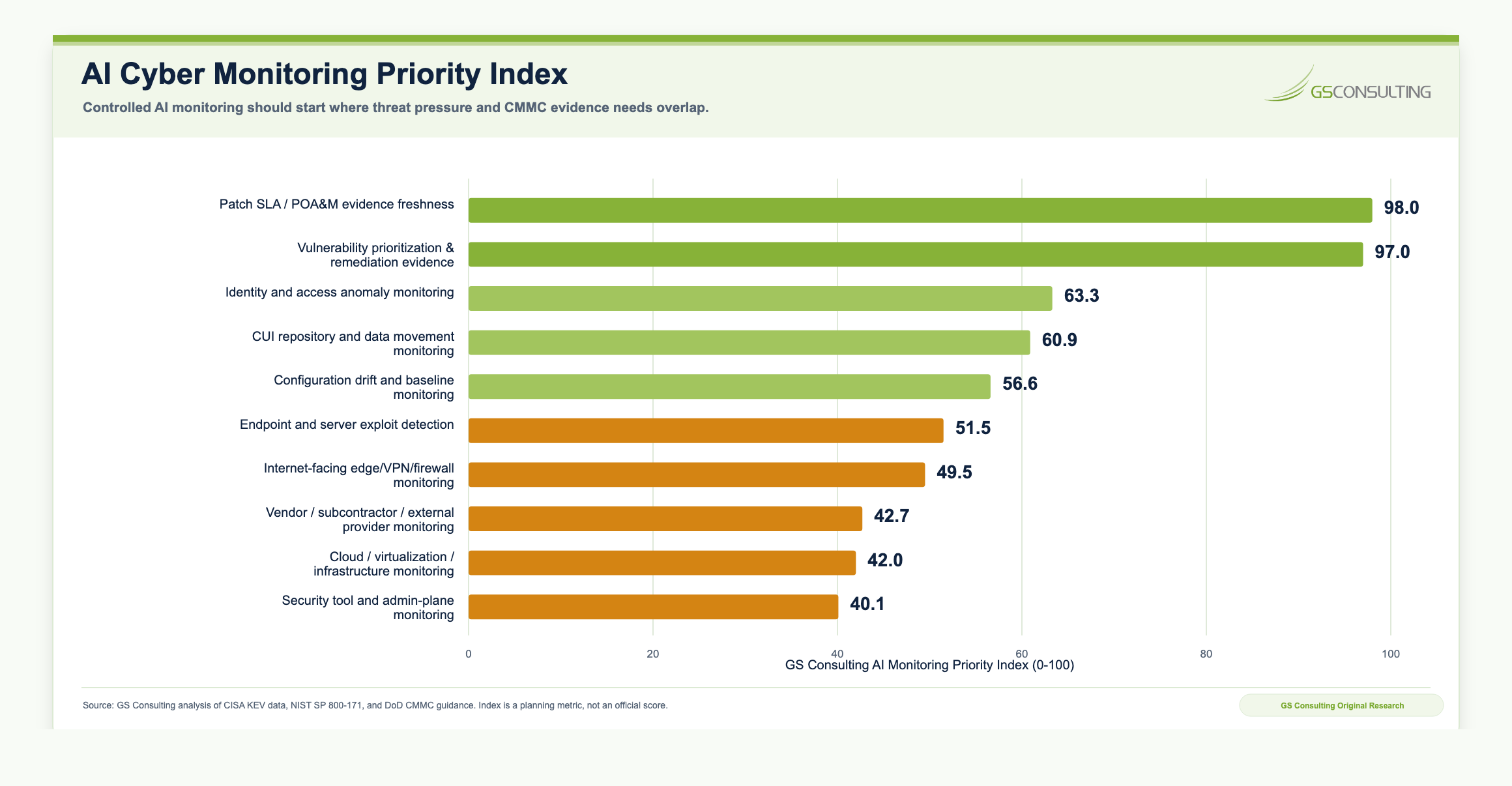
Original GS Consulting research shows that AI-enabled cybersecurity for GovCon should start where threat pressure and compliance evidence overlap. GS Consulting analyzed 1,619 rows from CISA's Known Exploited Vulnerabilities catalog and mapped them to GovCon monitoring workflows, CMMC and NIST evidence needs, CUI boundary risk, and human-review requirements.
The highest-priority workflows were patch SLA and POA&M evidence freshness, vulnerability prioritization and remediation evidence, identity and access anomaly monitoring, CUI repository and data movement monitoring, and configuration drift detection.
Methodology and caveat
The AI Monitoring Priority Index, monitoring-surface classification, and evidence packet are GS Consulting-derived planning tools. They are not official CISA, NIST, DoD, or CMMC metrics. CISA KEV is a catalog of known exploited vulnerabilities; it is not a complete list of all cyber threats, incidents, vulnerabilities, or GovCon-specific exploitation activity.
Threat Detection vs. Compliance Monitoring
Threat detection focuses on identifying suspicious activity, malicious behavior, unauthorized access, malware, phishing, data movement, compromised accounts, abnormal system behavior, and other signs of attack.
Compliance monitoring focuses on whether required controls are implemented, operating, documented, and supported by evidence. For CMMC and NIST SP 800-171, this includes access control, audit logging, vulnerability management, incident response, configuration management, awareness training, media protection, cloud provider review, subcontractor flow-downs, and CUI handling.
Where AI Can Improve Threat Detection
The KEV analysis reinforces a practical monitoring sequence: focus first on endpoint and server telemetry, internet-facing edge devices, cloud and virtualization infrastructure, collaboration and file-transfer systems, identity activity, and vulnerability remediation evidence.
1. Alert Triage and Noise Reduction
Security teams often receive too many alerts and not enough context. AI can help group related alerts, summarize timelines, identify duplicate notifications, flag high-risk patterns, and recommend which alerts deserve human review first.
The goal is not to let AI close alerts automatically. The goal is to help analysts focus on what matters.
2. User and Entity Behavior Analysis
AI can help identify behavior that looks unusual for a user, device, service account, or administrator. Examples include abnormal login times, impossible travel, unusual file downloads, privilege escalation, unexpected API calls, or access to repositories the user does not normally touch.
This is especially valuable in GovCon environments where CUI repositories, project folders, engineering systems, and cloud collaboration tools may contain sensitive contract information.
3. CUI Data Movement Monitoring
AI can help identify patterns that suggest CUI is moving outside approved boundaries. This may include uploads to unapproved cloud storage, sensitive attachments in email, copying files to unmanaged devices, unusual external sharing, or use of unauthorized AI tools.
CMMC scoping and NIST SP 800-171 implementation depend on knowing where CUI is processed, stored, transmitted, and protected. AI-enabled monitoring can help detect when real workflows drift away from the approved CUI data flow map.
4. Phishing and Business Email Compromise Detection
AI can support email security by analyzing language patterns, sender reputation, suspicious links, attachment behavior, impersonation attempts, and changes in communication style. For GovCon companies, this matters because attackers may target executives, proposal teams, finance staff, contracts personnel, and program managers with highly specific lures.
5. Threat Hunting Across Logs and Cloud Activity
AI can help analysts search across logs more effectively by translating questions into queries, summarizing results, identifying related events, and suggesting additional leads. This is useful when a contractor needs to investigate suspicious cloud activity, endpoint behavior, failed logins, privilege changes, or unusual access to CUI repositories.
Where AI Can Improve Compliance Monitoring
1. CMMC Evidence Tracking
One of the hardest parts of CMMC readiness is maintaining current evidence. Contractors need proof that controls are implemented and operating. That evidence may live in screenshots, policies, ticketing systems, cloud exports, access reviews, vulnerability scan reports, training records, incident response exercises, and configuration baselines.
AI can help organize evidence by control family, flag stale artifacts, detect missing documentation, summarize evidence status, and create leadership dashboards.
2. SSP and POA&M Consistency Checks
System Security Plans often become outdated because environments change. New cloud tools are added. MSP responsibilities shift. AI tools are introduced. Subcontractor workflows change. CUI moves to a new repository.
AI can compare SSP language against asset inventories, data flow maps, cloud architecture diagrams, control matrices, and POA&M records. It can flag inconsistencies such as a tool appearing in the asset inventory but not in the SSP, a CUI repository missing from the data flow map, or a control marked implemented while evidence shows unresolved gaps.
3. Vulnerability Prioritization
Vulnerability management is not just about scanning. It is about prioritizing what matters most. AI can combine vulnerability scan results with asset criticality, CUI exposure, internet exposure, exploitability, business function, contract relevance, and known exploitation data.
- Is this vulnerability on an asset that stores CUI?
- Is it on an internet-facing system?
- Does it affect an identity provider, VPN, firewall, endpoint tool, or CUI repository?
- Is remediation past the internal SLA?
- Does the risk affect a contract deliverable or operationally critical support?
4. Configuration Drift Detection
A contractor may be compliant today and drift out of compliance next month. Configuration drift can happen when administrators change settings, cloud defaults update, new integrations are added, logging is disabled, MFA policies are modified, or users gain excessive permissions.
AI can help detect drift by comparing current settings against approved baselines and flagging changes in conditional access, logging, retention, encryption, endpoint protection, external sharing, privileged roles, firewall rules, and backup settings.
5. Access Review Support
AI can help identify users with unusual access, excessive privileges, dormant accounts, inactive guest users, privilege accumulation, access outside need-to-know, and users who have changed projects but retained old permissions.
Final access decisions should remain with accountable humans. AI can make the review process faster and more complete.
6. Subcontractor and External Service Provider Monitoring
AI can help track subcontractor questionnaires, CMMC status requests, flow-down language, evidence due dates, external provider reviews, customer responsibility matrices, and unresolved supplier security issues.
This is not glamorous work, but it is a major source of GovCon compliance risk.
AI Use Cases by Security Function
AI can enrich and summarize signals, while humans validate findings and choose response actions.
AI can identify gaps and stale artifacts, while accountable leaders certify accuracy before submission or affirmation.
What AI Should Not Do in GovCon Cybersecurity
AI should not make final compliance claims. It should not submit SPRS affirmations. It should not decide whether a cyber incident is reportable to the government. It should not classify information as CUI without human validation. It should not approve privileged access, accept residual risk, close POA&M items without evidence review, or communicate with a contracting officer, prime contractor, or government customer without human approval.
GovCon-Specific Risks of AI Cybersecurity Tools
AI-enabled cybersecurity tools can create new risk if they are not governed correctly. The first risk is data exposure. Security logs may contain usernames, system names, IP addresses, file names, project names, CUI indicators, vulnerability details, or customer-sensitive information.
The second risk is CMMC scope expansion. If an AI tool processes, stores, transmits, summarizes, indexes, or protects CUI or security protection data, it may affect the assessment boundary.
The third risk is model training and retention. Contractors need to understand whether prompts, logs, alerts, files, outputs, embeddings, and metadata are retained, reviewed, reused, or used to train vendor models.
The fourth risk is false confidence. AI can summarize wrong information clearly. It can miss context, hallucinate control mappings, misinterpret logs, and under-prioritize high-risk events. Human validation is required.
The fifth risk is adversarial manipulation. Threat actors may attempt prompt injection, data poisoning, evasion, model manipulation, or malicious inputs designed to confuse analysis.
What DoD AI Cybersecurity Guidance Means for Contractors
DoD AI cybersecurity guidance makes clear that AI systems require lifecycle governance across acquisition, development, use, sustainment, monitoring, and disposal. Cybersecurity professionals should be integrated early so risks and mitigations are considered during each phase.
For contractors, the practical message is that AI-enabled security tools should have boundaries, AI models should have documentation, AI outputs should be tested, AI-related changes should be managed, AI use should produce evidence, and AI systems used in or on behalf of DoD missions may require stronger lifecycle governance than ordinary commercial tools.
A Safe Architecture for AI-Enabled Threat Detection and Compliance Monitoring
A GovCon AI cybersecurity architecture should be designed around controlled data flows, not convenience.
Define which data sources are approved and whether they contain CUI, security protection data, or customer-sensitive information.
Use AI to support review, not to replace accountable decisions.
Preserve the human-validated evidence needed for CMMC, NIST, customers, and leadership.
Controls Every AI Cybersecurity Tool Should Have
Before using AI for threat detection or compliance monitoring, contractors should review the tool against a practical control set. The tool should have an approved data boundary, role-based access control, MFA, logging, retention management, encryption, administrative access review, exportable evidence, vendor terms for model training and support access, human review before major decisions, and a change management process.
If the tool touches in-scope systems or data, it should be included in the SSP, asset inventory, CUI data flow map, cloud responsibility matrix, and evidence repository.
Metrics That Matter
AI-enabled security and compliance should be measured. Useful metrics include mean time to detect suspicious activity, mean time to triage alerts, mean time to respond to confirmed incidents, percentage of CUI repositories covered by monitoring, percentage of in-scope assets sending logs, vulnerability SLA performance, number of unauthorized cloud or AI detections, percentage of controls with current evidence, number of stale evidence artifacts, overdue POA&M items, and access review completion rate.
Those metrics need a decision system behind them. The continuous control monitoring guide shows how to validate source health, join signals to contract scope, assign response authority, preserve the original event, and close on a matched retest.
Minimum Viable AI Cyber Monitoring Evidence Packet
For GovCon contractors, the most useful AI cybersecurity pilot produces evidence, not just alerts. A minimum viable evidence packet should show what AI reviewed, which sources it used, what humans validated, what changed in the risk queue, and which compliance artifacts were updated.
A 90-Day AI Cybersecurity Action Plan for GovCon Contractors
- Days 1-30Identify the opportunity and risk.
Inventory security tools, compliance tools, SIEM sources, endpoint tools, scanners, cloud logs, ticketing systems, evidence repositories, AI tools, and CUI repositories.
- Days 31-60Build governance and pilot design.
Create an AI cybersecurity use policy, define approved tools and prohibited data, update the CUI map and SSP if needed, and define pilot metrics.
- Days 61-90Launch controlled pilots and document evidence.
Run controlled pilots with approved data and human review. Track outputs, errors, false positives, missed findings, time savings, and evidence quality.
By the end of 90 days, leadership should be able to answer where AI is used in cybersecurity and compliance, what data it touches, whether it is inside or outside the CMMC boundary, how humans validate output, what evidence it generates, what risks remain, and what measurable improvement it produced.
Common Mistakes to Avoid
The first mistake is buying an AI security tool before mapping the data. If the tool will touch CUI, security logs, vulnerability data, or incident records, it needs a GovCon-specific review.
The second mistake is assuming AI-generated compliance mappings are accurate. Control mapping should always be validated by someone who understands NIST SP 800-171, CMMC, the SSP, and the actual system.
The third mistake is feeding sensitive evidence into unapproved AI tools. SSPs, POA&Ms, network diagrams, incident timelines, vulnerability reports, and CUI data flow maps may contain sensitive information.
The fourth mistake is letting AI make final decisions. AI should assist with detection, prioritization, summarization, and evidence preparation, not make final decisions on reporting, risk acceptance, access approval, or compliance affirmation.
The fifth mistake is measuring AI by novelty instead of risk reduction. AI should make security and compliance more defensible, not just more modern.
The Bottom Line
AI can give government contractors a major advantage in cybersecurity and compliance, but only when it is implemented with discipline.
The best AI use cases are practical: alert triage, threat hunting, vulnerability prioritization, CUI movement detection, evidence monitoring, SSP consistency checks, POA&M tracking, access review support, and executive compliance reporting.
GS Consulting helps government contractors assess AI-enabled cybersecurity opportunities, evaluate AI tool risk, map CUI and security data flows, design compliance monitoring workflows, strengthen CMMC evidence processes, review cloud and external provider responsibilities, and implement practical AI cybersecurity roadmaps aligned to DoD, IC, and federal contract requirements.
Research Sources and Caveats
The original research in this article uses GS Consulting-derived planning metrics based on public CISA KEV data and GovCon monitoring workflow mapping. Contractors should validate AI-generated summaries, control mappings, evidence conclusions, incident decisions, remediation priorities, and reporting obligations through accountable security, compliance, legal, and executive review.
- CISA KEV Data GitHub mirror
- CISA Known Exploited Vulnerabilities CSV
- NIST SP 800-171 Rev. 3
- DoD CIO, About CMMC
- WIRED reporting on CISA's June 2026 AI vulnerability directive
Ready to improve threat detection and CMMC readiness with controlled AI automation?
Contact GS Consulting for a GovCon AI Cybersecurity and Compliance Monitoring Assessment.
Contact GS ConsultingFrequently Asked Questions About AI and GovCon Cybersecurity
Does using an AI security tool bring it into my CMMC assessment boundary?
Yes, likely. If an AI tool is used to process, store, transmit, or protect CUI (including processing security protection data, vulnerability logs, or incident records for an in-scope system), it typically becomes part of your CMMC and NIST SP 800-171 assessment boundary and must meet applicable security requirements.
Can AI automatically close CMMC POA&M items?
No. While AI can help track POA&M (Plan of Action and Milestones) status, organize remediation evidence, and flag stale artifacts, it should not automatically close items or submit compliance affirmations. A qualified human must review the evidence and accept accountability for the remediation.
How can AI help with CISA KEV compliance?
AI assists with CISA Known Exploited Vulnerabilities (KEV) compliance by prioritizing scanner alerts based on real-world exploitability, asset criticality, and CUI exposure. It helps security teams cut through alert noise and compress the remediation window for high-risk vulnerabilities.
Suggested Future Reading
- GovCon Cybersecurity & Compliance Cluster
- CMMC Readiness Checklist for Small and Mid-Sized Government Contractors
- NIST SP 800-171 Compliance: What GovCon Leaders Need to Know
- How to Build a CUI Data Flow Map for CMMC
- Secure Cloud Architecture for Federal Contractors Handling CUI
- Continuous Control Monitoring for Government Contractors
- How DoD Contractors Can Use AI Without Putting CUI at Risk