AI Procurement | | 28 min read
AI Procurement Rules for Government Contractors: Checklist

Key Takeaways
AI procurement readiness connects requirements to evidence and acceptance tests
Establish applicability
Start with the solicitation, contract, data and deployment boundary. Agency policy, contract clauses and voluntary frameworks play different roles.
Request usable evidence
Ask vendors for architecture, data terms, evaluation results and monitoring records that match the proposed workflow.
Test the delivered system
Agree on acceptance criteria and verify the actual environment, access controls, review process and change handling.
Record the decision
Use the readiness worksheet to assign owners, track evidence gaps and document a reviewer’s acceptance decision.
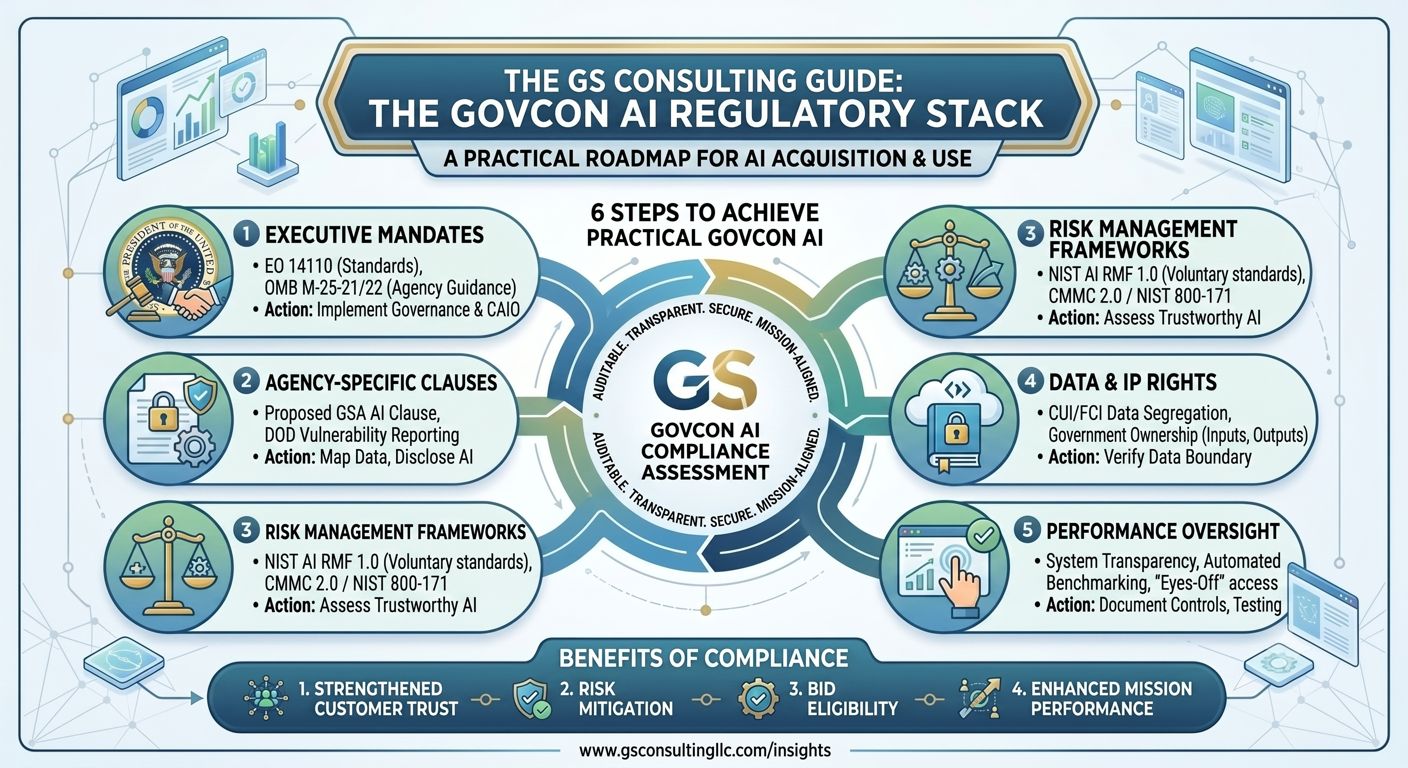
AI procurement regulations for government contractors connect acquisition guidance, contract clauses, data safeguards and agency requirements to the evidence a contractor must prepare.
There is no single AI regulation that covers every contract, tool, data type, agency, mission, or delivery model. Start with the solicitation and contract, then map the use case, data, system boundary, provider, and customer requirements.
The real problem is more practical: contractors need to know what AI is being used, what data it touches, which contract requirements apply, who approved it, how it was tested, how it is monitored, and what evidence exists when the government asks.
That matters whether you are selling an AI system, using AI to support contract performance, embedding AI in a service, relying on a subcontractor's AI enabled workflow, or evaluating a commercial tool that might process government information.
The contractors that handle this well will not be the ones with the longest AI policy. They will be the ones with cleaner answers, stronger evidence, and fewer surprises.
| Authority and applicability | Contractor check | Evidence and review owner |
|---|---|---|
| Solicitation and contract terms: the requirements for the specific acquisition. | Identify AI deliverables, disclosure, safeguarding, acceptance, records and flowdowns in the actual terms. | Requirement to evidence register. Contracts lead with program and legal review. |
| OMB and agency guidance: directions to covered agencies with defined scope and exclusions. | Check agency implementation and resulting solicitation terms. Do not assume every memo applies to every contractor use or national security system. | Applicability rationale and customer requirements. Acquisition and program team. |
| DFARS, CMMC and NIST SP 800-171: relevant when the contract and information handled bring them into scope. | Confirm clauses, required assessment level, applicable standard version and actual data boundary. | Data flows, system security documentation and applicable assessment evidence. Security and contracts leads. |
| Cloud requirements: depend on the agency, data, service and contract. | For external cloud processing of Covered Defense Information under DFARS 252.204-7012, review its FedRAMP Moderate equivalence and incident provisions. | Evidence for the exact service offering and boundary. Cloud security reviewer. |
| NIST AI RMF: voluntary risk management guidance unless a requirement incorporates it. | Use it to organize risks and evaluations. Check whether the customer requires specific practices or artifacts. | Risk register and evaluation plan. AI risk and technical leads. |
| Privacy, records, data rights and mission policy: depend on the information and intended use. | Identify permitted processing, retention, licensing, disclosure and approval conditions. | Data terms, retention schedule and mission review record. Privacy, records, legal and mission owners. |
The review owners above are suggested working roles, not a delegation of approval authority. Confirm the responsible officials through the agency and contractor processes. See OMB M-25-22, sections 2–4, DFARS 252.204-7012 and the NIST AI RMF for those distinctions.
Do not wait for the RFP to build your AI evidence.
GS Consulting helps government contractors assess AI readiness, map AI use, define data boundaries, evaluate compliant use cases, document governance, and prepare customer ready evidence for proposals, security reviews, and post award oversight.
Explore Secure AI Automation ConsultingThis article breaks down the AI procurement rules and guidance every government contractor should turn into practical evidence.
AI Procurement Checklist: Requirements, Vendor Evidence, and Acceptance Tests
What agencies may request—and what contractors should prepare: a clear requirement, evidence for the proposed system and a way to verify delivery. Use the examples below to structure an RFP response or vendor review. Tailor them to the acquisition with the responsible contracting, technical and security reviewers.
This is a GS Consulting planning checklist, not prescribed federal contract language or an official legal, audit or compliance determination. Agree on test data, thresholds, evidence access and acceptance authority before evaluation.
| Example requirement | Vendor evidence to request | Example acceptance test |
|---|---|---|
| Operate inside the approved deployment boundary. | Architecture, supported runtimes, dependencies, external endpoints and support access paths. | Run the agreed workflow in the approved environment. Inspect traffic for undeclared external services. |
| Use data only for the agreed purpose and retention period. | Data flows and terms covering storage, training, subprocessors, retention and deletion. | Follow an approved sample through processing, logs and deletion. Reconcile configured behavior with the agreed terms. |
| Enforce user and service permissions. | Role mapping, identity integration and controls for retrieval, outputs and exports. | Use accounts with different access. Verify that an unauthorized account cannot retrieve or export restricted content. |
| Meet agreed performance and human review criteria. | Evaluation plan, representative results, known limitations and escalation procedures. | Run the agreed test set. Record failures against defined thresholds and demonstrate reviewer override. |
| Produce reviewable audit records. | Sample exports showing actor, time, system version, relevant actions and approval history. | Reconstruct a test transaction from exported records while confirming access and sensitive data controls. |
| Support monitoring and incident response. | Monitoring rules, triage contacts, recovery procedures and applicable notice obligations. | Simulate an AI failure or data exposure using approved test data. Verify escalation, evidence preservation and recovery. |
| Control material changes and supplier dependencies. | Model and dependency inventory, subcontractor terms, change notices and rollback process. | Simulate a model or integration update. Demonstrate the required review, retest and rollback before release. |
| Support an orderly exit. | Export formats, transition assistance, licensing limits and deletion commitments. | Export agreed data and records into a usable format. Verify access removal and the agreed deletion process. |
Example: an approved runtime is part of the requirement
If a customer permits only hardened Java runtime images, name that constraint and the permitted network paths in the requirement. Ask the vendor to identify native libraries, external inference calls and support dependencies. A Java interface alone does not demonstrate that processing stays within the approved boundary.
For example: “Demonstrate the proposed capability within the customer approved runtime and network boundary. Disclose all additional components and external connections for review before acceptance.” This illustrative wording needs technical and acquisition review before use in a solicitation.
Use the AI audit trail guide for logging evidence and the AI and CUI guide when setting data boundaries.
Download the AI Procurement Readiness Worksheet
The worksheet turns the 14 items in the contractor readiness packet into an editable review. It includes suggested evidence, example verification steps and fields for applicability, supplied evidence, owner, gaps and acceptance decisions.
Download the AI Procurement Readiness Worksheet (Excel)
- Scope one review. Identify the workflow, contract, vendor, product version and permitted data.
- Tailor the requests. Record the applicable clause or rationale. Assign an owner and adjust the requested evidence.
- Verify and decide. Link the supplied evidence and record test results, remaining gaps, reviewer and date. Explain any item marked not applicable.
Keep evidence in the approved repository and use references in the worksheet. A completed template does not grant procurement, security or operational approval. For implementation support, see our secure AI automation services and the GovCon AI insights hub.
Why AI Procurement Is Different in GovCon
Commercial AI buying usually starts with speed. GovCon AI procurement starts with the contract.
A commercial team can test a tool, measure productivity, and scale it if the numbers look good. A government contractor has to ask harder questions first: what customer is involved, what data is being processed, what system boundary applies, what clauses govern the work, what evidence will be needed, and whether the AI use changes contract performance risk.
That is why OMB M-25-22 matters. Issued in April 2025, it replaced prior AI acquisition guidance and pushes agencies to think about AI acquisition across the lifecycle, not just at the point of award. Contractors should expect more questions about transparency, data handling, documentation, testing, monitoring, interoperability, vendor lock in, and performance evidence.
A proposal that says "we use AI to increase efficiency" is not a strategy. It is a sentence. The strategy is showing what the AI does, why it belongs in the workflow, what data it touches, how it performs, how risks are managed, and what happens when it fails.
AI Procurement Rules Are Context Specific
There is no useful answer to "Is this AI compliant?" until you know the context.
The right answer depends on what the AI does, who is using it, what contract it supports, what agency is involved, what data it touches, whether it is cloud based, whether it affects a deliverable, whether it is directed by the government, and whether the tool is part of a federal, defense, intelligence, healthcare, law enforcement, or other regulated mission environment.
Those answers matter because different rules apply in different situations. M-25-22 applies to AI systems or services acquired by or on behalf of covered agencies, but it excludes AI used incidentally by a contractor during performance when the AI is used at the contractor's option and is not directed or required to fulfill contract requirements. It also does not apply to AI acquired for use as a component of a National Security System.
That does not mean contractors can ignore AI use. The same OMB memo tells agencies to determine when solicitations should require disclosure of vendor AI use in contract performance, especially where the government may not otherwise anticipate that AI is being used.
Original Research: The AI Procurement Evidence Burden
The strongest signal in AI procurement is not "write a policy." It is "produce evidence."
A separate GS Consulting study shows how uneven that public evidence can be. The Federal AI Procurement Safeguards Index analyzed a frame of 1,532 public solicitation notices, of which 1,076 contained scoreable public text. Its sampled semantic review produced a weighted index of 31.5 out of 100 across testing, monitoring, data rights, portability, pricing, change notification, and other safeguards.
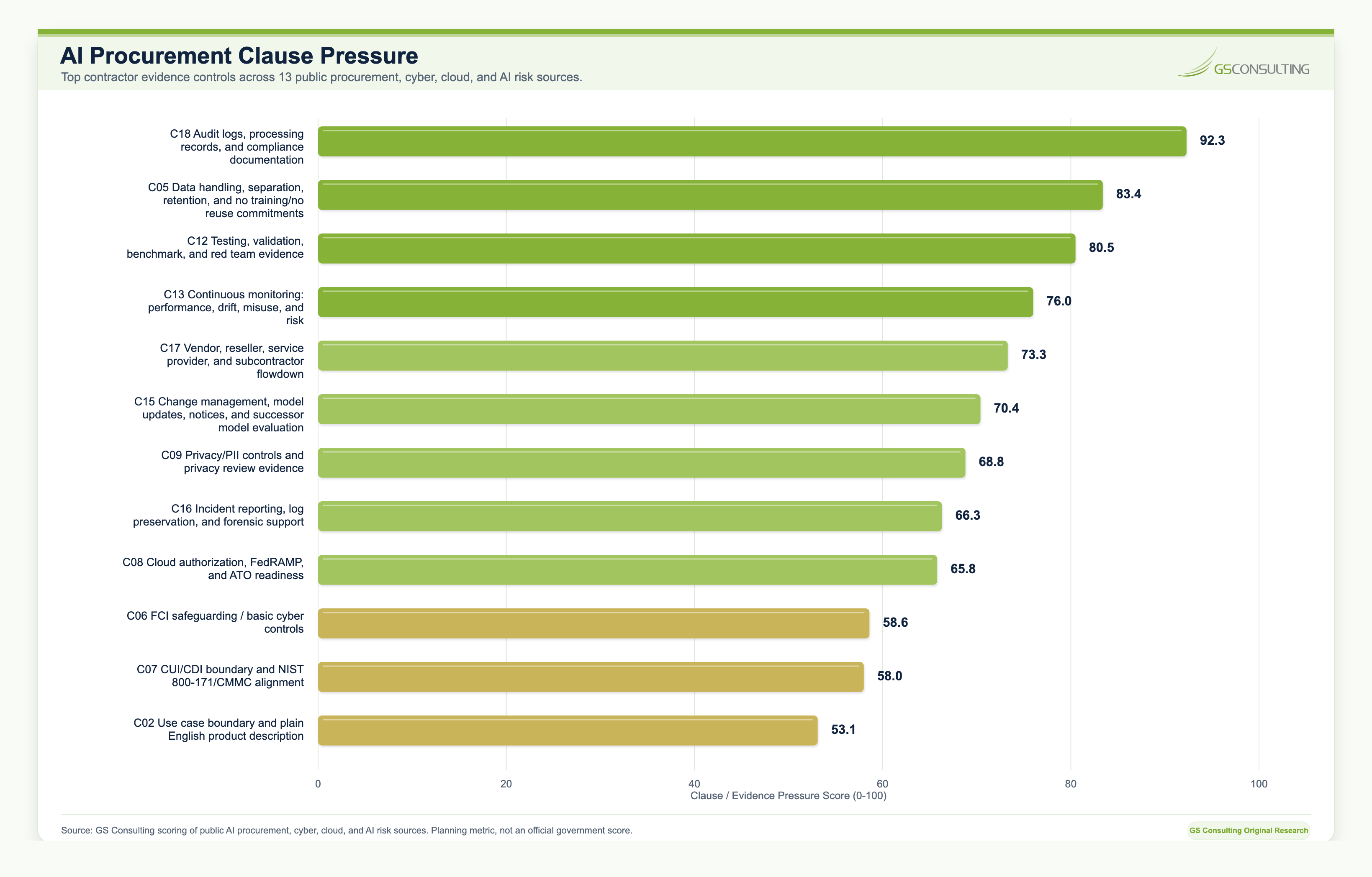
GS Consulting analyzed 13 public AI procurement, cybersecurity, cloud authorization, AI governance, and federal AI inventory sources against 22 contractor evidence controls. The pattern was clear: contractors should expect more pressure to prove what AI system was used, what data it touched, who approved it, how it was tested, how it is monitored, how incidents are handled, and what changed over time.
The final Clause/Evidence Pressure Score is a GS Consulting derived 0 to 100 planning metric. It is not an official government score, legal conclusion, compliance determination, or procurement forecast. It is useful because it translates a fragmented policy environment into the evidence artifacts contractors should begin building before AI appears in solicitations, security reviews, data rights negotiations, FedRAMP or ATO conversations, CMMC scoping, or post award oversight.
What this means for contractors
AI evidence, controls, and contract readiness will not be satisfied by a generic policy or a vendor sales sheet. Contractors should be ready to show what AI systems are used, where they support contract performance, what data they touch, whether they process FCI, CUI, Covered Defense Information, PII, or customer data, how the system was tested, how people remain accountable, how changes are reviewed, how incidents are reported, and how vendors or subcontractors are controlled.
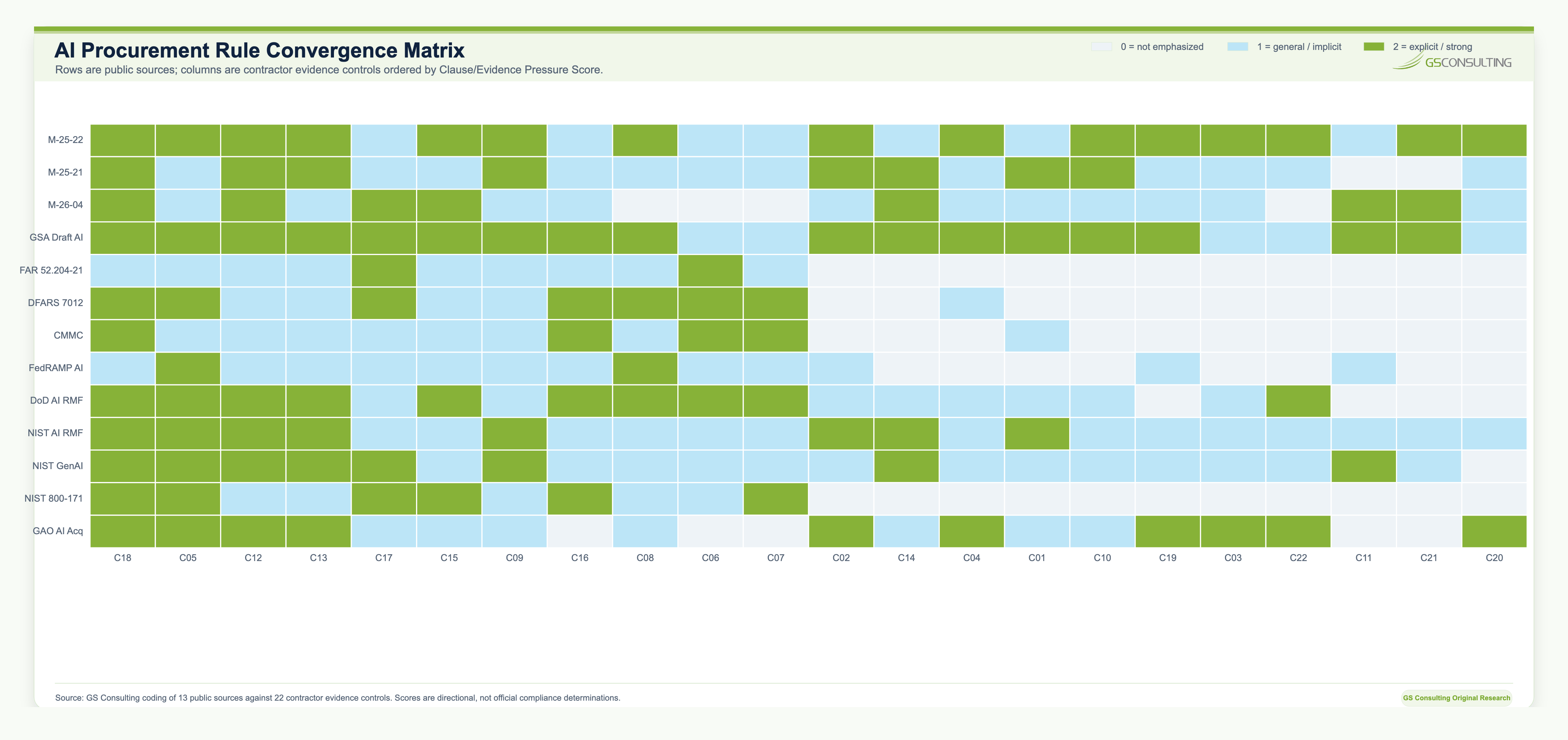
Methodology and caveat
The source set included OMB AI acquisition and AI use guidance, OMB LLM procurement guidance, FAR and DFARS cyber clauses, CMMC implementation information, FedRAMP AI prioritization, NIST AI RMF material, NIST SP 800-171, DoD AI cybersecurity and RMF guidance, GAO AI acquisition lessons learned, GSA draft AI system terms, and the 2025 Federal Agency AI Use Case Inventory. GSA's proposed AI terms are draft language and should be treated as a leading indicator, not final clause text. The federal AI inventory is self reported and excludes some categories, including certain national security, intelligence, research, and non public use cases.
1. OMB M-25-22: The Core Federal AI Acquisition Guidance
OMB M-25-22 is the starting point for federal AI acquisition because it tells agencies to treat AI as a lifecycle purchase, not a feature demo.
That matters for contractors. AI proposals need to make sense to more than a technical evaluator. They need to make sense to contracting officers, program managers, cybersecurity reviewers, privacy officials, legal teams, data stakeholders, civil rights and civil liberties reviewers, budget teams, and mission owners.
The memo directs agencies to use teams across functions during AI acquisition, including acquisition, IT, cybersecurity, privacy, legal, civil rights, civil liberties, data, budget, and program expertise as needed. It also instructs agencies to identify potential risks early and determine whether an AI system is likely to support a high impact use case.
M-25-22 also encourages broad market research, product demonstrations, testing in realistic environments, performance based acquisition techniques, Quality Assurance Surveillance Plans, and contract incentives tied to measurable business or mission outcomes.
Contractors should build that evidence before proposal week: plain English product description, use case boundaries, data flow diagrams, model or system documentation, testing results, risk management approach, human review plan, cybersecurity controls, monitoring plan, and performance metrics.
The memo also tells agencies to address vendor lock in, intellectual property rights, use of government data, M-25-21 compliance requirements, and ongoing testing and monitoring in contract terms. A contractor that can explain portability, licensing, data rights, model updates, documentation, and monitoring will be better positioned than a contractor that only describes features.
2. OMB M-25-21: High Impact AI and Risk Management
High impact AI is where the evidence burden gets heavier.
If AI supports decisions or actions with legal, material, binding, or significant effects, contractors should assume the government will care about documentation, testing, monitoring, training, human review, and risk management in a much more serious way.
OMB M-25-21 governs federal agency AI use and is especially important because M-25-22 links acquisition expectations back to M-25-21 compliance. The memo defines high impact AI as AI whose output serves as a principal basis for decisions or actions with legal, material, binding, or significant effects on areas such as civil rights, civil liberties, privacy, access to critical government resources, human health and safety, critical infrastructure, public safety, or sensitive and classified federal information.
M-25-21 requires agencies to implement minimum risk management practices for high impact AI, including pre deployment testing, AI impact assessments, ongoing monitoring, human training, and appropriate human review.
Document performance measures, privacy concerns, civil rights risk, security risk, human review, and how failures will be handled.
Track unexpected outputs, adverse impacts, and whether the system still performs acceptably.
For GovCon firms, the competitive advantage is not just having AI capability. It is having AI capability that can survive government risk review.
3. OMB M-26-04: LLM Procurement and Unbiased AI Requirements
LLMs are not just another software category anymore. They are getting procurement specific expectations.
OMB M-26-04, issued in December 2025, applies to procured LLMs and requires agencies to include contractual requirements addressing compliance with Unbiased AI Principles in solicitations or orders for LLMs issued after the memo. Agencies were also required to update procurement policies by March 11, 2026, to include those requirements.
For contractors that provide LLM based tools, the practical impact is documentation. Agencies may need enough information to understand acceptable use, model behavior, system limits, evaluation methods, feedback mechanisms, enterprise controls, output provenance, red teaming, and update processes.
Depending on the use case, agencies may also request information on pre training and post training activities, model evaluations, enterprise controls, output provenance, third party modifications, and red teaming or other evaluation methods. Relevant requirements may be identified as material to eligibility and payment, which raises the stakes for corrective action and compliance.
Government contractors that provide LLM based tools should build a repeatable LLM documentation package before the customer asks for it. At minimum, the package should identify the provider, model source, intended uses, prohibited uses, user guidance, known limits, evaluation approach, feedback process, update process, security controls, and a compliance point of contact.
The draft GSA terms should not be treated as final clause text. They should be treated as a preview of the questions contractors may need to answer. They point toward evidence categories contractors should expect to discuss: AI system disclosure, human review, incident reporting, log and artifact preservation, privacy and PII handling, testing evidence, limits, portability, interoperability, and change notices.
Where AI Procurement Questions May Show Up First
AI procurement pressure will not show up evenly across the federal market.
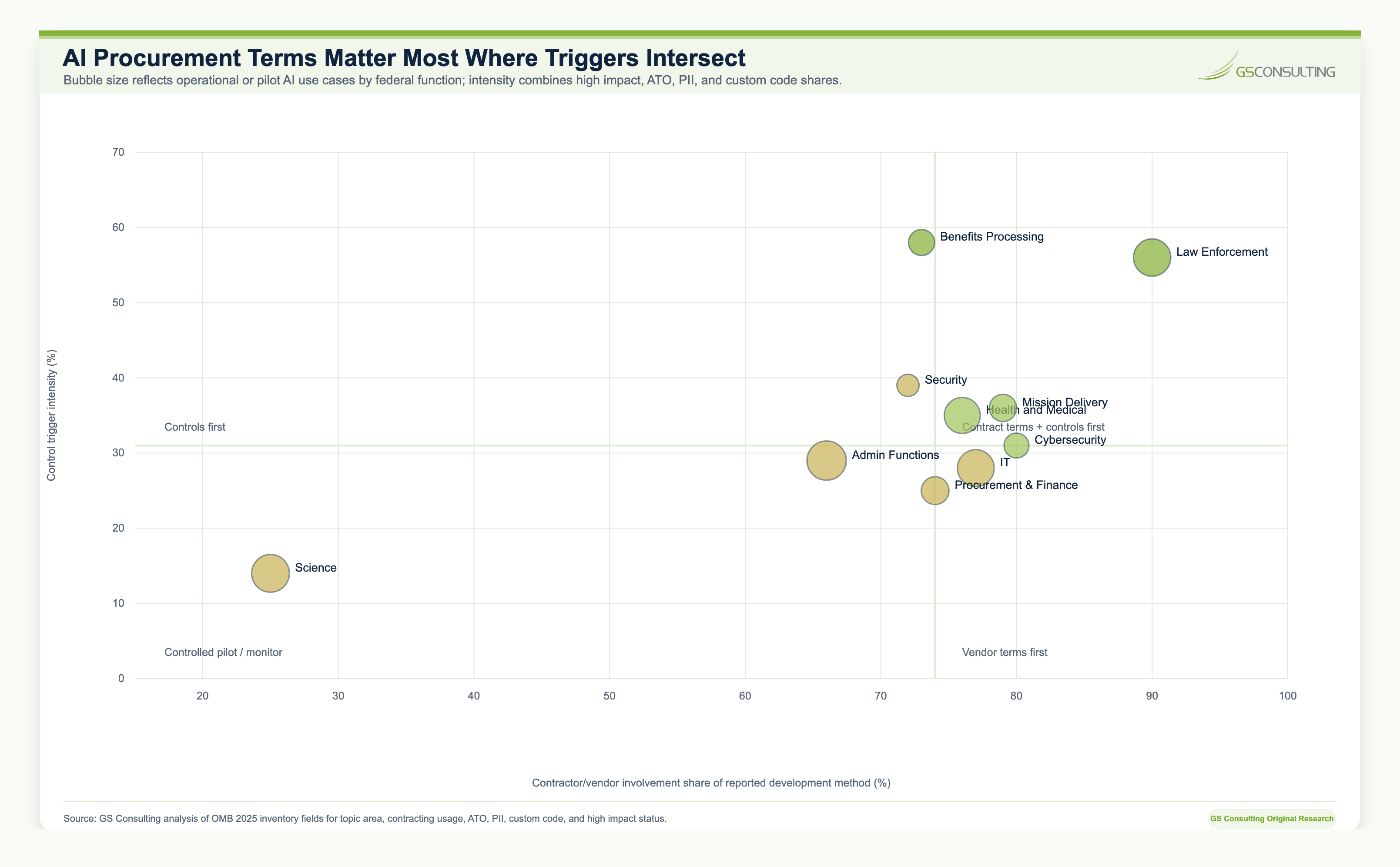
It will be louder where AI intersects with high impact workflows, PII, ATO boundaries, custom code, cybersecurity, law enforcement, health, benefits, mission operations, and contractor or vendor involvement.
GS Consulting used the 2025 Federal Agency AI Use Case Inventory to build a directional AI Procurement Contracting Exposure Index using vendor or hybrid involvement, high impact AI counts, operational or pilot AI use, ATO indicators, PII indicators, custom code indicators, and COTS breadth.
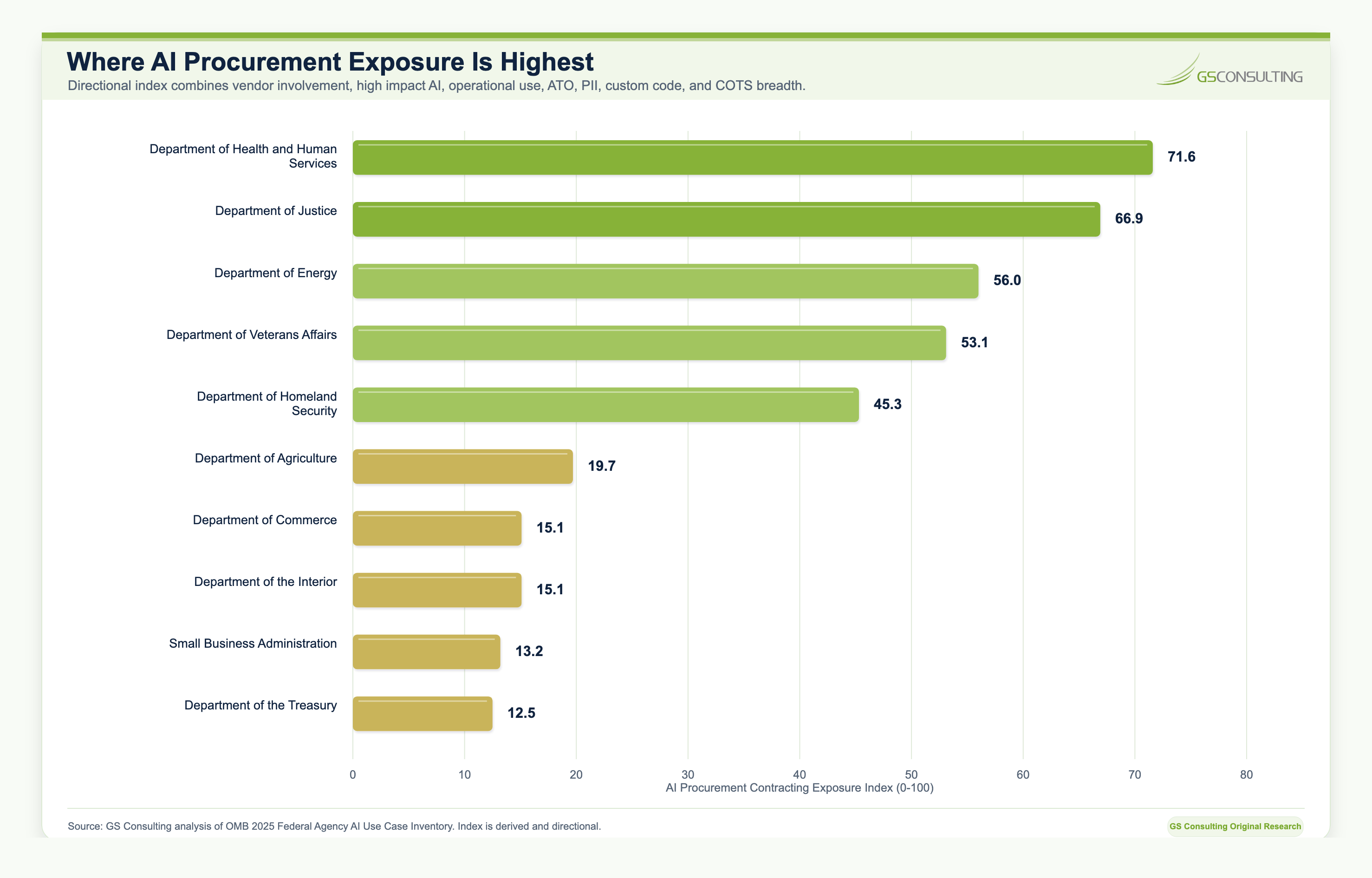
Function matters because the same AI tool can create very different obligations depending on where it is used. AI in law enforcement, health, benefits, cybersecurity, or mission critical operations will attract different scrutiny than AI used for lower risk internal research.
4. FAR 52.204-21: Basic Safeguarding of Federal Contract Information
AI does not create a workaround for existing safeguarding rules.
If an AI tool processes, stores, transmits, summarizes, or generates work from Federal Contract Information, contractors need to treat that as a real information protection issue, not a productivity shortcut.
FAR 52.204-21 defines Federal Contract Information as non public information provided by or generated for the government under a contract, excluding public information and simple transactional information. It requires contractors to apply basic safeguarding controls to covered contractor information systems and to flow the clause to certain subcontractors.
This is directly relevant to AI because employees may be tempted to paste contract documents, customer emails, meeting notes, deliverables, or program data into AI tools. If that information is Federal Contract Information, the contractor must ensure the system and workflow meet applicable safeguarding requirements.
Practical rule: do not allow AI use with government contract information unless the tool, account, environment, data handling process, vendor terms, and contract restrictions have been reviewed and approved.
5. DFARS 252.204-7012: Covered Defense Information, NIST SP 800-171, and Cyber Reporting
For DoD contractors, AI use with contract data can pull the tool into serious territory fast.
If an AI platform processes DoD CUI, Covered Defense Information, controlled technical information, or technical data used in support of contract performance, the contractor needs to think about the covered environment, NIST SP 800-171, cloud requirements, logging, incident reporting, subcontractor flowdowns, and vendor access.
The clause applies to Covered Defense Information and covered contractor information systems. Covered Defense Information includes certain CUI and controlled technical information that is provided to the contractor by DoD or collected, developed, received, transmitted, used, or stored by or on behalf of the contractor in support of contract performance.
The clause requires adequate security and, for covered contractor information systems not operated on behalf of the government, points to NIST SP 800-171. It also requires that external cloud service providers used to store, process, or transmit Covered Defense Information meet security requirements equivalent to the FedRAMP Moderate baseline and comply with cyber incident reporting and related requirements.
DFARS 252.204-7012 also requires contractors to rapidly report certain cyber incidents to DoD and flow the clause to subcontractors when subcontract performance involves Covered Defense Information or operationally critical support.
The AI implication is simple: if the tool touches covered DoD data, it may affect the contractor's security boundary, tool selection, access controls, audit logging, vendor terms, cloud authorization, incident response, and subcontractor management.
6. CMMC: AI Use Can Affect the Compliance Boundary
CMMC is not an AI rule. But AI can still create CMMC problems.
The issue is boundary control. If employees use an AI application to process CUI, generate deliverables from CUI, summarize controlled documents, store prompts and outputs with regulated information, or move contract data into an unapproved system, that AI use may affect CMMC scoping and evidence.
DoD's CMMC Phase 1 implementation began November 10, 2025, and the first phase runs through November 9, 2026, focusing primarily on Level 1 and Level 2 self assessments.
Contractors should review AI tools against CMMC scoping, system security plans, access controls, audit logging, data retention, incident response, and subcontractor flowdown requirements. Shadow AI is dangerous here because leadership cannot scope, secure, document, or assess what it cannot see.
7. FedRAMP and Cloud Based AI
FedRAMP helps answer one question. It does not answer every question.
Many AI tools are cloud based, so FedRAMP status can matter. FedRAMP announced AI prioritization effective August 18, 2025, for certain AI based cloud services that provide conversational AI engines for routine and repeated federal worker use. The prioritization criteria include enterprise grade features such as single sign on, SCIM provisioning, role based access control, and real time analytics.
For contractors, FedRAMP authorization or prioritization should not be treated as a blanket approval for every use case. Contract specific data restrictions still matter. A tool may be appropriate for public information but not for CUI, classified information, export controlled data, law enforcement sensitive information, source selection information, or agency specific restricted data.
The right question is not only "Is this tool FedRAMP authorized?" The better question is: "Is this tool approved for this contract, this data type, this user group, this workflow, this customer, and this security boundary?"
8. NIST AI Risk Management Framework
The NIST AI RMF is useful because it gives contractors a language the government already recognizes.
It is voluntary, but it helps contractors organize AI governance around the lifecycle: who owns the rules, where AI is used, how performance is measured, and how risk is managed after launch.
Govern means someone owns the rules, approvals, risk decisions, training, escalation, and customer facing use. Map means the contractor understands the use case, context, data, users, contract touchpoints, stakeholders, and failure modes. Measure means the AI is tested for performance, reliability, cybersecurity exposure, bias, hallucination risk, and workflow fit. Manage means the contractor monitors drift, misuse, incidents, vendor changes, model changes, data changes, and retirement criteria.
For proposal purposes, aligning internal AI governance with NIST language can help contractors communicate maturity in a way that federal stakeholders recognize.
9. DoD and IC Specific AI Requirements
DoD and IC contractors do not get to treat AI like a casual productivity layer.
AI may intersect with national security systems, classified information, intelligence data, operational risk, cybersecurity boundaries, mission decisions, model provenance, auditability, and customer authorization requirements.
The DoD Artificial Intelligence Cybersecurity Risk Management Tailoring Guide applies to AI systems operated by DoD or on behalf of DoD by a contractor or other entity. It also establishes cybersecurity risk management guidance for the acquisition, development, use, sustainment, monitoring, and disposal of AI systems.
The guide makes an important distinction: AI models themselves do not need an Authority to Operate, but the actual system infrastructure layer does. AI models need cybersecurity evidence developed through an assessment process, including change management documentation, acquisition documentation, and test and evaluation results.
For the Intelligence Community, ICD 505 establishes policy for governance and management of AI developed, acquired, or used by or on behalf of the IC. The directive includes expectations for accountability, auditability, AI provenance, model registry documentation, and risk management.
Contractors operating in DoD and IC environments should assume that AI will require stronger documentation, stricter data handling, closer cybersecurity review, and more disciplined lifecycle management than commercial AI deployments.
What Contractors Should Build Now
Government contractors should not wait for an RFP to ask about AI. By then, the evidence should already exist.
The goal is not to create a giant binder. The goal is to create a reusable readiness packet that helps the company answer customer questions, support proposals, pass security reviews, manage vendors, administer contracts, and respond cleanly when AI use is challenged.
A strong GovCon AI procurement readiness packet should include:
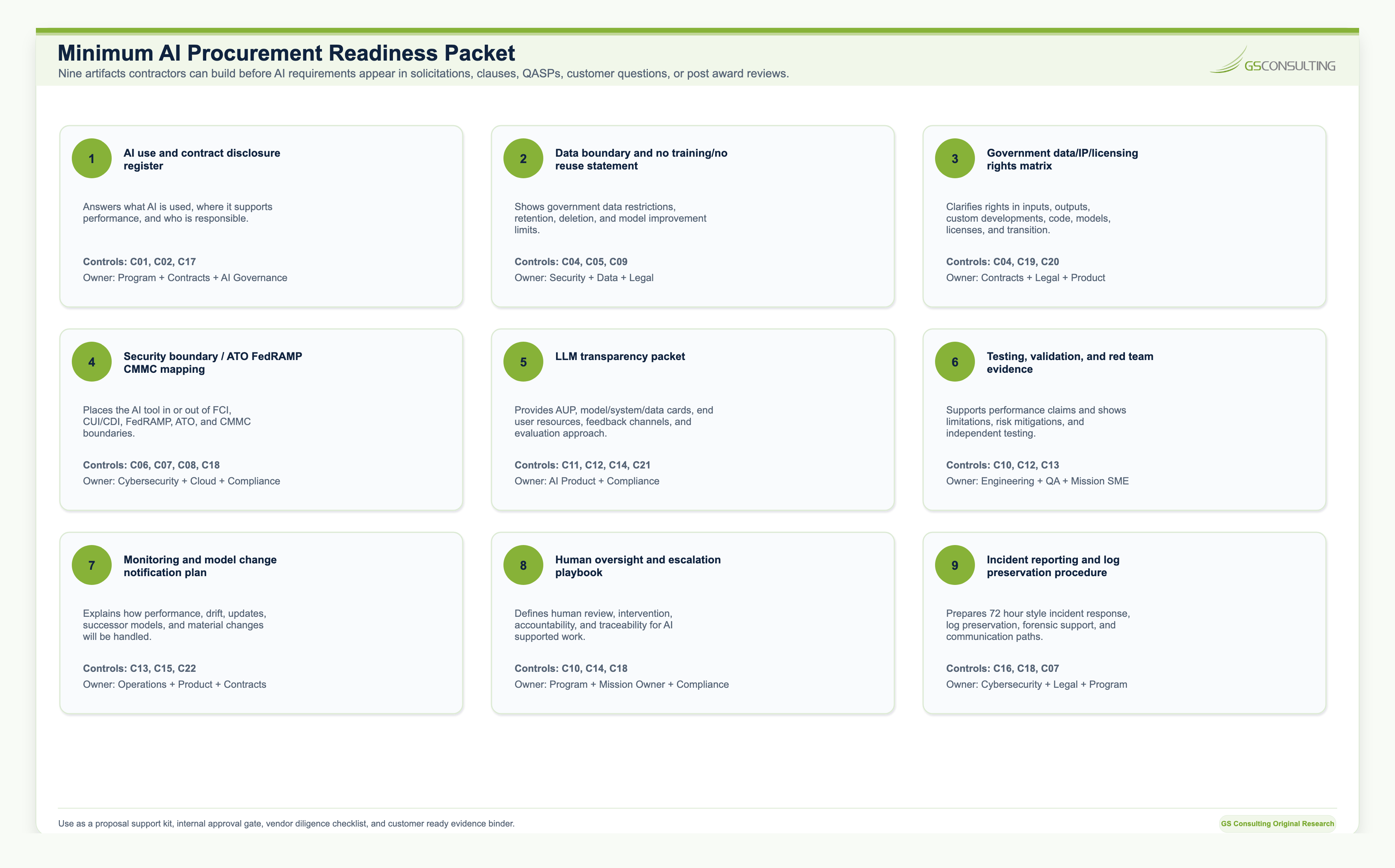
- AI use and disclosure register showing tools, owners, vendors, data types, use cases, and contract touchpoints.
- AI use policy defining approved uses, prohibited uses, data entry restrictions, and escalation paths.
- Data handling matrix for public data, proprietary data, FCI, CUI, CDI, PII, export controlled data, classified information, and customer specific restricted data.
- Government data and IP rights matrix for prompts, inputs, outputs, generated artifacts, model behavior, and customer furnished information.
- Security boundary mapping showing whether the AI tool is inside or outside relevant contract, cloud, CMMC, FedRAMP, ATO, or enclave boundaries.
- Vendor risk review process for AI tools, including retention, training, subprocessors, support access, logging, deletion, and incident notice terms.
- Model, system, or product documentation for AI enabled offerings.
- Testing and evaluation evidence showing performance, limits, failure modes, and review results.
- Human review and escalation procedures that identify who reviews outputs, what they check, and when they escalate.
- Monitoring and incident playbook for AI related data exposure, incorrect outputs, system failure, vendor changes, or policy violations.
- Subcontractor AI disclosure and flow down language.
- CMMC and FedRAMP alignment evidence where applicable.
- Change notice process for model updates, product changes, new integrations, new data sources, and expanded use.
- LLM transparency packet where LLM based tools are offered or used in support of contract performance.
This does not need to be elegant. It needs to be real, documented, current, and usable.
Common AI Procurement Mistakes to Avoid
Most AI procurement problems do not start with bad technology. They start with bad assumptions.
Mistake 1: Treating AI like a normal productivity tool. If employees are entering government contract information into public or unapproved AI tools, the company may already have a compliance problem. Speed does not make the data boundary disappear.
Mistake 2: Checking vendor terms too late. Contractors need to know whether prompts, files, outputs, metadata, logs, or user activity can be stored, reviewed, reused, shared with subprocessors, or used for model improvement before the tool touches contract data.
Mistake 3: Assuming FedRAMP means blanket approval. FedRAMP status can help the review. It does not automatically approve a tool for every contract, agency, data type, workflow, user group, or security boundary.
Mistake 4: Forgetting subcontractor AI use. Prime contractors should not discover after award that a subcontractor used an unapproved AI tool to process customer data, summarize CUI, draft deliverables, or support contract performance.
Mistake 5: Failing to document testing. AI performance claims need evidence, especially when AI supports mission, compliance, cybersecurity, public facing services, high impact decisions, or regulated workflows.
Mistake 6: Treating human review as a magic phrase. Human review matters only when reviewers are trained, accountable, able to detect errors, empowered to override, and supported by a documented escalation path.
Mistake 7: Ignoring lifecycle management. AI systems change. Models update. Vendors change terms. Users adapt. Data shifts. Workflows expand. Contractors need monitoring and reassessment after deployment.
Mistake 8: Waiting for the customer to ask. By the time an RFP, contracting officer, program office, security reviewer, or auditor asks about AI, the contractor should already know what AI is used, what data it touches, who approved it, and what evidence exists.
The Bottom Line
AI procurement is becoming a trust test for government contractors.
Agencies want AI that improves performance, reduces burden, and supports mission outcomes. But they also need contractors that understand acquisition rules, data boundaries, cybersecurity, documentation, oversight, and mission risk.
The contractors that win in this environment will not be the ones with the loudest AI claims or the most impressive demo. They will be the ones that can show how AI is governed, secured, tested, monitored, documented, and aligned to contract requirements.
That is the real standard: better capability, cleaner evidence, and no surprises.
GS Consulting helps government contractors turn fragmented AI procurement rules into a practical operating plan.
That means mapping AI use, defining data boundaries, reviewing vendors, preparing disclosure language, building governance documentation, creating testing and monitoring evidence, supporting proposal positioning, and helping DoD, IC, and federal contractors explain their AI approach before customers, security reviewers, auditors, or contracting officers ask.
How GS Consulting applies the control stack
In a private AI cyber analysis implementation, GS Consulting kept processing inside an approved environment and built the full pipeline around the locally hosted model: controlled data preparation, repeatable domain instructions, structured JSON, validation, orchestration, destination-system integration, processing visibility, and human review. That pattern turns broad procurement questions into inspectable architecture and operating evidence.
Read the Private AI Case StudyResearch Sources and Caveats
The original research in this article uses GS Consulting planning metrics. The Clause/Evidence Pressure Score, AI Procurement Contracting Exposure Index, and Function Trigger Score are not official government rankings, legal conclusions, compliance determinations, or procurement forecasts.
They are planning tools. They help contractors see where public procurement, cybersecurity, cloud, AI governance, and federal AI inventory sources appear to create practical evidence pressure.
- OMB M-25-22, Driving Efficient Acquisition of Artificial Intelligence in Government
- OMB M-26-04, Increasing Public Trust in Artificial Intelligence Through Unbiased AI Principles
- 2025 Federal Agency AI Use Case Inventory
- FAR 52.204-21, Basic Safeguarding of Covered Contractor Information Systems
- GSA Federal Acquisition Service proposed government AI system terms and conditions
Review your AI procurement readiness.
GS Consulting helps contractors map customer requirements, review deployment boundaries and identify gaps in vendor evidence. Bring a proposed workflow or upcoming procurement to define the review scope and the evidence your team needs next.
Request an AI Procurement Readiness ReviewFrequently Asked Questions About GovCon AI Procurement
Does OMB M-25-22 apply to existing government contracts?
Within its scope, OMB M-25-22 applies to contracts awarded under solicitations issued at least 180 days after April 3, 2025, and to options to renew or extend existing contracts exercised after that interval. Contractors should review the applicable agency implementation and actual contract terms when preparing for an option or extension.
Do DoD contractors need a FedRAMP authorized AI tool to process CUI?
If an AI tool is a cloud service used to store, process, or transmit Covered Defense Information or CUI, DFARS 252.204-7012 may require the cloud service provider to meet security requirements equivalent to the FedRAMP Moderate baseline, along with applicable cyber incident reporting requirements. Contractors should review the specific contract, data type, cloud architecture, and security boundary before approving the tool.
Are government contractors required to disclose internal, incidental AI use?
Generally, OMB guidance excludes AI used incidentally by a contractor at its own option when it is not directed or required to fulfill contract requirements. But that does not make every internal use irrelevant. If internal AI use processes sensitive government data, touches CUI, generates contract deliverables, supports performance, or creates risk the government would not otherwise anticipate, contractors should run a disclosure and safeguarding review.
What AI compliance frameworks should government contractors review?
Review the actual solicitation and contract first, then map applicable OMB acquisition and agency guidance, FAR and DFARS clauses, CMMC requirements, NIST SP 800-171 for CUI, FedRAMP or equivalent cloud requirements where applicable, NIST AI RMF, privacy and records duties, data rights, and agency or mission-specific AI policies.
Sources and Suggested Future Reading
- Acquisition.gov: FAR 52.204-21 Basic Safeguarding of Covered Contractor Information Systems
- Acquisition.gov: DFARS 252.204-7012 Safeguarding Covered Defense Information and Cyber Incident Reporting
- DoD CIO: CMMC Program Information
- NIST SP 800-171 Rev. 3: Protecting Controlled Unclassified Information
- NARA CUI Registry Category List
- CISA Known Exploited Vulnerabilities Data
- AI Integration in Government Contracting: A Practical Guide for GovCon Leaders
- How DoD Contractors Can Use AI Without Putting CUI at Risk
- AI Disclosure in Federal Contracts: What GovCon Firms Should Prepare For
- AI & Automation in Government Contracting Insights Hub