Responsible AI | | 26 min read
AI Integration for Government Contractors: A Practical Guide

Key Takeaways
GovCon AI integration connects a bounded workflow to contract obligations.
Choose an approved use case
Start with a defined operational task and measurable business value.
Preserve the data boundary
Map contract requirements, sensitive data, vendors, and access before integration.
Operate with evidence
Retain human accountability, test results, monitoring, and customer disclosure support where required.
AI integration for government contractors means connecting an approved AI capability to a bounded workflow while preserving contract requirements, data controls, human accountability, test evidence, monitoring, and customer trust.
It is not simply buying a tool. It is changing how work gets done without losing control of the contract, the data, the customer relationship, or the mission.
The contractors that win with AI will not be the ones with the loudest claims. They will be the ones that can show where AI improves delivery, what data it touches, who approved it, how outputs are reviewed, and what evidence exists when the customer asks.
AI is already inside government contracting. It is showing up in proposal development, compliance tracking, program reporting, cybersecurity operations, knowledge management, help desk triage, financial operations, software development, and mission support.
That is not automatically a problem. The problem starts when AI enters the workflow faster than leadership can answer basic questions: What tool is being used? What data does it touch? Is the environment approved? Does the output affect a deliverable? Who reviews it? What happens when it is wrong? Could a subcontractor be using AI in the background?
Commercial companies can sometimes treat those as internal management questions. Government contractors do not have that luxury.
In GovCon, AI can create contract risk, data risk, cybersecurity risk, disclosure risk, performance risk, and customer trust risk. It can also create real advantage when it is used in the right workflows with the right controls.
Do not let AI use spread before the controls exist.
GS Consulting helps DoD, IC, and federal contractors identify practical AI use cases, define data boundaries, build governance workflows, prepare implementation roadmaps, and create customer ready evidence.
Explore Secure AI Automation Consulting See a Private AI ImplementationThis guide is about the middle path: using AI where it improves business and mission outcomes without letting speed outrun security, compliance, evidence, or accountability.
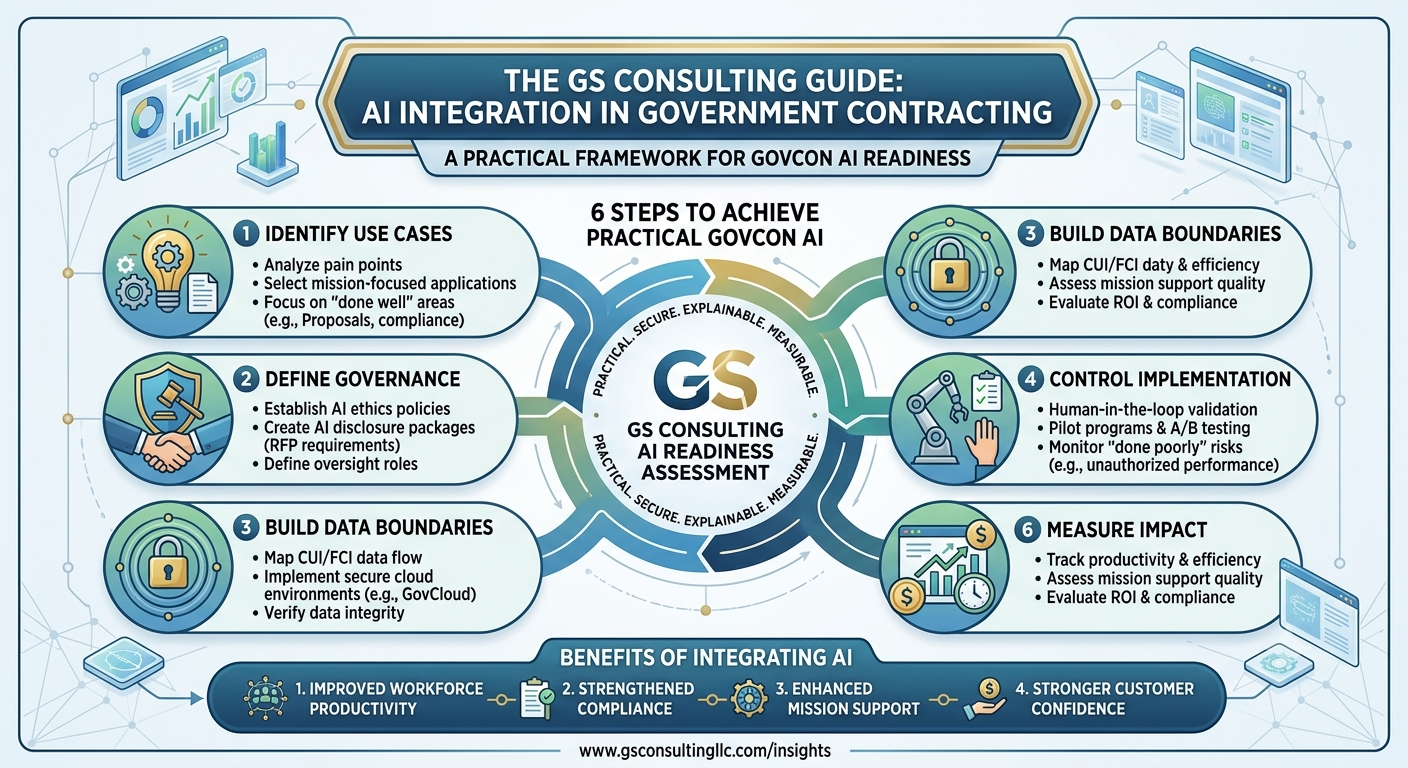
Why AI Matters in GovCon Now
Federal customers are moving toward AI, but they are not asking contractors to be reckless.
The policy direction is clear: agencies are being pushed to adopt AI faster, use it more effectively, and acquire it in ways that support performance, competition, risk management, data protection, and public trust. That creates opportunity for contractors, but only for contractors that understand the operating environment.
OMB Memorandum M-25-21, issued in April 2025, rescinded and replaced M-24-10 and directs agencies to take a forward leaning approach to AI while maintaining safeguards for privacy, civil rights, civil liberties, and public trust. OMB Memorandum M-25-22, also issued in April 2025, rescinded and replaced M-24-18 and gives agencies guidance for acquiring AI responsibly, with emphasis on competition, performance, risk management, and acquisition engagement across functions.
For contractors, this means AI will increasingly appear in requirements, evaluation criteria, internal agency modernization initiatives, and contract performance expectations. Agencies are being encouraged to adopt AI, but they are also being told to measure performance, manage risk, avoid vendor lock in, protect government data, and maintain public trust.
The DoD environment adds another layer. The Department's 2023 Data, Analytics, and Artificial Intelligence Adoption Strategy focuses on accelerating adoption of data, analytics, and AI to support decision advantage, with priorities that include interoperable infrastructure, data ecosystem maturity, digital talent, foundational data management, governance, and enterprise and warfighting impact. The Intelligence Community has also formalized AI governance through ICD 505, which establishes policy for AI developed, acquired, or used by or on behalf of the IC.
The opportunity is real. So is the filter. Agencies will need contractors that can bring AI into delivery without creating new problems for the customer to clean up later.
Original Research: Federal AI Integration Is Already Operational
The federal market is past the "AI someday" stage.
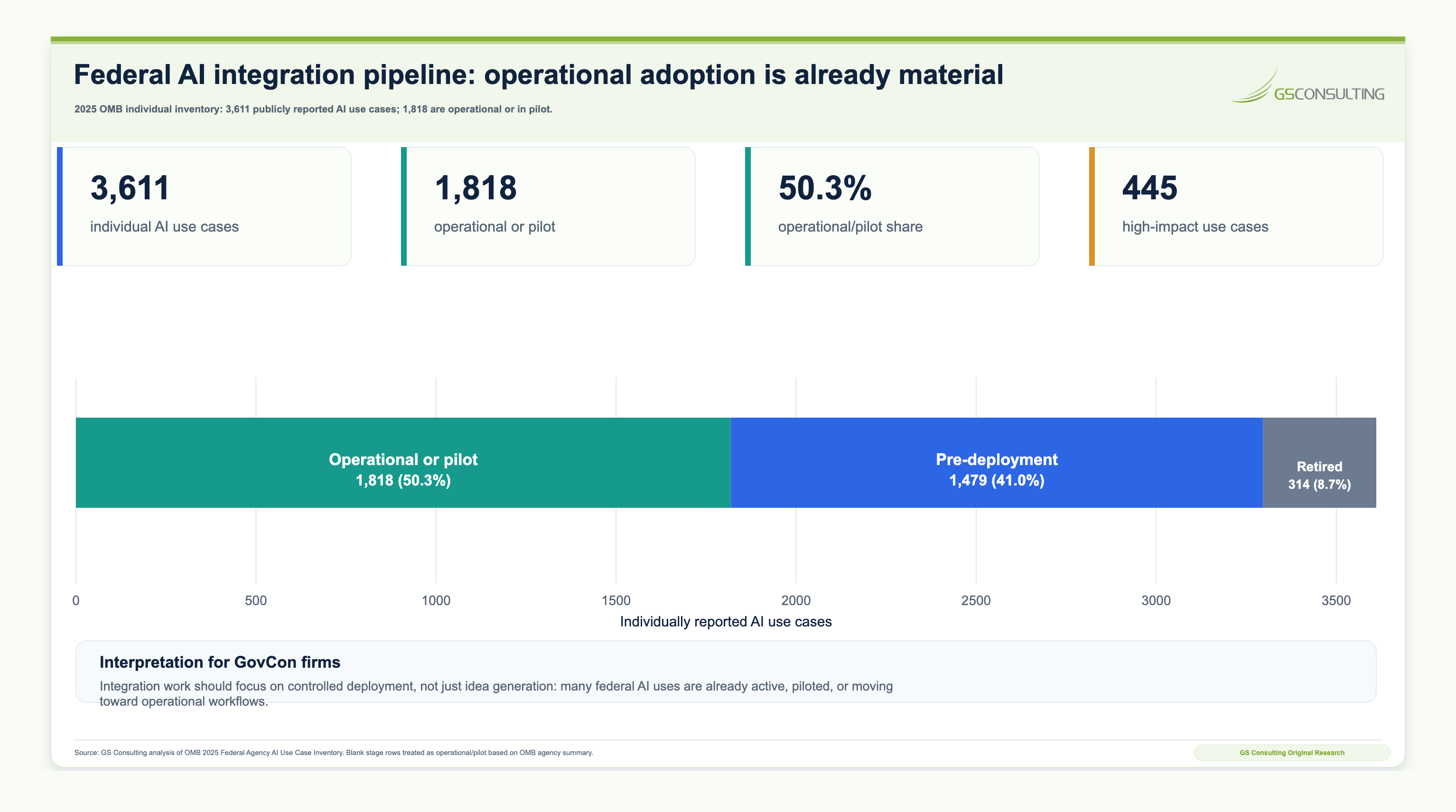
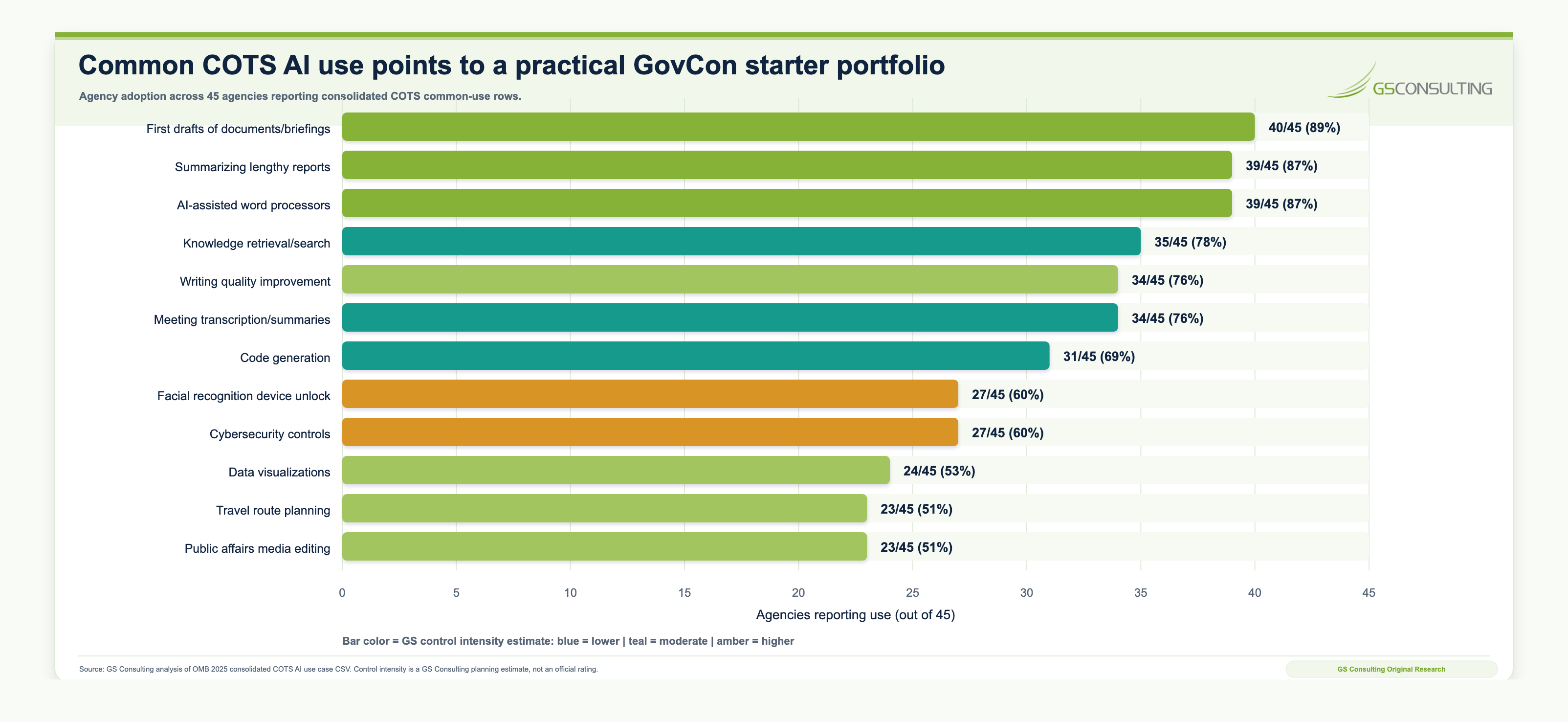
GS Consulting's analysis of the 2025 Federal Agency AI Use Case Inventory and the 2025 consolidated COTS AI use case inventory shows that AI is already moving into operational federal workflows. That matters for contractors because operational AI creates a different kind of opportunity: less theory, more delivery discipline.
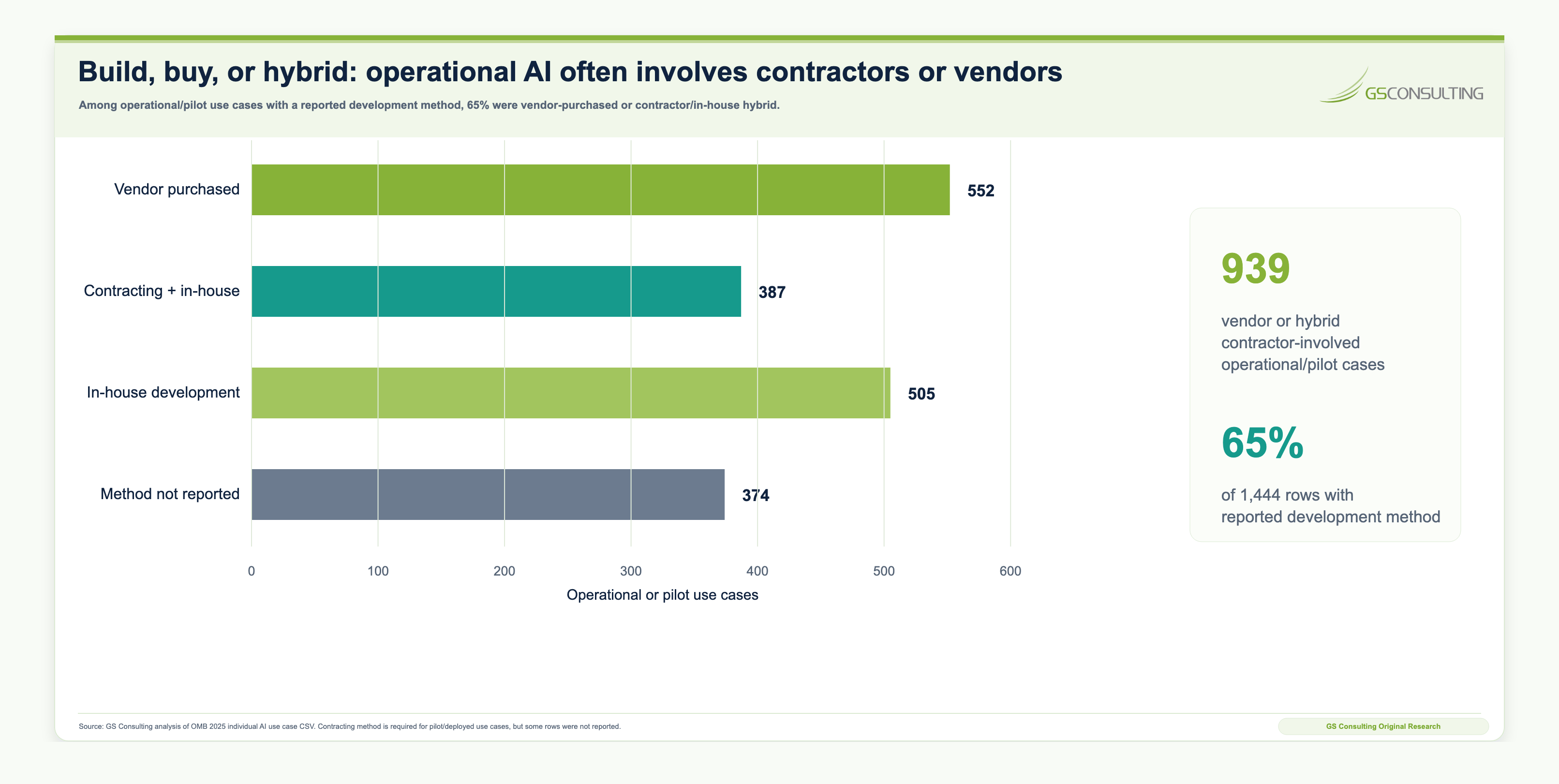
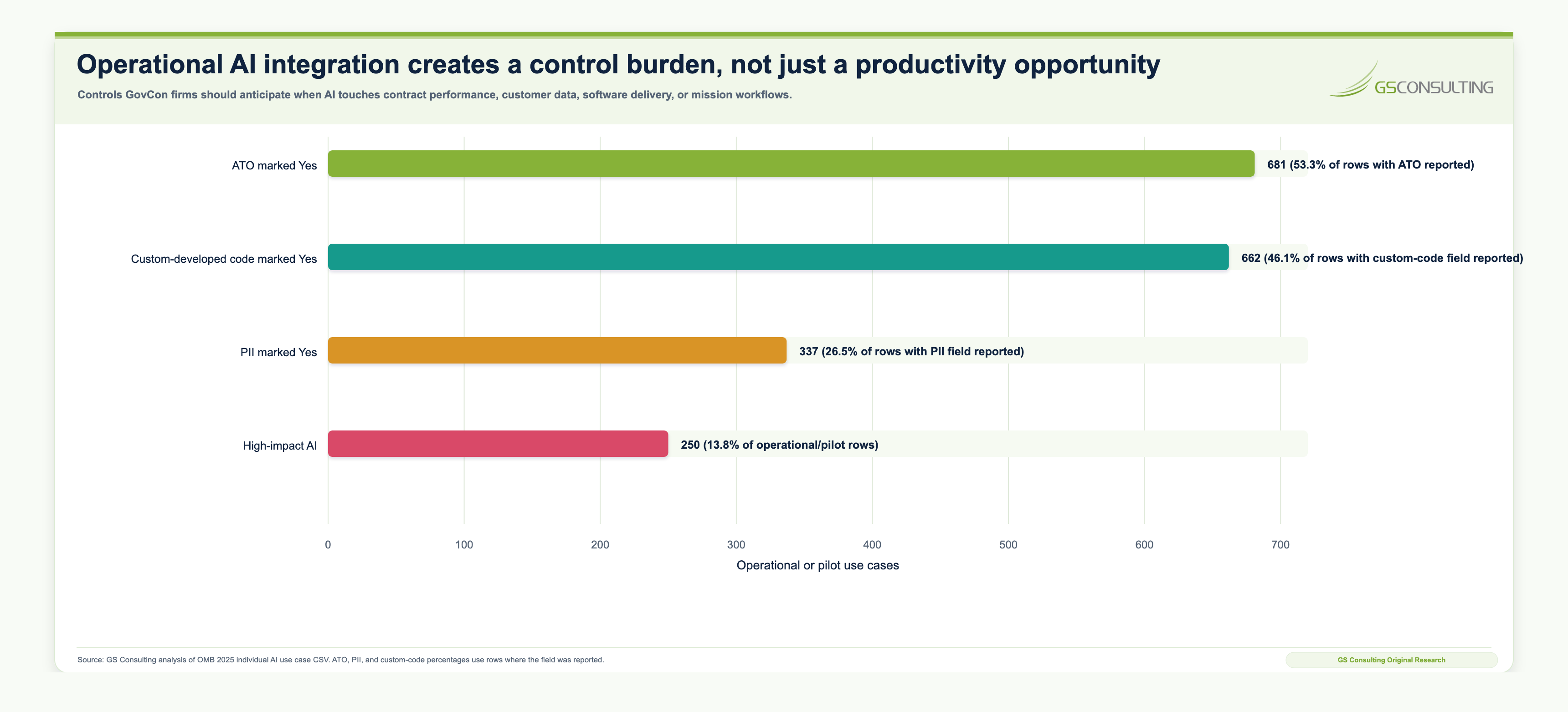
Of 3,611 individually reported AI use cases, 1,818 were operational or in pilot. Among operational or pilot use cases with a reported development method, 65% were vendor purchased or developed through a contractor and internal hybrid model. The data points to a practical integration strategy for government contractors: start with bounded, measurable use cases, then build the control layer early.
What this means for contractors
AI integration is becoming a controlled delivery discipline, not a productivity experiment. Contractors should be building the basics now: implementation roadmaps, approved tool boundaries, ATO awareness, vendor review, testing evidence, human review, logging, monitoring, and reusable customer ready documentation.
Methodology and caveat
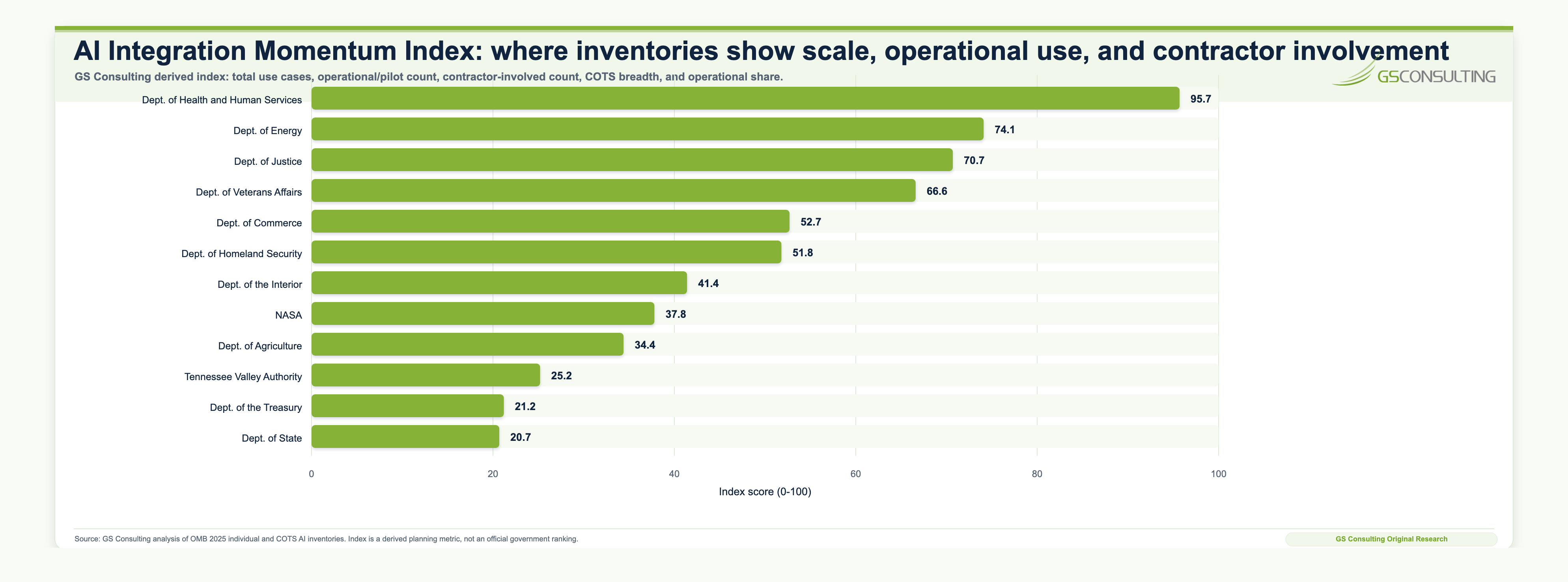
Sources: GS Consulting analysis of the 2025 Federal Agency AI Use Case Inventory and 2025 consolidated COTS AI use case inventory. Derived planning metrics include the AI Integration Momentum Index, COTS Starter Pilot Score, and Operational Control Trigger Profile. These are not official government scores, legal conclusions, compliance determinations, or procurement forecasts. The public inventory is self reported and does not cover every federal AI use.
What AI Integration Means for Government Contractors
AI integration is not procurement. It is implementation.
Buying an AI tool is the easy part. The harder work is deciding where AI belongs in the workflow, what data it can touch, what environment it can run in, how performance will be tested, who reviews the output, what records must be kept, and when the tool should be paused or retired.
For a government contractor, AI integration may include internal business automation, customer facing delivery support, or direct mission enablement. Each category carries a different risk profile.
The category matters because the control level should match the risk. A public market research assistant does not need the same review as AI that summarizes CUI, supports cybersecurity triage, interacts with controlled systems, or influences mission decisions.
A lower risk internal use case might involve using AI to summarize publicly available market research, organize proposal schedules, or generate first draft internal templates. A moderate risk use case might involve contract deliverable tracking, HR workflow automation, cybersecurity ticket triage, or finance process automation. A higher risk use case might involve AI that supports mission decisions, processes sensitive government information, interacts with controlled systems, or affects personnel, safety, privacy, classified information, or mission outcomes.
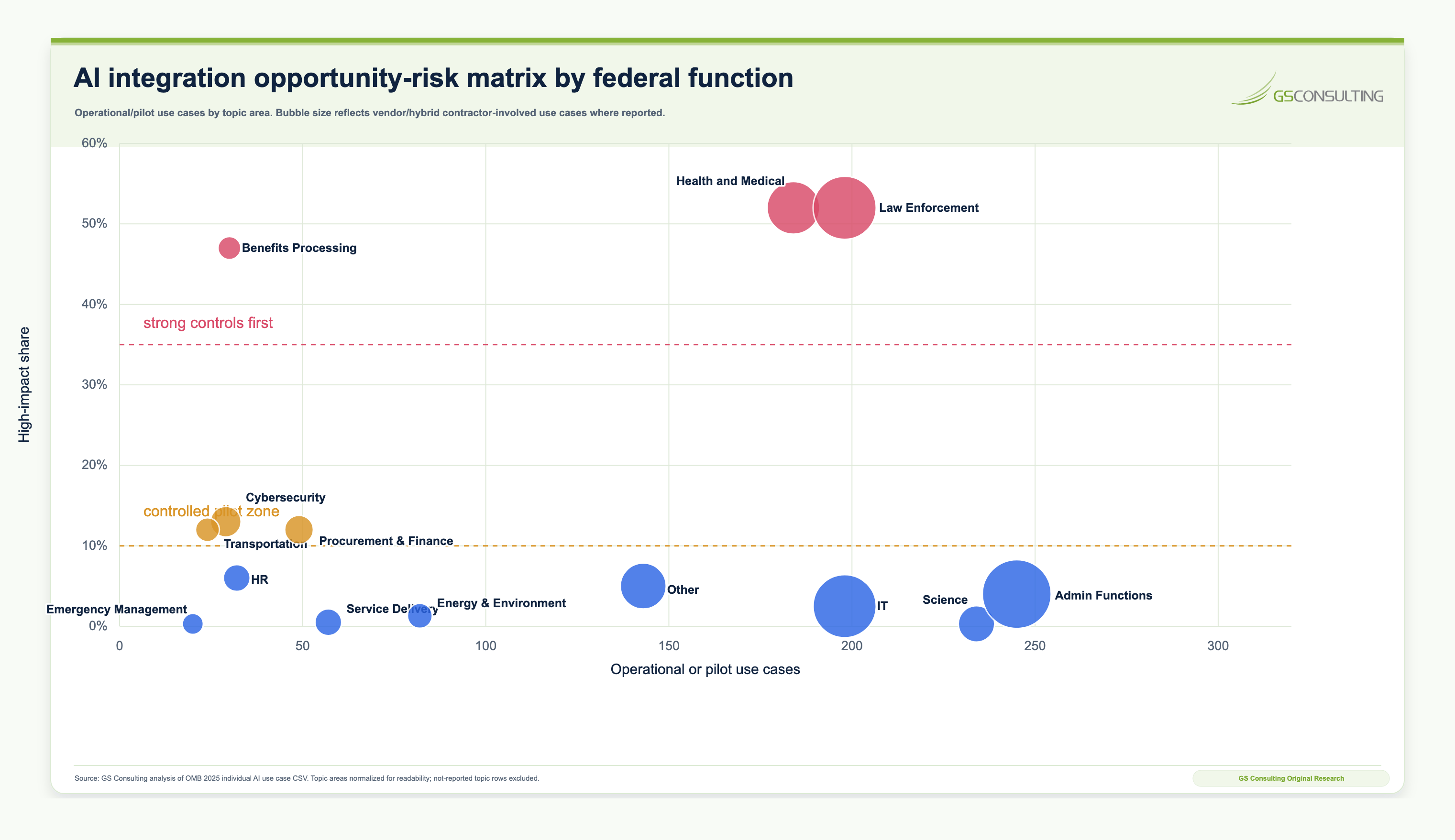
OMB defines "high impact AI" as AI whose output serves as a principal basis for decisions or actions with legal, material, binding, or significant effects in areas such as privacy, civil rights, access to critical government resources, health and safety, critical infrastructure, public safety, or strategic assets including sensitive or classified federal information. That definition should shape how GovCon firms assess risk before deploying AI in or near customer environments.
The Best GovCon AI Use Cases to Start With
The best first AI use cases are not the flashiest ones. They are the ones where the workflow is painful, the data boundary is manageable, the value is measurable, and a person can stay accountable.
That usually means starting with work the company already understands well: proposals, program management, compliance operations, knowledge management, help desk triage, reporting, and controlled internal analysis.
Proposal and capture work is a strong starting point because the pain is obvious and the value is measurable. AI can help teams organize solicitation requirements, draft compliance matrices, summarize agency priorities, review past performance language, identify outline gaps, and prepare color team materials faster. The key is to ensure proprietary, source selection sensitive, CUI, or customer provided information is handled only in approved environments.
Program management is another practical starting point because the work is repetitive, deadline driven, and full of status information that often lives in too many places. AI can support action item tracking, deliverable status summaries, schedule risk identification, quality assurance surveillance preparation, and recurring report generation.
Contracts and compliance teams do not need AI to make legal judgments. They need AI to reduce the manual burden around visibility, tracking, and first pass analysis. AI can help track clauses, map deliverables to contract requirements, flag missing documentation, summarize policy changes, and support internal audit readiness.
Knowledge management may be one of the highest value AI use cases in GovCon because most contractors are sitting on years of useful knowledge that employees cannot find quickly. AI assisted search and retrieval can help employees find lessons learned, customer context, SOPs, proposal language, onboarding material, and technical documentation faster when access controls and data segmentation are properly designed.
Mission adjacent AI is where contractors need to slow down and get serious. AI may help with data triage, workflow prioritization, analytics support, document summarization, and decision support, but only inside approved systems with authorization, human review, auditability, and handling that respects classification requirements.
The Compliance and Risk Framework Contractors Need
AI governance in GovCon does not need to be theatrical. It needs to be real.
A policy is useful, but it is not enough. Governance has to show up in the operating model: who approves tools, what data can be used, how use cases are reviewed, how outputs are tested, how users are trained, how incidents are handled, and what evidence exists after launch.
NIST's AI Risk Management Framework provides a useful structure for organizing AI risk activities around four functions: govern, map, measure, and manage. For GovCon leaders, that framework translates into practical operating rules.
"Govern" means someone owns the rules. Assign accountability for approved tools, data rules, training, risk acceptance, escalation, and customer facing use. This cannot live only with IT. AI governance needs input from operations, contracts, security, legal, HR, business development, and delivery leadership.
"Map" means the contractor knows where AI is being used. Identify workflows, data categories, users, dependencies, contract touchpoints, and failure modes. A proposal assistant using public information has a different risk profile than a model summarizing CUI or supporting a mission workflow.
"Measure" means the tool has to prove itself. Test accuracy, consistency, cybersecurity exposure, hallucination risk, bias, user fit, and performance in the actual operating environment.
"Manage" means the contractor keeps control after launch. Monitor drift, vendor changes, data changes, user misuse, incidents, version changes, and retirement criteria.
Federal acquisition guidance is moving in this direction. M-25-22 encourages performance based acquisition techniques for AI, including Statements of Objectives, Performance Work Statements, Quality Assurance Surveillance Plans, and incentives tied to relevant metrics. It also emphasizes testing proposed AI solutions, reducing vendor lock in, addressing IP rights and government data use, and including contract terms for ongoing testing and monitoring.
Special Considerations for DoD and IC Contractors
DoD and IC contractors do not get to treat AI like a normal productivity tool.
The environment is different. AI may intersect with controlled information, classified systems, mission workflows, operational risk, national security equities, customer authorization boundaries, and policies that were not written for casual experimentation.
The DoD Artificial Intelligence Cybersecurity Risk Management Tailoring Guide states that cybersecurity professionals should be integrated as early as possible in the AI lifecycle, and that security objectives should be established early because AI system missions vary. The guide also states that its security priorities apply to AI systems operated by DoD or on behalf of DoD by a contractor or other entity.
For contractors, that means AI cannot be treated as "just another software tool." AI systems may require cybersecurity evidence, model assessment, infrastructure authorization, test and evaluation artifacts, change management, and alignment with the customer's risk posture. AI systems used in Sensitive Compartmented Information missions must also follow existing DoD and Intelligence Community policies, as applicable.
The IC's ICD 505 includes requirements around governance, accountability, model documentation, provenance, risk management, periodic audits, impact assessments, and handling of AI outputs that respects classification requirements. This is why DoD and IC contractors should build the control model before a customer, auditor, security team, or contracting officer asks them to explain it.
Data Protection Comes First
The fastest way to create AI risk in GovCon is to let convenience beat data protection.
Employees do not usually misuse AI because they are trying to create risk. They do it because the tool is fast. They paste contract language, customer emails, technical documentation, CUI, pricing, source material, or controlled program information into whatever tool helps them finish the task.
That is why data rules have to come before tool selection. If the contractor cannot say what data the AI can touch, where the data goes, whether the vendor can retain it, and whether outputs inherit sensitivity from source material, the use case is not ready.
NIST SP 800-171 Rev. 3 provides recommended security requirements for protecting the confidentiality of CUI in nonfederal systems and organizations, and those requirements are intended for use in federal contracts and agreements. CMMC implementation has also begun, with Phase 1 running from November 10, 2025, through November 9, 2026, focused primarily on Level 1 and Level 2 self assessments.
AI programs should be designed around data categories from the beginning. At minimum, contractors should distinguish between public information, company proprietary information, contractor bid and proposal information, FCI, CUI, export controlled information, government furnished information, law enforcement sensitive information, U.S. person information, and classified information.
Each category should have clear rules for approved tools, storage, access, retention, logging, sharing, and model training. For sensitive or customer provided data, contractors should also verify whether vendor terms allow data to be used for model training, product improvement, or human review.
A Practical AI Integration Roadmap for GovCon Firms
A useful AI roadmap should not start with a vendor shortlist. It should start with the work.
The first question is not "Which AI tool should we buy?" The first question is "Which workflow is painful enough, valuable enough, and controlled enough to improve with AI?"
First, find the workflow. Identify places where AI could create measurable improvement: proposal cycle time, deliverable quality, onboarding speed, contract compliance visibility, help desk triage, report generation, or knowledge retrieval.
Second, map the data. Determine what information the workflow uses, where it lives, who owns it, what contract restrictions apply, and what security controls are required.
Third, score value and risk. Move high value, lower risk use cases into controlled pilots. For high value, higher risk use cases, build stronger controls before implementation.
Proposal support, public source research, internal templates, and approved knowledge retrieval.
CUI workflows, customer facing delivery support, mission adjacent analytics, and regulated decisions.
Fourth, choose the architecture. Decide whether the use case can use a commercial AI tool or needs tenant isolation, private cloud, retrieval augmented generation over approved repositories, FedRAMP authorized services, DoD impact level considerations, on premise deployment, or classified environment controls.
Fifth, test before scaling. Evaluate AI outputs against real work products, known answers, expert review, and defined performance thresholds. Capture where the tool fails, not just where it works.
Sixth, train users. Give employees clear rules on what they may enter, what they may not enter, how to verify outputs, when to escalate, and when AI use must be disclosed.
Seventh, document and monitor. Maintain the AI inventory, approved use cases, risk register, tool owner, data categories, test results, user guidance, review cadence, and retirement criteria.
What Contractors Should Prepare for Future RFPs
Contractors should not build their AI readiness package during proposal week.
As AI becomes more common in federal acquisition, solicitations and customer conversations may ask harder questions about AI use, data handling, testing, monitoring, human review, vendor controls, subcontractor use, and disclosure. The contractors that already have the answers will move faster.
A strong AI readiness package should include:
- AI use policy
- Inventory of approved tools
- Data handling rules
- Model or tool documentation
- Cybersecurity boundary description
- Human review procedures
- Testing methodology
- Performance metrics
- Incident response process
- Vendor risk review
- Subcontractor AI disclosure process
- Ongoing monitoring plan
- Reusable proposal language
- Customer ready evidence packet
M-25-22 notes that agencies may require disclosure of AI use in contract performance when vendor use of AI creates risk the government may not otherwise anticipate. The signal is simple: even when AI is not the product being procured, AI used to perform the work may still matter to the government.
Common Mistakes to Avoid
Most AI integration problems do not start with bad technology. They start with bad sequencing.
Mistake 1: Starting with the tool instead of the workflow. AI should be selected after the contractor understands the mission or business problem, the data, the users, the contract boundaries, the risk, and the performance target.
Mistake 2: Treating every AI use case as a quick productivity win. A public source research assistant is not the same as a tool that touches CUI, customer data, cybersecurity workflows, deliverables, mission systems, or personnel decisions.
Mistake 3: Using human review as a shortcut. Human review helps only when reviewers are trained, accountable, able to detect errors, and empowered to override or escalate.
Mistake 4: Ignoring data rights and model training terms. Contractors need to know whether prompts, inputs, outputs, files, logs, or metadata can be retained, reviewed, reused, shared with subprocessors, or used to improve the vendor's model.
Mistake 5: Forgetting that AI changes after launch. Models update. Vendors change features. Users adapt. Data shifts. Workflows expand. A pilot that worked in May may not be safe to scale in November without monitoring and change review.
Mistake 6: Overlooking subcontractor AI use. Prime contractors should not discover after the fact that a subcontractor used an unapproved AI tool to process customer data, draft deliverables, summarize CUI, or support contract performance.
Mistake 7: Treating AI governance as a policy document. A policy matters, but governance has to appear in the workflow: approvals, tool access, logging, testing, training, monitoring, audits, disclosure, and corrective action.
Mistake 8: Waiting for the customer to ask. By the time an RFP, contracting officer, program office, or security review asks about AI, the contractor should already know where AI is used, what data it touches, who approved it, and what evidence exists.
A 90 Day AI Action Plan: Move From Interest to Control
Ninety days is enough time to stop guessing.
The goal is not to solve every AI issue in one quarter. The goal is to find active AI use, stop the riskiest behavior, select practical pilots, define the first control model, and create enough evidence that leadership can answer basic customer and contract questions.
- Days 1 to 30Find the AI and set urgent guardrails.
Inventory AI tools, browser extensions, vendor features, pilots, employee use, subcontractor use, and affected contracts. Identify what data is being touched and where unauthorized use may be occurring.
- Days 31 to 60Pick the pilots that are worth doing.
Select a small number of high value, manageable use cases and define success metrics before implementation starts.
- Days 61 to 90Make the control model real.
Create or update the policy, approved tool list, data handling rules, training, risk register, vendor review checklist, subcontractor process, testing method, monitoring cadence, and review workflow.
Good pilot candidates include proposal support, internal knowledge management, contract deliverable tracking, help desk triage, compliance document review, reporting support, and approved knowledge retrieval.
By the end of 90 days, leadership should be able to answer six questions without scrambling: Where are we using AI? What data does it touch? Who approved it? How do we know it works? What would we disclose if asked? What do we do when it fails?
How GS Consulting Helps
GS Consulting helps government contractors move from AI interest to controlled AI execution.
That means starting with the real operating questions: where AI can improve contract performance, which workflows are worth piloting, what data the tools can touch, what governance is required, what security controls apply, what evidence should be created, and how the company can explain its approach to customers.
We help DoD, IC, and federal contractors assess AI readiness, identify practical use cases, define data boundaries, build governance workflows, develop AI policies, prepare implementation roadmaps, support proposal positioning, and align AI use with mission focused technical delivery.
The goal is not to chase AI hype. The goal is to use AI where it improves delivery, reduces friction, strengthens visibility, and protects the customer, the company, and the contract.
Government agencies are moving faster on AI, but they still need contractors that understand the environment.
The advantage will not go to contractors that claim AI expertise in the abstract. It will go to contractors that can show practical use cases, controlled data boundaries, tested outputs, accountable review, vendor discipline, monitoring, and customer ready evidence.
In GovCon, AI maturity is not measured by how many tools a company buys. It is measured by whether the company can use AI to improve delivery without creating new risk for the customer.
That is the standard: better performance, cleaner evidence, and no surprises.
A practical integration pattern from GS Consulting
GS Consulting designed and implemented a private AI cyber analysis pipeline that prepared host and operational data, applied repeatable domain instructions through a locally hosted model, validated structured JSON, orchestrated execution, and integrated approved results into a SIEM or database. Processing visibility and human review surrounded the model so the implementation operated as a controlled system.
Read the Case StudyReady to find where AI actually fits in your GovCon business?
GS Consulting helps DoD, IC, and federal contractors assess AI readiness, prioritize practical use cases, define data boundaries, build governance workflows, and create implementation roadmaps that support growth without putting the contract or customer at risk.
Assess a WorkflowFrequently Asked Questions About GovCon AI Integration
How should a government contractor begin AI integration?
Start with one bounded workflow, define the contract and business outcome, map the data and approved environment, assign an accountable owner, set human review and action limits, test with representative data, and retain the evidence needed to authorize a pilot.
Can government contractors use AI with CUI?
Only when the contract, system boundary, provider terms, data flow, access controls, security requirements, and customer authorization support that use. A private or enterprise product label alone does not make an AI workflow suitable for CUI.
What evidence should a GovCon AI implementation retain?
Retain the use case decision, owners, data boundary, architecture, vendor review, model and workflow versions, evaluation results, human review rules, logs, incidents, monitoring records, change history, and any required customer disclosure or approval.
Suggested Future Reading
- AI Procurement Regulations Every Government Contractor Should Know
- How DoD Contractors Can Use AI Without Putting CUI at Risk
- AI Disclosure in Federal Contracts: What GovCon Firms Should Prepare For
- AI & Automation in Government Contracting Insights Hub
- GovCon Cybersecurity & Compliance Hub: CMMC, NIST, CUI, Cloud, and AI Enabled Readiness