Secure AI Automation | | 24 min read
AI Governance Policies for Workflow Automation

Key Takeaways
AI policies must become enforceable workflow rules.
Define action authority
Specify approved use cases, owners, data boundaries, and permitted actions.
Make review operational
Set approval, escalation, logging, and monitoring rules people and systems can follow.
Retain policy evidence
Keep use case decisions, exceptions, reviews, and change records with the workflow.
AI governance policies for workflow automation define approved use cases, responsible owners, data and model boundaries, action limits, human approval, logging, monitoring, and escalation.
Those policies turn responsible AI from a general principle into authorization rules that people and systems can follow.
AI workflow automation fails when the organization cannot answer basic operational questions once AI starts touching real work.
- Who approved this use case?
- What data is the AI allowed to see?
- Can the AI write back to a system?
- Who reviews the output?
- What happens when the model is wrong?
- Who can pause the workflow?
- Where is the evidence?
That is the real governance problem.
A policy that says "use AI responsibly" will not help much when an employee pastes customer records into an unapproved tool, when an AI agent routes a sensitive HR case to the wrong queue, or when a workflow sends a customer response no one reviewed.
Build AI governance policies before workflow automation scales.
GS Consulting helps regulated organizations define AI acceptable use, approval authority, data handling, model use, action limits, human review, escalation paths, monitoring, and evidence controls.
Explore AI Governance ConsultingWhy AI Workflow Automation Needs Policies Before It Scales
A single AI assistant is one thing. AI connected to workflows is something else.
Once AI starts classifying tickets, summarizing contracts, drafting customer responses, reviewing invoices, organizing compliance evidence, routing HR cases, or calling tools across systems, the risk changes.
Now AI is part of how work happens.
That means the organization needs rules for data, decisions, approvals, vendors, logs, actions, exceptions, and monitoring.
NIST's AI Risk Management Framework is useful because it forces leaders to govern, map, measure, and manage AI risk. In plain English: define ownership, understand the workflow, measure risk, and manage the system after launch.
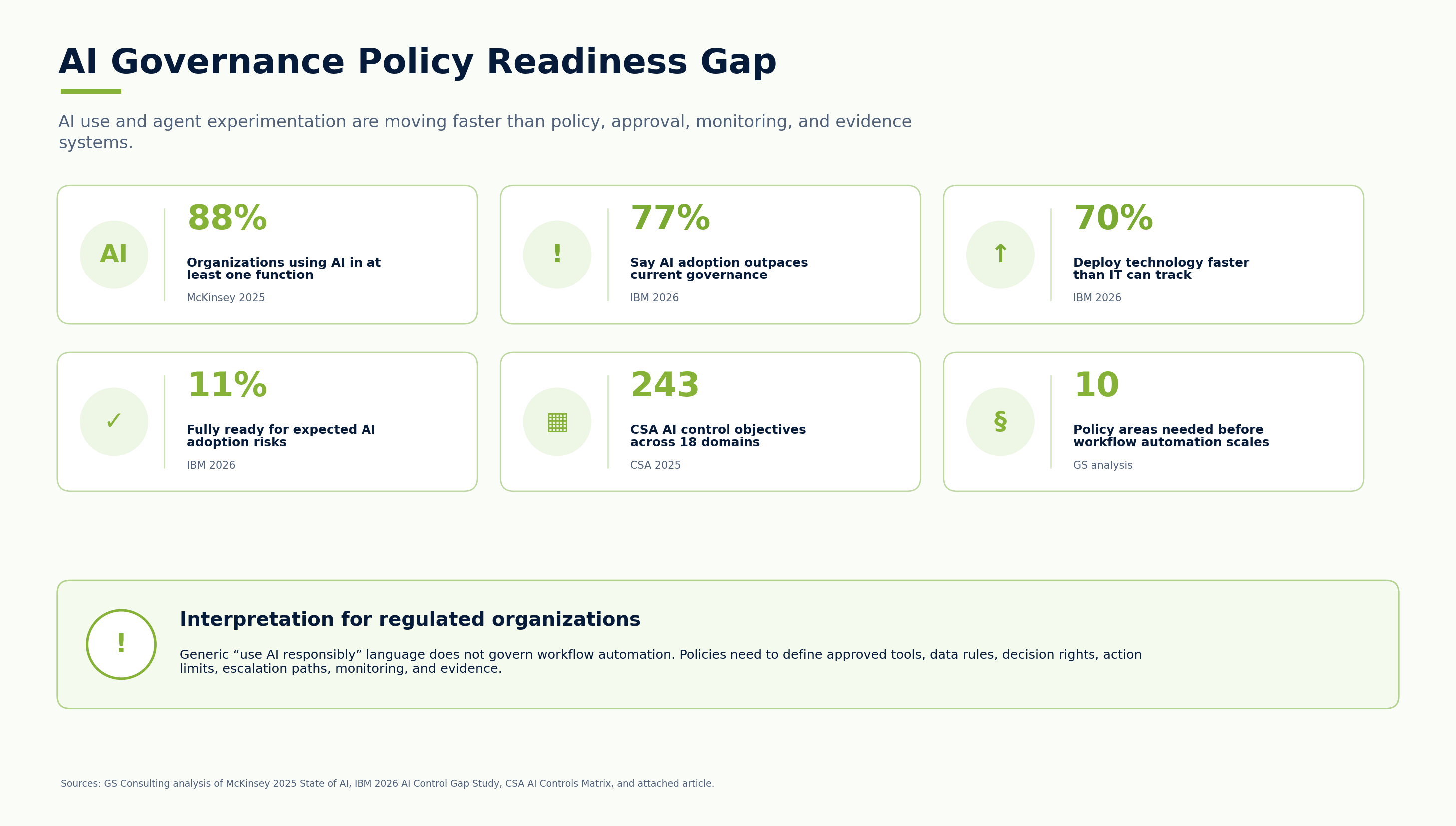
Original Research: The AI Governance Policy Evidence Burden Index
Original GS Consulting research shows that AI governance policies must operate as workflow gates, not generic responsible use statements.
GS Consulting analyzed public AI governance, security, regulatory, accountability, and enterprise adoption sources against ten AI workflow policy areas. The source set included NIST AI RMF, NIST AI RMF Playbook, NIST Generative AI Profile, ISO IEC 42001, EU AI Act high risk obligations, OWASP LLM Top 10, CISA and NSA agentic AI guidance, CISA, NSA, and FBI AI data security guidance, CSA AI Controls Matrix, GAO's AI Accountability Framework, NIST SP 800 53, IBM's 2026 AI Control Gap Study, McKinsey's 2025 State of AI, and Microsoft's 2025 Digital Defense Report.
Each source policy intersection was coded from 0 to 2, then weighted by source type. Binding regulation, formal security guidance, AI control frameworks, and official standards guidance received higher weights than survey signals. The result is a GS Consulting derived planning metric, not an official legal, regulatory, audit, or compliance score.
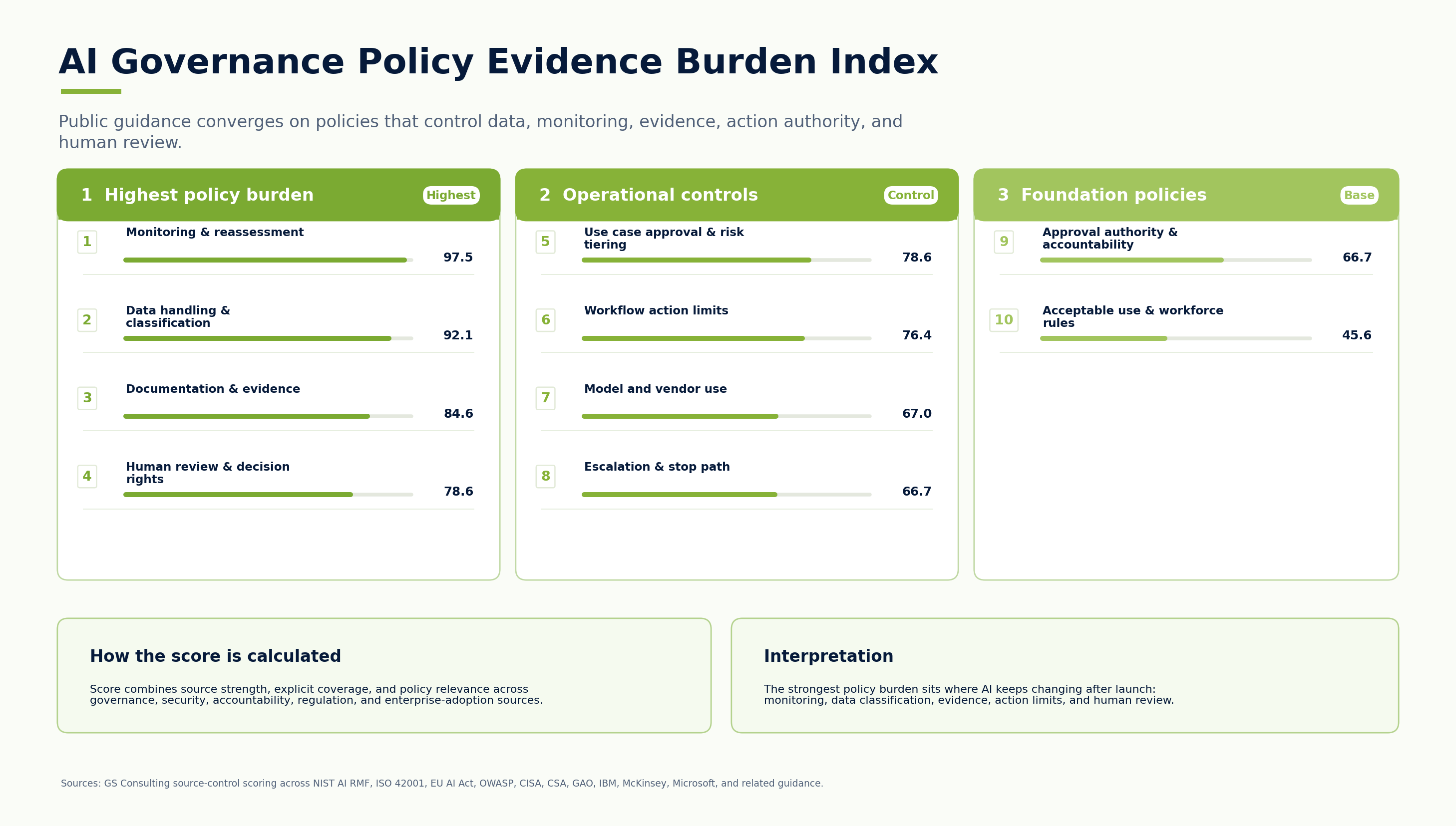
McKinsey's 2025 State of AI survey reported that 88 percent of organizations regularly use AI in at least one business function, 62 percent are at least experimenting with AI agents, 23 percent are scaling an agentic AI system somewhere in the enterprise, and only 39 percent report enterprise level EBIT impact. IBM's June 2026 AI control gap study adds the governance warning: 77 percent of surveyed technology executives said AI adoption is outpacing governance, 70 percent said teams deploy technology faster than IT can track, and only 11 percent said they are fully ready for AI adoption risks.
The practical takeaway is simple: the issue is not whether organizations are using AI. The issue is whether their policies are operational enough to control AI once it enters workflows.
The AI Governance Policy Stack
Think of AI governance policies as a stack.
At the bottom is acceptable use. That tells people what they can and cannot do. Next is data handling. That tells people what data AI can touch. Next is model use. That tells people which tools and environments are allowed. Next is approval authority. That tells people who decides.
Then come the operating controls: workflow action limits, human review, escalation, monitoring, and documentation. If one layer is missing, the whole system gets weaker.
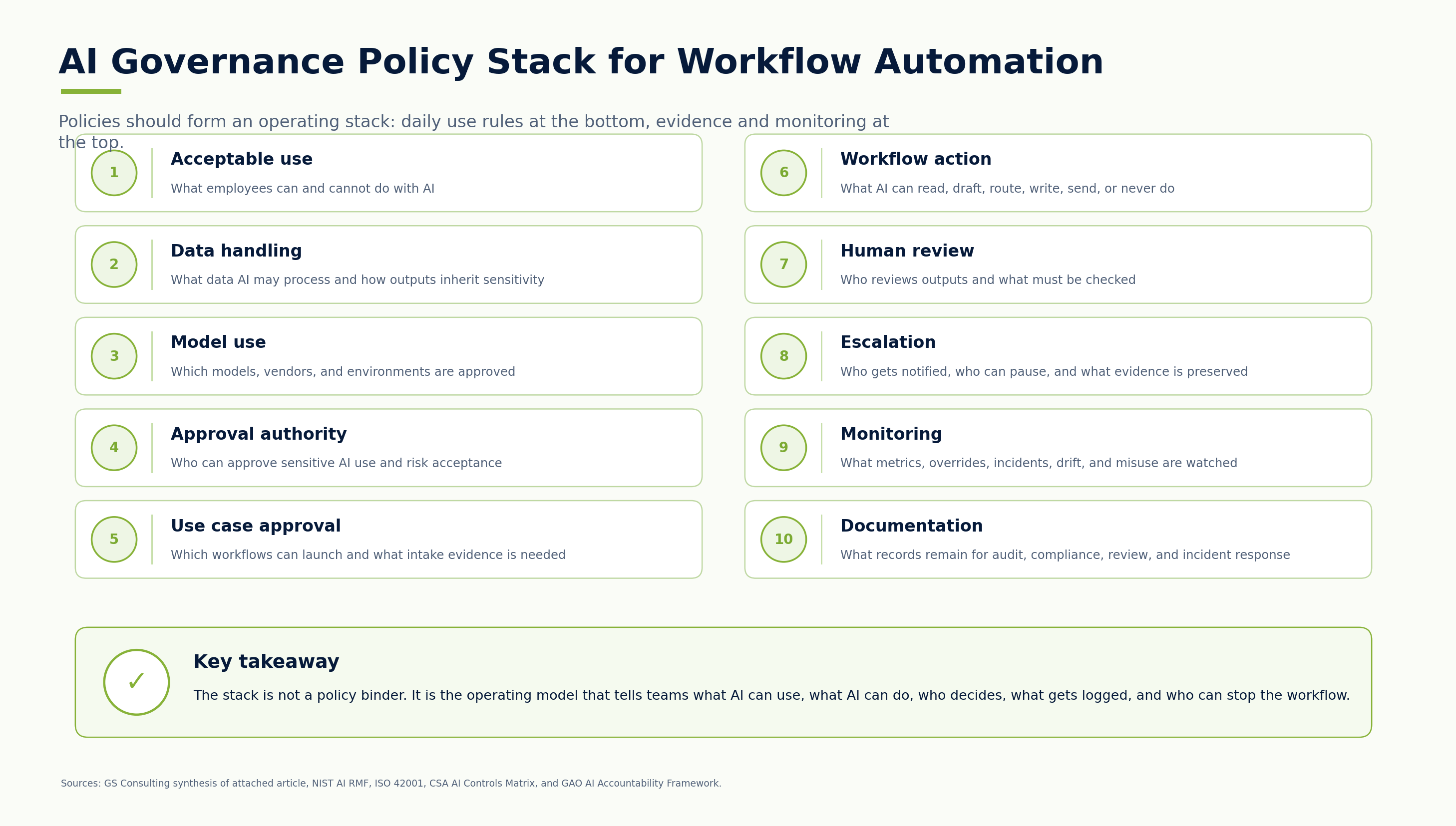
| Policy area | What it decides | Why it matters |
|---|---|---|
| Acceptable use | What employees can do with AI | Prevents unsafe daily use |
| Use case approval | Which workflows can launch | Stops risky ideas before production |
| Data handling | What data AI can process | Protects sensitive information |
| Model use | Which tools can be used | Prevents unreviewed vendors and models |
| Workflow action | What AI can do | Limits authority and system risk |
| Human review | Who approves outputs | Keeps people accountable |
| Escalation | What happens when something breaks | Gives teams a stop path |
| Monitoring | How workflows are watched | Detects drift, errors, and misuse |
| Documentation | What evidence is kept | Supports audit, compliance, and review |
The Policies You Need Before Scaling AI Automation
For regulated organizations, AI governance policies need to be operational. They need to tell people what is allowed, what is not allowed, who decides, what gets documented, and what happens when AI creates risk.
- 1Acceptable use policy.
Define approved tools, prohibited tools, allowed uses, restricted uses, data that cannot be entered into public AI, and examples employees can understand.
- 2Use case approval policy.
Require intake before AI connects to workflows. Capture the owner, business purpose, data, systems, AI role, human review, risk tier, and expected value.
- 3Approval authority policy.
Name who can approve low, moderate, and high risk AI use. Do not hide decision rights behind a vague governance committee.
- 4Data handling policy.
Define which data categories AI can process, whether prompts and outputs inherit sensitivity, whether logs are retained, and when vendor review is required.
- 5Model use policy.
Define which models, platforms, vendors, and deployment environments are allowed for public, internal, confidential, regulated, or restricted data.
- 6Workflow action policy.
Separate what AI can read, summarize, classify, recommend, draft, route, update, send, approve, and never do.
- 7Human review policy.
Define who reviews AI output, what they check, what they can approve, edit, reject, or escalate, and when a second reviewer is required.
- 8Escalation policy.
Tell employees what to do when AI retrieves the wrong source, exposes sensitive data, routes a case incorrectly, or takes an unexpected action.
- 9Monitoring policy.
Track acceptance rates, overrides, escalations, errors, complaints, access issues, cost spikes, data exposure events, audit findings, and stop conditions.
- 10Documentation and evidence policy.
Define what records must be kept for use case approval, data handling, human review, workflow action, monitoring, incidents, and change history.
What Policies Look Like in Real Workflows
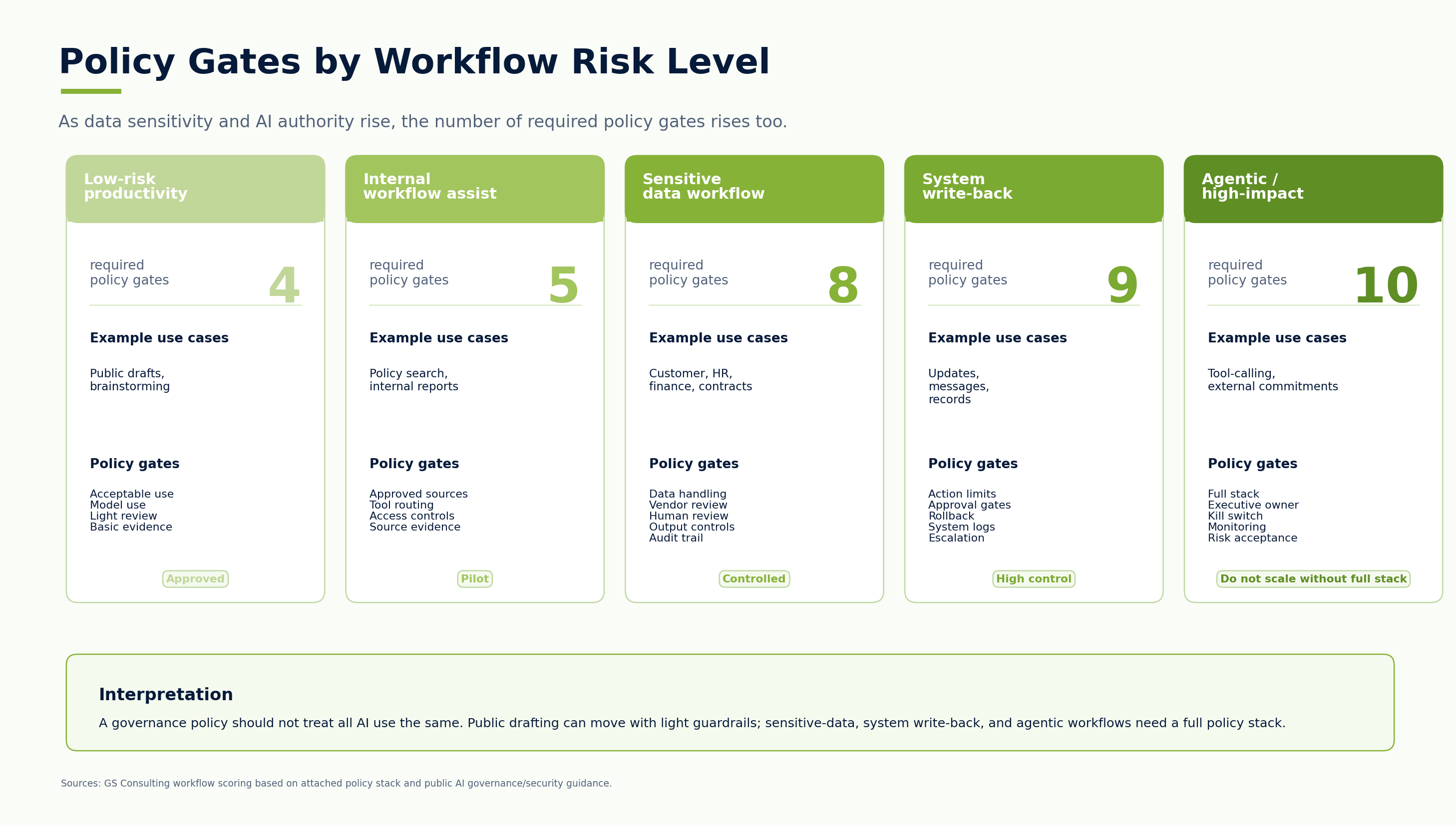
Not every workflow needs the same governance. Public content drafting and finance exception review should not pass through the same gate.
Define which ticket fields AI can read, whether security tickets are excluded, whether AI can route tickets, whether humans approve high impact tickets, and what gets logged. Do not let AI close sensitive tickets or grant access without approval.
Define which employee data AI can process, which topics require escalation, who reviews sensitive cases, and whether AI outputs are stored in the HR system. AI should not make employee decisions.
Define which invoice fields AI can read, whether vendor banking data is excluded, who approves exceptions, and whether AI can write to finance systems. AI should not approve payment.
Define approved evidence sources, human approval for compliance conclusions, audit trail requirements, and retention rules. AI should not certify compliance.
Define approved knowledge sources, customer data rules, review requirements, and what AI is prohibited from promising. A person should approve refunds, pricing, legal terms, regulated information, or commitments.
If AI can update systems, send messages, close records, trigger workflows, or call tools across systems, require the full policy stack, strict monitoring, rollback, and pause authority.
Common AI Governance Policy Mistakes
Most weak AI policies fail in predictable ways.
- Writing policies that sound good but do not guide behavior. If employees cannot understand the rule, it will not work.
- Treating all AI use the same. Public content drafting and customer record automation do not need the same review.
- Ignoring embedded AI. AI features inside vendor platforms still need governance.
- Forgetting outputs. AI generated summaries, drafts, extracted fields, and reports may need protection.
- Saying human review is required without defining it. Human review only works when the reviewer knows what to check.
- Letting AI write back too early. Reading and recommending are safer first steps. System action needs stronger approval.
- Leaving no escalation path. When AI does something strange, employees need to know who to call.
- Skipping monitoring. A workflow that is safe on launch day can become risky later.
OWASP's LLM Top 10 reinforces why action limits and human review matter. Once AI is connected to tools, data, and enterprise systems, prompt injection, sensitive information disclosure, insecure output handling, excessive agency, and overreliance become practical business risks.
A 30 Day AI Governance Policy Build Plan
You do not need to write a giant AI manual first. Start with the policies that control the most risk.
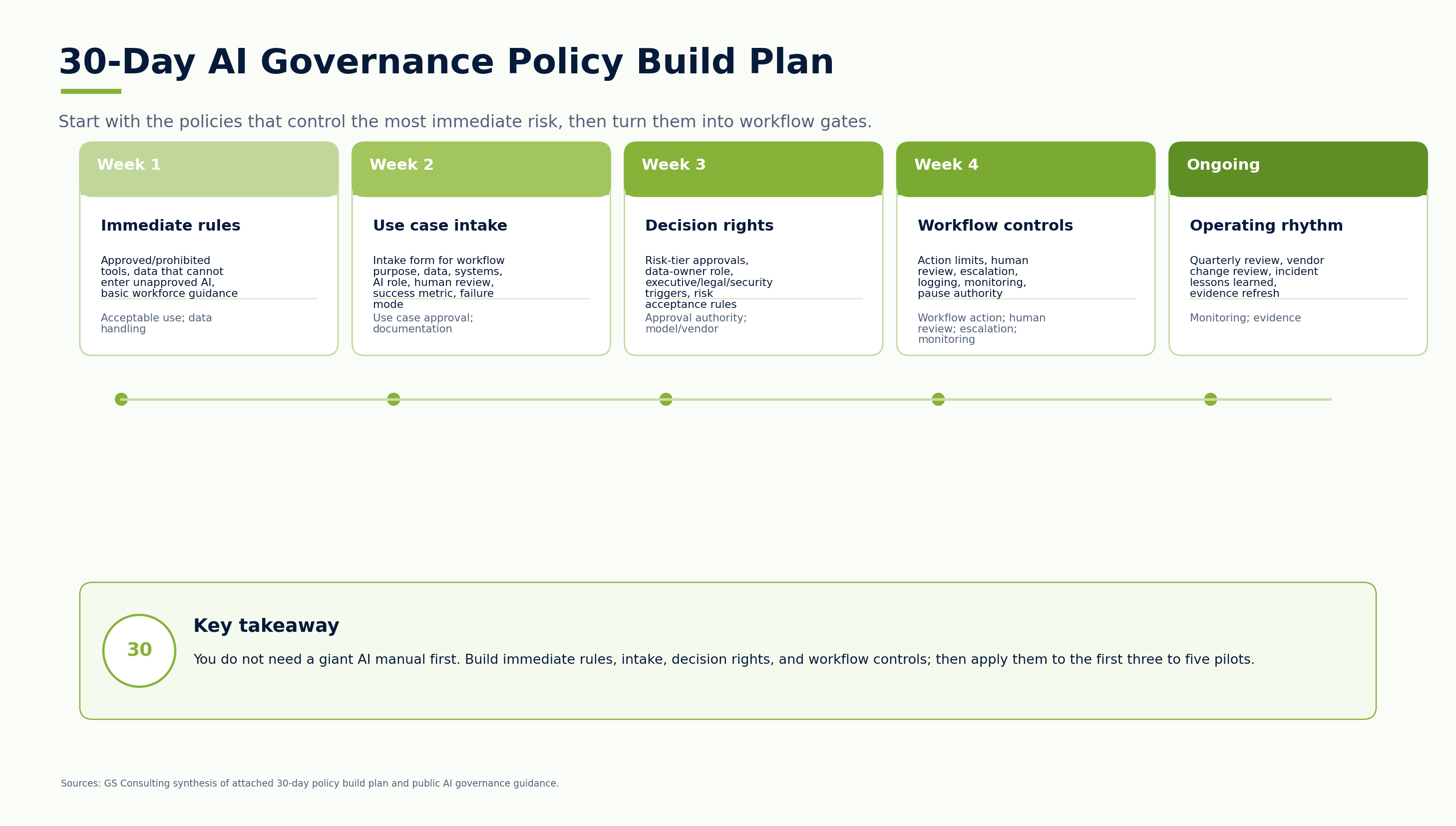
- Week 1Create immediate rules.
Define approved tools, prohibited tools, and data that cannot go into unapproved AI. Focus on stopping obvious data exposure.
- Week 2Create the use case intake.
Build a simple intake form for AI workflow automation. Ask about workflow purpose, data, systems, AI role, human review, and risk.
- Week 3Define approval authority.
Decide who approves low, moderate, and high risk use cases. Name the roles. Do not leave it vague.
- Week 4Define workflow controls.
Create standard rules for data handling, action limits, human review, logging, escalation, and monitoring. Apply them to the first three to five AI automation pilots.
Policy Questions Leaders Should Ask
Before scaling AI automation, leaders should ask direct questions.
- Do employees know which AI tools are approved?
- Do they know what data is prohibited?
- Do we have a process to approve use cases?
- Do we know who can approve sensitive AI use?
- Do we know what models and vendors are allowed?
- Do we know when human review is required?
- Do we know what AI can and cannot do inside workflows?
- Do we have escalation paths?
- Do we monitor AI after launch?
- Do we keep enough evidence for audit, compliance, customer review, or incident response?
- Do we know who can pause a workflow?
If the answer is no, the organization is not ready to scale AI automation. It may be ready to pilot. It is not ready to scale.
The Minimum Viable AI Governance Policy Evidence Packet
If AI supports real workflows, the organization needs evidence. The evidence packet should show the policy owner, approved tools, data rules, use case intake, approval authority, action limits, human review, escalation, monitoring, and documentation standards.
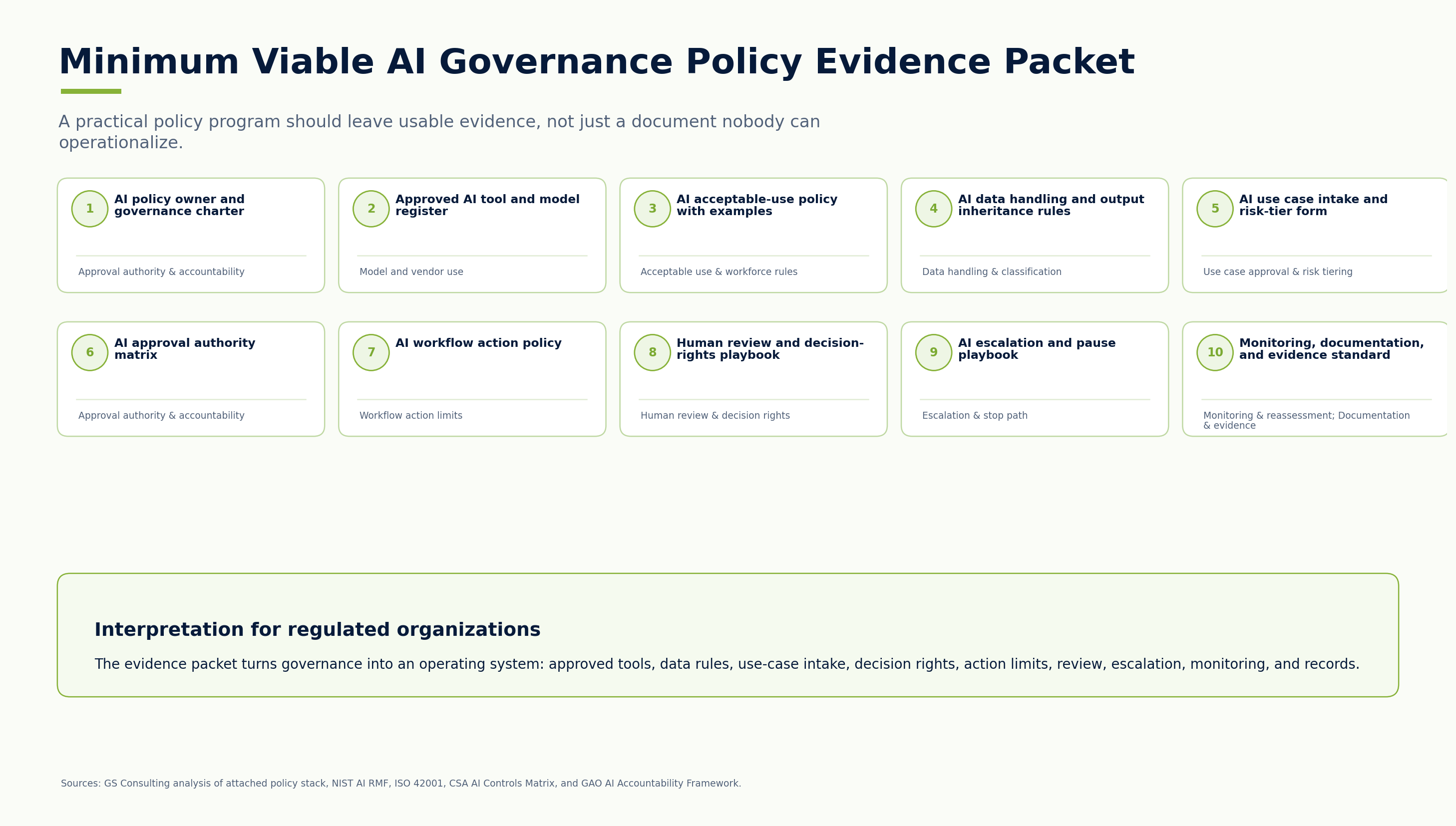
This does not mean every prompt in every low risk workflow must be stored forever. It means the level of documentation should match the risk. If AI output supports a customer response, compliance review, finance action, HR case, security decision, contract summary, or system update, there should be enough evidence to reconstruct what happened.
How This Supports Secure AI Automation
AI governance policies are part of a broader secure AI automation approach. Secure AI Automation Consulting explains how GS Consulting helps organizations automate workflows with the right governance, architecture, data controls, security, and measurable outcomes.
This guide answers one specific question: what policies need to exist before AI automation becomes part of real workflows?
That question matters because workflow automation moves AI from individual use into business operations. Once that happens, informal rules are not enough.
How GS Consulting applies this framework
In a private AI cyber analysis implementation, GS Consulting combined a locally hosted model with a Python pipeline, defined structured JSON, workflow orchestration, processing visibility, and human review. The model was one controlled layer inside an operational system, not an unbounded decision maker. That implementation pattern makes ownership, data boundaries, output checks, exceptions, and accountable review part of the architecture.
Read the Private AI Case Study Review Governance ServicesThe Bottom Line
AI workflow automation needs policies that work in the real world.
Not generic statements. Not vague principles. Not a policy that says "be careful" and calls it governance.
Organizations need rules for acceptable use, approval authority, data handling, model use, action limits, human review, escalation, monitoring, and documentation.
The policy goal is simple: make it clear what AI can use, what AI can do, who approves it, who reviews it, what happens when it fails, and what evidence remains.
That is how regulated organizations move from AI experiments to secure AI automation.
Ready to build AI governance policies before scaling automation?
Contact GS Consulting for an AI Governance Policy Assessment.
Contact GS ConsultingResearch Sources and Caveats
The AI Governance Policy Evidence Burden Score, Workflow Policy Gate Index, and evidence packet are GS Consulting derived planning tools. They are not official legal, regulatory, audit, NIST, ISO, CISA, OWASP, CSA, EU AI Act, GAO, IBM, Microsoft, or McKinsey determinations.
Actual AI governance policy requirements depend on the organization's workflows, data sensitivity, contracts, jurisdictions, vendor terms, system architecture, approval model, security maturity, monitoring capability, and risk tolerance.
- NIST AI Risk Management Framework
- NIST AI RMF Playbook
- ISO IEC 42001 AI management systems
- European Commission AI Act overview
- OWASP Top 10 for Large Language Model Applications
- CISA: Careful Adoption of Agentic AI Services
- CISA: Securing AI Data guidance announcement
- GAO Artificial Intelligence Accountability Framework
- McKinsey: The State of AI in 2025
- IBM: AI Control Gap Study
Frequently Asked Questions About AI Governance Policies for Workflow Automation
What AI governance policies are needed for workflow automation?
Organizations need policies for acceptable use, use case approval, approval authority, data handling, model and vendor use, workflow action limits, human review, escalation, monitoring, documentation, and evidence.
Why are generic AI policies not enough for workflow automation?
Generic policies often tell employees to use AI responsibly but do not define what AI can access, what actions it can take, who approves use cases, who reviews outputs, what happens when AI fails, or what evidence must be retained.
Which AI governance policy should organizations build first?
Start with approved tools, prohibited tools, and data categories that cannot enter unapproved AI. Then add use case intake, risk tiering, approval authority, workflow action limits, human review, logging, escalation, and monitoring.
How should AI governance policies change by workflow risk?
Low risk workflows may only need approved tools and basic data rules. Higher risk workflows need data owner approval, vendor review, human review, audit logs, escalation paths, monitoring, and limits on what AI can update, send, approve, or trigger.
Who should own responsible AI use?
A designated accountable executive should own the responsible AI program, while business owners, data owners, security, legal or compliance, and technical owners retain defined approval and operating responsibilities for each use case.
How should organizations authorize or restrict AI use cases?
Use a documented intake and risk-tier process that records the purpose, owner, data, model, integrations, action limits, human review, evidence, and residual risk. Approval authority should increase with data sensitivity, decision impact, and system access, with a named path to pause, escalate, remediate, or retire the workflow.