Secure AI Automation | | 25 min read
AI Automation Risk Assessment Framework

Key Takeaways
AI risk follows the data, decisions, and actions in a workflow.
Assess before connecting
Identify sensitive data, decision impact, system access, and applicable obligations.
Test the failure modes
Review what happens when sources are missing, permissions fail, or an action goes wrong.
Make an explicit decision
Use the risk review to approve, restrict, defer, or reject the workflow and assign owners.
Most AI automation risk starts before launch.
Not after.
The problem usually is not that the AI tool suddenly becomes dangerous. The problem is that nobody asked the hard questions before connecting it to real data, real users, and real workflows.
- What data will the AI touch?
- Can the output harm a customer, employee, contract, audit, or operation?
- Can the AI write back to a system?
- Who reviews the result?
- What happens when the AI is wrong?
- Can we prove what happened later?
If those questions are not answered before launch, the organization is not managing AI risk. It is hoping the demo becomes a safe workflow.
Assess AI automation risk before it reaches production.
GS Consulting helps regulated organizations evaluate AI workflow risk, data exposure, compliance obligations, system access, human oversight, failure modes, logging, and launch readiness.
Request an AI Risk AssessmentWhat Is an AI Automation Risk Assessment?
An AI automation risk assessment is a structured review of an AI workflow before it goes live.
It looks at what the AI will do, what data it will access, what systems it will connect to, what decisions it will influence, what rules apply, and what could go wrong.
A good assessment answers five questions: what is the workflow, what risk does AI introduce, what controls are required, who owns the decision, and should this use case launch now?
That last question matters. Not every AI automation idea deserves to launch. Some are ready. Some need stronger controls. Some need cleaner data. Some need better workflow design. Some should not be automated yet.
NIST's AI Risk Management Framework Core is useful because it frames AI risk work around Govern, Map, Measure, and Manage. In plain English, that means define ownership, understand the use case, test and measure risk, and manage the system after launch.
Original Research: The AI Automation Risk Gate Index
Original GS Consulting research shows that AI automation risk assessment is a pre-launch gate, not a post-launch cleanup activity.
GS Consulting analyzed public AI governance, security, accountability, regulatory, and enterprise adoption sources against ten AI automation risk assessment areas. The source set included NIST AI RMF, NIST AI RMF Playbook, NIST Generative AI Profile, NIST SP 800 53, OWASP LLM Top 10, CISA and NSA agentic AI guidance, AI data security guidance, EU AI Act high risk obligations, GAO's AI Accountability Framework, CSA AI Controls Matrix, McKinsey's 2025 State of AI, IBM's 2026 AI Control Gap study, and Microsoft's 2025 Digital Defense Report.
The analysis created three GS Consulting derived planning metrics: AI Risk Assessment Control Burden Score, Workflow Risk Gate Score, and Failure Mode Priority Score. These are planning tools, not official legal, regulatory, audit, NIST, CISA, OWASP, EU AI Act, CSA, GAO, IBM, McKinsey, Microsoft, or compliance determinations.
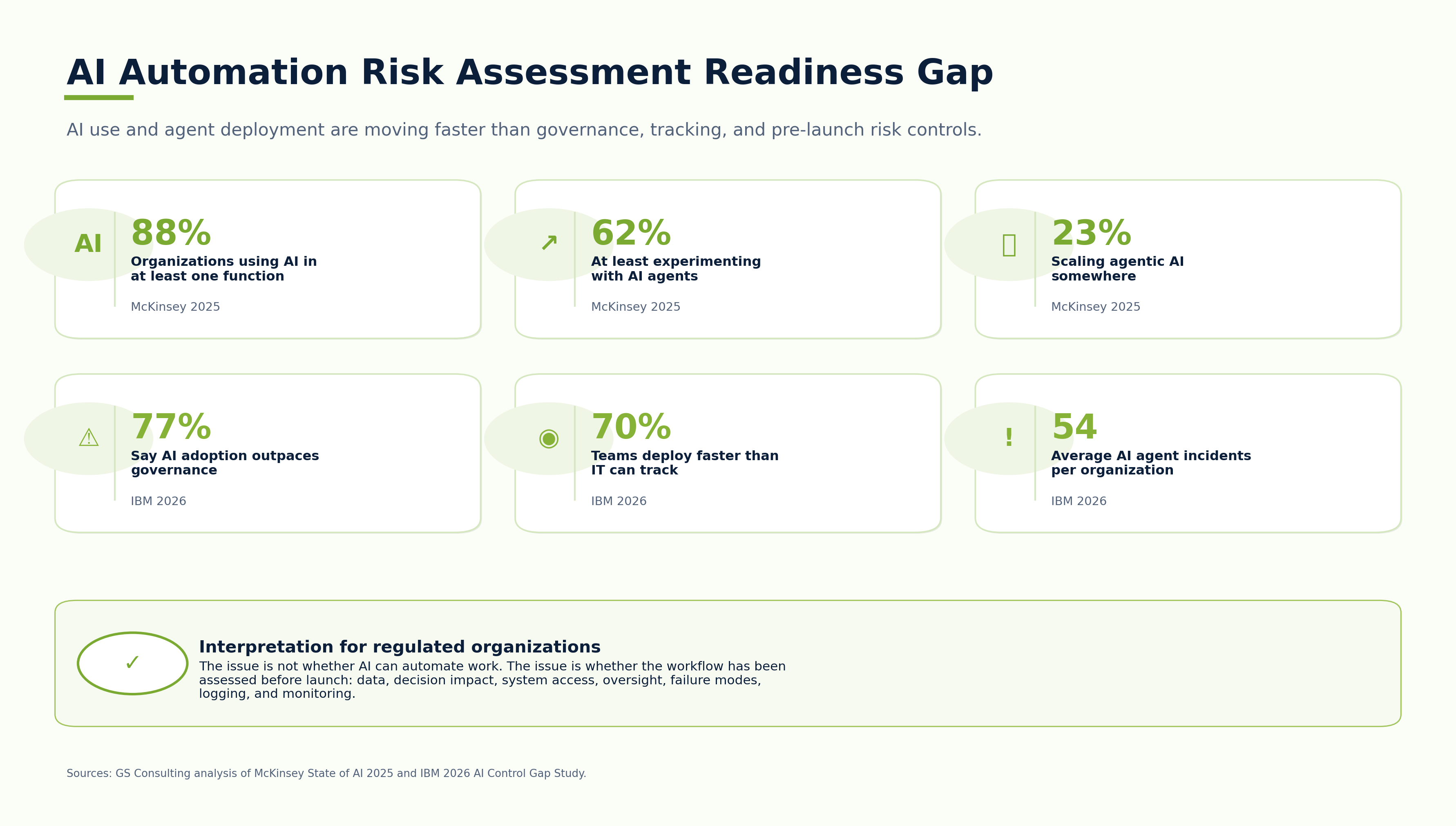
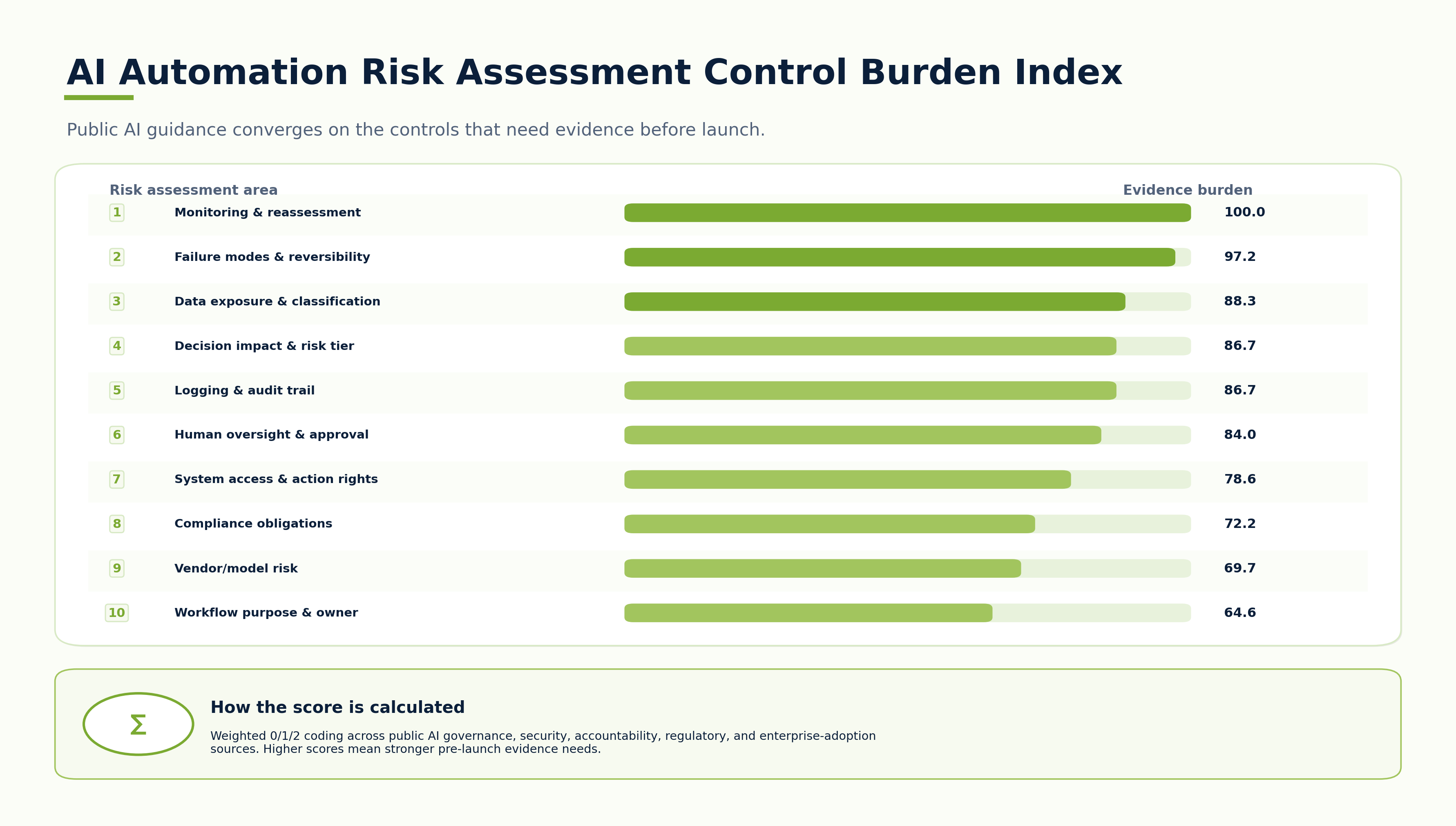
The Core Idea: Risk Follows Data, Decisions, and Action
AI automation risk comes from three places: data, decisions, and action.
If AI only uses public information and drafts a low impact internal note, the risk is lower. If AI uses employee data, customer records, CUI, PHI, financial records, contracts, or security logs, the risk is higher.
If AI only summarizes information for review, the risk is manageable. If AI influences hiring, payment, access, compliance, customer commitments, legal positions, or security response, the risk is higher.
If AI only recommends, the risk is one thing. If AI can update systems, send messages, close tickets, change records, grant access, or trigger workflows, the risk is much higher.
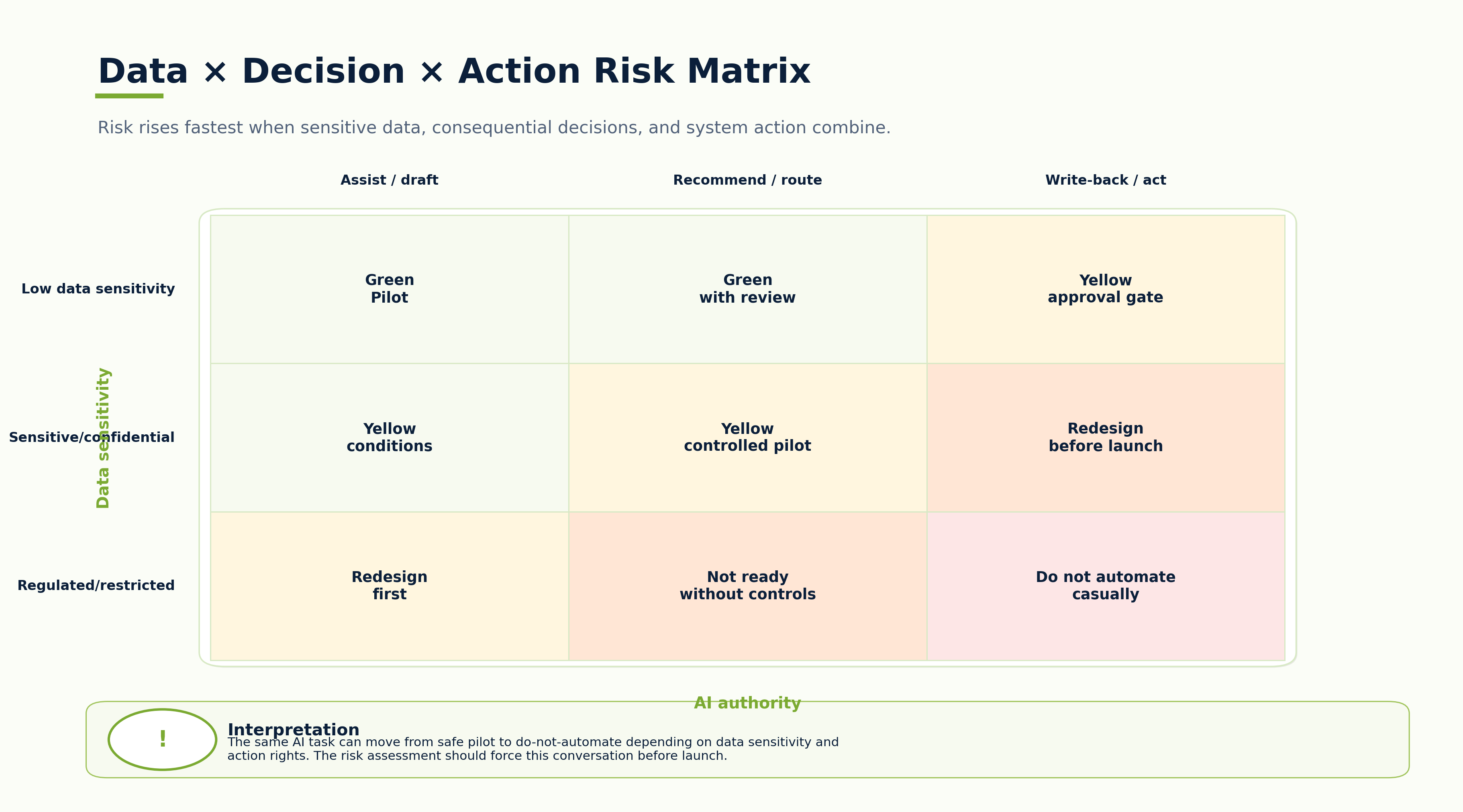
The more sensitive the data, the more important the decision, and the more authority AI has, the stronger the controls need to be.
The AI Automation Risk Assessment Framework
Use this framework before launching any AI automation workflow.
- 1Workflow purpose.
Start with the business process, not the tool. Define the owner, systems involved, AI output, success measure, and failure impact.
- 2Data exposure.
Identify whether AI touches public, internal, confidential, regulated, or restricted data, and whether outputs inherit source sensitivity.
- 3Decision impact.
Review whether AI affects customers, employees, money, compliance, security, contracts, operations, or external communications.
- 4Compliance obligations.
Map laws, contracts, customer requirements, privacy obligations, security frameworks, audit standards, and records rules before launch.
- 5System access and action rights.
Define what AI can read, write, trigger, approve, route, send, or update, and whether it has more permission than the user.
- 6Human oversight.
Specify who reviews the output, what they check, what they can approve, edit, reject, or escalate, and how review is documented.
- 7Failure modes.
Ask how the workflow fails, who would be affected, whether the issue can be detected, and whether the action can be reversed.
- 8Vendor and model risk.
Review hosting, retention, training use, subprocessors, model changes, exportability, deletion, incident reporting, and contract terms.
- 9Logging and audit trail.
Capture who used AI, what they asked, what data and sources were used, what output was produced, who reviewed it, and what changed.
- 10Monitoring after launch.
Define who reviews errors, overrides, access issues, user complaints, cost spikes, data exposure events, and stop conditions.
OWASP's LLM Top 10 reinforces why this matters: prompt injection, sensitive information disclosure, insecure output handling, excessive agency, and overreliance become real business risks once AI is connected to enterprise systems.
Failure Modes Are Where Weak Assessments Break
Do not only ask how the workflow succeeds. Ask how it fails.
AI can retrieve the wrong source, summarize incorrectly, hallucinate, miss an exception, overstate confidence, expose sensitive information, route work to the wrong team, take action too early, rely on outdated data, or fail quietly.
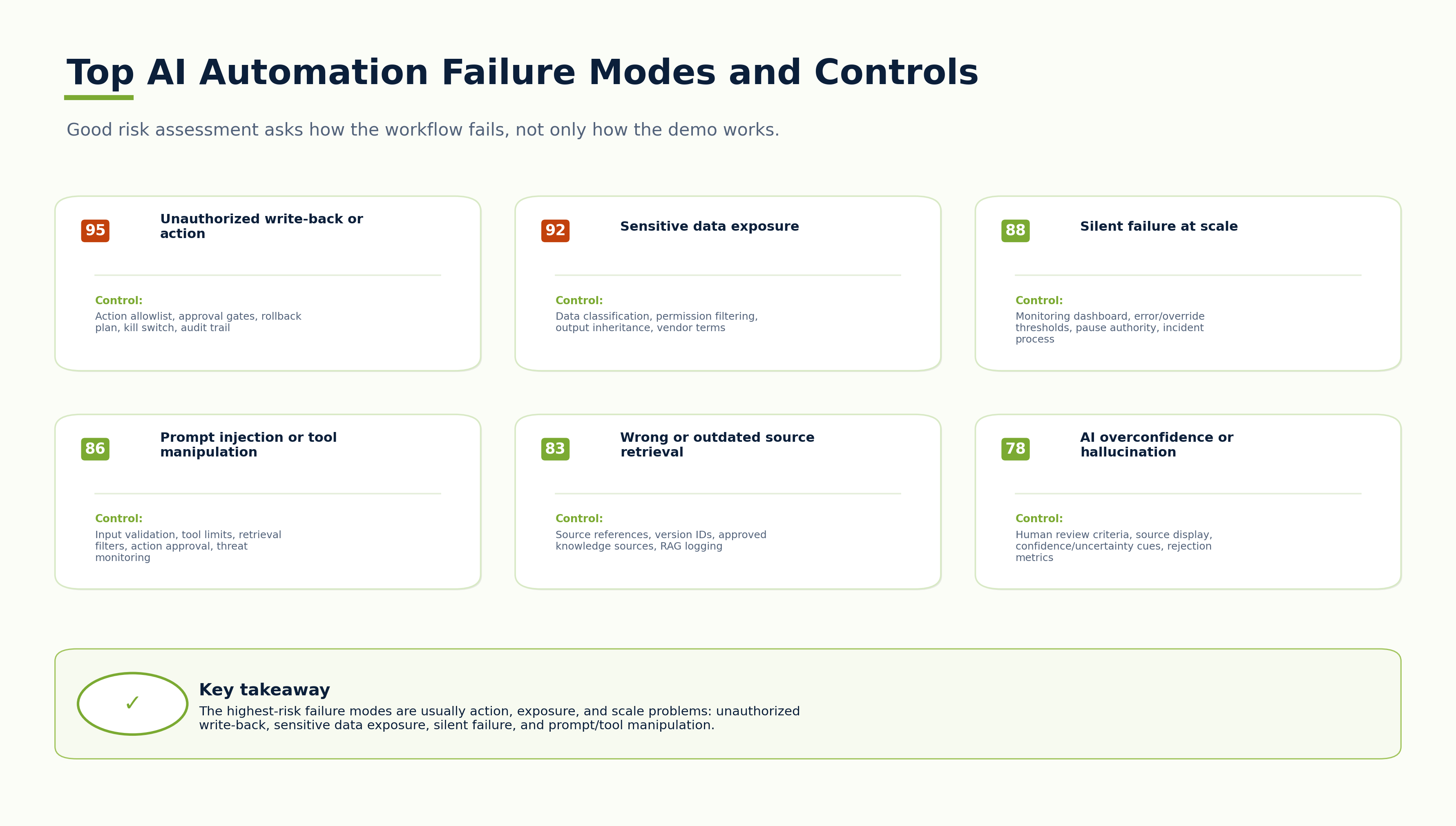
If a failure would be serious and hard to detect, the workflow needs stronger controls or should not launch yet.
The Risk Tier Model
Use a simple tier model to decide how much review the workflow needs.
AI uses public or approved internal data, supports low impact work, does not write back, and does not make decisions. Use approved tools, basic data rules, training, and output review where needed.
AI uses confidential or sensitive data, supports decisions, routes, classifies, summarizes, or drafts. Use data owner approval, security review, human approval, logging, vendor review, output classification, and monitoring.
AI uses regulated or restricted data, affects high impact decisions, writes to systems, triggers actions, or influences legal, financial, HR, compliance, security, medical, contract, or customer outcomes.
Action rights should be earned through stronger review, approval gates, strict access controls, audit trails, testing, rollback, monitoring, and clear ownership.
The AI Automation Risk Scorecard
Score each risk area from 1 to 5. A low score may be ready for a controlled pilot. A middle score needs controls before launch. A high score needs leadership review and may not be ready.
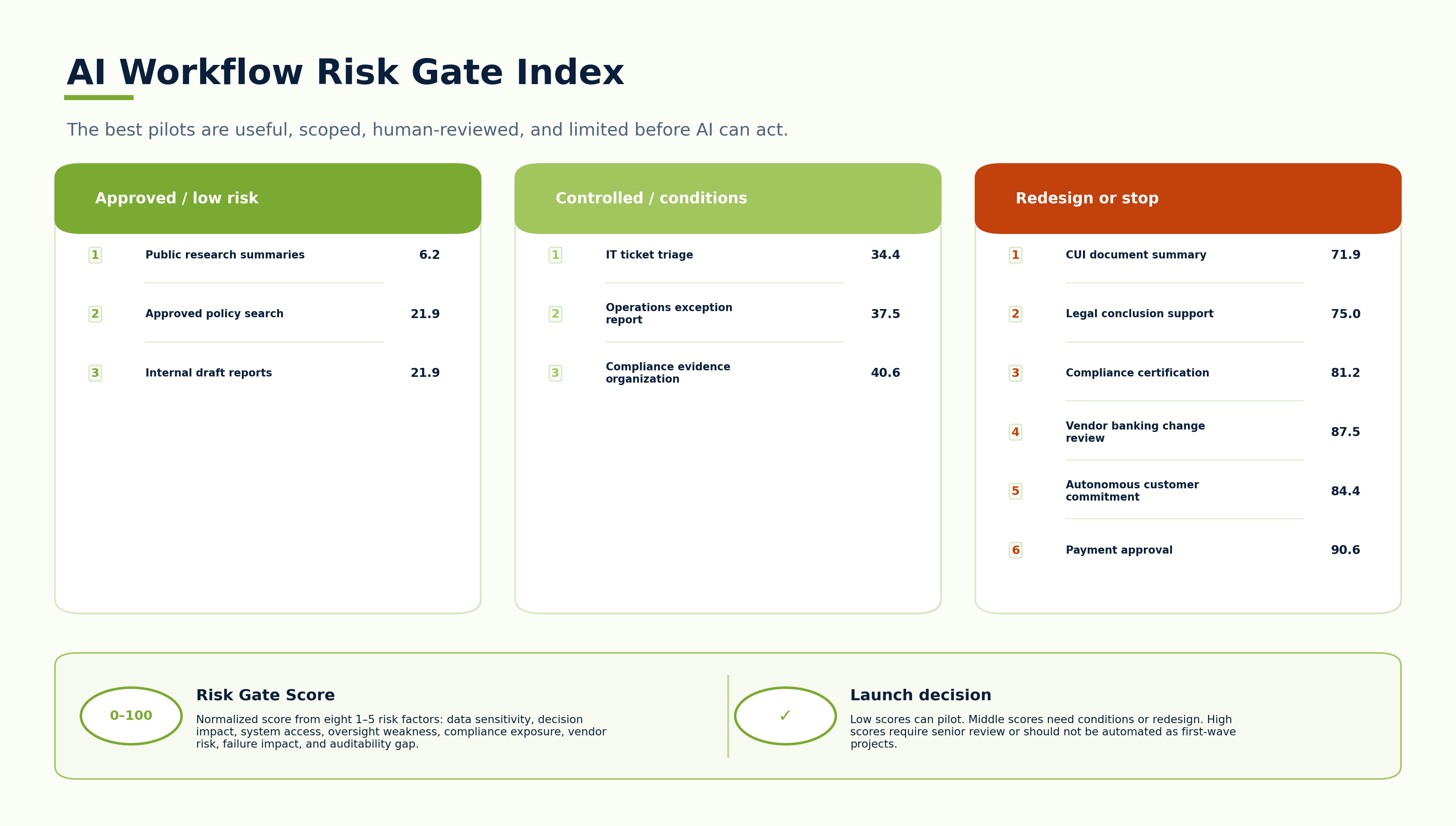
Do not use the score as a substitute for judgment. Use it to force the right conversation.
Examples of AI Automation Risk Assessment
AI classifies tickets, summarizes issues, recommends a queue, and suggests knowledge articles. Use user permissions, category restrictions, human review for sensitive tickets, audit logs, routing accuracy monitoring, and escalation rules.
AI can extract fields and summarize exceptions, but finance review, payment approval outside AI, audit trails, thresholds, limited fields, and vendor review matter.
Use approved HR environments, sensitive case detection, trained HR escalation, limited access, logs, and no AI final decisions on employee outcomes.
Start with read only access, analyst review, no autonomous containment, restricted outputs, strong logs, security team ownership, and model error monitoring.
Approval Decisions
After the risk assessment, make one of five decisions.
- ApprovedApproved for pilot.
The use case is valuable, scoped, and controlled enough to test.
- ConditionsApproved with conditions.
The use case can proceed after specific controls such as vendor review, logging, human approval, permission filtering, or output classification are added.
- RedesignNeeds redesign.
The workflow has value, but AI should summarize instead of write back, draft instead of send, or recommend instead of approve.
- WaitNot ready.
The organization needs to fix data quality, access controls, compliance review, or workflow maturity before launch.
- StopDo not automate.
The use case is not appropriate for AI automation at this time. Good risk assessment does not approve everything.
The Pre Launch Checklist
Before launching AI automation, ask the practical questions.
- What workflow are we improving?
- Who owns it?
- What data will AI touch?
- Is the data approved for this tool?
- Does the output become sensitive?
- What systems can AI access?
- Can AI write back, call tools, or trigger workflows?
- What decision does AI influence?
- Who reviews the output?
- What actions require approval?
- What actions are prohibited?
- What compliance obligations apply?
- What could go wrong?
- Can we detect failure?
- Can we reverse action?
- What logs are kept?
- Who monitors the workflow?
- Who can pause it?
- What would make us stop the pilot?
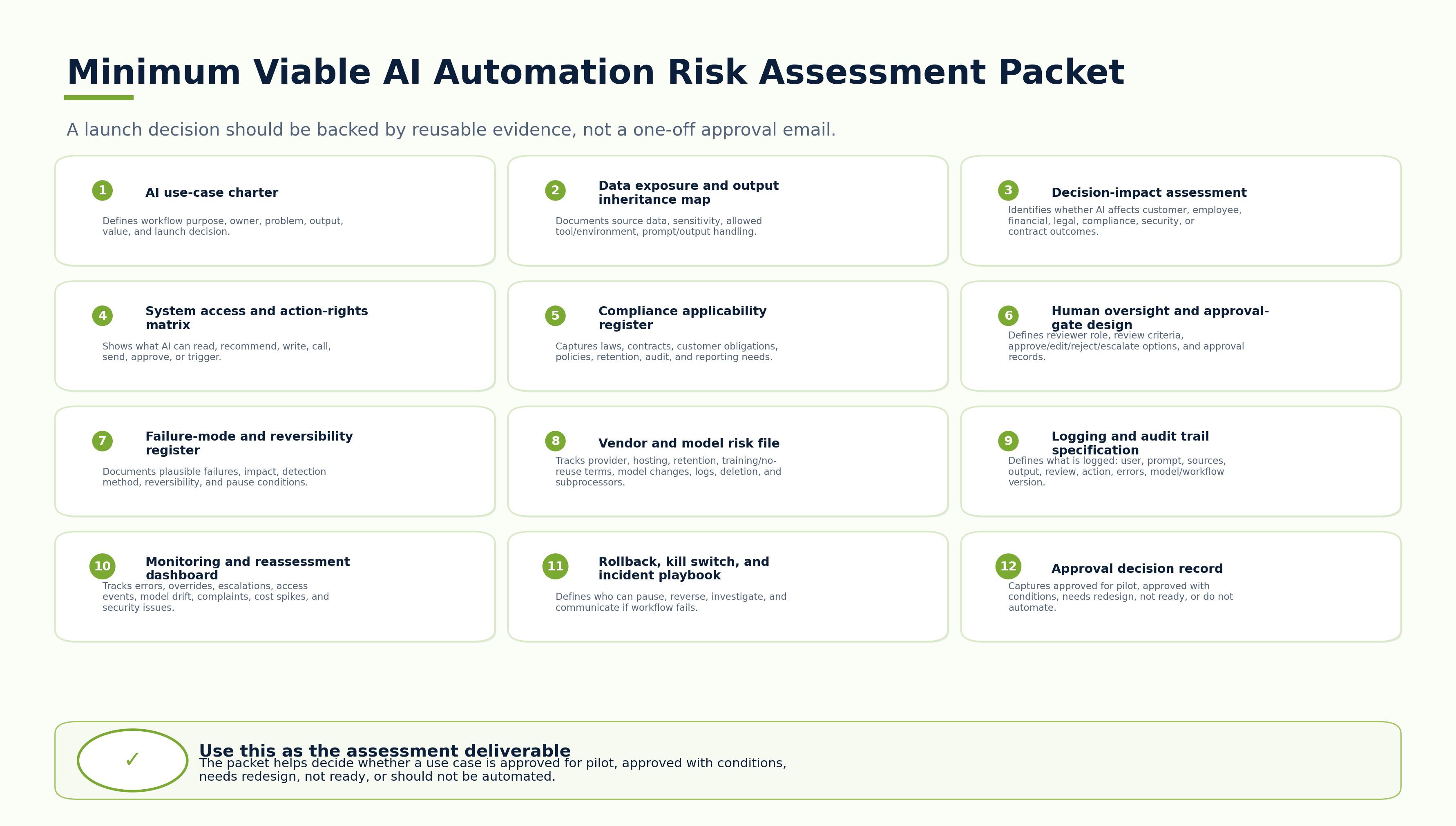
If the team cannot answer these questions, the workflow should not launch.
The First 30 Days
Start small. Pick three candidate workflows, complete the risk assessment for each one, and choose one pilot.
Good candidates include IT ticket triage, compliance evidence summaries, contract obligation summaries, operations exception reports, customer support drafts, and invoice exception review.
- Week 1Select candidate workflows.
Choose three workflows with clear owners, known data, visible business value, and manageable scope.
- Week 2Map the risk model.
Map data exposure, decision impact, system access, compliance exposure, human review, failure modes, and logging needs.
- Week 3Score and decide.
Use the risk gate scorecard to decide whether each workflow is approved, conditional, redesigned, delayed, or stopped.
- Week 4Prepare the pilot evidence.
Document the controls, owner, monitoring rules, audit trail, rollback path, stop conditions, and reassessment cadence.
Do not choose the flashiest pilot. Choose the safest valuable one. That is how you build trust.
How This Supports Secure AI Automation
Risk assessment is part of a broader secure AI automation approach. Secure AI Automation for Regulated Organizations explains how GS Consulting helps organizations automate workflows with the right governance, architecture, data controls, security, and measurable outcomes.
This guide answers one specific question: how do we decide whether an AI automation workflow is safe enough to launch?
That question matters because AI risk starts with use case selection and workflow design. If the risk assessment is weak, every downstream control gets weaker.
The Bottom Line
AI automation should not launch because the demo looked good.
It should launch because the workflow has been assessed, the data is approved, the decision impact is understood, the compliance obligations are known, the human review is clear, and the failure modes are controlled.
That is the point of an AI automation risk assessment framework. It gives leaders a practical way to separate safe pilots from risky ideas.
GS Consulting helps regulated organizations assess AI automation risk before launch, including data exposure, decision impact, compliance obligations, system access, user oversight, failure modes, logging, and governance controls.
Ready to assess AI automation risk before it reaches production?
Contact GS Consulting for an AI Automation Risk Assessment.
Contact GS ConsultingResearch Sources and Caveats
The AI Automation Risk Gate Score, Evidence Burden Score, and Failure Mode Priority Score are GS Consulting derived planning tools. They are not official legal, regulatory, audit, NIST, CISA, OWASP, EU AI Act, CSA, GAO, IBM, McKinsey, Microsoft, or compliance determinations.
Actual launch decisions should use the organization's own workflows, data sensitivity, contracts, jurisdictions, system architecture, AI vendor terms, human review capacity, incident response process, monitoring maturity, and risk tolerance.
- NIST AI Risk Management Framework
- NIST AI RMF Playbook
- OWASP Top 10 for Large Language Model Applications
- CISA: Careful Adoption of Agentic AI Services
- GAO Artificial Intelligence Accountability Framework
- McKinsey: The State of AI
- IBM: AI Control Gap Study
Frequently Asked Questions About AI Automation Risk Assessment
What is an AI automation risk assessment?
An AI automation risk assessment is a structured pre-launch review of an AI workflow. It examines what AI will do, what data it will access, what decisions it may influence, what systems it can touch, what compliance obligations apply, what could fail, and what controls are required before launch.
When should organizations assess AI automation risk?
Risk should be assessed before the workflow launches, before AI is connected to sensitive data, and again when the workflow, model, vendor, data, user base, or action rights change.
What makes an AI automation workflow high risk?
Risk rises when AI touches regulated or restricted data, influences high impact decisions, writes back to systems, calls tools, triggers actions, uses unreviewed vendors, lacks human oversight, has weak logs, or could fail in a way that is hard to detect or reverse.
What should a risk assessment produce?
A risk assessment should produce a launch decision: approved for pilot, approved with conditions, needs redesign, not ready, or do not automate. It should also define the controls, owner, evidence, monitoring, and stop conditions required for the workflow.