Secure AI Automation | | 24 min read
AI Automation for Compliance Operations

Key Takeaways
Automate compliance preparation while keeping compliance judgment accountable.
Reduce evidence chase work
Use AI to collect, organize, map, and draft from approved compliance sources.
Keep decisions with people
Assign control owners and reviewers for conclusions and attestations.
Preserve evidence reliability
Maintain source references, access rules, review records, and recurring operating proof.
Compliance teams do not need more dashboards.
They need less chase work.
That is the real problem.
Every compliance function has some version of the same grind. Policies need review. Evidence needs to be collected. Controls need to be mapped. Questionnaires need answers. Audit requests need support. Exceptions need follow up. Owners need reminders. Reports need to be updated. The same information gets copied from one system to another, again and again.
AI can help with that. But only if it is used the right way.
AI automation for compliance operations is not about letting a model certify controls, make final risk decisions, or tell auditors everything is fine. That would be reckless.
Reduce compliance busywork without losing control.
GS Consulting helps regulated organizations design secure AI workflows for evidence collection, policy review, control mapping, questionnaire response, audit preparation, recurring compliance tasks, and executive reporting.
Request a Compliance AI AssessmentThe Real Compliance Problem
Most compliance work is not hard because teams do not know what good looks like. It is hard because the work is scattered.
Evidence lives in ticketing systems, shared drives, cloud platforms, screenshots, reports, access reviews, training records, vendor portals, policy libraries, security tools, and email threads.
Control owners are busy. Systems change. Policies get stale. Audit requests arrive with short deadlines. Customer questionnaires ask the same questions in slightly different ways. A control may be implemented, but the evidence is hard to find.
That is the real friction. Compliance operations often fail at the handoff layer.
- Who owns the evidence?
- Where is the current version?
- Which control does it support?
- When was it last reviewed?
- Is this artifact still valid?
- Who approved it?
- What changed since the last audit?
- Can we prove it?
AI can help answer those questions faster. But the workflow has to be controlled.
Original Research: The AI Compliance Operations Evidence Reliability Index
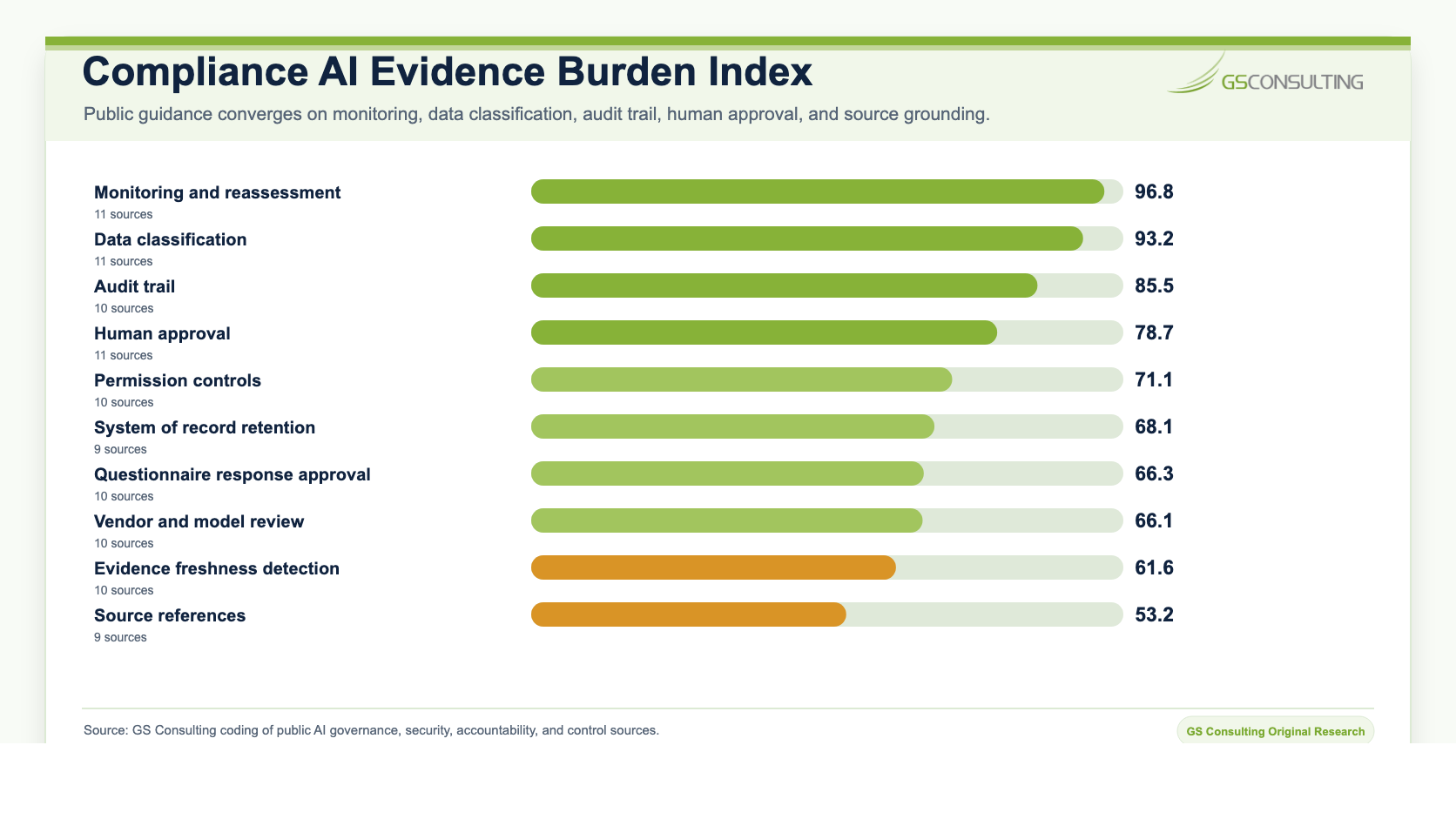
GS Consulting analyzed public AI governance, security, regulatory, accountability, and enterprise adoption sources against compliance AI controls and common compliance workflows. The research shows that AI automation for compliance operations should be measured by evidence reliability, not just time saved.
The source set included NIST AI RMF, the NIST AI RMF Playbook, NIST SP 800-53 Rev. 5, GAO's AI Accountability Framework, the EU AI Act, OWASP LLM Top 10, CISA AI data security guidance, CISA and NSA agentic AI guidance, the CSA AI Controls Matrix, McKinsey's 2025 State of AI, and IBM's 2026 AI Control Gap study.
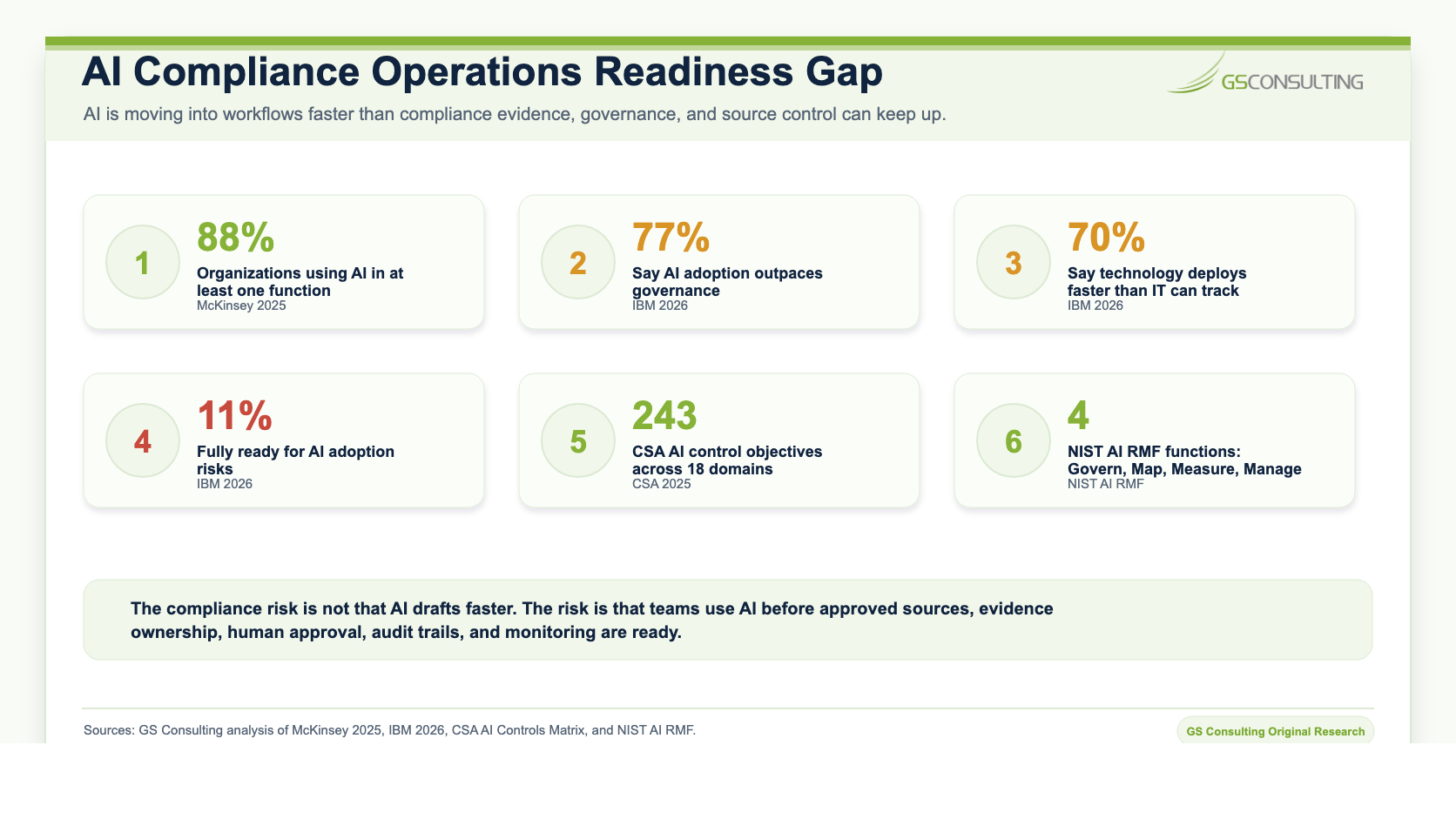
McKinsey reports that 88% of respondents say their organizations regularly use AI in at least one business function, while many organizations remain in experimentation or pilot stages. IBM's 2026 control gap research reports that 77% of surveyed organizations say AI adoption is outpacing governance, 70% say teams deploy technology faster than IT can track, and only 11% say they are fully ready for expected AI agent scale.
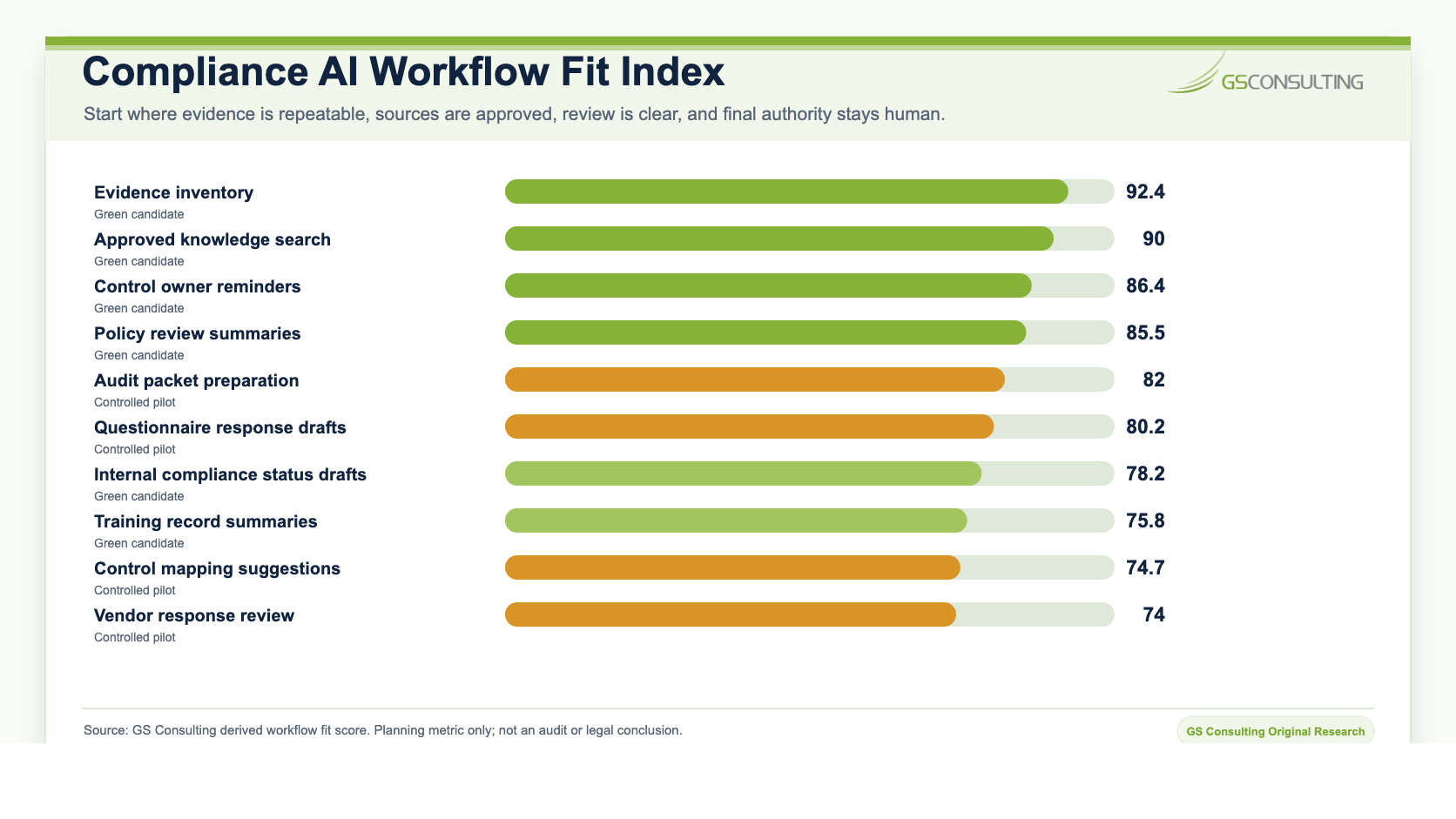
The highest scoring first wave use cases were evidence inventory, approved knowledge search, control owner reminders, policy review summaries, internal compliance status drafts, and training record summaries. Controlled pilots include audit packet preparation, questionnaire response drafts, control mapping suggestions, vendor response review, compliance reporting drafts, and risk register summaries.
The practical takeaway is simple: use AI to prepare the work, not own the compliance conclusion. AI can find evidence, draft responses, summarize gaps, identify stale artifacts, and prepare review packets. People approve the mappings, customer responses, audit responses, risk acceptance, and final compliance statements. Logs prove the work.
What AI Can Do Well in Compliance Operations
AI is useful in compliance because much of the work is language, documents, evidence, comparison, and status tracking.
AI can help with policy review, evidence collection, control mapping, questionnaire response, audit preparation, exception summaries, risk register cleanup, owner reminders, gap summaries, status reports, vendor response review, procedure comparison, training record summaries, and compliance reporting.
Compliance work has a lot of repeatable structure. It also has a lot of messy input. That is exactly where AI can help.
But the key word is help. AI can prepare, summarize, draft, classify, and flag. People still approve.
Use Case 1: Policy Review
Policy review is a strong AI use case because policies are long, repetitive, and easy to lose track of. AI can summarize policy changes, compare policy versions, identify missing sections, find outdated references, map policies to control areas, flag inconsistent language, draft review notes, and create owner review packets.
For example, a compliance team may need to review an information security policy, acceptable use policy, incident response policy, vendor policy, and access control policy before an audit. AI can compare the current policies against required topics and prepare a summary for the policy owner. The policy owner still decides what needs to change.
Use Case 2: Evidence Collection
Evidence collection is where compliance teams lose a lot of time. A control may be implemented, but the evidence is in five places.
AI can find likely evidence, group artifacts by control, detect stale evidence, identify missing owners, summarize artifact quality, draft evidence request messages, and prepare evidence packets for review.
This is valuable because evidence collection is not just a search problem. It is a context problem. A screenshot, report, ticket, export, or policy may only be useful if it proves the right thing for the right period.
Use Case 3: Control Mapping
Control mapping is one of the most useful compliance AI workflows. Teams often need to map internal policies, procedures, evidence, system controls, and vendor responses to frameworks or customer requirements.
AI can suggest mappings between controls and evidence, identify duplicate control language, compare requirements across frameworks, draft mapping notes, flag controls with weak evidence, group similar requirements, and support crosswalks between standards.
But control mapping needs human validation. AI should suggest mappings. Compliance owners approve them.
Use Case 4: Questionnaire Response
Security and compliance questionnaires are painful because they ask similar questions in different formats. Customers ask about encryption, access control, logging, incident response, vendor management, backups, business continuity, data retention, privacy, employee screening, and AI use.
AI can search approved prior responses, draft first responses, pull supporting evidence, flag questions that need review, identify changed answers, summarize evidence attachments, and route questions to the right owner.
But questionnaire response is high trust work. A wrong answer can create contract risk, customer trust issues, or audit problems. The safest workflow is simple: AI drafts from approved sources, the control owner reviews, legal or compliance reviews where needed, and the final answer is stored in the response library.
Use Case 5: Audit Preparation
Audit preparation is usually a rush because the evidence is not managed continuously. AI can identify missing evidence, flag outdated artifacts, summarize control status, draft owner follow up messages, organize audit packets, create audit readiness dashboards, compare current evidence to prior audit evidence, and highlight changes since the last review.
If a compliance team spends 300 hours preparing for an audit, and AI can cut that by 30%, that is 90 hours back. More importantly, it makes readiness less dependent on heroics.
Use Case 6: Recurring Compliance Workflows
Compliance is not a once a year event. Recurring workflows include quarterly access reviews, vendor reviews, policy reviews, evidence refresh, training completion, risk register updates, control owner attestations, exception follow up, incident response tests, business continuity tests, and vulnerability remediation tracking.
AI can track recurring tasks, draft reminders, summarize owner status, detect overdue items, identify stale evidence, prepare monthly compliance reports, group repeated issues, and highlight trends.
Use Case 7: Vendor and Third Party Review
Vendor review is another compliance workflow full of documents and repeated questions. AI can summarize vendor questionnaires, SOC reports, security summaries, data processing terms, contract clauses, exception responses, and risk statements.
AI can read faster. It cannot own the risk.
Use Case 8: Compliance Reporting
Compliance leaders spend a lot of time turning status into reports. AI can draft monthly compliance summaries, executive updates, open issue reports, control owner dashboards, audit readiness summaries, risk register summaries, exception reports, and evidence gap summaries.
The human owns the final message. AI can draft the report. Leadership approves the report.
What AI Should Not Do
Leaders need to be clear about the boundary.
- AI should not certify compliance.
- AI should not accept risk.
- AI should not approve audit responses.
- AI should not make final legal interpretations.
- AI should not tell a customer that a control is fully implemented unless a qualified owner has verified it.
- AI should not decide that evidence is sufficient without human review.
- AI should not submit regulator, auditor, or customer responses without approval.
- AI should not use sensitive evidence in unapproved tools.
Compliance operations can benefit from AI, but only if accountability stays with the organization.
Why Secure AI Matters in Compliance
Compliance data is often sensitive. It may include policies, control evidence, system diagrams, vulnerability summaries, access reviews, audit findings, incident records, vendor security details, employee training records, customer commitments, contracts, and security configurations.
That is not data you want copied into random tools. The compliance team may be trying to reduce risk, but if it uses AI carelessly, it can create new risk.
NIST's AI Risk Management Framework organizes AI risk work around Govern, Map, Measure, and Manage. That structure is useful for compliance teams because AI use needs ownership, context, evaluation, and ongoing management, not just a tool rollout. The NIST AI RMF Playbook provides suggested actions aligned to those functions and is not intended to be a rigid checklist.
The Compliance AI Control Model
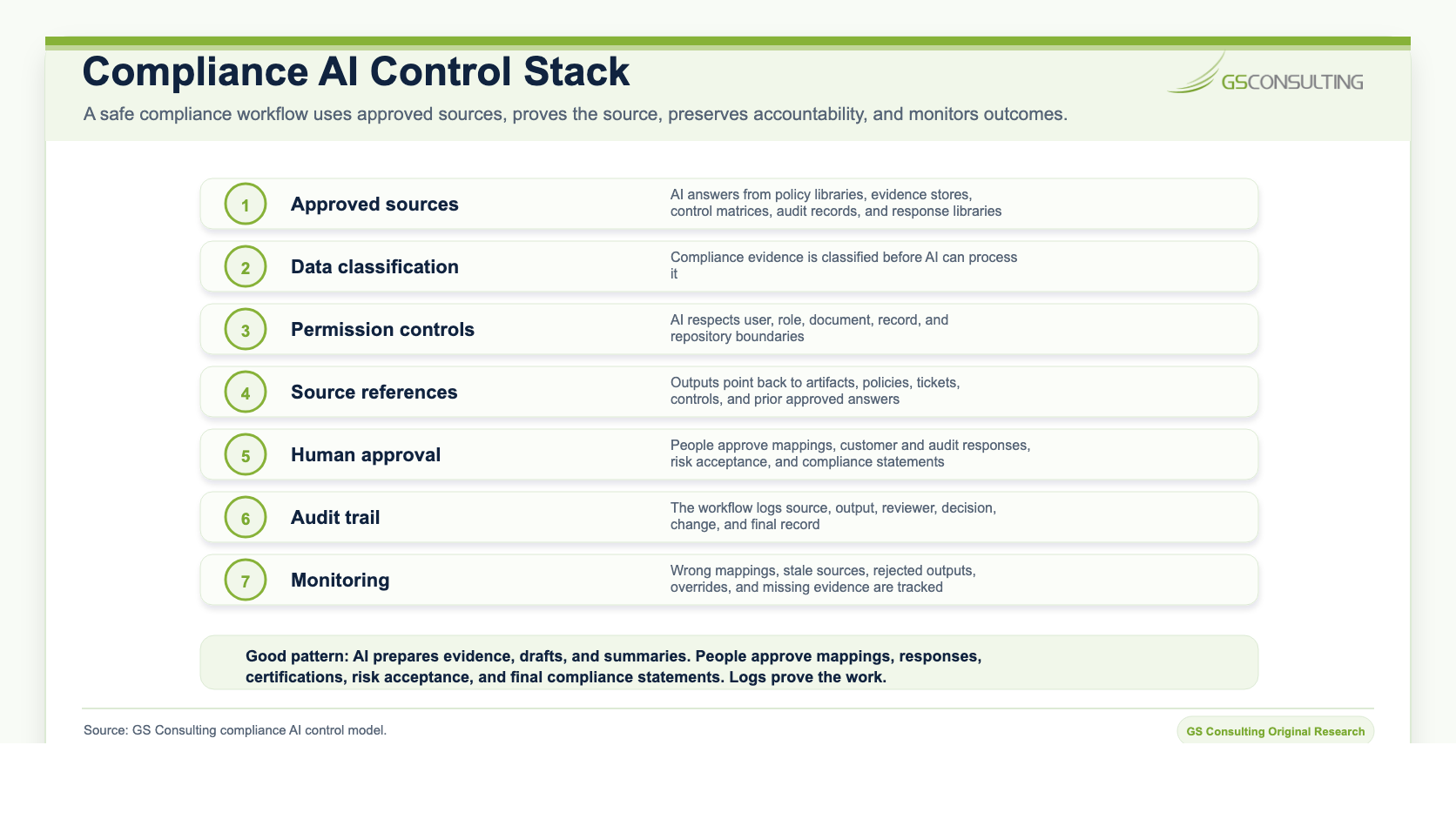
A safe AI automation model for compliance operations should include approved source libraries, data classification, permission controls, human approval, source references, audit trail, and monitoring.
- Approved source libraries. AI should answer from approved sources, not random files, old screenshots, personal folders, stale evidence, or forgotten chat threads.
- Data classification. Compliance evidence can contain security, customer, contract, employee, and system information. Classify it before connecting AI to it.
- Permission controls. A user who cannot access a security evidence folder should not be able to ask AI to summarize it.
- Human approval. AI can draft and recommend. People approve customer responses, audit responses, control mappings, policy changes, risk acceptance, and compliance status statements.
- Source references. If AI says evidence supports a control, show the artifact. No source, no trust.
- Audit trail. Log who asked, what sources were used, what output was generated, who reviewed it, what changed, and where the final record lives.
- Monitoring. Track wrong mappings, stale sources, rejected outputs, human overrides, missing evidence, and user feedback.
The Compliance AI Risk Levels
Not every compliance use case carries the same risk. The operating model should reflect that.
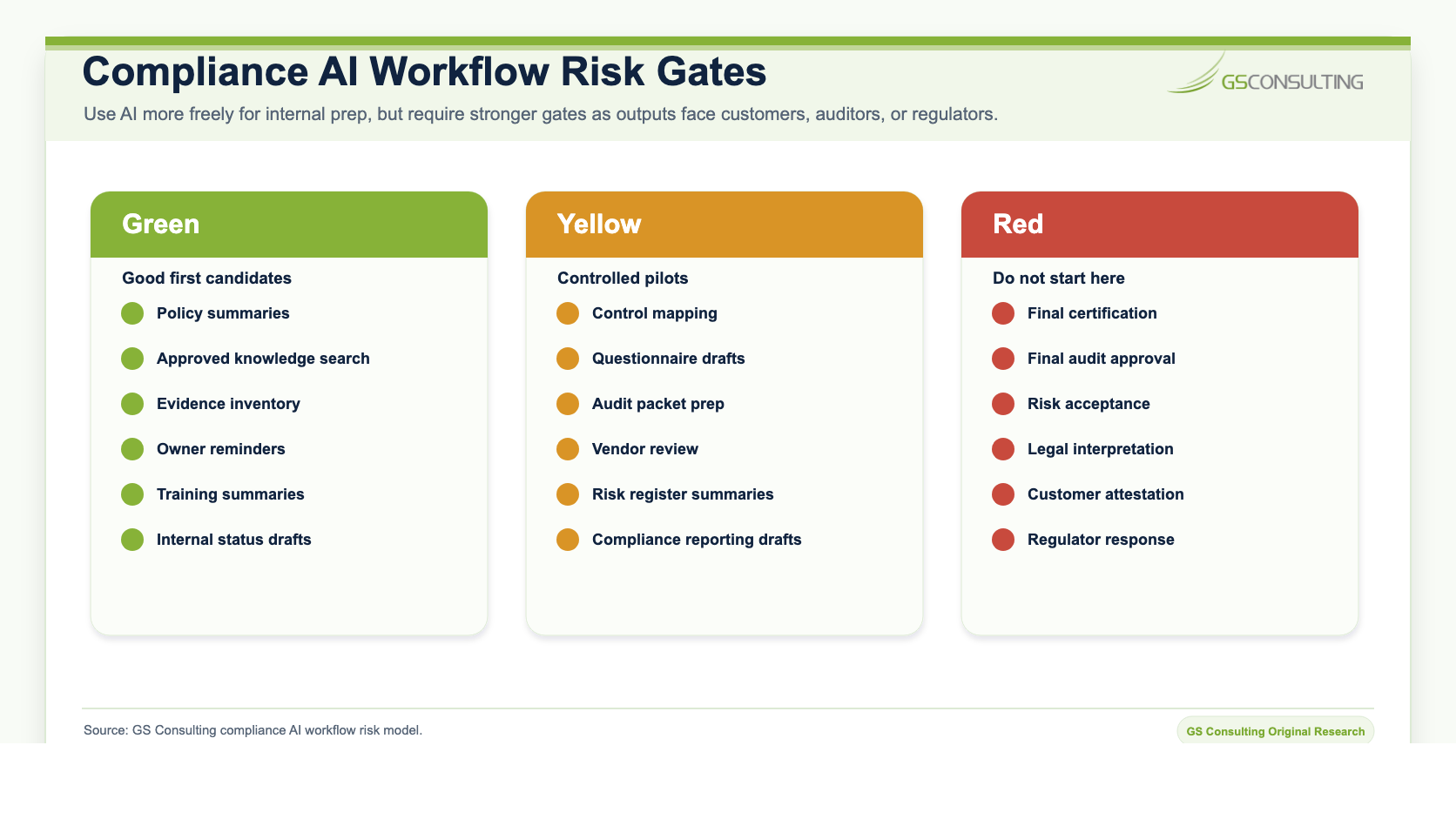
Green use cases are good first candidates: policy summaries, approved knowledge search, evidence inventory, owner reminders, training record summaries, and internal status drafts.
Yellow use cases are valuable but need stronger controls: control mapping, questionnaire response drafts, audit packet preparation, vendor response review, risk register summaries, and compliance reporting drafts.
Red use cases are not where to start: final compliance certification, final audit response approval, risk acceptance, legal interpretation, customer attestation without review, and regulator response without approval.
What Good Looks Like
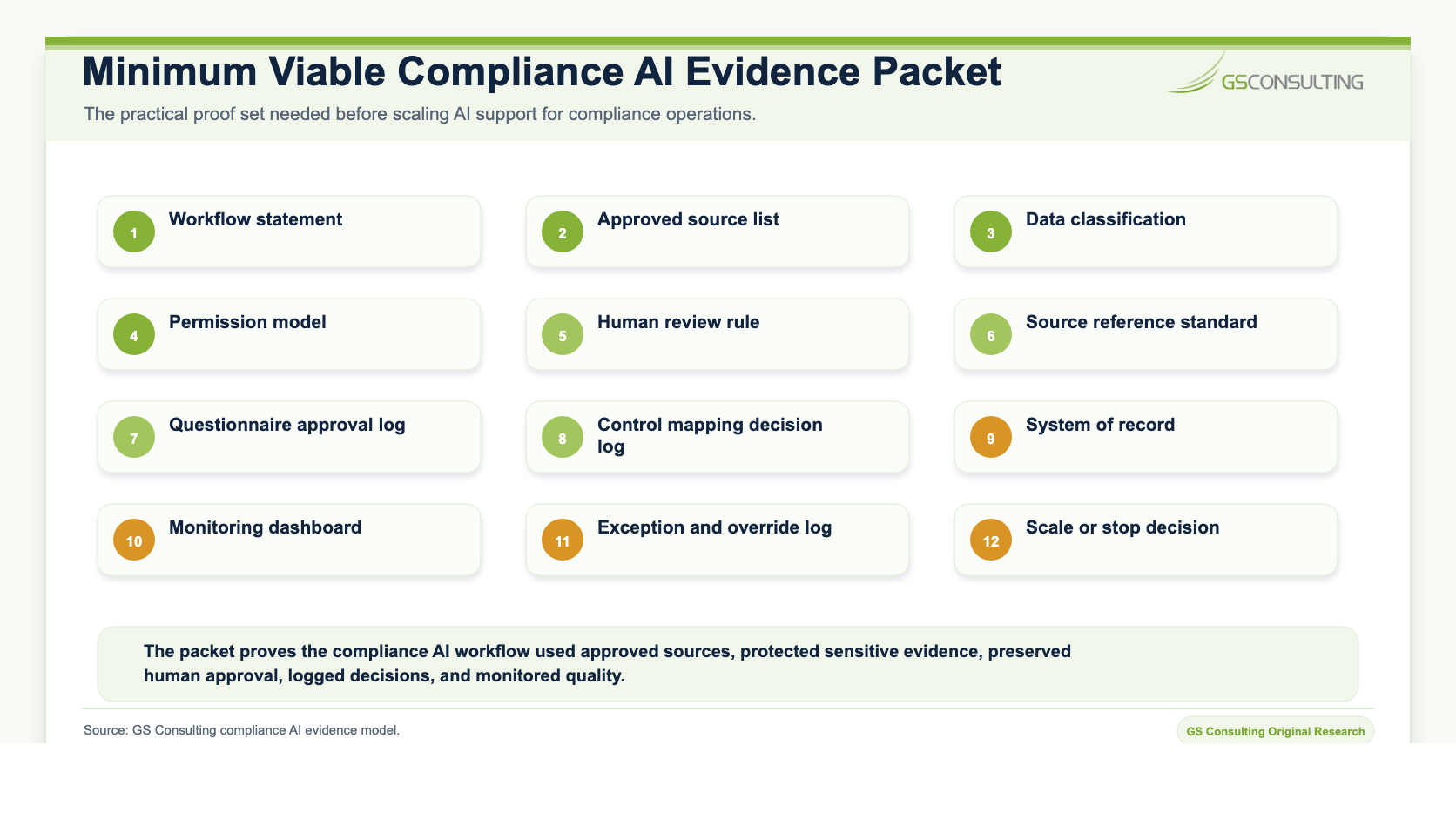
A strong AI compliance workflow uses approved sources. The data is classified. Access is permission controlled. The output shows source references. The human reviewer approves or changes the output. The final response is stored in the system of record. The activity is logged. The workflow is monitored.
That pattern is not complicated. It is disciplined.
A weak AI compliance workflow looks different. A team uploads policies, audit reports, security diagrams, and customer evidence into a public tool. AI drafts questionnaire answers. No one knows if the vendor retains prompts. The responses are copied into a customer portal. The evidence is not linked. No approval trail exists. No one can prove where the answer came from.
Metrics That Matter
AI automation in compliance should be measured by readiness quality, not just speed.
Track hours spent collecting evidence, time to prepare audit packets, questionnaire response time, stale evidence items, missing control owners, rejected AI outputs, human override rate, control mapping accuracy, audit findings, customer response review time, policy review cycle time, evidence refresh rate, and compliance reporting time.
Suppose a compliance team spends 20 hours a month collecting evidence and preparing status updates. That is 240 hours a year. At a loaded labor rate of $85 per hour, that is $20,400 in annual effort. If AI reduces that work by 35%, the direct productivity value is about $7,140.
That number alone may not justify a large platform. But now add the real value: fewer stale artifacts, less audit scramble, faster customer questionnaire response, better control owner visibility, reduced consultant support, and cleaner evidence history.
The ROI is not just labor savings. It is operational control.
Common Mistakes
- Letting AI answer without approved sources. Compliance work needs source grounding.
- Treating all evidence as safe. Evidence can contain sensitive security, customer, contract, employee, or system information.
- Letting AI certify controls. AI can organize evidence. People certify.
- Skipping approval records. If a response goes to an auditor or customer, the approval should be logged.
- Using outdated evidence. AI can find old files quickly. That is not helpful if the files are wrong.
- Ignoring questionnaire risk. A wrong answer in a customer questionnaire can create real contract and trust problems.
- Measuring only time saved. Compliance AI should also measure evidence quality, audit readiness, and reduced risk.
The First 30 Days
Start with one compliance workflow. Do not try to automate the whole compliance function at once.
Good first candidates include evidence inventory, policy review summaries, questionnaire draft support, control owner reminders, audit packet preparation, and training record summaries.
Then map the workflow. What sources are approved? What data is sensitive? Who owns the evidence? Who reviews the output? What gets logged? What final system stores the record? How will success be measured?
Build one clean pattern. Then reuse it.
The Bottom Line
AI can make compliance operations better. It can help with policy review, evidence collection, control mapping, questionnaire response, audit preparation, vendor review, recurring workflows, and compliance reporting.
But AI should not become the person responsible for compliance.
Use AI to prepare the work. Use people to approve the work. Use logs to prove the work.
That is how regulated organizations get the value of AI automation without turning compliance into a guessing game.
Build compliance AI workflows that can be trusted later.
GS Consulting helps regulated organizations automate compliance operations with secure AI workflows for policy review, evidence collection, control mapping, questionnaire response, audit preparation, recurring compliance tasks, and executive reporting.
Contact GS ConsultingRelated Reading
- Secure AI Automation for Regulated Organizations
- AI Audit Trails and Activity Logging
- AI Governance Policies for Workflow Automation
- Data Classification Before AI Automation
- AI Automation Risk Assessment Framework
- Measuring ROI from Secure AI Automation