Enterprise AI Strategy | | 24 min read
AI Agent Lifecycle Management and Oversight

Key Takeaways
AI agents need lifecycle control, not launch control
Agents Are Identities
An AI agent can hold credentials, reach systems, use tools, and take actions. Treat it like a privileged software identity, not a passive feature.
Lifecycle Prevents Drift
Registry, ownership, least privilege, monitoring, logs, review, and retirement keep agents from multiplying into an unmanaged fleet.
Evidence Builds Trust
Regulated buyers need proof of what agents exist, what they can do, who owns them, how they are watched, and how they are retired.
An AI agent is not a feature you ship and forget. It is a software identity with credentials, permissions, access to your systems, and the ability to take actions on its own. That makes it much closer to an employee than to an app.
You would never give a new hire system access, a set of tools, and standing authority to act, then never check what they were doing, never review their permissions, and never offboard them when their job ended. Yet that is almost exactly how many organizations are treating their AI agents right now.
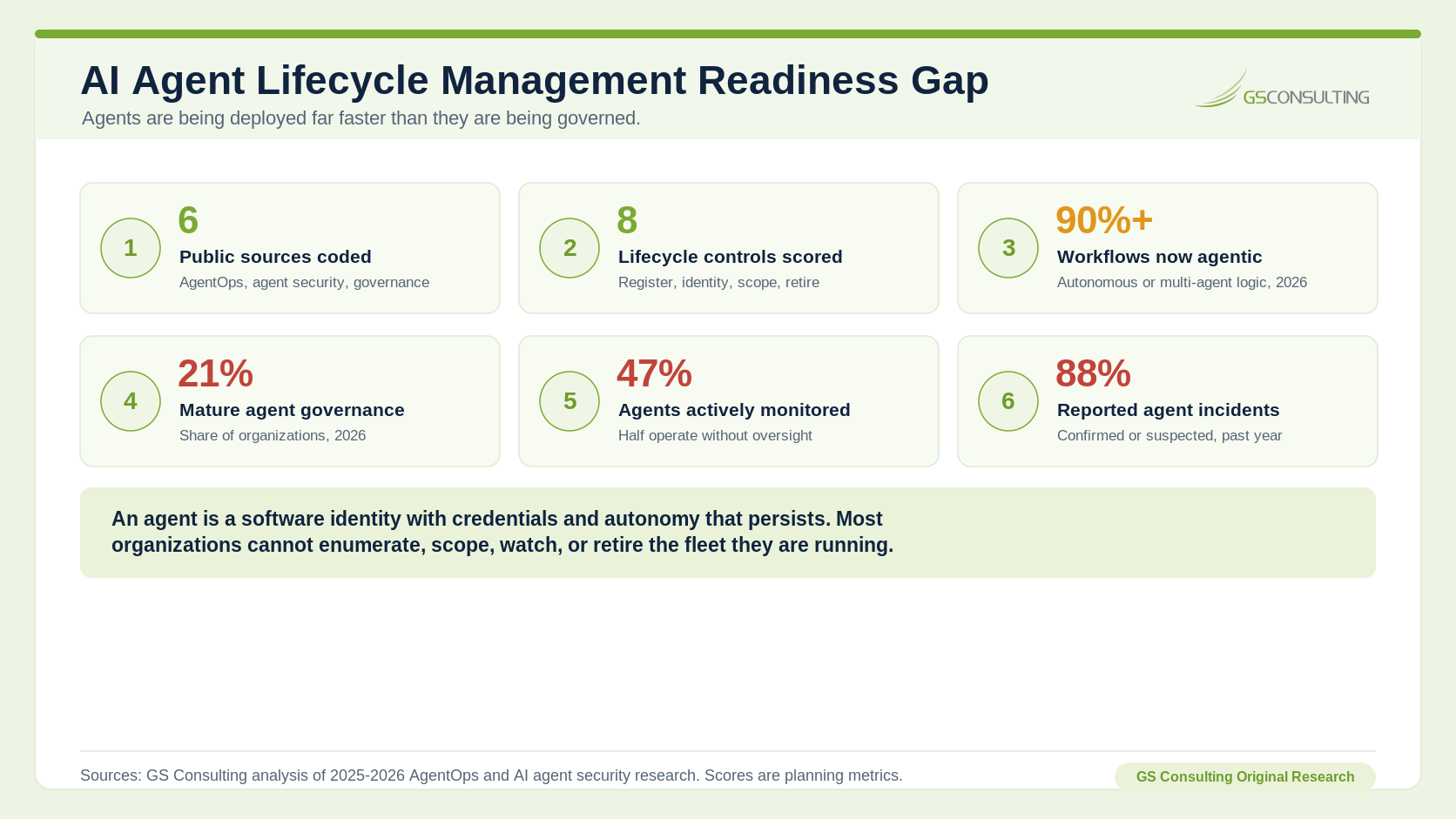
The numbers tell the story bluntly. By 2026, the large majority of AI driven business workflows involve autonomous or multi agent logic, but only about one in five organizations has a mature governance model for those agents. Roughly half of deployed agents are not consistently monitored at all. Most organizations report risky agent behavior, including unauthorized data access and unexpected system interactions, while executives often believe existing policies have the issue covered. They usually do not.
AI agent lifecycle management is how organizations close that gap with an operating discipline instead of a policy memo. It governs each agent from the moment it is provisioned to the moment it is retired, so the agent stays identified, bounded, monitored, and accountable for its entire operational life.
For the architecture that sits underneath this lifecycle, start with the practical guide to agentic workflows and the Agentic AI insights hub. The workflow guide defines the action loop and control load. This article governs the identity across its operational life.
The Core Problem: Agents Persist, Accumulate, and Drift
The reason agents need a lifecycle is that, unlike a one time script, an agent is a standing thing. Once it exists, it keeps existing. It holds credentials that do not expire on their own. It retains access to connected systems. It accumulates memory, integrations, and permissions. And it keeps acting, on a schedule or on demand, long after the person who created it has moved on or forgotten it exists.
Three failure patterns follow directly from that persistence. The first is proliferation: agents are easy to spin up, so they multiply faster than anyone tracks them. The second is privilege accumulation: agents are commonly handed broad, high privilege credentials so they just work, and that excessive agency becomes permanent because no one scopes it back down. The third is orphaning: agents outlive their purpose, owners, and oversight, becoming standing, credentialed, unwatched access into your environment.
None of these is a model problem. They are lifecycle problems. They come from treating the agent as something you launch rather than something you operate.
What AI Agent Lifecycle Management Actually Is
AI agent lifecycle management is the operational discipline of governing an autonomous agent across distinct stages, from provisioning through retirement, so that it remains attributable, bounded, and auditable the whole way through. It treats the agent the way mature organizations already treat any privileged identity or critical system: nothing exists in production without an owner, defined scope, monitoring, and a plan to decommission it.
That breaks into a sequence of stages. The agent is provisioned with a registered identity and a named owner. It is given an authenticated, attributable identity rather than a shared credential. It is authorized to least privilege, with only the access and tools its job requires. It is constrained so high impact actions need human approval. It is monitored in production for behavior, performance, and policy violations. Everything it does is logged in a way that can be reconstructed and defended. It is periodically reviewed and updated as its job or the environment changes. And when it is no longer needed, it is retired cleanly.
Deploying AI agents faster than you can govern them?
GS Consulting helps government contractors and regulated organizations stand up AI agent lifecycle management and oversight: agent registry and ownership, identity and least privilege design, monitoring and logging, human approval controls, and clean retirement.
Request an AI Agent Oversight AssessmentThe Stages, and Why Each One Carries Weight
A lifecycle is only as strong as the stage you neglect, but the stages are not equally load bearing. Some are foundational because every later control depends on them; others harden a lifecycle that already has its foundations right. GS Consulting scored the lifecycle controls on how much governance weight each one carries.
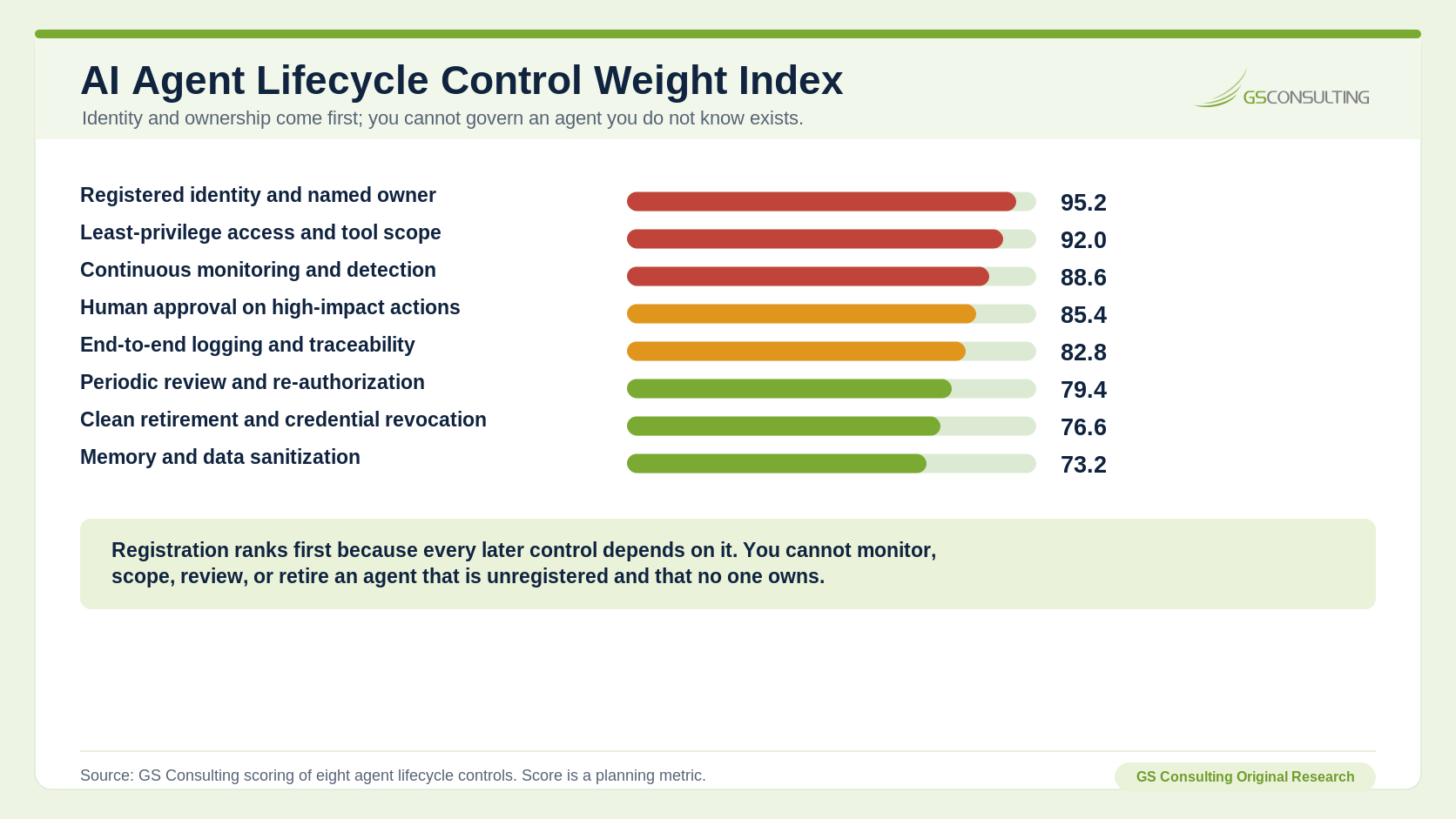
The highest weighted control is registered identity with a named owner, because everything else is impossible without it. You cannot monitor, scope, review, or retire an agent you do not know exists and that no one owns. Least privilege access and tool scope rank second because that is what bounds the blast radius of any single agent failure. Continuous monitoring ranks third because an agent that acts without being watched is the condition behind most reported agent incidents.
- 95.2 control weight for registered identity and a named owner, the foundation every other control depends on.
- About 21 percent of organizations with a mature AI agent governance model, against the large majority running agentic workflows.
- About 47 percent of deployed agents actively monitored or secured, leaving the rest without consistent oversight.
- About 88 percent of organizations reporting a confirmed or suspected AI agent security incident in recent industry research.
- About 14 percent of agents going live with full security and IT approval, even while most executives feel covered.
(The AI Agent Lifecycle Control Weight Index is a GS Consulting derived planning metric. It is not an official NIST, OWASP, or vendor determination.)
What Ungoverned Agents Actually Cost You
The risk of skipping lifecycle management is not abstract. It shows up as specific conditions that quietly accumulate until one of them becomes an incident. GS Consulting scored the conditions that make an ungoverned agent fleet dangerous in regulated environments.
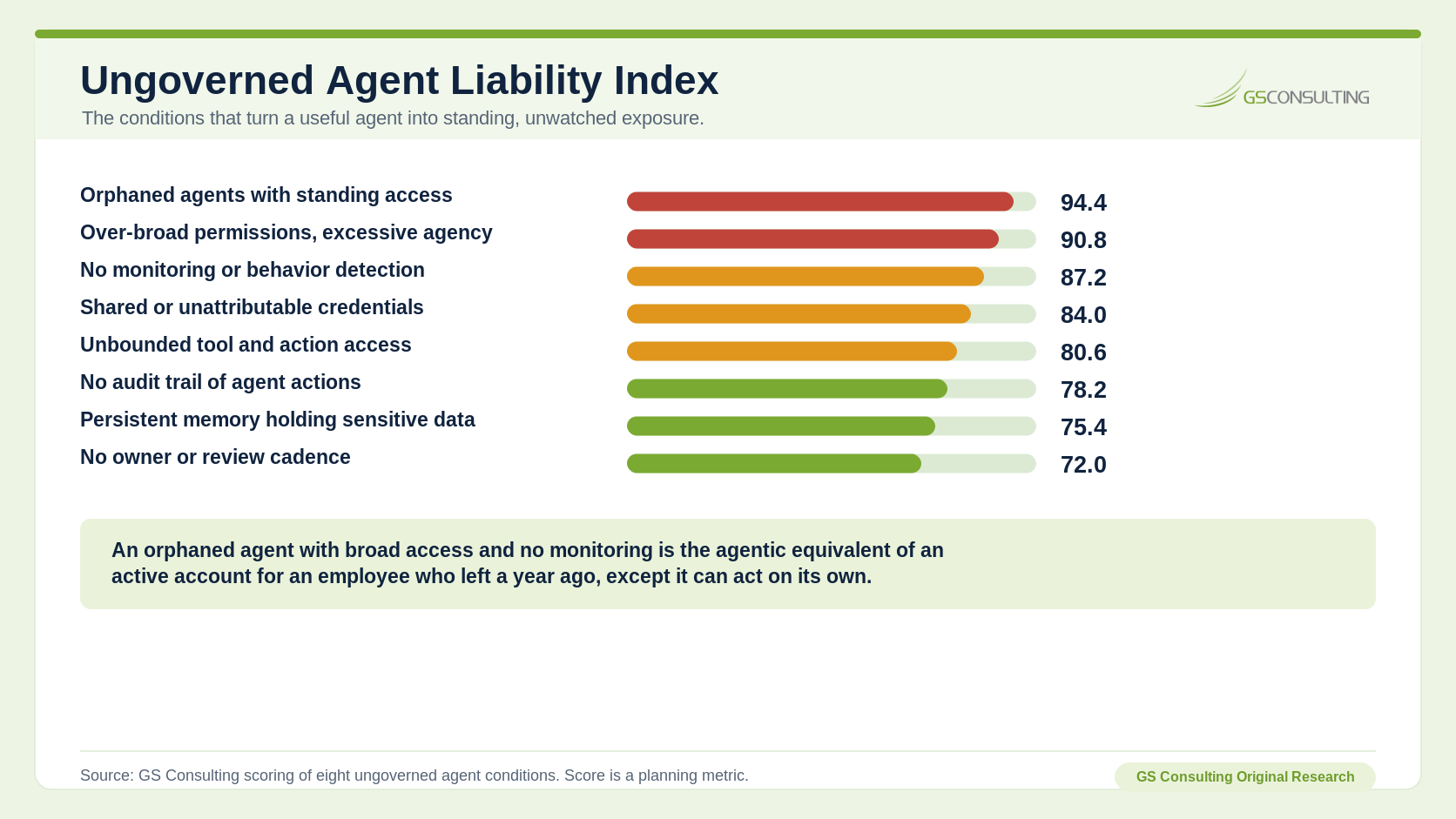
The worst condition is the orphaned agent with standing access: a credentialed, capable agent that outlived its purpose and oversight, still able to reach systems and take actions, with no one responsible for it. Broad permissions rank second because excessive agency turns every other failure into something with a larger blast radius than the task ever needed. The absence of monitoring ranks third because an agent you do not watch is one you cannot catch.
Notice the pattern. The top liabilities are not about the agent being unintelligent. They are about the agent being unmanaged: unknown, over permitted, unwatched, and never retired.
The Wrong Way to Run Agents
The wrong way is the fast way, and it is nearly universal because it produces visible results quickly.
A team builds an agent to automate a real process. To make it work without friction, they give it a broad service credential and wide tool access because scoping permissions tightly is slow and the demo needs to work. They put it into production because it is useful. They do not register it in any central inventory because there is no inventory. They do not monitor it because monitoring was not part of the build. And they do not plan its retirement because it is brand new and working.
Then they build another one. Within a year the organization has dozens of agents it cannot fully enumerate, most with more access than they need, most unwatched, and many whose original owners have moved on.
The Right Way: A Managed Lifecycle With Gates
The right way treats every agent as something that moves through a governed lifecycle, where each stage is a gate it must pass before and during production. An agent that skips a gate is an agent you cannot account for.
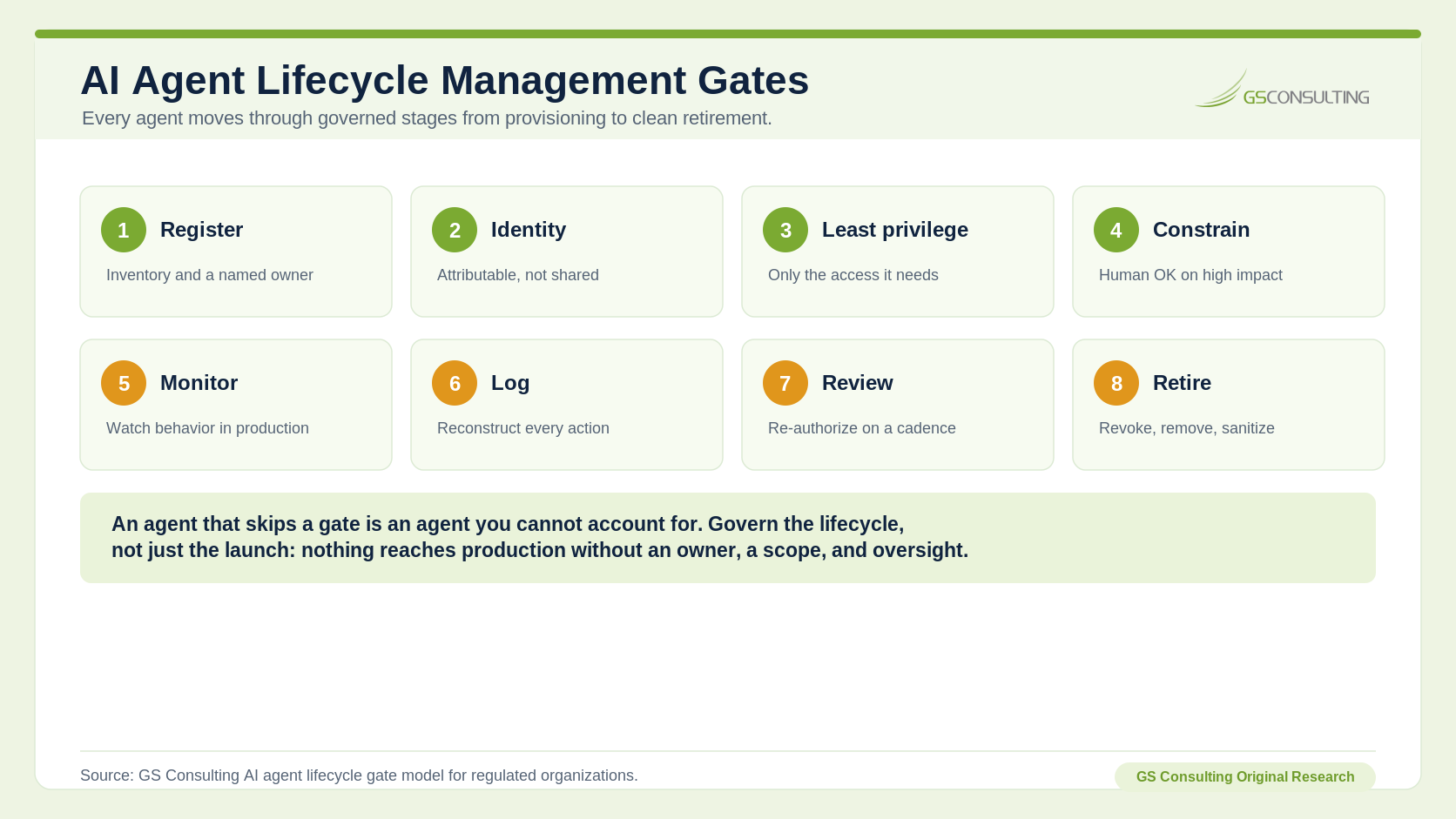
- Gate 1Register and assign an owner.
No agent reaches production without an entry in a central registry and a named human owner accountable for it.
- Gate 2Give an attributable identity.
Each agent gets its own authenticated identity, never a shared or anonymous credential. Actions must trace to a specific agent acting for a specific purpose.
- Gate 3Authorize least privilege.
The agent receives only the access and tools its job requires, scoped to the minimum practical level.
- Gate 4Constrain tools and require human approval.
The agent's tool access is bounded, and high impact or irreversible actions require a human in the loop.
- Gate 5Monitor behavior.
The agent is watched in production for anomalies, policy violations, performance drift, and unexpected access.
- Gate 6Log every action.
Every action, tool call, and data access is logged with enough detail to reconstruct and defend it.
- Gate 7Review and re authorize.
On a set cadence, each agent's permissions, usage, performance, and continued need are reviewed.
- Gate 8Retire cleanly.
When an agent is no longer needed, credentials are revoked, access is removed, integrations are disconnected, and residual memory and stored data are sanitized.
A Little Math on the Unwatched Fleet
The risk of ungoverned agents is multiplicative, which is why it sneaks up on organizations.
Take a fleet of fifty agents, a modest number for 2026. If only about half are actively monitored, you have roughly twenty five credentialed, capable agents acting in your environment with no consistent oversight. If most of those carry broad permissions because tight scoping was skipped, each one can reach far more than its task requires. The organization's real exposure is not fifty agents doing their jobs. It is roughly twenty five unwatched agents, each with an oversized blast radius, any one of which can become the incident.
Now apply the lifecycle. Registration means you know all fifty exist and who owns each. Least privilege shrinks every agent's reach from broad to exactly its task. Monitoring means strange behavior is caught instead of discovered later. Logging means actions can be reconstructed. Retirement means the count goes down when purpose ends, instead of only ever up.
Lifecycle Decisions, Ranked
Standing up agent oversight is a series of moves, and they are not equally valuable. GS Consulting scored the major lifecycle management decisions on how much they reduce risk, how feasible they are to implement, and how durable the benefit is.
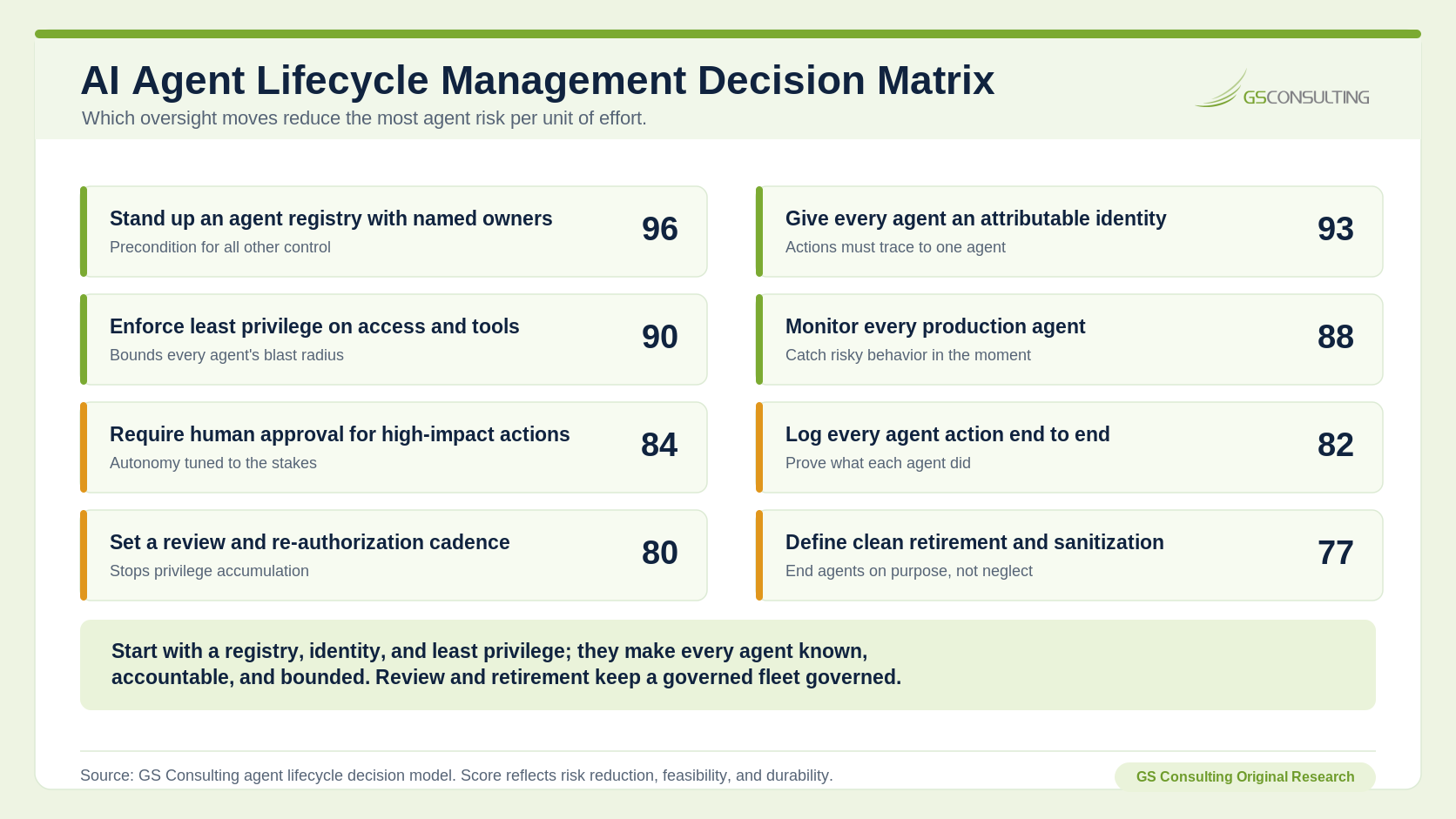
The highest scoring move is standing up an agent registry with named owners because it is the precondition for everything else. Attributable identity and least privilege round out the top tier because together they make every agent accountable and bounded. Monitoring ranks just below as the control that catches problems while they are still small.
(The AI Agent Lifecycle Management Decision Matrix is a GS Consulting derived planning model, not a product or compliance evaluation.)
The Evidence: What a Governed Agent Fleet Produces
In a regulated environment, running agents well is not enough; you have to be able to show it. GS Consulting frames the output of an agent oversight engagement as an evidence packet, because that is what an assessor, authorizing official, or customer's security team will ask for before they trust autonomous agents in your environment.
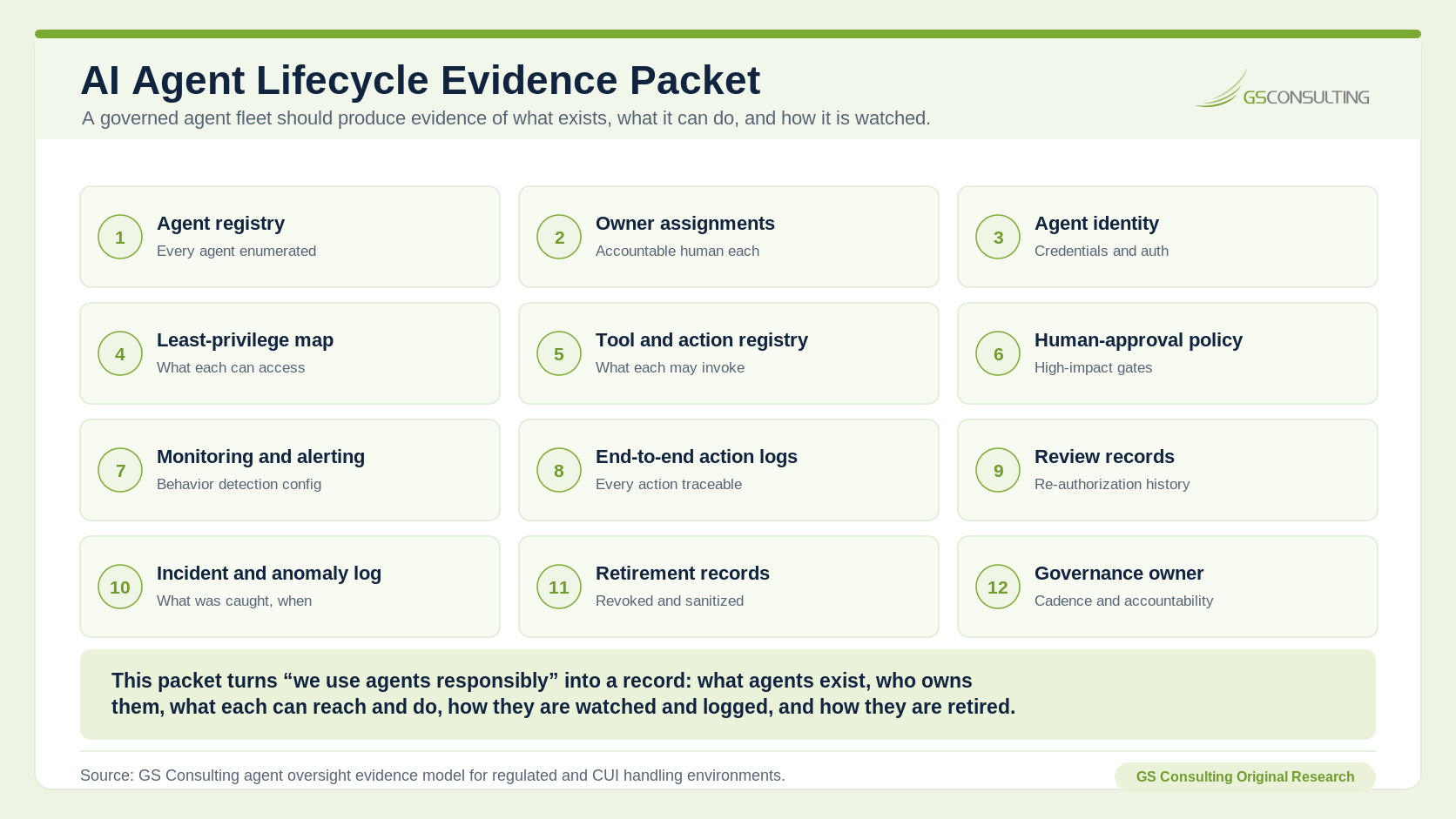
This packet shows what agents exist, who owns them, what each can access and do, how they are watched and logged, when they were last reviewed, and how they are retired. If you cannot produce something like this, you do not have an agent program. You have a population of autonomous identities you are hoping behaves.
The First 90 Days
If you are an operations or technology leader who suspects your agent fleet has outrun your oversight, here is a realistic sequence.
- Weeks 1 to 2Discover and inventory.
Find every agent, what credentials it uses, what it can access, what tools it can call, and who owns it.
- Weeks 3 to 6Assign owners and scope access.
Assign a named owner to every agent, give each an attributable identity, and scope back the worst cases of excessive permission.
- Week 7+Monitor, log, and gate actions.
Turn on monitoring and end to end logging for production agents, then put human approval controls on the highest impact actions.
- Final stretchReview and retire.
Define the review cadence and retirement process, then retire orphaned and obsolete agents found during discovery.
Ninety days does not give you a fully mature AgentOps practice. It gives you a known, owned, monitored fleet with the worst liabilities closed, plus a repeatable lifecycle for every agent the organization builds next.
Common Mistakes
- Standing up agents with broad credentials because scoping is slow. Excessive agency becomes the permanent default.
- Deploying agents with no central registry. The fleet grows faster than anyone can track, and orphaning becomes inevitable.
- Skipping monitoring. Risky behavior is discovered after the fact instead of caught in the moment.
- Never defining retirement. Agents accumulate and orphan instead of ending when their purpose does.
- Letting executive confidence stand in for actual visibility. Policies do not govern agents that were never inventoried, scoped, monitored, or reviewed.
Every one of these is the same root error: treating an agent as something you launch rather than something you operate.
How This Fits a Secure Enterprise AI Strategy
Agent lifecycle management is the operational layer of a larger program. It is where a Secure Enterprise AI Strategy stops being a set of intentions and becomes a daily practice: the strategy decides which autonomous capabilities are worth the risk, and lifecycle management is how each one is provisioned, bounded, watched, and retired in the real environment.
It also operationalizes the broader governance commitments described in Enterprise AI Governance Frameworks for GovCon. A governance framework defines the policies, accountability, and risk posture for AI across the organization; agent lifecycle management enforces those policies on the specific autonomous identities that can act on their own.
This article also connects directly to Securing AI Agents, AI Access Controls and Permission Design, AI Audit Trails and Activity Logging, Establishing Guardrails for Enterprise Generative AI, Shifting from Point Solutions to Unified AI Platforms, and Aligning Enterprise AI Strategy with CMMC and NIST.
The Bottom Line
An AI agent is a software identity with access, autonomy, and a tendency to persist. Most organizations are deploying agents faster than they are governing them. The result is a fleet that multiplies, accumulates privilege, and orphans, mostly unwatched, until one agent does something nobody authorized and nobody can reconstruct.
Agent lifecycle management closes that gap by treating every agent the way you already treat a privileged identity: registered with an owner, given an attributable identity, scoped to least privilege, constrained on high impact actions, monitored, logged, reviewed, and cleanly retired when its job ends. Govern the lifecycle, not just the launch.
Ready to turn an ungoverned agent fleet into a managed, auditable one?
GS Consulting helps government contractors and regulated organizations implement AI agent lifecycle management and oversight, from agent registry and identity through least privilege design, monitoring, logging, human approval controls, and clean retirement.
Request an AI Agent Oversight AssessmentResearch Sources and Caveats
This article draws on public 2025 and 2026 sources on AI agent governance, AgentOps, and agent security, including industry definitions of AI agent lifecycle management, reporting on monitoring, incident, and approval rates, enterprise AI agent governance guidance, OWASP excessive agency risk, and general NIST AI Risk Management Framework guidance on accountability and monitoring.
The AI Agent Lifecycle Control Weight Index, Ungoverned Agent Liability Index, and AI Agent Lifecycle Management Decision Matrix are GS Consulting derived planning tools. They are scoring models built to help operations and security leaders prioritize agent oversight controls in regulated environments. They are not official NIST, OWASP, vendor, legal, audit, or compliance determinations.
Frequently Asked Questions About AI Agent Lifecycle Management
What is AI agent lifecycle management?
AI agent lifecycle management is the operational discipline of governing an autonomous AI agent across its full life, from provisioning through retirement, so it stays identified, bounded, monitored, logged, reviewed, and accountable.
Why do AI agents need a lifecycle?
AI agents persist and act on their own. They hold credentials, retain access to connected systems, accumulate permissions and memory, and keep taking actions after deployment. That persistence creates proliferation, privilege accumulation, and orphaning unless the organization manages each agent from provisioning to retirement.
What is the biggest risk from ungoverned AI agents?
The biggest risk is an orphaned agent with standing access: a credentialed, capable agent that has outlived its purpose and oversight but can still reach systems and act, with no owner responsible for it.
How does agent retirement actually work?
Agent retirement means revoking credentials, removing access, disconnecting integrations, sanitizing residual memory and stored data, and recording the decommissioning. The goal is to ensure a retired agent leaves no standing access or sensitive data behind.
Are AI policies enough to govern autonomous agents?
Usually not. A policy that is not enforced on each specific agent through registration, scoped access, monitoring, logging, review, and retirement does not govern the fleet. Lifecycle management is how the policy reaches the agents running in production.
Related Reading
- AI Agents vs RPA vs Traditional Automation
- Secure Enterprise AI Strategy
- Enterprise AI Governance Frameworks for GovCon
- AI Access Controls and Permission Design
- AI Audit Trails and Activity Logging
- Establishing Guardrails for Enterprise Generative AI
- Shifting from Point Solutions to Unified AI Platforms
- Aligning Enterprise AI Strategy with CMMC and NIST